Chapter 9
b. Fixed costs cannot change from one month to another.
c. Variable costs cannot change from one month to another.
d. The master budget can reflect seasonal effects.
e. None of these.
47. Which of the following is true of budgets?
a. Budgets eradicate the need to compare a company’s actual results with budgeted results.
b. Budgets ensure that the financial goals set by management are achieved.
c. Budgets rule out the need to communicate and coordinate the plans of the organization to each employee.
d. Budgets are financial plans for the future.
e. Budgets delegate the decision making power to the employees.
48. The master budget is
a. the selective financial plan for the organization as a whole.
b. typically for a 1-year period corresponding to the fiscal year of the company.
c. broken down into daily and weekly budgets.
Chapter 9
d. used for misinformation and coordination.
e. all of these.
49. Which of the following is not true?
a. The sales forecast is done before the sales budget.
b. The master budget is the comprehensive plan for the organization as a whole.
c. The production budget is prepared in units and dollars.
d. One approach to forecasting sales is the bottom-up approach.
e. In creating the sales forecast, outside factors such as the state of the economy, should be considered.
50. The first step in creating the master budget is the creation of the
a. production budget.
b. direct labor budget.
c. cash budget.
d. sales budget.
e. budgeted income statement.
Chapter 9
51. The budget that describes how many units must be produced in order to meet sales needs and ending inventory
objectives is the
a. production budget.
b. direct materials purchases budget.
c. cash budget.
d. budgeted income statement.
e. none of these.
52. Direct materials needed for production is calculated by
a. multiplying units to be produced by direct materials per unit.
b. subtracting units to be produced from direct materials per unit.
c. dividing units to be produced by direct materials per unit.
d. adding units to be produced to direct materials per unit.
e. subtracting direct materials per unit from units to be produced.
Chapter 9
53. In preparing the overhead budget, many companies use
a. activity-based costing.
b. multiple drivers for a simple budget.
c. participative costing.
d. a unit-based driver such as direct labor hours.
e. none of these.
54. Which of the following statements is true?
a. The overhead budget is typically composed of variable overhead and fixed overhead.
b. The direct labor budget uses an average wage rate for direct labor.
c. The production budget is not converted into dollars.
d. The sales budget includes both units and dollars.
e. All of these.
Chapter 9
55. The ending finished goods inventory budget supplies information needed for the
a. sales budget.
b. cash budget.
c. budgeted income statement.
d. cost of goods sold budget.
e. all of these.
56. Which of the following budgets are needed to calculate a budgeted unit cost?
a. Direct materials purchases budget
b. Direct labor budget
c. Overhead budget
d. Direct materials purchases budget and overhead budget
e. Direct materials purchases budget, direct labor budget, and overhead budget
Chapter 9
57. The selling and administrative expenses budget includes
a. cost of goods sold.
b. overhead.
c. fixed production expense.
d. variable cost of selling.
e. all of these.
58. Budgeted operating income includes
a. budgeted interest expense.
b. budgeted income taxes.
c. budgeted cost of goods sold.
d. budgeted net income.
e. none of these.
Chapter 9
59. Depreciation expense on sales equipment appears in a separate line on which of the following budgets?
a. Cash budget
b. Selling and administrative expenses budget
c. Direct labor budget
d. Production budget
e. Overhead budget
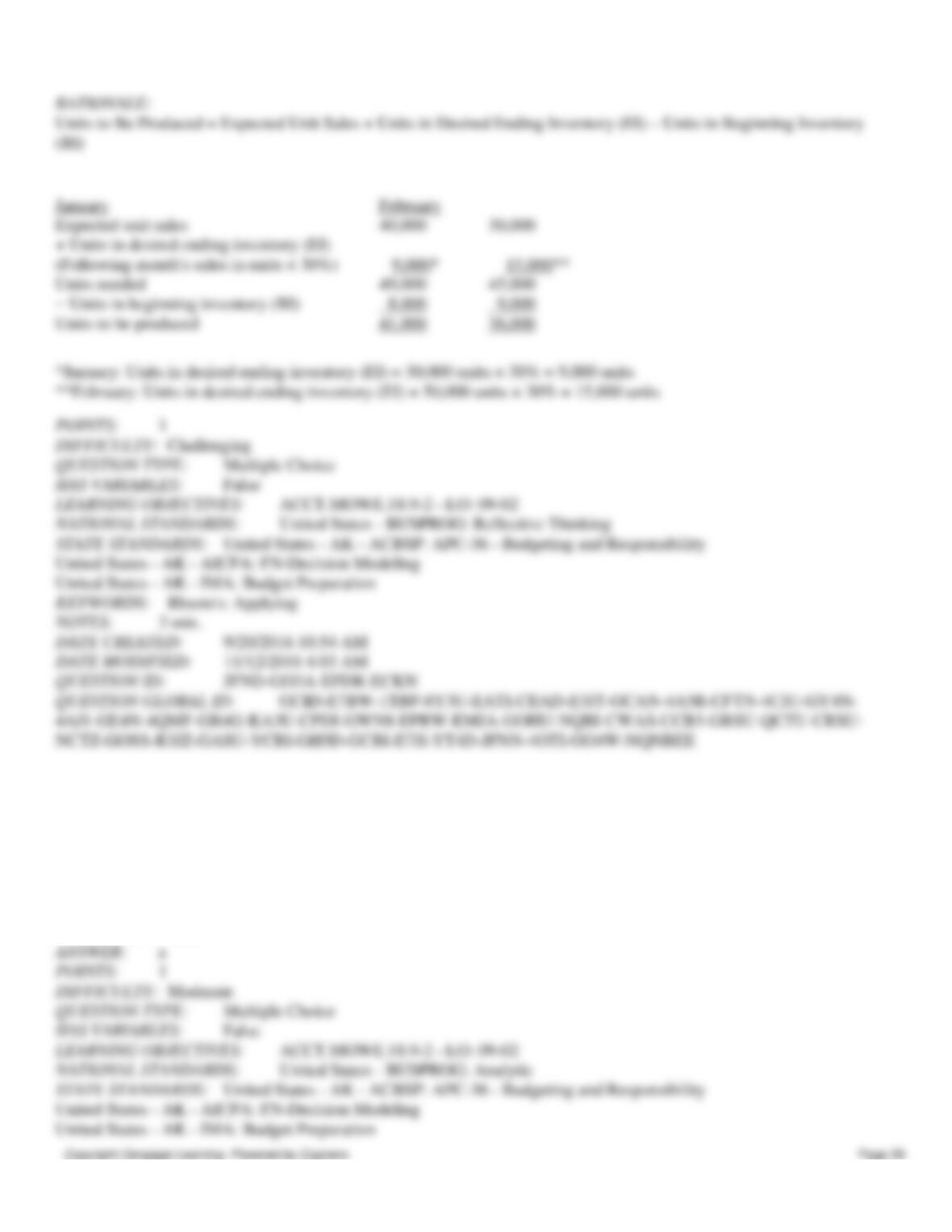
60. Omega Enterprises budgeted the following sales in units:
January 40,000
February 30,000
March 50,000
Omega’s policy is to have 30% of the following month’s sales in inventory. On January 1, inventory equaled 8,000 units.
February production in units is:
a. 20,000.
b. 28,000.
c. 40,000.
d. 26,500.
e. 36,000.
Chapter 9
61. A company has had stable sales and production for several years. Next year, sales are expected to increase by at least
50%. Assuming that the company maintains its policy for desired ending inventories of finished product and direct
materials purchases, what will be the likely effect on the desired ending inventory of finished product?
a. It will increase
b. It will decrease
c. It will stay the same
d. It will be twice the size of the desired ending inventory of raw materials
e. None of these
Chapter 9
62. A company expects the following sales for the coming year:
1st Quarter 2nd Quarter 3rd Quarter 4th Quarter
Units 50,000 40,000 70,000 90,000
Average selling price $6 $6 $6 $8
Budgeted sales revenue for the year is:
a. $1,050,000.
b. $1,260,000.
c. $1,155,000.
d. $1,680,000.
e. It is impossible to tell from this information.
63. A company provided the following information on sales for the coming year:
1st Quarter 2nd Quarter 3rd Quarter 4th Quarter
Units 50,000 60,000 40,000 90,000
Average selling price $6 $6 $6 $7
Chapter 9
Assume that the beginning inventory is 4,000 units, and that the company policy is to have 30% of the next quarter’s sales
in ending inventory. Which of the following quarters will have the lowest production?
a. Quarter 4
b. Quarter 3
c. Quarter 2
d. Quarter 1
e. All quarters have the same production
Chapter 9
64. Workshape Company budgeted 250,000 units of production for June, 260,000 units for July, and 320,000 units for
August. Each unit requires 0.30 direct labor hours. How many direct labor hours are budgeted for August?
a. 50,000 direct labor hours
b. 5,000 direct labor hours
c. 96,000 direct labor hours
d. 52,500 direct labor hours
e. 300,000 direct labor hours
65. In budgeting direct labor hours for the coming year, it is important to
a. multiply production in units by the direct labor hours per unit.
b. divide production in units by the direct labor hours per unit.
c. subtract production in units from the direct labor hours per unit.
d. subtract direct labor hours per unit from production in units.
e. multiply production in units by the labor wage rate.
Chapter 9
66. Unique Company provided the following budgeted data for July:
Direct materials $60,000
Direct labor $35,000
Overhead $100,000
Beginning finished goods $20,000
Ending finished goods $36,000
Production in units 15,000
What is the budgeted cost of goods sold?
a. $165,000
b. $179,000
c. $214,000
d. $184,000
e. $75,000
67. A production budget is most important for which of the following?
a. retail stores
b. manufacturing firms
c. not-for-profit agencies
d. local government agencies
e. all of these
Chapter 9
68. A company requires 220 pounds of plastic to meet the production needs of a product. It currently has 25 pounds of
plastic inventory. The desired ending inventory of plastic is 70 pounds. How many pounds of plastic should be budgeted
for purchasing during the coming period?
a. 195 pounds
b. 265 pounds
c. 245 pounds
d. 290 pounds
e. 175 pounds
69. A company plans on selling 500 units. The selling price per unit is $10. There are 60 units in beginning inventory, and
the company would like to have 100 units in ending inventory. How many units should be produced for the coming
period?
a. 540 units
Chapter 9
b. 400 units
c. 365 units
d. 2,000 units
e. 2,035 units
70. A company has provided a sales budget for the next four months. It bases its production budget on the sales budget,
and has a policy that each month’s ending inventory of finished product must be equal to 25% of the following month’s
sales needs. The direct materials purchases budget is based on the production budget. The company’s policy for each
month’s ending inventory of raw materials is that they must be equal to 10% of the following month’s production needs for
raw materials. Given this information, the company can prepare direct materials purchases budgets for how many months?
a. One
b. Two
c. Three
d. Four
e. Five
Chapter 9
71. Which of the following is the most common starting point in the information gathering process for budgeting?
a. The personnel forecast
b. The sales forecast
c. The production forecast
d. The projected income statement
72. Which of the following is an operating budget?
a. Budgeted statement of cash flows
b. Capital expenditures budget
c. Budgeted income statement
d. Cash budget
Chapter 9
73. Which of the following formulas is used to compute the units to be produced?
a. Units to Be Produced = Expected Unit Sales – Units in Desired Ending Inventory
b. Units to Be Produced = Units in Beginning Inventory + Units in Ending Inventory
c. Units to Be Produced = Units in Desired Ending Inventory + Units in Beginning Inventory – Units in Ending
Inventory
d. Units to Be Produced = Expected Unit Sales + Units in Desired Ending Inventory – Units in Beginning Inventory
74. Sleepgood Company produces and sells pillows. It expects to sell 15,000 pillows in the next year and will have 1,500
pillows in finished goods inventory at the end of the current year. Sleepgood would like to complete operations next year
with at least 1,350 completed pillows in inventory. There is no ending work-in-process inventory. The pillows sell for $6
each. How many pillows would be produced in the next year?
a. 10,000 pillows
b. 16,500 pillows
c. 11,250 pillows
d. 14,850 pillows
Chapter 9
75. Excellent Company manufactures lamps. The estimated number of lamp sales for three months are as follows:
Month Sales
August 12,000
September 16,000
October 15,000
Finished goods inventory at the end of July was 3,600 units. Ending finished goods inventory is budgeted as 30% of the
next month’s sales. Excellent expects to sell the lamps for $30 each. In November, sales are projected at 18,000 lamps.
How many lamps should be produced in September?
a. 11,000 lamps
b. 10,500 lamps
c. 14,000 lamps
d. 15,700 lamps
76. In going from the sales budget to the production budget, adjustments to the sales budget need to be made for
a. finished goods inventories.
b. cash receipts.
c. factory overhead costs.
d. selling expenses.
Chapter 9
77. Unicorn Corporation manufactures boxes. The estimated numbers of boxes sold for the first three months of the
current year are as follows:
Month Sales
January 3,200
February 5,000
March 4,600
Finished goods inventory at the end of December was 800 units. Ending finished goods inventory is equal to 25% of the
next month’s sales. Unicorn Corporation expects to sell the boxes for $5 each. April sales are projected at 4,500 boxes.
How many boxes should be produced in February?
a. 4,900 boxes
b. 4,200 boxes
c. 4,260 boxes
d. 3,900 boxes
Chapter 9
78. Wright & Boyle Company budgeted the following production in units for the second quarter of the year:
April 50,000
May 43,000
June 47,000
Each unit requires five pounds of raw material. Wright & Boyle’s policy is to have 20% of the following month’s
production needs for materials in inventory. This policy was met in March. Raw materials purchases budgeted for May in
pounds equal:
a. 219,000 pounds.
b. 202,400 pounds.
c. 45,600 pounds.
d. 171,600 pounds.
e. 225,600 pounds.
Chapter 9
79. Saphire Company budgeted the following production in units for the second quarter of the year:
April 45,000
May 38,000
June 42,000
Each unit requires four pounds of raw material. Saphire’s policy is to have 30% of the following month’s production needs
for materials in inventory. This policy was met in March. Desired ending inventory for April in pounds equals:
a. 45,600.
b. 11,400.
c. 10.500.
d. 38,300.
e. 54,000.