35) At the end of the accounting period, Armstrong Corporation reports operating income of $30,000.
Which of the following statements is true, if Armstrong’s inventory levels decrease during the accounting
period?
A) Variable costing will report less operating income than absorption costing.
B) Absorption costing will report less operating income than variable costing.
C) Variable costing and absorption costing will report the same operating income since the cost of goods
sold is the same.
D) Variable costing and absorption costing will report the same operating income since the total costs are
the same.
36) Given a constant contribution margin per unit and constant fixed costs, the period-to-period change
in operating income under variable costing is driven solely by ________.
A) changes in the quantity of units actually sold
B) changes in the quantity of units produced
C) changes in ending inventory
D) changes in sales price per unit
37) The contribution-margin format of the income statement is used with absorption costing.
38) The contribution-margin format of the income statement distinguishes manufacturing costs from
nonmanufacturing costs.
39) Fixed manufacturing overhead is a period cost both under variable costing and under absorption
costing.
22
40) In variable costing, all nonmanufacturing costs are subtracted from contribution margin.
41) In absorption costing, fixed manufacturing overhead is treated as a period cost.
42) The basis of the difference between variable costing and absorption costing is how fixed
manufacturing costs are accounted for.
43) The income under variable costing will always be the same as the income under absorption costing.
44) Absorption costing enables managers to increase operating income by increasing the unit level of
sales, as well as by producing more units.
45) As a company reduces its inventory levels, operating income differences between absorption costing
and variable costing become immaterial.
46) Fixed manufacturing costs included in cost of goods available for sale + the production-volume
variance will always = total fixed manufacturing costs under absorption costing.
47) The production-volume variance only exists under variable costing and not under absorption costing.
48) Given a constant contribution margin per unit and constant fixed costs, the period-to-period change
in operating income under variable costing is driven solely by changes in the quantity of units actually
manufactured.
49) Absorption-costing income statements do not need to differentiate between variable and fixed costs.
50) The production-volume variance, which relates only to fixed manufacturing overhead, exists under
absorption costing but not under variable costing.
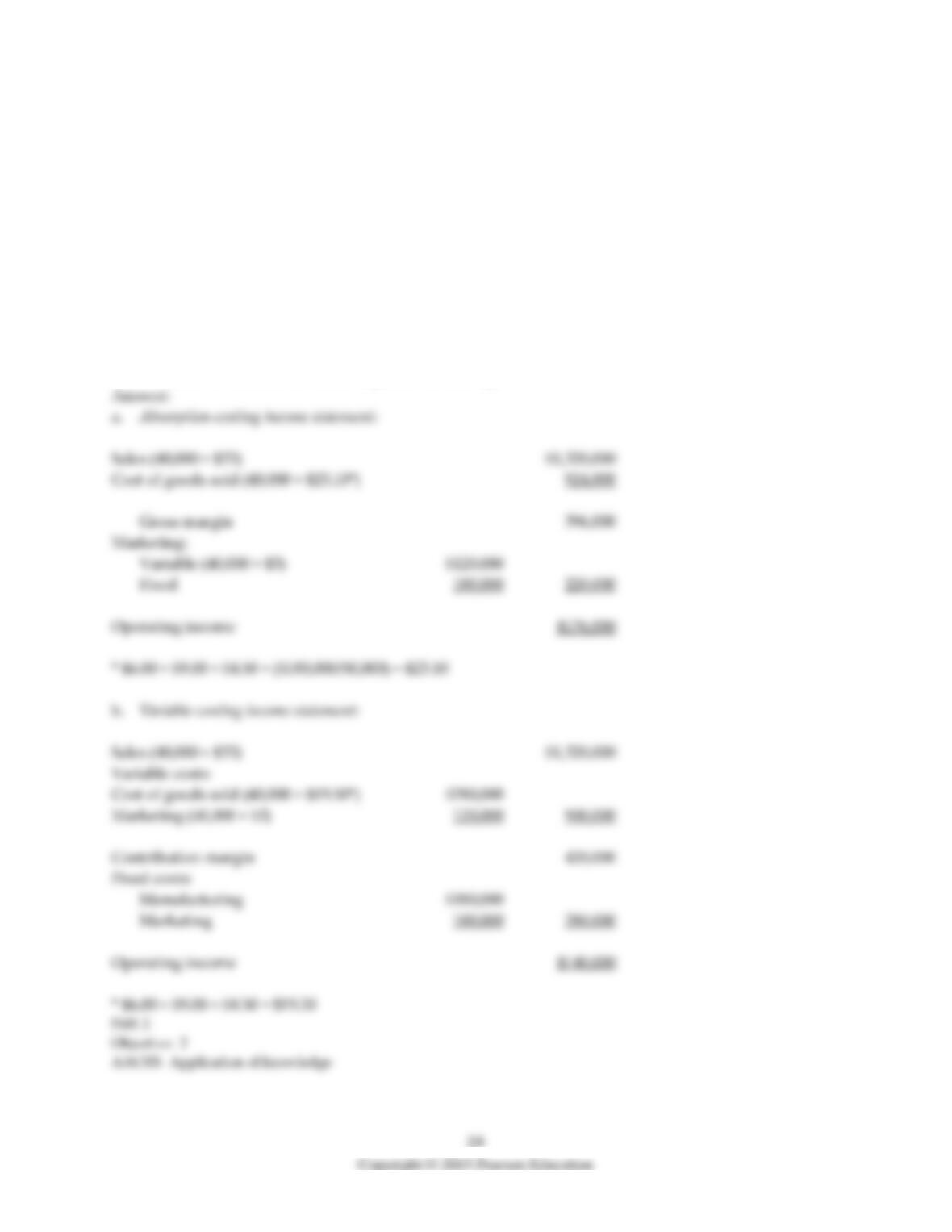
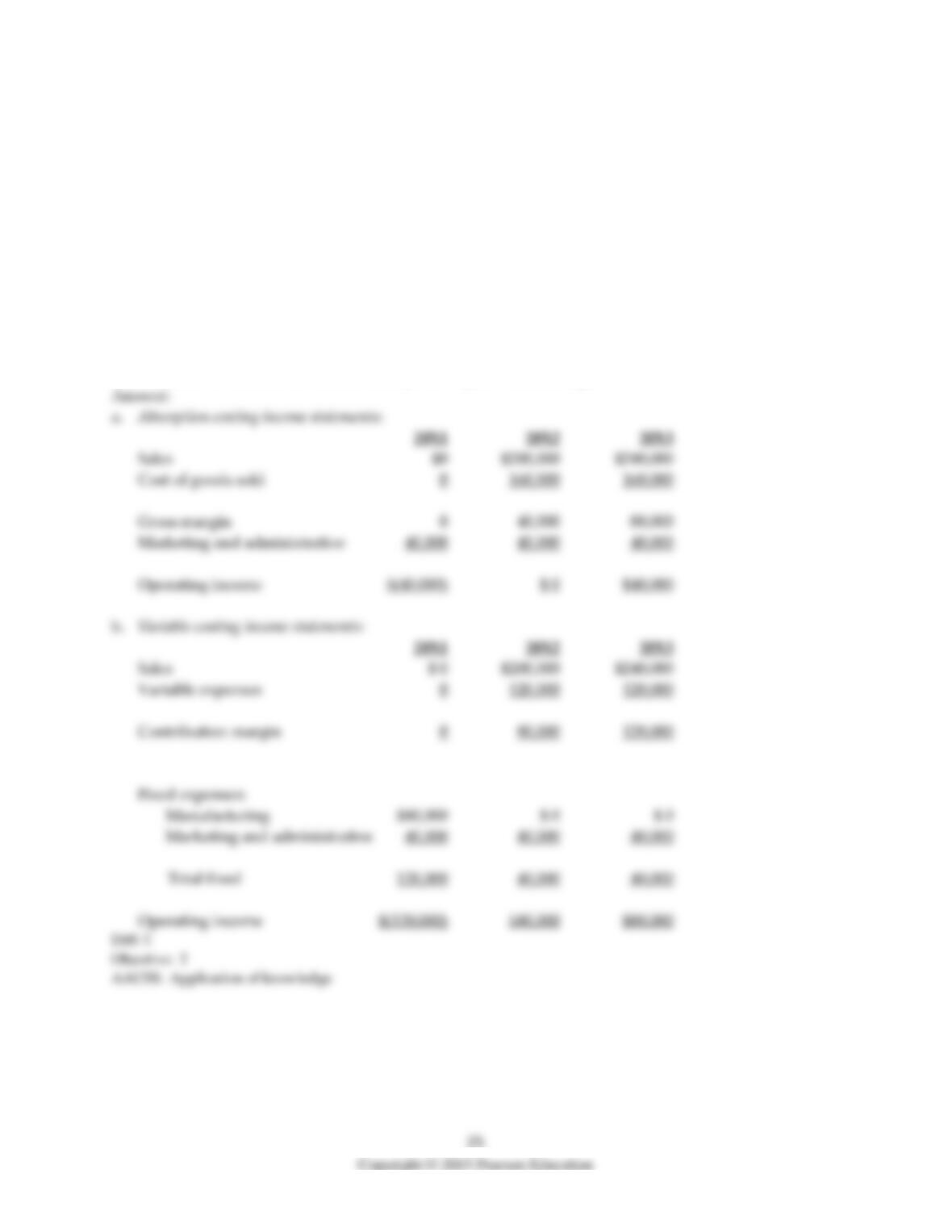
51) Aspen Manufacturing Company sells its products for $33 each. The current production level is 50,000
units, although only 40,000 units are anticipated to be sold.
Unit manufacturing costs are:
Direct materials $6.00
Direct manufacturing labor $9.00
Variable manufacturing costs $4.50
Total fixed manufacturing costs $180,000
Marketing expenses $3.00 per unit, plus $100,000 per year
Required:
a. Prepare an income statement using absorption costing.
b. Prepare an income statement using variable costing.
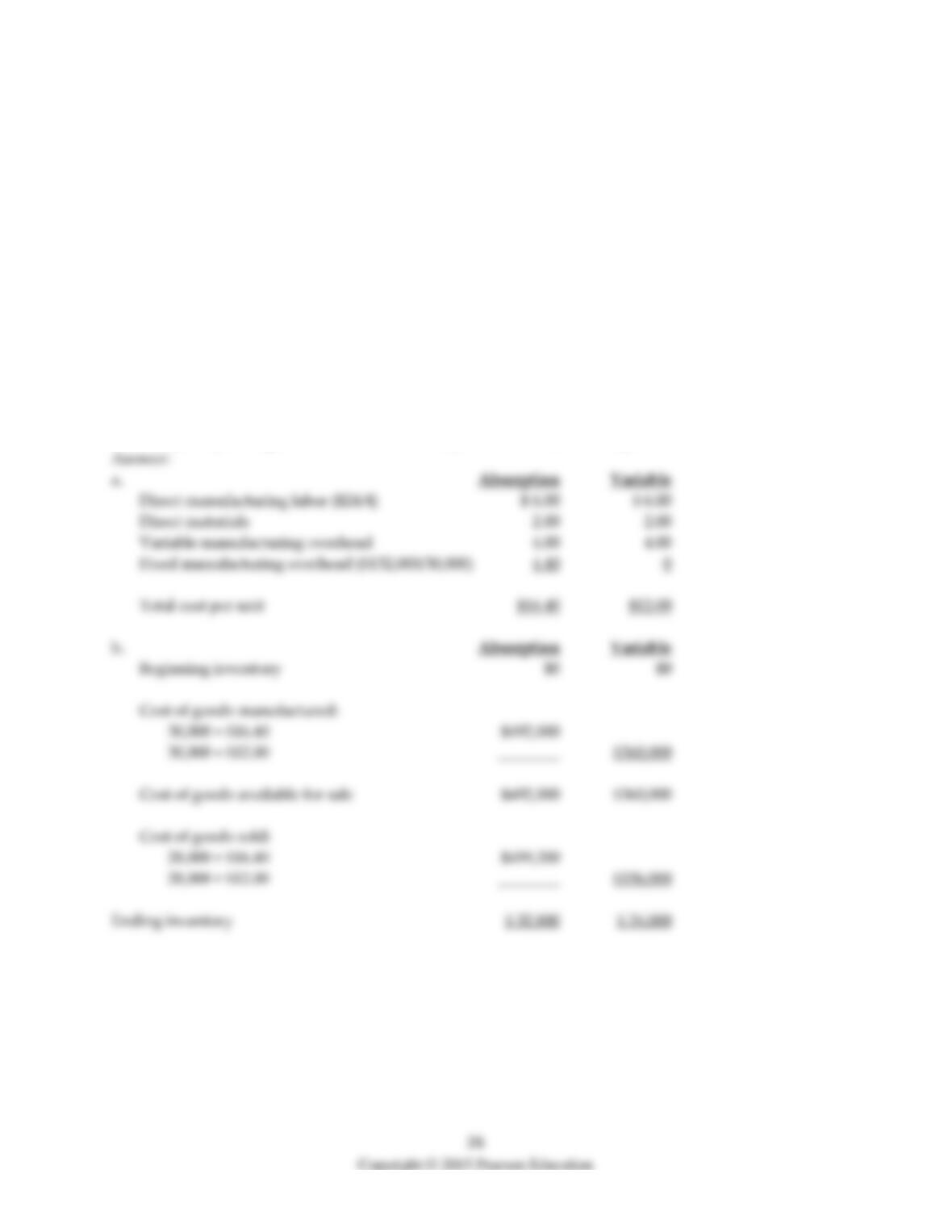
52) Ireland Corporation planned to be in operation for three years.
• During the first year, 2015, it had no sales but incurred $240,000 in variable manufacturing expenses
and $80,000 in fixed manufacturing expenses.
• In 2016, it sold half of the finished goods inventory from 20×1 for $200,000 but it had no
manufacturing costs.
• In 2017, it sold the remainder of the inventory for $240,000, had no manufacturing expenses and went
out of business.
• Marketing and administrative expenses were fixed and totaled $40,000 each year.
Required:
a. Prepare an income statement for each year using absorption costing.
b. Prepare an income statement for each year using variable costing.
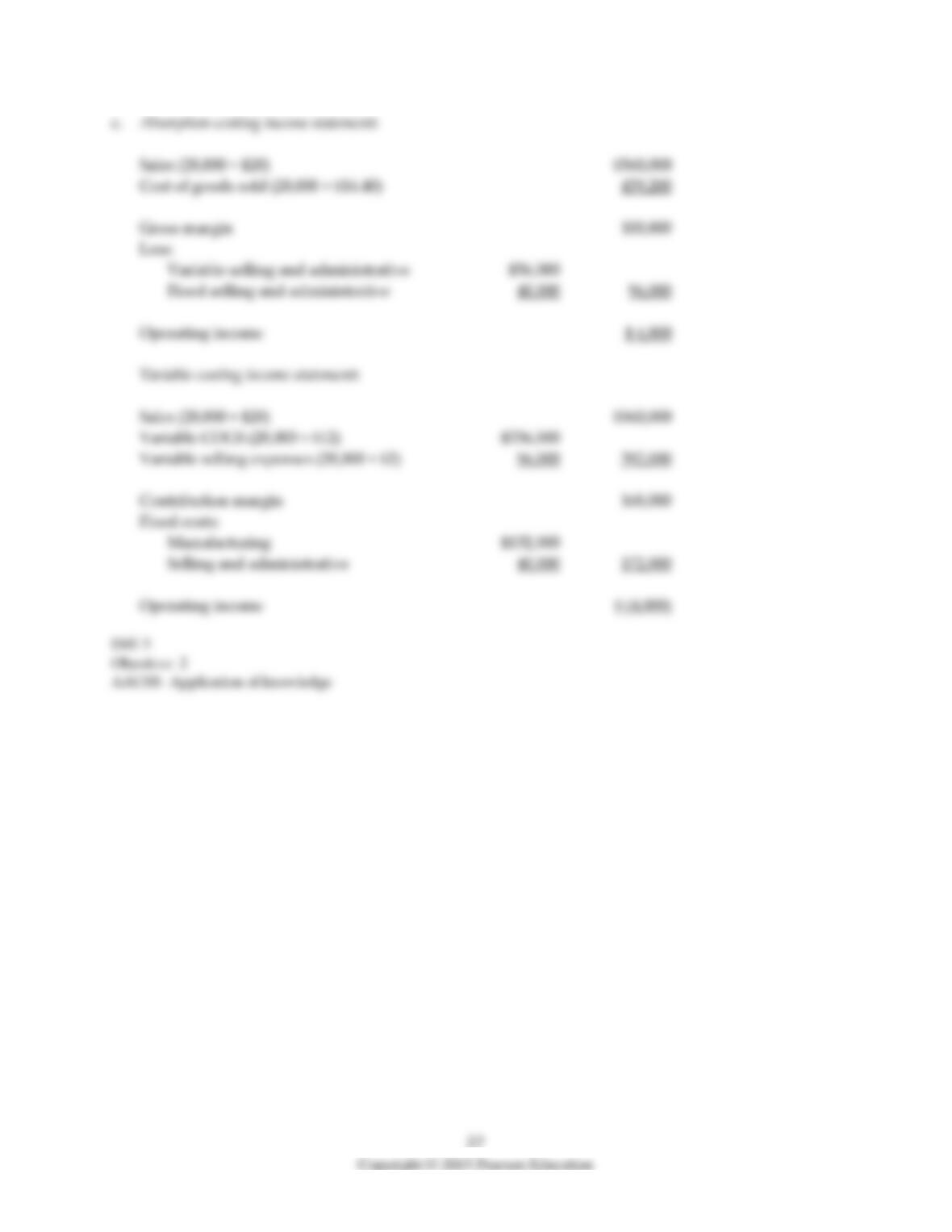
53) Jarvis Golf Company sells a special putter for $20 each. In March, it sold 28,000 putters while
manufacturing 30,000. There was no beginning inventory on March 1. Production information for March
was:
Direct manufacturing labor per unit 15 minutes
Fixed selling and administrative costs $ 40,000
Fixed manufacturing overhead 132,000
Direct materials cost per unit 2
Direct manufacturing labor per hour 24
Variable manufacturing overhead per unit 4
Variable selling expenses per unit 2
Required:
a. Compute the cost per unit under both absorption and variable costing.
b. Compute the ending inventories under both absorption and variable costing.
c. Compute operating income under both absorption and variable costing.
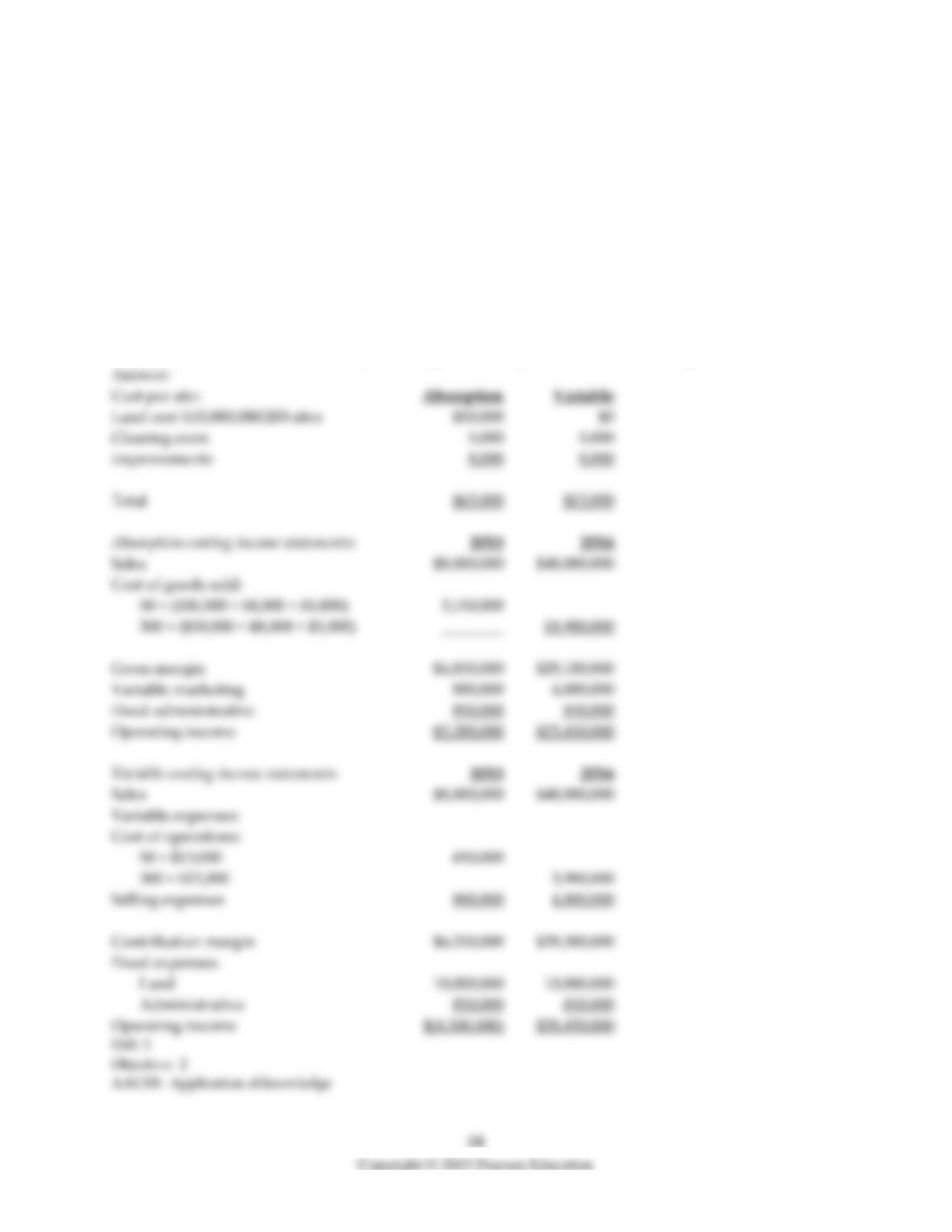
54) Johnson Realty bought a 2,000-acre island for $10,000,000 and divided it into 200 equal size lots.
As the lots are sold, they are cleared at an average cost of $5,000.
Storm drains and driveways are installed at an average cost of $8,000 per site.
Sales commissions are 10% of selling price.
Administrative costs are $850,000 per year.
The average selling price was $160,000 per lot during 20X5 when 50 lots were sold.
During 20X6, the company bought another 2,000-acre island and developed it exactly the same way. Lot
sales in 20X6 totaled 300 with an average selling price of $160,000. All costs were the same as in 20X5.
Required:
Prepare income statements for both years using both absorption and variable costing methods.
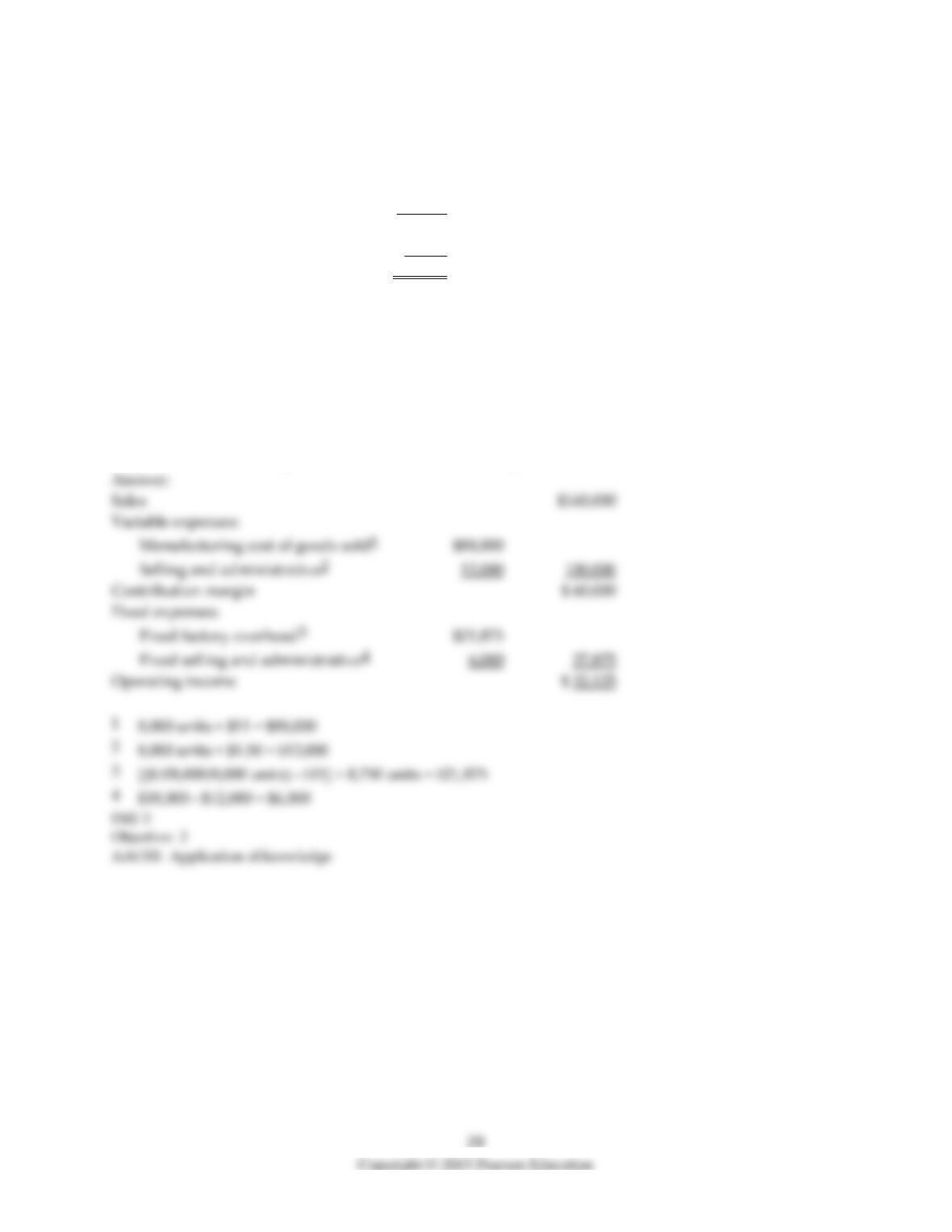
55) Aspen Popular Company prepared the following absorption-costing income statement for the year
ended May 31, 2015.
Sales (8,000 units) $160,000
Cost of goods sold 108,000
Gross margin $52,000
Selling and administrative expenses 18,000
Operating income $ 29,000
Additional information follows:
Selling and administrative expenses include $1.50 of variable cost per unit sold. There was no beginning
inventory, and 8,750 units were produced. Variable manufacturing costs were $11 per unit. Actual fixed
costs were equal to budgeted fixed costs
Required:
Prepare a variable-costing income statement for the same period.
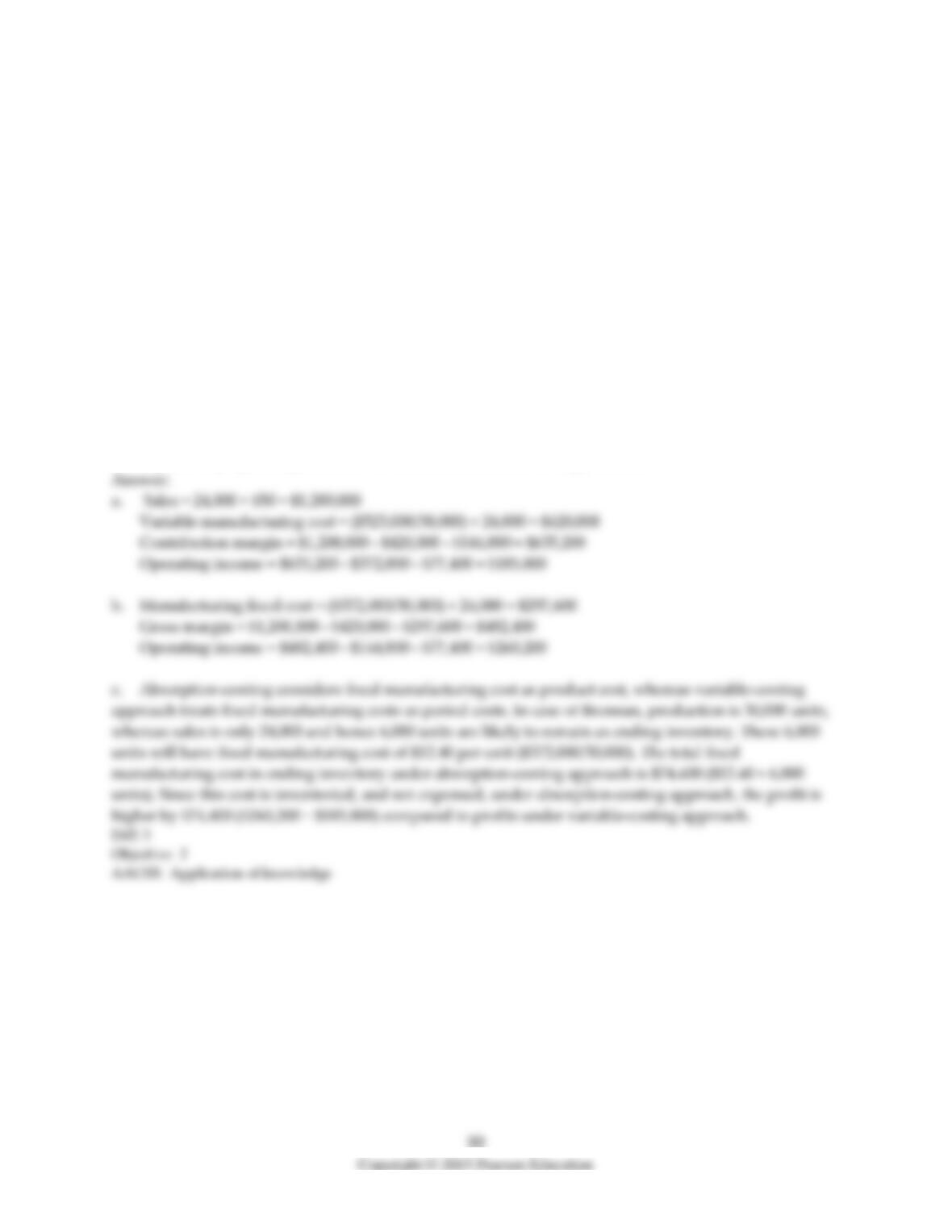
56) The following data are available for Brennan Soft Toys Company for the year ended September 30,
2015.
Sales: 24,000 units at $50 each
Expected and actual production: 30,000 units
Manufacturing costs incurred:
Variable: $525,000
Fixed: $372,000
Nonmanufacturing costs incurred:
Variable: $144,800
Fixed: $77,400
Beginning inventories: none
Required:
a. Determine operating income using the variable-costing approach.
b. Determine operating income using the absorption-costing approach.
c. Explain why operating income is not the same under the two approaches.

31
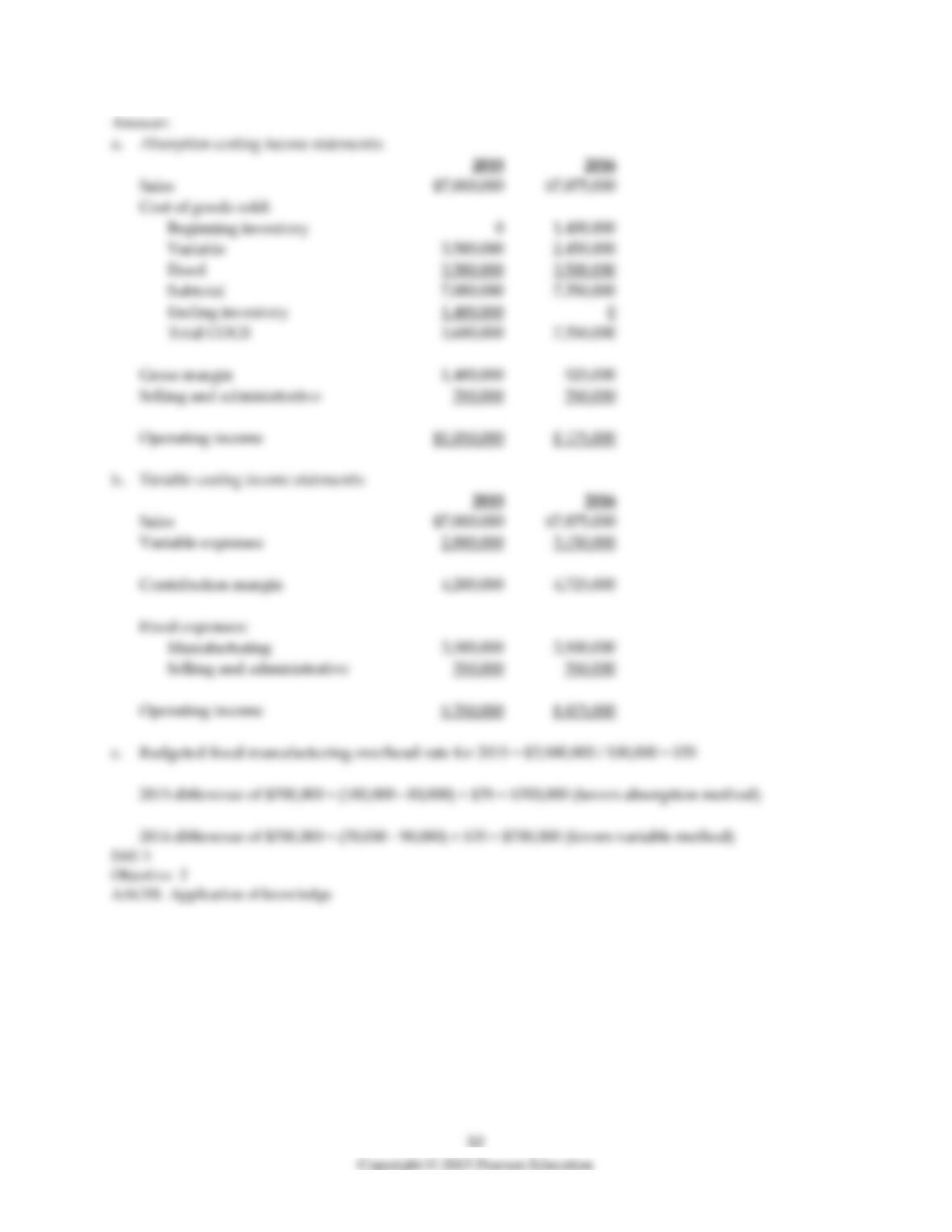
57) Raul Technologies is concerned that increased sales did not result in increased profits for 2016. Both
variable unit and total fixed manufacturing costs for 2015 and 2016 remained constant at $35 and
$3,500,000, respectively.
In 2015, the company produced 100,000 units and sold 80,000 units at a price of $87.50 per unit. There was
no beginning inventory in 2015. In 2016, the company made 70,000 units and sold 90,000 units at a price
of $87.50. Selling and administrative expenses were all fixed at $350,000 each year.
Required:
a. Prepare income statements for each year using absorption costing.
b. Prepare income statements for each year using variable costing.
c. Explain why the income was different each year using the two methods. Show computations.
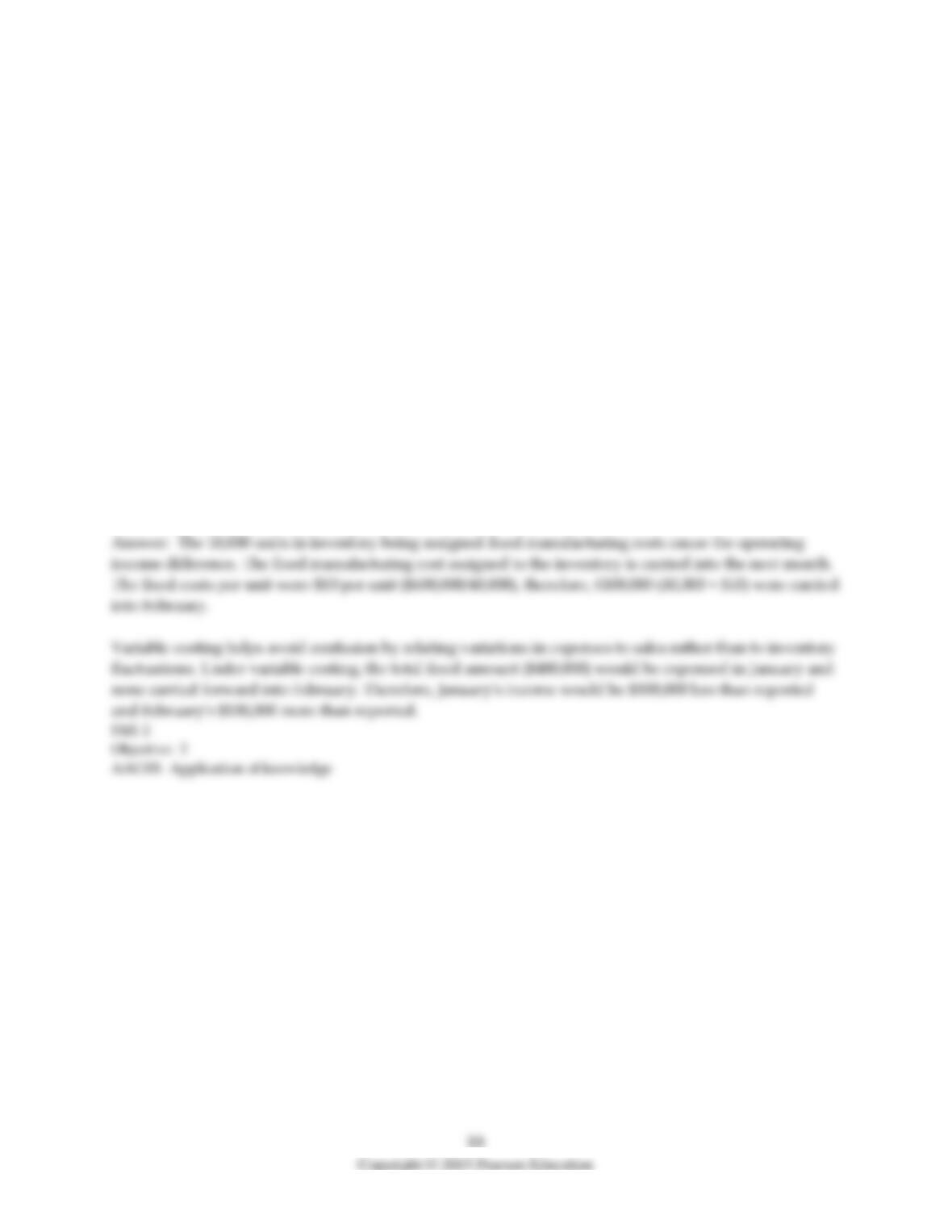
58) The manager of the manufacturing division of Iowa Windows does not understand why income went
down when sales went up. Some of the information he has selected for evaluation include:
January February
Units produced 40,000 30,000
Units sold 30,000 40,000
Sales $600,000 $800,000
Beginning inventory 0 150,000
Cost of production 600,000 550,000
Ending inventory 150,000 0
Operating income 70,000 35,000
The division operated at normal capacity during January.
Variable manufacturing cost per unit was $5, and the fixed costs were $400,000.
Selling and administrative expenses were all fixed.
Required:
Explain the profit differences. How would variable costing income statements help the manager
understand the division’s operating income?
59) Explain the difference between the gross margin format and the contribution margin format for the
income statement. What information is highlighted with each?
60) Galliart Company has two identical divisions, East and West. Their sales, production volume, and
fixed manufacturing costs have been the same for the last five years. The amounts for each division were
as follows:
20X1 20X2 20X3 20X4 20X5
Units produced 50,000 55,000 55,000 44,000 44,000
Units sold 45,000 45,000 50,000 50,000 50,000
Fixed manufacturing costs $55,000 $55,000 $55,000 $55,000 $55,000
East Division uses absorption costing and West Division uses variable costing.
Both use FIFO inventory methods.
Variable manufacturing costs are $5 per unit.
Selling and administrative expenses were identical for each division.
There were no inventories at the beginning of 20X1.
Which division reports the highest income each year? Explain.
Objective 9.3
1) Which of the following is a reason for companies to use absorption costing for internal accounting?
A) It is the required inventory method for internal accounting as per GAAP.
B) It measures the cost of all resources, whether manufacturing or nonmanufacturing, necessary to
produce inventory.
C) It does not take into account fixed manufacturing overhead while valuing inventory and hence is more
suited for decision making.
D) It can help prevent managers from taking actions that make their performance measure look good but
that hurt the income they report to shareholders.
2) Many companies have switched from absorption costing to variable costing for internal reporting
________.
A) to comply with external reporting requirements as required by GAAP
B) to increase bonuses for managers
C) to reduce the undesirable incentive to build up inventories
D) so the denominator level is more accurate
3) Ways to “produce for inventory” that result in increasing operating income include ________.
A) switching production to products that absorb the least amounts of fixed manufacturing costs
B) delaying items that absorb the greatest amount of fixed manufacturing costs
C) deferring maintenance to accelerate production
D) undervaluing ending inventory by not recording certain costs that have been incurred
4) Switching production to products that absorb the highest amount of fixed manufacturing costs is also
called ________.
A) cost reduction
B) cherry picking
C) producing for sales
D) throughput costing
5) To discourage producing for inventory, management can ________.
A) discourage using nonfinancial measures such as units in ending inventory compared to units in sales
B) evaluate performance over a quarterly period rather than a single year
C) incorporate a carrying charge for inventory in the internal accounting system
D) implement absorption costing across all departments
6) Which of the following steps can a management take to reduce the undesirable effects of absorption
costing?
A) It can evaluate managers on quarterly basis rather than the usual yearly period thereby mitigating the
undesirable effects of absorption costing.
B) It can delegate powers to managers to decide which orders they want to accept so that any order which
will lead to inventory build-up can be rejected.
C) It can empower managers to decide the timings of maintenance of plants thereby ensuring that the
production is not affected.
D) It can encourage using nonfinancial measures such as units in ending inventory compared to units in
sales.
7) Under absorption costing, if a manager’s bonus is tied to operating income, then increasing inventory
levels compared to last year would result in ________.
A) increasing the manager’s bonus
B) decreasing the manager‘s bonus
C) not affecting the manager’s bonus
D) being unable to determine the manager’s bonus using only the above information
8) Under variable costing, if a manager’s bonus is tied to operating income, then increasing inventory
levels compared to last year would result in ________.
A) increasing the manager’s bonus
B) decreasing the manager‘s bonus
C) not affecting the manager’s bonus
D) being unable to determine the manager’s bonus using only the above information
9) Critics of absorption costing suggest evaluating management on its ability to ________.
A) exceed production quotas
B) increase operating income
C) decrease fixed costs
D) decrease variable costs
10) Which of the following is a reason for companies adopting variable costing for internal reporting
purposes?
A) It is cost-effective to use variable costing for both internal and external reporting.
B) It reduces the incentives for undesirable buildup of inventories.
C) It measures the cost of all manufacturing resources, whether variable or fixed, necessary to produce
inventory.
D) It assists in accurate pricing decisions in case of long-run pricing.
11) Which of the following is true of absorption costing?
A) It enables a manager to decrease margins and operating income by producing more beginning
inventory.
B) It enables a manager to increase margins and operating income by producing more beginning
inventory.
C) It enables a manager to decrease margins and operating income by producing more ending inventory.
D) It enables a manager to increase margins and operating income by producing more ending inventory.
12) Which of the following inventory costing methods shown below is most likely to cause undesirable
incentives for managers to build up finished goods inventory?
A) absorption costing
B) variable costing
C) throughput costing
D) direct costing
13) Under absorption costing, managers can increase operating income by holding less inventories at the
end of the period.
14) To reduce the undesirable incentives to build up inventories that absorption costing can create, a
number of companies use variable costing for internal reporting.
15) Evaluating performance of managers over a long period, say over three-to five-years, helps to reduce
undesirable buildup of inventories.
16) Absorption costing is the required inventory method for external financial reporting in most
countries.
17) One of the most common problems reported by companies using variable costing is the difficulty of
classifying costs into fixed or variable categories.
18) Absorption costing helps managers to artificially inflate profits by encouraging the production of
products that absorb the highest amount of fixed manufacturing costs.
19) To reduce the undesirable incentives to build up inventories that absorption costing can
create, a number of companies use variable costing for internal reporting.
39
20) Kaiser Company just hired its fourth production manager in three years. All three previous managers
had quit because they could not get the company above the break-even point, even though sales had
increased somewhat each year. The company was operating at about 60 % of plant capacity. The flatware
industry was growing, so increased sales were not out of the question.
I. R. Thinking took the job as manager of the production division with a very attractive salary package.
After interviewing for the position, he proposed a salary and bonus package that would give him a very
small salary but a large bonus if he took the operating income (using absorption costing) above the
breakeven point during his very first year.
Required:
What do you think Mr. Thinking had in mind for increasing the company’s operating income?
21) Explain three methods under absorption costing that managers can use to improve operating income.
22) Briefly explain why many companies use absorption costing for external reporting as well as internal
accounting.
Objective 9.4
1) Throughput costing is also called ________.
A) absorption costing
B) super-variable costing
C) mixed costing
D) direct costing
2) Advocates of throughput costing argue that ________.
A) fixed manufacturing costs are also to be included as inventoriable costs
B) direct manufacturing labor is relatively fixed
C) direct materials costs are a cost of the period
D) only direct material costs are included as inventoriable costs
3) Assume a manufacturing company that has started production in the current year. Which of the
following would result in the highest profit being reported if the company has 1,000 units of ending
inventory?
A) throughput costing
B) variable costing
C) absorption costing
D) standard costing