
Chapter 9: Reporting Principles and Preparation of Fund Financial Statements
Multiple Choice
1. An organization is a component unit of a primary government and hence part of the
primary government’s financial reporting entity, provided that:
a. the primary government provides grants to the organization
b. the primary government sells tax-exempt debt on behalf of the organization
c. the primary government is financially accountable for the organization
d. the primary government makes appropriations to the organization
2. An entity can be a component unit of how many primary governments in the same
fiscal year?
a. 1
b. 2
c. 3
d. 4 or more
3. Which of the following is a true statement about a government financial reporting
entity?
a. if it includes discrete component unit(s) it cannot also include blended
component unit(s)
b. if it includes blended component unit(s) it cannot also include discrete
component unit(s)
c. it cannot include more discrete component units than blended component
units
d. it can include both blended and discrete component units
4. Which of the following interfund transactions does not affect fund balance?
a. reimbursements
b. transfers
c. loans
d. interfund services provided and used

5. Which of the following account captions are you most likely to see on a
governmental funds balance sheet?
a. bonds payable
b. accumulated depreciation
c. inventory
d. land
6. Which of the following sections is not found in proprietary fund operating
statements?
a. operating revenues
b. nonoperating revenues
c. operating revenues
d. investing activities
7. The financial statements prepared for fiduciary funds are
a. statement of fiduciary net position
b. statement of changes in fiduciary net position
c. statement of fiduciary cash flows
d. only a and b
e. only b and c
8. The General Fund and other funds for which individual fund financial information
is presented in separate columns in the basic governmental fund financial
statements are known as
a. principal funds
b. primary funds
c. major funds
d. master funds
9. A government’s discussion of how it defined the reporting entity is presented in
which of the following places within the Comprehensive Annual Financial
Report?
a. the auditor’s report
b. management’s discussion and analysis (MD&A)
c. the notes to the financial statements
d. required supplementary information (RSI)

10. The Basic Financial Statements, as defined for governments, do not include which of the
following components?
a. government-wide financial statements
b. governmental fund financial statements
c. fiduciary fund financial statements
d. combining financial statements
11. Which fund categories should be included in the fund-level financial statements?
a. governmental, proprietary, and fiduciary
b. only governmental and proprietary
c. only governmental, proprietary, and blended component units
d. only governmental, proprietary, and discretely-presented component units
12. Which of the following is one of the two basic criteria that makes a primary government
financially accountable for a legally separate entity?
a. The primary government’s chief executive appoints three of the entity’s trustees.
b. The primary government appoints a voting majority of the entity’s governing
body.
c. A department of the primary government can make grants to the entity.
d. A department of the primary government is authorized to obtain and review the
entity’s financial statements.
13. A state has different relationships with many legally separate organizations. Some
elements of the relationships are: (1) the state can appoint a majority of some governing
boards; (2) the state is able to impose its will on some; and (3) the state gets financial
benefits from or is financially burdened by some. Which relationship or combination of
relationships will cause an organization to be part of the state’s financial reporting entity?
a. Any one of the three relationships must exist.
b. All three relationships must exist.
c. A combination of relationship (3) and either relationship (1) or (2) must exist.
d. A combination of relationship (1) and either relationship (2) or (3) must exist.
14. In addition to the notes, what are the components of the “basic” governmental financial
statements?
a. balance sheets and cash flow statements
b. modified accrual financial statements and full accrual financial statements
c. fund financial statements and government-wide financial statements
d. major fund financial statements and minor fund financial statements

15. Which of the following is one of the minimum requirements established by the GASB for
general purpose external financial reporting?
a. introductory letter to report recipients
b. management’s discussion and analysis
c. statistical section, with tables of revenues by source and expenditures by function
d. combining statement of non-major funds
16. Which basis of accounting is used when presenting governmental and proprietary funds
in fund-level financial statements?
a. governmental – modified accrual; proprietary – modified accrual
b. governmental – accrual; proprietary – accrual
c. governmental – modified accrual; proprietary – accrual
d. governmental – accrual; proprietary – modified accrual
17. Which of the following statements is true regarding the inclusion of individual non-major
funds in the fund-level financial statements?
a. Individual non-major internal service funds are reported in the fund-level financial
statements if a government makes a special election to report them
b. Individual non-major funds must always be reported in the fund-level financial
statements.
c. Individual non-major funds must be reported in the fund-level financial statements
if, in total, they are more than 50 percent of the total assets or liabilities of the
fund category.
d. Individual non-major funds may be reported as “major funds” in the fund-level
financial statement if governmental officials believe it is important to financial
statement users.
18. What is the general rule regarding the reporting of special items in fund-level financial
statements?
a. They should be displayed separately in the operating statements prepared for
governmental and proprietary funds.
b. They should be reported as part of expenditures or expenses in operating
statements.
c. They should be displayed as separate items in proprietary fund operating
statements, but not in governmental fund operating statements.
d. They should be included as part of revenues in fund operating statements.
19. Which of the following account captions are you least likely to see on a governmental

funds balance sheet?
a. Due from other governments
b. Property, plant and equipment
c. Advance deposits
d. Due to other funds
20. Which financial statements are required to be prepared for governmental funds in the
fund-level financial statements?
a. balance sheet and statement of cash flows
b. balance sheet and statement of revenues, expenditures, and changes in fund
balances
c. statement of fiduciary net assets and statement of revenues, expenditures, and
changes in fund balances
d. balance sheet and statement of revenues, expenses, and changes in fund net assets
21. What is the reporting requirement for the fund balance section of the governmental funds
balance sheet?
a. governmental fund balances should be reported in a single amount
b. governmental fund balances should be segregated in three components: invested
in capital assets, net of related debt; restricted; and unrestricted
c. governmental fund balances should be segregated between reserved and
unreserved amounts
d. governmental fund balances should be segregated in five components:
nonspendable, restricted, committed, assigned and unassigned
22. How are amounts due to other funds reported in fund-level financial statements?
a. assets in the balance sheet
b. expenditures in the statement of revenues, expenditures, and changes in fund
balances
c. liabilities in the balance sheet
d. transfers out in the statement of revenues, expenditures, and changes in fund
balances
23. How are long-term loan receivables reported in the fund balance section of governmental
funds balance sheets?
a. nonspendable
b. unassigned
c. unrestricted
d. restricted, committed, assigned, or unassigned
24. Why are separate operating statements prepared for governmental funds and proprietary
funds in the fund-level financial statements?

a. because a single operating statement would require too many columns for the
average reader to understand readily
b. because governmental funds use the full accrual basis of accounting in the fund
financial statements, whereas proprietary funds use the modified accrual basis of
accounting
c. because governmental funds have a different measurement focus and basis of
accounting than proprietary funds in the fund-level financial statements
d. because governmental fund operating statements need to be read together with the
“budget and actual” schedules, whereas proprietary fund operating statements do
not
25. A municipality allows its employees to accumulate up to 45 days’ vacation pay that may be
“cashed in” by the employees on retirement. Many employees whose salaries are paid from
General Fund appropriations avail themselves of this opportunity. Where does this liability
appear on the governmental funds balance sheet when employees are not expected to retire
in the near future?
a. General Fund column; Accrued vacation leave caption
b. This liability is not reported in the governmental funds balance sheet.
c. General Fund column; Noncurrent liabilities caption
d. General Fund column; Payable from restricted assets caption
26. Which of the following financial statements is not required to be prepared for proprietary
funds in the fund-level financial statements?
a. Statement of net position (or balance sheet)
b. Statement of revenues, expenses, and changes in fund net assets
c. Statement of revenues, expenditures, and changes in fund balances
d. Statement of cash flows
27. What is the purpose of preparing proprietary fund balance sheets in classified format?
a. to distinguish between current and noncurrent assets and liabilities
b. to distinguish between assets and liabilities
c. to distinguish between restricted and unrestricted net position
d. to segregate net position into three components: invested in capital assets, net of
related debt; restricted; and unrestricted
28. In the net position component called “invested in capital assets, net of related debt” (that
appears in proprietary fund financial statements), what is the meaning of net of related

debt?
a. bonds, notes, or other borrowings originally issued to acquire or improve the
capital assets shown in the amount invested in capital assets
b. outstanding balances of bonds, notes, or other borrowings, issued for any purpose
approved by the governing body
c. outstanding balances of all liabilities, regardless of their form, issued to acquire or
improve the capital assets shown in the amount invested in capital assets
d. outstanding balances of bonds, notes, or other borrowings, issued to acquire or
improve the capital assets shown in the amount invested in capital assets
29. Which of the following best expresses the general rule regarding the reporting of
operating revenues, nonoperating revenues, and special items in the proprietary funds
statement of revenues, expenses, and changes in fund net position?
a. operating revenues, nonoperating revenues, and special items should be reported in
separate sections of the statement.
b. operating revenues, nonoperating revenues, and special items should be included in a
single section, headed “Revenues and other gains.”
c. special items should be included as nonoperating revenues, but operating revenues
and nonoperating revenues should be reported in separate sections of the statement.
d. nonoperating revenues and special items should be netted against nonoperating
expenses and reported as a single item, captioned “other.”
30. A municipality incurs liabilities in its operations (such as vacation leave and expected
claim settlements) that could be classified as “long-term” because cash payouts will not
occur for more than one year. The liabilities result from both governmental and
proprietary activities. Where are these long-term liabilities reported in the fund-level
balance sheets?
a. as noncurrent liabilities, in the appropriate fund column, on both fund level
balance sheets
b. as noncurrent liabilities on both fund level balance sheets, but the long-term
liabilities for governmental funds are reported only in the “total” column and not
in any fund column
c. as noncurrent liabilities in the proprietary funds balance sheet; but long-term
liabilities are not reported in the governmental funds balance sheet
d. long-term liabilities are not reported in the fund level balance sheets of either
governmental or proprietary funds
31. What is the general rule for reporting on funds in the fund-level financial statements for
fiduciary funds?
a. There is no requirement for reporting on fiduciary funds in the fund-level

statements.
b. All individual major funds must be reported in separate columns of the fund-level
financial statements for fiduciary funds; nonmajor funds may be combined in a
single column.
c. All individual fiduciary funds, whether major or nonmajor, must be reported in
separate columns of the fund-level financial statements for fiduciary funds.
d. Separate columns should be shown for each fund type, such as Investment Trust
Funds (rather than individual funds), in the fund-level financial statements for
fiduciary funds.
32. Which of the following financial statements or schedules is prepared for all fiduciary
funds?
a. Statement of fiduciary cash flows
b. Budgetary comparison schedule
c. Statement of fiduciary net position
d. Reconciliation between fund-level and government-wide level operating
activities
33. Which basis of accounting must be used in presenting the “actual” column of the fund-
level budgetary comparison schedules for the General Fund and major Special Revenue
Funds?
a. the government’s budgetary basis of accounting
b. the modified accrual basis of accounting
c. the full accrual basis of accounting
d. the cash basis of accounting
34. Which information must be presented in budgetary comparison schedules?
a. only the original appropriated budget
b. only the final appropriated budget
c. both the original appropriated budget and the final appropriated budget
d. both the original budget submitted by the chief executive officer and the first
budget approved by the legislative body
35. Budgetary comparison schedules (or statements) must be prepared for:
a. major governmental and proprietary funds
b. the General Fund and major Special Revenue Funds
c. only major governmental funds
d. all major fund and fiduciary funds
36. Which of the following best expresses the kind of information included in notes to the
financial statements?
a. notes help to explain differences of opinion between the preparer of financial

statements and the auditor.
b. notes contain information essential to a user’s understanding of the reporting
government’s financial position and resource inflows and outflows.
c. notes contain explanations of why the reporting unit did not follow generally
accepted accounting principles.
d. notes contain the required management’s discussion and analysis.
37. Statistical tables included in the Comprehensive Annual Financial Report are intended to
help users by providing what kind of information?
a. detailed data on the financial position and results of operations of each individual
fund
b. additional financial, economic, and demographic data helpful in placing the
financial statements of a government in a broader context
c. data showing whether the entity has delivered public services efficiently and
effectively
d. an overview of the financial position and results of operations of the entity as a
whole
38. To what extent should economic factors be discussed in Management’s Discussion and
Analysis (MD&A)?
a. major economic factors affecting operating results should be discussed in MD&A
b. economic factors affecting operating results should not be discussed in MD&A
c. economic factors affecting operating results should be discussed in MD&A,
provided the auditor extends his/her opinion to the MD&A
d. economic factors should be discussed in MD&A, provided they are also discussed
in the notes
Problems
39. (Matching captions with financial statements)
Match the specific line items in the left-hand column below with the letter of the
financial statement within which each line item would properly appear. (Note that
financial statements are identified generically and answers can be used more than
once).
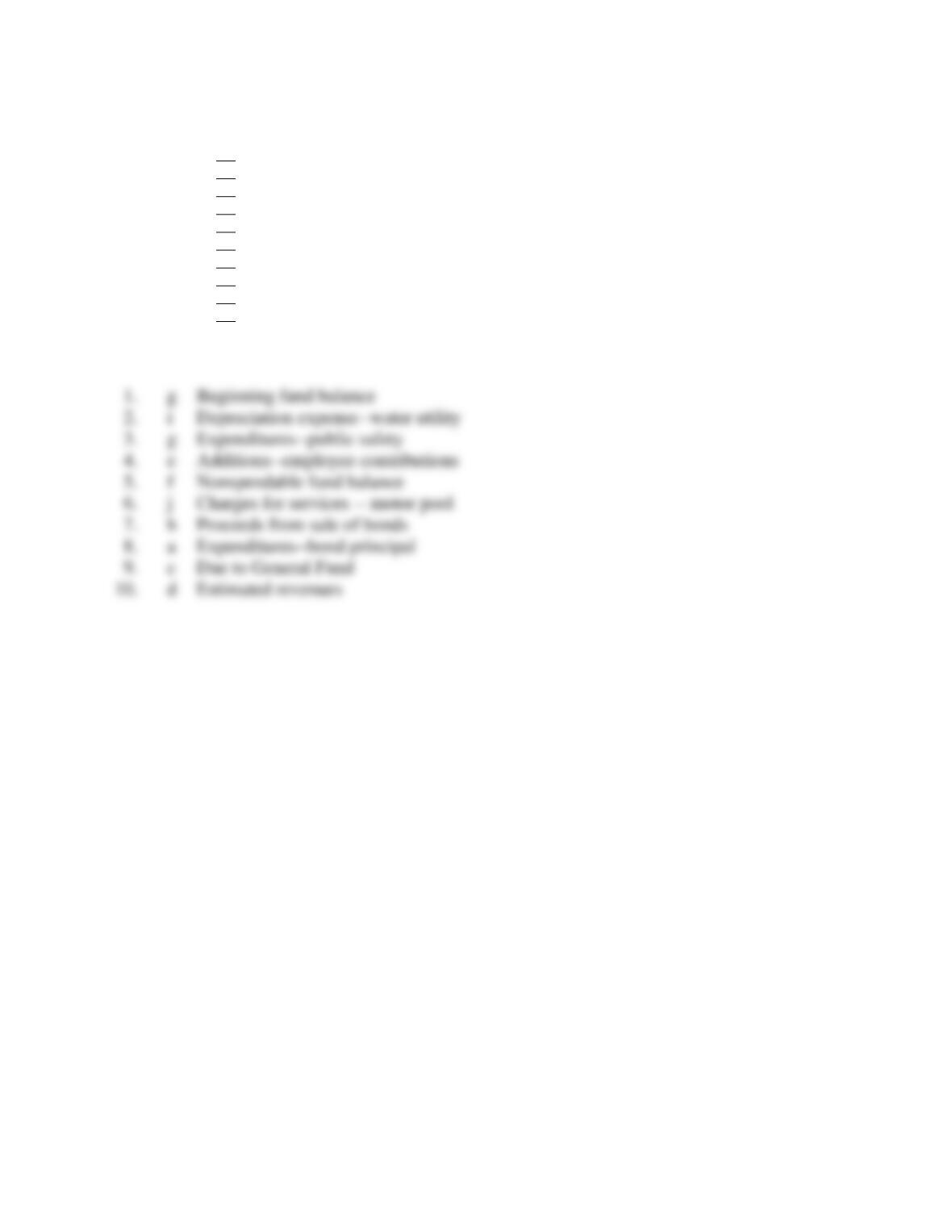
1. Beginning fund balance a. Debt Service Fund Operating Statement
2. Depreciation expense—water utility b. Internal Service Fund Statement of Cash Flows
3. Expenditures—public safety c. Agency Fund Balance Sheet
4. Additions—employee contributions d. Does not appear on financial statements
5. Nonspendable fund balance e. Pension Trust Fund Operating Statement
6. Charges for services — motor pool f. General Fund Balance Sheet
7. Proceeds from sale of bonds g. General Fund Operating Statement
8. Expenditures—bond principal h. Capital Projects Fund Operating Statement
9. Due to General Fund i. Enterprise Fund Operating Statement
10. Estimated revenues j. Internal Service Fund Operating Statement
Answer

40. (Matching transactions with funds and operating statement line items)
Harmony Township maintains four funds:
A the General Fund,
B the Library Special Revenue Fund,
C the Capital Projects Fund (recently established to account for the
construction of a new city park), and
D the Water Enterprise Fund.
For each of the transactions described below, indicate by letter the fund(s)
involved and by number the operating statement line item(s) that could be
affected.
1 Revenues 4 Other financing sources
2 Expenditures 5 Other financing uses
3 Expenses 6 None (this is a balance sheet transaction)
No.
Transaction
Fund(s)
Operating
Statement
Line Item(s)
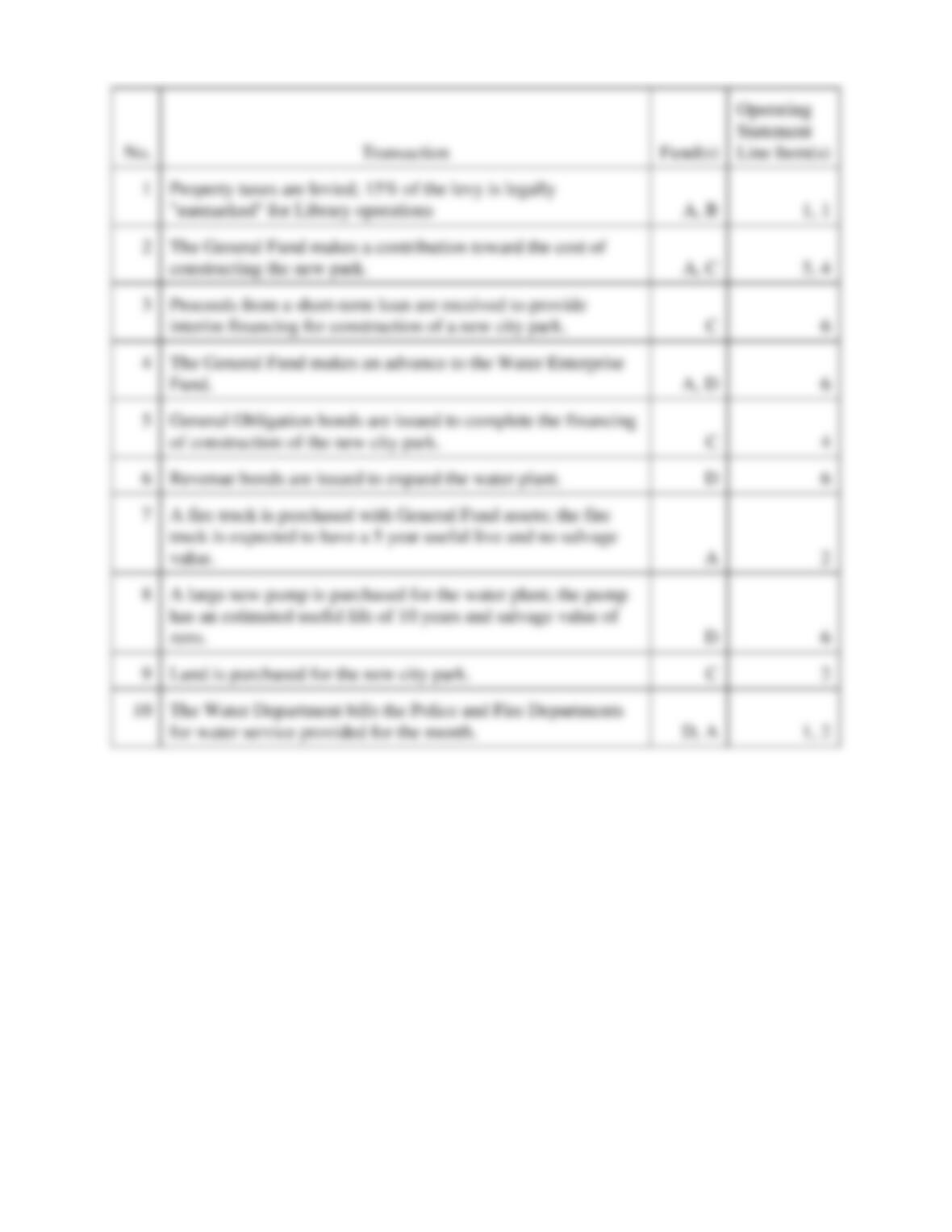
1
Property taxes are levied; 15% of the levy is legally
“earmarked” for Library operations
2
The General Fund makes a contribution toward the cost of
constructing the new park.
3
Proceeds from a short-term loan are received to provide
interim financing for construction of a new city park.
4
The General Fund makes an advance to the Water Enterprise
Fund.
5
General Obligation bonds are issued to complete the financing
of construction of the new city park.
6
Revenue bonds are issued to expand the water plant.
7
A fire truck is purchased with General Fund assets; the fire
truck is expected to have a 5 year useful live and no salvage
value.
8
A large new pump is purchased for the water plant; the pump
has an estimated useful life of 10 years and salvage value of
zero.
9
Land is purchased for the new city park.
10
The Water Department bills the Police and Fire Departments
for water service provided for the month.
Answer