12. Overton Corporation purchased a truck for $80,000. The company expected the truck to last four years
or 100,000 miles, with an estimated residual value of $8,000 at the end of that time. During the second
year, the truck was driven 27,500 miles. Compute the depreciation for the second year under each of
the following methods: (a) straight-line, (b) production, and (c) double-declining-balance. (Show your
work.)
13. Saticoy Corporation purchased a truck for $50,000. The company expected the truck to last five years
or 100,000 miles, with an estimated residual value of $5,000 at the end of that time. During the second
year, the truck was driven 23,000 miles. Compute the depreciation for the second year under each of
the following methods: (a) straight-line, (b) production, and (c) double-declining-balance. (Show your
work.)
14. Speedy Printing purchased a new printing press for $80,000. It depreciates the press over a five-year
period, using the double-declining-balance method of depreciation. If the press has an $8,000
estimated residual value, calculate depreciation expense for each of the five years. (Show your work.)
15. Shelby Manufacturing Company purchased three machines during the year:
Feb. 7
Machine 1
$ 5,400
July 29
Machine 2
36,000
Oct. 9
Machine 3
64,800
Each machine is expected to last six years and have no residual value. The company’s fiscal year
corresponds to the calendar year. Using the straight-line method, compute the depreciation charge for
each machine for the year. Round amounts to the nearest dollar.
16. Marcus Photography purchased photographic equipment for $75,000. The equipment was to be used
for ten years and had a $5,000 estimated residual value. After the company took three years of
straight-line depreciation, it decided that the equipment would instead have a $2,000 residual value
and a total useful life of eleven years. Calculate depreciation expense that should be recorded in year 4.
(Show your work.)
17. A truck that cost $20,000 and on which $8,000 of depreciation had been recorded was disposed of for
$11,600. Indicate whether a gain or loss should be recorded, and for what amount.
18. A machine that cost $72,000 and on which $52,000 of depreciation had been recorded was disposed of
for $20,800. Indicate whether a gain or a loss should be recorded, and for what amount.
19. Under what circumstances will a loss be recorded on the sale of equipment, and what effect will the
loss have on stockholders’ equity?
20. In 2013, Minneapolis Mining purchased a mineral deposit for $12,000,000. It is estimated that
15,000,000 tons can be extracted from the mine. Calculate depletion expense during 2013 when
700,000 tons were extracted and sold.
21. In 2013, McMinn Mining purchased a mineral deposit for $72,000,000. It is estimated that 30,000,000
tons can be extracted from the mine. Calculate depletion expense during 2013 when 1,600,000 tons
were extracted and sold.
22. What is goodwill and when may it be recorded?
23. For each of the following descriptions, provide the name of the intangible asset that is being described.
a. Exclusive right to use a name or symbol
b. Exclusive right to sell photographic reproductions of a painting
c. Excess paid for a business over the fair market value of the net assets purchased
d. Long-term exclusive right to use certain property
e. A right to an exclusive territory or market
f. Exclusive right to use an invention to sell or manufacture a certain product or use a specific process
MATCHING
Match each definition with the correct term below.
a.
Enlargements of a plant’s physical layout.
b.
A right to occupy land or buildings under a long-term contract.
c.
The portion of an asset’s acquisition cost that a company expects to recover when it
disposes of the asset.
d.
The proportional allocation of the cost of a natural resource to the units extracted.
e.
A registered symbol that can be used only by its owner to identify a product or service.
f.
The excess of the amount paid for a business over the fair market value of the business’s
net assets.
g.
The periodic allocation of the cost of an intangible long-lived asset to the periods it
benefits.
h.
Improvements to a plant asset that do not add to the plant’s physical layout.
i.
The total number of service units expected from a long-term asset.
j.
The periodic allocation of the cost of a tangible long-lived asset over its estimated useful
life.
1. Depreciation
2. Depletion
3. Amortization
4. Additions
5. Betterments
6. Residual value
7. Estimated useful life
8. Leasehold
9. Goodwill
10. Trademark
PROBLEM
1. Long-term assets include tangible assets, natural resources, and intangible assets. Explain the
difference between each of these types of assets and explain how each is accounted for on the income
statement.
2. Indicate whether each of the following expenditures should be classified as land, land improvements,
buildings, equipment, or none of these.
_____ a. Clearing costs
_____ b. Driveway cost
_____ c. Computer installation cost
_____ d. Architect’s fee for building plans
_____ e. Surveying costs
_____ f. Cost of assembly line trial run
_____ g. Property taxes paid after purchase
_____ h. Grading costs
_____ i. Insurance and freight on computer purchased
_____ j. Cost of lighting for parking lot
_____ k. Landscaping cost
_____ l. Material and labor costs incurred to construct factory
_____ m. Cost of tearing down a warehouse on land just purchased
_____ n. Utilities cost during first year
_____ o. Cost of building wing
_____ p. Sales tax on file cabinets purchased
_____ q. Real estate commissions on land purchased
_____ r. Contractor’s fee for building construction
_____ s. Cost to put up chain-link fence
_____ t. Accrued taxes on land purchased
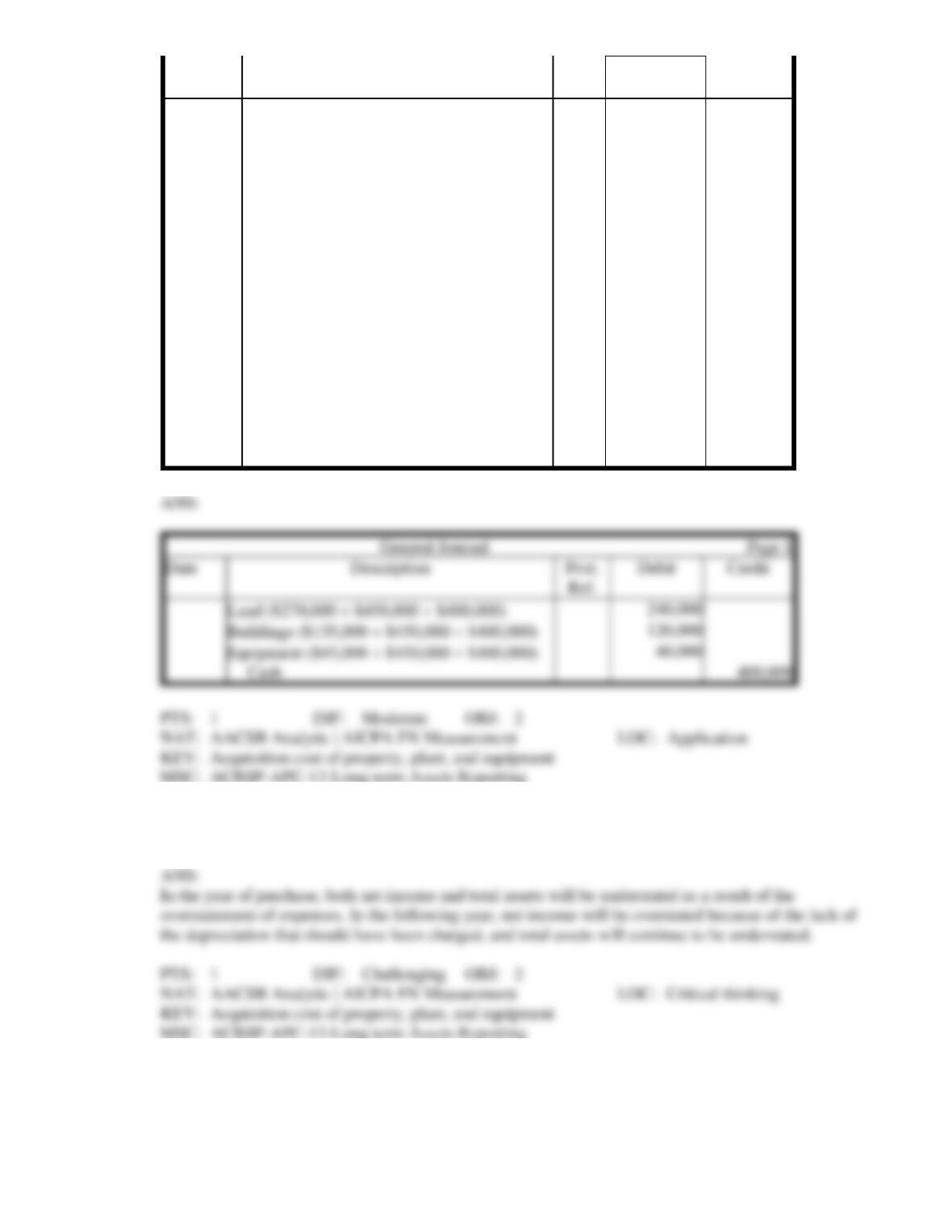
3. A company purchases land, a building on the land, and equipment in the building all for $400,000
cash. The appraised values are $270,000, $135,000, and $45,000 for the land, building, and equipment,
respectively. In the journal provided, record the entry for the purchase.(Omit explanation.)
General Journal
Page 1
Date
Description
Post.
Ref.
Debit
Credit
4. If the purchase of machinery is treated incorrectly as a revenue expenditure, what will be the effect on
net income and total assets in the year of purchase and in the following year, and why?
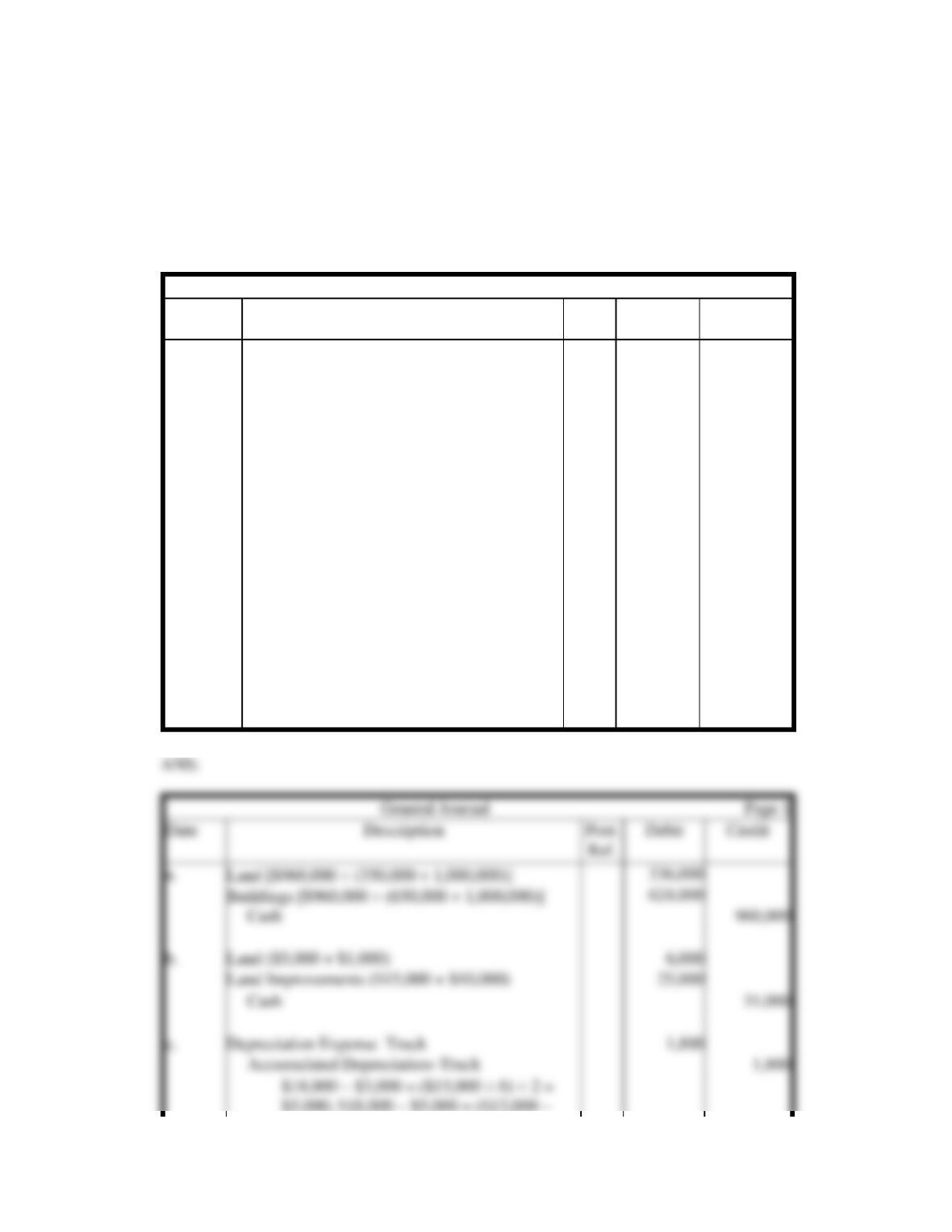
5. In the journal provided, prepare entries for the following independent transactions. (Omit
explanations.)
Land ($270,000 ÷ $450,000 $400,000)
Buildings ($135,000 ÷ $450,000 $400,000)
Equipment ($45,000 ÷ $450,000 $400,000)
Cash
a. Purchased land and a building on the land for $960,000. The appraised values of the land and
building are $350,000 and $650,000, respectively.
b. Paid $5,000 for a sewage system, $15,000 for a parking lot, $1,000 to tear down a shack on land just
purchased, and $10,000 for a block wall.
c. Purchased a truck two years ago for $18,000 with an original six-year estimated useful life and
$3,000 residual value. After a full two years of use, revised the residual value to $4,000 and the useful
life to a total of seven years. Record depreciation for year 3, assuming the straight-line method.
d. Purchased a machine on May 1, 2013 (assume a calendar-year accounting period) for $15,000. The
machine has an estimated life of 10,000 hours and no salvage value. Record depreciation for 2013
under the production method, assuming that the machine was used 2,000 hours.
General Journal
Page 1
Date
Description
Post.
Ref.
Debit
Credit
6. On January 2, 2012, Topanga Company purchased a machine for $90,000. The machine has a
five-year estimated useful life and a $6,000 estimated residual value. In addition, the company expects
to use the machine 200,000 hours. Assuming that the machine was used 35,000 hours during 2013,
complete the following chart. If a figure cannot be determined, indicate so by placing an X in the box.
(Show your work.)
Method
Depreciation Expense for
2013
Carrying Value at 12/31/13
Straight-line
Production
Double-declining-balance
7. On January 2, 2012, Vanowen Company purchased a machine for $80,000. The machine has an
eight-year estimated useful life and an $8,000 estimated residual value. In addition, the company
expects to use the machine 200,000 hours. Assuming that the machine was used 35,000 hours during
2013, complete the following chart. If a figure cannot be determined, indicate so by placing an X in the
box. (Show your work.)
Method
Depreciation Expense for
2013
Carrying Value at 12/31/13
Straight-line
Production
Double-declining-balance
8. Al’s Car Wash purchased a piece of equipment on October 1, 2011, for $27,000. The equipment has an
estimated life of four years or 40,000 units of production and an estimated residual value of $2,000.
Compute depreciation for 2011, 2012, and 2013 using the following methods: (a) straight-line, (b)
production, and (c) double-declining-balance. Assume that the company’s fiscal year corresponds to
the calendar year and that 3,000, 12,000, and 8,000 units were produced in the respective years. (Show
your work.)
Method
9. On January 1, 2012, Rhea Manufacturing Company purchased for $80,000 a machine that will produce
an estimated 75,000 units of Product X. The machine has an estimated useful life of four years and an
estimated residual value of $8,000. Calculate the following amounts, rounding answers to the nearest
dollar: (a) the carrying value of the machine after it has been used for three and one-half years, under
the straight-line method; (b) depreciation expense for 2013, under the production method (assume that
13,000 units were produced that year); and (c) accumulated depreciation at the end of 2013 under the
double-declining-balance method. (Show your work.)
10. On January 1, 2012, Pung Manufacturing Company purchased for $94,000 a machine that will produce
an estimated 75,000 units of Product X. The machine has an estimated useful life of five years and an
estimated residual value of $4,000. Calculate the following amounts: (a) the carrying value of the
machine after it has been used for three and one-half years, under the straight-line method; (b)
depreciation expense for 2013, under the production method (assume that 13,000 units were produced
that year); and (c) accumulated depreciation at the end of 2013, under the double-declining-balance
method. (Show your work.)
11. On January 1, 2009, Town Spa Pizza purchased for $16,000 a delivery truck that will be driven an
estimated 100,000 miles. The truck has an estimated useful life of ten years and an estimated residual
value of $5,000. Calculate the following amounts: (a) depreciation expense for 2013, under the
production method (assume that 17,000 miles were driven that year); (b) the accumulated depreciation
after the truck has been used for five and one-half years, under the straight-line method; and (c)
depreciation expense for 2011, under the double-declining-balance method. (Show your work.)
12. On January 1, 2009, Tipton’s Pizza purchased for $48,000 a delivery truck that will be driven an
estimated 120,000 miles. The truck has an estimated useful life of eight years and an estimated
residual value of $12,000. Calculate the following amounts: (a) depreciation expense for 2013, under
the production method (assume that 17,000 miles were driven that year); (b) the accumulated
depreciation after the truck has been used for five and one-half years, under the straight-line method;
and (c) depreciation expense for 2011, under the double-declining-balance method.
13. Suppose an accounting intern mistakenly calculated depreciation expense on the Land account. She
assigned it a 50-year life and a residual value of $10,000,000. Using the cost of the land (assume it was
$811,000,000) and the straight-line method of depreciation, discuss the dollar effect of this error on
pretax earnings and total assets.