74. Madeline Sports uses the dollar-value LIFO retail method. The price index on January 1, 2010, was 100,
and on that date the inventory was $20,000 (retail) and $14,000 (cost). Additional information follows:
2010
2011
Purchases, retail
$160,000
$204,000
Purchases, cost
115,200
150,960
Sales
160,416
202,160
Price index, Dec. 31.
102
103
What is the cost of the December 31, 2011, inventory (to the nearest dollar)?
75. What is the effect on net income if a company fails to record a purchase in transit (FOB shipping point) and
also fails to include the purchase in physical inventory?
76. If purchases are recorded correctly but ending physical inventory is understated, which one of the following
situations occurs for the current year?
77. The accountant for Shelley Company made the following errors related to purchases of merchandise and
ending inventory in 2010:
1.
A $1,200 purchase of merchandise on credit was not recorded or included in ending inventory.
2.
A $1,180 purchase of merchandise on credit was recorded, but it was inadvertently omitted from the end-of-year physical inventory
count.
Assuming a periodic inventory system, Shelley Company’s 2010 net income will be
78. The accountant for the Shelley Company made the following errors related to purchases of merchandise and
ending inventory in 2010:
1.
A $2,100 purchase of merchandise on credit early in 2011 was recorded and included in ending inventory at December 31, 2010.
2.
A $1,550 purchase of merchandise on credit in 2010 was recorded, but it was not included in the end–of-year physical inventory count.
Assuming a periodic inventory system, Shelley Company’s 2010 net income will be
79. Brenda Corp. reported 2012 net income of $30,000. However, the ending inventory in 2011 had been
understated by $3,000, and 2012’s ending inventory had been overstated by $6,000. Brenda’s correct net income
for 2012 was
80. A purchase on credit is recorded twice and not corrected during the physical inventory. Which of the
following statements correctly describes the impact of this error?
81. The correct net income for Lana Corp. was $43,500. The company reported incorrect net income because
beginning inventory was understated by $2,500, purchases were overstated by $2,000, and ending inventory
was overstated by $2,000. What net income did Lana Corp. report?
82. The accountant for Elaine Company made the following errors related to the inventory in 2010:
1.
The beginning inventory for 2010 was understated by $1,350 due to an error in the physical count.
2.
A $1,500 purchase of merchandise on credit was not recorded or included in ending inventory.

Assuming a periodic inventory system, Elaine Company’s 2010 net income will be
83. Kim Company’s accountant made the following errors related to merchandise inventory in 2010:
1.
The beginning inventory for 2010 was overstated by $1,900 due to an error in the physical count.
2.
A $1,150 purchase of merchandise on credit was not recorded, but the items were included in the ending inventory.
Assuming a periodic inventory system, Kim Company’s 2010 cost of goods sold will be
84. The accountant for Leslie Company made the following errors related to merchandise inventory in 2010:
1.
The beginning inventory for 2010 was overstated by $750 due to an error in the physical count.
2.
A $1,300 purchase of merchandise on credit was not recorded or included in the ending inventory.
Assuming a periodic inventory system, Leslie Company’s 2010 cost of goods sold will be
85. The accountant for Frieda Company did not record a purchase of merchandise on credit or include the items
in the ending inventory. Assuming a periodic inventory system, the effect of these omissions on assets,
liabilities, and retained earnings would be
Assets
Liabilities
Retained Earnings
I.
Understate
Understate
Understate
II.
Understate
Understate
No effect
III.
No effect
Understate
No effect
IV.
Understate
No effect
Understate

86. The accountant for the Iris Company did not record a purchase of merchandise on credit for the current year,
but the merchandise was correctly included in the ending inventory. Assuming a periodic inventory system,
how would assets, liabilities, and retained earnings be affected on the year-end balance sheet?
Assets
Liabilities
Retained Earnings
I.
No effect
Understated
Understated
II.
Understated
Understated
No effect
III.
No effect
No effect
Overstated
IV.
No effect
Understated
Overstated
87. The accountant for Sue Company made the following errors related to inventory in 2010:
1.
The beginning inventory for 2010 was overstated by $375 due to an error in the physical count.
2.
A $650 purchase of merchandise on credit in 2010 was not recorded or included in the ending inventory.
Assuming a periodic inventory system, how would Sue’s cost of goods sold, gross profit, and net income be affected in 2010 by these errors?
Cost of Goods Sold
Gross Profit
Net Income
I.
Overstated
Understated
Understated
II.
Overstated
Understated
No effect
III.
Understated
Overstated
Overstated
IV.
No effect
No effect
No effect
88. What is the effect on net income for the current year if a company fails to record a purchase of materials in
transit (FOB shipping point) but includes the materials in physical inventory at year-end?
89. If in the current year a purchase was not recorded but the purchased item was included in ending physical
inventory, which one of the following situations occurs for the current year?
90. The accountant for the Hilda Company recorded a purchase of merchandise on credit for the current year,
but the merchandise was shipped FOB destination and did not arrive until after current year-end. Assuming a
periodic inventory system, how would assets, liabilities, and retained earnings be affected on the year-end
balance sheet?
Assets
Liabilities
Retained Earnings
I.
No effect
Understated
Understated
II.
Understated
Understated
Understated
III.
No effect
Overstated
Overstated
IV.
No effect
Overstated
Understated
91. Although IFRS require the use of the lower of cost or market method to value inventory, some differences
from GAAP still exist. Which of the following is not one of the differences?
92. Zelda Company has provided the following values for its 400 units of inventory at the end of 2010:
Item
Per Unit
Historical cost
$5.00
Replacement cost
$4.20
Net realizable value
$4.50
Normal profit margin
$ .80
Under IFRS requirements, the per-unit reported value for Zelda’s inventory will be

93. The following information was taken from the inventory records of the Walker Company:
Product
A
B
C
D
E
Units
75
100
150
100
200
Unit cost
$5.50
$10.00
$5.10
$5.10
$5.00
Replacement cost
$6.00
$9.00
$4.60
$4.50
$4.50
Net realizable value (NRV)
$5.20
$12.50
$7.00
$7.00
$7.00
NRV–Normal profit
$4.80
$10.30
$5.25
$4.00
$4.80
Required:
Determine the valuation of the inventory at the lower of cost or market applied to:
a.
individual items
b.
the inventory as a whole
94. Information about the ending inventories of Chair Company is shown below:
Current
Normal
Replacement
Selling
Cost of
Profit
Year
Cost
Cost
Price
Completion
Margin
2010
$10,000
$11,500
$12,000
$1,000
$1,100
2011
15,000
13,000
14,000
1,500
1,250
2012
20,000
18,600
24,000
2,200
2,900
Required:
a.
Determine the value of the
inventory for each year using the
lower of cost or market rule.
b.
Assuming that Chair Company
maintains a periodic inventory
system, prepare journal entries for
2012 to record the reduction of the
inventory to market value using:
(1)
the direct method
(2)
the allowance method
a.
($5.20 ´ 75) + ($10.00 ´ 100) + ($5.10 ´ 150) +
($4.50 ´ 100) + ($4.80 ´ 200) = $3,565
b.
Cost = $412.50 + $1,000 + $765 + $510 + $1,000 = $3,687.50
Market = $390 + $1,030 + $787.50 + $450 + $960 = $3,617.50
95. Given the following information for Galloway Company:
Net
NRV Minus
Realizable
Replacement
Normal
Unit
Quantity
Cost
Value
Cost
Profit
1
1
$17.70
$24.60
$18.00
$17.10
2
1
10.80
8.28
9.30
5.58
3
1
72.00
64.80
67.20
57.60
4
1
4.80
3.12
2.88
2.64
5
1
12.00
12.30
12.60
11.10
6
1
48.00
45.60
38.40
40.80
2010: $10,000
Cost = $10,000
2011: $12,500
Cost = $15,000
2012: $18,900
Cost = $20,000
$21,800)
(1)
Direct method:
Income Summary
12,500
Inventory
12,500
Inventory
18,900
Income Summary
18,900
(2)
Allowance method:
Income Summary
15,000
Inventory
15,000
Inventory
20,000
Income Summary
20,000

Required:
a.
Determine the lower of cost or market value for each inventory item for Galloway Company.
b.
Determine the lower of cost or market value for Galloway Company’s inventory if the lower of cost or market rule is applied to the total
inventory.
96. Given the following information for the Lawton Company:
NRV Minus
Net
Normal
Realizable
Replacement
Unit
Cost
Profit
Value
Cost
a
$ 3.40
$ 2.79
$ 4.14
$ 4.65
b
36.00
28.80
32.40
27.60
c
2.40
1.32
1.56
1.94
d
6.00
5.55
6.15
6.30
e
24.00
20.40
22.80
21.00
f
13.35
10.55
12.30
12.90
Required:
Determine the lower of cost or market for each inventory item.
a.
$ 3.40
$ 6.00
$28.80
e.
$21.00
c.
$ 1.56
$12.30
$17.70
$ 2.88
$ 8.28
$12.00
$64.80
$40.80
Net
NRV Minus
Realizable
Replacement
Normal
Unit
Quantity
Cost
Value
Cost
Profit
Market
1
1
$ 17.70
$24.60
$18.00
$17.10
$ 18.00
2
1
10.80
8.28
9.30
5.58
8.28
3
1
72.00
64.80
67.20
57.60
64.80
4
1
4.80
3.12
2.88
2.64
2.88
5
1
12.00
12.30
12.60
11.10
12.30
6
1
48.00
45.60
38.40
40.80
40.80
Total
$165.30
$147.06

97. Walker Tile Shop uses the lower of cost or market method and has a periodic inventory system. Additional
information follows:
Inventory
Date
Cost
Market
January 1, 2010
$4,600
$4,000
December 31, 2010
6,000
5,000
December 31, 2011
9,000
8,200
Required:
a.
If the direct method of recording the reduction of inventory to market is in use, what would be the amount of the debit to Inventory on
December 31, 2011?
b.
If the allowance method is in use, what would be the debit to Income Summary on December 31, 2010?
98. The Sloan Company uses a periodic inventory system and values its inventory at lower of cost or market. Its
accounting records indicate the following information relating to inventory:
Inventory
Date
Cost
Market
January 1, 2010
$ 75,000
$ 75,000
December 31, 2010
110,000
80,000
December 31, 2011
140,000
128,000
Required:
Prepare the required journal entries at December 31, 2010, and December 31, 2011, to record the inventory at lower of cost or market using the
following methods:
a.
Direct method
b.
Allowance method
$8,200
b.
$4,600
99. Farmer Company uses a perpetual inventory system and values its inventory at lower of cost or market. Its
accounting records indicate the following information relating to inventory:
Inventory
Date
Cost
Market
January 1, 2010
$ 60,000
$ 60,000
December 31, 2010
102,000
88,000
December 31, 2011
115,000
109,000
Required:
Prepare the required journal entries at December 31, 2010, and December 31, 2011, to record the inventory at lower of cost or market using the
following methods:
a.
Direct method
b.
Allowance method
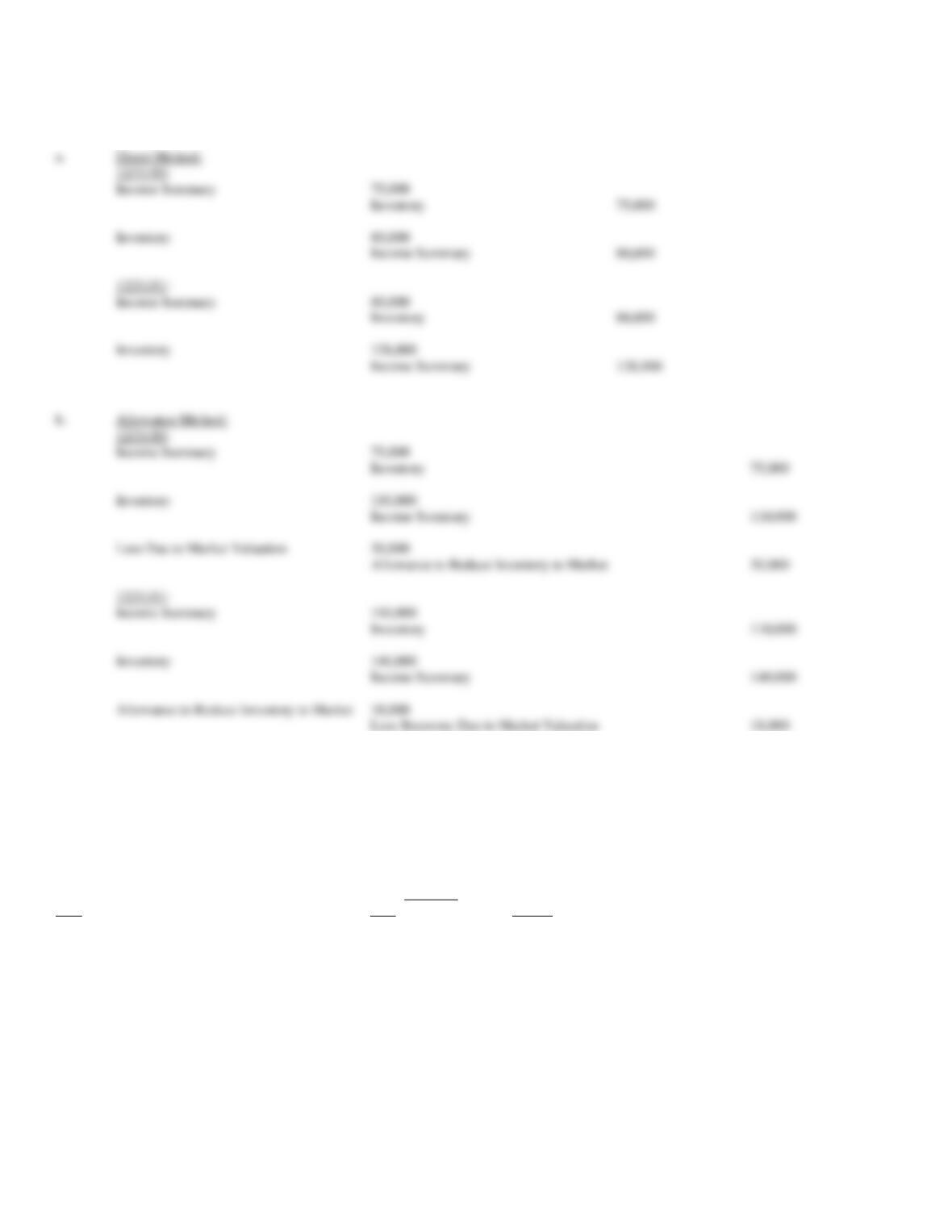
Direct Method:
12/31/10:
Income Summary
75,000
Inventory
75,000
Inventory
80,000
Income Summary
80,000
12/31/11:
Income Summary
80,000
Inventory
80,000
Inventory
128,000
Income Summary
128,000
Allowance Method:
12/31/10:
Income Summary
75,000
Inventory
75,000
Inventory
110,000
Income Summary
110,000
Loss Due to Market Valuation
30,000
Allowance to Reduce Inventory to Market
30,000
12/31/11:
Income Summary
110,000
Inventory
110,000
Inventory
140,000
Income Summary
140,000
Allowance to Reduce Inventory to Market
18,000
Loss Recovery Due to Market Valuation
18,000
100. The Peterson Company began operations in early 2010. At December 31, 2010, the company’s ending
inventory’s cost was $12,950. The market value of the inventory at this date was $11,800. Peterson values its
inventory at lower of cost or market applied on an individual item basis and uses a perpetual inventory system.
Below is information relating to Peterson’s inventory at December 31, 2011:
Estimated
Estimated
Normal
No. of
Unit
Replacement
Selling
Costs of
Profit
Item
Units
Cost
Cost
Price
Disposal
Margin
1
200
$5.00
$4.00
$ 7.50
$1.00
$2.00
2
400
9.00
8.00
10.00
1.50
2.00
3
350
6.00
7.00
8.00
2.50
1.00
4
450
7.50
8.80
10.00
2.00
1.50
5
500
3.00
2.50
5.00
.50
1.50
Required:
a.
Assuming that the company uses the allowance method, prepare the required entry at December 31, 2010, to record the inventory at
lower of cost or market.
b.
Prepare a schedule to calculate the inventory’s value as of December 31, 2011, using the lower of cost or market method. The schedule
should contain the following column headings: Item, Upper Constraint, Lower Constraint, Applicable Unit Inventory Value, Number of
Units, and Total Inventory Value.
c.
Prepare the required entry at December 31, 2011, to record the inventory at lower of cost or market. Assume the allowance method is
used.
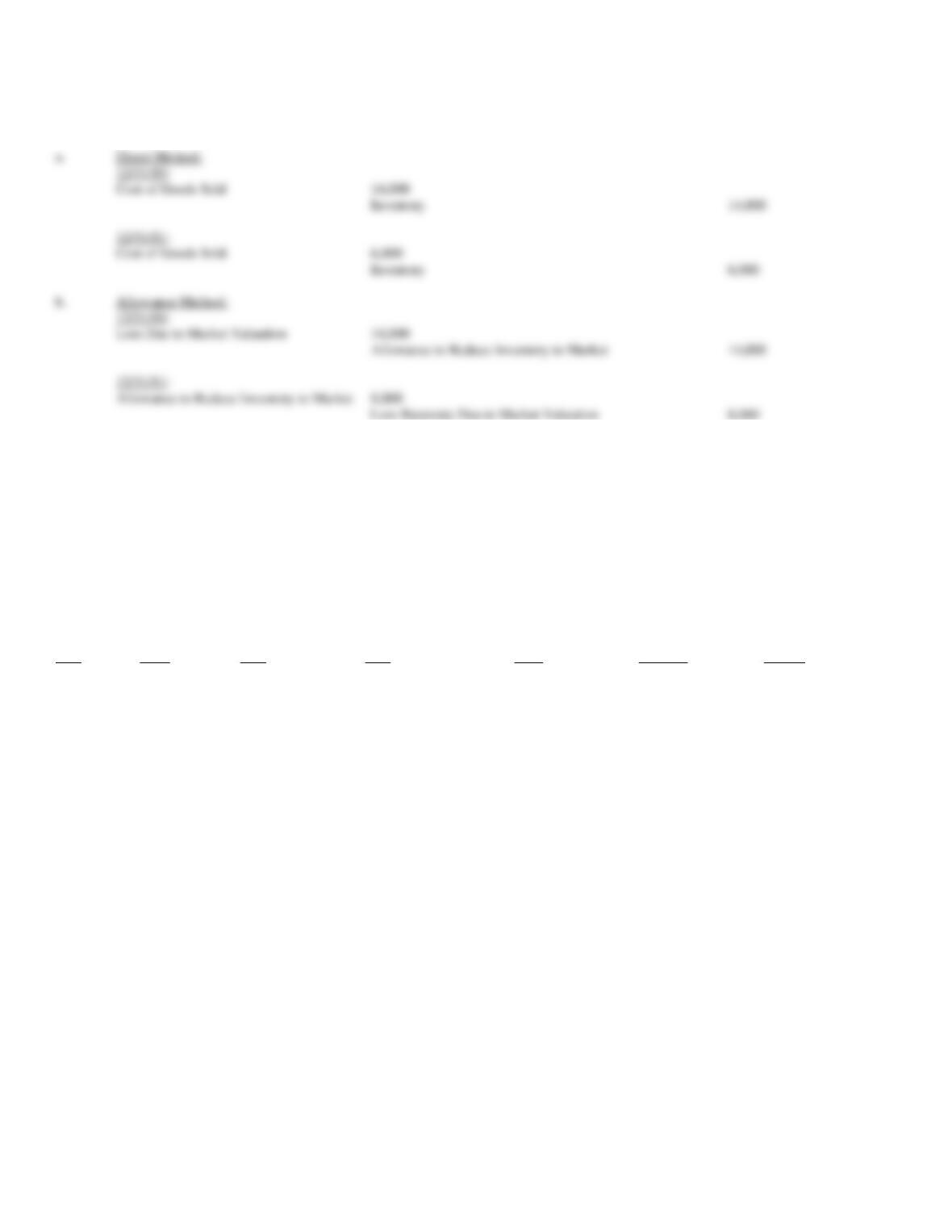
Direct Method:
12/31/10:
Cost of Goods Sold
14,000
Inventory
14,000
12/31/11:
Cost of Goods Sold
6,000
Inventory
6,000
b.
Allowance Method:
12/31/10:
Loss Due to Market Valuation
14,000
Allowance to Reduce Inventory to Market
14,000
12/31/11:
Allowance to Reduce Inventory to Market
8,000
Loss Recovery Due to Market Valuation
8,000
101. On December 18, 2010, Red Co. signed a non-cancellable purchase commitment for 15,000 pounds of mix
at $6.75 a pound with Green, Inc. On December 31, 2010, the market price of the mix had risen to $6.98 a
pound.
Required:
a.
Prepare the December 31, 2010, adjusting entry.
b.
If, instead, the price of the mix at December 31, 2010, had fallen to $6.15 a pound, explain the effect on Red’s 2010 net income?
c.
Assuming the price of the mix at December 31, 2010, had fallen to $6.15 a pound, explain the effect on Green’s 2010 net income?
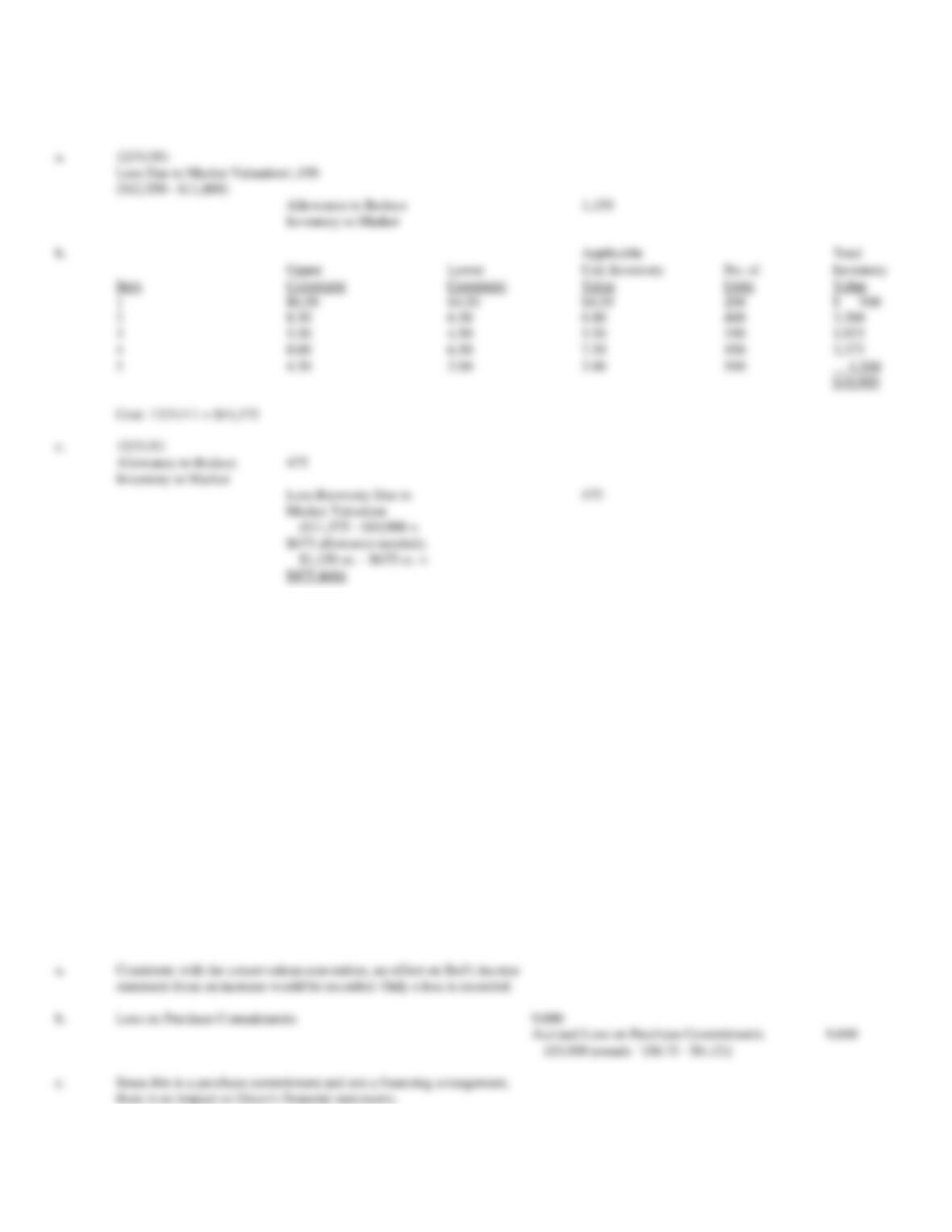
b.
Loss on Purchase Commitments
9,000
Accrued Loss on Purchase Commitments
[15,000 pounds ´ ($6.75 – $6.15)]
a.
Applicable
Total
Upper
Lower
Unit Inventory
No. of
Inventory
Item
Constraint
Constraint
Value
Units
Value
1
$6.50
$4.50
$4.50
200
$ 900
2
8.50
6.50
8.00
400
3,200
3
5.50
4.50
5.50
1,925
4
8.00
6.50
7.50
450
3,375
5
4.50
3.00
3.00
500
1,500
$10,900
Cost: 12/31/11 = $11,575
c.
102. On December 20, 2010, Lopez Inc. signed a non-cancellable purchase commitment for 9,000 pounds of
material at $4.75 a pound. By December 31, 2010, the price of the material had fallen to $4.38 a pound.
Required:
Prepare the entry for January 7, 2011, when the material was received and payment was made.
103. A fire destroyed the Winston Company’s warehouse on March 15, 2010. Only goods with a normal selling
price of $12,500 and a net realizable value of $5,000 were saved. The following information is available from
the company’s records:
Inventory in warehouse, 1/1/10
$250,000
Purchases, 1/1/10-3/15/10
620,000
Purchase returns
9,500
Freight-in
14,000
Sales, 1/1/10-3/15/10
850,000
Sales returns
20,000
For the period from 2006 through 2009, Winston had a gross profit of $2,100,000 on net sales of $6,000,000.
Required:
a.
Estimate Winston’s inventory loss from the fire using the gross profit method.
b.
What assumptions allow the use of the gross profit method in these circumstances?
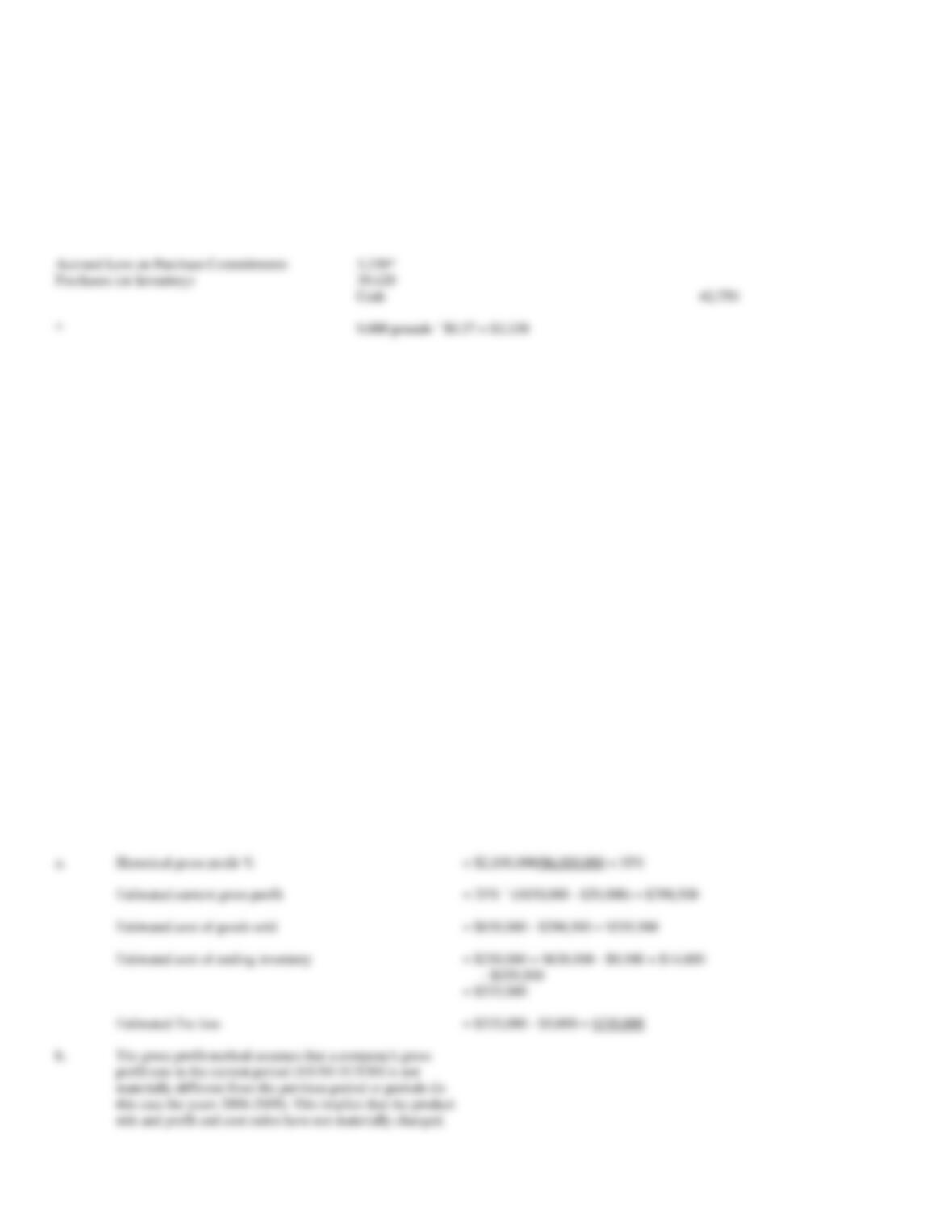
a.
Historical gross profit %
= $2,100,000/$6,000,000 = 35%
Estimated current gross profit
= 35% ´ ($850,000 – $20,000) = $290,500
Estimated cost of goods sold
= $830,000 – $290,500 = $539,500
Estimated cost of ending inventory
= $250,000 + $620,000 – $9,500 + $14,000
– $539,500
= $335,000
Estimated fire loss
= $335,000 – $5,000 = $330,000
Accrued Loss on Purchase Commitments
3,330*
Purchases (or Inventory)
39,420
Cash
42,750
*
9,000 pounds ´ $0.37 = $3,330