Chapter 9
110. Cash budgeting is important to which of the following?
a. retail stores
b. manufacturing firms
c. not-for-profit agencies
d. local government agencies
e. all of these
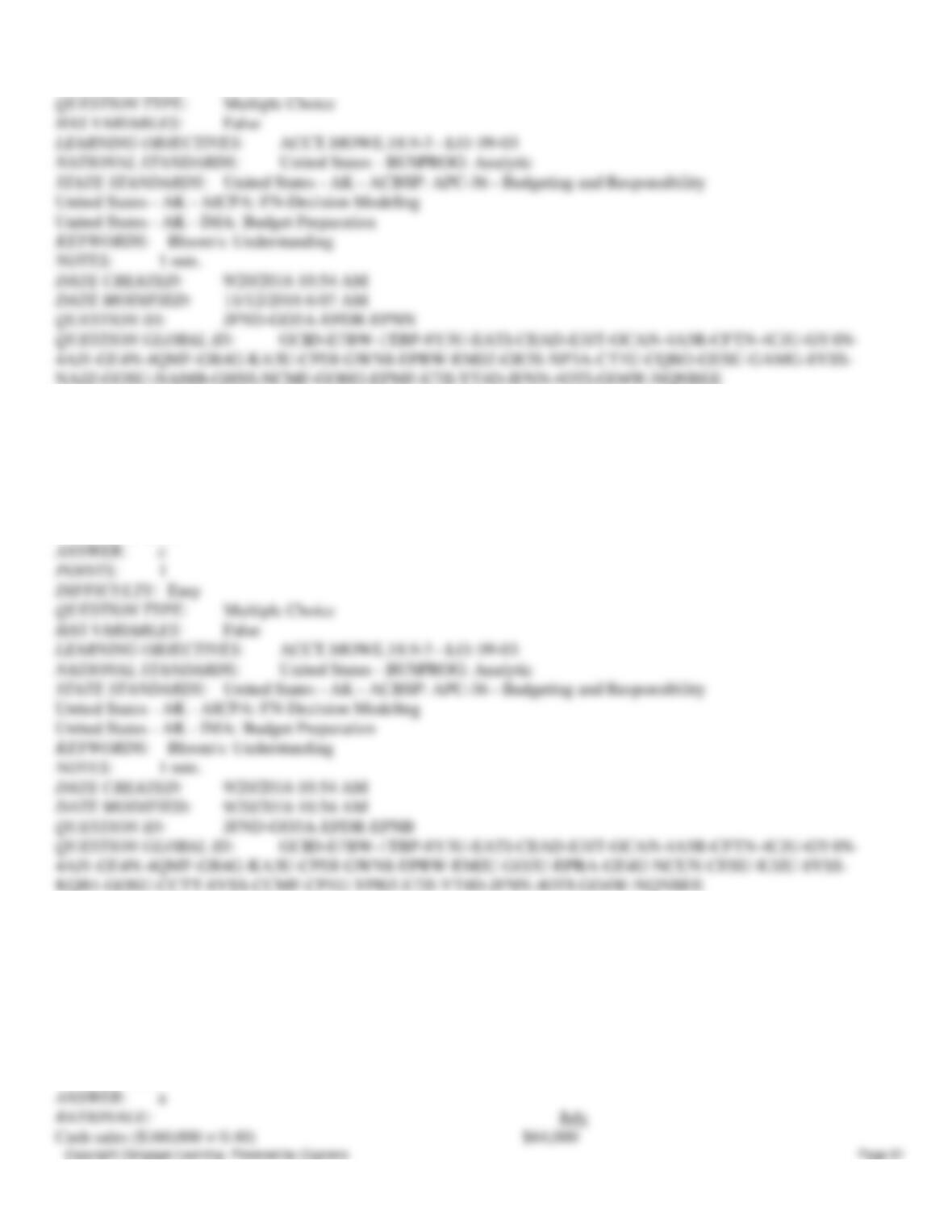
111. Foray Company finds that typically 40% of a month’s sales are for cash. Payments on accounts receivable are 70% in
the month of sale and 28% in the month following sale. Budgeted sales for June are $120,000, for July $160,000, and for
August $140,000. What are the total cash receipts budgeted for July?
a. $151,360
b. $85,400
c. $122,000
d. $262,000
e. $140,000
Chapter 9
112. Rocha & Noel Company, an importer and retailer of Polish pottery and kitchenware, prepares a monthly master
budget. Data for the July master budget are given below:
The June 30th balance sheet follows.
Cash $35,000 Accounts payable $55,000
Accounts receivable 120,000 Capital stock 320,000
Inventory 56,000 Retained earnings 96,000
Building and equipment (net) 260,000
Actual sales for June and budgeted sales for July, August, and September are given below.
June $147,500
July 370,000
August 420,000
September 330,000
Sales are 30% for cash and 70% on credit. All credit sales are collected in the month following the sale. There are no bad
debts.
The gross margin percentage is 45% of sales. The desired ending inventory is equal to 30% of the following month’s sales.
One fourth of the purchases are paid for in the month of purchase and the others are purchased on account and paid in full
the following month.
Chapter 9
The monthly cash operating expenses are $45,000, and the monthly depreciation expenses are $7,500.
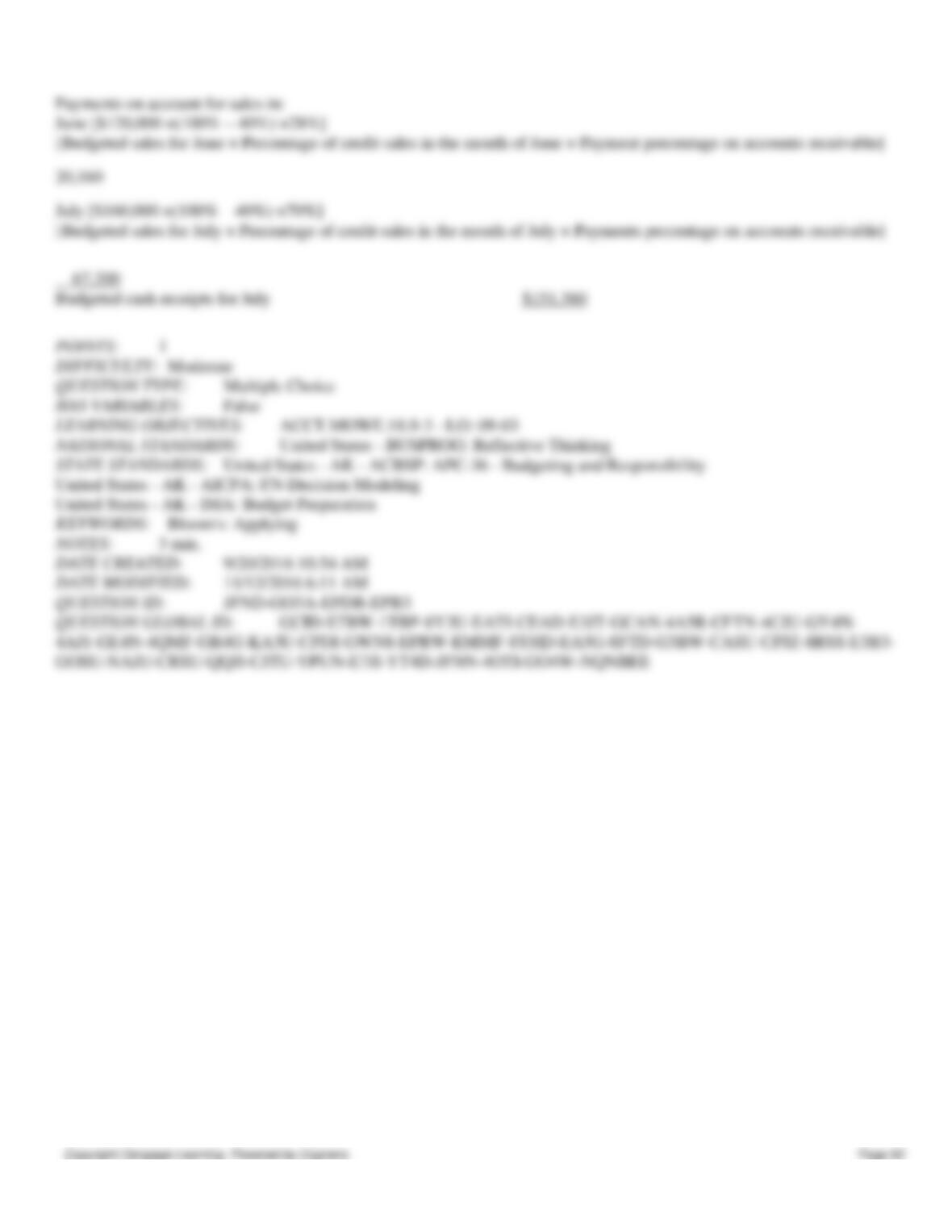
What is the balance of the accounts receivable at the end of July?
a. $110,000
b. $259,000
c. $360,000
d. $398,000
113. Thomas & Cooke Corporation has the following sales forecasts for the first three months of the current year:
Month Sales
January $39,000
February 26,000
March 45,000
85% of sales are collected in the month of the sale and the remainder is collected in the following month.
Accounts receivable balance (January 1) $25,800
Cash balance (January 1) 25,000
Minimum cash balance needed 22,000
What is the cash balance at the end of January, assuming that cash is received only from customers and that $50,000 is
paid out during January?
a. $39,400
b. $33,950
c. $20,600
d. $21,000
Chapter 9
114. Alpha Company makes all its sales on account. Accounts receivable payment experience is as follows:
Percent paid in the month of sale 35%
Percent paid in the month after the sale 54%
Percent paid in the second month after the sale 6%
Alpha provided information on sales as follows:
May $150,000
June $125,000
July $136,000
August (expected) $142,000
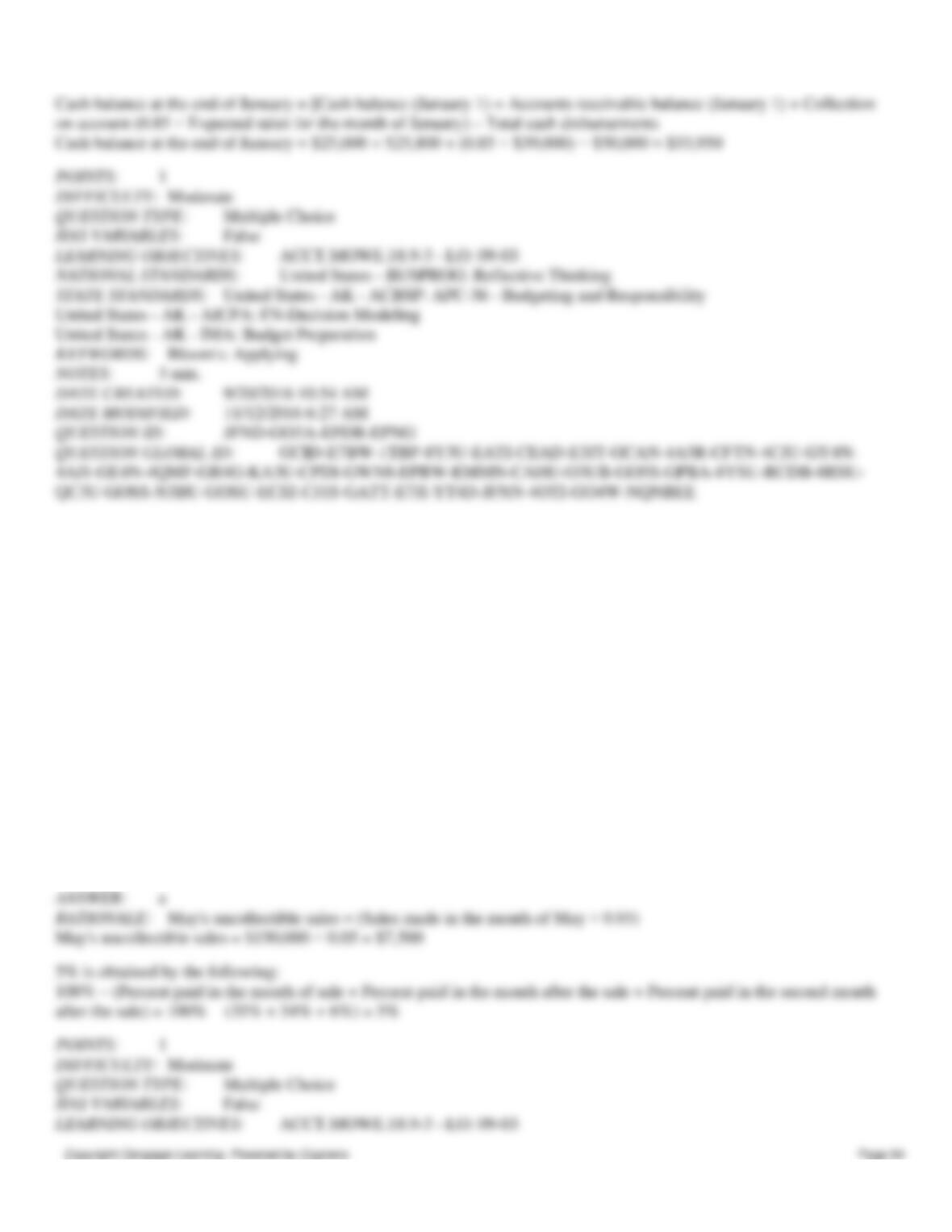
How much of May’s sales are expected to be uncollectible?
a. $7,500
b. $5,000
c. $2,500
d. $7,200
e. $0
Chapter 9
115. Alpha Company makes all its sales on account. Accounts receivable payment experience is as follows:
Percent paid in the month of sale 35%
Percent paid in the month after the sale 54%
Percent paid in the second month after the sale 6%
Alpha provided information on sales as follows:
May $150,000
June $125,000
July $136,000
August (expected) $142,000
How much of June’s credit sales is expected to be collected in the month of July?
a. $30,000
b. $60,000
c. $36,000
d. $67,500
e. $80,000
Chapter 9
116. Alpha Company makes all its sales on account. Accounts receivable payment experience is as follows:
Percent paid in the month of sale 35%
Percent paid in the month after the sale 54%
Percent paid in the second month after the sale 6%
Alpha provided information on sales as follows:
May $150,000
June $125,000
July $136,000
August (expected) $142,000
What is budgeted cash to be collected on account for the month of August?
a. $45,000
b. $132,000
c. $130,640
d. $150,000
e. $154,600
117. Lambert Company purchased $140,000 of goods in September and expects to purchase $130,000 of goods in
October. Lambert typically pays for 20% of purchases in the month of purchase and 80% in the following month.
Every month, Lambert must make the following payments:
Chapter 9
Rent $5,000
Wages 14,000
Utilities 3,000
Telephone 400
Loan on equipment 1,200
In mid-October, Lambert expects to buy a new computer for $4,500 using the company credit card. Typically, the credit
card bill is paid in full in the following month. September credit card purchases totaled $6,000. What is Lambert’s
expected cash disbursement in October for purchases of goods?
a. $140,000
b. $130,000
c. $112,000
d. $138,000
e. $26,000
118. Lambert Company purchased $140,000 of goods in September and expects to purchase $130,000 of goods in
October. Lambert typically pays for 20% of purchases in the month of purchase and 80% in the following month.
Every month, Lambert must make the following payments:
Rent $5,000
Wages 14,000
Utilities 3,000
Telephone 400
Loan on equipment 1,200
In mid-October, Lambert expects to buy a new computer for $4,500 using the company credit card. Typically, the credit
card bill is paid in full in the following month. September credit card purchases totaled $6,000. What are the total cash
disbursements expected by Lambert during the month of October?
a. $167,600
b. $172,100
c. $161,600
d. $55,600
e. $60,100
Chapter 9
119. Forward Company makes all its sales on account. Forward’s accounts receivable payment experience is as follows:
Percent paid in the month of sale 30%
Percent paid in the month after the sale 65%
Percent paid in the second month after the sale 3%
Forward provided information on sales as follows:
September $120,000
October $140,000
November $220,000
December (expected) $260,000
What are the expected cash receipts in the month of November?
a. $200,000
b. $40,000
c. $190,000
d. $160,600
e. $114,000
Chapter 9
120. Forward Company makes all its sales on account. Forward’s accounts receivable payment experience is as follows:
Percent paid in the month of sale 30%
Percent paid in the month after sale 65%
Percent paid in the second month after sale 3%
Forward provided information on sales as follows:
September $120,000
October $140,000
November $220,000
December (expected) $260,000
What are the expected cash receipts in December?
a. $225,200
b. $210,400
c. $50,000
d. $250,000
e. $179,000
Chapter 9
121. Which of the following is true of a static budget?
a. It is considered a good choice for benchmarks in preparing a performance report.
b. It divides costs into those that vary with units of production and those that are fixed with respect to unit-level
drivers.
c. It provides a measure of the efficiency of a manager.
d. It provides expected cost for a given level of activity.
e. None of these are correct.
122. Which budget should be used to determine managerial effectiveness?
a. before-the-fact flexible budget
b. after-the-fact flexible budget
c. static budget
d. financial budget
e. cash budget
Chapter 9
123. Which budget is used to assess managerial efficiency?
a. sales budget
b. production budget
c. static budget
d. flexible budget
e. cash budget
124. Which of the following is true of a flexible budget?
a. It is prepared by large firms only.
b. It is used to measure whether or not a manager accomplishes his or her goals.
c. It is usually not a good choice for benchmarks while preparing a performance report.
d. It is a budget created in advance that is based on a particular level of activity.
e. It enables a firm to compute expected costs for a range of activity levels.
Chapter 9
125. To create a meaningful performance report,
a. actual costs are compared with the expected costs found in the static budget.
b. actual costs are calculated as a percentage of sales.
c. actual costs are compared with the prior year’s actual costs.
d. expected costs of the static budget are compared with the expected costs of the flexible budget.
e. actual costs are compared with the expected costs at the same level of activity.
126. A before-the-fact flexible budget:
a. allows managers to develop a financial result for only one potential scenario.
b. gives expected costs for one activity level.
c. provides useful information for planning and decision making.
d. allows managers to see the activity level at which the actual cost is equal to budgeted cost.
e. All of these are correct.
Chapter 9
127. An after-the-fact flexible budget:
a. is useful for control.
b. is used to provide the expected cost for a range of activity levels.
c. is used only when the actual level of activity is the same as the static budget level of activity.
d. is the key to receiving frequent feedback from customers.
e. All of these are correct.
128. A budget prepared for a particular level of activity is a(n)
a. operational budget.
b. ABB budget.
c. static budget.
d. flexible budget.
e. variable budget.
Chapter 9
129. Which of the following is true of a static budget?
a. A static budget represents certain goals that a firm wants to achieve.
b. It divides costs into those that vary with units of production and those that are fixed with respect to unit-level
drivers.
c. It ascertains how well costs were controlled during a year.
d. It is best used to create a meaningful performance report.
e. None of these is correct.
130. Assume that the expectations on the static budget were met. We can conclude that
a. the static budget was ill conceived.
b. the effectiveness of the manager is not in question.
c. the manager is very efficient.
d. there is no need for a flexible budget.
e. None of these.
Chapter 9
131. Which of the following is true of a performance report?
a. In preparing a performance report, static budgets are usually a good choice for benchmarks.
b. It compares actual costs with budgeted costs from the master budget.
c. It is prepared only if the top management has only superficial participation in the budgeting process.
d. To create a meaningful performance report, a static budget should be used.
e. To create a meaningful performance report, actual costs and expected costs should be compared at different levels
of activity.
132. Which of the following is true of flexible budgets?
a. They serve only the control needs of management of an organization.
b. They enable firms to compute expected costs for a range of activity levels.
c. They allow managers to develop financial results for only one potential scenario.
d. They do not require the managers to know the cost behavior pattern of each item in the budget.
e. All of these are correct.
Chapter 9
133. Wright Inc. produces leather purses. Wright has developed a static budget for the first quarter based on 25,000 direct
labor hours. During the quarter, the actual activity was 30,000 direct labor hours. Data for the first quarter are summarized
as follows:
Static budget
(25,000 hours) Actual costs
(30,000 hours)
Direct materials cost $ 85,000 $ 90,000
Direct labor cost 180,000 164,000
Building rental 56,000 60,000
Total $321,000 $314,000
Comparing the static budget to the actual outcomes, we can say:
a. direct materials variance is favorable.
b. direct labor variance is unfavorable.
c. the comparison is useful for assessing managerial efficiency.
d. a flexible budget should be used for assessing efficiency.
e. All of these are correct.
134. Jason, Inc. produces leather purses. Jason has developed a static budget for the first quarter, based on 20,000 direct
labor hours. During the quarter, the actual activity was 22,000 direct labor hours. Data for the first quarter are summarized
as follows:
Chapter 9
Static budget
(20,000 hours) Actual costs
(22,000 hours)
Direct materials cost $ 80,000 $ 87,000
Direct labor cost 160,000 174,000
Building rental 48,000 50,000
Total $288,000 $311,000
What is the flexible budget amount for the first quarter?
a. $288,000
b. $311,000
c. $312,000
d. $261,000
e. Cannot be determined.
135. Jason, Inc. produces leather purses. Jason has developed a static budget for the first quarter, based on 20,000 direct
labor hours. During the quarter, the actual activity was 22,000 direct labor hours. Data for the first quarter are summarized
as follows:
Static budget
(20,000 hours) Actual costs
(22,000 hours)
Chapter 9
Direct materials cost $ 80,000 $ 87,000
Direct labor cost 160,000 174,000
Building rental 48,000 50,000
Total $288,000 $311,000
What is the flexible budget variance for the first quarter?
a. $1,000 U
b. $23,000 U
c. $23,000 F
d. $1,000 F
e. None of these.
136. Tangerine Inc. produces plastic grocery bags. Tangerine has developed a static budget for the month of July based on
9,000 direct labor hours. During the quarter, the actual activity was 10,000 direct labor hours. Data for July are
summarized as follows:
Static budget
(9,000 hours) Actual costs
(10,000 hours)
Direct materials cost $106,000 $128,000
Power 50,000 57,000
Chapter 9
Salary of plant supervisor 9,000 9,000
Total $165,000 $194,000
Comparing the static budget to the actual costs, we can conclude that:
a. direct materials variance is favorable.
b. power variance is unfavorable.
c. the plant manager was clearly not efficient.
d. the plant manager should be dismissed.
e. None of these are correct.
137. Synergy Inc. produces plastic grocery bags. Synergy has developed a static budget for the month of July based on
10,000 direct labor hours. During the quarter, the actual activity was 12,000 direct labor hours. Data for July are
summarized as follows:
Static budget
(10,000 hours) Actual costs
(12,000 hours)
Direct materials cost $ 86,000 $108,000
Power 30,000 37,000
Salary of plant supervisor 7,000 7,000
Total $123,000 $152,000
What is the flexible budget amount for July?
a. $142,000
b. $146,200
Chapter 9
c. $171,000
d. $165,000
e. None of these.
138. Synergy Inc. produces plastic grocery bags. Synergy has developed a static budget for the month of July based on
10,000 direct labor hours. During the quarter, the actual activity was 12,000 direct labor hours. Data for July are
summarized as follows:
Static budget
(10,000 hours) Actual costs
(12,000 hours)
Direct materials cost $ 86,000 $108,000
Power 30,000 37,000
Salary of plant supervisor 7,000 7,000
Total $123,000 $152,000
What is the flexible budget variance for July?
a. $5,800 U
b. $12,000 F
c. $9,000 U
d. $29,000 F
e. None of these.