Inventories: Additional Valuation Issues
9 – 53
Solution 9-147
PROBLEMS
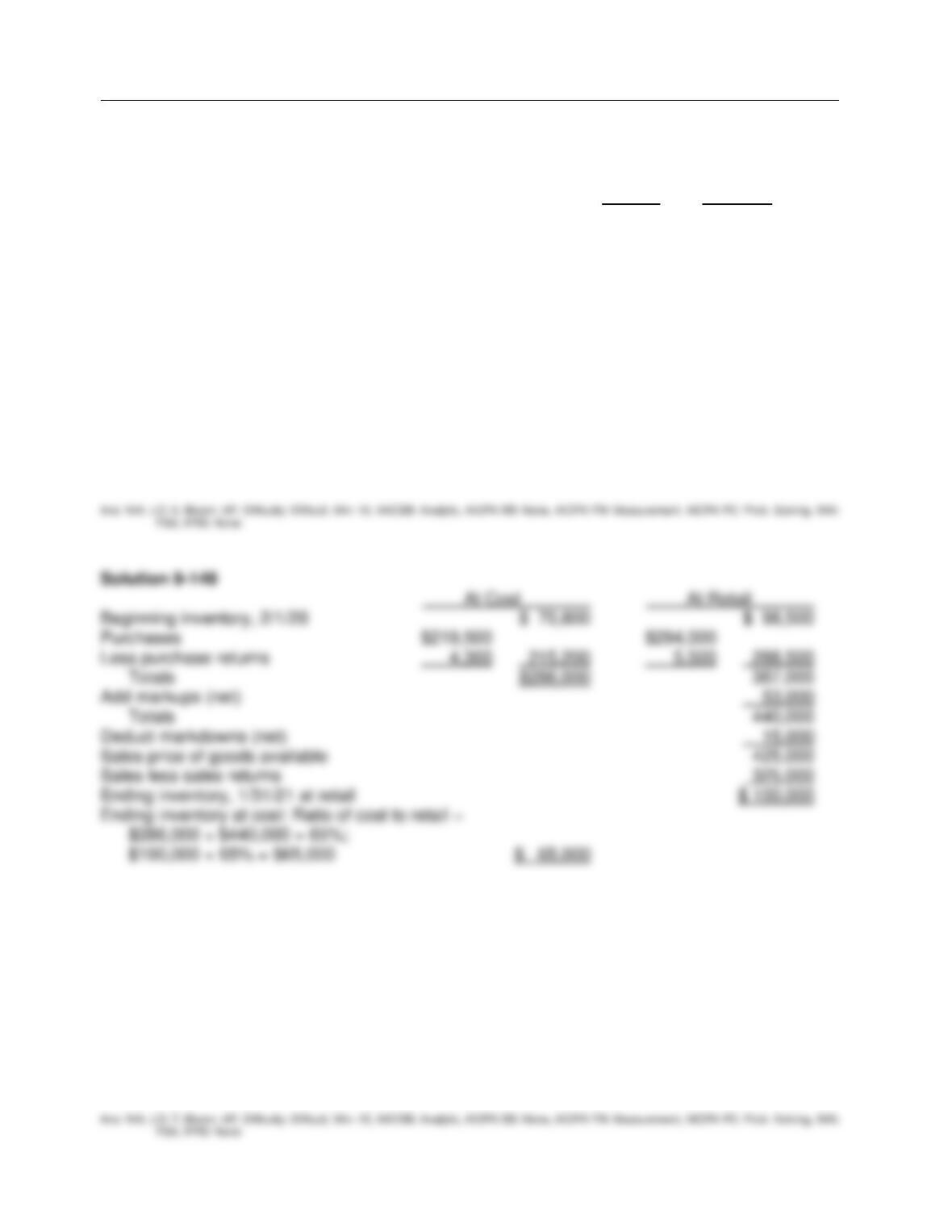
Pr. 9-148—Gross profit method.
On December 31, 2021 Felt Company’s inventory burned. Sales and purchases for the year had
been $1,500,000 and $980,000, respectively. The beginning inventory (Jan. 1, 2021) was
$170,000; in the past Felt’s gross profit has averaged 30% of selling price.
Instructions
Compute the estimated cost of inventory burned, and give entries as of December 31, 2021 to
close merchandise accounts.
Test Bank for Intermediate Accounting, Seventeenth Edition
9 – 54
Pr. 9-149—Retail inventory method.
When you undertook the preparation of the financial statements for Telfer Company at January
31, 2021, the following data were available:
At Cost At Retail
Inventory, February 1, 2020 $70,800 $ 98,500
Markdowns 35,000
Markups 63,000
Markdown cancellations 20,000
Markup cancellations 10,000
Purchases 219,500 294,000
Sales revenue 335,000
Purchases returns and allowances 4,300 5,500
Sales returns and allowances 10,000
Instructions
Compute the ending inventory at cost as of January 31, 2021, using the retail method which
approximates lower of cost or market. Your solution should be in good form with amounts clearly
labeled.
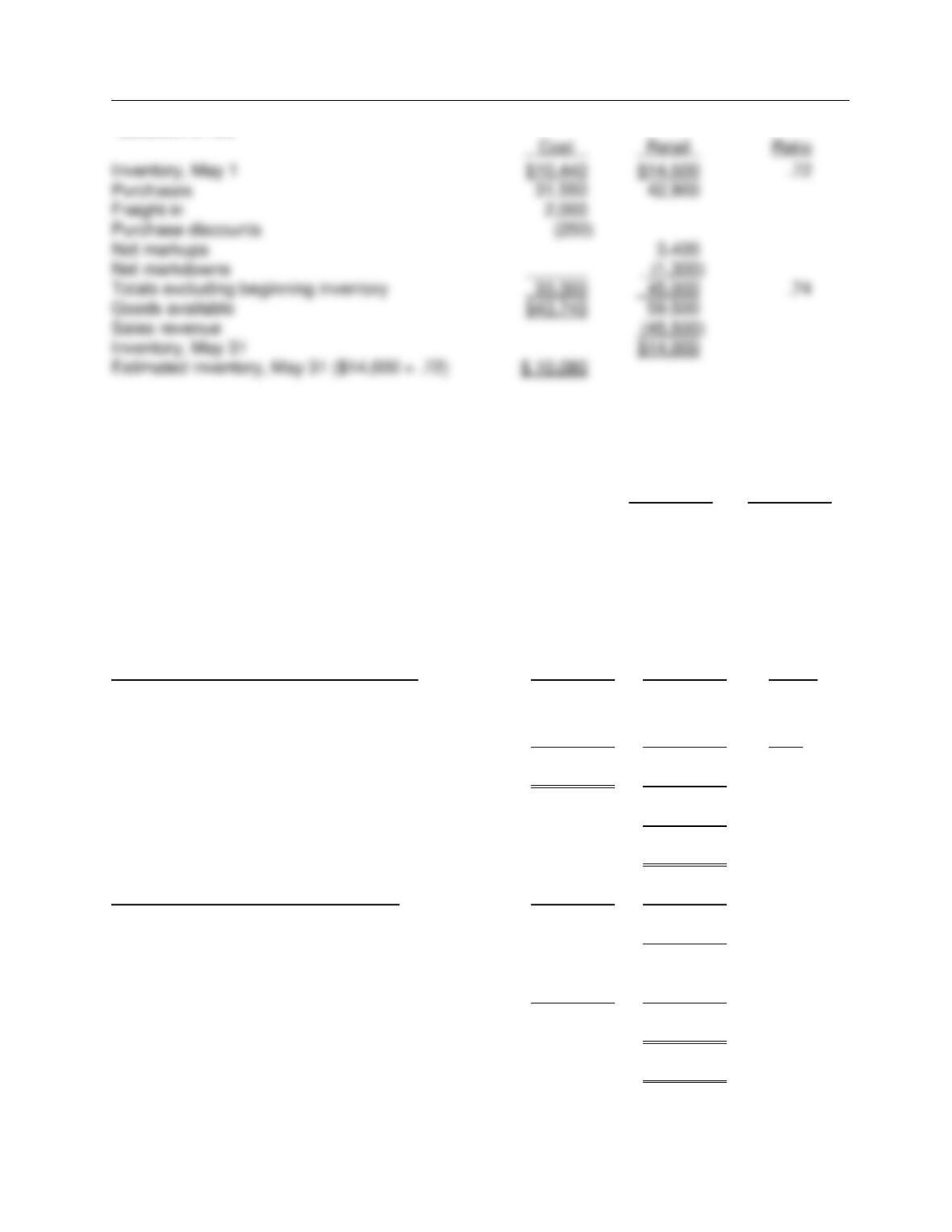
*Pr. 9-150—Retail inventory method.
The records of Lohse Stores included the following data:
Inventory, May 1, at retail, $14,500; at cost, $10,440
Purchases during May, at retail, $42,900; at cost, $31,550
Freight-in, $2,000; purchase discounts, $250
Additional markups, $3,800; markup cancellations, $400; net markdowns, $1,300
Sales during May, $45,500
Instructions
Calculate the estimated inventory at May 31 on a LIFO basis. Show your calculations in good
form and label all amounts.
Inventories: Additional Valuation Issues
9 – 55
*Solution 9-150
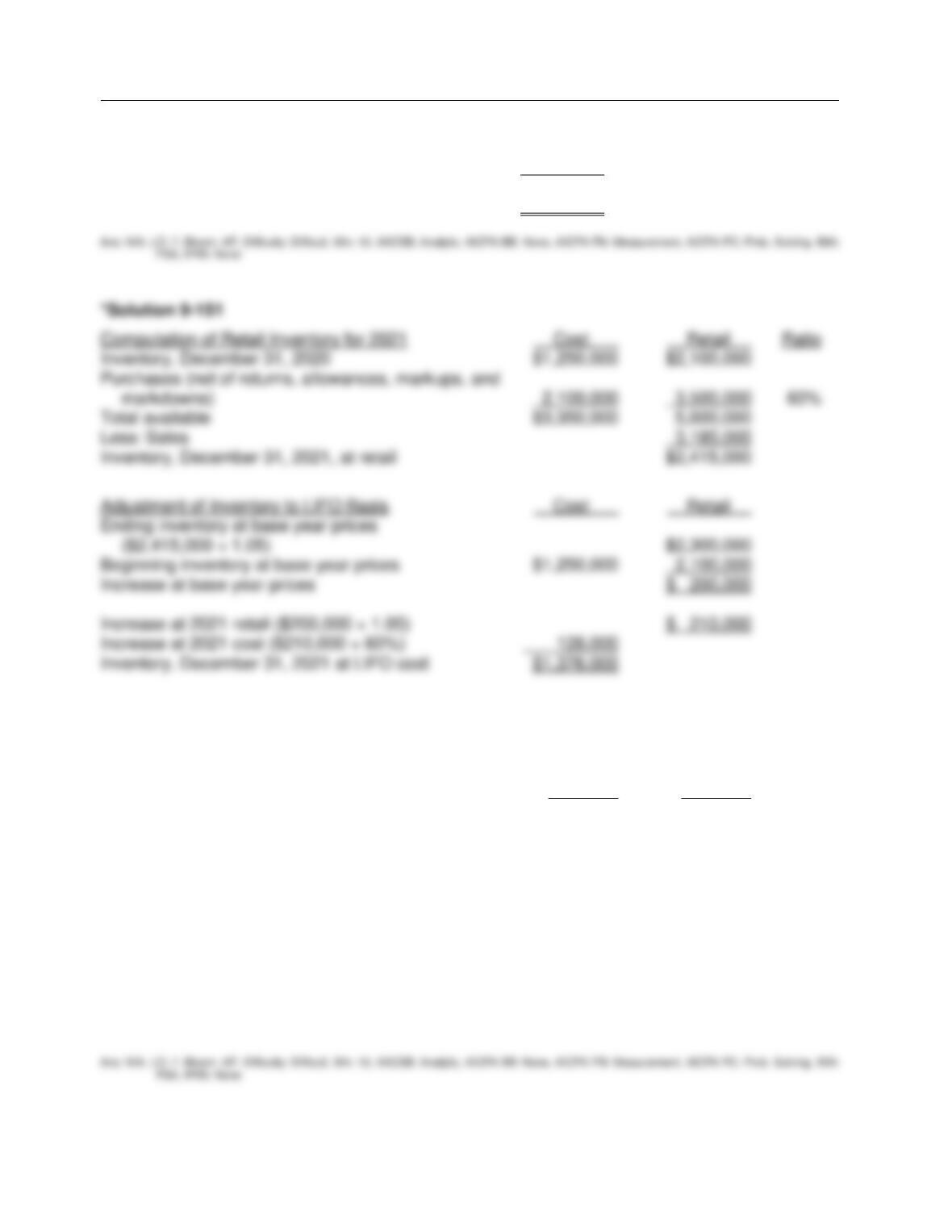
*Pr. 9-151—LIFO retail inventory method, fluctuating prices.
Flint Department Store wishes to use the retail LIFO method of valuing inventories for 2021. The
appropriate data are as follows:
At Cost At Retail
December 31, 2020 inventory (base layer) $1,250,000 $2,100,000
Purchases (net of returns, allowances, markups, and markdowns) 2,100,000 3,500,000
Sales revenue 3,185,000
Price index for 2021 105
Instructions
Complete the following schedule (fill in all blanks and show calculations in the parentheses):
Computation of Retail Inventory for 2021 Cost Retail Ratio
Inventory, December 31, 2020 $1,250,000 $2,100,000
Purchases (net of returns, allowances,
markups, and markdowns) %
Total available $
____________________________________
Inventory, December 31, 2021, at retail $
Adjustment of Inventory to LIFO Basis Cost Retail
Ending inventory at base year prices $
( )
Beginning inventory at base year prices $
Increase at base year prices $
Increase at 2021 retail ( ) $
Test Bank for Intermediate Accounting, Seventeenth Edition
9 – 56
*Pr. 9-151 (Cont.)
Increase at 2021 cost ( )
Inventory, December 31, 2021, at LIFO cost $
*Pr. 9-152—LIFO retail inventory method, stable prices.
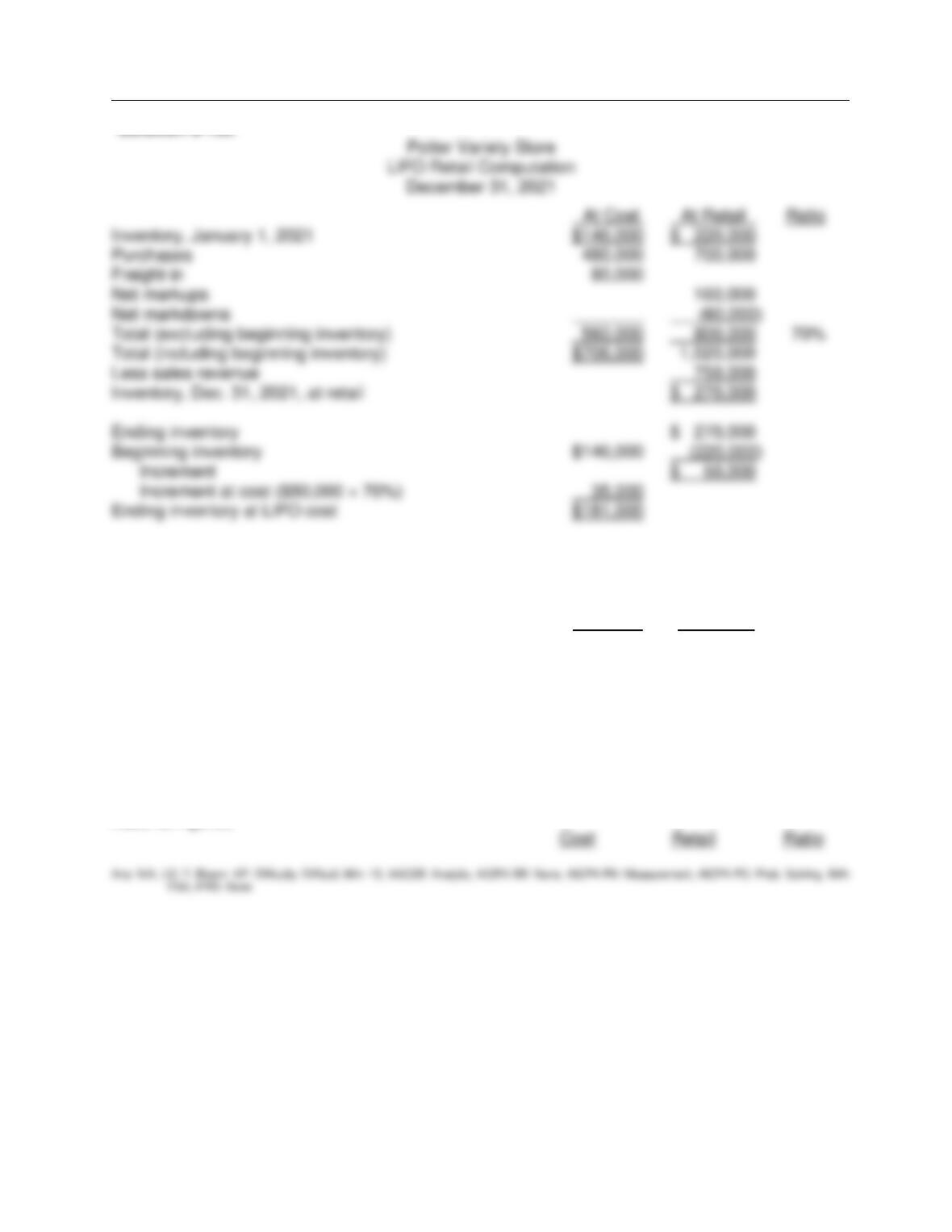
Potter Variety Store uses the LIFO retail inventory method. Information relating to the
computation of the inventory at December 31, 2021, follows:
Cost Retail
Inventory, January 1, 2021 $146,000 $220,000
Purchases 480,000 700,000
Freight-in 80,000
Sales 750,000
Net markups 160,000
Net markdowns 60,000
Instructions
Assuming that there was no change in the price index during the year, compute the inventory at
December 31, 2021, using the LIFO retail inventory method.
Inventories: Additional Valuation Issues
9 – 57
*Solution 9-152
*Pr. 9-153—Dollar-value LIFO-retail method.
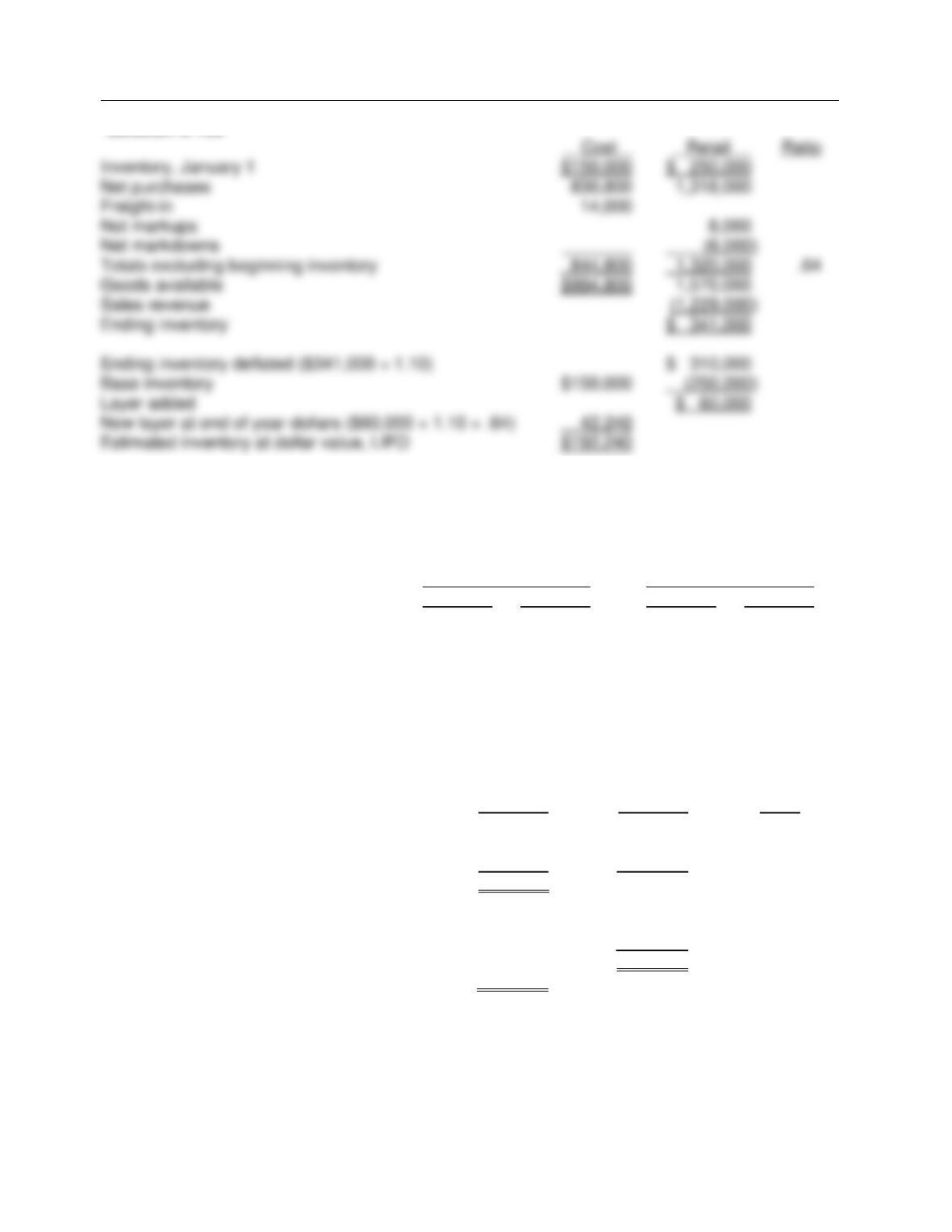
The records of Heese Stores provided the following data for the year:
Cost Retail
(Base inventory) Inventory, January 1 $150,000 $ 250,000
Net purchases 830,800 1,318,000
Sales revenue 1,229,000
Other data are: Freight-in, $14,000; net markups, $8,000; net markdowns, $6,000; and the price
index for the year is 110.
Instructions
Determine the approximate valuation of the final inventory by the dollar-value, LIFO-retail method.
Label all figures.
Test Bank for Intermediate Accounting, Seventeenth Edition
9 – 58
*Solution 9-153
*Pr. 9-154—Retail LIFO.
Klein Book Store uses the conventional retail method and is now considering converting to the
LIFO retail method for the period beginning 1/1/21. Available information consists of the following:
2020 2021
Cost Retail Cost Retail
Inventory 1/1 $ 12,500 $ 22,500 $ ? $ ?
Purchases (net) 250,000 347,500 245,000 345,000
Net markups — 5,000 — 10,000
Net markdowns — 2,500 — 5,000
Sales (net) — 322,000 — 327,500
Loss from breakage — 500 — -0-
Applicable price index — 100 — 110
Following is a schedule showing the computation of the cost of inventory on hand at 12/31/20
based on the conventional retail method.
Cost Retail Ratio
Inventory 1/1/20 $ 12,500 $ 22,500
Purchases (net) 250,000 347,500
Net markups — 5,000
Goods available $262,500 375,000 70%
Sales (net) (322,000)
Net markdowns (2,500)
Loss from breakage (500)
Inventory 12/31/20 at retail $ 50,000
Inventory 12/31/20 at LCM ($50,000 × 70%) $ 35,000
Inventories: Additional Valuation Issues
9 – 59
Instructions
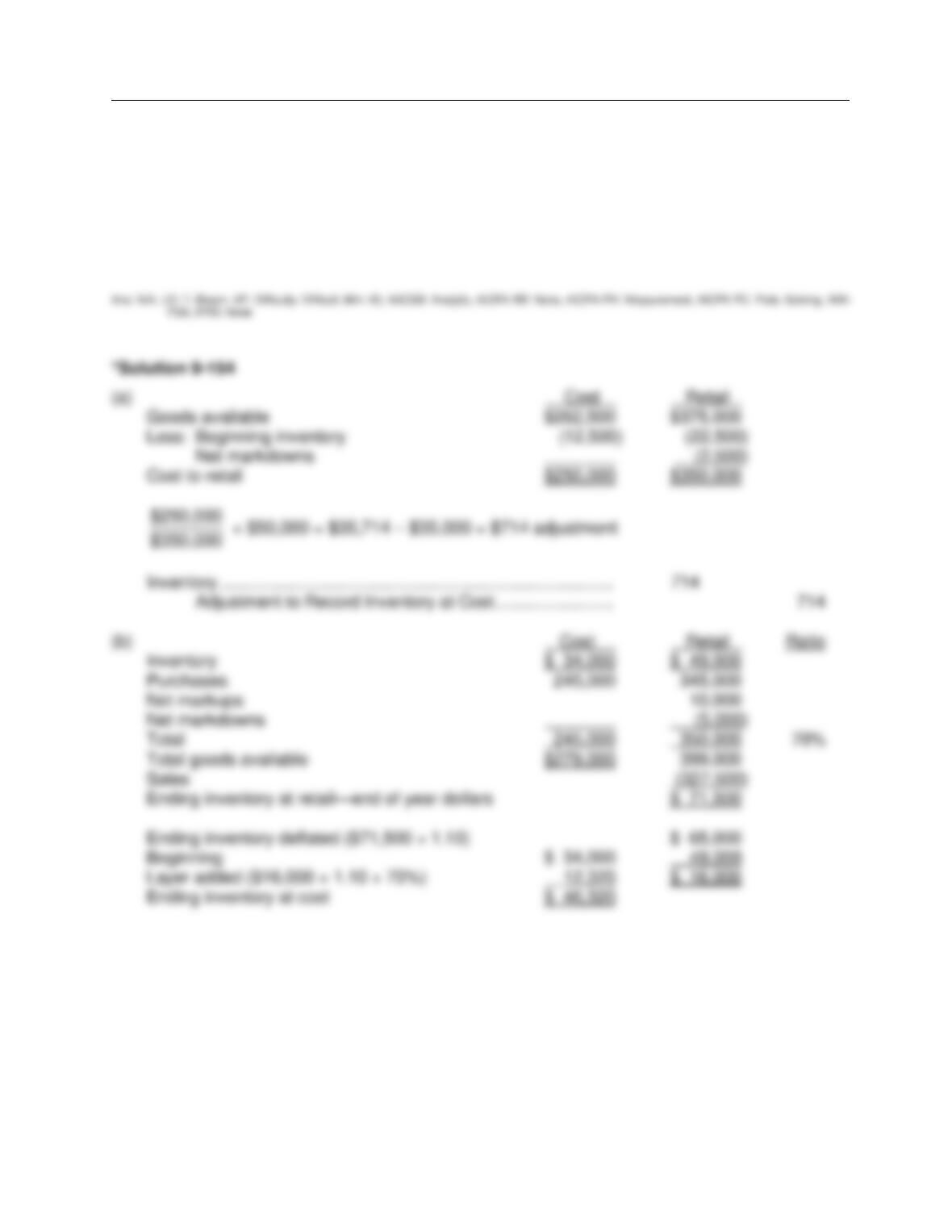
(a) Prepare the journal entry to convert the inventory from the conventional retail method to the
LIFO retail method. Show detailed calculations to support your entry.
(b) Prepare a schedule showing the computation of the 12/31/21 inventory based on the LIFO
retail method as adjusted for fluctuating prices. Without prejudice to your answer to (a) above,
assume that you computed the 1/1/21 inventory (retail value $49,000) under the LIFO retail
method at a cost of $34,000.
Test Bank for Intermediate Accounting, Seventeenth Edition
9 – 60
IFRS QUESTIONS
True / False
1. IFRS permits an entity to reverse inventory write-downs in certain situations, whereas GAAP
does not.
2. IFRS defines market as replacement cost subject to certain constraints.
3. IFRS uses a ceiling to determine market.
4. Similar to GAAP, certain agricultural products and mineral products must be reported at net
realizable value using IFRS.
5. IFRS records market in the lower-of-cost-or-market differently than GAAP.
Answers to True/False
Multiple Choice Questions
1. Where is the authoritative IFRS guidance related to accounting and reporting for inventories
found?
a. IAS 2 only.
b. IAS 41 only.
c. Neither IAS 2 or IAS 41 deal with inventory
d. Both IAS2 and IAS 41.

Inventories: Additional Valuation Issues
9 – 61
2. A major difference between GAAP and IFRS with respect to accounting for inventories
pertains to:
a. guidelines on ownership of goods.
b. costs to include in inventories .
c. The use of LIFO cost flow assumption.
d. The use of LCNRV.
3. Which of the following is a similarity between GAAP and IFRS with respect to accounting for
inventories?
a. Both standards use a ceiling or a floor to determine lower-of-cost–or-market.
b. Both standards allow for reversals of write downs.
c. The use of more principles based guidelines exist under both IFRS and GAAP standards.
d. Inventory acquisitions are accounted for at historical cost.
4. Alonzo Company in Italy prepares its financial statements in accordance with IFRS. In 2020, it
reported cost of goods sold of €600 million and average inventory of €100 million. What is
Alonzo’s average days to sell inventory?
a. 6 days
b. 16.7 days
c. 60.8 days
d. 30.4 days
5. Starfish Company (a company using GAAP and LIFO inventory method) is considering
changing to IFRS and the FIFO inventory method. How would a comparison of these methods
affect Starfish’s financials?
a. During a period of inflation, the current ratio would decrease when IFRS and the FIFO
inventory method are used as compared to GAAP and LIFO.
b. During a period of inflation, the taxes will decrease when IFRS and the FIFO inventory
method are used as compared to GAAP and LIFO.
c. During a period of inflation, net income would be greater if IFRS and the FIFO inventory
method are used as compared to GAAP and LIFO.
d. During a period of inflation, working capital would decrease when IFRS and the FIFO
inventory method are used as compared to GAAP and LIFO.

Test Bank for Intermediate Accounting, Seventeenth Edition
9 – 62
6. Which of the following statements is true regarding IFRS and inventories?
a. In order to determine market valuation of inventories, IFRS uses a ceiling and a floor.
b. IFRS permits the option of valuing inventories at fair value.
c. With respect to inventories, IFRS defines market as net realizable value.
d. IFRS allows inventory to be written up above its original cost.
7. State Company manufactured a machine at a cost of $80,000. The product is sold for
$88,000 at a 5% discount. The delivery costs are estimated to be $8,000. Under IFRS, how
much should be the carrying amount of this inventory?
a. $80,000
b. $88,000
c. $72,000
d. $75,600
8. The following information relates to Moore Company’s inventory:
Cost of inventory = $460
Selling price of inventory = $500
Normal profit margin = 10% of selling price
Current replacement cost = $370
Cost of completion and disposal = $50
Under IFRS, which of the following would be the correct measurement value for the
inventory?
a. $460
b. $370
c. $500
d. $450
9. Assume that Darcy Industries had the following inventory values:
Inventory cost (on December 31, 2020) = $500
Inventory market (on December 31, 2020) = $450
Inventory net realizable value (on December 31, 2020) = $440
Inventory market (on June 30, 2021) = $520
Inventory net realizable value (on June 30, 2021) = $525
Under IFRS, what is the inventory carrying value on December 31, 2020?
a. $500
b. $450
c. $440
d. $525
Inventories: Additional Valuation Issues
9 – 63
10. Assume that Darcy Industries had the following inventory values:
Inventory cost (on December 31, 2020) = $500
Inventory market (on December 31, 2020) = $450
Inventory net realizable value (on December 31, 2020) = $440
Inventory market (on June 30, 2021) = $520
Inventory net realizable value (on June 30, 2021) = $525
Under IFRS, what is the inventory carrying value on June 30, 2021?
a. $500
b. $520
c. $525
d. $440
Answers to Multiple Choice
Short Answer
11. Briefly describe some of the similarities and differences between GAAP and IFRS with
respect to the accounting for inventories.