Inventories: Additional Valuation Issues
9 – 41
135. Keen Company’s accounting records indicated the following information:
Inventory, 1/1/20 $ 1,800,000
Purchases during 2020 9,000,000
Sales during 2020 11,400,000
A physical inventory taken on December 31, 2020, resulted in an ending inventory of
$2,100,000. Keen’s gross profit on sales has remained constant at 25% in recent years.
Keen suspects some inventory may have been taken by a new employee. At December
31, 2020, what is the estimated cost of missing inventory?
a. $150,000.
b. $450,000.
c. $600,000.
d. $750,000.
136. Henke Co. uses the retail inventory method to estimate its inventory for interim statement
purposes. Data relating to the computation of the inventory at July 31, 2020, are as
follows:
Cost Retail
Inventory, 2/1/20 $ 300,000 $ 375,000
Purchases 1,500,000 2,362,500
Markups, net 262,500
Sales 2,400,000
Estimated normal shoplifting losses 30,000
Markdowns, net 165,000
Under the lower-of-cost-or-market method, Henke’s estimated inventory at July 31, 2020
is
a. $243,000.
b. $261,000.
c. $279,000.
d. $405,000.
137. At December 31, 2020, the following information was available from Kohl Co.’s accounting
records:
Cost Retail
Inventory, 1/1/20 $147,000 $ 203,000
Purchases 833,000 1,155,000
Additional markups 42,000
Available for sale $980,000 $1,400,000
Sales for the year totaled $1,250,000. Markdowns amounted to $10,000. Under the lower–
of-cost-or-market retail inventory method, Kohl’s inventory at December 31, 2020 was
a. $294,000.
b. $112,000.
c. $105,000.
d. $98,000.
Test Bank for Intermediate Accounting, Seventeenth Edition
9 – 42
*138. On December 31, 2020, Pacer Co. adopted the dollar-value LIFO retail inventory method.
Inventory data for 2021 are as follows:
LIFO Cost Retail
Inventory, 12/31/20 $900,000 $1,260,000
Inventory, 12/31/21 ? 1,650,000
Increase in price level for 2021 10%
Cost to retail ratio for 2021 70%
Under the LIFO retail method, Pacer’s inventory at December 31, 2018, should be
a. $1,084,800.
b. $1,155,500.
c. $1,173,000.
d $1,200,300.
Multiple Choice Answers—CPA Adapted
DERIVATIONS — Computational
No. Answer Derivation
Inventories: Additional Valuation Issues
9 – 43
DERIVATIONS — Computational (cont.)
No. Answer Derivation
Test Bank for Intermediate Accounting, Seventeenth Edition
9 – 44
DERIVATIONS — Computational (cont.)
No. Answer Derivation
Inventories: Additional Valuation Issues
9 – 45
DERIVATIONS — Computational (cont.)
No. Answer Derivation
Test Bank for Intermediate Accounting, Seventeenth Edition
9 – 46
DERIVATIONS — Computational (cont.)
No. Answer Derivation
DERIVATIONS — CPA Adapted
No. Answer Derivation
Inventories: Additional Valuation Issues
9 – 47
BRIEF EXERCISES
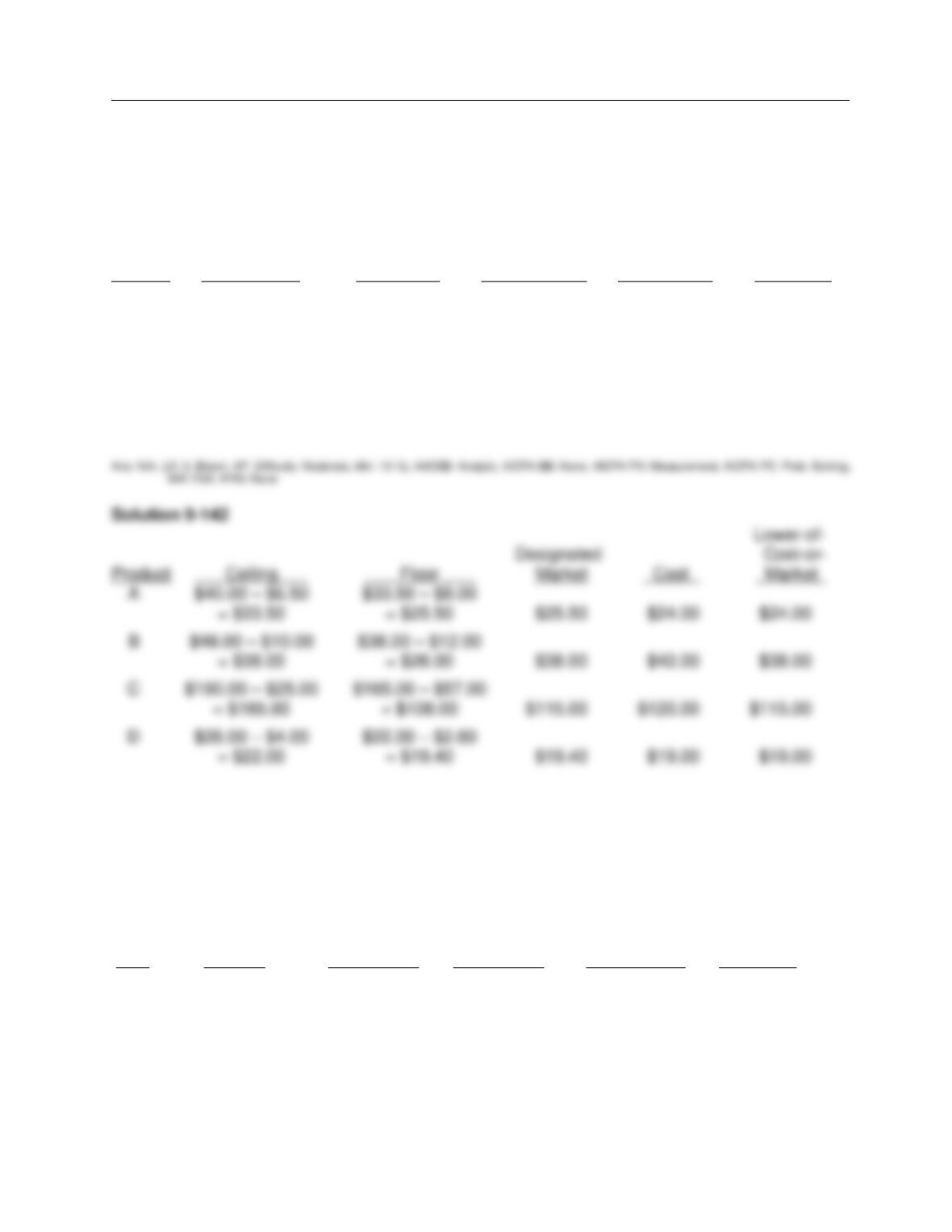
BE. 9–139—Lower-of-cost-or-market.
Determine the proper unit inventory price in the following independent cases by applying the
lower of cost or market rule. Circle your choice.
1 2 3 4 5
Cost $7.80 $10.50 $11.80 $6.00 $7.20
Net realizable value 8.85 10.00 12.20 4.25 6.90
Net realizable value less normal profit 8.15 9.00 11.40 3.75 6.50
Market replacement cost 7.90 10.10 12.50 4.00 5.40
BE. 9–140—Lower-of-cost-or-market.
Determine the unit value that should be used for inventory costing following “lower of cost or
market value”.
A B C D E F
Cost $2.35 $2.47 $2.35 $2.54 $2.44 $2.44
Replacement cost 2.20 2.55 2.20 2.52 2.37 2.46
Net realizable value 2.50 2.50 2.50 2.45 2.50 2.50
Net realizable value less normal profit 2.25 2.30 2.40 2.30 2.30 2.30
Test Bank for Intermediate Accounting, Seventeenth Edition
9 – 48
BE. 9–141—Lower-of-cost-or-market.
Assume in each case that the selling expenses are $8 per unit and that the normal profit is $5 per
unit. Calculate the limits for each case. Then enter the amount that should be used for lower of
cost or market.
Selling Replacement
Price Upper Limit Cost Lower Limit Cost LCM
(a) $59 $______ $43 $______ $47 $______
(b) 47 ______ 36 ______ 40 ______
(c) 60 ______ 44 ______ 45 ______
(d) 48 ______ 42 ______ 40 ______
Inventories: Additional Valuation Issues
9 – 49
EXERCISES
Ex. 9-142—Lower-of-cost-or-market.
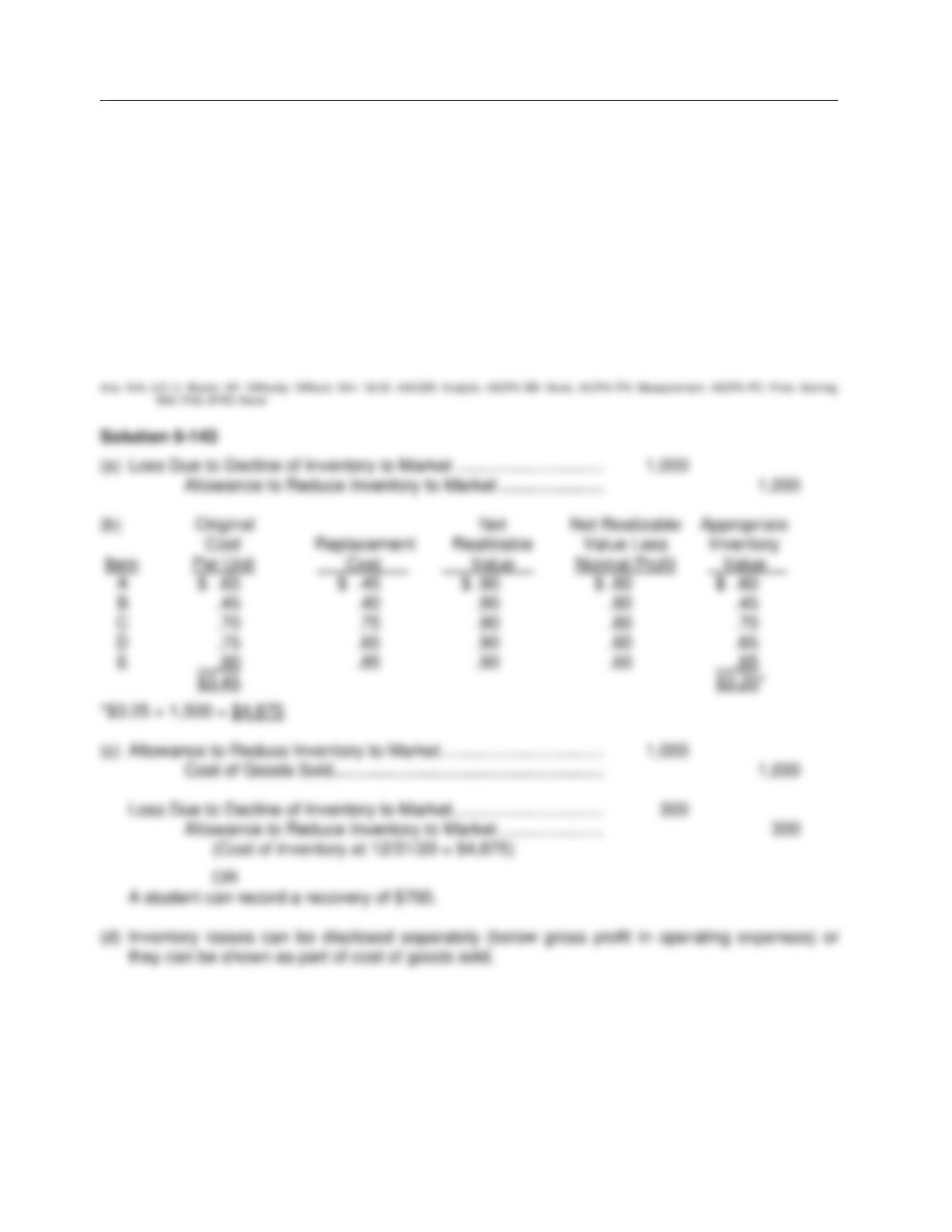
The December 31, 2020 inventory of Gwynn Company consisted of four products, for which
certain information is provided below.
Replacement Estimated Expected Normal Profit
Product Original Cost Cost Disposal Cost Selling Price on Sales
A $24.00 $22.00 $6.50 $40.00 20%
B $42.00 $40.00 $10.00 $48.00 25%
C $120.00 $115.00 $25.00 $190.00 30%
D $19.00 $15.80 $4.00 $26.00 10%
Instructions
Using the lower-of-cost-or-market approach applied on an individual-item basis, compute the
inventory valuation that should be reported for each product on December 31, 2020.
Ex. 9-143—Lower-of-cost-or-market.
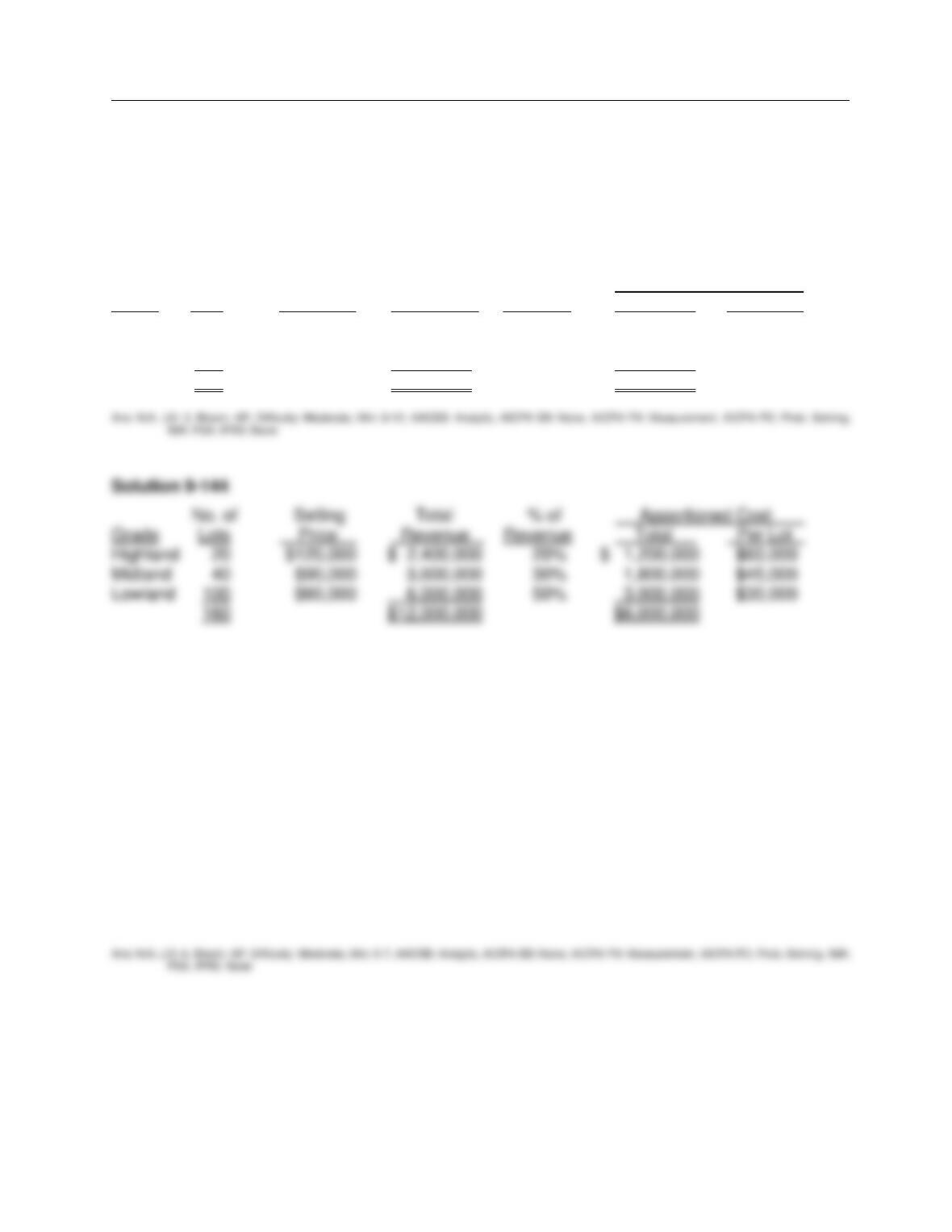
At 12/31/20, the end of Jenner Company’s first year of business, inventory was $6,100 and
$5,100 at cost and at market, respectively.
Following is data relative to the 12/31/21 inventory of Jenner:
Original Net Net Realizable Appropriate
Cost Replacement Realizable Value Less Inventory
Item Per Unit Cost Value Normal Profit Value
A $ .65 $ .45
B .45 .40
C .70 .75
D .75 .65
E .90 .85
Test Bank for Intermediate Accounting, Seventeenth Edition
9 – 50
Selling price is $1.00/unit for all items. Disposal costs amount to 10% of selling price and a
“normal” profit is 30% of selling price. There are 1,500 units of each item in the 12/31/21
inventory.
Instructions
(a) Prepare the entry at 12/31/20 necessary to implement the lower–of-cost-or-market procedure
assuming Jenner uses a contra account for its balance sheet.
(b) Complete the last three columns in the 12/31/21 schedule above based upon the lower–of–
cost-or-market rules.
(c) Prepare the entry(ies) necessary at 12/31/21 based on the data above.
(d) How are inventory losses disclosed on the income statement?
Inventories: Additional Valuation Issues
9 – 51
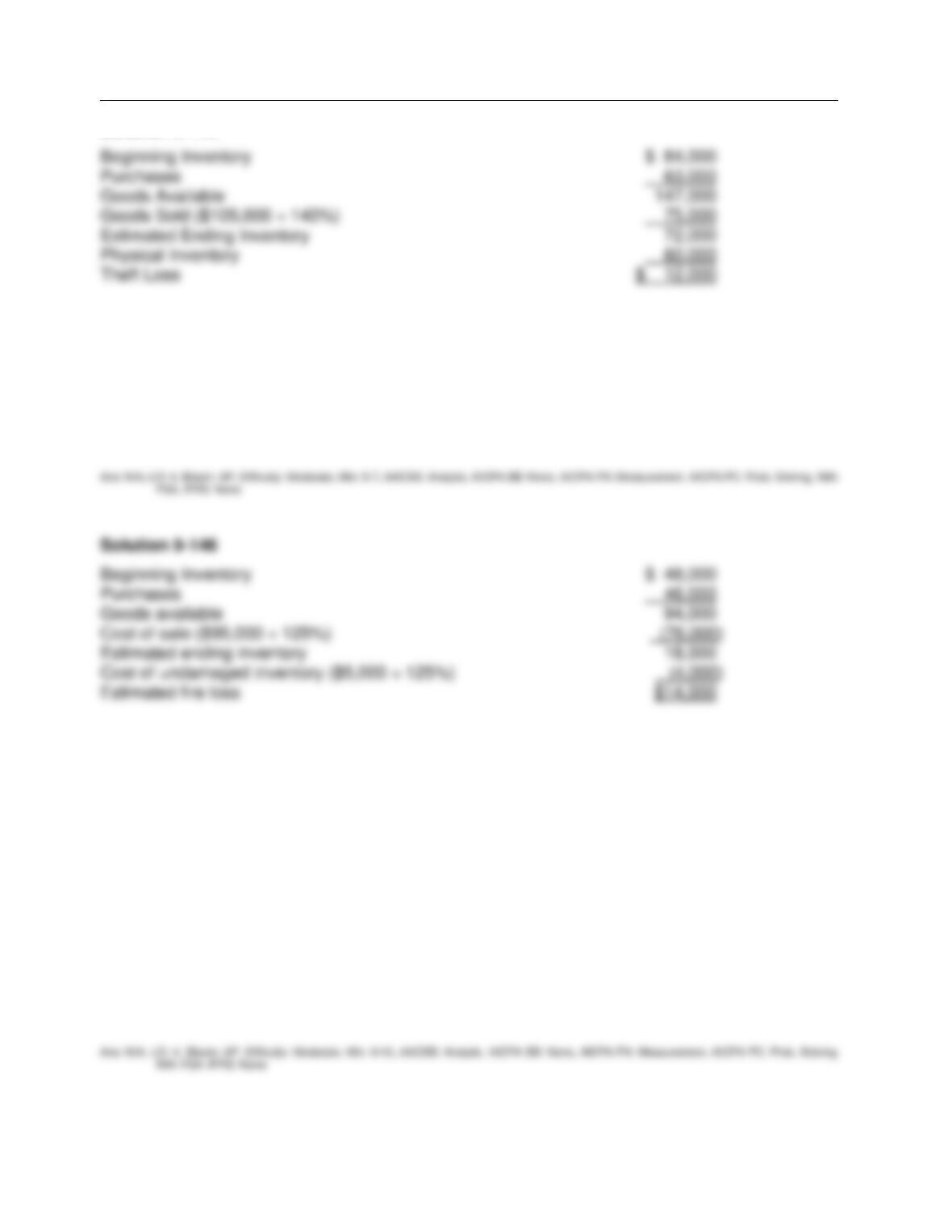
Ex. 9-144 – Relative sales value method.
Doran Realty Company purchased a plot of ground for $1,900,000 and spent $4,100,000 in
developing it for building lots. The lots were classified into Highland, Midland, and Lowland
grades, to sell at $120,000, $90,000, and $60,000 each, respectively.
Instructions
Complete the table below to allocate the cost of the lots using a relative sales value method.
No. of Selling Total % of Apportioned Cost
Grade Lots Price Revenue Revenue Total Per Lot
Highland 20 $ $ $ $
Midland 40 $ $
Lowland 100 $ $
160 $ $
Ex. 9-145—Gross profit method.
An inventory taken the morning after a large theft discloses $60,000 of goods on hand as of
March 12. The following additional data is available from the books:
Inventory on hand, March 1 $ 84,000
Purchases received, March 1 – 11 63,000
Sales (goods delivered to customers) 105,000
Past records indicate that sales are made at 40% above cost.
Instructions
Estimate the inventory of goods on hand at the close of business on March 11 by the gross profit
method and determine the amount of the theft loss. Show appropriate titles for all amounts in
your presentation.
Test Bank for Intermediate Accounting, Seventeenth Edition
9 – 52
Solution 9-145
Ex. 9-146—Gross profit method.
On January 1, a store had inventory of $48,000. January purchases were $46,000 and January
sales were $95,000. On February 1 a fire destroyed most of the inventory. The rate of gross profit
was 25% of cost. Merchandise with a selling price of $5,000 remained undamaged after the fire.
Compute the amount of the fire loss, assuming the store had no insurance coverage. Label all
figures.
Ex. 9-147—Gross profit method.
Utley Co. prepares monthly income statements. Inventory is counted only at year end; thus,
month-end inventories must be estimated. All sales are made on account. The rate of mark-up on
cost is 20%. The following information relates to the month of May.
Accounts receivable, May 1 $21,000
Accounts receivable, May 31 15,000
Collections of accounts during May 90,000
Inventory, May 1 45,000
Purchases during May 58,000
Instructions
Calculate the estimated cost of the inventory on May 31.