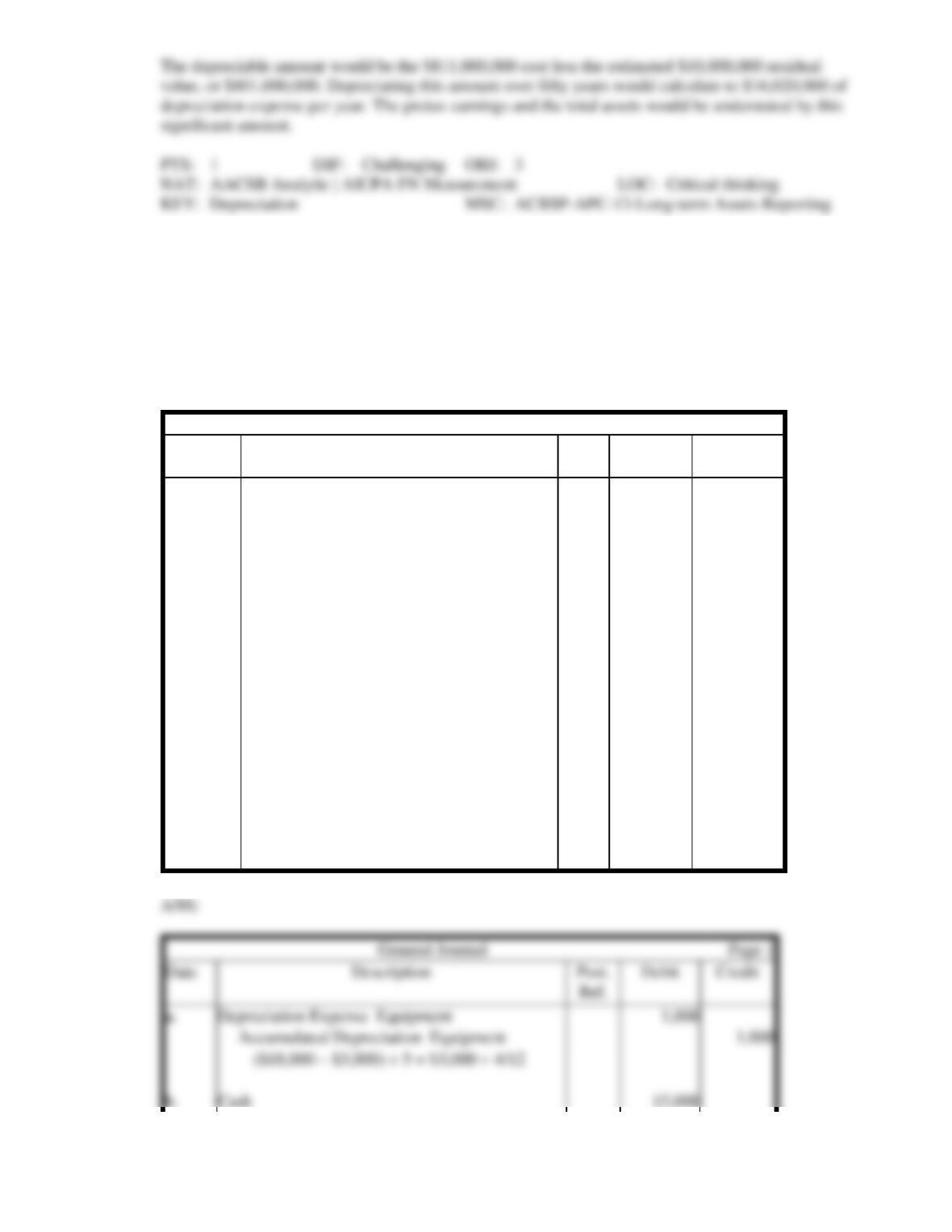
14. On November 1, 2011, Rob’s Auto Repair purchased diagnostic equipment for $18,000. The
equipment had an estimated residual value of $3,000 and a five-year life and was sold on May 1, 2013.
Assuming that the company depreciates the asset on a straight-line basis and reports on a calendar-year
basis, journalize the following independent transactions in the journal provided. (Omit explanations.)
a. The entry to update depreciation to May 1, 2013
b. The entry to record the sale for $15,000
c. The entry to record the sale instead for $11,000
d. The entry to record the sale instead for $13,500
General Journal
Page 1
Date
Description
Post.
Ref.
Debit
Credit
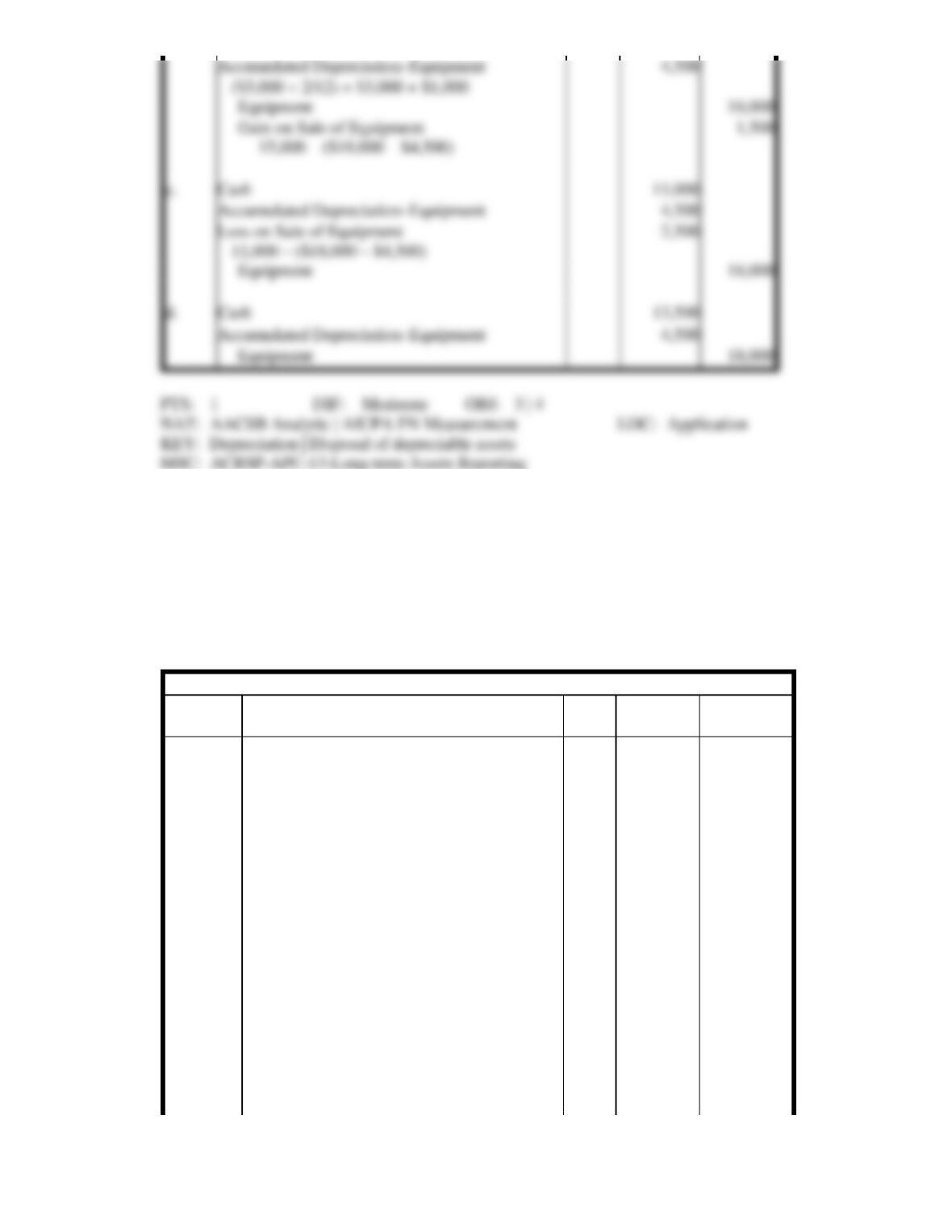
15. On October 1, 2011, Racie’s Auto Repair purchased diagnostic equipment for $13,600. The equipment
had an estimated residual value of $4,000 and an eight-year life and was sold on April 1, 2013.
Assuming that the company depreciates the asset on a straight-line basis and reports on a calendar-year
basis, journalize the following independent transactions in the journal provided. (Omit explanations.)
a. The entry to update depreciation to April 1, 2013
b. The entry to record the sale for $12,000
c. The entry to record the sale instead for $8,600
d. The entry to record the sale instead for $11,800
General Journal
Page 1
Date
Description
Post.
Ref.
Debit
Credit
16. A truck that cost $80,000 and on which $60,000 of accumulated depreciation had been recorded was
disposed of on July 1, the first day of the new fiscal year. Prepare entries in journal form (without
explanation) to record the disposal under each of the following assumptions:
a. It was discarded as having no value.
b. It was sold for $14,400 cash.
c. It was sold for $27,000 cash.
General Journal
Page 1
Date
Description
Post.
Ref.
Debit
Credit
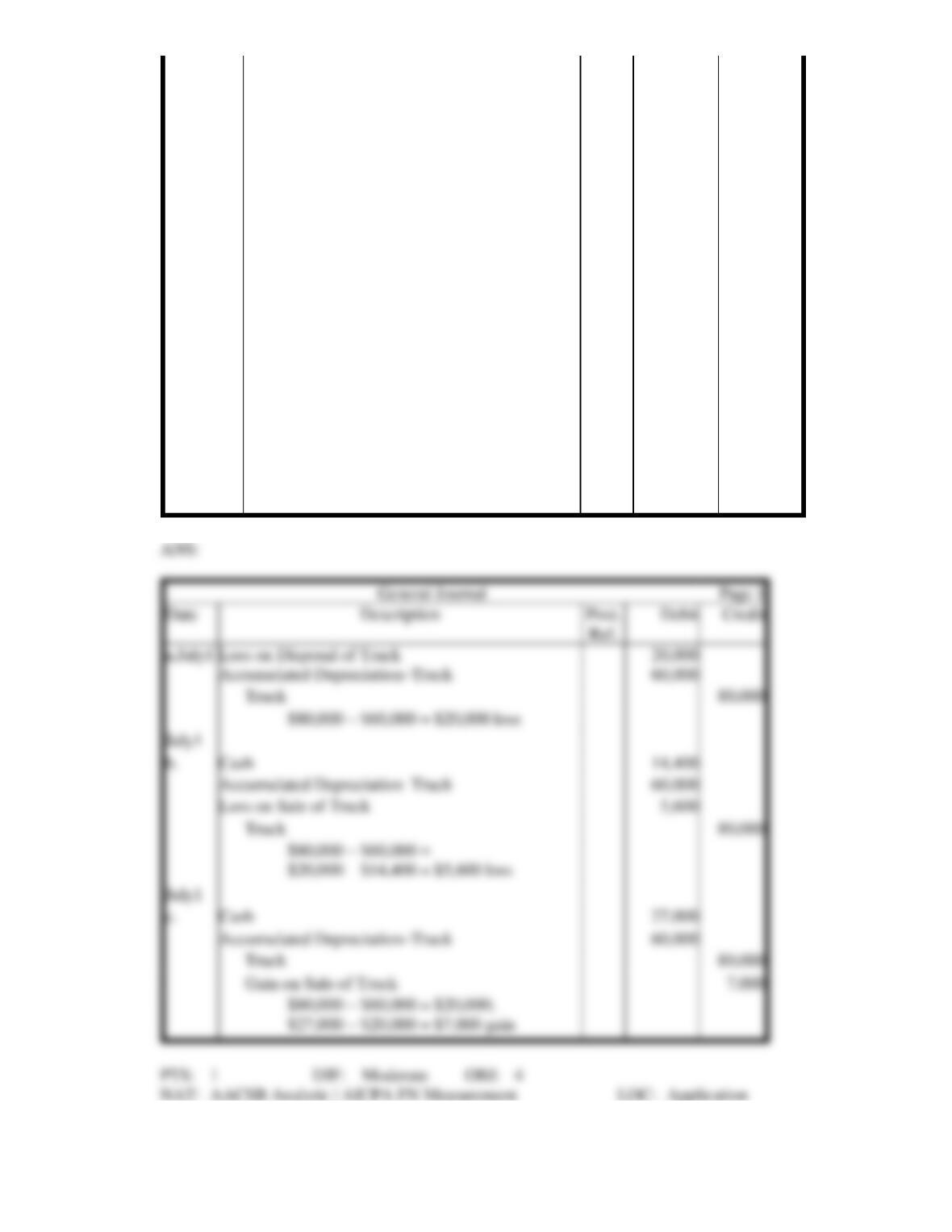
Accumulated Depreciation–Truck
$80,000 – $60,000 = $20,000 loss
Cash
Accumulated Depreciation–Truck
Truck
July1
Accumulated Depreciation–Truck
Gain on Sale of Truck
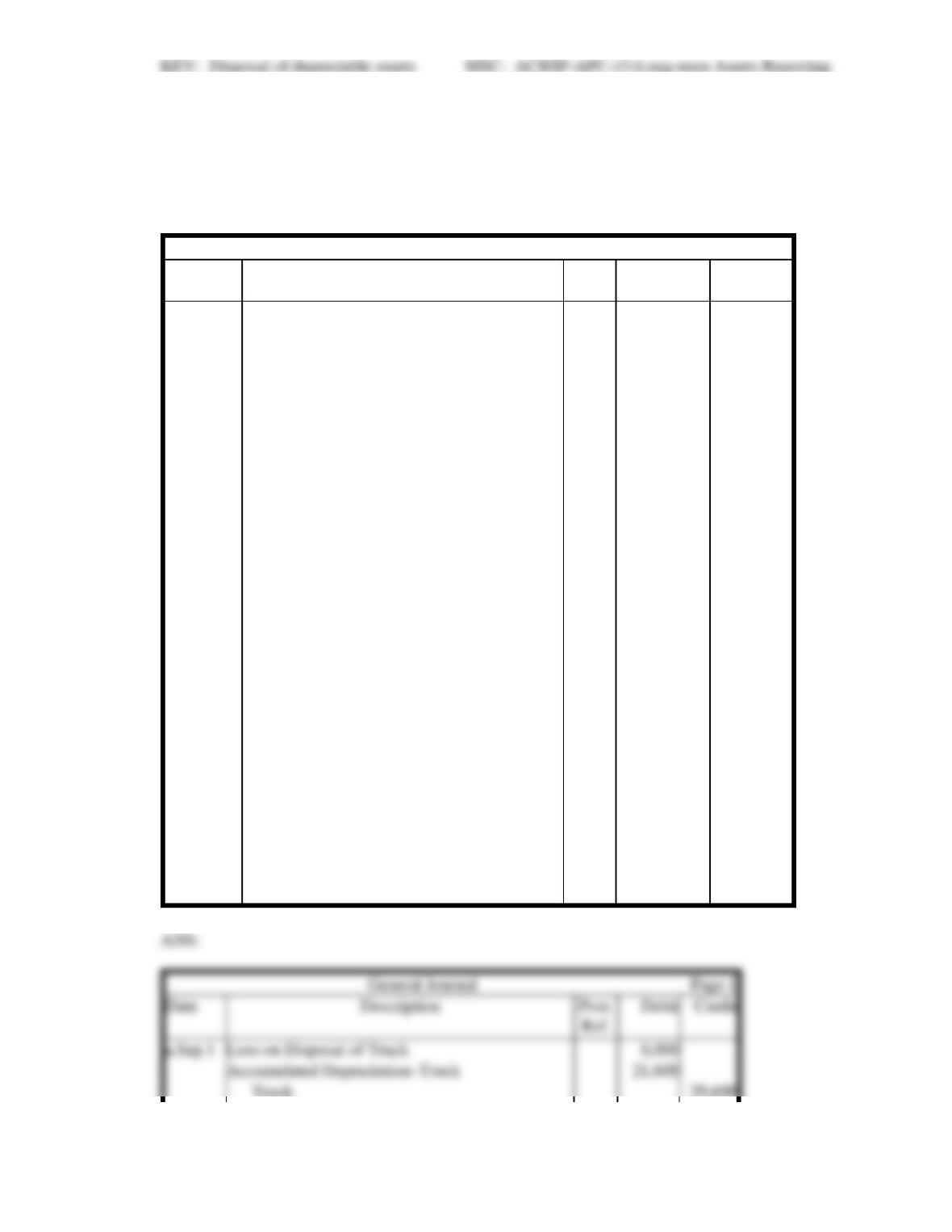
17. A truck that cost $29,600 and on which $21,600 of accumulated depreciation had been recorded was
disposed of on September 1, the first day of the new fiscal year. Prepare entries in journal form
without explanation to record the disposal under each of the following assumptions:
a. It was discarded as having no value.
b. It was sold for $6,000 cash.
c. It was sold for $11,200 cash.
General Journal
Page 1
Date
Description
Post.
Ref.
Debit
Credit
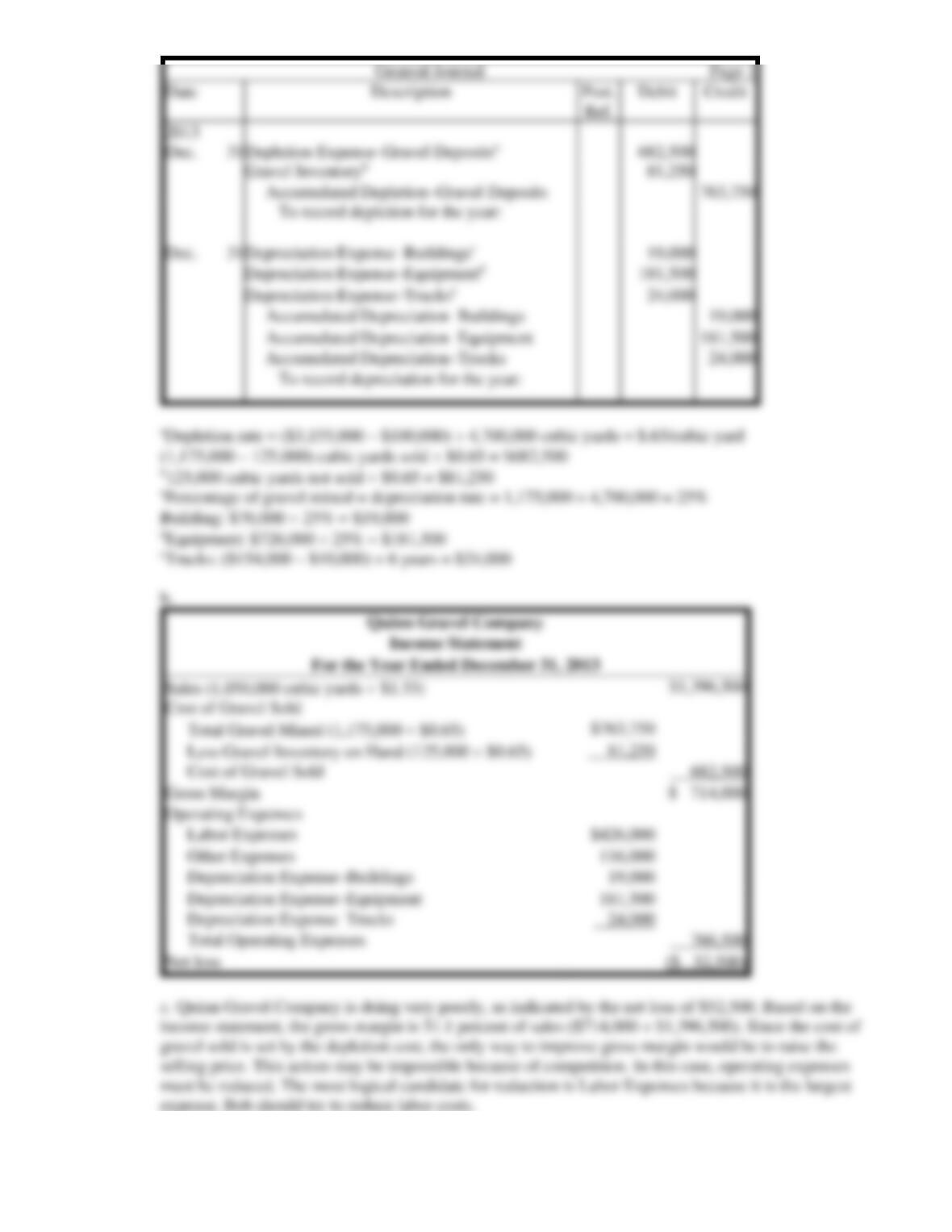
18. Bob Quinn is in the gravel business and has engaged you to assist in evaluating his company, Quinn
Gravel Company. Your first step is to collect the facts about the company’s operations. On January 3,
2013, Bob purchased a piece of property with gravel deposits for $3,155,000. He estimated that the
gravel deposits contained 4,700,000 cubic yards of gravel. The gravel is used for making roads. After
the gravel is gone, the land, which is in the desert, will be worth only about $100,000.
The equipment required to extract the gravel cost $726,000. In addition, Bob had to build a small
frame building to house the mine office and a small dining hall for the workers. The building cost
$76,000 and will have no residual value after its estimated useful life of ten years. It cannot be moved
from the mine site. The equipment has an estimated useful life of six years (with no residual value) and
also cannot be moved from the mine site.
Trucks for the project cost $154,000 (estimated life, six years; residual value, $10,000). The trucks, of
course, can be used at a different site.
Bob estimated that in five years all the gravel would be mined and the mine would be shut down.
During 2013, 1,175,000 cubic yards of gravel were mined. The average selling price during the year
was $1.33 per cubic yard, and at the end of the year 125,000 cubic yards remained unsold. Operating
expenses were $426,000 for labor and $116,000 for other expenses.
a. Prepare adjusting entries to record depletion and depreciation for the first year of operation (2013).
Assume that the depreciation rate is equal to the percentage of the total gravel mined during the year,
unless the asset is movable. For movable assets, use the straight-line method. (Omit explanations.)
General Journal
Page 1
Date
Description
Post.
Ref.
Debit
Credit
$29,600 – $21,600 = $8,000 loss
Cash
Accumulated Depreciation–Truck
Sep.1
Accumulated Depreciation–Truck
Gain on Sale of Truck
b. Prepare an income statement for 2013 for Quinn Gravel Company.
Quinn Gravel Company
Income Statement
For the Year Ended December 31, 2013
c. What is your evaluation of the company’s operations? Explain your evaluation and offer
suggestions. Ignore income tax effects.
19. Leroy Mining Company purchased land containing an estimated 10,000,000 tons of ore for a cost of
$750,000. The land without the ore is estimated to be worth $150,000 (the residual value). Buildings
costing $45,000 with an estimated useful life of 20 years were erected on the site. Because of the
remote location, the buildings have no residual value. The company expects that all the usable ore can
be mined in eight years. During its first year of operation, the company mined 1,000,000 tons of ore
and at the end of the year had an inventory of 200,000 tons. Determine the following amounts for the
first year: (a) depletion charge per ton; (b) depletion expense for the year; and (c) depreciation expense
for buildings, using the straight-line method. (Show your work.)
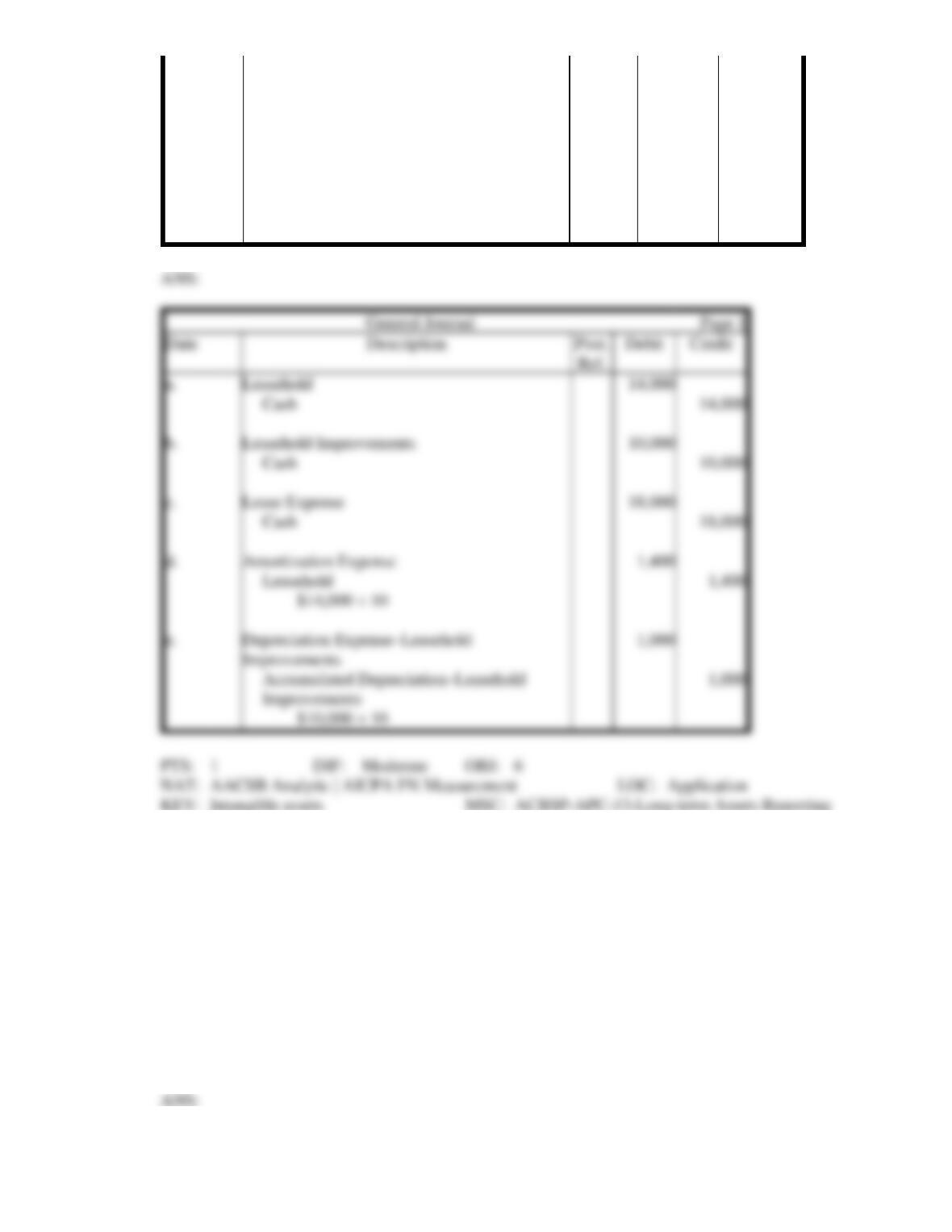
20. John Jackson obtained a ten-year sublease on a busy corner to open a used car business. To obtain the
sublease, he had to pay $14,000 to the current tenant, who had 12 years to go on his lease. The annual
cost of the lease is $18,000. In addition to paying for the sublease, Bob paid $10,000 to pave the lot.
The paving will have no residual value after its useful life of ten years. Prepare entries in journal form
to record the following (omit explanations):
a. The payment for the sublease
b. The payment for the paving
c. The lease payment for the first year
d. The expense, if any, associated with the sublease for the first year
e. The expense, if any, associated with the paving, using the straight-line method for the first year
General Journal
Page 1
Date
Description
Post.
Ref.
Debit
Credit
21. For each of the following descriptions, provide the name of the intangible asset that is being described.
a. The amount paid for a business in excess of its fair market value
b. A registered symbol or name to identify a product or service
c. An exclusive right for 20 years to produce a particular product
d. A contract restricting the rights of others to operate in a specific industry
e. A right to occupy land or buildings under a long-term rental contract
f. An exclusive right to sell literary, artistic, or musical works and computer software
g. Capitalized costs associated with computer programs developed for sale, lease, or internal use
h. A right to an exclusive territory or market
i. A planned search for a new product, as well as pure research
j. Access to the names of subscribers or patrons