70) When computing the cost-to-retail percentage for the average cost retail method, included in
the denominator are:
A) Net markups and net markdowns.
B) Neither net markups nor net markdowns.
C) Net markups, but not net markdowns.
D) Net markdowns, but not net markups.
71) The conventional retail inventory method is based on:
A) Average cost.
B) LIFO cost.
C) Average, lower of cost or net realizable value.
D) LIFO, lower of cost or net realizable value.
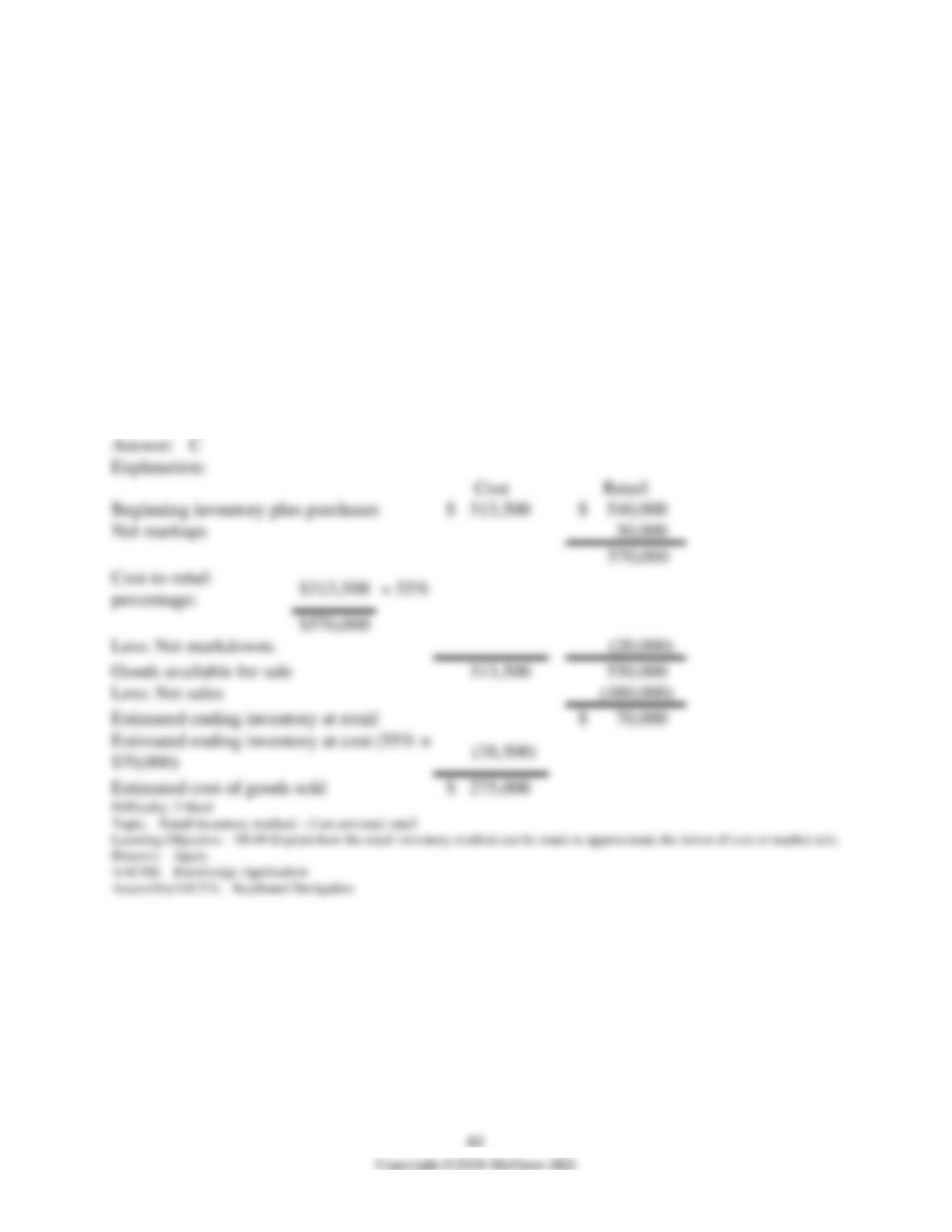
72) Cloverdale, Inc., uses the conventional retail inventory method to account for inventory. The
following information relates to current year’s operations:
Cost
Retail
Beginning inventory and purchases
$
313,500
$
540,000
Net markups
30,000
Net markdowns
20,000
Net sales
480,000
What amount should be reported as cost of goods sold for the year?
A) $273,600.
B) $272,861.
C) $275,000.
D) None of these answer choices are correct.
Cost
Beginning inventory plus purchases
$
313,500
$
Net markups
percentage:
$570,000
Less: Net markdowns
(20,000
)
Goods available for sale
313,500
Less: Net sales
(480,000
)
Estimated ending inventory at retail
$
$70,000)
Estimated cost of goods sold
$
275,000
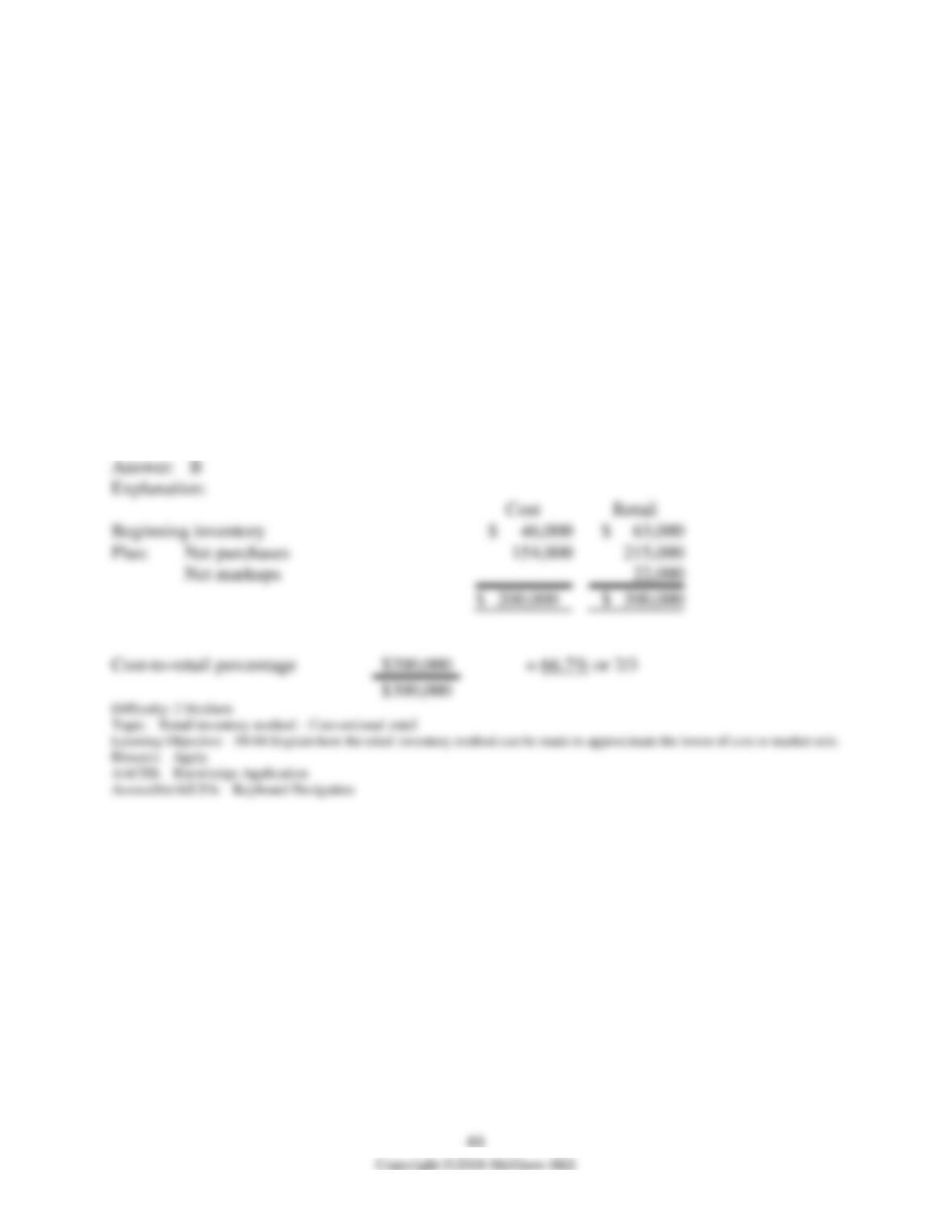
73) Willie Nelson’s Boots uses the conventional retail method to estimate ending inventory. Cost
data for the most recent quarter is shown below:
Cost
Retail
Beginning inventory
$
46,000
$
63,000
Net purchases
154,000
215,000
Net markups
22,000
Net markdowns
35,000
Net sales
220,000
The conventional cost-to-retail percentage (rounded) is:
A) 82.6%.
B) 66.7%.
C) 71.9%.
D) 75.5%.
Beginning inventory
$
$
63,000
Plus:
Net purchases
154,000
215,000
Net markups
22,000
$
200,000
$
300,000
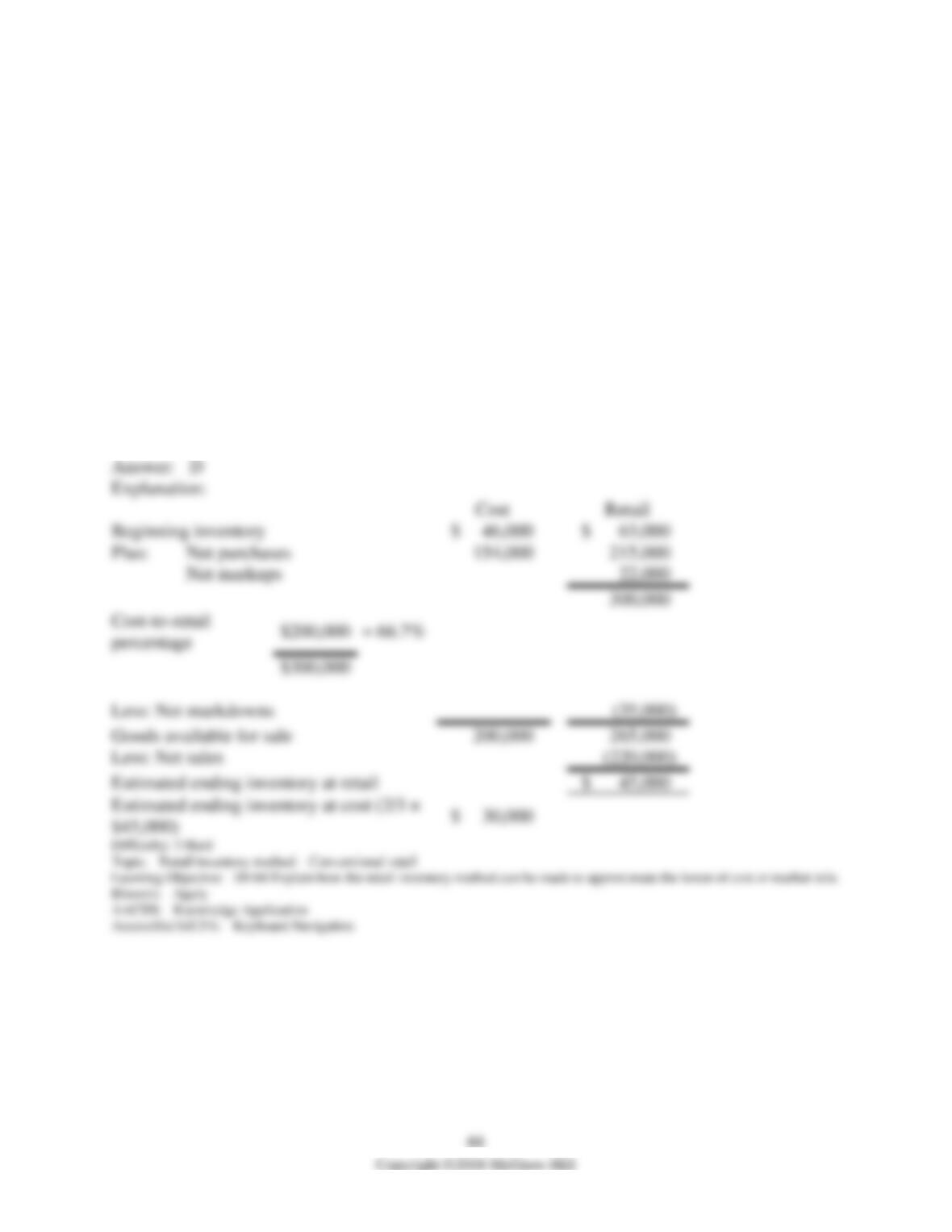
74) Willie Nelson’s Boots uses the conventional retail method to estimate ending inventory. Cost
data for the most recent quarter is shown below:
Cost
Retail
Beginning inventory
$
46,000
$
63,000
Net purchases
154,000
215,000
Net markups
22,000
Net markdowns
35,000
Net sales
220,000
To the nearest thousand, estimated ending inventory using the conventional retail method is:
A) $37,000.
B) $32,000.
C) $34,000.
D) $30,000.
Cost
Beginning inventory
$
46,000
$
Plus:
Net purchases
154,000
Net markups
$300,000
Less: Net markdowns
(35,000
)
Goods available for sale
200,000
Less: Net sales
(220,000
)
Estimated ending inventory at retail
$
$45,000)
75) Clarabell Inc. uses the conventional retail method to estimate ending inventory. Cost data for
the most recent quarter is shown below:
Cost
Retail
Beginning inventory
$
112,000
$
191,000
Net purchases
402,000
703,000
Net markups
43,000
Net markdowns
21,000
Net sales
685,000
The conventional cost-to-retail percentage (rounded) is:
A) 54.9%.
B) 58.9%.
C) 53.6%.
D) 70.6%.
Beginning inventory
$
112,000
$
191,000
Plus:
Net purchases
402,000
703,000
Net markups
43,000
$
514,000
$
937,000
76) Clarabell Inc. uses the conventional retail method to estimate ending inventory. Cost data for
the most recent quarter is shown below:
Cost
Retail
Beginning inventory
$
112,000
$
191,000
Net purchases
402,000
703,000
Net markups
43,000
Net markdowns
21,000
Net sales
685,000
To the nearest thousand, estimated ending inventory using the conventional retail method is:
A) $163,000.
B) $124,000.
C) $127,000.
D) $136,000.
Cost
Beginning inventory
$
112,000
$
Plus:
Net purchases
402,000
Net markups
514,000
$937,000
Less: Net markdowns
(21,000
)
Goods available for sale
514,000
Less: Net sales
(685,000
)
Estimated ending inventory at retail
$
(54.9% × $231,000)
77) Using the dollar-value LIFO retail method for inventory:
A) Is the same as dollar-value LIFO, except that the inventory is measured at retail, rather than at
cost.
B) Combines retail LIFO accounting with dollar-value LIFO accounting.
C) Allows companies to report inventory on the balance sheet at retail prices.
D) All of these answer choices are correct.
78) The first step, when using dollar-value LIFO retail method for inventory, is to:
A) Determine the estimated ending inventory at current year retail prices.
B) Determine the estimated cost of goods sold for the current year.
C) Determine the cost-to-retail percentage for the current year transactions.
D) Price index adjust the LIFO inventory layers.
79) The second step, when using dollar-value LIFO retail method for inventory, is to determine the
estimated:
A) Ending inventory at current year retail prices.
B) Cost of goods sold for the current year.
C) Ending inventory at cost.
D) Ending inventory at base year retail prices.

80) Under the dollar-value LIFO retail method, to determine if the increase in the value of
inventory was due to an increase in quantities:
A) Compare beginning and ending inventory amounts at current year prices.
B) Compare beginning and ending inventory amounts after adjusting both amounts to the average
price level for the year.
C) Inflate beginning inventory amount to end of year prices and compare to ending inventory
amount.
D) Deflate the ending inventory amount to beginning of year prices and compare to the beginning
inventory amount.
81) Under the dollar-value LIFO retail method, to determine the value of a LIFO layer:
A) Divide the LIFO layer by the layer-year price index and multiply by the layer-year cost-to-retail
percentage.
B) Multiply the LIFO layer by the base year price index and the current year cost-to-retail
percentage.
C) Multiply the LIFO layer by the layer-year price index and by the layer-year cost-to-retail
percentage.
D) Divide the LIFO layer by the layer-year cost-to-retail percentage and multiply by the layer-year
price index.
82) Portman Inc. uses the conventional retail inventory method. Expressed in millions of dollars,
information about Portman’s 2018 inventory account is expressed in the table below:
Cost
Retail
Beginning inventory
$
55
$
90
Purchases
1,160
2,170
Freight-in
30
Purchase returns
45
115
Net markups
255
Net markdowns
100
Normal spoilage
60
Net sales
1,940
What is the value of Portman’s inventory at 12/31/2018?
A) $150 million.
B) $252 million.
C) $300 million.
D) None of these answer choices are correct.
(in millions of dollars)
Retail
Beginning inventory
55
Plus: Purchases
1,160
2,170
Freight-in
30
Less: Purchase returns
(45
)
(115
)
Plus: Net markups
2,400
Cost-to-retail percentage: 1,200 ÷ 2,400 = 50%
Less: Net markdowns
(100
)
Goods available for sale
1,200
2,300
Less: Normal spoilage
(60
)
Less: Net sales
(1,940
)
Estimated ending inventory at retail
Estimated ending inventory at cost (50% × 300)
150
83) Harlequin Co. has used the dollar-value LIFO retail method since it began operations in early
2017 (its base year). Its beginning inventory for 2018 was $36,000 at cost and $72,000 at retail
prices. At the end of 2018, it computed its estimated ending inventory at retail to be $120,000.
Assuming its cost-to-retail percentage for 2018 transactions was 60%, what is the inventory
balance that Harlequin Co. would report in its 12/31/2018 balance sheet?
A) $64,800.
B) $72,000.
C) $120,000.
D) The balance can’t be determined with the given information.
84) Harlequin Co. adopted the dollar-value LIFO retail method at the beginning of 2018 (its base
year). Its beginning inventory for 2018 was $36,000 at cost and $72,000 at retail prices. At the end
of 2018, it computed its estimated ending inventory at retail to be $110,000. Assuming its
cost-to-retail percentage for 2018 transactions was 60%, and that the retail price index at the end of
2018 was 1.10, what is the inventory balance that Harlequin Co. would report in its 12/31/2018
balance sheet?
A) $66,000.
B) $54,480.
C) $110,000.
D) $60,000.
85) On January 1, 2018, the Coldstone Corporation adopted the dollar-value LIFO retail inventory
method. Beginning inventory at cost and at retail were $180,000 and $282,000, respectively. Net
purchases during the year at cost and at retail were $604,500 and $920,000, respectively. Markups
during the year were $10,000. There were no markdowns. Net sales for 2018 were $900,000. The
retail price index at the end of 2018 was 1.04. What is the inventory balance that Coldstone would
report in its 12/31/2018 balance sheet?
A) $195,000.
B) $312,000.
C) $192,168.
D) $202,800.
86) Retrospective treatment of prior years’ financial statements is required when there is a change
from:
A) Average cost to FIFO.
B) FIFO to average cost.
C) LIFO to average cost.
D) All of these answer choices are correct.
87) When changing from the average cost method to FIFO, the company:
A) Includes in current year’s income the cumulative after-tax difference that would have resulted if
the company had used FIFO in all prior years.
B) Revises comparative financial statements.
C) Records a journal entry to adjust the book balances from their current amounts to what those
balances would have been using FIFO.
D) All of these answer choices are correct.
88) Which of the following would not require the company to account for the change
retrospectively?
A) From average cot to FIFO.
B) From FIFO to LIFO.
C) From LIFO to FIFO.
D) From LIFO to average cost.
89) Sampress, Inc., reported inventory in the 2017 year-end balance sheet, using the average cost
method, as $342,000. In 2018, the company decided to change its inventory method to FIFO. If the
company had used the FIFO method in 2017, ending inventory would have been $367,000. What
adjustment would Sampress make for this change in inventory method?
A) Debit Inventory for $25,000; Credit Retained earnings for $25,000.
B) Debit Inventory for $367,000; Credit Cost of goods sold for $367,000.
C) Debit Cost of goods sold for $25,000; Credit Inventory for $25,000.
D) No adjustment is necessary.
90) Nidal Company reported inventory in the 2017 year-end balance sheet, using the FIFO
method, as $185,000. In 2018, the company decided to change its inventory method to average
cost. If the company had used the average cost method in 2017, ending inventory would have been
$171,000. What adjustment would Nidal make for this change in inventory method?
A) Debit Inventory for $14,000; Credit Cost of goods sold for $14,000.
B) Debit Retained earnings for $14,000; Credit Inventory for $14,000.
C) Debit Retained earnings for $14,000; Credit Cost of goods sold for $14,000.
D) No adjustment is necessary.
91) Connors Academy reported inventory in the 2017 year-end balance sheet, using the FIFO
method, as $154,000. In 2018, the company decided to change its inventory method to LIFO. If the
company had used the LIFO method in 2017, the company estimates that ending inventory would
have been in the range $130,000-$135,000. What adjustment would Connors make for this change
in inventory method?
A) Debit Inventory for $21,500; Credit Cost of goods sold for $21,500.
B) Debit Retained earnings for $24,000; Credit Inventory for $24,000.
C) Debit Retained earnings for $19,000; Credit Cost of goods sold for $19,000.
D) No adjustment is necessary.
92) Prunedale Co. uses a periodic inventory system. Beginning inventory on January 1 was
overstated by $32,000, and its ending inventory on December 31 was understated by $62,000.
These errors were not discovered until the next year. As a result, Prunedale’s cost of goods sold for
this year was:
A) Overstated by $94,000.
B) Overstated by $30,000.
C) Understated by $94,000.
D) Understated by $30,000.
93) Poppy Co. uses a periodic inventory system. Beginning inventory on January 1 was
understated by $30,000, and its ending inventory on December 31 was understated by $17,000. In
addition, a purchase of merchandise costing $20,000 was incorrectly recorded as a $2,000
purchase. None of these errors were discovered until the next year. As a result, Poppy’s cost of
goods sold for this year was:
A) Overstated by $31,000.
B) Overstated by $5,000.
C) Understated by $31,000.
D) Understated by $48,000.
94) On July 10, 2018, Johnson Corporation signed a purchase commitment to purchase inventory
for $200,000 on or before February 15, 2019. The company’s fiscal year-end is December 31. The
contract was exercised on February 1, 2019, and the inventory was purchased for cash at the
contract price. On the purchase date of February 1, the market price of the inventory was $210,000.
The market price of the inventory on December 31, 2018, was $180,000. The company uses a
perpetual inventory system.
How much loss on purchase commitment will Johnson recognize in 2018?
A) $10,000.
B) $20,000.
C) $30,000.
D) None.
95) On July 10, 2018, Johnson Corporation signed a purchase commitment to purchase inventory
for $200,000 on or before February 15, 2019. The company’s fiscal year-end is December 31. The
contract was exercised on February 1, 2019, and the inventory was purchased for cash at the
contract price. On the purchase date of February 1, the market price of the inventory was $210,000.
The market price of the inventory on December 31, 2018, was $180,000. The company uses a
perpetual inventory system.
At what amount will Johnson record the inventory purchased on February 1, 2019?
A) $210,000.
B) $200,000.
C) $180,000.
D) $190,000.
96) Sullivan Corporation has determined its year-end inventory on a FIFO basis to be $500,000.
Information pertaining to that inventory is as follows:
Selling price
$
520,000
Costs to sell
30,000
Replacement cost
440,000
What should be the reported value of Sullivan’s inventory?
A) $500,000.
B) $440,000.
C) $470,000.
D) $490,000.
97) Sullivan Corporation has determined its year-end inventory on a FIFO basis to be $500,000.
Information pertaining to that inventory is as follows:
Selling price
$
520,000
Costs to sell
30,000
Replacement cost
440,000
What should be the reported value of Sullivan’s inventory if the company prepares its financial
statements according to International Financial Reporting Standards (IFRS)?
A) $500,000.
B) $440,000.
C) $470,000.
D) $490,000.
98) Under International Financial Reporting Standards (IFRS), inventory is valued at the lower of
cost and:
A) Replacement cost.
B) Net realizable value.
C) Net realizable value reduced by a normal profit margin.
D) None of these answer choices are correct.
99) Haskell Corporation has determined its year-end inventory on a FIFO basis to be $785,000.
Information pertaining to that inventory is as follows:
Selling price
$
805,000
Costs to sell
35,000
Replacement cost
765,000
What should be the reported value of Haskell’s inventory if the company prepares its financial
statements according to International Financial Reporting Standards (IFRS)?
A) $765,000.
B) $785,000.
C) $770,000.
D) $750,000.
Listed below are five terms followed by a list of phrases that describe or characterize each of the
terms. Match each phrase with the correct term.
A) Requires retrospective treatment.
B) Required for a change from FIFO to average cost.
C) Added in arriving at ending inventory at retail.
D) Estimates value of inventory based on historical relationships.
E) Beginning inventory is not included in the calculation of the current period’s cost-to-retail
percentage.
100) Retrospective treatment
101) LIFO retail
102) Gross profit method
103) Net markup

104) Change from LIFO to FIFO