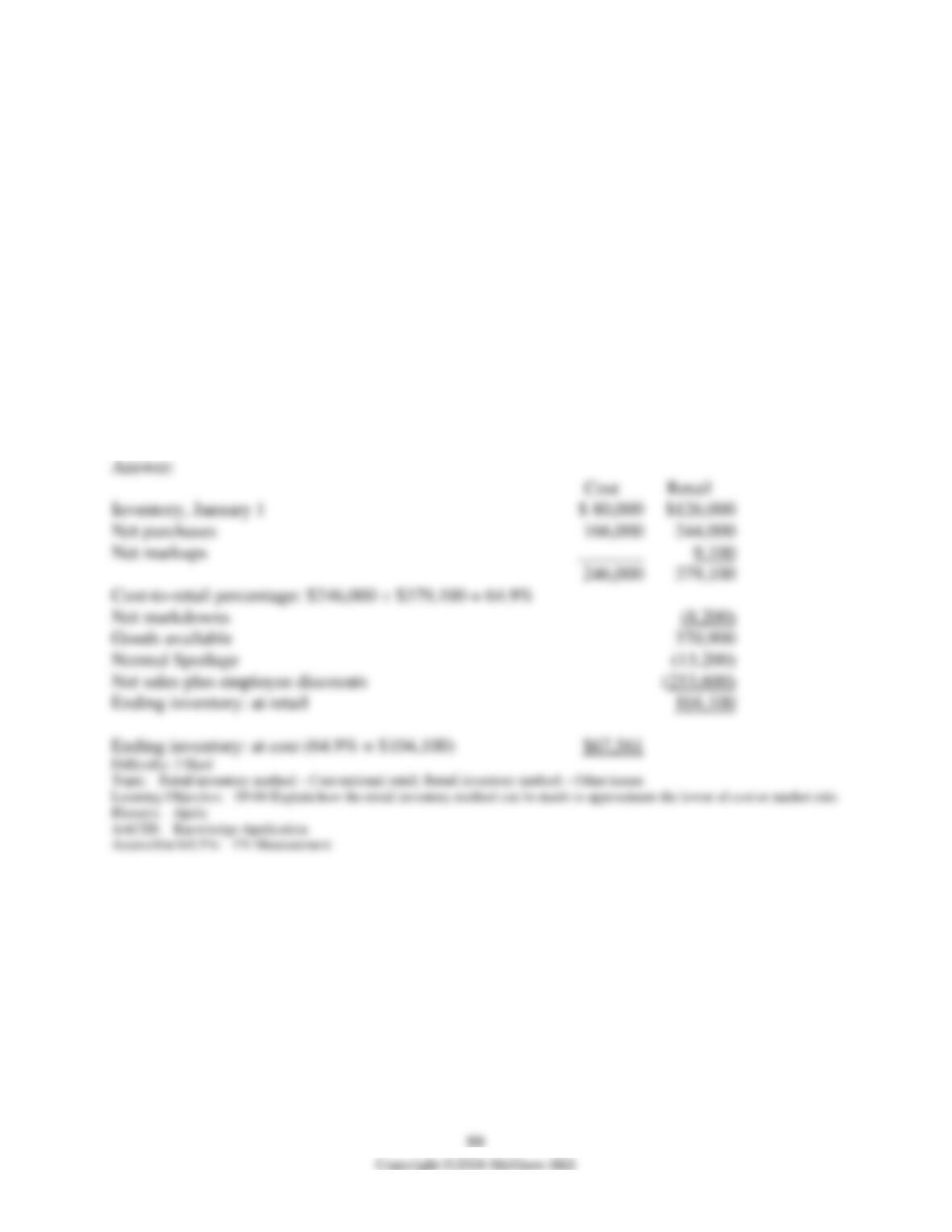
167) Cornhusker Can Co. uses the conventional retail method to estimate ending inventories. The
following data has been summarized for year ended December 31, 2018:
Cost
Retail
Inventory, January 1
$ 80,000
$ 126,000
Purchases
166,000
244,000
Net markups
9,100
Net markdowns
8,200
Normal spoilage
13,200
Employee discounts
15,600
Net sales
238,000
Required:
Estimate the cost of ending inventory applying the conventional retail method. Assume that sales
are recorded net of employee discounts.
Inventory, January 1
Net purchases
Net markups
Net markdowns
Goods available
Normal Spoilage
(13,200)
Net sales plus employee discounts
Ending inventory: at retail
Ending inventory: at cost (64.9% × $104,100)
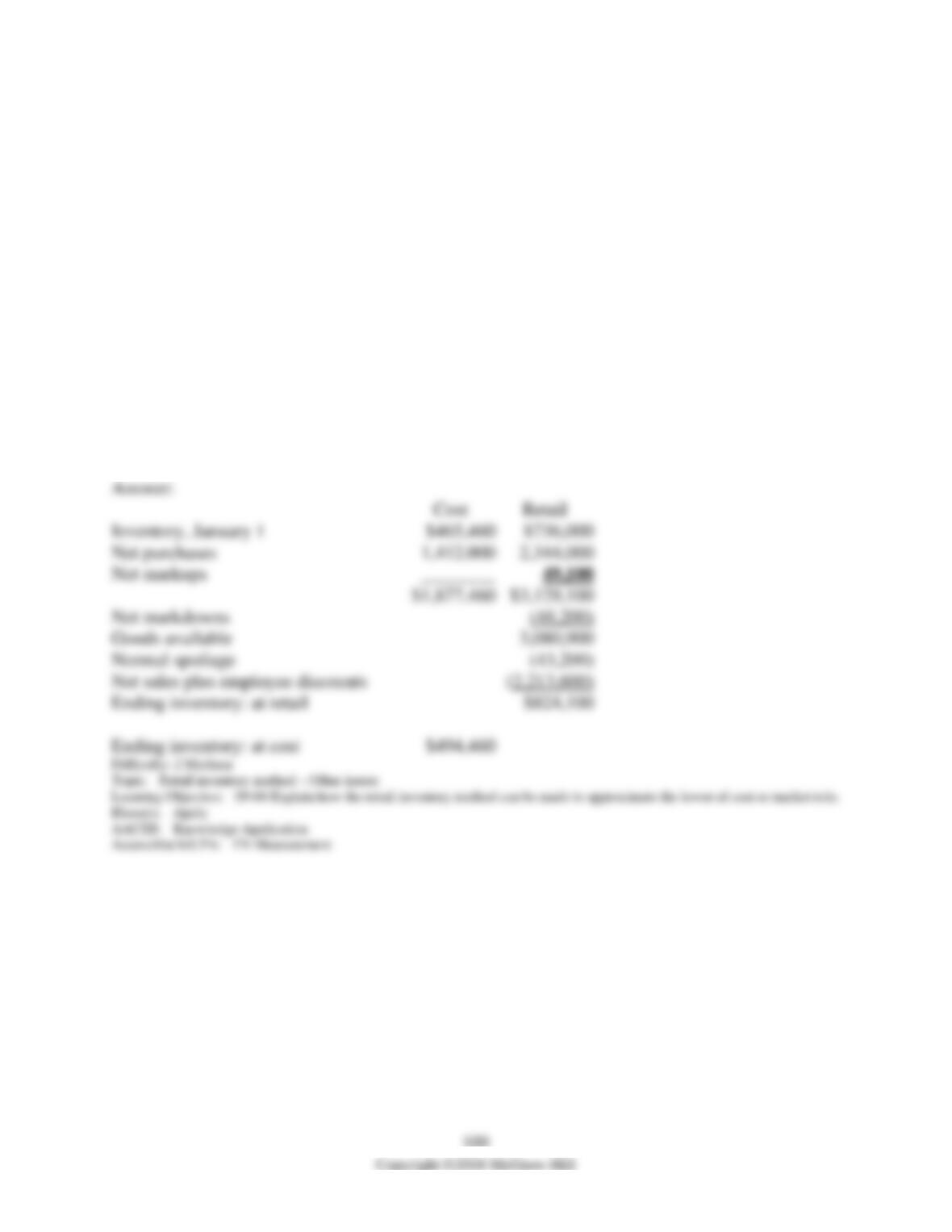
168) Cindy Lou Linens uses the conventional retail method to estimate its ending inventories. The
company records sales net of employee discounts. The following partial data has been summarized
for the year ended December 31, 2018:
Cost
Retail
Inventory, January 1
$ 465,460
$ 736,000
Purchases
1,412,000
2,344,000
Net markups
???
Net markdowns
48,200
Normal spoilage
43,200
Employee discounts
75,600
Net sales
2,138,000
Inventory, Dec. 31
494,460
824,100
Required:
Compute the net markups for Cindy Lou Linens during 2018.
Cost
Retail
Inventory, January 1
Net purchases
2,344,000
Net markups
________
Net markdowns
Goods available
3,080,900
Normal spoilage
Net sales plus employee discounts
Ending inventory: at retail
Ending inventory: at cost
169) Charleston Company has elected to use the dollar-value LIFO retail method to value its
inventory. The following data has been accumulated from the accounting records:
Cost
Retail
Merchandise inventory, January 1, 2018
$320,000
$ 500,000
Net purchases
670,000
1,020,000
Net markups
14,000
Net markdowns
4,000
Net sales
650,000
Pertinent retail price indexes:
January 1, 2018
1.00
December 31, 2018
1.10
Required:
Estimate the ending inventory for December 31, 2018.
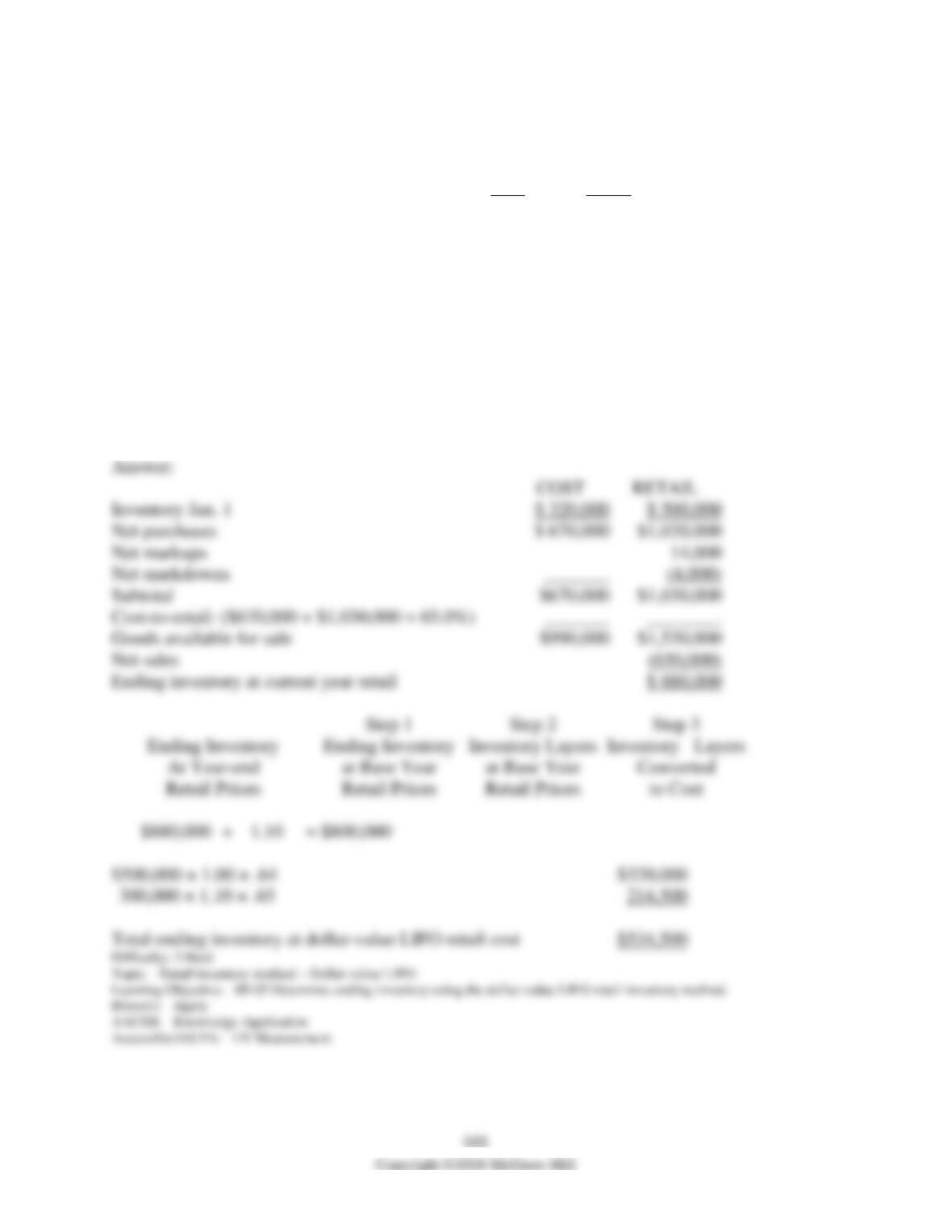
Inventory Jan. 1
$ 500,000
Net purchases
$1,020,000
Net markups
Net markdowns
(4,000)
Subtotal
$670,000
$1,030,000
________
Goods available for sale
$990,000
$1,530,000
Net sales
Ending inventory at current year retail
$ 880,000
Converted
$500,000 × 1.00 × .64
300,000 × 1.10 × .65
Total ending inventory at dollar-value LIFO retail cost
170) Green Acres Co. has elected to use the dollar-value LIFO retail method to value its inventory.
The following data has been accumulated from the accounting records:
Pertinent retail price indexes:
Cost
Retail
Merchandise inventory, January 1, 2018
$240,000
$375,000
Net purchases
505,000
765,000
Net markups
10,500
Net markdowns
3,000
Net sales
570,000
January 1, 2018
1.00
December 31, 2018
1.10
Required:
Estimate the cost of ending inventory for December 31, 2018.
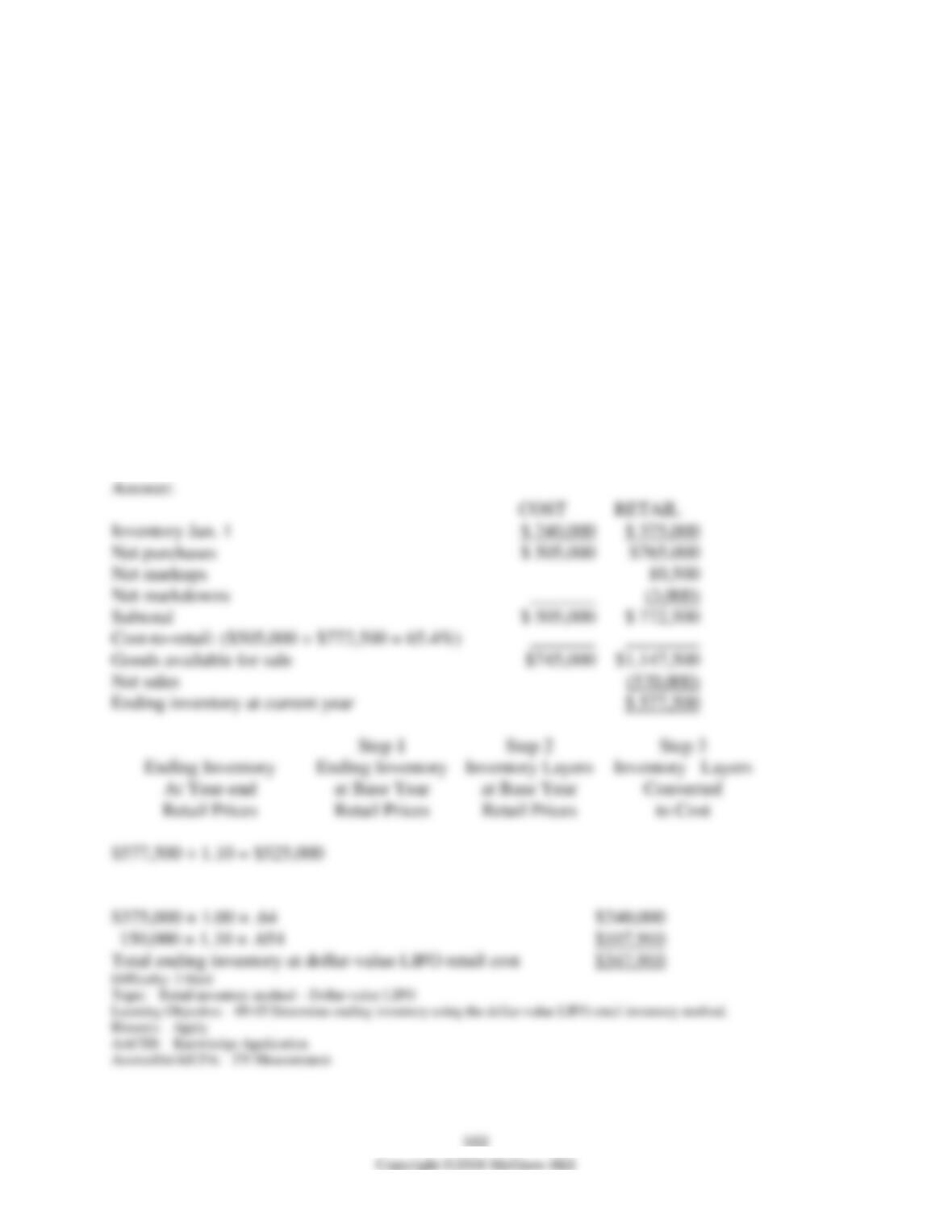
COST
Inventory Jan. 1
$ 375,000
Net purchases
Net markups
Net markdowns
Subtotal
$ 772,500
________
Goods available for sale
$1,147,500
Net sales
(570,000)
Ending inventory at current year
$ 577,500
$375,000 × 1.00 × .64
$240,000
150,000 × 1.10 × .654
$107,910
Total ending inventory at dollar-value LIFO retail cost
$347,910
171) Orlando Company has used the average cost method for inventory valuation since it began
business in 2014, but has elected to change to the FIFO method starting in 2017. Year-end
inventory valuations under each method are shown below:
Year
Average
Cost
FIFO
2014
$42,000
$47,000
2015
53,000
61,000
2016
59,000
68,000
2017
62,000
72,000
Required:
How would Orlando reflect the change in accounting principle in its financial statements (ignore
income taxes)?
172) Ramsgate Company has used the FIFO method for inventory valuation since it began
business in 2014, but has elected to change to the average cost method starting in 2017. Year-end
inventory valuations under each method are shown below:
Average
Year
FIFO
Cost
2014
$49,000
$46,000
2015
55,000
48,000
2016
57,000
51,000
2017
61,000
53,000
Required:
How, and when, would Ramsgate reflect the change in accounting principle in its financial
statements (ignore income taxes)?
Use the following to answer the question(s) below:
In the following questions, inventory errors are noted for 2018. Assume that the errors are not
discovered until 2019, and that the company uses a periodic inventory system. Indicate the effect
of the error, if any, on the accounts noted in the columns, using the following code:
U = Understated; O = Overstated; NE = No effect
173)
Error
Cost of goods sold
Retained earnings
Double counted items in ending inventory
Double counted items in ending inventory
174)
Error
Cost of goods sold
Retained earnings
Unrecorded purchases
Cost of goods sold
Retained earnings
Unrecorded purchases
175)
Error
Cost of goods sold
Retained earnings
Understated beginning inventory
Understated beginning inventory
176)
Error
Cost of goods sold
Retained earnings
The company ignored its purchase of
inventory that was bought FOB shipping point
and was in transit at year end
Cost of goods sold
Retained earnings
Ignored items purchased and owned that
were still in transit at year-end
177)
Error
Cost of goods sold
Retained earnings
Recorded purchases for $523,000 that should
have been $532,000.
Cost of goods sold
Retained earnings
Recorded purchases for $523,000 that
should have been $532,000.
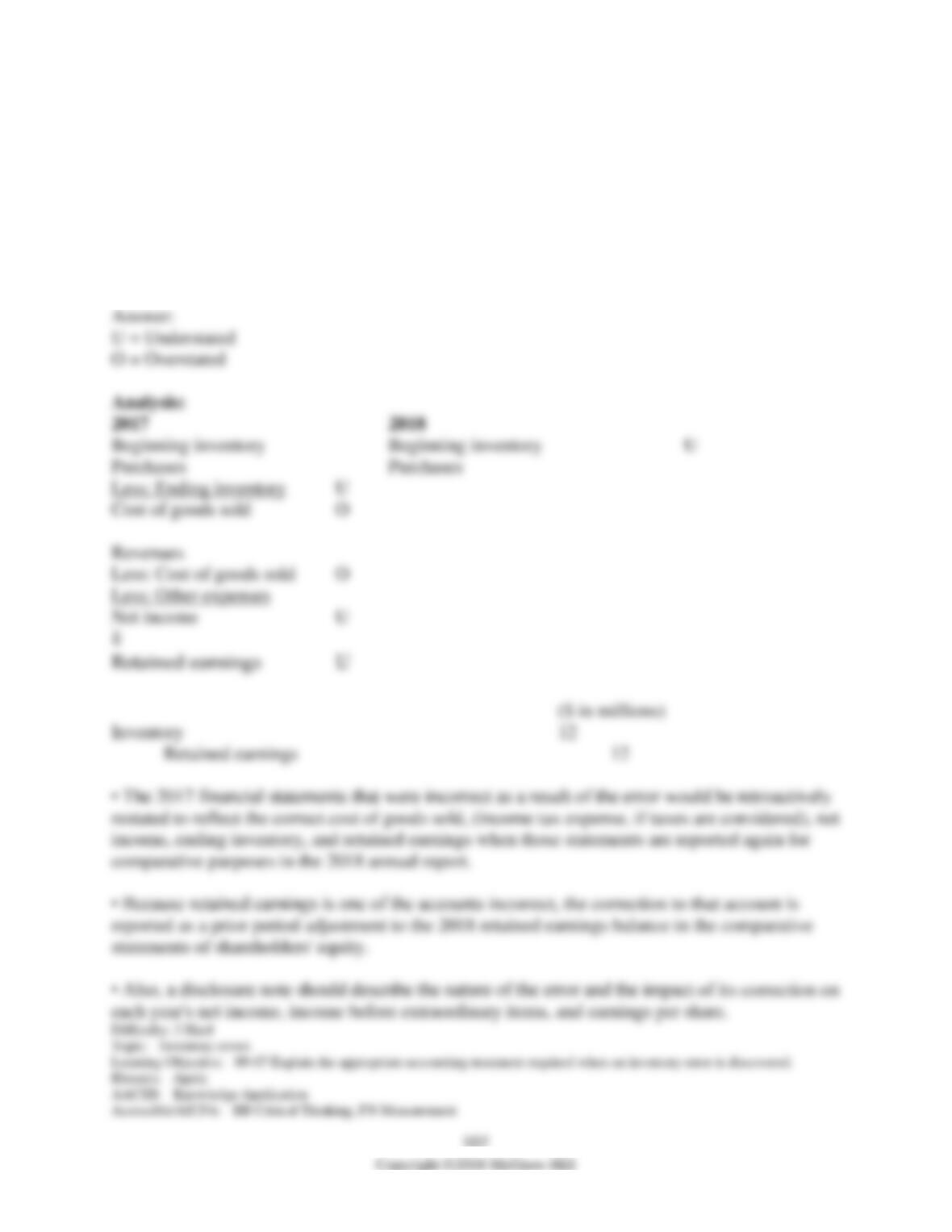
178) In 2018, the internal auditors of Blooper Inc. discovered that goods costing $12 million that
were shipped f.o.b. shipping point in December of 2017 were in transit on December 31. The
goods were recorded as a purchase in December of 2017 but were not included in the 2017
year-end inventory.
Required:
Prepare the journal entry needed in 2018 to correct the error. Also, briefly describe any other
measures Blooper would take in connection with correcting the error. (Ignore income taxes.)

108
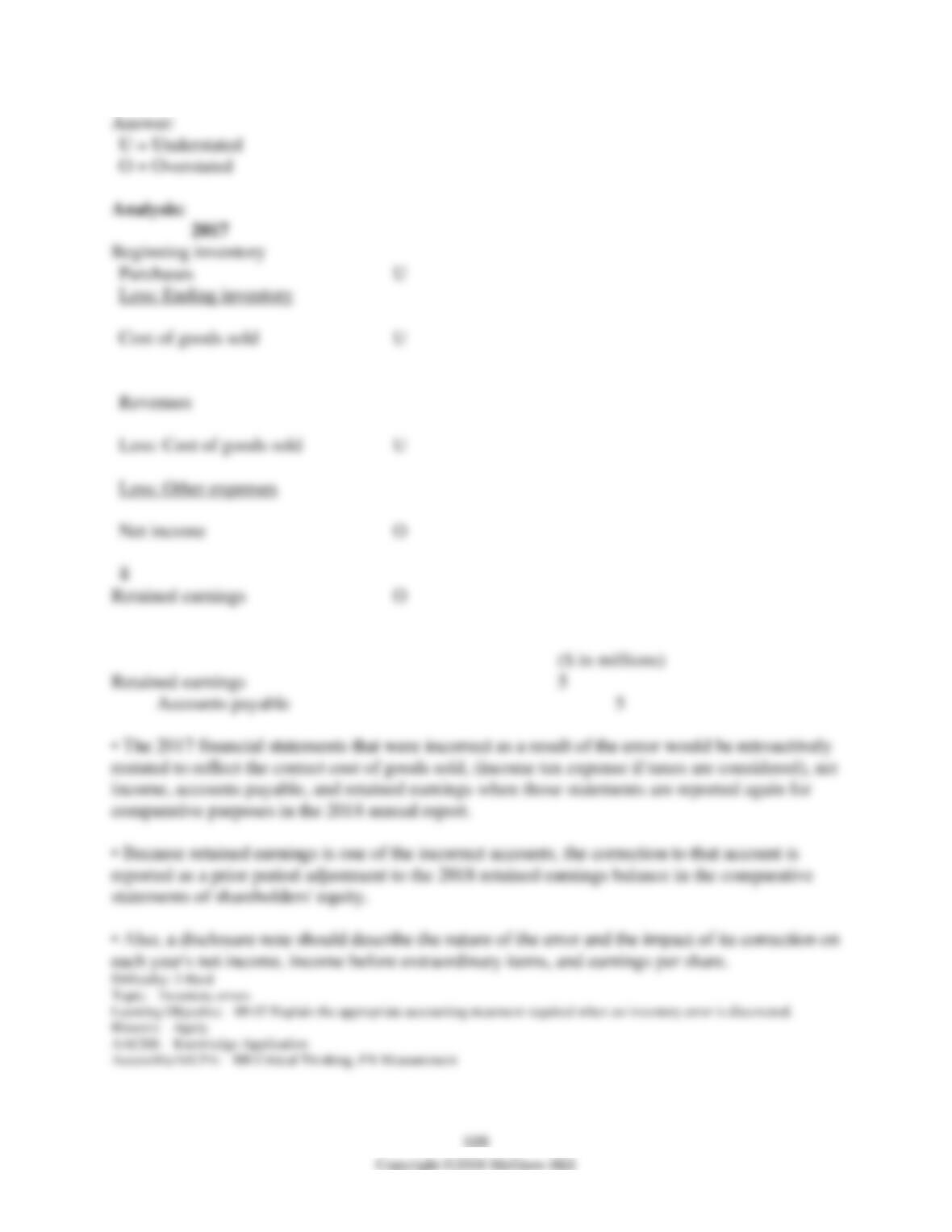
179) In the year 2018, the internal auditors of Goofy Co. discovered that goods costing $25 million
that were purchased in December of 2017 were recorded for $20 million. The goods were properly
measured in the December 31, 2017, ending physical inventory.
Required:
Prepare the journal entry needed in 2018 to correct the error. Also, briefly describe any other
measures Goofy would take in connection with correcting the error. (Ignore income taxes.)
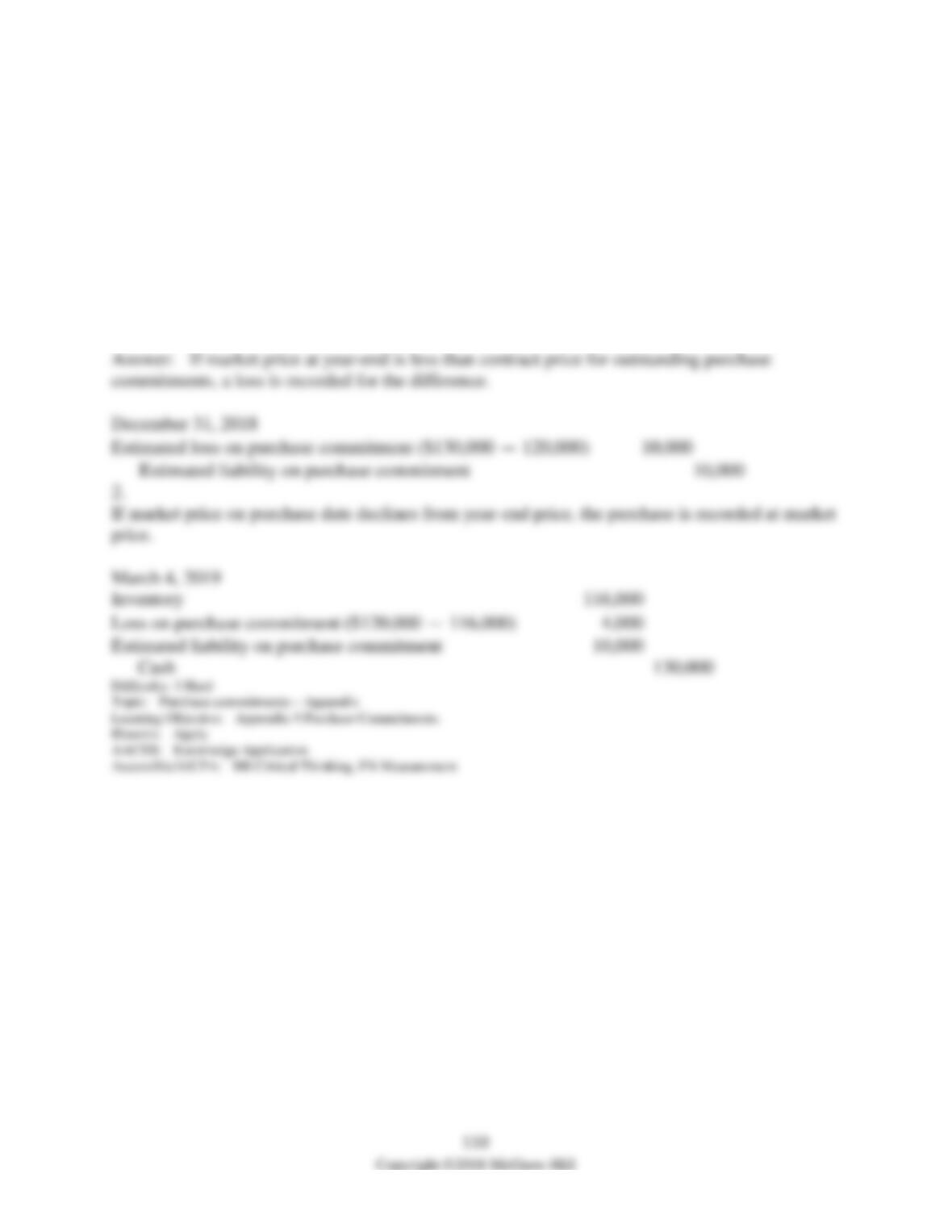
180) On September 5, 2018, Howard Corporation signed a purchase commitment to purchase
inventory for $130,000 on or before March 31, 2019. The company’s fiscal year-end is December
31. The contract was exercised on March 4, 2019, and the inventory was purchased for cash at the
contract price. On the purchase date of March 4, the market price of the inventory was $116,000.
The market price of the inventory on December 31, 2018, was $120,000. The company uses a
perpetual inventory system.
Required:
1. Prepare the necessary adjusting journal entry (if any is required) on December 31, 2018.
2. Prepare the journal to record the purchase on March 4, 2019.
Use the following to answer the question(s) below:
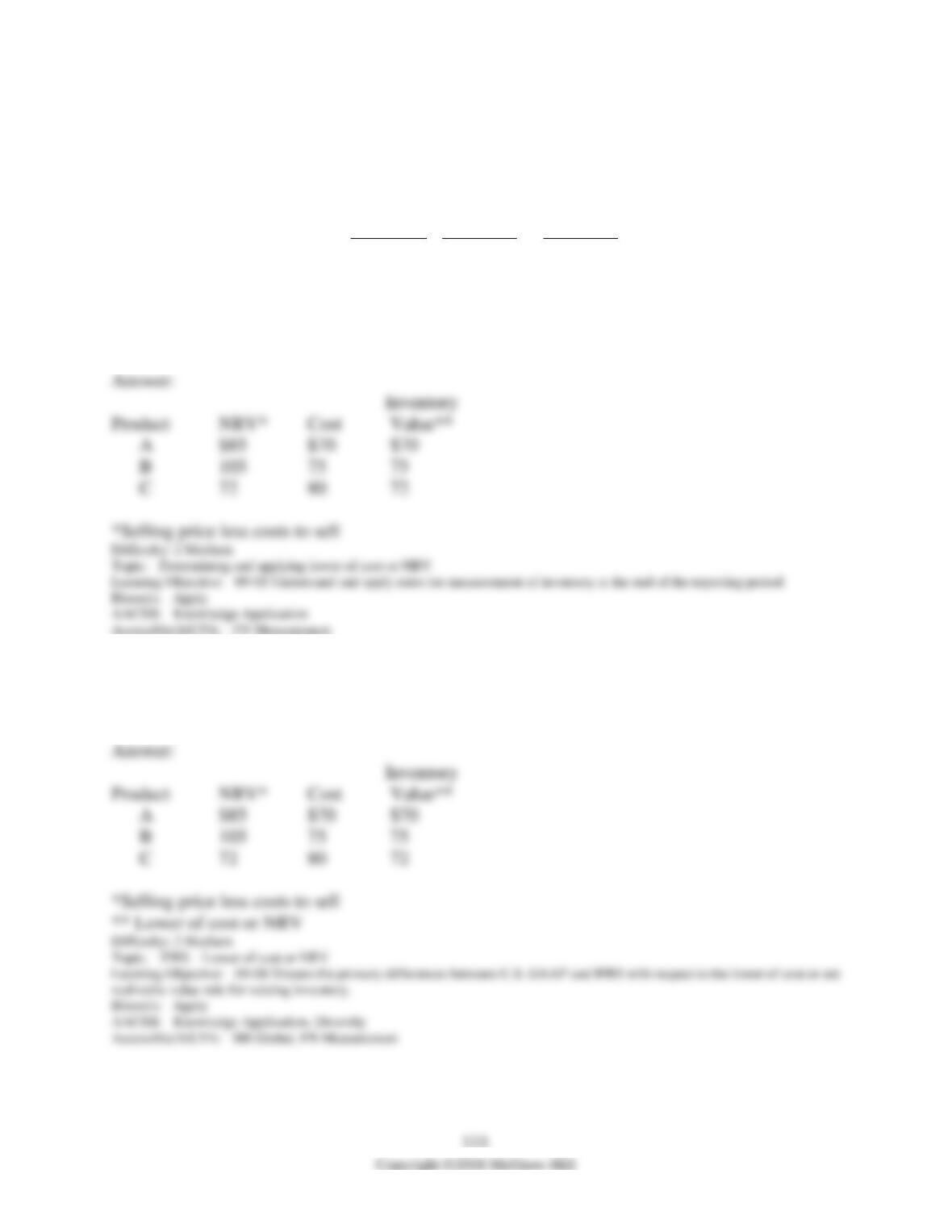
Memphis Wholesale Market applies the lower of cost or net realizable valuation to individual
products and has collected the following data:
Product A
Product B
Product C
Selling price
$100
$125
$80
Cost
70
75
80
Costs to sell
15
20
8
181) Determine the inventory book value for Products A, B, and C.
182) Determine the inventory carrying value for Products A, B, and C assuming that Memphis
Wholesale Market prepares its financial statements according to International Financial Reporting
Standards (IFRS).
112
183) Briefly explain how a material adjustment to inventory due to application of the lower of cost
or net realizable value rule should be reported in the financial statements.
184) The following disclosure note appeared in the 2018 annual report to shareholders of Upton
Systems Inc.
Inventories are stated at the lower of cost or net realizable value. Cost is computed using standard
cost, which approximates actual cost, on a first-in, first-out basis. The Company provides
inventory allowances based on excess and obsolete inventories.
Another disclosure note in the annual report stated:
The Company recorded a provision for inventory, including purchase commitments, totaling $1.40
billion during fiscal 2018, which included an additional excess inventory charge as previously
discussed. This additional excess inventory charge was due to a sudden and significant decrease in
demand for the Company’s products and was calculated in accordance with the Company’s
accounting policy.
A skeptic may conclude that Upton’s policy and practices threaten earnings quality. Discuss how it
may do so.
185) Briefly explain the differences between U.S. GAAP and International Financial Reporting
Standards (IFRS) in the application of the lower of cost or net realizable value rule for valuing
inventory.
186) Briefly explain what is meant by “market” in the lower of cost or market (LCM) approach to
valuing inventory at the end of a reporting period.
187) Briefly explain how a material adjustment to inventory due to application of the lower of cost
or market (LCM) rule should be reported in the financial statements.
188) Briefly outline the steps in the gross profit method of estimating ending inventory and
indicate when the method might be used.
189) The gross profit method and retail method are both ways of estimating ending inventory.
Briefly explain how the two methods differ.
190) Briefly explain the difference between the LIFO retail method and the dollar-value LIFO
retail method.
191) Briefly explain the financial reporting required when a company changes to or from the LIFO
inventory method.
192) Briefly explain the financial reporting required when material misstatements are found in
previous years’ financial statements that are included for comparative purposes in the current
year’s financial statements.
193) Symington and Cribbs (S&C) is a sporting goods distributor. S&C uses the FIFO inventory
method to determine the cost of its ending inventory. Ending inventory quantities are determined
by a physical count. For the fiscal year-end December 31, 2018, ending inventory was originally
determined to be $67 million. However, in early January of 2019, the company’s controller, Amy
Grant, discovered that an error was made in the inventory count. The correct amount of ending
inventory should be $87 million. The auditors did not discover the error and the financial
statements are scheduled to be issued on February 26, 2019. S&C is a public company.
Amy’s first reaction was to communicate her finding to the auditors and to revise the financial
statements before they are issued. However, she knows that this was a very good year for the
company with profits far exceeding analysts’ expectations. If the error is not corrected this year, it
will self-correct next year as long as 2019 ending inventory is correctly stated. This will help
future 2019 profits. On the other hand, her fellow workers’ profit sharing plans are based on annual
pretax earnings and if she revises the statements, everyone’s profit sharing bonus will be higher
this year.
Required:
1. Is Amy correct by stating that the error will self-correct next year as long as 2019 ending
inventory is correctly stated? If the error is not corrected in the current year, what will be the effect
on 2018 and 2019 income before tax?
2. Discuss the ethical dilemma Amy faces.