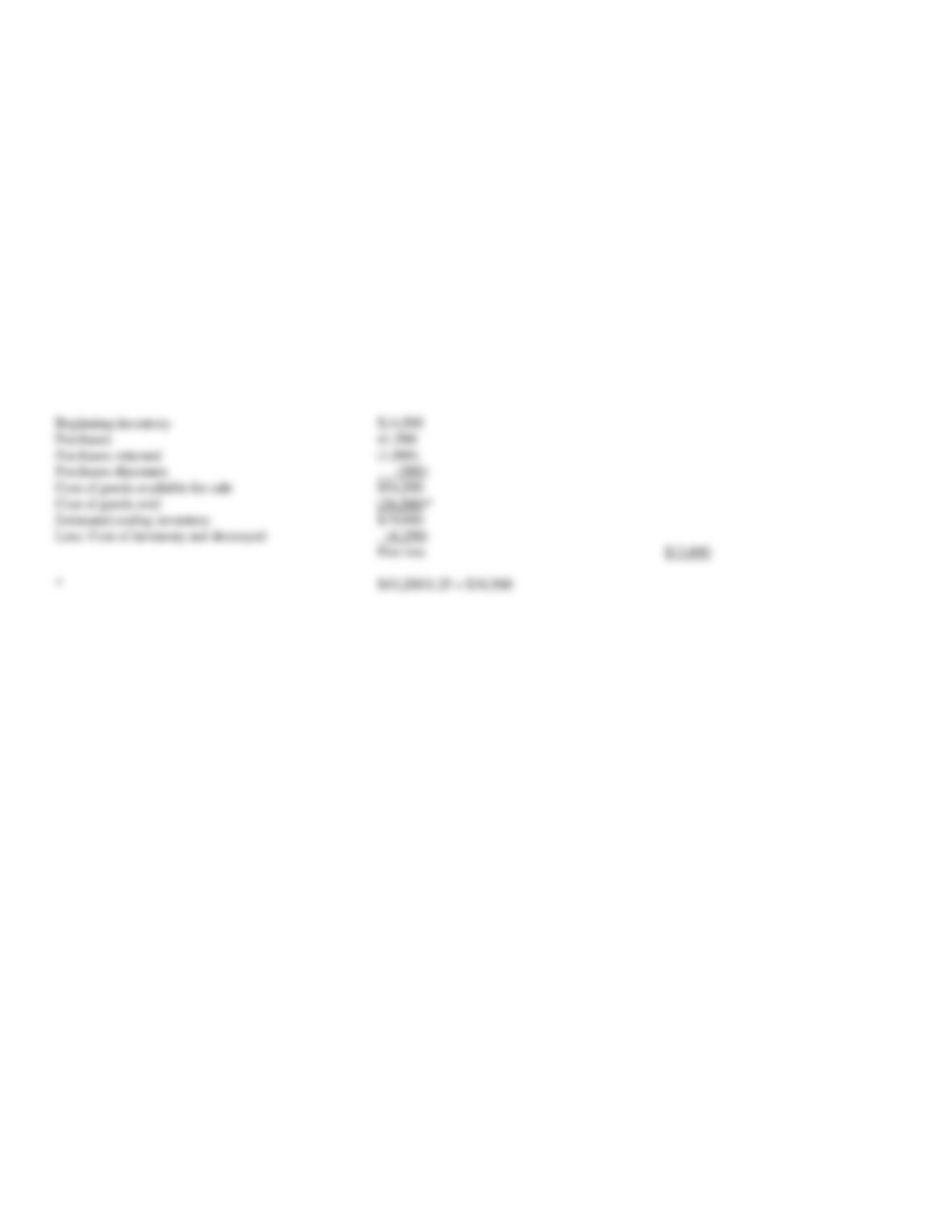
104. England Inc. incurred a fire loss. Certain information follows:
Gross profit on cost
25%
Purchase returns
$ 1,000
Sales
43,200
Beginning inventory
14,500
Cost of goods not burned
6,250
Accounts receivable
5,000
Purchases
41,500
Purchase discounts
500
Required:
Using the gross profit method, compute the amount of the fire loss.
105. Yamaguci Inc. incurred a loss from a flash flood on July 20, 2010. The following information was
available from the company’s accounting records:
Gross profit on cost
20%
Beginning inventory, 1/1/10
$18,000
Sales, 1/1/10-7/20/10
85,000
Sales returns
2,500
Cost of goods not destroyed
3,500
Beginning inventory
$14,500
Purchases
41,500
Purchases returned
(1,000)
Purchases discounts
(500)
Cost of goods available for sale
$54,500
Cost of goods sold
Estimated ending inventory
$19,940
Less: Cost of inventory not destroyed
(6,250)
Fire loss
$13,690
*
$43,200/1.25 = $34,560
All purchases of merchandise are on account. The accounts payable balance on January 1, 2010, was $16,500, and cash paid to suppliers during 2010
to the date of the flood loss was $60,000. Purchase discounts taken during the period were $1,200. The unpaid purchase invoices as of July 20, 2010,
totaled $35,050. The accounts payable account is used only to record purchases of merchandise.
Required:
Using the gross profit method, compute the amount of the loss from the flash flood. (Hint: The accounts payable account must be analyzed to
determine purchases.)
106. Companies may express their gross profit as a percentage of net sales or as a percentage of cost of goods
sold. The following data are available on two different companies:
Company A gross profit as a percentage of net sales
20%
Company B gross profit as a percentage of cost of goods sold
75%
Required:
a.
Compute the gross profit as a percentage of cost of goods sold for Company A.
b.
Compute the gross profit as a percentage of net sales for Company B.
0.20/(1 – 0.20) = 0.20/0.80 = 25%
b.
0.75/(1 + 0.75) = 0.75/1.75 = 42.9% (rounded)
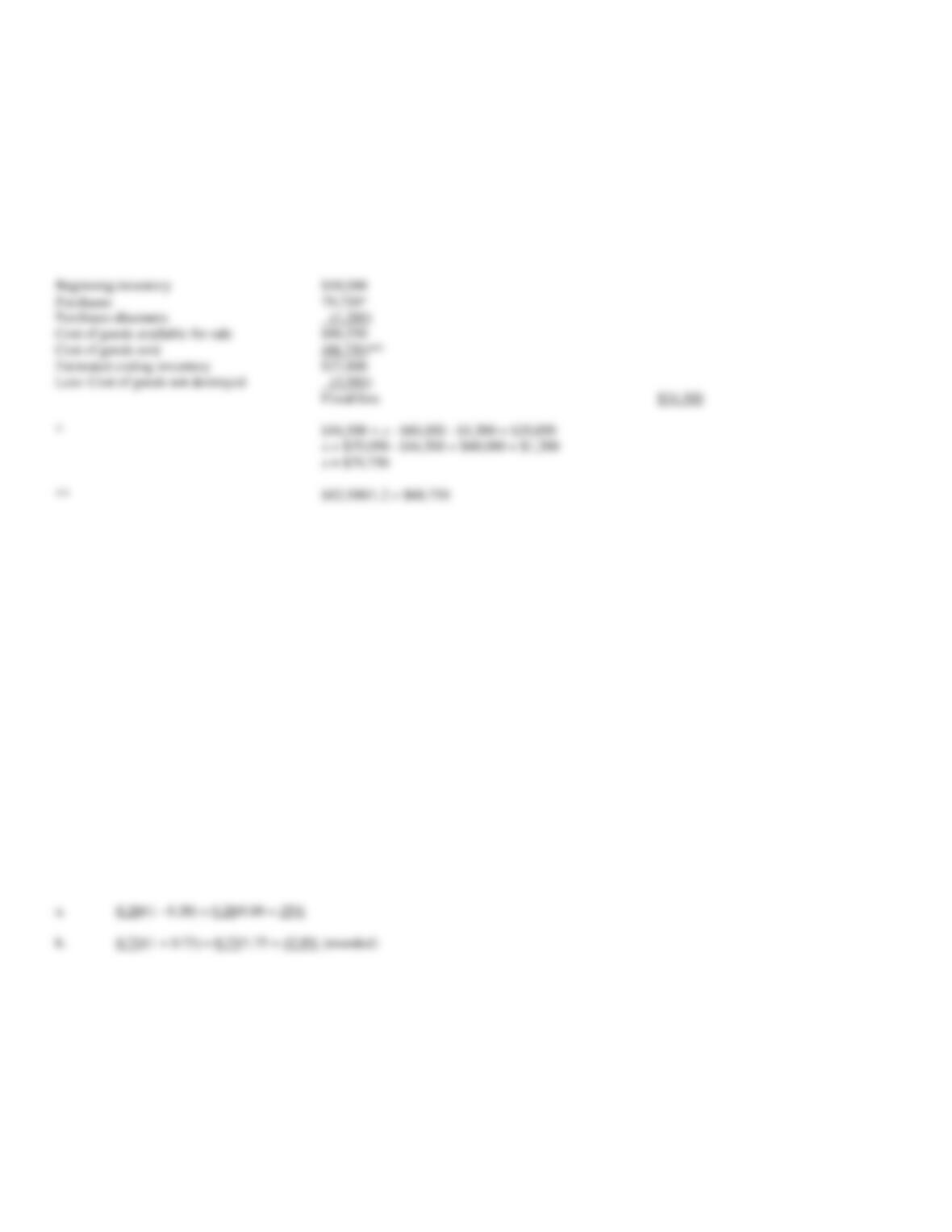
Beginning inventory
$18,000
Purchases
79,750*
Purchases discounts
(1,200)
Cost of goods available for sale
$96,550
Cost of goods sold
(68,750)**
Estimated ending inventory
$27,800
Less: Cost of goods not destroyed
(3,500)
Flood loss
*
$16,500 + x – $60,000 – $1,200 = $35,050
$82,500/1.2 = $68,750
107. The Farmer Company uses the retail inventory method to compute ending inventory. Information for 2010
is as follows:
Cost
Retail
Beginning inventory
$12,000
$20,000
Net markups
8,000
Purchases
40,000
80,000
Freight-in
7,100
Purchase returns
3,000
6,000
Sales
50,000
Net markdowns
4,000
Required:
Determine Farmer Company’s ending inventory based on the retail lower of average cost or market method.
108. The Smitty Company uses the retail inventory method to estimate inventory for interim financial
statements. The following inventory information is available:
Cost
Retail
Beginning inventory
$12,500
$15,000
Purchases
38,500
59,000
Freight-in
500
Purchase returns
1,800
3,000
Net markups
7,050
Sales
51,500
Net markdowns
1,050
Required:
a.
Determine the inventory value using the retail inventory method and the FIFO cost flow assumption.
b.
Determine the inventory value using the retail inventory method and the LIFO cost flow assumption.
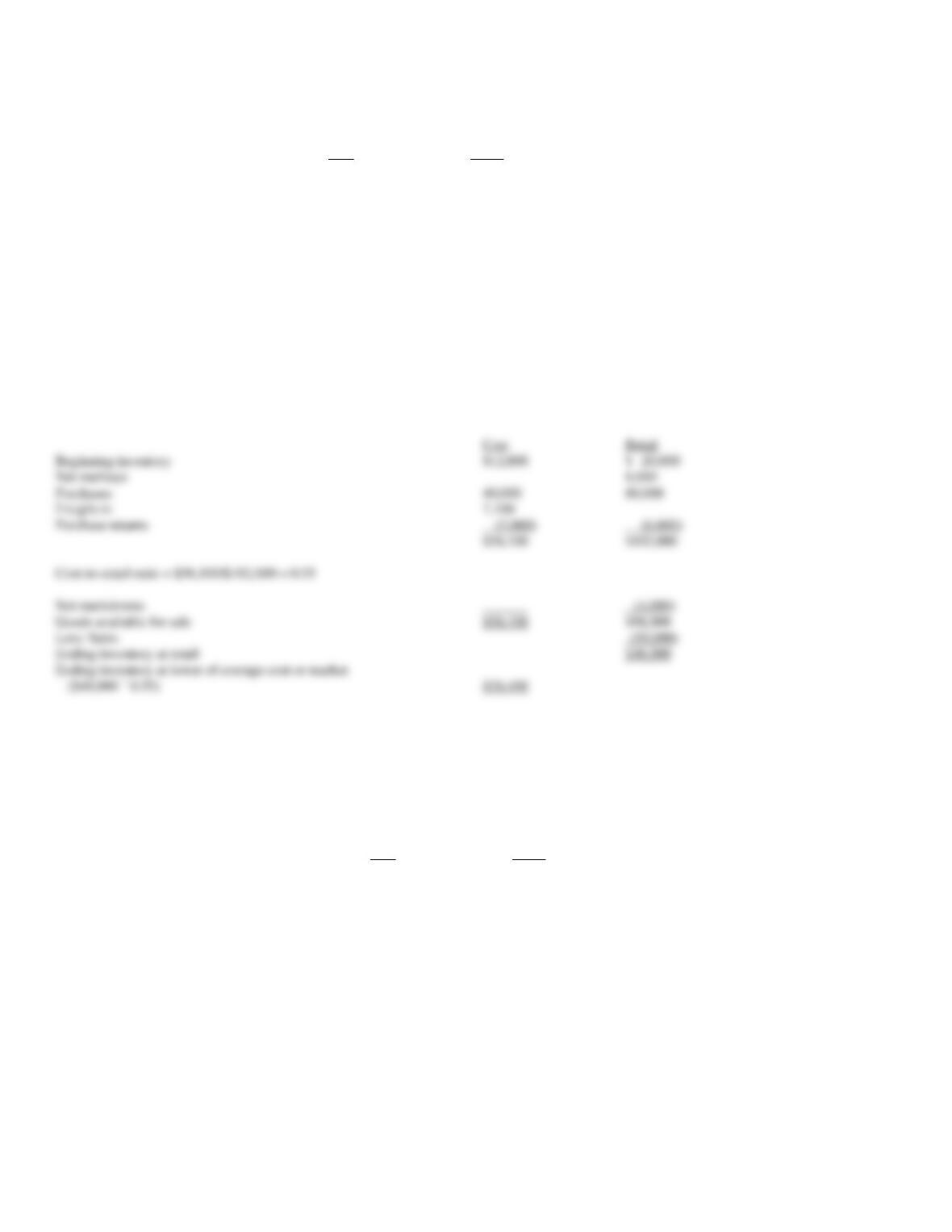
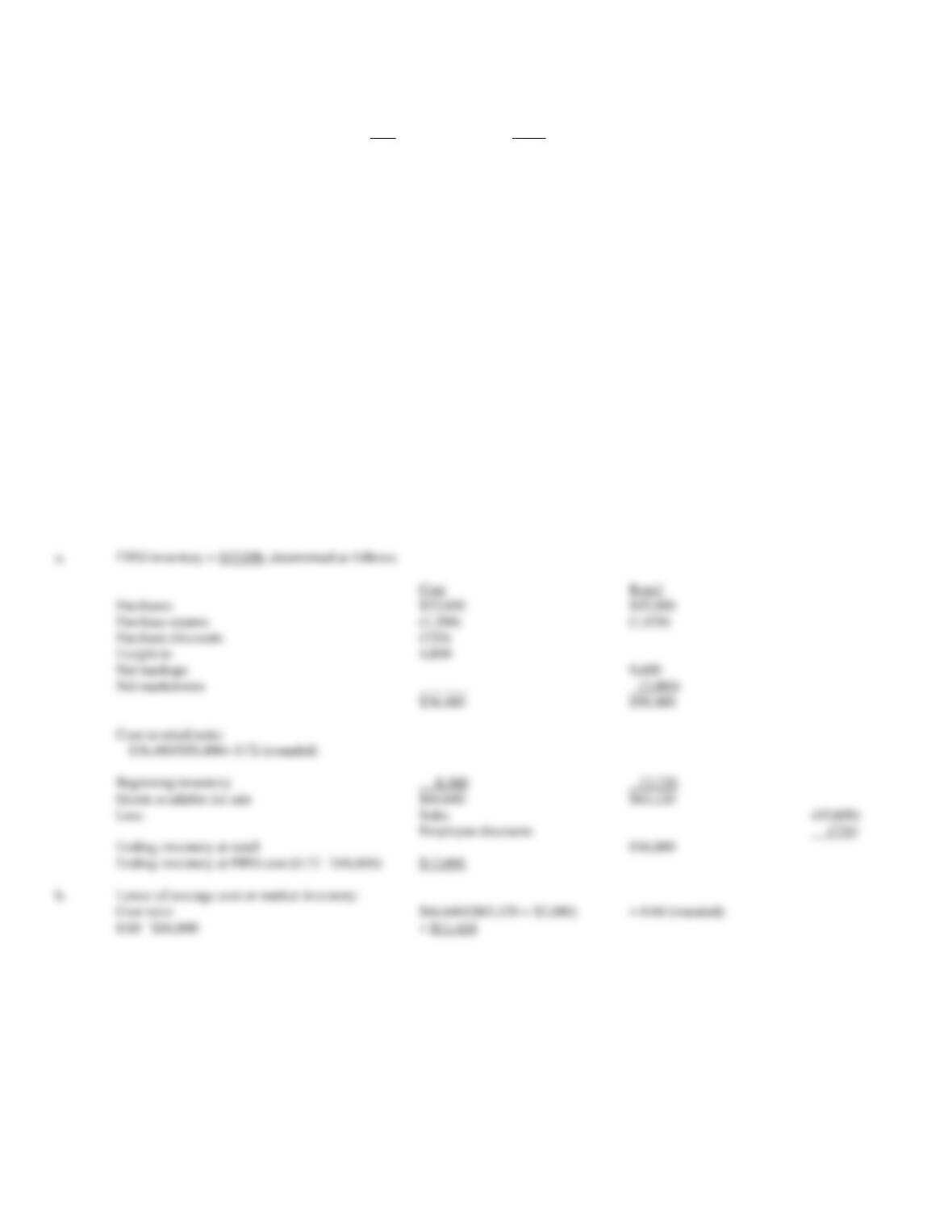
Cost
Retail
Beginning inventory
$12,000
$ 20,000
Net markups
8,000
Purchases
40,000
80,000
7,100
Purchase returns
(3,000)
(6,000)
$56,100
$102,000
Net markdowns
(4,000)
Goods available for sale
$56,100
$98,000
Less: Sales
(50,000)
Ending inventory at retail
$48,000
Ending inventory at lower of average cost or market
($48,000 ´ 0.55)
$26,400
109. Given the following information for Miller, Inc.:
Cost
Retail
Markdown cancellations
$ 720
Markup cancellations
2,400
Employee discounts
720
Purchase returns
$ 1,200
1,920
Purchases
33,600
45,600
Inventory, January 1
8,160
12,720
Purchase discounts taken
720
Freight-in
4,800
Markups
12,000
Markdowns
3,600
Sales
45,600
Required:
a.
Determine the inventory value using the retail inventory method and the FIFO cost flow assumption. Round off any decimals to two
places.
b.
Determine the inventory value using the retail inventory method and the lower of average cost or market cost flow assumption.
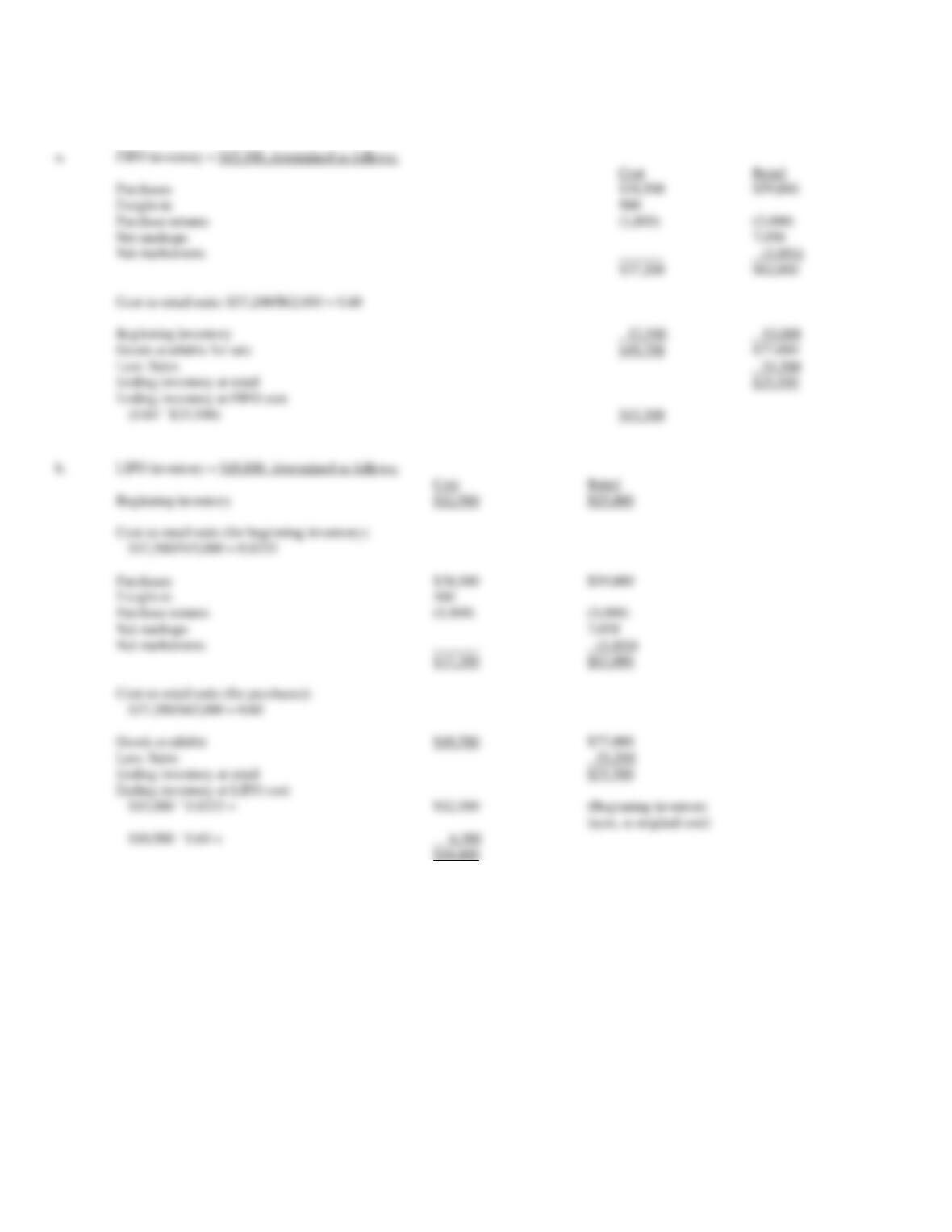
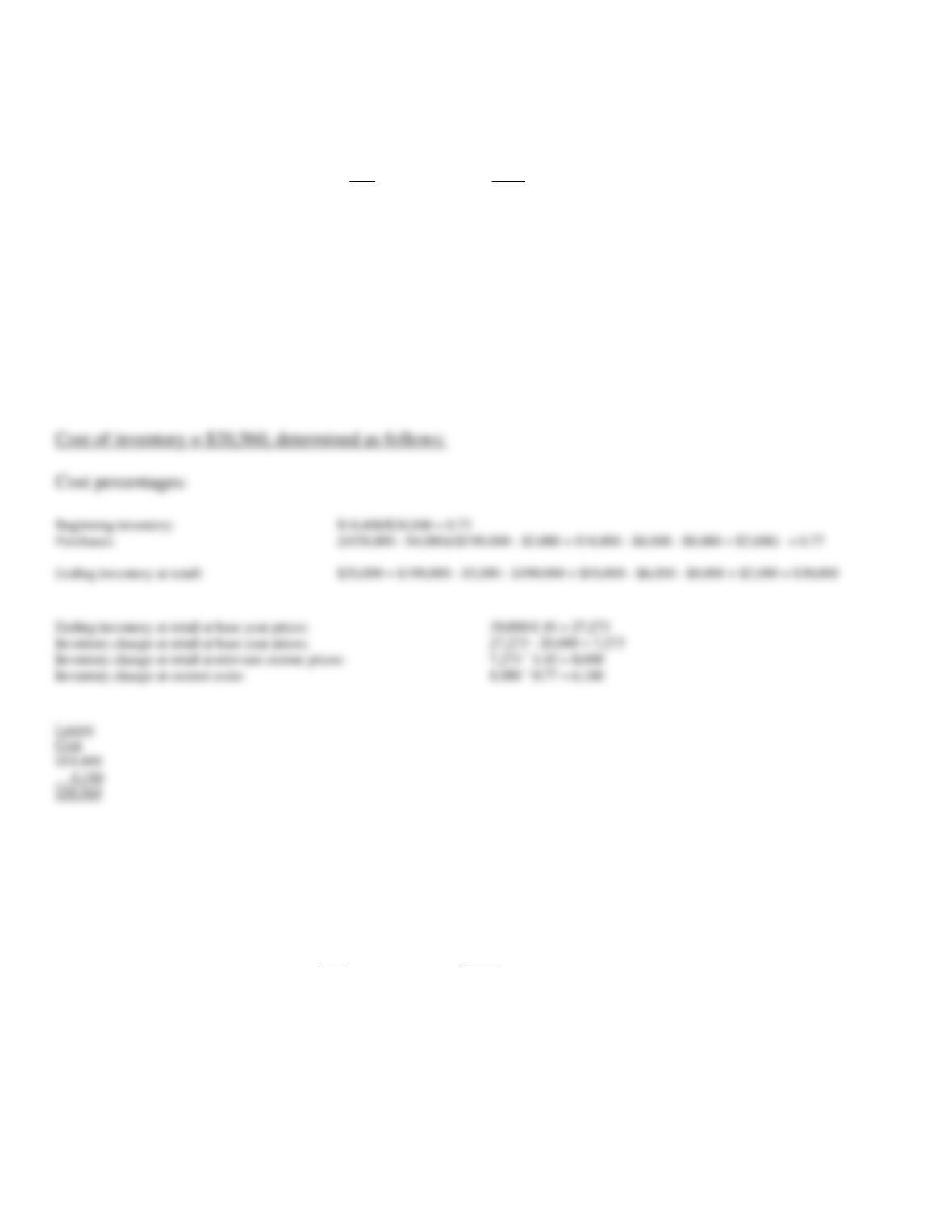
FIFO inventory = $12,096, determined as follows:
Cost
Retail
Purchases
$33,600
$45,600
Purchase returns
(1,200)
(1,920)
Purchase discounts
(720)
Freight-in
4,800
Net markups
9,600
Net markdowns
(2,880)
$36,480
$50,400
Cost-to-retail ratio:
$36,480/$50,400= 0.72 (rounded)
Beginning inventory
8,160
12,720
Goods available for sale
$44,640
$63,120
Less:
Sales
(45,600)
Employee discounts
(720)
Ending inventory at retail
$16,800
Ending inventory at FIFO cost (0.72 ´ $16,800)
$12,096
b.
Lower of average cost or market inventory:
Cost ratio:
$44,640/($63,120 + $2,880)
= 0.68 (rounded)
0.68 ´ $16,800
110. Guerra, Inc. adopted the dollar-value LIFO retail inventory method on January 1, 2010, when the price
index was 100. The following information was taken from company records on December 31, 2010, when the
price index was 110.
Cost
Retail
Sales
$190,000
Additional markups
18,000
Markup cancellations
6,000
Markdowns
8,000
Markdown cancellations
2,000
Inventory, January 1
$ 14,400
20,000
Purchases
158,000
199,000
Purchase returns
4,000
5,000
Required:
Compute the cost of the December 31, 2010, inventory. (Round off calculations to the nearest dollar.)
111. Dawson adopted the dollar-value LIFO retail inventory method on January 1, 2010. The following
information for 2010 was taken from the company’s records:
Cost
Retail
Sales
$173,350
Net markups
2,000
Inventory, January 1, 2010
$ 24,300
30,000
Purchases
147,740
180,000
Net markdowns
4,000
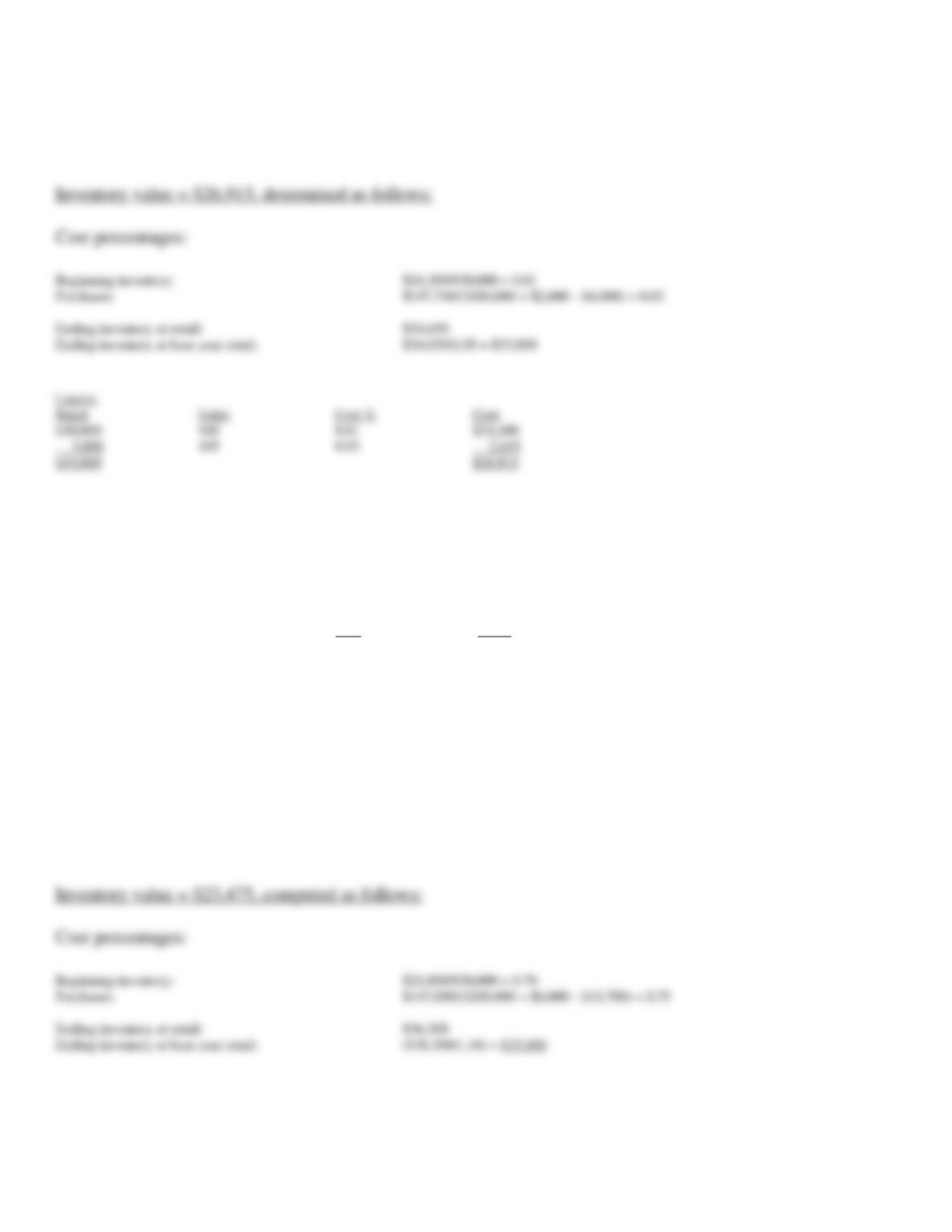
Beginning inventory:
$14,400/$20,000 = 0.72
Purchases:
($158,000 – $4,000)/($199,000 – $5,000 + $18,000 – $6,000 – $8,000 + $2,000) = 0.77
Ending inventory at retail:
$20,000 + $199,000 – $5,000 – $190,000 + $18,000 – $6,000 – $8,000 + $2,000 = $30,000
Ending inventory at retail at base year prices:
30,000/1.10 = 27,273
Inventory change at retail at relevant current prices:
7,273 ´ 1.10 = 8,000
Inventory change at current costs:
8,000 ´ 0.77 = 6,160
Layers
Cost
$14,400
6,160
$20,560
The price index on January 1, 2010, was 100. On December 31, 2010, it was 105.
Required:
Compute the inventory value for December 31, 2010.
112. Davies adopted the dollar-value LIFO retail inventory method on January 1, 2010. The following
information for 2010 was taken from the company’s records:
Cost
Retail
Sales
$189,000
Net markups
6,000
Inventory, January 1, 2010
$ 21,000
30,000
Purchases
147,000
200,000
Net markdowns
10,700
The price index on January 1, 2010, was 100. On December 31, 2010, it was 110. Round cost/retail percentages to the nearest whole percent if
necessary.
Required:
Compute the inventory value for December 31, 2010.
Beginning inventory:
$21,000/$30,000 = 0.70
Purchases:
$147,000/($200,000 + $6,000 – $10,700) = 0.75
Ending inventory at retail:
$36,300
Ending inventory at base year retail:
($36,300/1.10) = $33,000
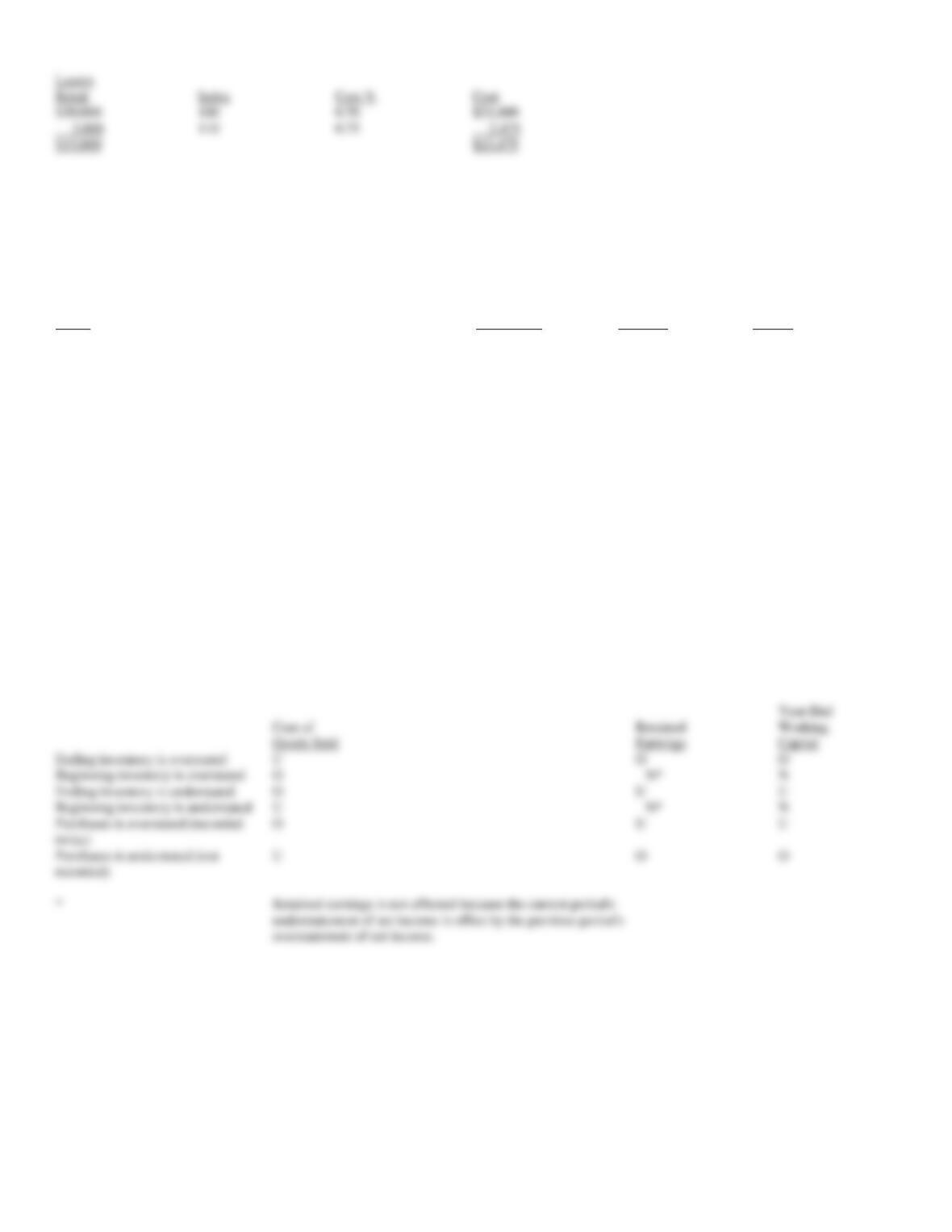
Beginning inventory:
$24,300/$30,000 = 0.81
Purchases:
$147,740/($180,000 + $2,000 – $4,000) = 0.83
Ending inventory at retail:
$34,650
Ending inventory at base year retail:
$34,650/1.05 = $33,000
Retail
Index
Cost %
Cost
$30,000
0.81
$24,300
3,000
0.83
2,615
$33,000
$26,915
113. A list of errors is shown below:
Year-End
Cost of
Retained
Working
Errors
Goods Sold
Earnings
Capital
Ending inventory is overstated
________
________
________
Beginning inventory is overstated
________
________
________
Ending inventory is understated
________
________
________
Beginning inventory is understated
________
________
________
Purchases is overstated (recorded twice)
________
________
________
Purchases is understated (not recorded)
________
________
________
Required:
Show the effects of the errors on the indicated balance sheet and income statement items. Use the following symbols: O = Overstated; U =
Understated; N = No Effect.
Ending inventory is overstated
U
O
O
Beginning inventory is overstated
O
N*
N
Ending inventory is understated
O
U
U
Beginning inventory is understated
U
N*
N
Retail
Index
Cost %
Cost
$30,000
0.70
$21,000
3,000
0.75
2,475
$33,000
$23,475
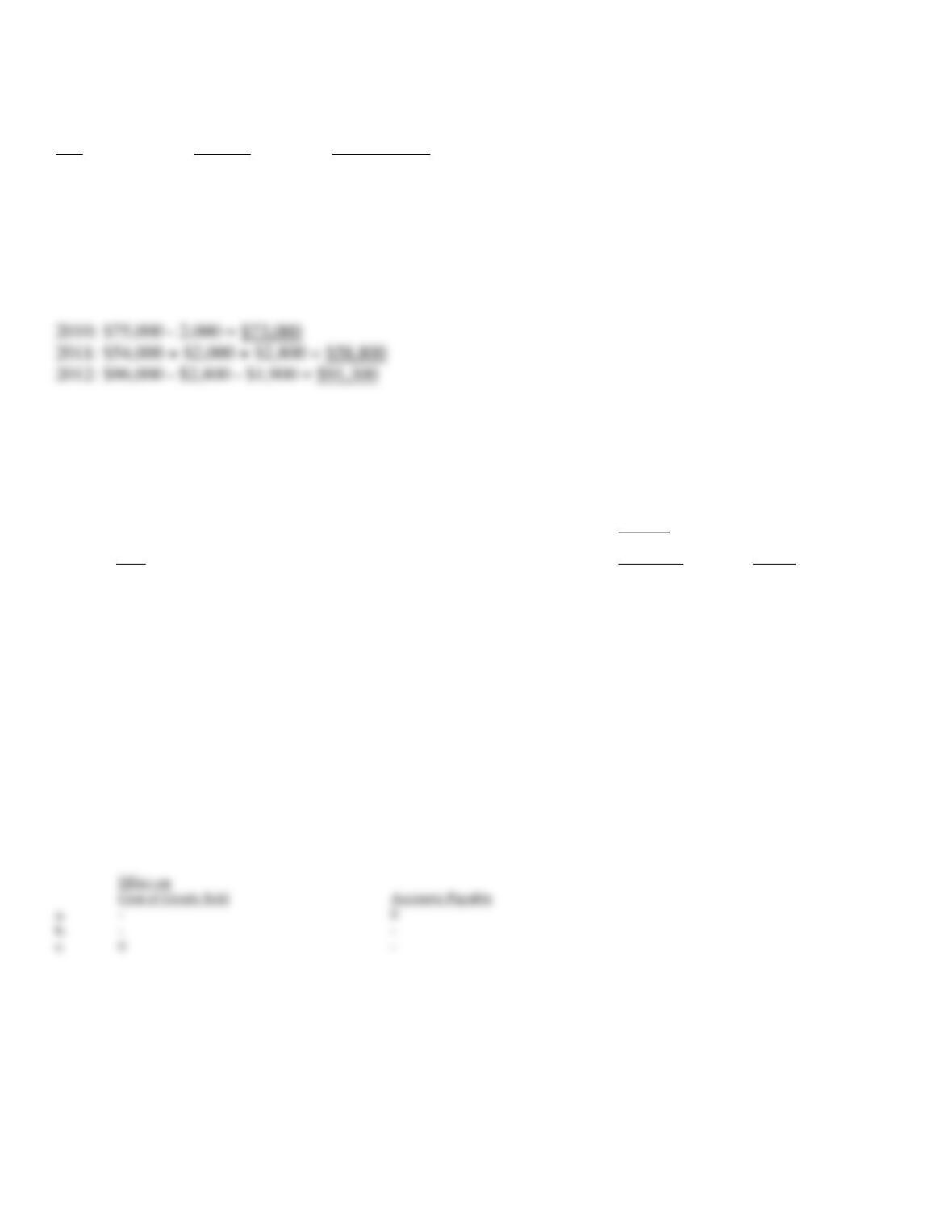
114. Information:
Net Income
Error in
Year
per Books
Ending Inventory
2010
$75,000
$2,000 Overstatement
2011
54,000
2,800 Understatement
2012
96,000
1,900 Overstatement
Required:
Assuming that no corrections were made in any year, compute the correct income for each of the three years.
115. Certain errors are listed below.
Effect on
Error
Cost of
Goods Sold
Accounts
Payable
a.
Ending inventory is overstated
because of a miscount.
________
________
b.
Merchandise received was not recorded
in the purchases account, but it was
included in the physical count.
________
________
c.
Merchandise shipped FOB shipping
point was not included in purchases
or the ending physical count.
________
________
Required:
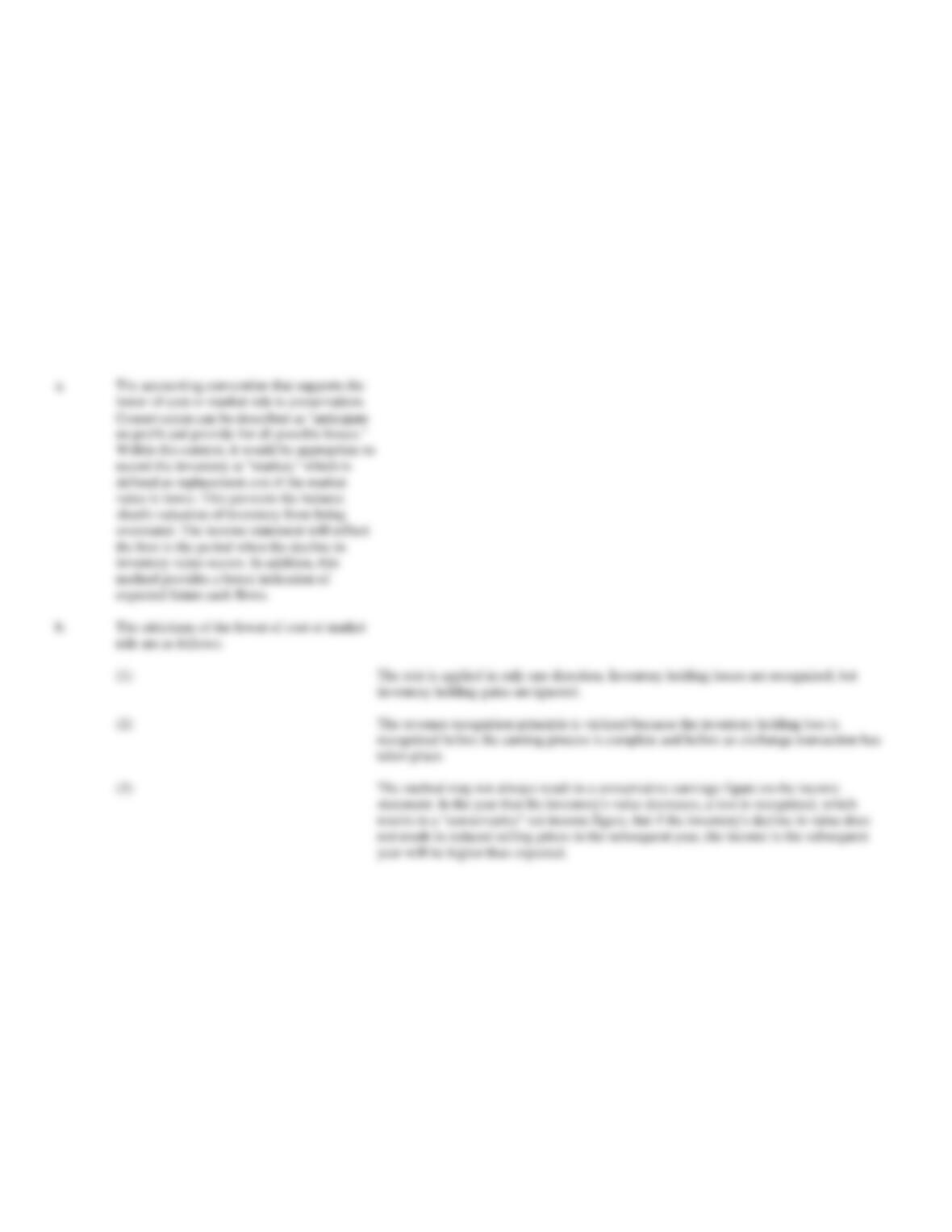
Indicate the effect the errors will have on cost of goods sold and accounts payable. Use +, -, and 0.
Effect on
Cost of Goods Sold
Accounts Payable
a.
–
0
b.
–
–
c.
0
–
116. Draper Company’s controller was explaining to the company’s president, Dana Draper, that if the
inventory’s value should decrease below its original cost, the inventory must be written down and a loss must be
recognized. The controller told the president that this is called the lower of cost or market rule. The president
was unclear as to the purpose of this rule and wanted to know the disadvantages of this method.
Required:
a.
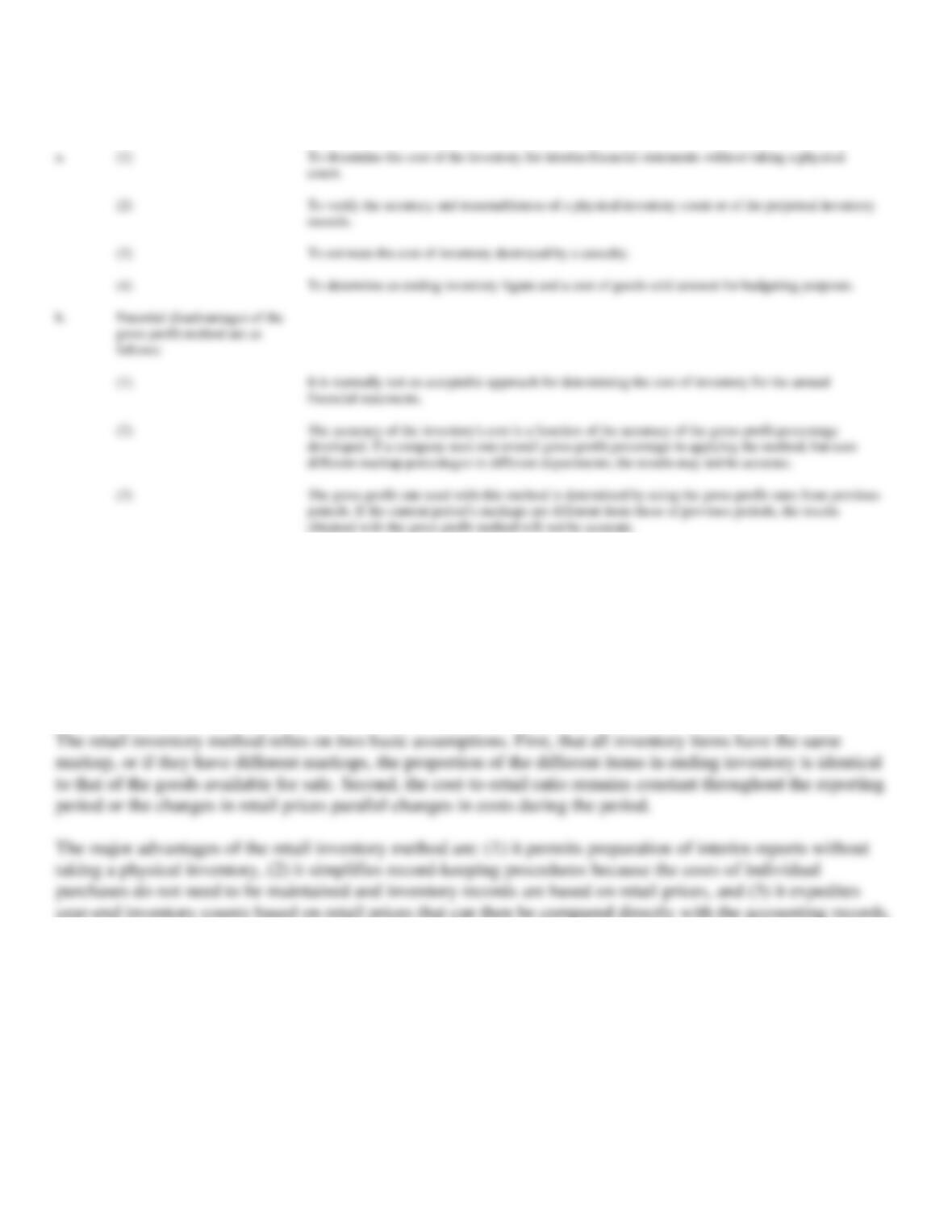
State the accounting convention that supports the lower of cost or market rule, and in this context, discuss the purpose of the rule.
b.
Discuss the criticisms of the lower of cost or market rule in the valuation of inventories.
117. The gross profit method may be used to estimate the cost of inventory.
Required:
a.
List four situations when it might be appropriate to use the gross profit method to estimate the cost of inventory.
b.
Discuss the potential disadvantages of the gross profit method.
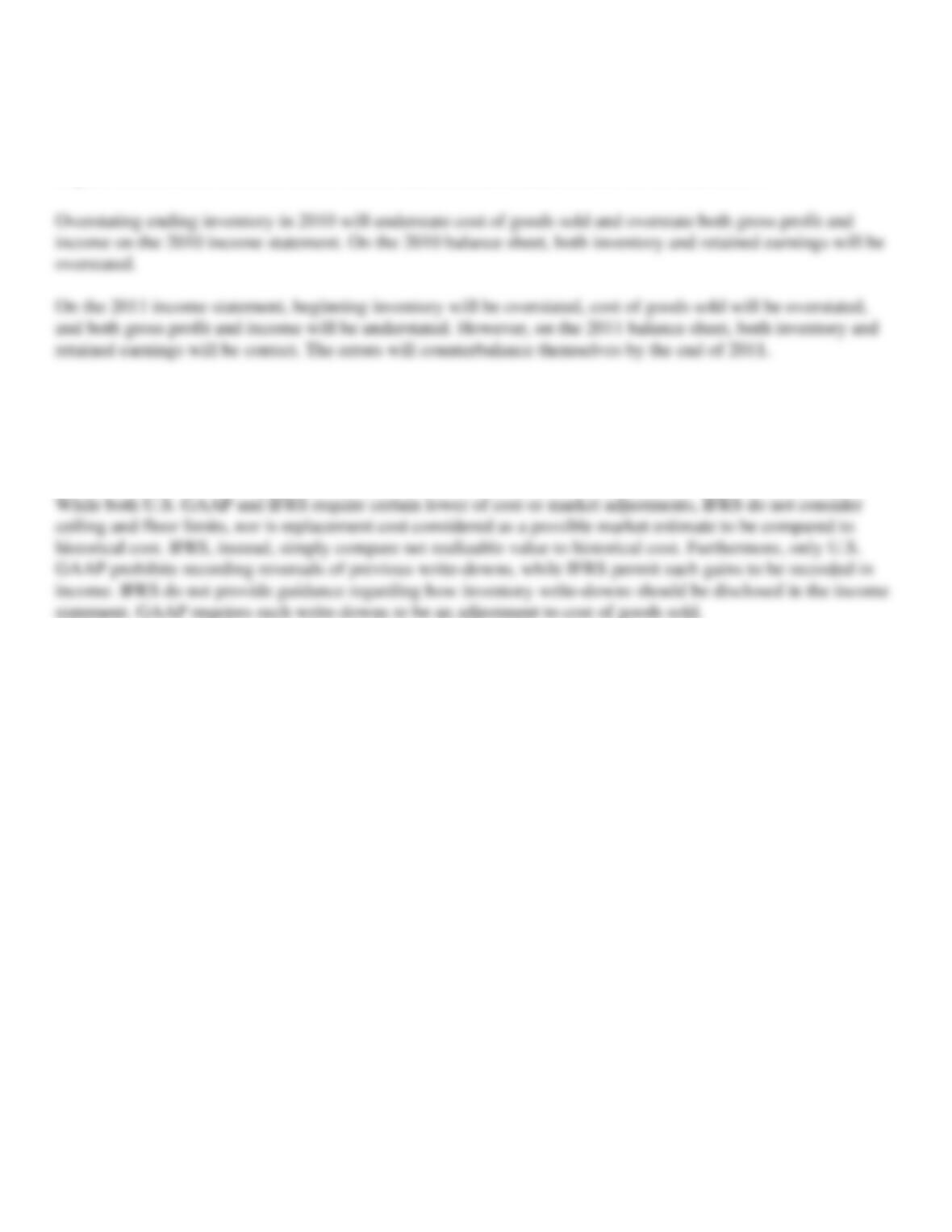
118. The retail inventory method is used extensively in the retail industry.
Required:
Discuss the assumptions and benefits of the retail inventory method.
119. Careful valuation of the ending inventory is necessary because errors can result in inaccurate values on
both the income statement and balance sheet. Assume that a company overstates its ending inventory for 2010.
Required:
Explain the effects of the error on the income statements and balance sheets for 2010 and 2011.
120. Describe the differences in the application of lower of the cost or market consideration between U.S.
GAAP and IFRS.