
Name:
Class:
Date:
chapter 9
Indicate whether the statement is true or false.
1. An advantage of a company selling its receivables is that it immediately receives cash for operating and other needs.
a.
True
b.
False
2. When a note is received from a customer on account, it is recorded by debiting Notes Receivable and crediting
Accounts Receivable.
a.
True
b.
False
3. In computing the maturity date of a note, the date the note is issued is included but the due date is omitted.
a.
True
b.
False
4. The balance of Allowance for Doubtful Accounts is added to Accounts Receivable on the balance sheet.
a.
True
b.
False
5. The direct write-off method records bad debt expense when an account is determined to be uncollectible.
a.
True
b.
False
6. The balance in Allowance for Doubtful Accounts at the end of the year includes the total of all accounts written off
since the beginning of the year.
a.
True
b.
False
7. When accounting for uncollectible receivables and using the percentage of sales method, the matching concept is
violated.
a.
True
b.
False
8. At the end of a period (before adjustment), Allowance for Doubtful Accounts has a debit balance of $2,000. The
Accounts Receivable balance is analyzed by aging the accounts, and the amount estimated to be uncollectible is $15,000.
The amount to be recorded in the adjusting entry for the bad debt expense is $15,000.
a.
True
b.
False
9. The maturity value of a 12%, 60-day note for $5,000 is $5,600.
a.
True
b.
False
10. The direct write-off method records bad debt expense in the year the specific account receivable is determined to be
uncollectible.
a.
True

Name:
Class:
Date:
chapter 9
b.
False
11. When a note is written to settle an open account, no entry is necessary.
a.
True
b.
False
12. Both accounts receivable and notes receivable represent claims that are expected to be collected in cash.
a.
True
b.
False
13. When using the direct write-off method of accounting for uncollectible receivables, the account Allowance for
Doubtful Accounts is debited when a specific account is determined to be uncollectible.
a.
True
b.
False
14. Small companies can use either the direct write-off method or the allowance method.
a.
True
b.
False
15. Companies may sell their receivables, which is often the case when a company issues its own credit card.
a.
True
b.
False
16. Other (nontrade) receivables that are not expected to be collected within one year are reported in the Investments
section of the balance sheet.
a.
True
b.
False
17. A primary difference between the direct write-off and allowance methods is whether or not bad debt is based on a
percentage of sales.
a.
True
b.
False
18. When using the analysis of receivables method for estimating uncollectible receivables, the amount computed in the
analysis is usually the amount that would be recorded in the end-of-period adjusting entry.
a.
True
b.
False
19. The due date of a 60-day note dated July 10 is September 10.
a.
True
b.
False
20. GAAP requires companies with a large amount of receivables to use the allowance method.
a.
True
b.
False

Name:
Class:
Date:
chapter 9
21. Allowance for Doubtful Accounts is a liability account.
a.
True
b.
False
22. Although Allowance for Doubtful Accounts normally has a credit balance, it may have either a debit or a credit
balance before adjusting entries are recorded at the end of the accounting period.
a.
True
b.
False
23. The accounts receivable turnover ratio is computed by dividing total sales by the average accounts receivable during
the year.
a.
True
b.
False
24. Other receivables include nontrade receivables such as loans to company officers.
a.
True
b.
False
25. The party promising to pay a note at maturity is the maker.
a.
True
b.
False
26. Of the two methods of accounting for uncollectible receivables, the allowance method makes use of an estimate of
uncollectible receivables.
a.
True
b.
False
27. The equation for computing interest on an interest-bearing note is as follows: Interest = Maturity Value × Interest Rate
× Time.
a.
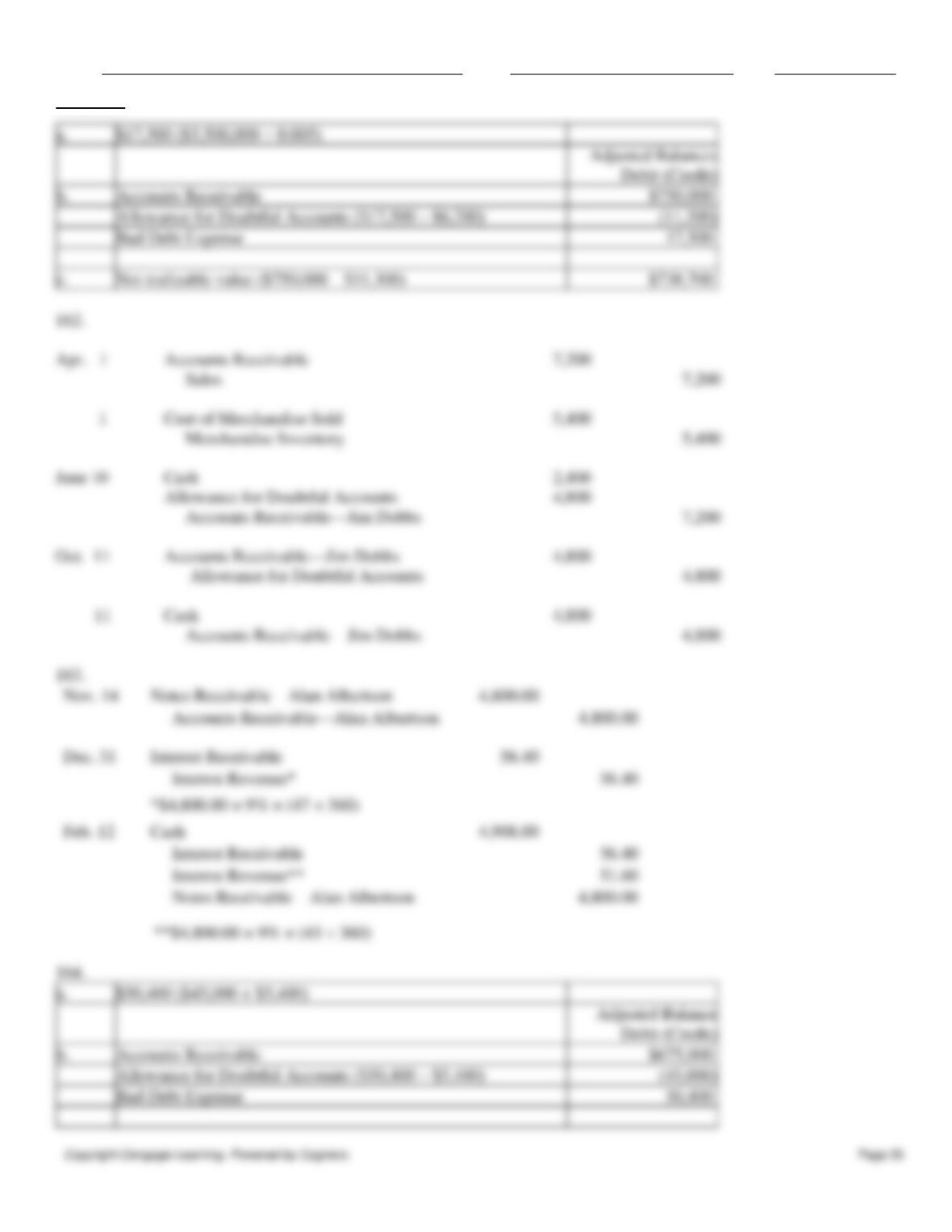
True
b.
False
28. Generally accepted accounting principles do not normally allow the use of the direct write-off method of accounting
for uncollectible accounts.
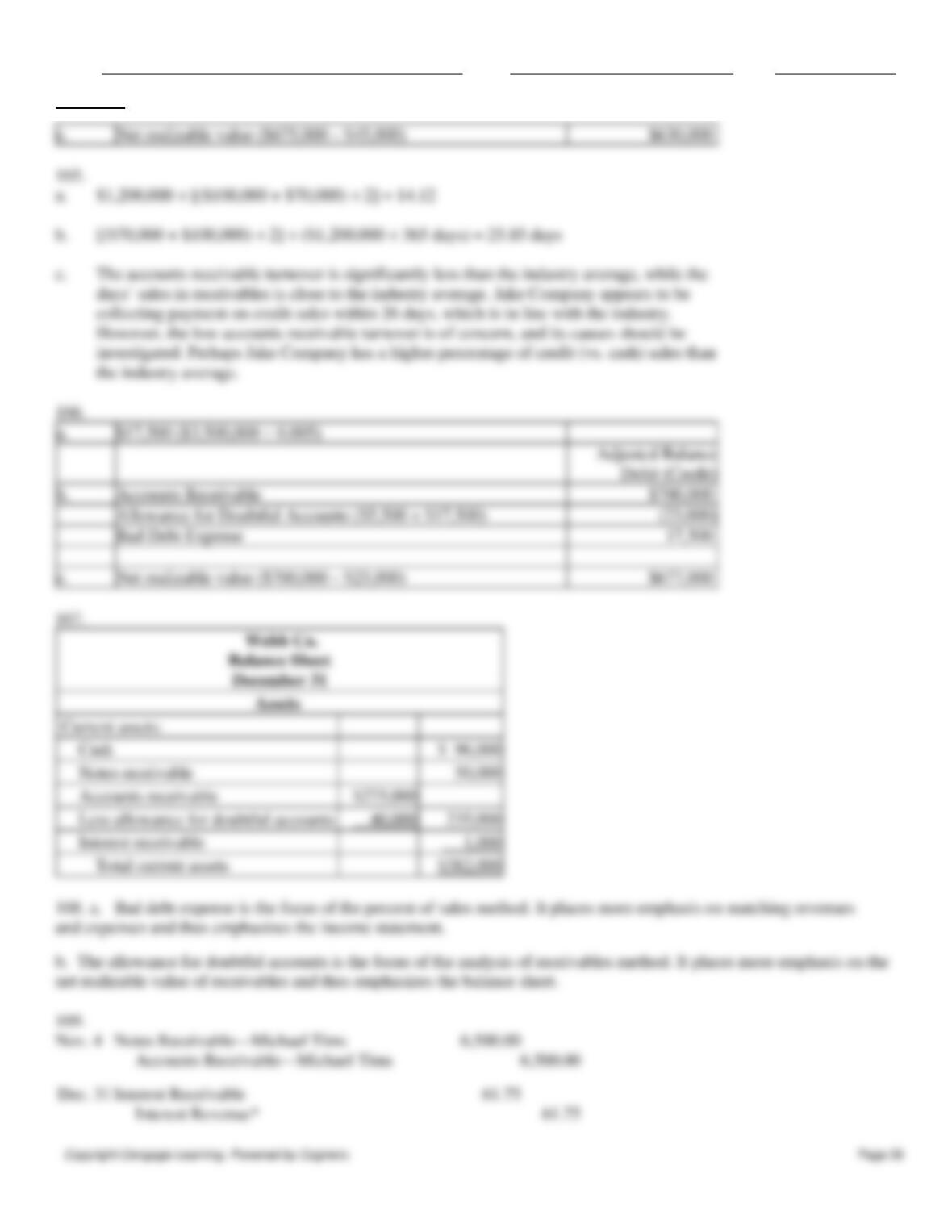
a.
True
b.
False
29. At the end of a period (before adjustment), Allowance for Doubtful Accounts has a credit balance of $5,000. The
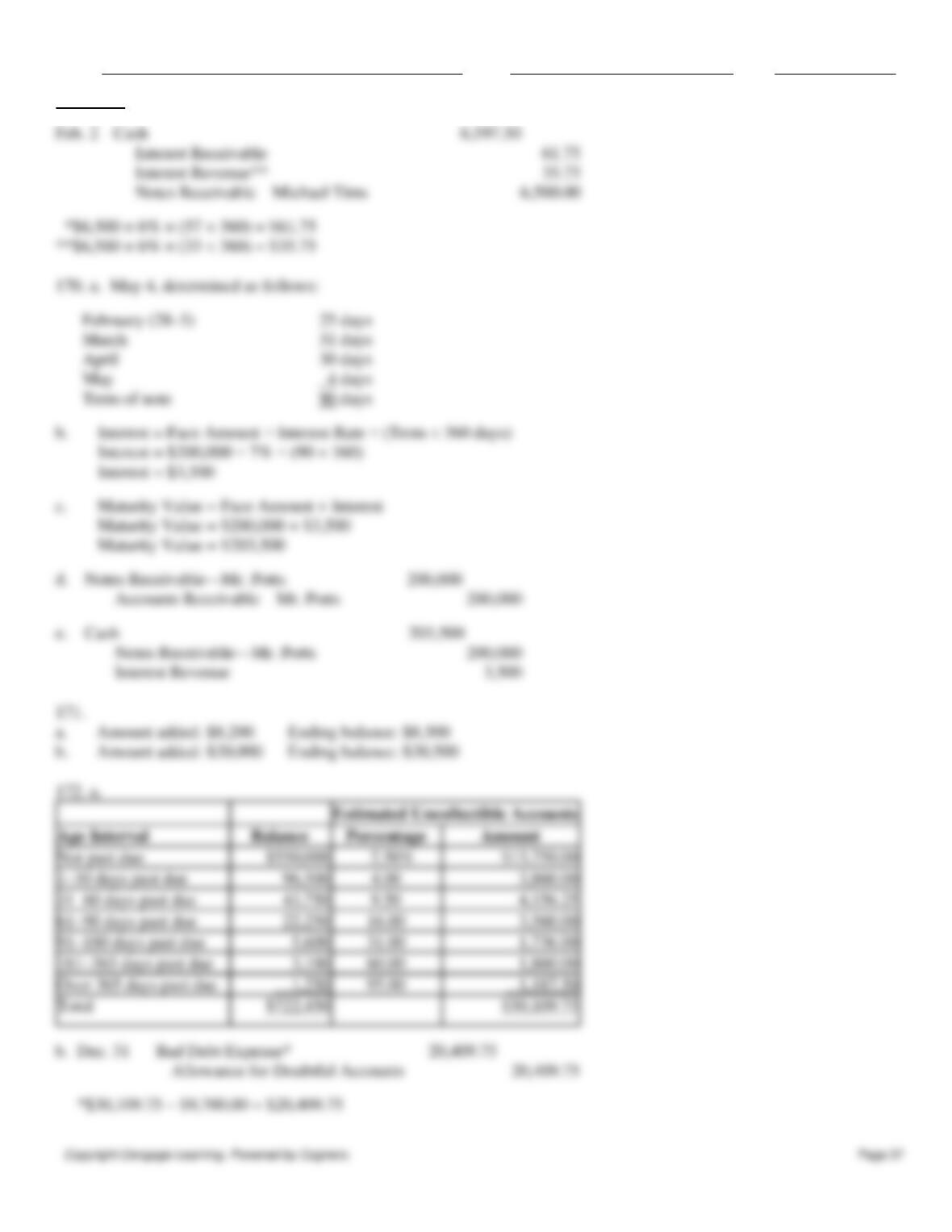
Accounts Receivable balance is analyzed by aging the accounts and the amount estimated to be uncollectible is $50,000.
The amount to be recorded in the adjusting entry for the bad debt expense is $45,000.
a.
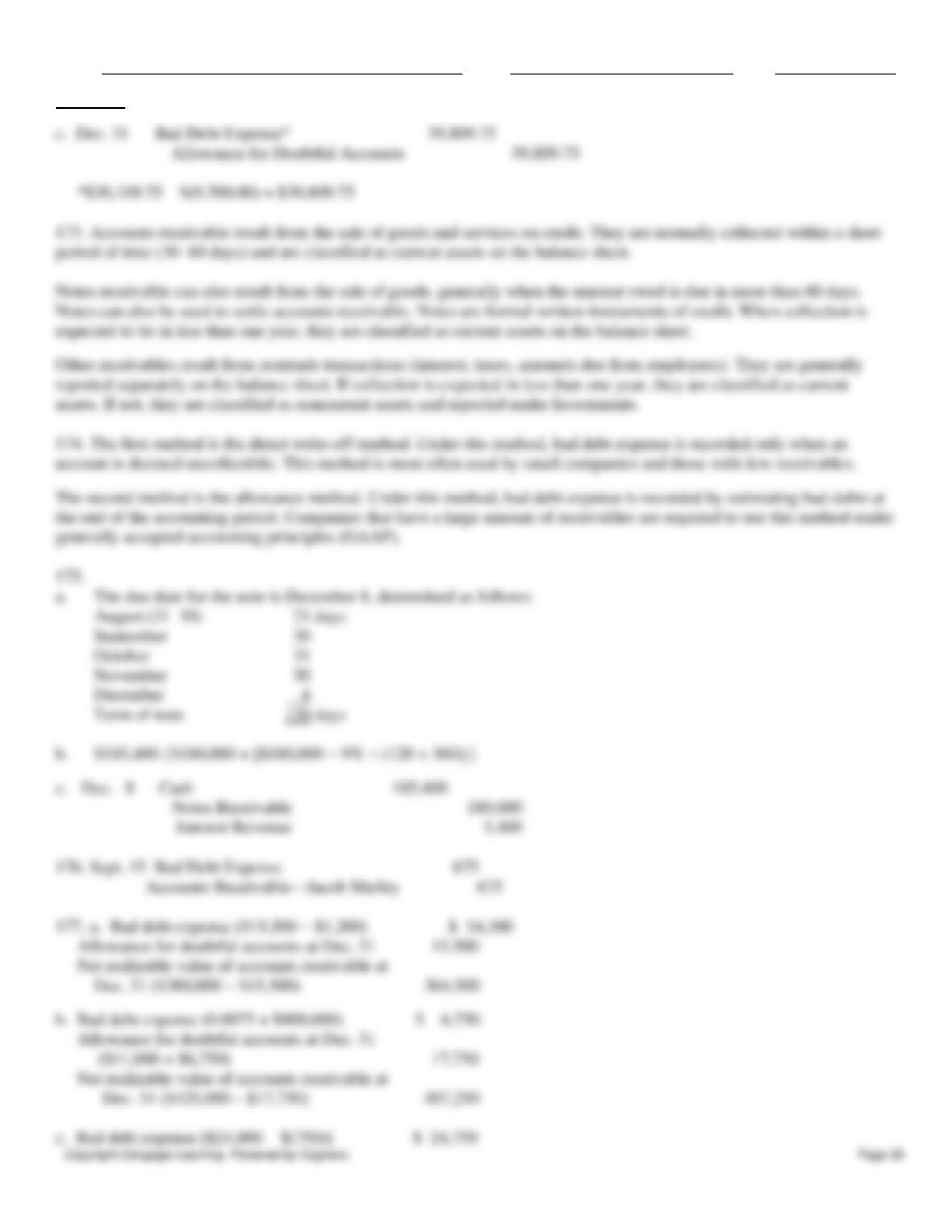
True
b.
False
30. The difference between the balance in Accounts Receivable and the balance in Allowance for Doubtful Accounts is
called the net realizable value of the receivables.
a.
True
b.
False

Name:
Class:
Date:
chapter 9
31. If a promissory note is dishonored, the payee should still record interest revenue.
a.
True
b.
False
32. When an account receivable that has been written off is subsequently collected, the account receivable must first be
reinstated before recording the receipt of payment.
a.
True
b.
False
33. At the end of a period (before adjustment), Allowance for Doubtful Accounts has a credit balance of $250. The credit
sales for the period total $500,000. If the company estimates uncollectible accounts expense at 1% of credit sales, the
amount of bad debt expense to be recorded in an adjusting entry is $4,750.
a.
True
b.
False
34. If the maker of a note fails to pay the debt on the due date, the note is said to be dishonored.
a.
True
b.
False
35. No allowance account is used with the direct write-off method.
a.
True
b.
False
36. The accounts receivable turnover measures the length of time in days it takes to collect a receivable.
a.
True
b.
False
37. The interest on a 6%, 60-day note for $5,000 is $300.
a.
True
b.
False
38. Trade receivables occur when two companies trade or exchange notes receivable.
a.
True
b.
False
39. At the end of a period (before adjustment), Allowance for Doubtful Accounts has a debit balance of $500. Credit sales
for the period total $800,000. If bad debt expense is estimated at 1% of credit sales, the amount of bad debt expense to be
recorded in the adjusting entry is $8,500.
a.
True
b.
False
40. Receivables that are expected to be collected in cash in 18 months or less are reported in the Current Assets section of
the balance sheet.
a.
True
b.
False

Name:
Class:
Date:
chapter 9
41. Days’ sales in receivables is an estimate of the length of time the accounts receivable have been outstanding.
a.
True
b.
False
42. The maturity value of a note receivable is always the same as its face value.
a.
True
b.
False
43. When using the percent of sales method of estimating uncollectibles, the entry to record bad debt expense includes a
credit to Accounts Receivable.
a.
True
b.
False
44. When the allowance method for accounting for uncollectible receivables is used, net income is reduced when a
specific receivable is written off.
a.
True
b.
False
45. Accounts receivable and notes receivable from sales transactions can also be called trade receivables.
a.
True
b.
False
Indicate the answer choice that best completes the statement or answers the question.
46. Allowance for Doubtful Accounts has a credit balance of $800 at the end of the year (before adjustment), and an
analysis of accounts in the customers ledger indicates that the estimated amount of uncollectible accounts is $16,000.
Based on the estimate, which of the following adjusting entries should be made?
a.
debit Bad Debt Expense, $800; credit Allowance for Doubtful Accounts, $800
b.
debit Bad Debt Expense, $15,200; credit Allowance for Doubtful Accounts, $15,200
c.
debit Allowance for Doubtful Accounts, $800; credit Bad Debt Expense, $800
d.
debit Bad Debt Expense, $16,800; credit Allowance for Doubtful Accounts, $16,800
47. Dalton Company uses the allowance method to account for uncollectible receivables. Dalton has determined that the
Irish Company account is uncollectible. To write off this account, Dalton should debit
a.
Bad Debt Expense and credit Accounts Receivable—Irish Company
b.
Bad Debt Expense and credit Allowance for Doubtful Accounts
c.
Allowance for Doubtful Accounts and credit Accounts Receivable—Irish Company
d.
Accounts Receivable—Irish Company and credit Allowance for Doubtful Accounts
48. The term “receivables” includes all
a.
money claims against other entities
b.
merchandise to be collected from individuals or companies
c.
cash to be paid to creditors
d.
cash to be paid to debtors
49. In accounting for uncollectible receivables, the balance in Allowance for Doubtful Accounts will directly impact the

Name:
Class:
Date:
chapter 9
amount of the adjustment when applying
a.
the direct write-off method
b.
the percentage of sales method
c.
the analysis of receivables method
d.
both the percentage of sales and analysis of receivables methods
50. When referring to a note receivable or promissory note,
a.
the maker is the party to whom the money is due
b.
the note is not considered a formal credit instrument
c.
the note cannot be factored to another party
d.
the note may be used to settle an accounts receivable
51. A company uses the allowance method to account for uncollectible accounts receivable. When the firm writes off a
specific customer’s account receivable,
a.
total current assets are reduced
b.
total expenses for the period are increased
c.
the net realizable value of accounts receivable increases
d.
there is no effect on total current assets or total expenses
52. When comparing the direct write-off method and the allowance method of accounting for uncollectible receivables, a
major difference is that the direct write-off method
a.
uses a percentage of sales to estimate uncollectible accounts
b.
is used primarily by large companies with many receivables
c.
is used primarily by small companies with few receivables
d.
uses an allowance account
53. If the direct write-off method of accounting for uncollectible receivables is used, what general ledger account is
debited to write off a customer’s account as uncollectible?
a.
Uncollectible Accounts Receivable
b.
Accounts Receivable
c.
Allowance for Doubtful Accounts
d.
Bad Debt Expense
54. Jefferson uses the percent of sales method of estimating uncollectible receivables. Based on past history, 2% of credit
sales are expected to be uncollectible. Sales for the current year are $5,550,000. Which of the following is correct?
a.
Uncollectible accounts are estimated to be $55,500.
b.
Uncollectible accounts are estimated to be $111,000.
c.
Bad debt expense is estimated to be $5,550.
d.
Bad debt expense is estimated to be $11,100.
55. At the beginning of the year, the balance in Allowance for Doubtful Accounts is a credit of $760. During the year,
previously written off accounts of $120 are reinstated and accounts totaling $740 are written off as uncollectible. The end-
of-year balance (before adjustment) in Allowance for Doubtful Accounts should be
a.
$760
b.
$120

Name:
Class:
Date:
chapter 9
c.
$140
d.
$740
56. An alternative name for Bad Debt Expense is
a.
Collection Expense
b.
Credit Loss Expense
c.
Uncollectible Accounts Expense
d.
Doubtless Accounts Expense
57. Allowance for Doubtful Accounts has a credit balance of $1,300 at the end of the year (before adjustment). The
company prepares an analysis of customers’ accounts to estimate the amount of uncollectible accounts of $41,900. Which
of the following adjusting entries would be made to record the bad debt expense for the year?
a.
debit Allowance for Doubtful Accounts, $40,600; credit Bad Debt Expense, $40,600
b.
debit Allowance for Doubtful Accounts, $43,200; credit Bad Debt Expense, $43,200
c.
debit Bad Debt Expense, $43,200; credit Allowance for Doubtful Accounts, $43,200
d.
debit Bad Debt Expense, $40,600; credit Allowance for Doubtful Accounts, $40,600
58. The receivable that is usually evidenced by a formal, written instrument of credit is a(n)
a.
trade receivable
b.
note receivable
c.
accounts receivable
d.
income tax receivable
59. If the allowance method of accounting for uncollectible receivables is used, what general ledger account is credited to
write off a customer’s account as uncollectible?
a.
Uncollectible Accounts Expense
b.
Accounts Receivable
c.
Allowance for Doubtful Accounts
d.
Interest Expense
60. When a company receives an interest-bearing note receivable, it will
a.
debit Notes Receivable for the maturity value of the note
b.
debit Notes Receivable for the face value of the note
c.
credit Notes Receivable for the maturity value of the note
d.
credit Notes Receivable for the face value of the note
61. One of the weaknesses of the direct write-off method is that it
a.
understates accounts receivable on the balance sheet
b.
violates the matching concept
c.
is too difficult to use for many companies
d.
is based on estimates
62. At the end of the current year, Accounts Receivable has a balance of $550,000; Allowance for Doubtful Accounts has
a credit balance of $5,500; and sales for the year total $2,500,000. An analysis of receivables estimates uncollectible
receivables as $25,000.

Name:
Class:
Date:
chapter 9
Determine the amount of the adjusting entry for bad debt expense and the adjusted balance of Allowance for Doubtful
Accounts, respectively.
a.
$19,500 and $25,000
b.
$30,500 and $525,000
c.
$19,500 and $525,000
d.
$30,500 and $25,000
63. An account becomes uncollectible
a.
when an account receivable is converted into a note receivable
b.
when a discount is availed on notes receivable
c.
There is no general rule for when an account becomes uncollectible.
d.
at the end of the fiscal year
64. A $6,000, 60-day, 12% note is not paid by the maker at maturity. The journal entry to recognize this event is
a.
debit Cash, $6,120; credit Notes Receivable, $6,120
b.
debit Accounts Receivable, $6,120; credit Notes Receivable, $6,000; credit Interest Receivable, $120
c.
debit Notes Receivable, $6,060; credit Accounts Receivable, $6,060
d.
debit Accounts Receivable, $6,120; credit Notes Receivable, $6,000; credit Interest Revenue, $120
65. The balance in Allowance for Doubtful Accounts will directly impact the end-of-period adjustment for bad debt
expense when using the
a.
allowance method based on aging the receivables
b.
direct write-off method
c.
allowance method based on the percent of sales method
d.
declining value method
66. Which of the following receivables would not be classified as an “other receivable”?
a.
advance to an employee
b.
interest receivable
c.
refundable income tax
d.
notes receivable from sales transactions
67. When a company uses the allowance method of accounting for uncollectible receivables, the entry to reinstate a
previously written off account would include a
a.
credit to Bad Debt Expense
b.
debit to Bad Debt Expense
c.
debit to Allowance for Doubtful Accounts
d.
credit to Allowance for Doubtful Accounts
68. Indications that an account may be uncollectible include all of the following except the customer
a.
closes its business
b.
is making small but regular payments
c.
files for bankruptcy
d.
cannot be located

Name:
Class:
Date:
chapter 9
69. Under the direct write-off method of accounting for uncollectible accounts, Bad Debt Expense is recorded
a.
at the end of each accounting period
b.
when a credit sale is past due
c.
whenever a predetermined amount of credit sales has been made
d.
when an account is determined to be worthless
70. Allowance for Doubtful Accounts has a debit balance of $600 at the end of the year (before adjustment), and an
analysis of accounts in the customers ledger indicates uncollectible receivables of $13,000. Which of the following entries
records the proper adjusting entry for bad debt expense?
a.
debit Bad Debt Expense, $600; credit Allowance for Doubtful Accounts, $600
b.
debit Bad Debt Expense, $12,400; credit Allowance for Doubtful Accounts, $12,400
c.
debit Allowance for Doubtful Accounts, $600; credit Bad Debt Expense, $600
d.
debit Bad Debt Expense, $13,600; credit Allowance for Doubtful Accounts, $13,600
71. Miles uses the allowance method and wrote off the account of James. Miles then received $559 as partial payment on
the account of James.
The journal entry for the initial write-off includes a
a.
debit to Allowance for Doubtful Accounts
b.
credit to Cash
c.
debit to Accounts Receivable—James
d.
credit to Bad Debt Expense
72. If collection of an other receivable is expected beyond one year, it is classified as a(n)
a.
other receivable under Noncurrent Assets
b.
other receivable under Current Assets
c.
investment under Current Assets
d.
investment under Noncurrent Assets
73. The maturity value of a $40,000, 9%, 40-day note receivable dated July 3 is
a.
$40,000
b.
$40,400
c.
$43,600
d.
$44,000
74. If the maker of a promissory note fails to pay the note on the due date, the note is said to be
a.
displaced
b.
disallowed
c.
dishonored
d.
discounted
75. The operating expense recorded from uncollectible receivables can be called all of the following except
a.
Accounts Receivable
b.
Bad Debt Expense
c.
Doubtful Accounts Expense

Name:
Class:
Date:
chapter 9
d.
Uncollectible Accounts Expense
76. The accounts receivable turnover measures
a.
how frequently during the year the accounts receivable are converted to cash
b.
the number of days of accounts receivable outstanding
c.
the fair market value of accounts receivable
d.
the efficiency of the accounts payable function
77. Allowance for Doubtful Accounts has a debit balance of $2,300 at the end of the year (before adjustment). The
company prepares an analysis of customers’ accounts and estimates the amount of uncollectible accounts to be $31,900.
Which of the following adjusting entries is needed for the bad debt expense for the year?
a.
debit Bad Debt Expense, $34,200; credit Allowance for Doubtful Accounts, $34,200
b.
debit Allowance for Doubtful Accounts, $34,200; credit Bad Debt Expense, $34,200
c.
debit Allowance for Doubtful Accounts, $29,600; credit Bad Debt Expense, $29,600
d.
debit Bad Debt Expense, $29,600; credit Allowance for Doubtful Accounts, $29,600
78. A debit balance in Allowance for Doubtful Accounts
a.
is the normal balance for that account
b.
indicates that actual bad debt write-offs have been less than what was estimated
c.
cannot occur if the percentage of receivables method of estimating bad debts is used
d.
indicates that actual bad debt write-offs have exceeded previous provisions for bad debts
79. To record estimated uncollectible receivables using the allowance method, the adjusting entry would be a
a.
debit to Bad Debt Expense and a credit to Allowance for Doubtful Accounts
b.
debit to Accounts Receivable and a credit to Allowance for Doubtful Accounts
c.
debit to Allowance for Doubtful Accounts and a credit to Accounts Receivable
d.
debit to Loss on Credit Sales and a credit to Accounts Receivable
80. Other receivables includes all of the following except
a.
notes receivable from sales transactions
b.
receivables from employees
c.
taxes receivable
d.
interest receivable
81. The collection of an account that had been previously written off under the allowance method of accounting for
uncollectibles
a.
will increase net income in the period it is collected
b.
will decrease net income in the period it is collected
c.
does not affect net income in the period it is collected
d.
requires a correcting entry for the period in which the account was written off
82. Abbott Company uses the allowance method of accounting for uncollectible receivables. Abbott estimates that 3% of
credit sales will be uncollectible. On January 1, Allowance for Doubtful Accounts had a credit balance of $2,400. During
the year, Abbott wrote off accounts receivable totaling $1,800 and made credit sales of $100,000. There were no sales
returns during the year. After the adjusting entry, the December 31 balance in Bad Debt Expense will be

Name:
Class:
Date:
chapter 9
a.
$1,200
b.
$3,000
c.
$3,600
d.
$7,200
83. Using the allowance method of accounting for uncollectible receivables, the entry to reinstate a specific receivable
previously written off would include a
a.
credit to Bad Debt Expense
b.
credit to Accounts Receivable
c.
debit to Allowance for Doubtful Accounts
d.
debit to Accounts Receivable
84. A 60-day, 12% note for $7,000, dated April 15, is received from a customer on account. The face value of the note is
a.
$6,860
b.
$7,140
c.
$7,840
d.
$7,000
85. The two methods of accounting for uncollectible receivables are the allowance method and the
a.
equity method
b.
direct write-off method
c.
interest method
d.
cost method
86. You have just received notice that a customer with an account receivable balance has gone bankrupt and will not
make any future payments. Assuming you use the allowance method, the entry you make is to
a.
debit Bad Debt Expense and credit Allowance for Doubtful Accounts
b.
debit Bad Debt Expense and credit Accounts Receivable
c.
debit Allowance for Doubtful Accounts and credit Accounts Receivable
d.
debit Allowance for Doubtful Accounts and credit Bad Debt Expense
87. On October 1, Black Company receives a 9% interest-bearing note from Reese Company to settle a $20,000 account
receivable. The note is due in six months. At December 31, Black should record interest revenue of
a.
$0
b.
$450
c.
$900
d.
$1,800
88. Interest on a note can be computed without knowledge of the
a.
fair value of the note
b.
rate of interest
c.
note duration
d.
principal amount
89. Current assets are usually listed in order

Name:
Class:
Date:
chapter 9
a.
of the due date
b.
of the size
c.
alphabetically
d.
of liquidity
90. The journal entry for a note received from a customer to replace an account is
a.
debit Notes Receivable; credit Accounts Receivable
b.
debit Accounts Receivable; credit Notes Receivable
c.
debit Cash; credit Notes Receivable
d.
debit Notes Receivable; credit Notes Payable
91. Under the allowance method of accounting for uncollectible receivables, writing off an uncollectible account
a.
affects only income statement accounts
b.
is not an acceptable practice
c.
affects only balance sheet accounts
d.
affects both balance sheet and income statement accounts
92. Selling receivables
a.
can shift some of the risk to the buyer
b.
delays the receipt of cash
c.
occurs when an account becomes uncollectible
d.
results in bad debt expense
93. What is the type of account and normal balance of Allowance for Doubtful Accounts?
a.
contra asset; credit
b.
asset; debit
c.
asset; credit
d.
contra asset; debit
94. Lowery Co. uses the direct write-off method of accounting for uncollectible accounts receivable. Lowery has a
customer whose accounts receivable balance has been determined to likely be uncollectible. The entry to write off this
account would be
a.
debit Allowance for Doubtful Accounts; credit Accounts Receivable
b.
debit Accounts Receivable; credit Notes Receivable
c.
debit Bad Debt Expense; credit Allowance for Doubtful Accounts
d.
debit Bad Debt Expense; credit Accounts Receivable
95. Allowance for Doubtful Accounts has a debit balance of $1,100 at the end of the year (before adjustment), and an
analysis of customers’ accounts indicates uncollectible receivables of $12,900. Which of the following entries records the
proper adjustment for bad debt expense?
a.
debit Bad Debt Expense, $14,000; credit Allowance for Doubtful Accounts, $14,000
b.
debit Allowance for Doubtful Accounts, $14,000; credit Bad Debt Expense, $14,000
c.
debit Allowance for Doubtful Accounts, $11,800; credit Bad Debt Expense, $11,800
d.
debit Bad Debt Expense, $11,800; credit Allowance for Doubtful Accounts, $11,800

Name:
Class:
Date:
chapter 9
96. An aging of a company’s accounts receivable indicates that the estimate of the uncollectible accounts totals $4,000. If
Allowance for Doubtful Accounts has a $800 credit balance, the adjustment to record the bad debt expense for the period
will require a
a.
debit to Allowance for Doubtful Accounts for $3,200
b.
debit to Bad Debt Expense for $3,200
c.
debit to Allowance for Doubtful Accounts for $4,000
d.
credit to Allowance for Doubtful Accounts for $4,000
97. The allowance method of estimating uncollectible accounts receivable based on an analysis of receivables shows that
$640 of accounts receivable are uncollectible. Allowance for Doubtful Accounts has a debit balance of $110. The
adjusting entry at the end of the year will include a credit to Allowance for Doubtful Accounts in the amount of
a.
$110
b.
$640
c.
$530
d.
$750
98. A 60-day, 9% note for $10,000, dated May 1, is received from a customer on account. The maturity value of the note
is
a.
$10,000
b.
$10,150
c.
$10,900
d.
$9,100
99. Days’ sales in receivables
a.
is an estimate of the length of time the receivables have been outstanding
b.
measures the number of times the receivables turn over each year
c.
is credit sales divided by average receivables
d.
is not meaningful and therefore is not used
100. On the balance sheet, the amount shown for Allowance for Doubtful Accounts is equal to the
a.
uncollectible accounts expense for the year
b.
total of the accounts receivable written off during the year
c.
total estimated uncollectible accounts as of the end of the year
d.
sum of all accounts that are past due
101. Given the following information, compute the accounts receivable turnover.
Cash $150,000
Accounts receivable, beginning of year $18,000
Sales 135,000
Accounts receivable, end of year 22,000
a.
6.75
b.
7.50
c.
6.13
d.
6.82
102. Which of these statements is not true?
a.
Current assets are normally reported in order of their liquidity.

Name:
Class:
Date:
chapter 9
b.
Disclosures related to receivables are reported in the financial statement notes.
c.
Cash and cash equivalents are the first items reported under Current Assets.
d.
All receivables that are expected to be realized in cash beyond 265 days are reported in the Noncurrent Assets
section.
103. If the direct write-off method of accounting for uncollectible receivables is used, what general ledger account is
credited to write off a customer’s account as uncollectible?
a.
Uncollectible Accounts Expense
b.
Accounts Receivable
c.
Allowance for Doubtful Accounts
d.
Interest Expense
104. Tanning Company analyzes its receivables to estimate bad debt expense. The accounts receivable balance is
$390,000 and credit sales are $1,300,000. An aging of accounts receivable shows that approximately 5% of the
outstanding receivables will be uncollectible. What adjusting entry will Tanning Company make if Allowance for
Doubtful Accounts has a credit balance of $2,500 before adjustment?
a.
Bad Debt Expense 17,000
Allowance for Doubtful Accounts 17,000
b.
Bad Debt Expense 19,500
Allowance for Doubtful Accounts 19,500
c.
Bad Debt Expense 22,000
Allowance for Doubtful Accounts 22,000
d.
Bad Debt Expense 65,000
Allowance for Doubtful Accounts 65,000
105. The direct write-off method of accounting for uncollectible accounts
a.
emphasizes balance sheet relationships
b.
is often used by small companies and companies with few receivables
c.
emphasizes cash realizable value
d.
emphasizes the matching of expenses with revenues
106. The amount for which a promissory note is written is called the
a.
realizable value
b.
maturity value
c.
face value
d.
proceeds
107. When a company uses the allowance method of accounting for uncollectible receivables, which entry would not be
found in its general journal?
a.
Bad Debt Expense 500
Allowance for Doubtful Accounts 500
b.
Bad Debt Expense 500
Accounts Receivable—Bob Smith 500
c.
Cash 300
Allowance for Doubtful Accounts 200
Accounts Receivable—Bob Smith 500

Name:
Class:
Date:
chapter 9
d.
Cash 500
Accounts Receivable—Bob Smith 500
108. On August 1, Kim Company accepted a 90-day note receivable as payment for services provided to Hsu Company.
The terms of the note were $20,000 face value and 6% interest. On October 30, the journal entry for the collection of the
note should include a
a.
credit to Notes Receivable for $20,300
b.
debit to Interest Receivable for $300
c.
credit to Interest Revenue for $300
d.
debit to Notes Receivable for $20,000
109. Allowance for Doubtful Accounts has a credit balance of $2,100 at the end of the year (before adjustment), and an
analysis of customers’ accounts indicates uncollectible receivables of $19,700. Which of the following entries records the
proper adjustment for bad debt expense?
a.
debit Allowance for Doubtful Accounts, $17,600; credit Bad Debt Expense, $17,600
b.
debit Allowance for Doubtful Accounts, $21,800; credit Bad Debt Expense, $21,800
c.
debit Bad Debt Expense, $21,800; credit Allowance for Doubtful Accounts, $21,800
d.
debit Bad Debt Expense, $17,600; credit Allowance for Doubtful Accounts, $17,600
110. At the end of the current year, Accounts Receivable has a balance of $550,000; Allowance for Doubtful Accounts
has a credit balance of $5,500; and sales for the year total $2,500,000. An analysis of receivables estimates uncollectible
receivables as $25,000.
Determine the net realizable value of accounts receivable after adjustment. (Hint: Determine the amount of the adjusting
entry for bad debt expense and the adjusted balance of Allowance for Doubtful Accounts.)
a.
$550,000
b.
$544,500
c.
$525,000
d.
$575,000
111. When the allowance method is used to account for uncollectible accounts, Bad Debt Expense is debited when
a.
a customer’s account becomes past due
b.
an account becomes bad and is written off
c.
a sale is made
d.
management estimates the amount of uncollectibles
112. An aging of a company’s accounts receivable indicates that the estimate of uncollectible receivables totals $7,900. If
Allowance for Doubtful Accounts has a $700 credit balance, the adjustment to record the bad debt expense for the period
will require a
a.
debit to Bad Debt Expense for $8,600
b.
debit to Bad Debt Expense for $7,900
c.
debit to Bad Debt Expense for $7,200
d.
credit to Allowance for Doubtful Accounts for $700
113. Notes or accounts receivable that result from sales transactions are often called
a.
nontrade receivables

Name:
Class:
Date:
chapter 9
b.
trade receivables
c.
merchandise receivables
d.
sales receivables
114. An aging of a company’s accounts receivable indicates that the estimate of uncollectible accounts totals $6,400. If
Allowance for Doubtful Accounts has a $1,300 debit balance, the adjustment to record the bad debt expense for the period
will require a
a.
debit to Bad Debt Expense for $7,700
b.
debit to Bad Debt Expense for $6,400
c.
debit to Bad Debt expense for $5,100
d.
credit to Allowance for Doubtful Accounts for $1,300
115. Under the allowance method, when a year-end adjustment is made for estimated uncollectible accounts
a.
liabilities decrease
b.
net income is unchanged
c.
total assets are unchanged
d.
total assets decrease
116. The amount of the promissory note plus the interest earned on the due date is called the
a.
interest value
b.
maturity value
c.
face value
d.
issuance value
117. Paper Company receives a $6,000, three-month, 6% promissory note from Dame Company in settlement of an open
accounts receivable. What entry will Paper Company make upon receiving the note?
a.
Notes Receivable, Dame Company 6,000
Accounts Receivable, Dame Company 6,000
b.
Notes Receivable, Dame Company 6,090
Accounts Receivable, Dame Company 6,090
c.
Notes Receivable, Dame Company 6,090
Accounts Receivable, Dame Company 6,000
Interest Revenue 90
d.
Notes Receivable, Dame Company 6,000
Interest Revenue 90
Accounts Receivable, Dame Company 6,000
Interest Receivable 90
118. After the accounts are adjusted and closed at the end of the fiscal year, Accounts Receivable has a balance of
$340,000 and Allowance for Doubtful Accounts has a balance of $51,000. What is the net realizable value of accounts
receivable?
a.
$51,000
b.
$289,000
c.
$340,000
d.
$391,000

Name:
Class:
Date:
chapter 9
119. Allowance for Doubtful Accounts is classified as a(n) _____ account and has a normal _____ balance.
a.
owner’s equity; credit
b.
contra asset; debit
c.
owner’s equity; debit
d.
contra asset; credit
120. Allowance for Doubtful Accounts has a debit balance of $2,500 at the end of the year (before adjustment), and bad
debt expense is estimated at 4% of credit sales. If credit sales are $800,000, the amount of the adjusting entry for the
estimate of the uncollectible accounts
a.
is $29,500
b.
is $34,500
c.
is $32,000
d.
cannot be determined with the information given
121. Harper Company lends Hewell Company $40,000 on March 1, accepting a four-month, 6% interest note. Harper
Company prepares financial statements on March 31. What adjusting entry should be made before the financial statements
can be prepared?
a.
Cash 200
Interest Revenue 200
b.
Interest Receivable 800
Interest Revenue 800
c.
Interest Receivable 200
Interest Revenue 200
d.
Notes Receivable 40,000
Cash 40,000
122. Two methods of accounting for uncollectible accounts are the
a.
direct write-off method and the allowance method
b.
allowance method and the accrual method
c.
allowance method and the net realizable method
d.
direct write-off method and the accrual method
123. Allowance for Doubtful Accounts has a credit balance of $500 at the end of the year (before adjustment), and bad
debt expense is estimated at 3% of credit sales. If credit sales are $300,000, the amount of the adjusting entry for the
estimated uncollectible accounts receivable
a.
is $8,500
b.
is $9,500
c.
is $9,000
d.
cannot be determined with the information given
124. Jefferson uses the percent of sales method of estimating uncollectible receivables. Based on past history, 2% of credit
sales are expected to be uncollectible. Sales for the current year are $5,550,000. Which of the following is correct
regarding the entry to record estimated uncollectible receivables?
a.
Cash will be debited.
b.
Bad Debt Expense will be credited.
c.
Allowance for Doubtful Accounts will be credited.

Name:
Class:
Date:
chapter 9
d.
Accounts Receivable will be debited.
125. If the allowance method of accounting for uncollectible receivables is used, what general ledger account is debited to
write off a customer’s account as uncollectible?
a.
Uncollectible Accounts Expense
b.
Allowance for Doubtful Accounts
c.
Accounts Receivable
d.
Interest Expense
126. A note receivable due in 18 months is listed on the balance sheet under the caption
a.
Long-term liabilities
b.
Fixed assets
c.
Current assets
d.
Investments
Match each of the following descriptions to the term (a–i) it describes.
a.
Accounts receivable turnover
b.
Net realizable value
c.
Accounts receivable
d.
Aging the receivables
e.
Receivables
f.
Direct write-off method
g.
Allowance for doubtful accounts
h.
Bad debt expense
i.
Notes receivable
127. A receivable created from selling merchandise or services on account
128. The process of analyzing the accounts receivable and classifying them according to various age groupings, with the
due date being the base point for determining age
129. A contra asset that represents the amount of estimated uncollectible receivables
130. Records bad debt expense only when a specific customer’s account is deemed worthless
131. Operating expense recorded as a result of receivables becoming uncollectible
132. The difference between accounts receivable and allowance for doubtful accounts
133. Amounts owed by customers documented by a formal written instrument of credit
134. All money claims against other entities
135. Measures how frequently during the year accounts receivable are being turned into cash

Name:
Class:
Date:
chapter 9
Match each of the following descriptions to the method of accounting for uncollectible receivables (a–d) it describes.
Each term may be used more than once.
a.
Direct write-off method
b.
Aging of receivables method
c.
Percent of sales method
d.
Allowance method
136. This method records bad debts when specific accounts are deemed uncollectible.
137. When using this method, estimated bad debts are added to the existing allowance balance.
138. This method is most often used by small companies with few receivables.
139. This method is based on the theory that older accounts are less likely to be collected.
140. This method focuses on the balance sheet.
141. This method estimates the uncollectible accounts receivable at the end of the accounting period.
142. With this method, there is no allowance account.
143. This method focuses on the income statement.
144. When writing off a specific uncollectible account, this method debits Bad Debt Expense.
Match each of the following descriptions to the term (a–h) it describes. Each term will be used only once.
a.
Face amount
b.
Term
c.
Interest
d.
Maturity value
e.
Dishonored note
f.
Maker
g.
Notes receivable
h.
Interest rate
145. A formal, written instrument of credit that represents amounts due from customers
146. The amount due that must be paid at the due date of a note receivable
147. The amount charged for using the money of another party
148. The stated rate charged for using the money of another party
149. A note that is not paid when it is due
150. The dollar amount stated on a promissory note
151. The party promising to pay a note
Name:
Class:
Date:
chapter 9
152. The time between the date a note is issued and the due date of the note
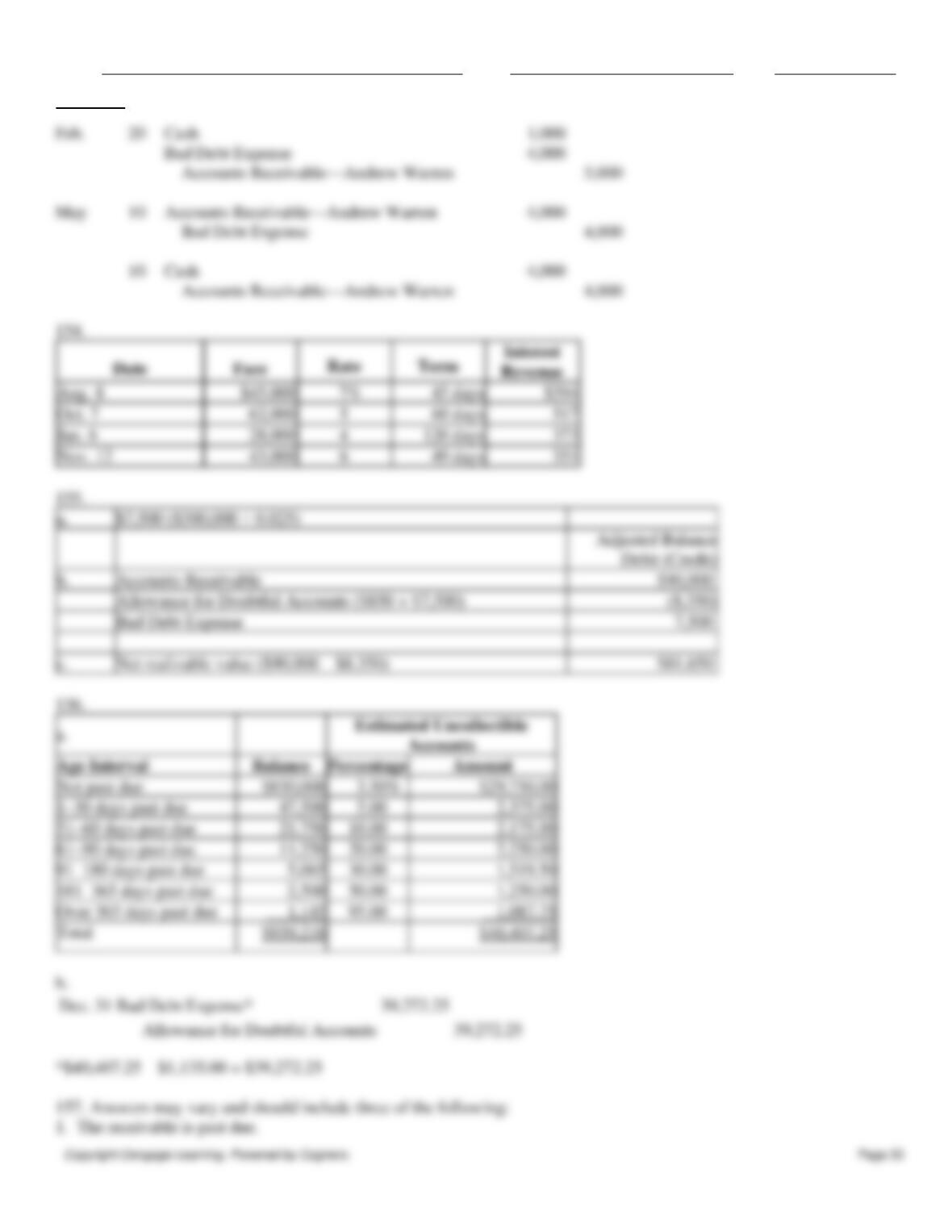
153. Journalize the following transactions using the direct write-off method of accounting for uncollectible receivables.
Feb. 20 Received $1,000 from Andrew Warren and wrote off the remainder owed of $4,000 as uncollectible.
May 10 Reinstated the account of Andrew Warren and received $4,000 cash in full payment.
154. For each of the following notes receivables held by Christensen Company, determine the interest revenue to be
reported on the income statements for the year ended December 31. Round answers to the nearest whole dollar.
Date
Face
Rate
Term
Interest Revenue
Aug. 8
$45,000
7%
45 days
Oct. 7
62,000
5
60 days
Jan. 6
28,000
4
120 days
Nov. 12
43,000
6
60 days
155. At the end of the current year, Accounts Receivable has a balance of $90,000; Allowance for Doubtful Accounts has
a credit balance of $850; and sales for the year total $300,000. Bad debt expense is estimated at 2.5% of sales.
Determine (a) the amount of the adjusting entry for uncollectible accounts; (b) the adjusted balances of Accounts
Receivable, Allowance for Doubtful Accounts, and Bad Debt Expense; and (c) the net realizable value of accounts
receivable.
156. The partially completed aging of receivables schedule for Torme Designs follows:
Estimated Uncollectible Accounts
Age Interval
Balance
Percentage
Amount
Not past due
$850,000
3.50%
1–30 days past due
47,500
5.00
31–60 days past due
21,750
10.00
61–90 days past due
11,250
20.00
91–180 days past due
5,065
30.00
181–365 days past due
2,500
50.00
Over 365 days past due
1,145
95.00
Total
$939,210
a. Complete the schedule and determine the total estimate of uncollectible accounts. Show amounts to the nearest cent (do
not round).
b. Assuming Allowance for Doubtful Accounts has an unadjusted credit balance of $1,135, journalize the adjusting entry
for the bad debt expense for the year.
157. List at least three indicators that a receivable may be uncollectible.
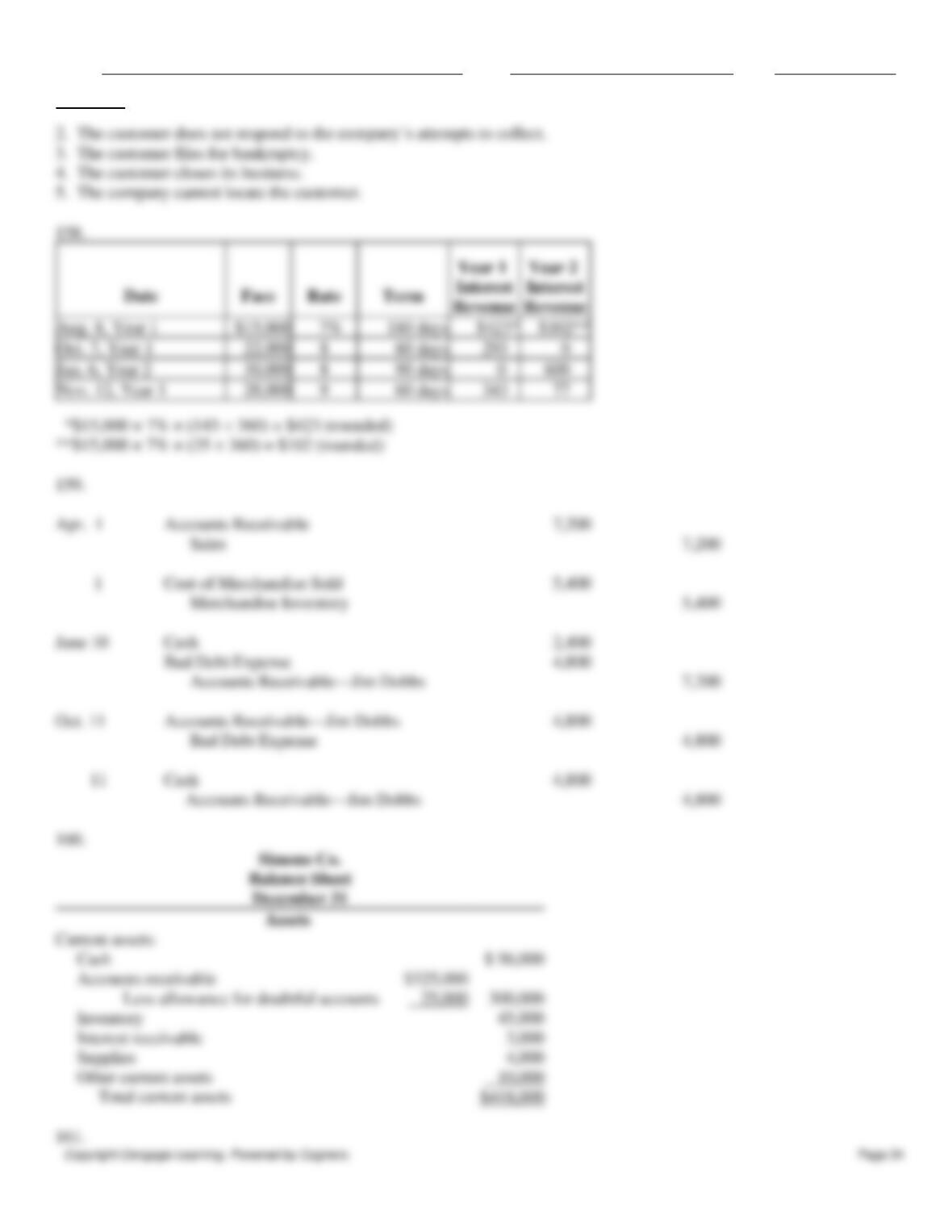
158. For each of the following notes receivable held by Winter Company, determine the interest revenue to be reported on
the income statements. Round answers to nearest whole dollar.
Date
Face
Rate
Term
Year 1
Interest
Revenue
Year 2
Interest
Revenue

Name:
Class:
Date:
chapter 9
Aug. 8, Year 1
$15,000
7%
180 days
Oct. 7, Year 1
22,000
8
60 days
Jan. 6, Year 2
30,000
8
90 days
Nov. 12, Year 1
28,000
9
60 days
159. Journalize the following transactions using the direct write-off method of accounting for uncollectible receivables.
Apr. 1 Sold merchandise on account to Jim Dobbs, $7,200. The cost of the merchandise is $5,400.
June 10 Received payment for one-third of the receivable from Jim Dobbs and wrote off the remainder.
Oct. 11 Reinstated the account of Jim Dobbs and received cash in full payment.
160. On the basis of the following data related to assets due within one year for Simons Co., prepare a partial balance
sheet at December 31. Show total current assets.
Cash
$ 56,000
Accounts receivable
325,000
Allowance for doubtful accounts
25,000
Interest receivable
3,000
Supplies
4,000
Inventory
45,000
Other current assets
10,000
161. At the end of the current year, Accounts Receivable has a balance of $750,000; Allowance for Doubtful Accounts
has a debit balance of $6,200; and sales for the year total $3,500,000. Bad debt expense is estimated at ½ of 1% of sales.
Determine (a) the amount of the adjusting entry for bad debt expense; (b) the adjusted balances of Accounts Receivable,
Allowance for Doubtful Accounts, and Bad Debt Expense; and (c) the net realizable value of accounts receivable.
162. Journalize the following transactions using the allowance method of accounting for uncollectible receivables.
Apr. 1 Sold merchandise on account to Jim Dobbs, $7,200. The cost of the merchandise is $5,400.
June 10 Received payment for one-third of the receivable from Jim Dobbs and wrote off the remainder.
Oct. 11 Reinstated the account of Jim Dobbs and received cash in full payment.
163. Journalize the following transactions for Lucite Company:
Nov. 14 Received a $4,800, 90-day, 9% note from Alan Albertson in payment of his account.
Dec. 31 Accrued interest on the Albertson note.
Feb. 12 Received the amount due from Albertson on his note.
164. At the end of the current year, Accounts Receivable has a balance of $675,000; Allowance for Doubtful Accounts
has a debit balance of $5,400; and sales for the year total $3,000,000. An analysis of receivables indicates the
uncollectible receivables are estimated to be $45,000.
Determine (a) the amount of the adjusting entry for bad debt expense; (b) the adjusted balances of Accounts Receivable,
Allowance for Doubtful Accounts, and Bad Debt Expense; and (c) the net realizable value of accounts receivable.
165. Based on the following data for Jake Company and using a 365-day year, compute (a) the accounts receivable
turnover and (b) days’ sales in receivables for Year 2. Round to two decimal places. The industry average accounts
receivable turnover is 20, and the industry average days’ sales in receivables is 25. (c) Comment on Jake Company’s
situation.

Name:
Class:
Date:
chapter 9
12/31/Year 1 accounts receivable
$ 100,000
12/31/Year 2 accounts receivable
70,000
For the year ended 12/31/Year 1, sales
1,050,000
For the year ended 12/31/Year 2, sales
1,200,000
166. At the end of the current year, Accounts Receivable has a balance of $700,000; Allowance for Doubtful Accounts
has a credit balance of $5,500; and sales for the year total $3,500,000. Bad debt expense is estimated at ½ of 1% of sales.
Determine (a) the amount of the adjusting entry for bad debt expense; (b) the adjusted balances of Accounts Receivable,
Allowance for Doubtful Accounts, and Bad Debt Expense; and (c) the net realizable value of accounts receivable.
167. On the basis of the following data related to assets due within one year for Webb Co., prepare a partial balance sheet
at December 31. Show total current assets.
Cash
$ 96,000
Notes receivable
50,000
Accounts receivable
275,000
Allowance for doubtful accounts
40,000
Interest receivable
1,000
168. Discuss the (a) focus and (b) financial statement emphasis of the percent of sales and the analysis of receivables
methods of estimating bad debts.
169. Journalize the following transactions for Scott Company:
Nov. 4 Received a $6,500, 90-day, 6% note from Michael Tims in payment of his account.
Dec. 31 Accrued interest on the Tims note.
Feb. 2 Received the amount due from Tims on his note.
170. Mr. Potts issued a 90-day, 7% note for $200,000, dated February 3 to Valley Co. on account. (Assume a 360-day
year when computing interest.)
a. Determine the due date of the note.
b. Determine the interest.
c. Determine the maturity value of the note.
d. Journalize the entry for the receipt of the note from Potts on February 3.
e. Journalize the entry for the receipt of payment of the note at maturity by Valley Co.
171. Determine the amount to be added to Allowance for Doubtful Accounts in each of the following cases and indicate
the ending balance in each case.
a.
Credit balance of $300 in Allowance for Doubtful Accounts just prior to adjustment.
Analysis of Accounts Receivable indicates uncollectible receivables of $8,500.
b.
Credit balance of $500 in Allowance for Doubtful Accounts just prior to adjustment.
Uncollectible receivables are estimated at 2% of credit sales, which totaled $1,000,000 for
the year.
172. A partially completed aging of receivables schedule for Lindy Designs follows:
Estimated Uncollectible
Accounts
Age Interval
Balance
Percentage
Amount
Not past due
$550,000
2.50%
Name:
Class:
Date:
chapter 9
1–30 days past due
96,500
4.00
31–60 days past due
43,750
9.50
61–90 days past due
22,250
16.00
91–180 days past due
5,600
31.00
181–365 days past due
3,100
60.00
Over 365 days past due
1,250
95.00
Total
$722,450
a. Complete the schedule and determine the total estimate of uncollectible accounts. Show amounts to the nearest cent (do
not round).
b. If Allowance for Doubtful Accounts has an unadjusted credit balance of $9,700, record the adjusting entry for bad debt
expense for the year.
c. If Allowance for Doubtful Accounts has an unadjusted debit balance of $9,700, record the adjusting entry for bad debt
expense for the year.
173. Discuss the similarities and differences between accounts receivable, notes receivable, and other receivables.
174. Discuss the two methods for recording bad debt expense. What type of company uses each method?
175. Blackwell Industries received a 120-day, 9% note for $180,000, dated August 10 from a customer on account.
a. Determine the due date of the note.
b. Determine the maturity value of the note.
c. Journalize the entry for the receipt of the payment of the note at maturity.
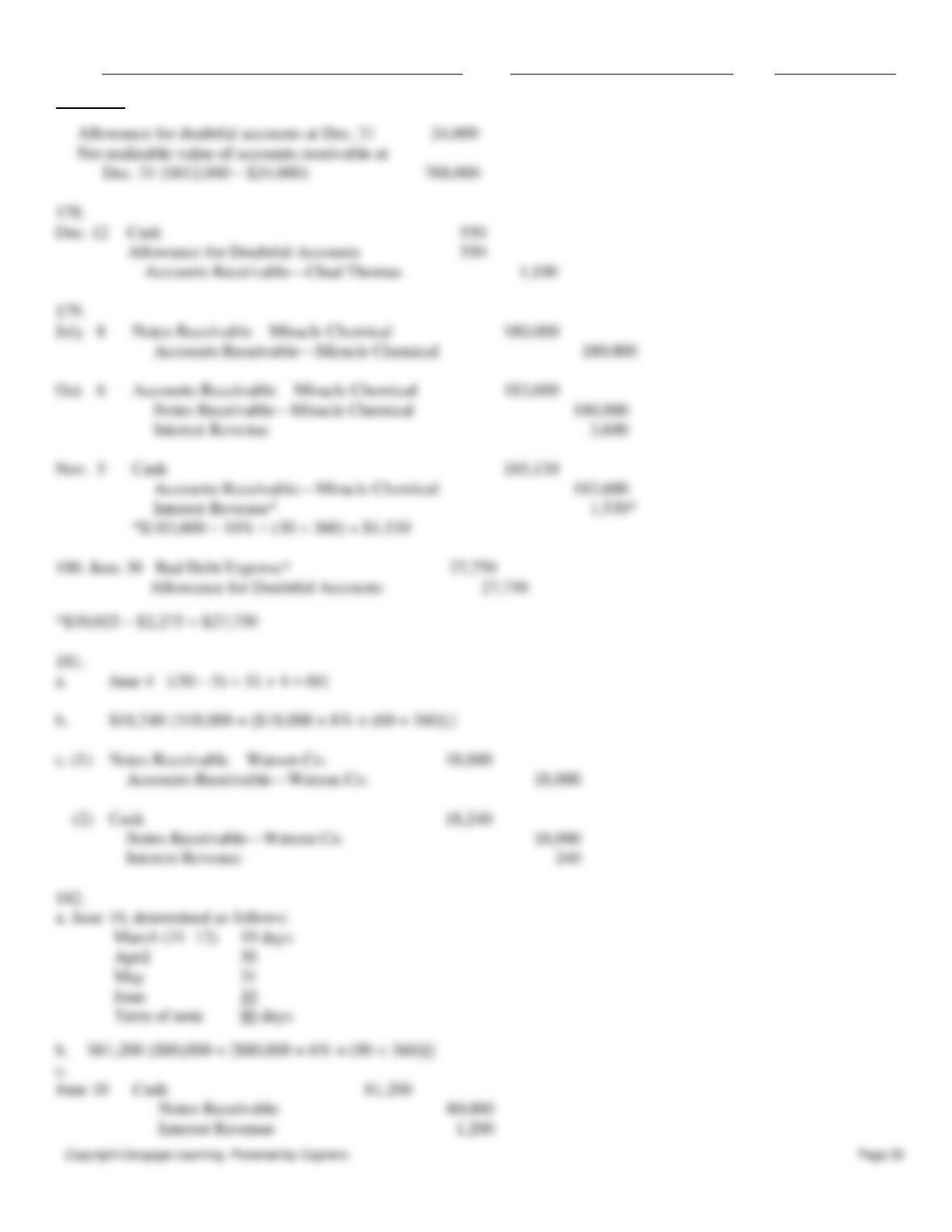
176. Stephanie Roe utilizes the direct write-off method of accounting for uncollectible receivables. On September 15, she
is notified by the attorneys for Jacob Marley that Jacob Marley is bankrupt, and none of the $675 balance due on his
account is expected in the liquidation process. Journalize the entry to write off Jacob Marley’s account.
177. For each of the following scenarios, indicate the amount of the adjusting journal entry for bad debt expense to be
recorded, the balance in Allowance for Doubtful Accounts after adjustment at December 31, and the net realizable value
of accounts receivable at December 31.
a. Based on an analysis of Simmons Company’s $380,000 balance in Accounts Receivable at December 31, it
was estimated that $15,500 will be uncollectible. There is a credit balance of $1,200 in Allowance for Doubtful
Accounts before adjustment.
b. Blake Company had credit sales of $900,000 at year-end, an Accounts Receivable balance of $425,000 at
December 31, and an Allowance for Doubtful Accounts credit balance of $11,000 before adjustment. Blake
estimates bad debt expense as ¾ of 1% of credit sales.
c. Hidgon Inc. has a balance of $812,000 in Accounts Receivable at December 31. An analysis of those
receivables shows $24,000 will probably not be collected. Before adjusting entries are prepared, Allowance
for Doubtful Accounts has a debit balance of $750.
178. Discount Mart utilizes the allowance method of accounting for uncollectible receivables. On December 12, the
company receives a $550 check from Chad Thomas in settlement of Thomas’s $1,100 outstanding accounts receivable.
Due to Thomas’s failing health, he is closing his company and is expecting to make no further payments to Discount
Mart. Journalize this transaction.
179. Journalize the following transactions of Upton Drugs:

Name:
Class:
Date:
chapter 9
July 8 Received a $180,000, 90-day, 8% note dated July 8 from Miracle Chemical on account.
Oct. 6 The note is dishonored by Miracle Chemical.
Nov. 5 Received the amount due on the dishonored note plus interest for 30 days at 10% on the total amount
charged to Miracle Chemical on October 6.
180. On June 30 (the end of the period), Brown Company has a credit balance of $2,275 in Allowance for Doubtful
Accounts. An evaluation of accounts receivable indicates that the proper balance should be $30,025. Journalize the
appropriate adjusting entry.
181. Watson Co. issued a 60-day, 8% note for $18,000, dated April 5, to Laker Company on account. (Assume a 360-day
year when computing interest.)
a.
Determine the due date of the note.
b.
Determine the maturity value of the note.
c.
Journalize the entries to record the following:
(1)
Receipt of the note by the payee.
(2)
Receipt by the payee of the amount due on the note at maturity.
182. Lone Star Company received a 90-day, 6% note for $80,000, dated March 12 from a customer on account. (Assume a
360-day year when computing interest.)
a.
Determine the due date of the note.
b.
Determine the maturity value of the note.
c.
Journalize the entry for the receipt of the payment of the note at maturity.
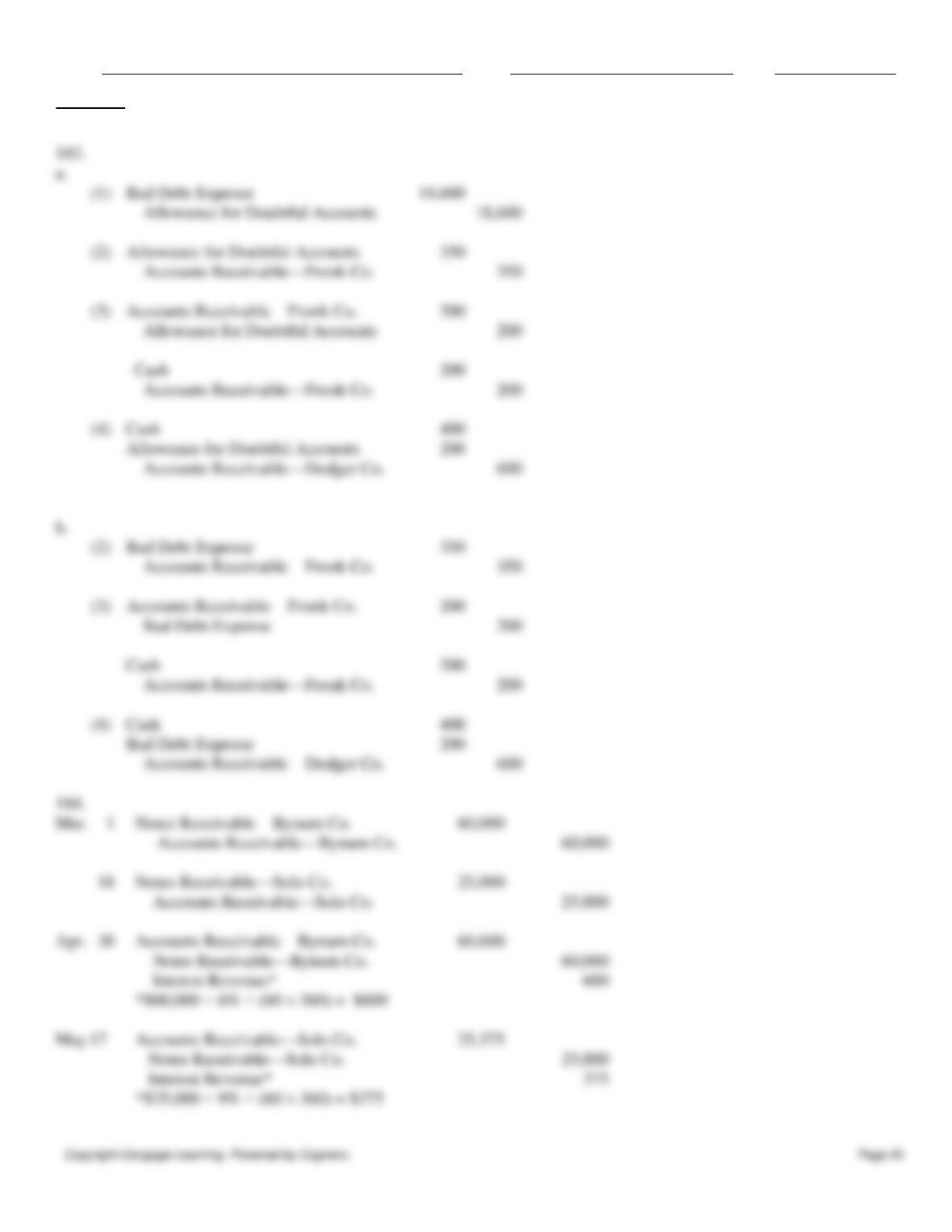
183. For a business that uses the allowance method of accounting for uncollectible receivables:
a.
Journalize the entries for the following transactions:
(1)
Record the adjusting entry at December 31, the end of the first fiscal year, to record
the bad debt expense. The accounts receivable account has a balance of $800,000, and
the contra asset account before adjustment has a debit balance of $600. Analysis of
the receivables indicates uncollectible receivables of $18,000.
(2)
In March of the next year, the $350 owed by Fronk Co. on account is written off as
uncollectible.
(3)
In November of the next year, $200 of the Fronk Co. account is reinstated and
payment of that amount is received.
(4)
In December of the next year, $400 is received on the $600 owed by Dodger Co. and
the remainder is written off as uncollectible.
b.
Redo the entries in steps (a2), (a3), and (a4), assuming the company uses the direct write-
off method.
184. Journalize the following transactions in the accounts of Simmons Company:
Mar. 1 Received a $60,000, 60-day, 6% note dated March 1 from Bynum Co. on account.
18 Received a $25,000, 60-day, 9% note dated March 18 from Solo Co. on account.
Apr. 30 The note dated March 1 from Bynum Co. is dishonored, and the customer’s account is charged for the note,
including interest.
May 17 The note dated March 18 from Solo Co. is dishonored, and the customer’s account is charged for the note,
including interest.
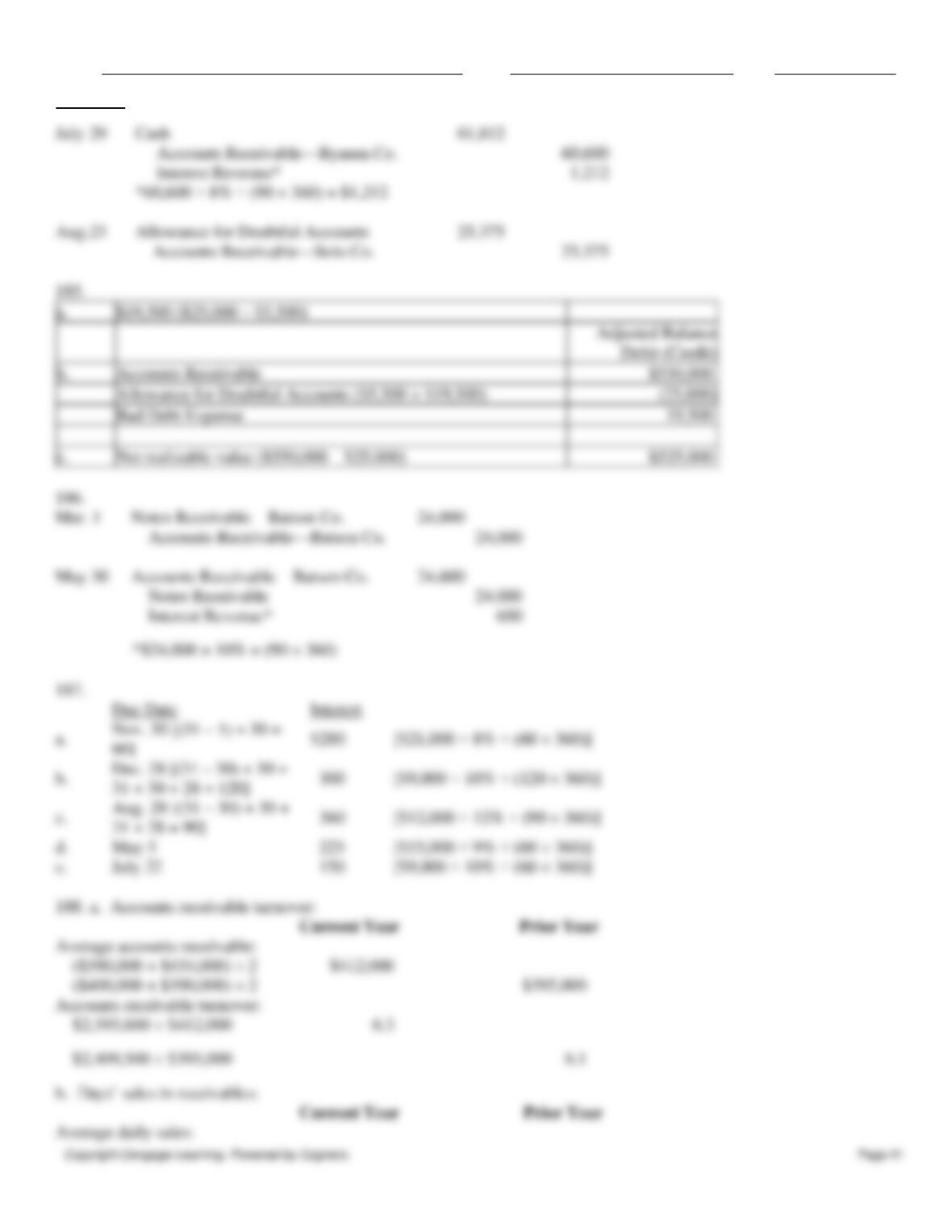
July 29 Cash is received for the amount due on the dishonored note dated March 1 plus interest for 90 days at 8% on
Name:
Class:
Date:
chapter 9
the total amount debited to Bynum Co. on April 30.
Aug. 23 Wrote off against the allowance account the amount charged to Solo Co. on May 17 for the dishonored note
dated March 18.
185. At the end of the current year, Accounts Receivable has a balance of $550,000; Allowance for Doubtful Accounts
has a credit balance of $5,500; and sales for the year total $2,500,000. An analysis of receivables estimates uncollectible
receivables as $25,000.
Determine (a) the amount of the adjusting entry for bad debt expense; (b) the adjusted balances of Accounts Receivable,
Allowance for Doubtful Accounts, and Bad Debt Expense; and (c) the net realizable value of accounts receivable.
186. Journalize the following transactions (assume a 360-day year when computing interest):
Mar. 1 Received a 90-day, 10% note for $24,000, dated March 1, from Batson Co. on account.
May 30 The note of March 1 was dishonored.
187. Determine the due date and the amount of interest due at maturity on the following notes:
Date of Note
Face Amount
Interest Rate
Term of Note
a.
October 1
$21,000
8%
60 days
b.
August 30
9,000
10
120 days
c.
May 30
12,000
12
90 days
d.
March 6
15,000
9
60 days
e.
May 23
9,000
10
60 days
188. Financial statement data for the years ended December 31 for Parker Corporation are as follows:
Current Year Prior Year
Sales $2,595,600 $2,409,500
Accounts receivable:
Beginning of year 390,000 400,000
End of year 434,000 390,000
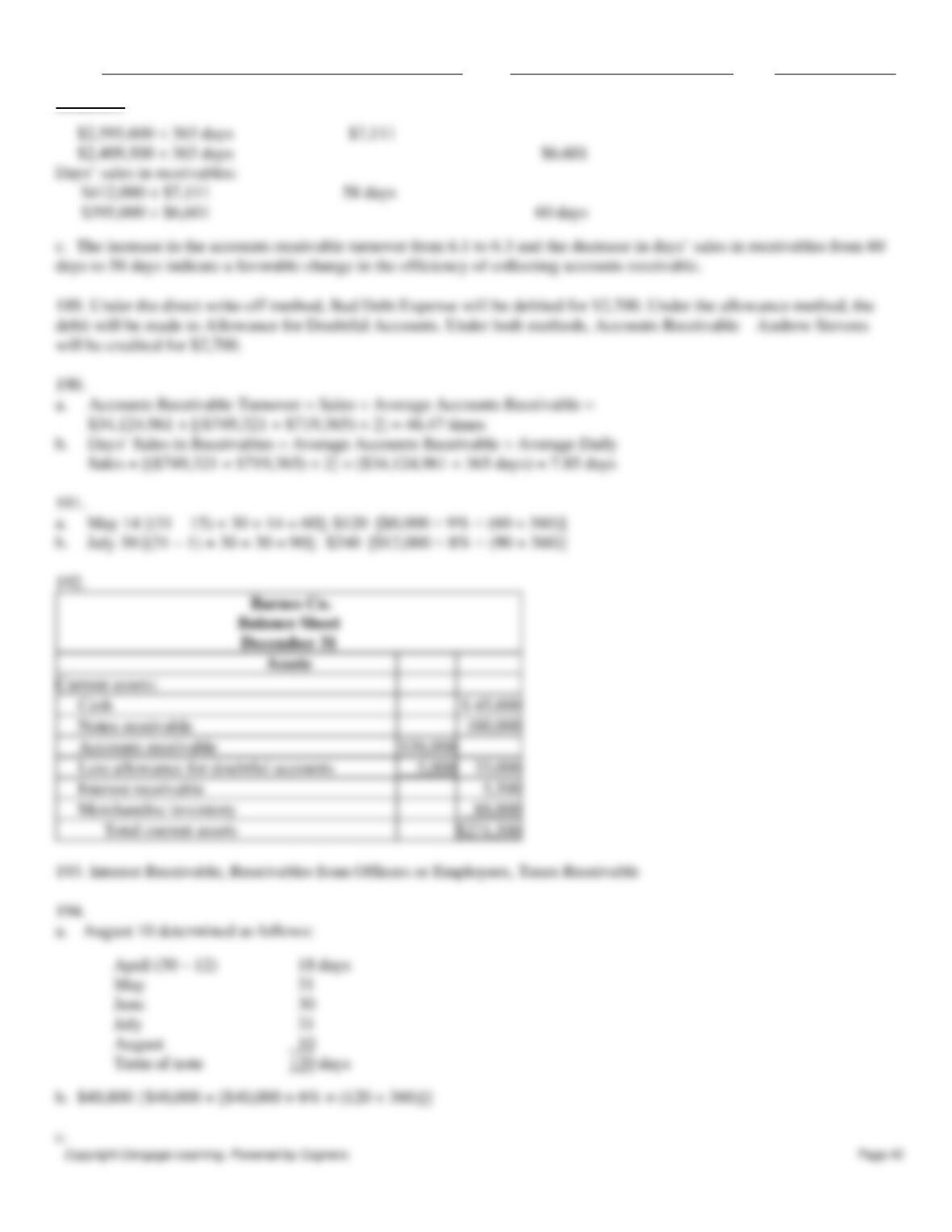
a. Determine the accounts receivable turnover for each year. Round to one decimal place.
b. Determine the days’ sales in receivables for each year. Round to whole days.
c. Does the change in accounts receivable turnover and days’ sales in receivables from
the first year to the second year indicate a favorable or unfavorable change?
189. Fellows Corporation has determined that the $2,700 accounts receivable due from Andrew Stevens is uncollectible.
Compare the journal entry that is required under the direct write-off method to the journal entry that is required using the
allowance method.
190. For fiscal Year 1 and Year 2, Grange Co. reported the following:
Year Ended December 31,
Year 2
Year 1
Sales
$34,124,961
$44,123,486
Accounts receivable
719,365
749,321
a. Compute the accounts receivable turnover for Year 2. Round to two decimal places.
b. Compute the days’ sales in receivables at the end of Year 2. Round to two decimal places.
191. Determine the due date and amount of interest due at maturity on the following notes:
Name:
Class:
Date:
chapter 9
Origination
Face
Term
Interest
Maturity
Interest
Date
Amount
of Note
Rate
Date
Amount
a.
Mar. 15
$8,000
60 days
9%
_______
_______
b.
May 1
12,000
90 days
8%
_______
_______
192. On the basis of the following data related to assets due within one year for Barnes Co., prepare a partial balance
sheet at December 31. Show total current assets.
Accounts receivable
$ 38,000
Allowance for doubtful accounts
5,000
Cash
45,000
Interest receivable
5,500
Merchandise inventory
88,000
Notes receivable
100,000
193. Other than Accounts Receivable and Notes Receivable, name other receivables that might be included in the general
ledger.
194. Sunshine Service Center received a 120-day, 6% note for $40,000, dated April 12 from a customer on account.
a.
Determine the due date of the note.
b.
Determine the maturity value of the note.
c.
Journalize the entry for the receipt of the payment of the note at maturity.
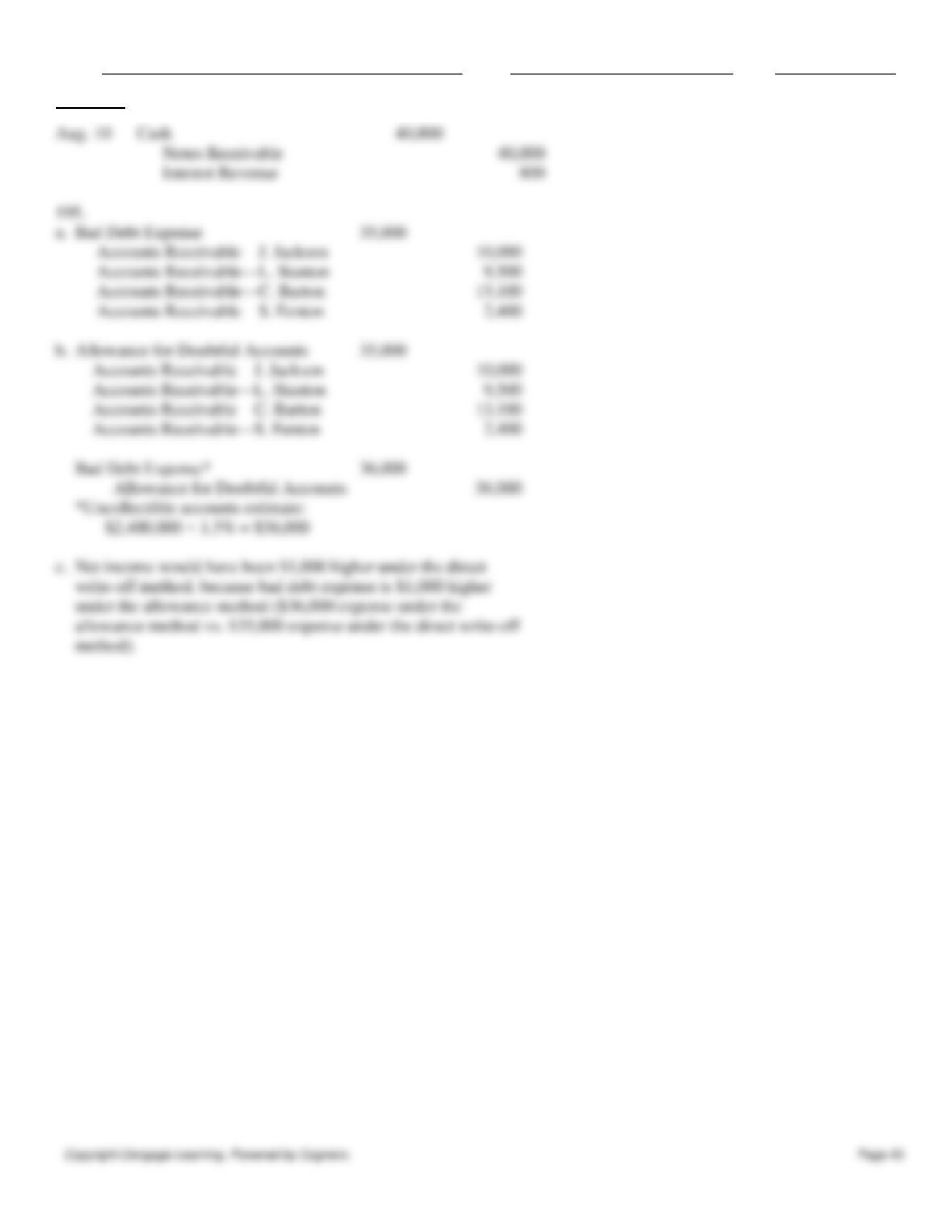
195. Morry Company wrote off the following accounts receivable as uncollectible for the first year of its operations
ending December 31:
Customer
Amount
J. Jackson
$10,000
L. Stanton
9,500
C. Barton
13,100
S. Fenton
2,400
Total
$35,000
a.
Journalize the write-offs for the current year under the direct write-off method.
b.
Journalize the write-offs for the current year under the allowance method. Also,
journalize the adjusting entry for uncollectible receivables assuming the company made
$2,400,000 of credit sales during the year and, based on the industry average, the
company expects uncollectible receivables to be 1.5% of credit sales.
c.
How much higher or lower would Morry Company’s net income have been under the
direct write-off method than under the allowance method?
Name:
Class:
Date:
chapter 9
Answer Key
Name:
Class:
Date:
chapter 9
Name:
Class:
Date:
chapter 9
Name:
Class:
Date:
chapter 9
Name:
Class:
Date:
chapter 9
Name:
Class:
Date:
chapter 9
Name:
Class:
Date:
chapter 9
Name:
Class:
Date:
chapter 9
Name:
Class:
Date:
chapter 9
Name:
Class:
Date:
chapter 9
Name:
Class:
Date:
chapter 9
Name:
Class:
Date:
chapter 9
Name:
Class:
Date:
chapter 9
Name:
Class:
Date:
chapter 9
Name:
Class:
Date:
chapter 9
Name:
Class:
Date:
chapter 9
Name:
Class:
Date:
chapter 9