9-101
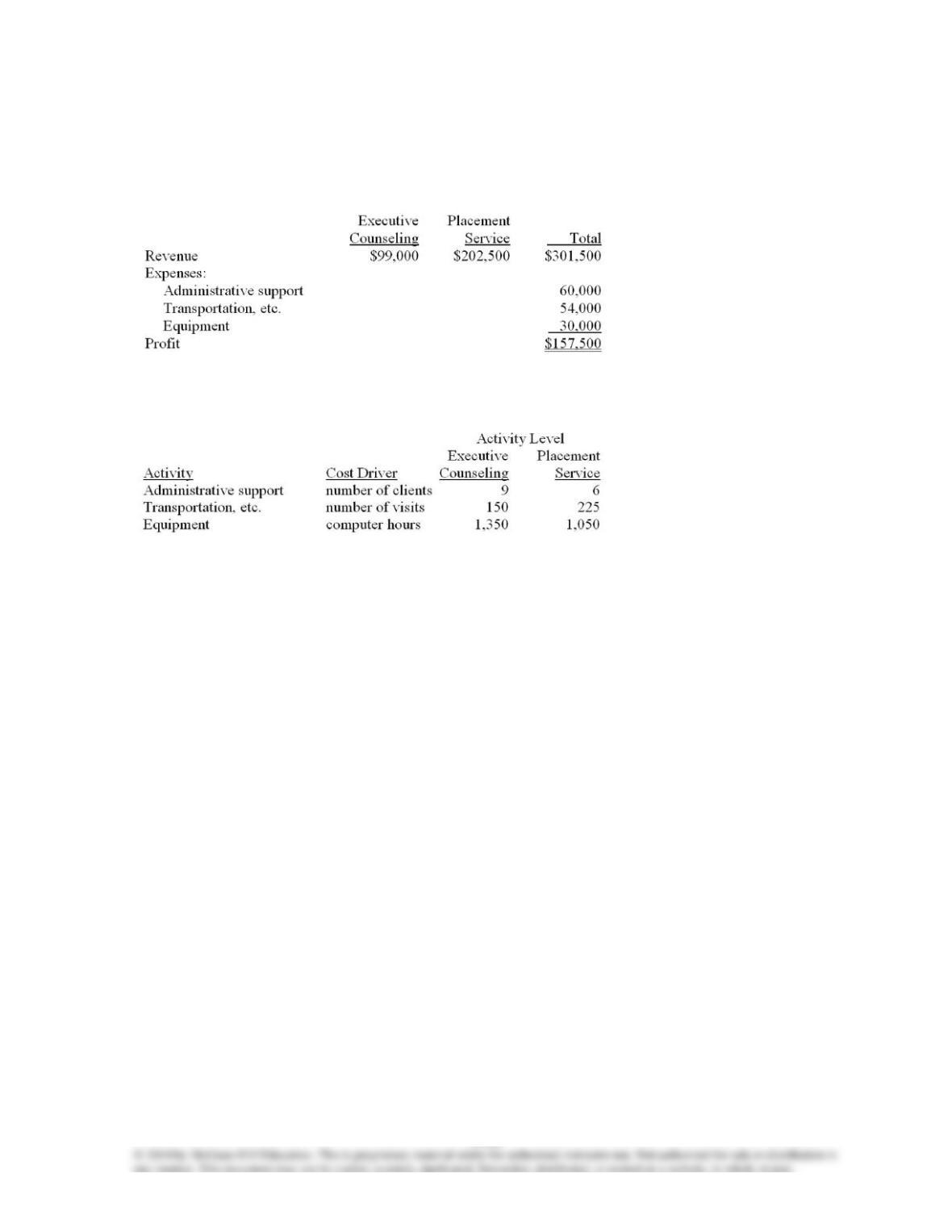
108. Wayne Shen established Windy City Placement Service (WCPS) to provide executive
counseling and job placement services to its clients. Wayne charges a fee of $450.00 per hour for
each service. The revenues and costs for the year are shown in the following income statement:
Wayne has kept good records of the following data for cost allocation purposes:
Required:
a. Complete the income statement using activity-based costing and WCPSs three cost drivers.
b. Recompute the income statement using direct labor-hours as the only allocation base (150
hours for executive counseling; 450 hours for placement services).
9-103
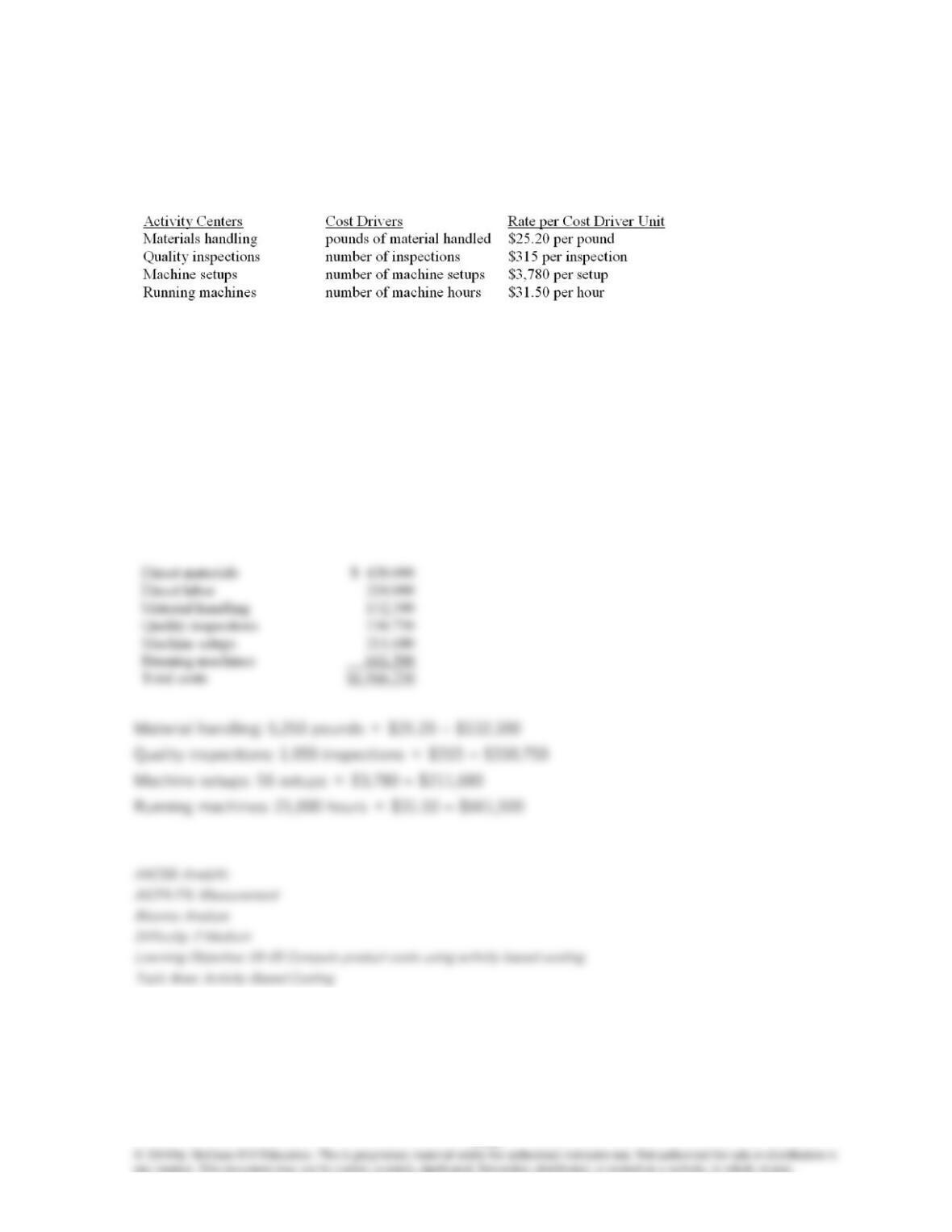
109. Delta Parts, Inc., recently switched to activity-based costing from the department
allocation method. The Fabrication Department manager has estimated the following cost drivers
and rates:
Direct materials of $420,000 were put into production during July, and direct labor costs were
$210,000. The Fabrication Department handled 5,250 pounds of materials, made 1,050
inspections, had 56 setups, and ran the machines for 21,000 hours during the month.
Required:
Prepare a schedule of the costs applied to work–in-process for July:
9-104
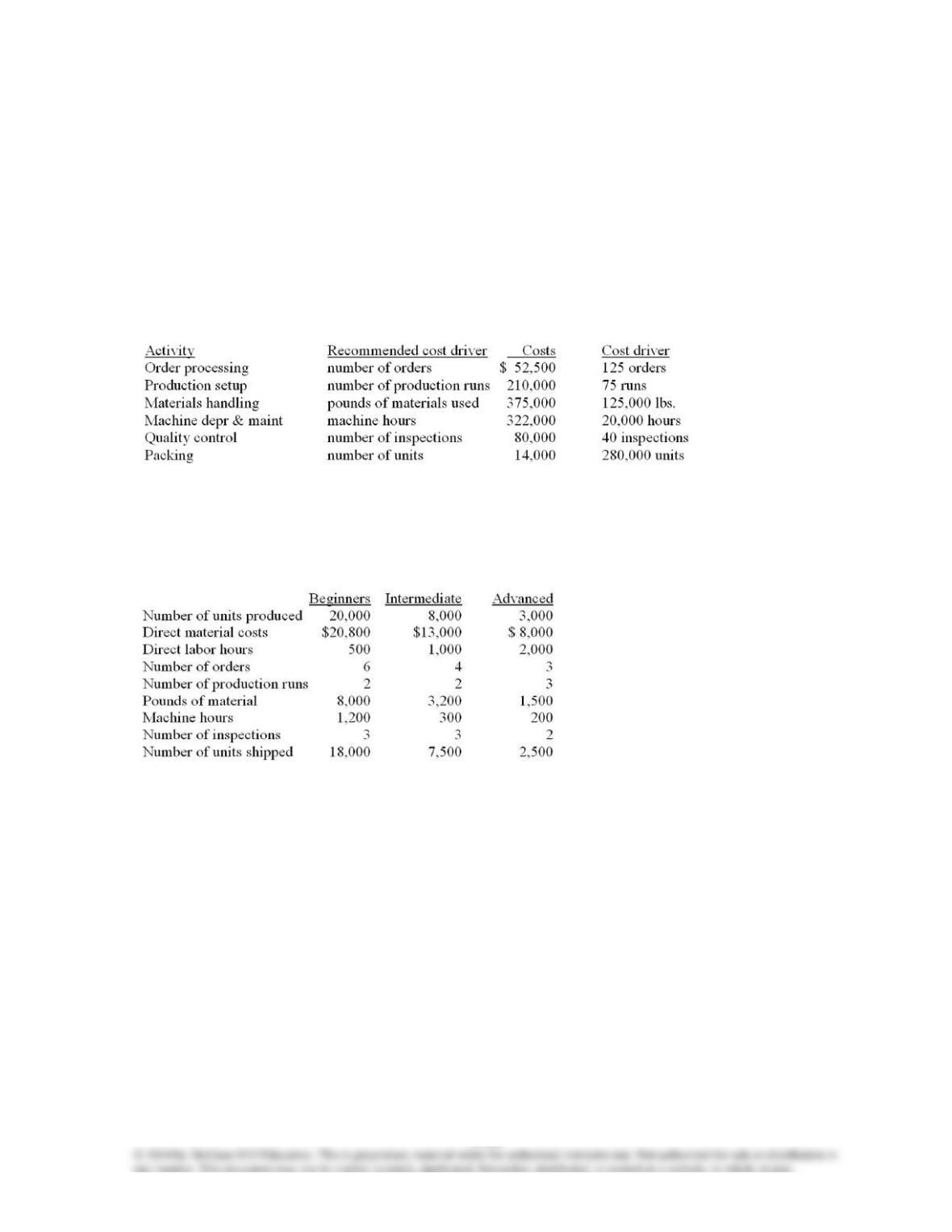
110. Platt Sports Products manufactures and distributes three types of golf clubs: beginners,
intermediate, and advanced. The materials used in these clubs increases in each level and allows
for more precise balancing and longer wear. Production is highly automated for the beginners’
clubs, whereas the intermediate and advanced clubs require a varying degree of labor, depending
on the intricacy of the balancing process. Platt applies all indirect costs according to a
predetermined rate based on direct labor hours. A consultant recently suggested that Platt switch
to an activity-based costing (ABC) system, and identified the following cost breakdown for the
upcoming year:
In addition, management estimates 50,000 direct labor hours will be used in the upcoming year at
a rate of $14 per hour.
Assume that the following activity took place in the first month of the upcoming year:
Required:
a. Compute the production costs for each product in the first month of the upcoming year using
direct labor hours as the allocation base.
b. Compute the production costs for each product in the first month of the upcoming year using
machine hours as the allocation base.
c. Compute the production costs for each product in the first month of the upcoming year using
activity-based costing.
9-105
9-107
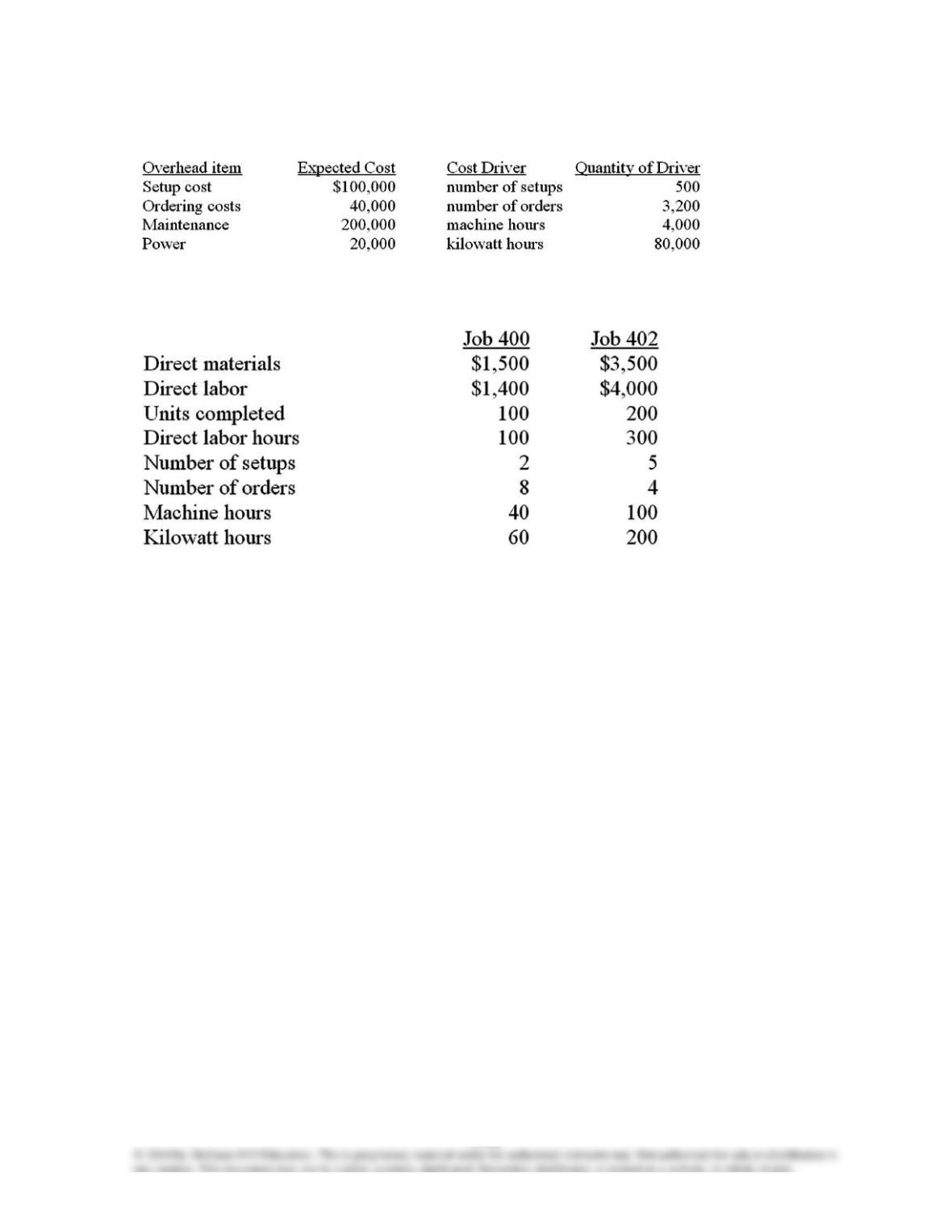
111. Ashland Company produces three products with the following production and cost
information:
Required:
Determine the amount of overhead that would be assigned to each unit of all three products using
activity-based costing.
9-108
112. Quartz, Inc., has identified the following overhead costs and cost drivers for next year:
The following are details for two of the many jobs completed during the year:
The company’s normal activity is 40,000 direct labor hours.
Required:
a. If Quartz, Inc., uses a traditional normal costing approach using direct labor hours to allocate
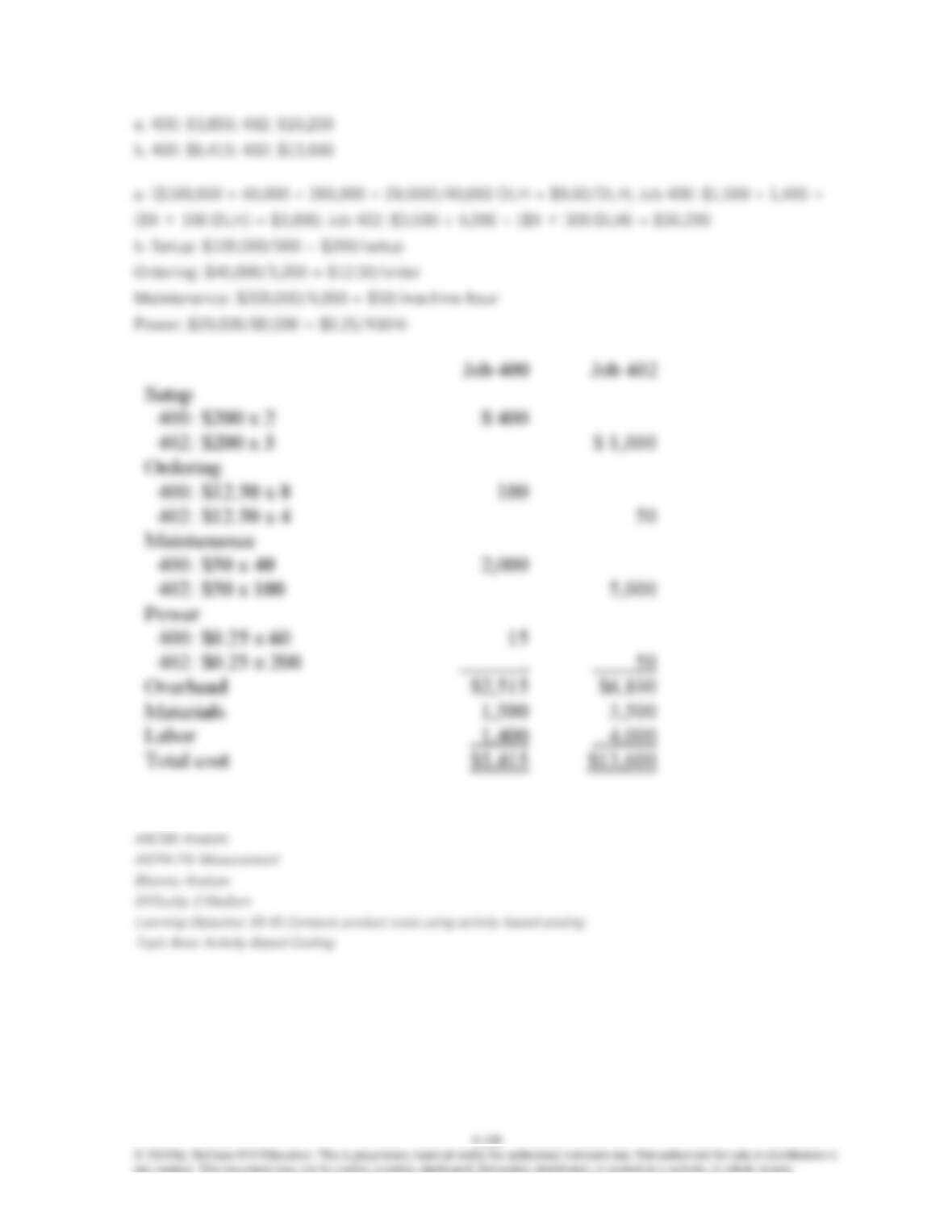
overhead costs, calculate the total cost of Job 400 and Job 402.
b. If Quartz, Inc. uses activity-based costing, calculate the total cost of Job 400 and Job 402.
9-110
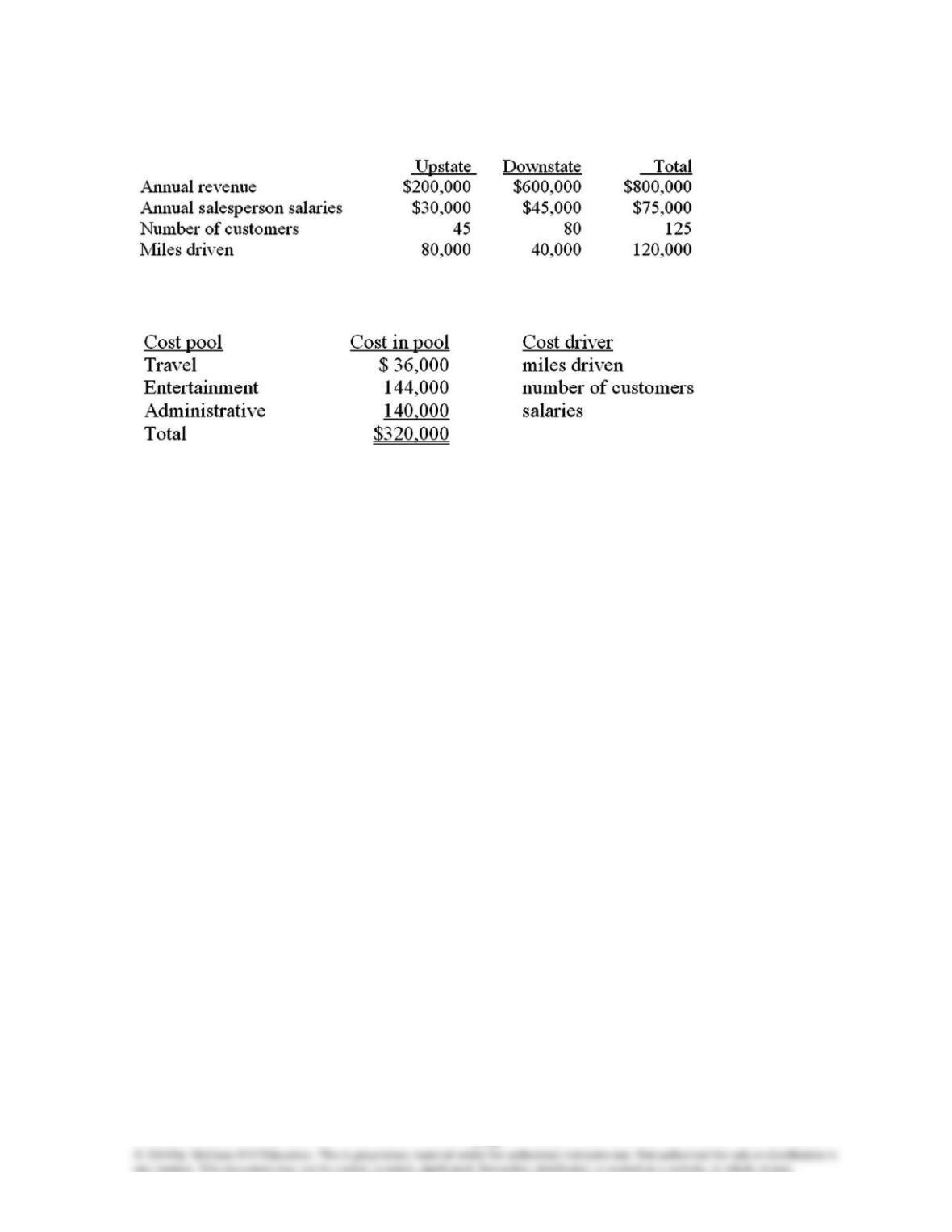
113. Lombard Company has two major segments with the following information:
The business also has overhead costs as follows:
NOTE: overhead does not include salesperson salaries.
Required:
a. Determine the income of each segment if overhead costs are allocated based on sales revenue.
b. Determine the income of each segment if overhead costs are allocated using activity-based
cost drivers.
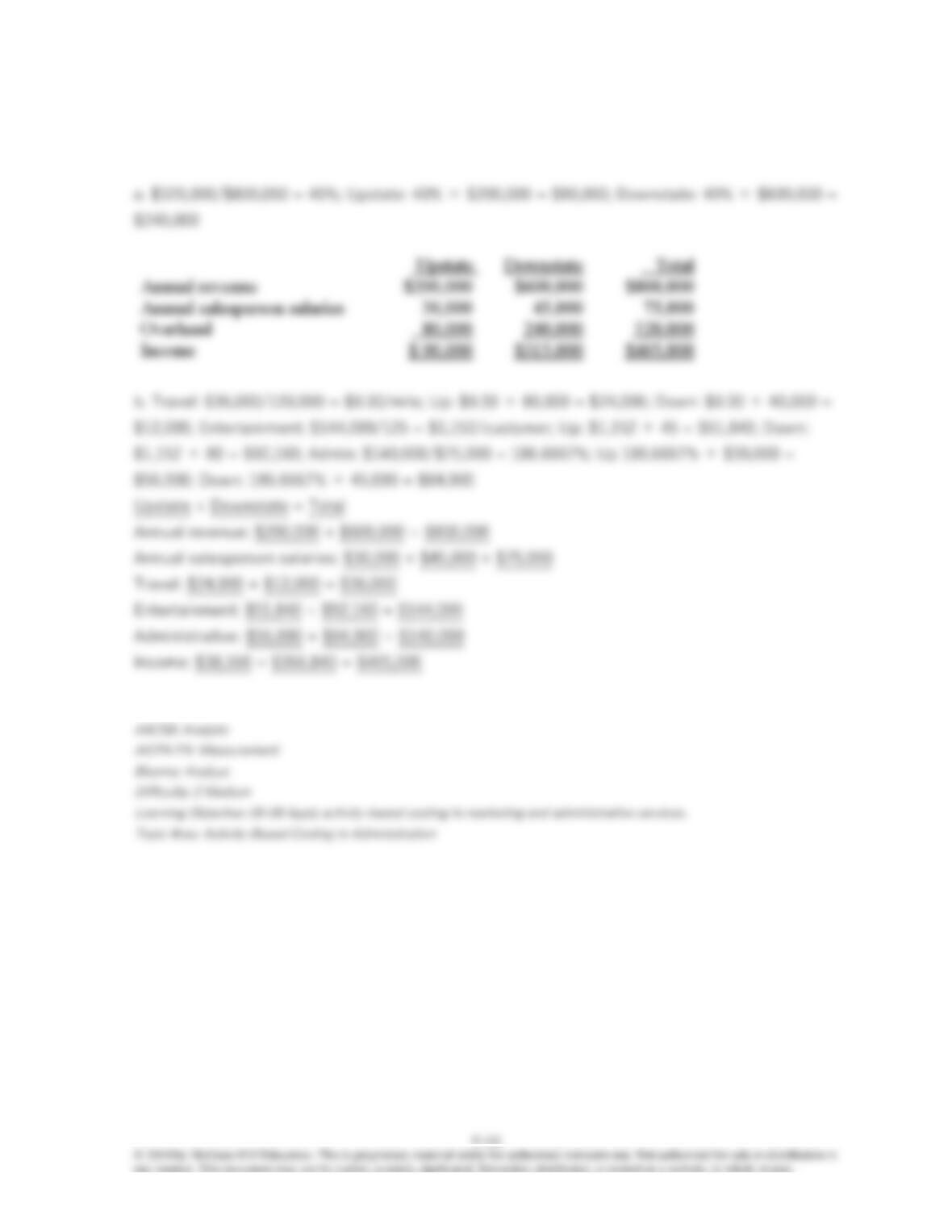
a. Upstate: $90,000; Downstate: $315,000
b. Upstate: $38,160; Downstate: $366,840
9-112
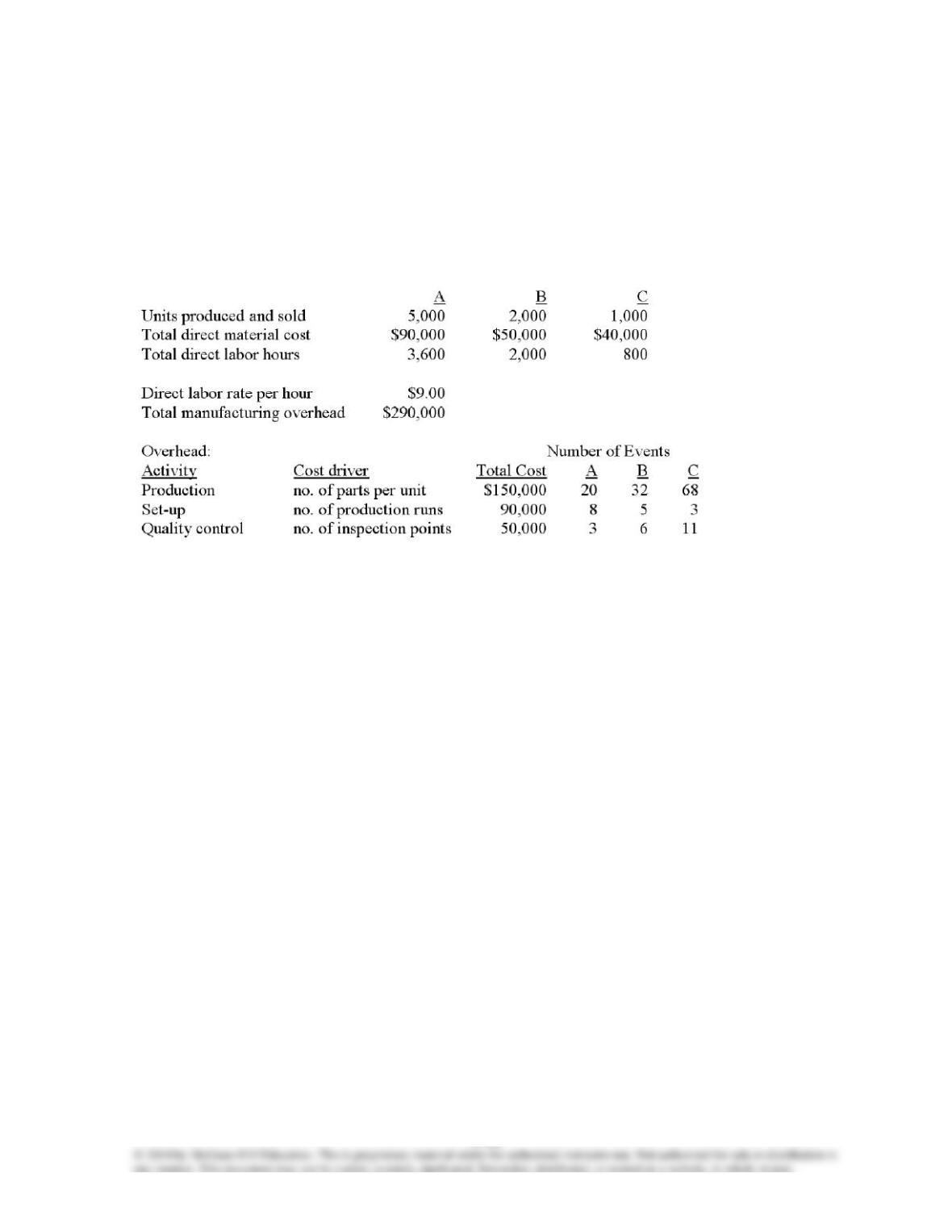
114. ABC Enterprises manufactures and distributes three products; A, B, and C. Over the past
few years, ABC has gradually automated its operations. As a result, total direct labor hours have
substantially declined, while total manufacturing overhead costs have significantly increased.
Because of these changes, ABC wants to evaluate its product costs using activity-based costing
procedures. The following information has been gathered from the company’s internal records and
budgetary system:
Required:
a. Calculate product costs for products A, B, and C using a traditional costing approach using
direct labor hours to assign overhead costs to products.
b. Calculate product costs for products A, B, and C using activity-based costing to assign
overhead costs to products.
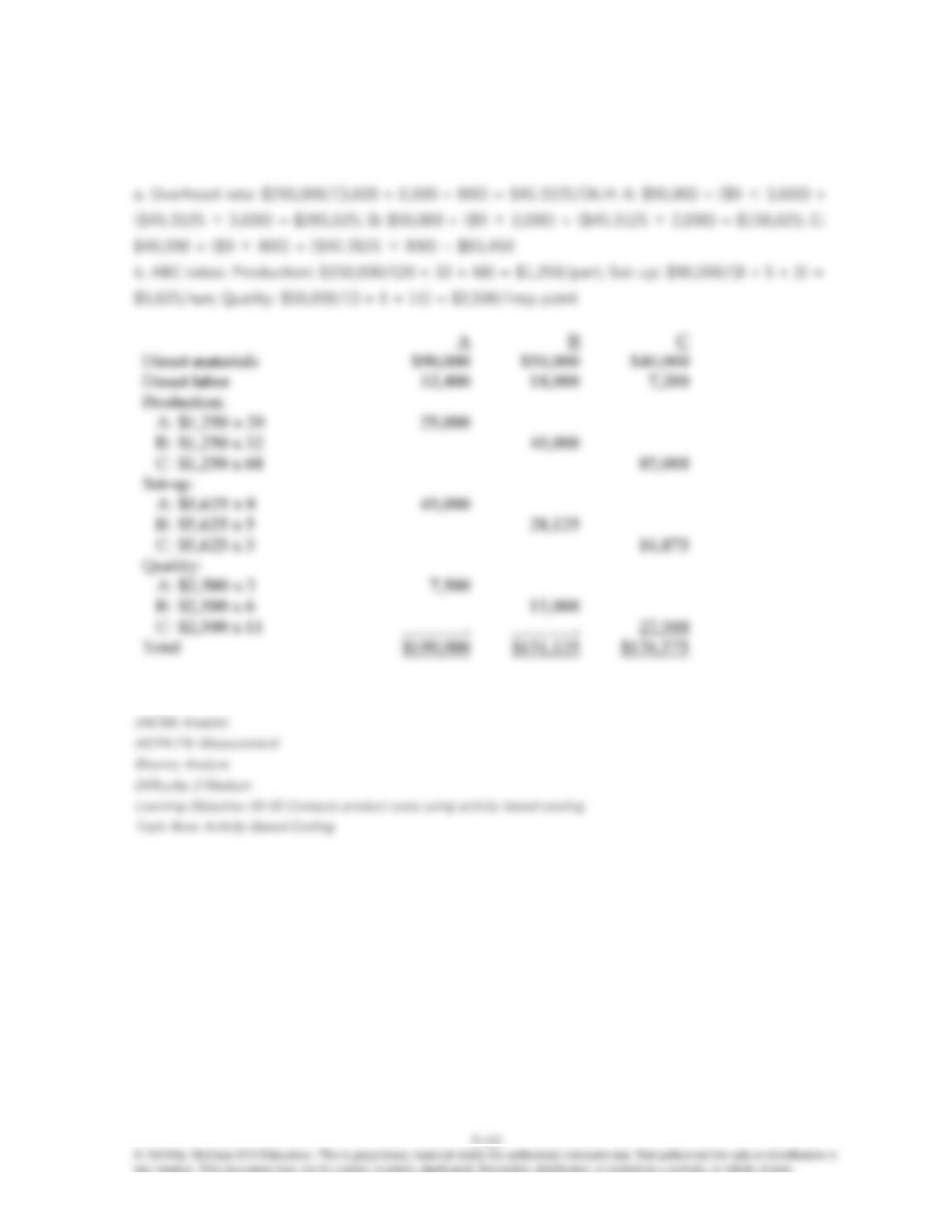
a. A: $285,525; B: $158,625; C: $83,450
b. A: $199,900; B: $151,125; C: $176,575
9-114
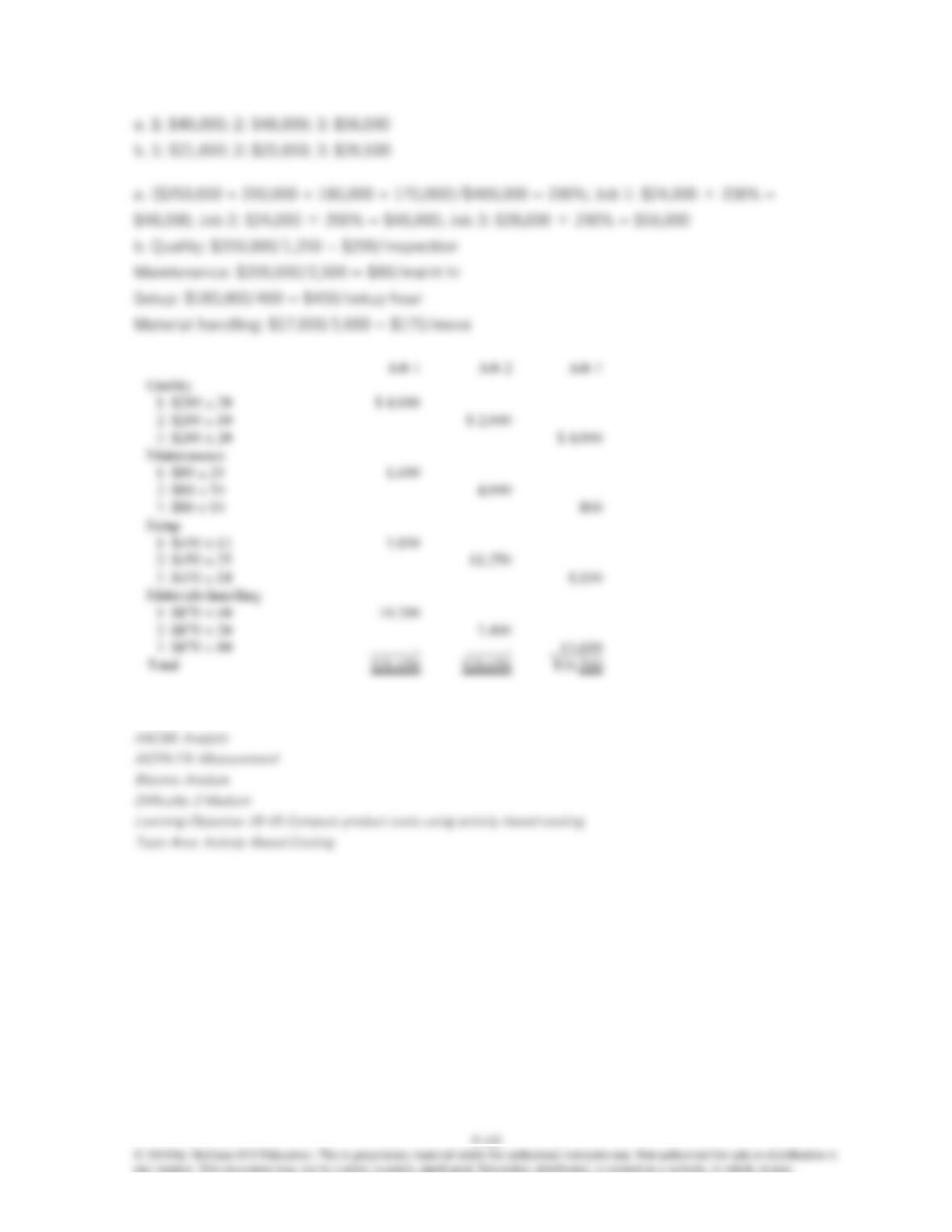
115. Roadrunner, Inc. has identified the following overhead costs and cost drivers for the
coming year:
Budgeted direct labor cost was $400,000 and budgeted direct material cost was $600,000. The
following information was collected on three jobs that were completed during the month:
Required:
a. If the company uses traditional costing and allocates overhead using direct labor cost, how
much overhead cost should be assigned to Jobs 1, 2, and 3?
b. If the company uses activity-based costing (ABC), how much overhead cost should be assigned
to Jobs 1, 2, and 3?
116. Pretty Dog Corporation manufactures two models of grooming stations, a standard and a
deluxe model. The following activity and cost information has been compiled:
Assume a traditional costing system applies the overhead costs based on direct labor hours.
Required:
a. What is the total amount of overhead costs assigned to the standard model?
b. What is the total amount of overhead costs assigned to the deluxe model?
Assume an activity-based costing system is used and that the number of setups and the number
of components are identified as the activity-cost drivers for overhead.
c. What is the total amount of overhead costs assigned to the standard model?
d. What is the total amount of overhead costs assigned to the deluxe model?
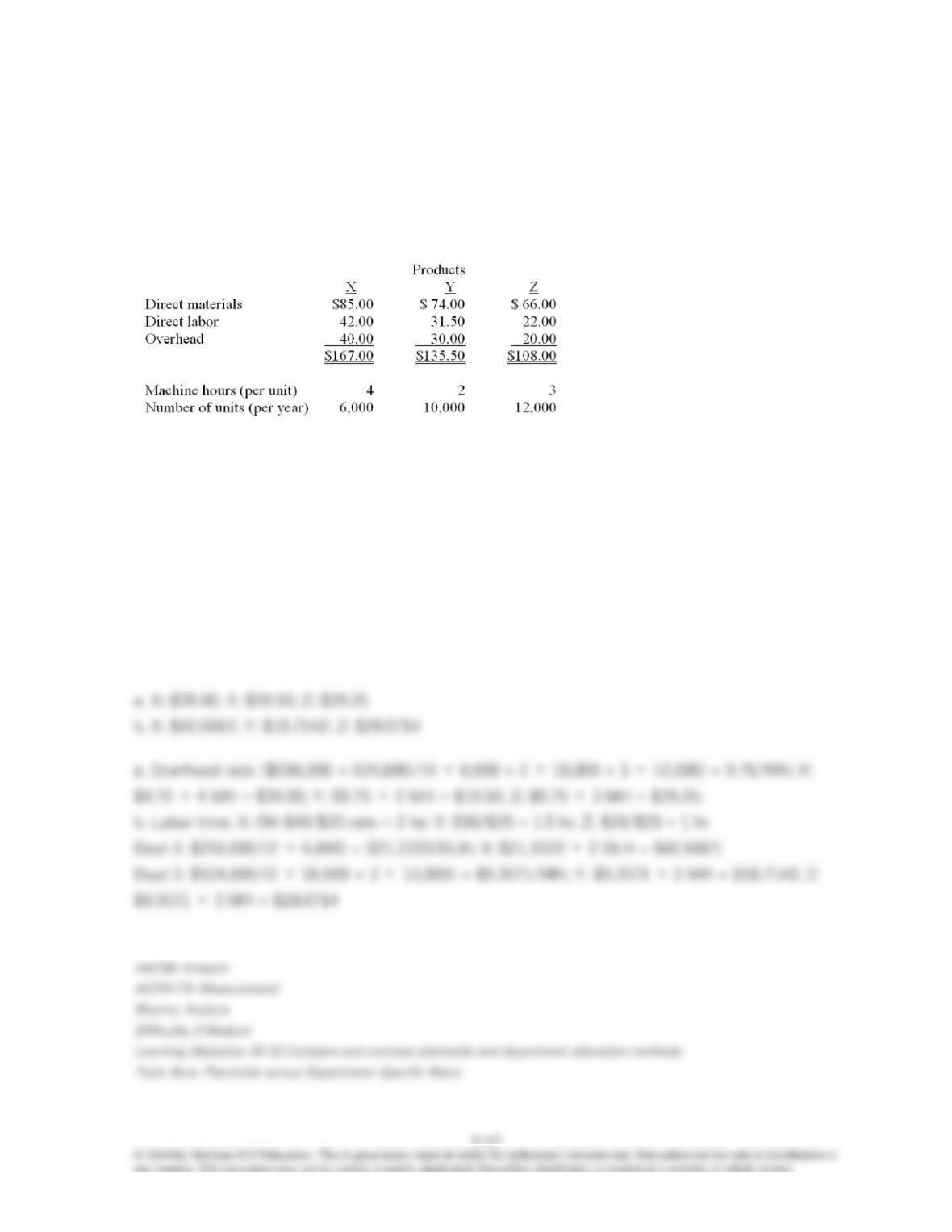
117. Beloit Company manufactures and distributes several different products. The company
currently uses a plantwide allocation method for allocating overhead at a rate of $20 per direct
labor hour. Department 1 produces Product X. Department 1 has $256,000 in traceable overhead.
Department 2 manufactures Products Y and Z. Department 2 has $524,000 in traceable overhead.
The product costs (per unit) and other information are as follows:
Required:
a. If Beloit changes its allocation basis to machine hours, what is the overhead cost per unit for
Product X, Y, and Z?
b. If Beloit changes its overhead allocation to departmental rates, what are the overhead costs per
unit for Product X, Y, and Z, assuming Department 1 uses direct labor hours and Department 2
uses machine hours as their respective allocation bases?
9-118
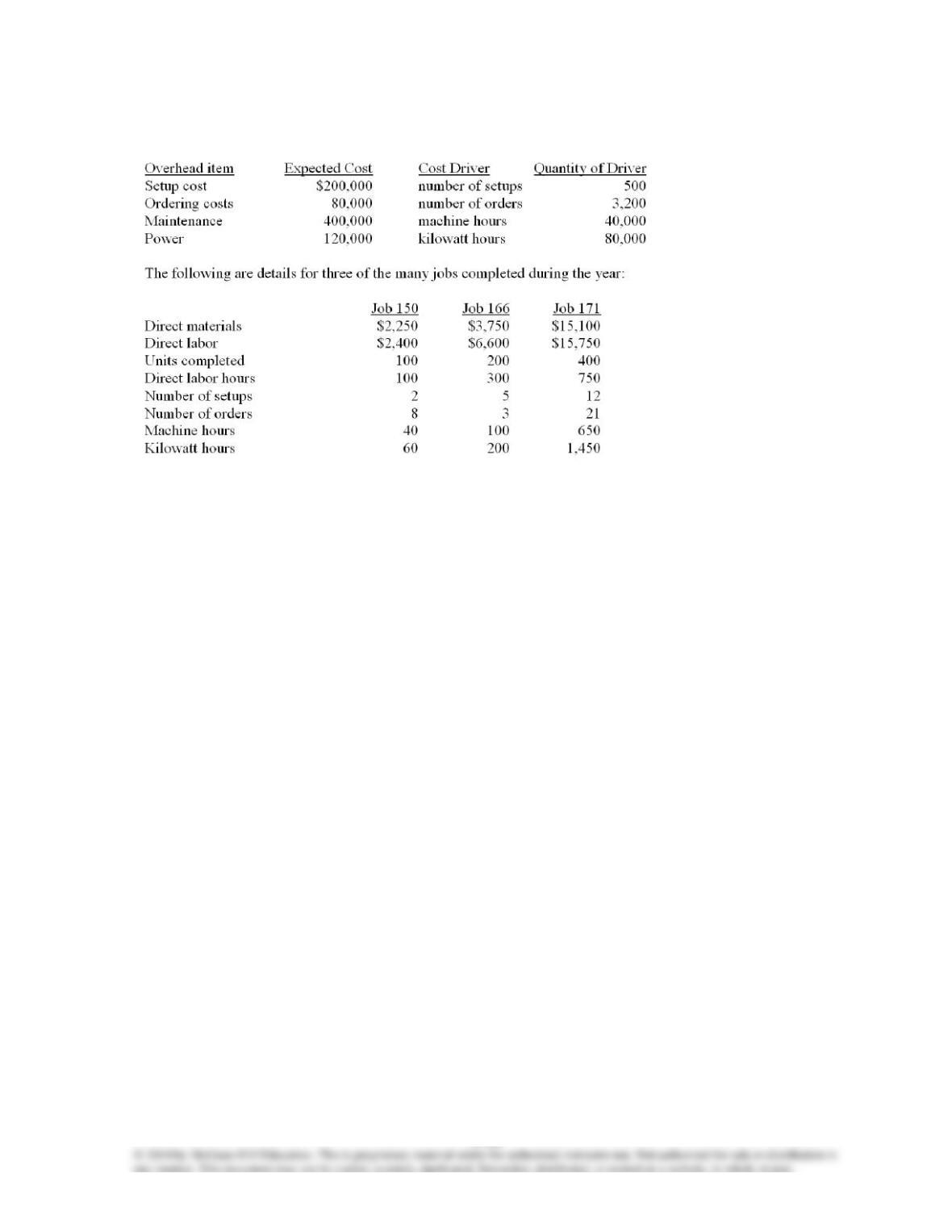
118. Abbyland, Inc., has identified the following overhead costs and cost drivers for next year:
The company’s normal activity is 40,000 direct labor hours.
Required:
a. If Abbyland, Inc., uses a traditional normal costing approach using direct labor hours to allocate
overhead costs, calculate the overhead cost of each of the three jobs.
b. If Abbyland, Inc., uses activity-based costing, calculate the overhead cost of each of the three
jobs.
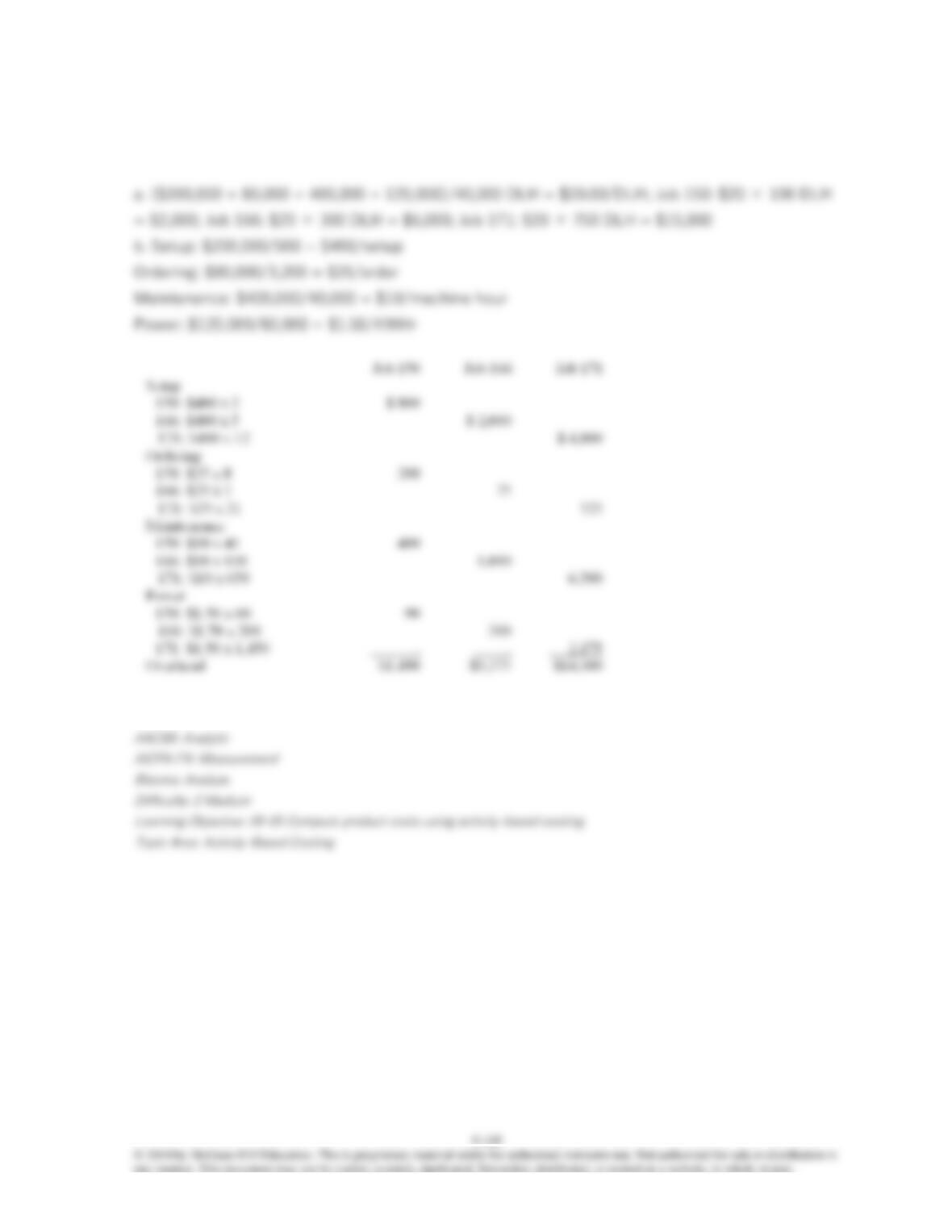
a. 150: $2,000; 166: $6,000; 171: $15,000
b. 150: $1,490; 166: $3,375; 171: $14,000
9-120
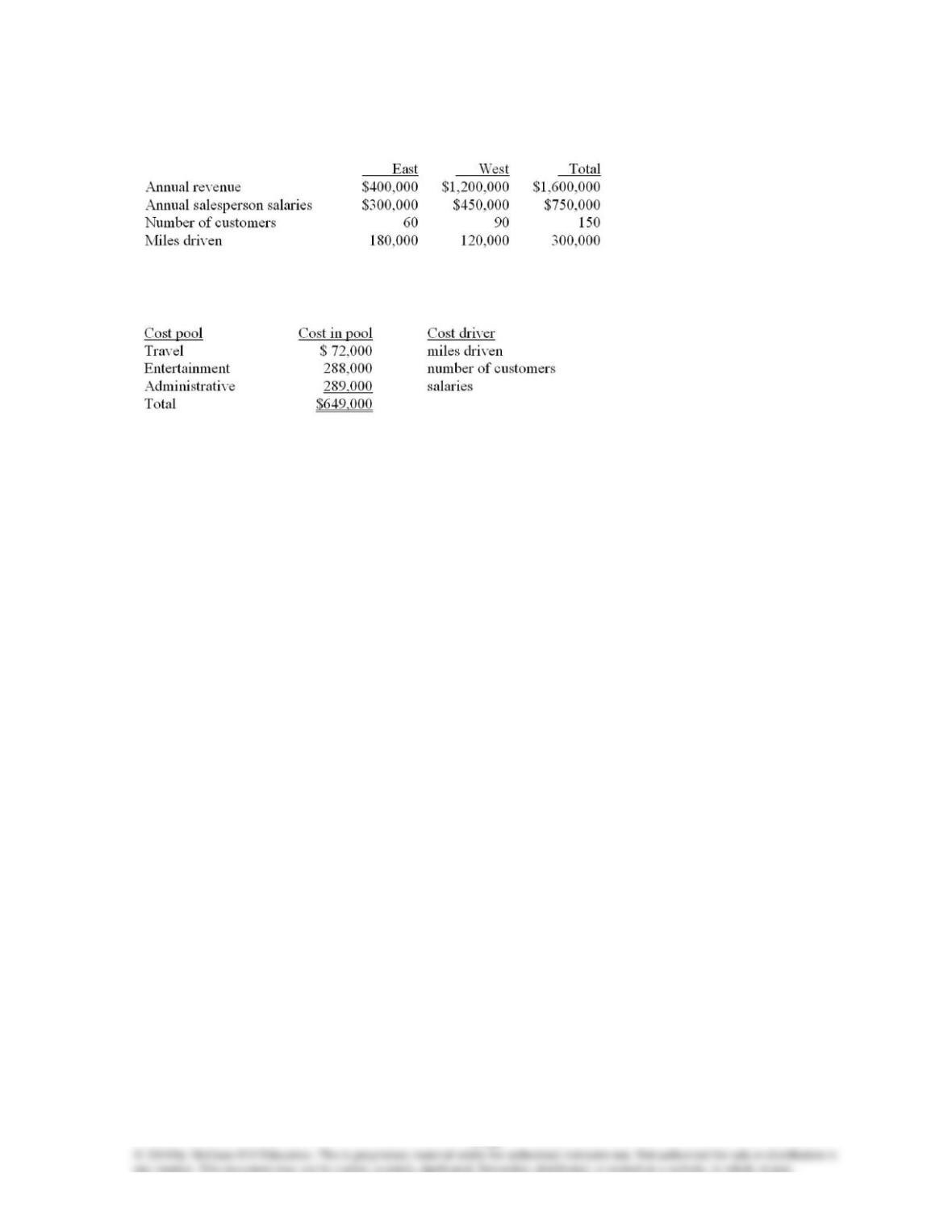
119. Cameron Company has two major segments with the following information:
The business also has overhead costs as follows:
NOTE: overhead does not include salesperson salaries.
Required:
a. Determine the income of each segment if overhead costs are allocated based on sales revenue.
b. Determine the income of each segment if overhead costs are allocated using activity-based
cost drivers.