101
127) Sarno Corporation has an activity-based costing system with three activity cost pools-
Processing, Batch Setup, and Other. Costs in the Processing cost pool are assigned to products
based on machine-hours (MHs) and costs in the Batch Setup cost pool are assigned to products
based on the number of batches. Costs in the Other cost pool are not assigned to products. Data
concerning the company’s two products appear below:
Activity Cost Pools
Processing $ 3,000
Batch Setup $ 9,800
Other $ 9,200
MHs Batches
Product #1 5,800 700
Product #2 4,200 300
Total 10,000 1,000
Product #1 Product #2
Sales $ 45,300 $ 48,400
Direct materials $ 19,600 $ 16,900
Direct labor $ 15,900 $ 24,200
Required:
a. Calculate activity rates for each activity cost pool using activity-based costing.
b. Determine the amount of overhead cost that would be assigned to each product using activity-
based costing.
c. Determine the product margins for each product using activity-based costing.
128) Market Corporation has an activity-based costing system with three activity cost pools-
Processing, Batch Setup, and Other. The company’s overhead costs, which consist of factory
utilities and indirect labor, are allocated to the cost pools in proportion to the activity cost pools’
consumption of resources. Data concerning the company’s costs and activity-based costing
system appear below:
Factory utilities $ 39,000
Indirect labor $ 3,000
Distribution of Resource Consumption Across Activity Cost Pools
Processing Batch Setup Other
Factory utilities 0.10 0.60 0.30
Indirect labor 0.30 0.10 0.60
Required:
Assign overhead costs to activity cost pools using activity-based costing.
129) Vargus Corporation has an activity-based costing system with three activity cost pools-
Processing, Batch Setup, and Other. The company’s overhead costs consist of equipment
depreciation and indirect labor and are allocated to the cost pools in proportion to the activity
cost pools’ consumption of resources. Equipment depreciation totals $72,000 and indirect labor
totals $8,000. Data concerning the distribution of resource consumption across activity cost pools
appear below:
Processing Batch Setup Other
Equipment depreciation 0.20 0.40 0.40
Indirect labor 0.20 0.30 0.50
Required:
Assign overhead costs to activity cost pools using activity-based costing.
105
130) Yang Corporation has an activity-based costing system with three activity cost pools-
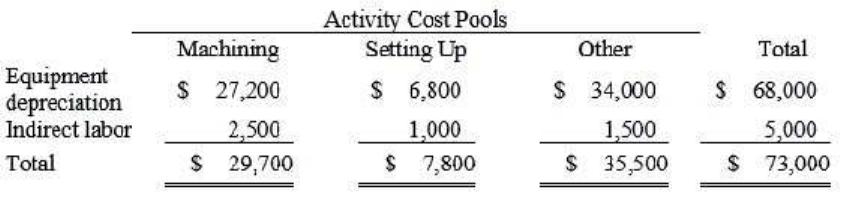
Machining, Batch Setup, and Other. The company’s overhead costs, which consist of equipment
depreciation and indirect labor, have been allocated to the cost pools already and are provided in
the table below.
Costs in the Machining cost pool are assigned to products based on machine-hours (MHs) and
costs in the Batch Setup cost pool are assigned to products based on the number of batches. Costs
in the Other cost pool are not assigned to products. Data concerning the company’s two products
and the company’s costs appear below:
MHs Batches
Product Z 4,400 400
Product Q 5,600 1,600
Total 10,000 2,000
Product Z Product Q
Sales $ 137,900 $ 173,300
Direct materials $ 59,700 $ 43,400
Direct labor $ 57,500 $ 96,000
Required:
a. Calculate activity rates for each activity cost pool using activity-based costing.
b. Determine the amount of overhead cost that would be assigned to each product using activity-
based costing.
c. Determine the product margins for each product using activity-based costing.
131) Air Dream Products has contracted with you to analyze and update its costing and pricing
practices. The company’s product line has changed over time from general air conditioning units
to customizable mini-split units. Although some large orders are received, the majority of
business is now generated from products designed and produced in small lots in order to meet
specific detailed environmental and technical standards.
The company has experienced increased overhead growth, including costs in customer service,
production scheduling, inventory control and laboratory work. Overhead has doubled since the
shift in product lines and management believes that the larger orders are being penalized, while
smaller orders are receiving favorable cost and selling price treatment.
Required:
1. Why would the shift in product lines have caused such major increases in overhead?
2. Is it possible that management is correct in its belief about the costs of the large and small
orders and, if so, why?
3. Write a memo to management suggesting how it might change the cost accounting system to
reflect the changes in the business.
108
132) How can activity-based systems help managers in a global marketplace?
133) Brenda’s Big Burgers, a small hamburger restaurant and take-out drive-through, has
identified the following resources that it uses in its business:
Required:
Suggest a proper cost driver for each of the following items:
Cost Driver Example
A. Bread for burger buns
B. Take-out bags assuming one per drive-through customer order
C. Ground sirloin
D. Mayonnaise, catsup, pickles, and onions
E. Salary of the restaurant manager
F. Restaurant rent
G. Workers hourly wages
H. Coupons for Brenda’s Colossal Burger
I. Utilities
J. Brenda’s Buy-Any One Burger and Get one Free Burger Promotion
110
134) Required:
For each of the following costs in manufacturing companies, identify a cost driver and explain
why it is appropriate.
Manufacturing Costs Driver and why appropriate
A. Equipment maintenance
B. Building utilities
C. Computer operations
D. Quality control
E. Material handling
F. Material storage
G. Factory depreciation
H. Set up costs
I. Engineering changes
J. Advertising expense
135) Why is a plantwide allocation method often considered to be a single-stage allocation
approach? Explain.
136) Describe the four steps involved in activity-based costing.
137) Describe four classifications of cost drivers.
138) Last year, Jasmine Taylor opened a gift store in a busy shopping center. She spent a lot on
advertising and attracted many customers into the store, but very few customers made purchases
and sales were declining. Jasmine paid attention to questions and requests made by customers
and determined that they often requested items that were within the scope of her business but that
she did not carry. When she offered to order items for her customers, delivery was usually too
late and, again, sales were lost. What measures should Jasmine take to improve her business?
139) “Activity-based costing is just a more precise form of product costing and is only usable in
a production setting.” Do you agree or disagree? Explain why.
140) Explain how activity-based costing provides a more detailed measure of costs than do
plantwide or department allocation methods.
141) In recent years, why has labor become such a small part of product costs and how can its
use in overhead allocation perpetrate errors in decision-making?
115
142) Lamar Company manufactures two products, Product K9 and Product L43. Product L43 is
of fairly recent origin, having been developed as an attempt to enter a market closely related to
that of Product K9. Product L43 is the more complex of the two products, requiring 2.0 hours of
direct labor time per unit to manufacture compared to 1.0 hour of direct labor time for Product
K9. Product L43 is produced on an automated production line.
Overhead currently is applied to the products on the basis of direct labor-hours. The company
estimated it would incur $510,000 in manufacturing overhead costs and produce 10,000 units of
Product L43 and 40,000 units of Product K9 during the current year.
Unit costs for materials and labor are:
Product K9 Product L43
Direct material $ 11 $ 24
Direct labor 6 12
Required:
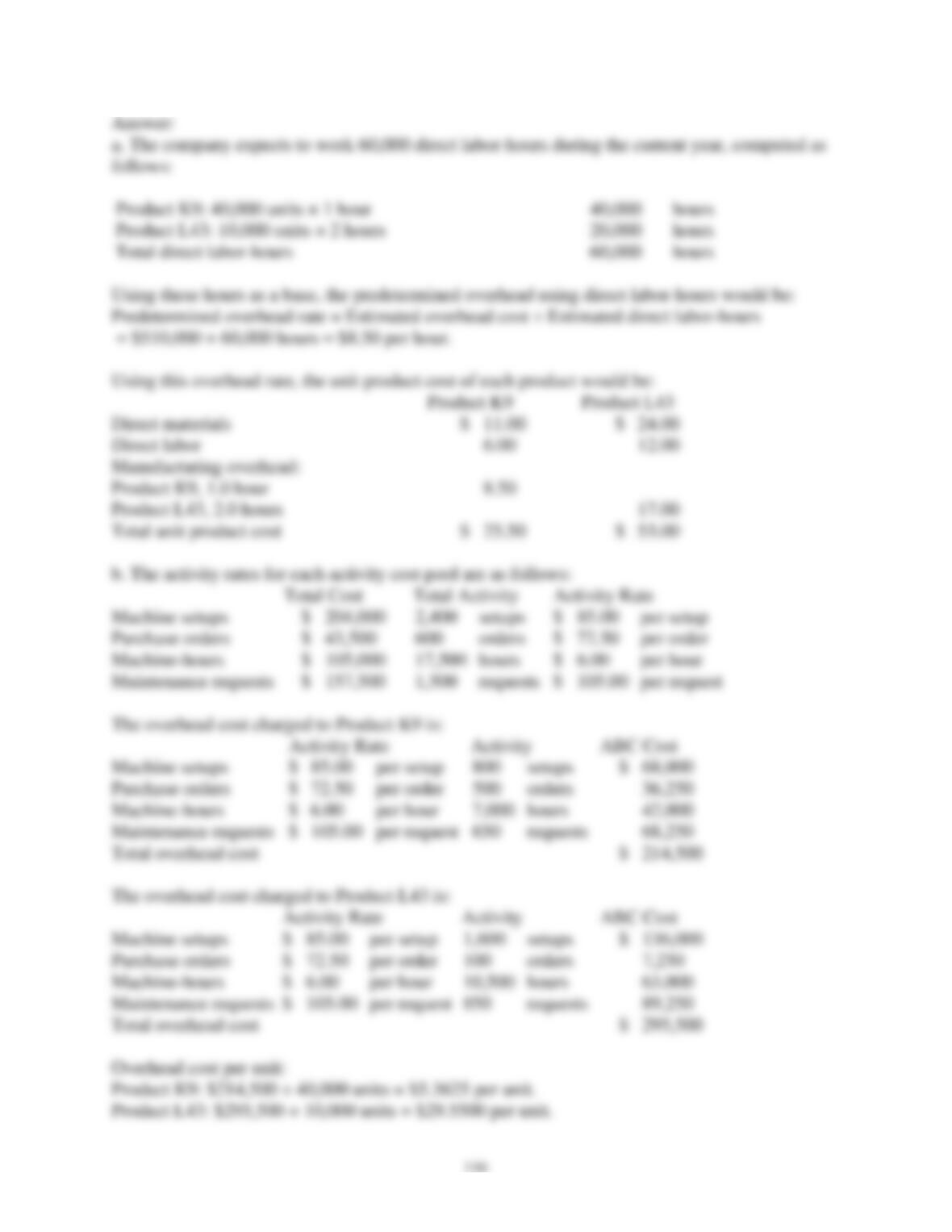
a. Compute the predetermined overhead rate under the current method and determine the unit
product cost of each product for the current year.
b. The company is considering the use of activity-based costing as an alternative to its traditional
costing method for manufacturing overhead. Data relating to the company’s activity cost pools
for the current year are given below:
Total Activity
Activity Cost Pool Total Cost Product K9 Product L43
Total
Machine setups required $ 204,000 800 1,600 2,400
Purchase orders issued 43,500 500 100 600
Machine-hours required 105,000 7,000 10,500 17,500
Maintenance requests issued 157,500 650 850 1,500
$ 510,000
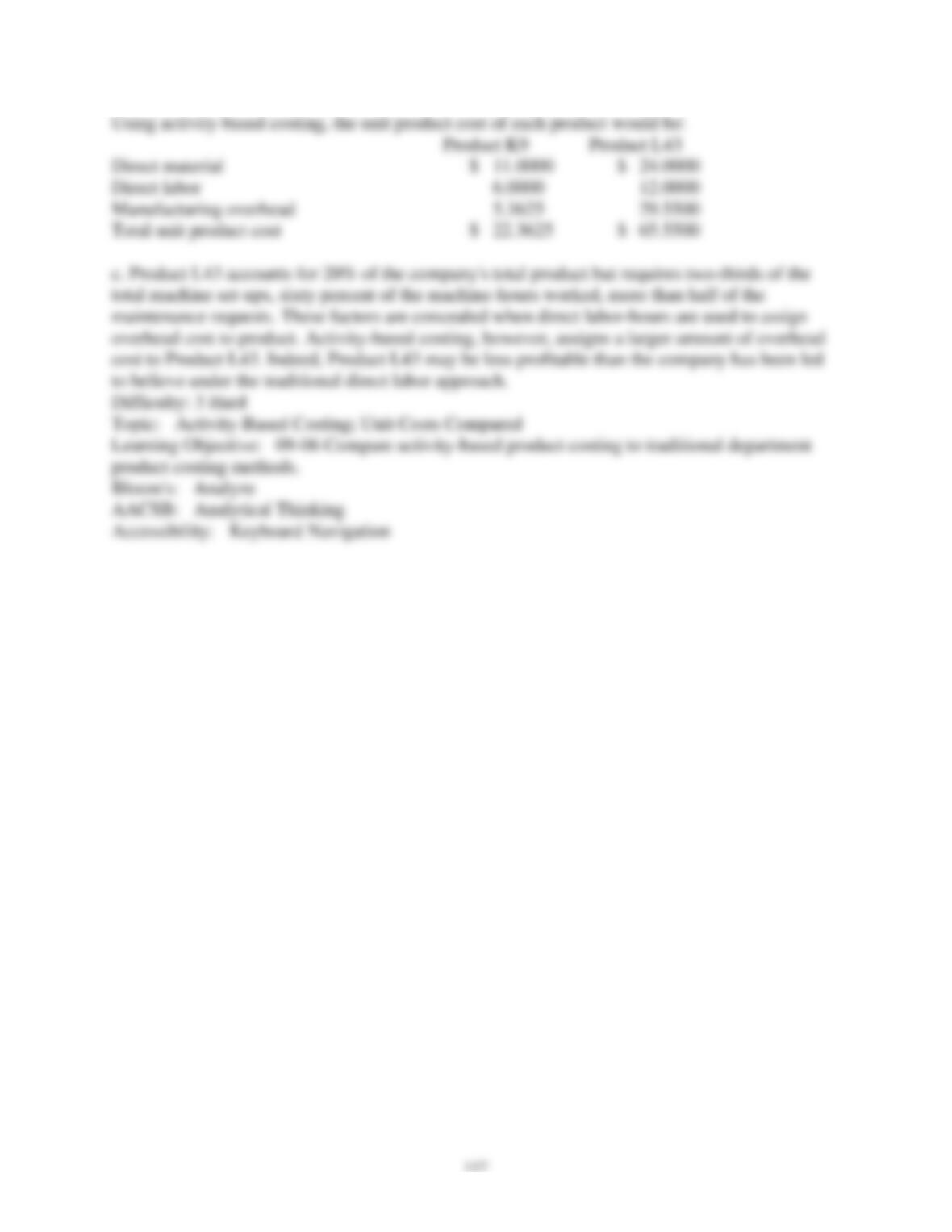
Using the data above, determine the unit product cost of each product for the current year.
c. What items of overhead cost make Product L43 so costly to produce according to the activity-
based costing system? What influence might the activity-based costing data have on
management’s opinions regarding the profitability of Product L43?
118
143) Sylvia’s Housecleaning Service provides housecleaning services to its clients. The company
uses an activity-based costing system for its overhead costs. The company has provided the
following data from its activity-based costing system:
Activity Cost Pool Total Cost Total Activity
Cleaning $ 252,787 44,900 hours
Job support 73,758 5,700 jobs
Client support 7,668 270 clients
Other 230,000 Not applicable
Total $ 564,213
The “Other” activity cost pool consists of the costs of idle capacity and organization-sustaining
costs.
One particular client, the Layton family, requested 49 jobs during the year that required a total of
245 hours of housecleaning. For this service, the client was charged $2,500.
Required:
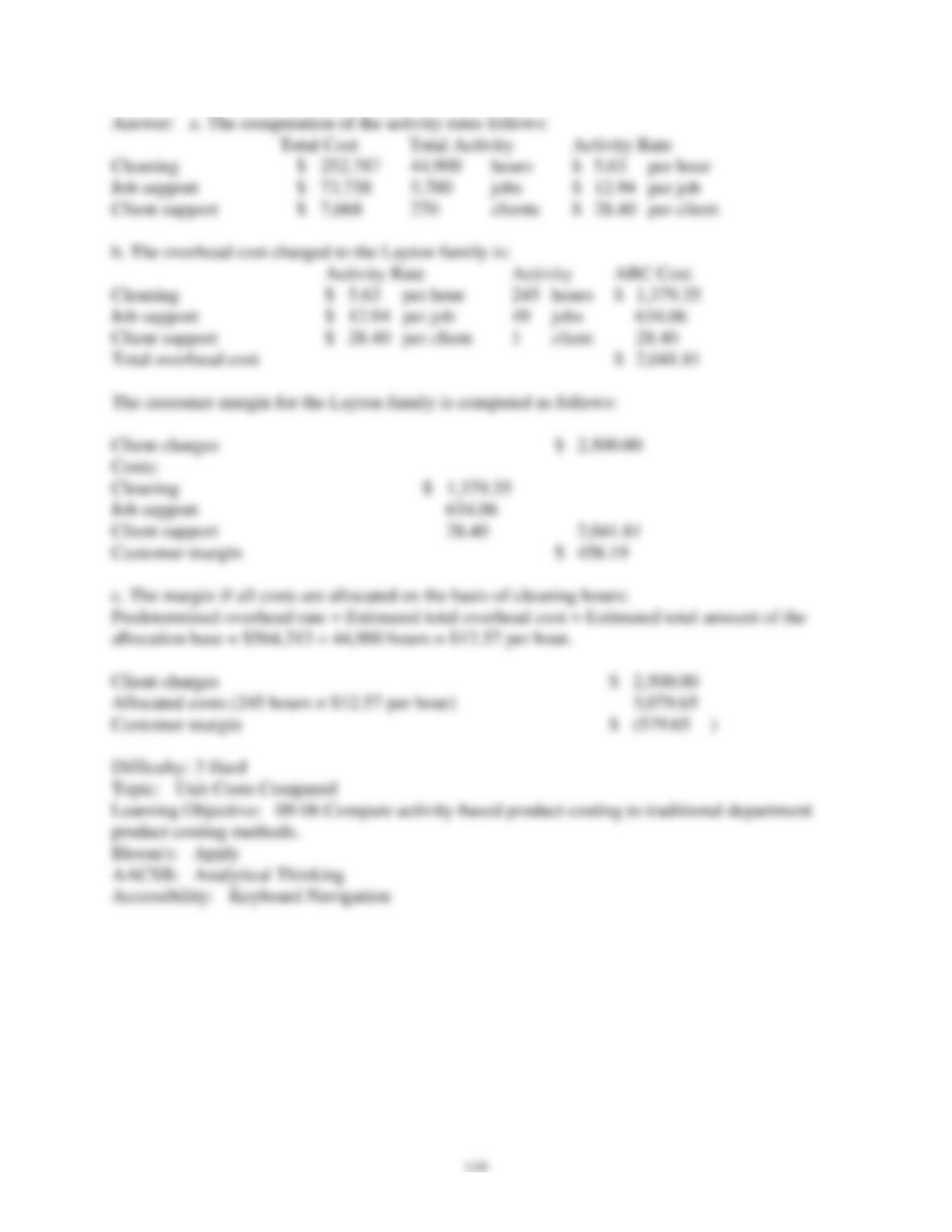
a. Compute the activity rates (i.e., cost per unit of activity) for the activity cost pools. Round all
calculations to the nearest whole cent.
b. Using the activity-based costing system, compute the customer margin for the Layton family.
Round all calculations to the nearest whole cent.
c. Assume the company decides instead to use a traditional costing system in which ALL costs
are allocated to customers on the basis of cleaning hours. Compute the margin for the Layton
family. Round all calculations to the nearest whole cent.
120
144) Harrison Industries has an activity-based costing system with three activity cost pools–
Processing, Batch Setup, and Other. The company’s overhead costs, which consist of factory
utilities and indirect labor, are allocated to the cost pools in proportion to the activity cost pools’
consumption of resources. Costs in the Processing cost pool are assigned to products based on
machine-hours (MHs) and costs in the Batch Setup cost pool are assigned to products based on
the number of batches. Costs in the Other cost pool are not assigned to products. Data
concerning the two products appear below:
Factory utilities $ 29,000
Indirect labor $ 7,000
Distribution of Resource Consumption Across Activity Cost Pools
Processing Setting Up Other
Factory utilities 0.40 0.10 0.50
Indirect labor 0.50 0.20 0.30
MHs Batches
Product #1 2,900 700
Product #2 7,100 300
Total 10,000 1,000
Product #1 Product #2
Sales $ 54,000 $ 85,100
Direct materials 19,100 $ 33,500
Direct labor 26,300 $ 35,000
Required:
a. Assign overhead costs to activity cost pools using activity-based costing.
b. Calculate activity rates for each activity cost pool using activity-based costing.
c. Determine the amount of overhead cost that would be assigned to each product using activity-
based costing.
d. Determine the product margins for each product using activity-based costing.