11) The debt ratio is computed by dividing:
A) total assets by long-term liabilities.
B) total assets by total debt.
C) total debt by total assets.
D) long-term liabilities by total assets.
12) If a company wants to maximize earnings per share it would issue:
A) stock or bonds, depending on the tax rate.
B) stock or bonds, depending on the interest rate.
C) bonds instead of stock.
D) stock instead of bonds.
13) Earnings per share is only computed for:
A) preferred stock.
B) treasury stock.
C) common stock.
D) preferred and common stock.
14) Dammer Corporation needs to raise $2,200,000. The corporation plans to sell 5%, 10-year bonds at
the face value of $2,200,000. Dammer Corporation currently has 120,000 shares of stock outstanding and
net income of $1,200,000. The $2,200,000 from the bond sale is expected to generate additional income of
$1,000,000 before interest and taxes. The income tax rate is 20%. What are the earnings per share after
the sale of bonds? (Round your final answer to the nearest cent.)
A) $10
B) $15.93
C) $18.90
D) $17.42
15) Drury Corporation needs to raise $1,700,000. The corporation plans on selling 80,000 shares of $17
par value common stock. Drury Corporation currently has 170,000 shares of stock outstanding and net
income of $1,600,000. The $1,700,000 from the stock sale is expected to generate additional income of
$500,000 before interest and taxes. The income tax rate is 40%. What are the earnings per share after the
sale of 80,000 shares of stock? (Round your final answer to the nearest cent.)
A) $7.60
B) $8.40
C) $8.00
D) $8.80
16) Frank’s Boat Shop, Inc. reports net income of $59,000, income before taxes of $120,000 and interest
expense of $18,000. The weighted-average number of shares of common stock outstanding during the
year was 40,000 shares. What is the times-interest-earned ratio? (Round your final answer to two
decimal places.)
A) 3.28
B) 6.67
C) 7.67
D) 10.94
17) Lloyd’s Boat Shop, Inc. reports net income of $63,000, income before taxes of $60,000 and interest
expense of $17,000. The weighted-average number of shares of common stock outstanding during 2017
was 40,000 shares. The gross profit was $130,000. What is the earnings per share? (Round your final
answer to the nearest cent.)
A) $1.58
B) $1.50
C) $1.93
D) $3.25
18) The leverage ratio is equal to average total ________ divided by average ________.
A) debt; total assets
B) debt; common stockholders’ equity
C) long-term debt; common stockholders’ equity
D) assets; common stockholders’ equity
19) According to DuPont analysis, the impact of debt on a company’s profitability is measured by the
________ ratio.
A) return on sales
B) times-interest-earned
C) return on equity
D) leverage
20) Following the DuPont analysis model, the higher the leverage ratio, the higher the:
A) net profit margin ratio.
B) return on assets.
C) return on sales.
D) return on stockholders’ equity.
21) JB Enterprises borrows by issuing bonds. If JB earns more on an investment than the interest it pays
on its bonds, JB is:
A) trading on the equity.
B) diluting control of its business.
C) showing a leverage ratio of 1.0.
D) decreasing its earnings per share on common stock.
22) List and briefly discuss the three main strategies that companies use to finance operations. For each
of the strategies, indicate the risk level to the company.
5 Learning Objective 9-5
1) When accounting for a capital lease, the lessee capitalizes the asset even though the lessee may never
take legal title to it.
2) An operating lease transfers title of the leased asset to the lessee at the end of the lease term.
3) Because operating leases require the lessee to make rent payments, a liability is created and it must
appear on the lessee’s balance sheet.
4) For operating leases, the lessee obtains the risks and rewards of owning the leased asset.
5) For employer sponsored retirement plans, the company records pension expense while employees
work for the company.
6) Lease payments are paid by the lessor.
7) Operating leases are preferred over capital leases because capital leases increase a company’s debt
ratio.
8) Which of the following statements about capital leases is INCORRECT?
A) Under a capital lease, the lessee does not report the leased asset on the financial statements.
B) A capital lease can transfer title of the leased asset to the lessee at the end of the lease term.
C) A capital lease may contain a bargain purchase option.
D) Under a capital lease, the lessee records a lease liability at the beginning of the lease term.
9) If, as part of the accounting for a lease, the lessee debits an asset and credits a liability, then the lease
must be a(n):
A) purchased lease.
B) operating lease.
C) cancelable lease.
D) capital lease.
10) Which of the following criteria would cause a lease to be recorded as an operating lease?
A) The lease transfers ownership of the property to the lessee.
B) The lease contains a bargain purchase option.
C) The lease term is less than 75% of the useful life of the leased property.
D) The present value of the lease payments equals or exceeds 90% of the fair market value of the leased
property.
11) Which of the following statements regarding leases is CORRECT?
A) Capital leases are favored over operating leases because capital leases lower the debt ratio.
B) A debit balance in the Leased Asset account on the balance sheet indicates an operating lease.
C) Title is transferred to the lessee at the end of an operating lease term.
D) If a lease does not meet one of the four exact criteria provided by U.S. GAAP guidelines, it is
classified as an operating lease by default.
12) Wayne Technical Corporation signed a lease for equipment, which requires lease payments of
$50,000 per year for four years. The equipment has an estimated useful life of 7 years. This lease would
be a capital lease if:
A) the equipment is leased for 4 years.
B) the present value of the lease payments equals $150,000 and the fair value of the equipment is
$200,000.
C) title to the equipment does not transfer to the lessee at the end of the lease term.
D) the lease agreement allows Wayne to purchase the equipment for $5 at the end of the lease.
13) Which type of lease will NOT increase a company’s assets or long-term liabilities?
A) an operating lease
B) a capital lease
C) a lease that contains a bargain purchase option
D) a lease that transfers title of the leased asset to the lessee at the end of the lease term
14) To determine whether a pension plan is overfunded or underfunded, a company must compare the:
A) fair market value of the pension plan assets to the projected benefit obligation.
B) cost of the pension plan assets to the accumulated benefit obligation.
C) accumulated benefit obligation to the plan’s anticipated obligations.
D) fair market value of the pension plan assets to the accumulated benefit obligation.
15) A company has pension plan assets with a fair market value of $7 million. The accumulated benefit
obligation for pensions is $8 million and the projected benefit obligation for pensions is $17 million.
What pension liability is reported on the balance sheet?
A) $1 million
B) $10 million
C) $8 million
D) $17 million
16) On January 1, 2017, Maranto Company signed a lease agreement that requires monthly payments of
$2500 at the beginning of every month for two years. Maranto Company paid $2500 on January 1, 2017.
This is an operating lease. What journal entry is required by Maranto Company on January 1, 2017?
A) debit Leased Asset $2500 and credit Lease Obligation $2500
B) debit Lease Expense $2500 and credit Lease Obligation $2500
C) debit Rent Expense $2500 and credit Rent Payable $2500
D) debit Rent Expense $2500 and credit Cash $2500
17) On January 1, 2017, Ferguson Company signed a lease agreement that requires monthly payments of
$5000 at the beginning of every month for two years. Ferguson Company paid $5000 on January 1, 2017.
This is a capital lease. The present value of the lease payments is $19,000. What journal entry is required
by Ferguson Company on January 1, 2017?
A) debit Leased Asset $5000 and credit Lease Obligation $5000
B) debit Rent Expense $5000 and credit Cash $5000
C) debit Leased Asset $19,000, credit Cash $5000 and credit Lease Obligation $14,000
D) debit Leased Asset $14,000 and credit Lease Obligation
18) An airline has the following data about an airplane:
Annual lease cost $11,000,000
Lease term: 12 years
Useful life of airplane: 15 years
Fair market value of leased asset: $85 million
Present value of lease payments: $75 million
Bargain purchase option: None
Transfer to lessor at end of lease? Yes
Is this a capital or operating lease? Why?
A) This is an operating lease. It fails all the capital lease criteria.
B) This is a capital lease because the substance of the transaction is a capital lease.
C) This is a capital lease because it meets at least one of the four capital lease criteria.
D) This is a capital lease because the leased asset cost exceeds $5 million.
19) An airline has the following data about an airplane:
Annual lease cost $8,000,000
Lease term: 8 years
Useful life of airplane: 35 years
Fair market value of leased asset: $83 million
Present value of lease payments: $78 million
Bargain purchase option: None
Transfer to lessor at end of lease? Yes
Is this a capital or operating lease? Why?
A) This is an operating lease. It fails all of the capital lease criteria.
B) This is a capital lease because the substance of the transaction is a capital lease.
C) This is a capital lease because it meets at least one of the four capital lease criteria.
D) This is a capital lease because the leased asset cost exceeds $5 million.
6 Learning Objective 9-6
1) Maturities of long-term debt due within one year of the balance sheet date are reported separately
from long-term debt.
2) Details about a company’s liabilities should be included in the notes to the financial statements.
3) Generally accepted accounting principles require companies to report the fair value of their long-term
debt.
4) The retirement of callable bonds at an amount below face value would appear on a statement of cash
flows as an:
A) outflow in the financing activities section.
B) inflow in the financing activities section.
C) outflow in the operating activities section.
D) inflow in the operating activities section.
5) Bonds with a face value of $330,000 are issued at 101. The statement of cash flows would report a cash
inflow of:
A) $330,000 in the financing activities section.
B) $333,300 in the financing activities section.
C) $3300 in the financing activities section.
D) $330,000 in the investing activities section.
6) David Corporation issued $110,000, 5-year bonds at 97 on January 1, 2014. On December 31, 2018, the
bonds matured. The payment of the bonds at maturity would be reported on the statement of cash
flows as a cash outflow of:
A) $106,700 in the financing activities section.
B) $106,700 in the investing activities section.
C) $110,000 in the financing activities section
D) $110,000 in the investing activities section.
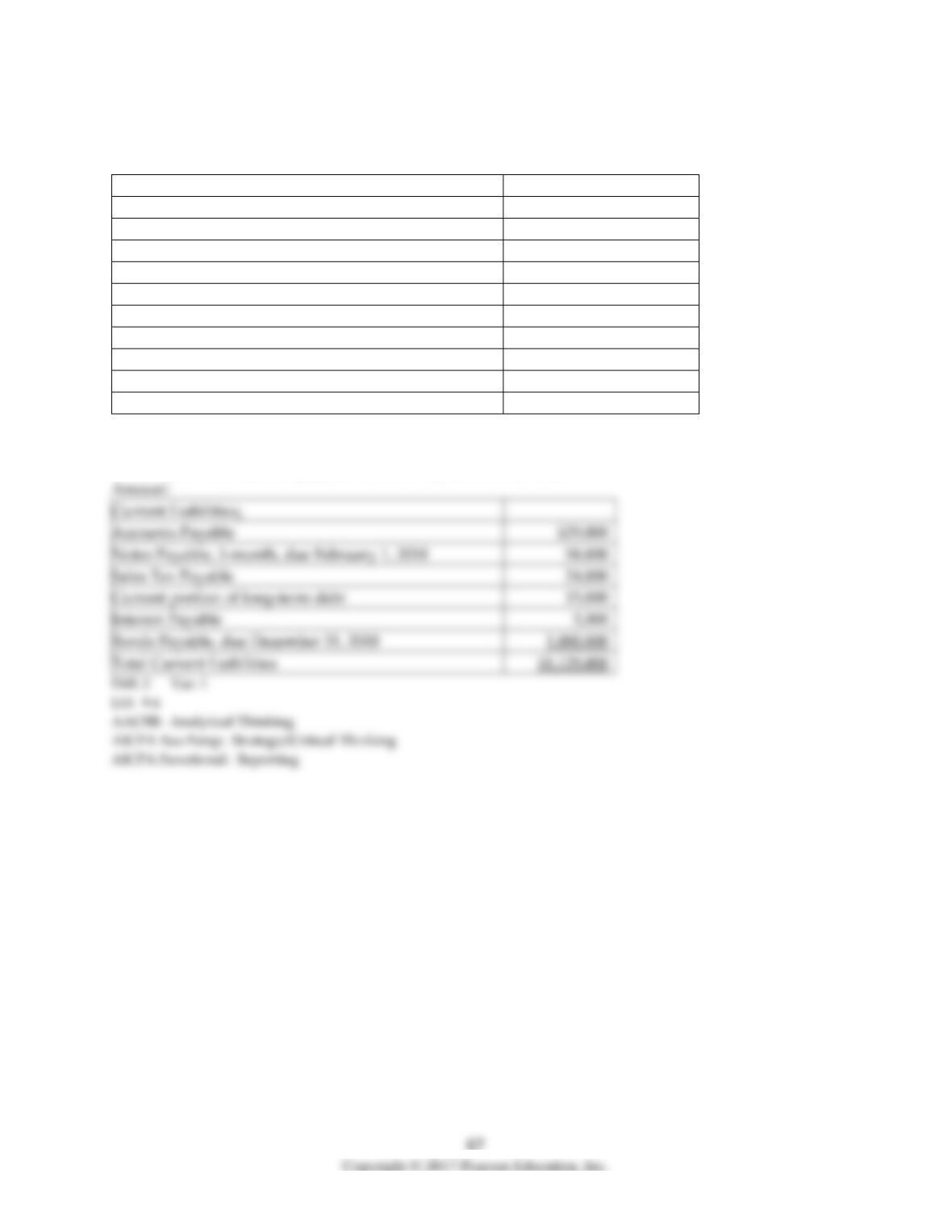
7) After posting the adjusting entries, Bing Corporation has the following account balances (partial
listing) at December 31, 2017.
Account
General Ledger Balance
Accounts Payable
$29,000
Notes Payable, 5-month, due February 1, 2018
58,000
Equipment
85,000
Accumulated Depreciation—Equipment
16,000
Notes Payable, 7-year, 7%, due February 1, 2024
120,000
Interest Expense
7,000
Interest Payable
3,000
Sales Tax Payable
24,000
Bonds Payable, due December 31, 2022
1,000,000
Bonds Payable, due December 31, 2018
1,000,000
Prepare the current liability section of Bing Corporation’s balance sheet at December 31, 2017. The
current portion of the note payable due February 1, 2024 is $15,000.
Current Liabilities:
Accounts Payable
Notes Payable, 5-month, due February 1, 2018
Sales Tax Payable
Current portion of long-term debt
Interest Payable
Total Current Liabilities