Chapter 9 – Financial Planning and Analysis: The Master Budget
Solution:
9-62
105. The following information is from Barkley’s Auto Alarm Company financial records.
Collections from customers are normally 70 percent in the month of sale, 20 percent in the
month following the sale, and 9 percent in the second month following the sale. The balance
is expected to be uncollectible. All purchases are on account. Management takes full
advantage of the 2 percent discount allowed on purchases paid for by the tenth of the
following month. Purchases for December are budgeted at $60,000, and sales for December
are forecasted at $66,000. Cash disbursements for expenses are expected to be $14,400 for the
month of December. The company’s cash balance on December 1 was $22,000.
Month
Sales
Purchases
August
$72,000
$42,000
September
66,000
48,000
October
60,000
36,000
November
78,000
54,000
Required:
Prepare the following schedules.
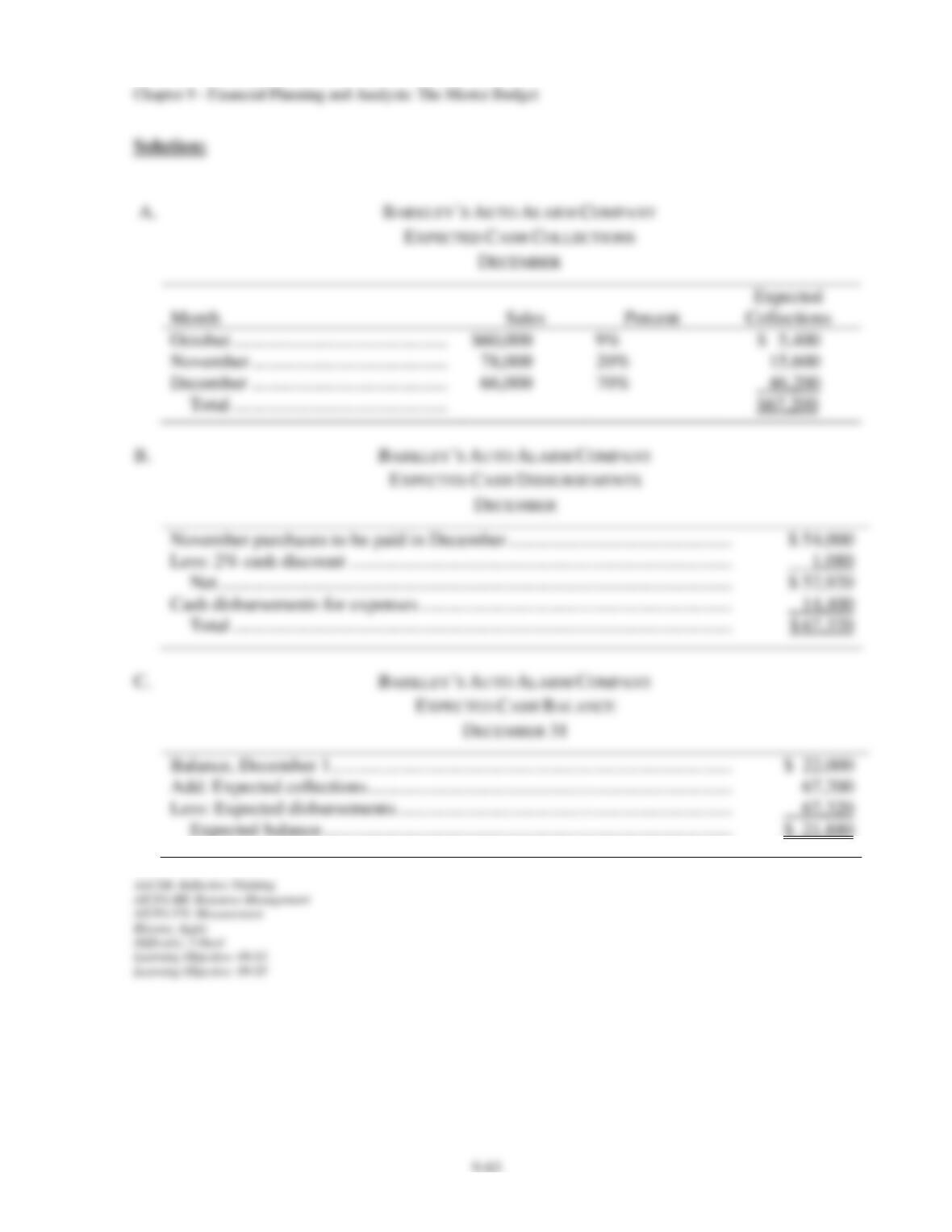
A. Expected cash collections during December.
B. Expected cash disbursements during December.
C. Expected cash balance on December 31.
106. State University is preparing its master budget for the upcoming academic year (an
academic year consists of two semesters). Currently, 12,000 students are enrolled on campus;
however, the admissions office is forecasting a 5% growth in the student body despite a
tuition hike to $80 per credit hour. The following additional information has been gathered
from an examination of university records and conversations with university officials:
· State is planning to award 150 tuition-free scholarships.
· The average class has 30 students, and the typical student takes 15 credit hours each
semester.
· Each class is three credit hours.
· Each faculty member teaches five classes during the academic year.
Required:
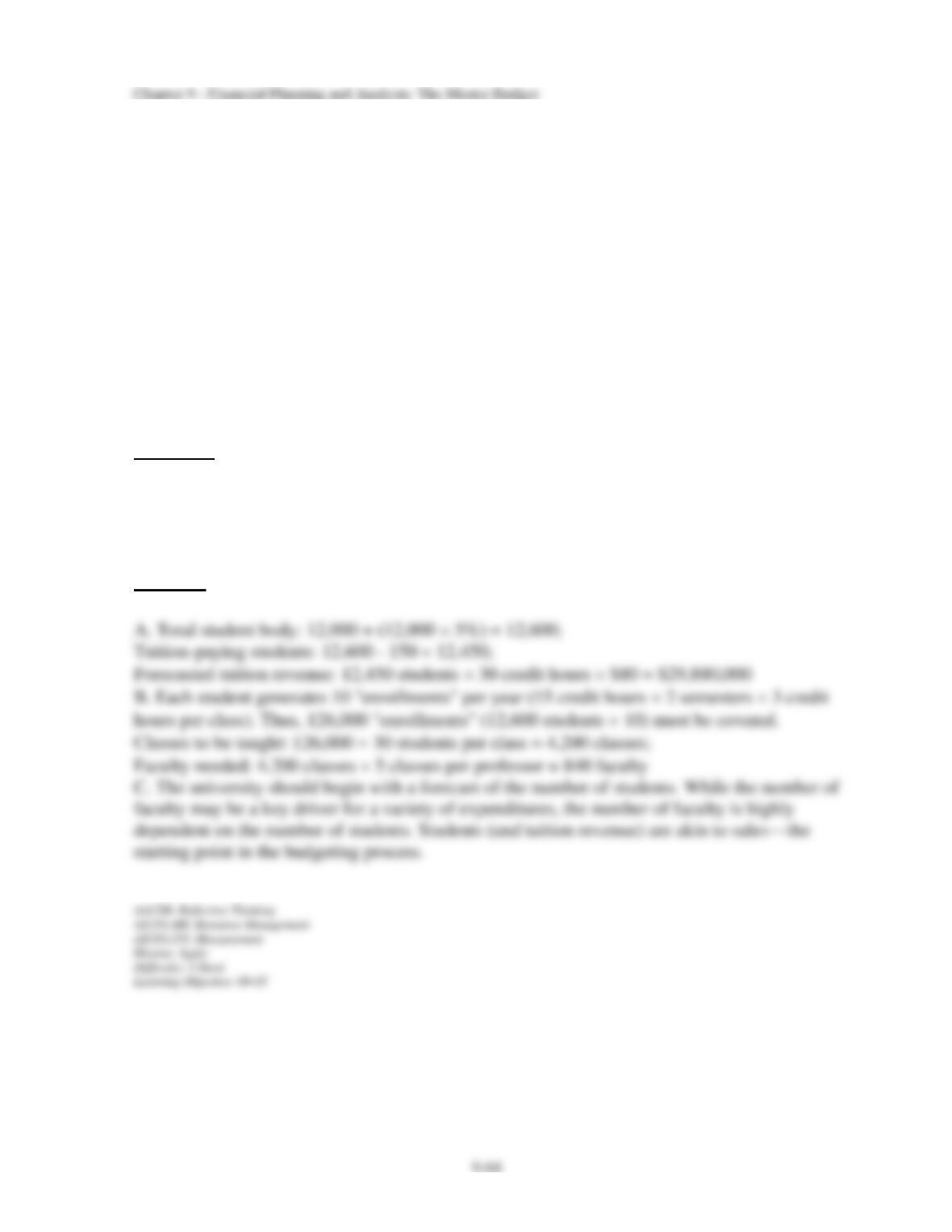
A. Compute the budgeted tuition revenue for the upcoming academic year.
B. Determine the number of faculty members needed to cover classes.
C. In preparing the university’s master budget, should the administration begin with a forecast
of students or a forecast of faculty members? Briefly explain.
Solution:
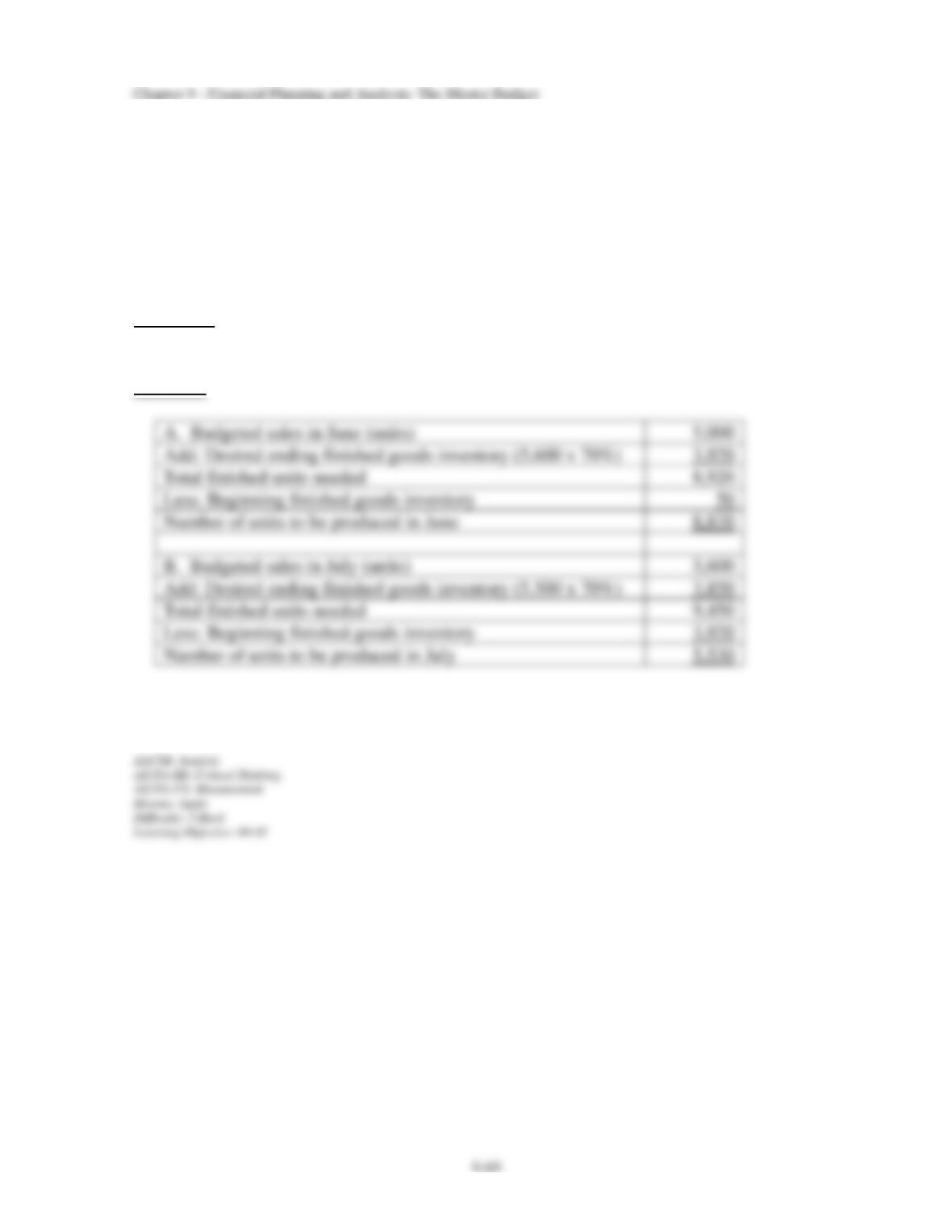
107. Markham Corporation has experienced a number of out-of-stock situations with respect
to its finished-goods inventories. Inventory at the end of May, for example, was only 50
units—an all-time low.
Management desires to implement a policy whereby finished-goods inventory is 70% of the
following month’s sales. Budgeted sales for June, July, and August are expected to be 5,000
units, 5,600 units, and 5,500 units, respectively.
Required:
Determine the number of units that Markham must produce in June and July.
Solution:
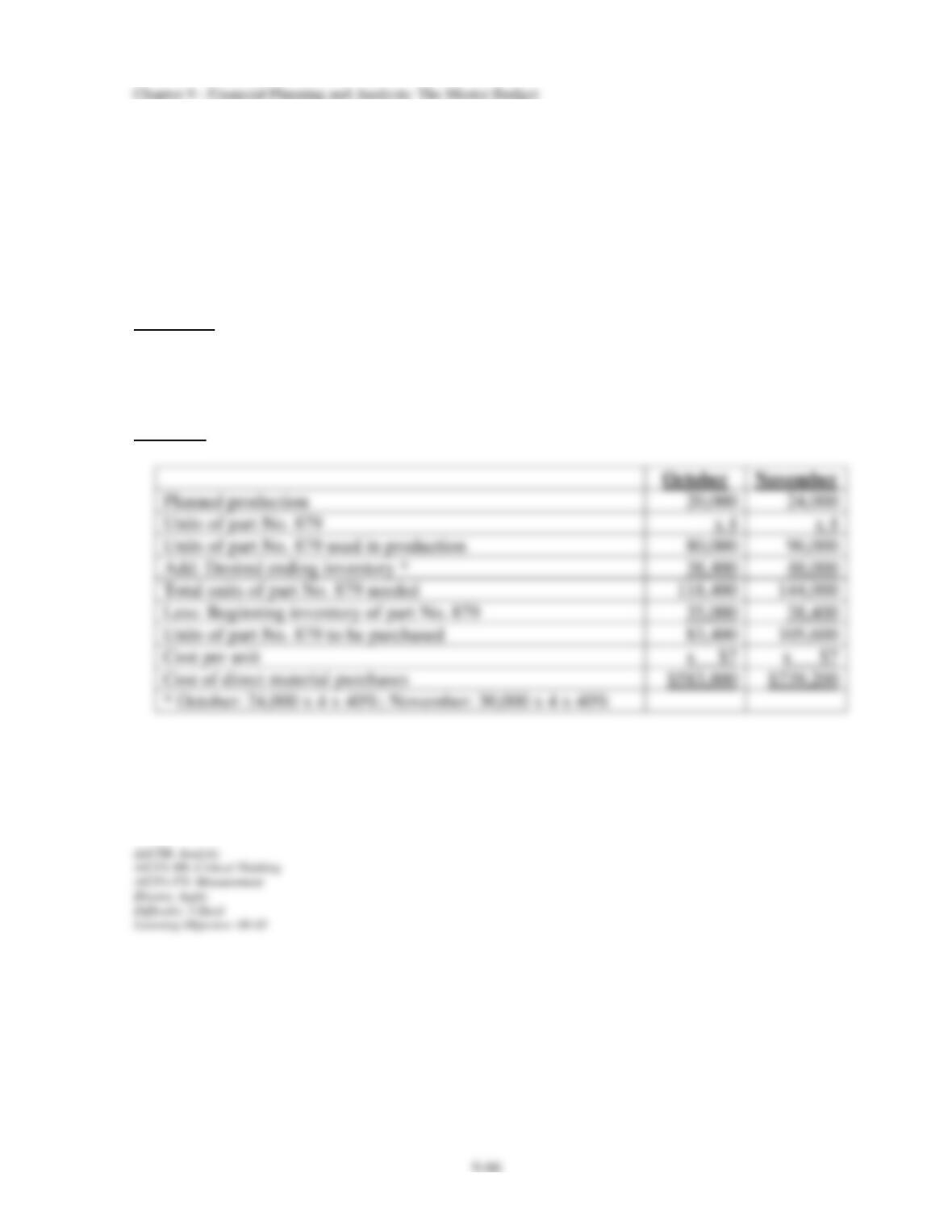
108. Planton Manufacturing plans to produce 20,000 units, 24,000 units, and 30,000 units,
respectively, in October, November, and December. Each of these units requires four units of
part no. 879, which the company can purchase for $7 each. Planton has 35,000 units of part
no. 879 in stock on September 30.
Required:
Prepare a direct-material purchases budget for October and November in units and dollars.
Management desires to maintain an ending raw-material inventory equal to 40% of the
following month’s production usage.
Solution:
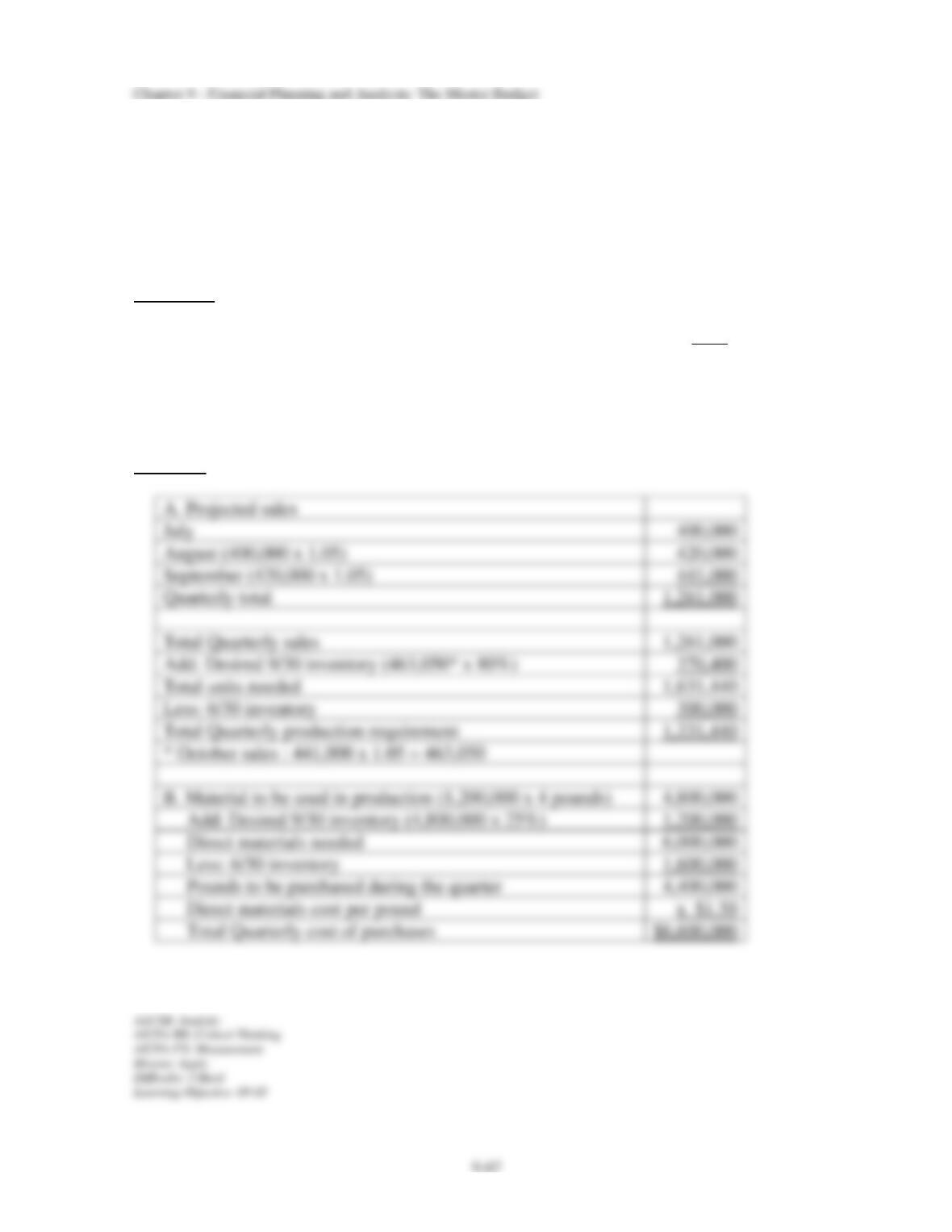
109. Boxer Company plans to sell 400,000 units of finished product in July 20×1.
Management (1) anticipates a growth rate in sales of 5% per month thereafter and (2) desires
a monthly ending finished-goods inventory (in units) of 80% of the following month’s
estimated sales. There are 300,000 completed units in the June 30, 20×1 inventory.
Each unit of finished product requires four pounds of direct material at a cost of $1.50 per
pound. There are 1,600,000 pounds of direct material in inventory on June 30, 20×1.
Required:
A. Prepare a production budget for the quarter ended September 30, 20×1. Note: For both part
“A” and part “B” of this problem, prepare your budget on a quarterly (not monthly) basis.
B. Independent of your answer to part “A,” assume that Boxer plans to produce 1,200,000
units of finished product for the quarter ended September 30. If the firm desires to stock direct
materials at the end of this period equal to 25% of current production usage, compute the cost
of direct material purchases for the quarter.
Solution:
110. Grande Corporation assembles bicycles by purchasing frames, wheels, and other parts
from various suppliers. Consider the following data:
* The company plans to sell 25,000 bicycles during each month of the year’s first
quarter.
*A review of the accounting records disclosed a finished-goods inventory of 1,400
bicycles on January 1 and an expected finished-goods inventory of 1,850 bicycles on
January 31.
*Grande has 4,300 wheels in inventory on January 1, a level that is expected to drop
by 5% at month-end.
*Assembly time totals 30 minutes per bicycle, and workers are paid $14 per hour.
*Grande accounts for employee benefits as a component of direct labor cost. Pension
and insurance costs average $2 per hour (total); additionally, the company pays Social
Security taxes that amount to 8% of gross wages earned.
Required:
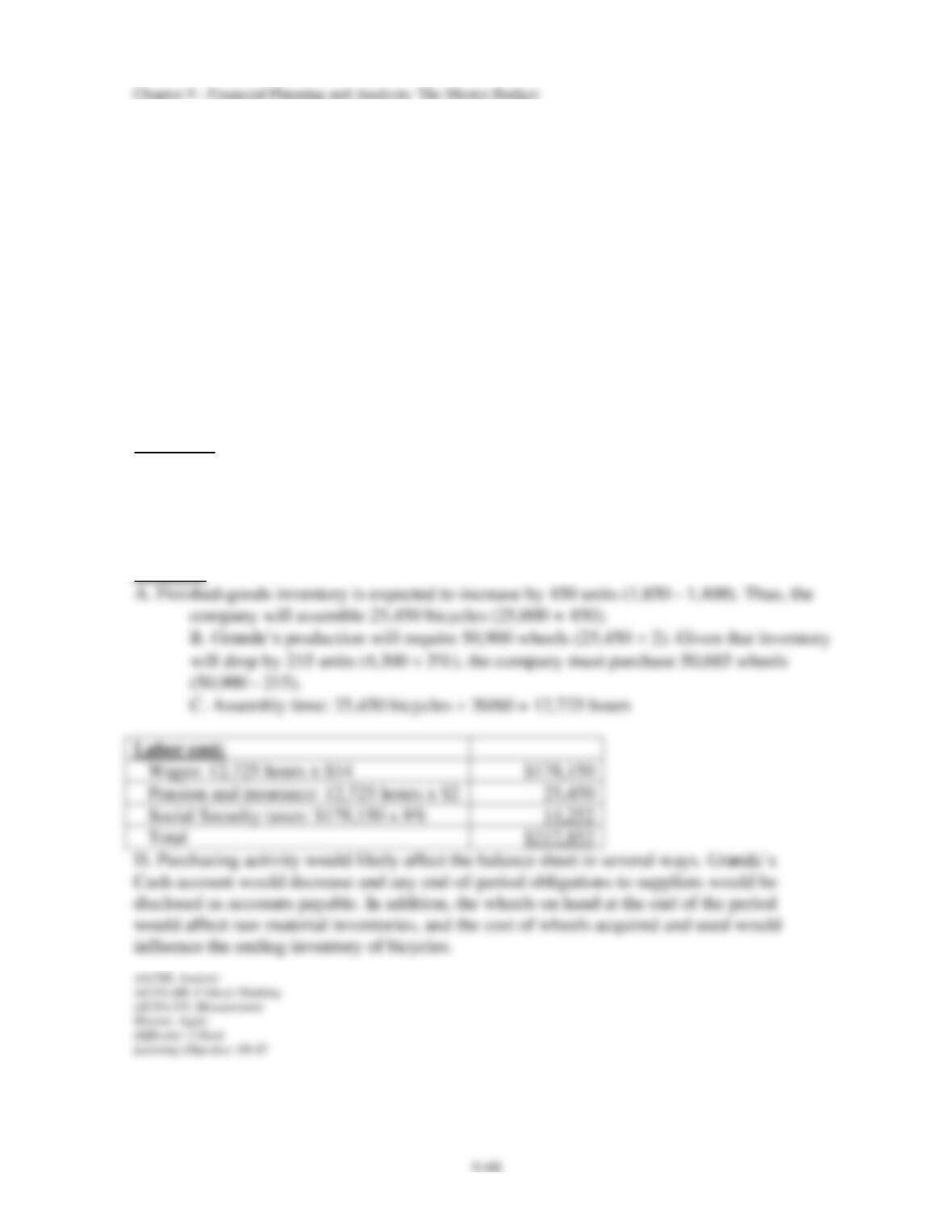
A. How many bicycles does Grande expect to produce (i.e., assemble) in January?
B. How many wheels are budgeted to be purchased in January?
C. Compute Grande’s total direct labor cost for January.
D. Briefly explain how the company’s purchasing activity would affect the end-of-
period balance sheet.
Solution:
9-69
111. Bacon Industries manufactures two products: A and B. The company predicts a sales
volume of 10,000 units for product A and ending finished-goods inventory of 2,000 units.
These numbers for product B are 12,000 and 3,000, respectively. Bacon currently has 7,000
units of A in inventory and 9,000 units of B.
The following raw materials are required to manufacture these products:
Raw Material
Cost per Pound
Required for Product
A
B
X
$2.00
2 pounds
Y
2.50
1 pound
1 pound
Z
1.25
3 pounds
Product A requires three hours of cutting time and two hours of finishing time; B requires
one hour and three hours, respectively. The direct labor rate for cutting is $10 per hour
and $18 per hour for finishing.
Required:
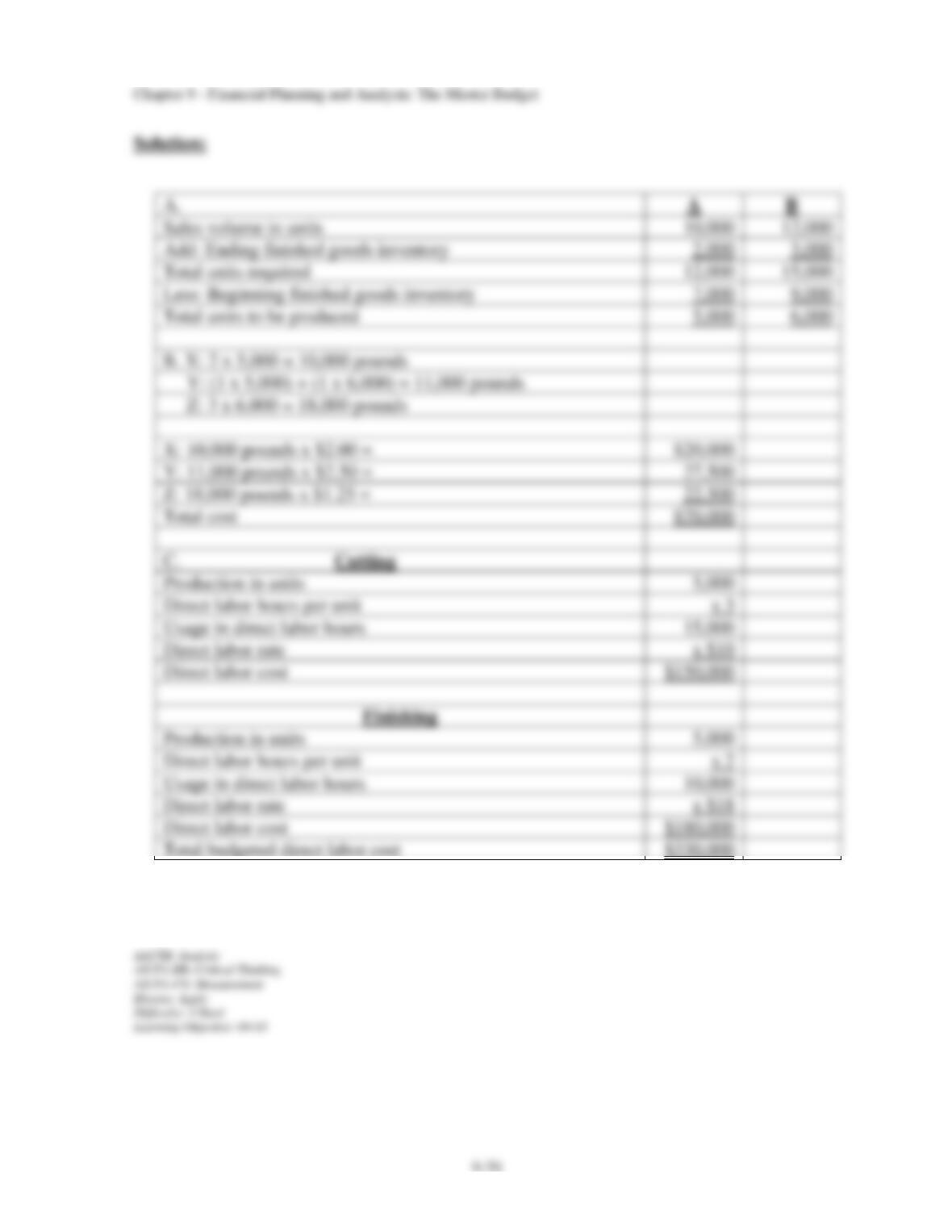
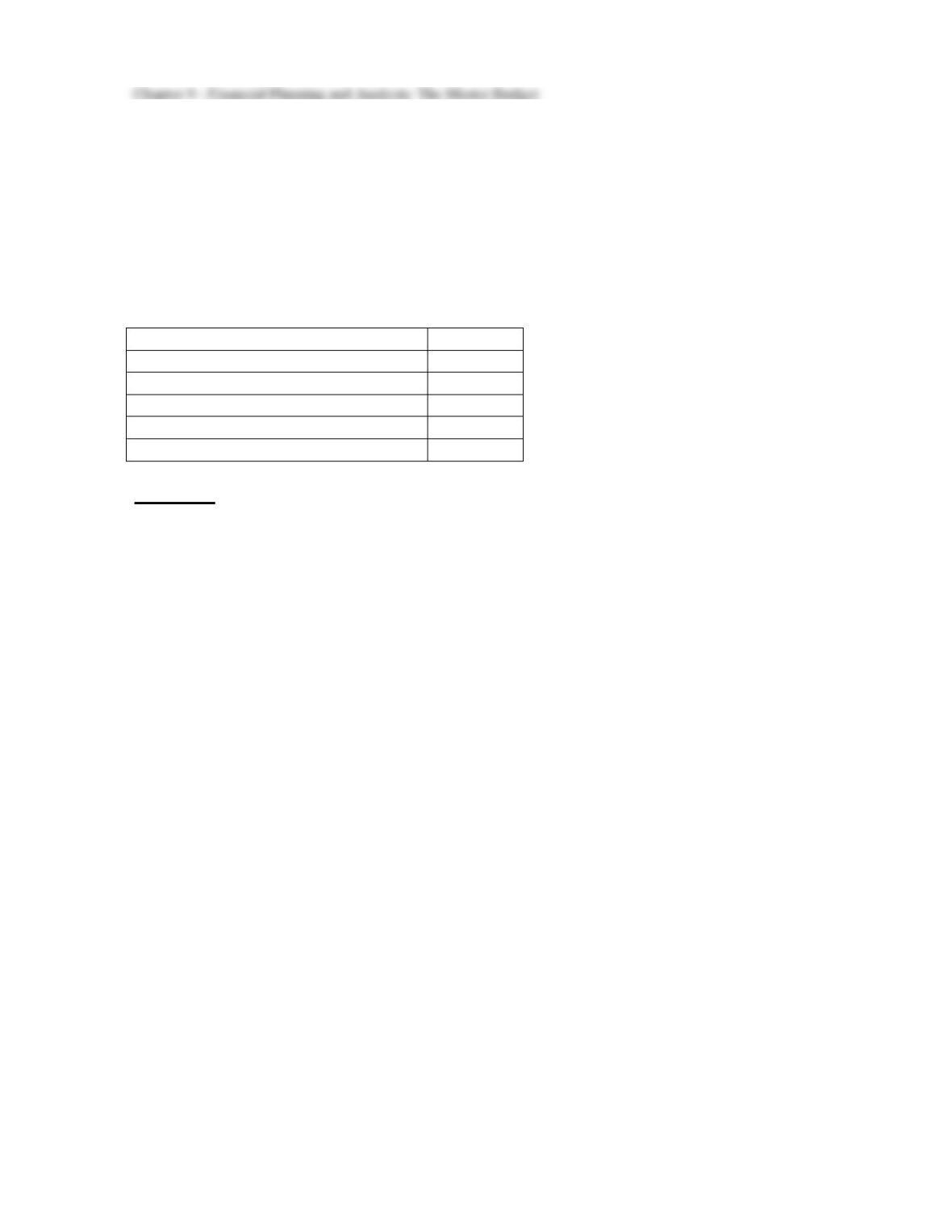
A. Prepare a production budget in units for products A and B.
B. Prepare a materials usage budget in pounds and dollars for materials X, Y, and Z.
C. Prepare a direct labor budget in hours and dollars for product A.
9-71
112. Joyner Company has the following historical collection pattern for its credit sales:
70% collected in month of sale
15% collected in the first month after sale
10% collected in the second month after sale
4% collected in the third month after sale
1% uncollectible
Budgeted credit sales for the last six months of the year follow.
July
$30,000
August
35,000
September
40,000
October
45,000
November
50,000
December
42,500
Required:
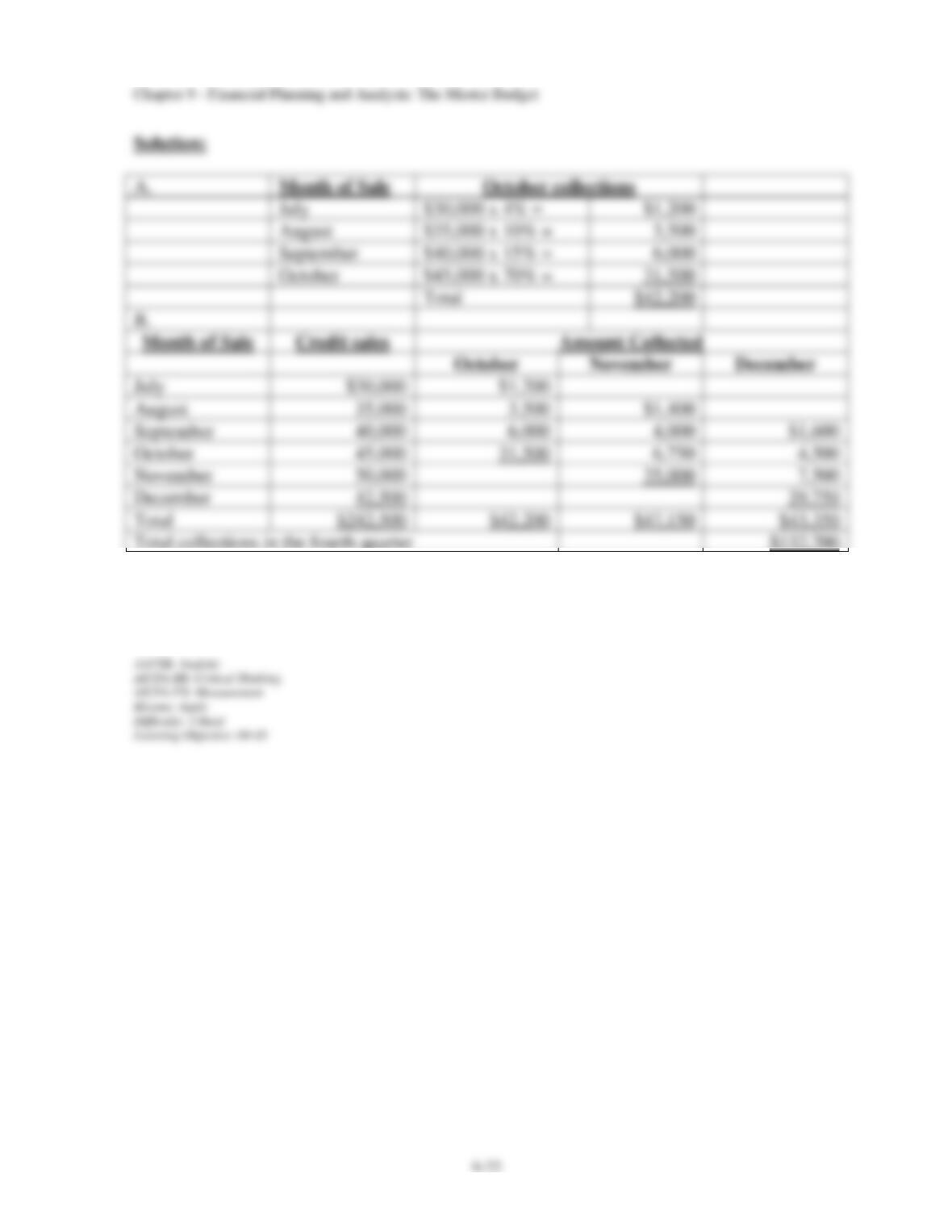
A. Calculate the estimated total cash collections during October.
B. Calculate the estimated total cash collections during the year’s fourth quarter.
9-73
113. The accounting records of Lowery, Inc., revealed an accounts receivable balance of
$195,000 on January 1, 20×6. Forty percent of the company’s sales are for cash, and the
remaining 60% are on account. Of the credit sales, 30% are collected in the month of sale and
70% are collected in the following month. Total sales in January and February are expected to
amount to $500,000 and $530,000, respectively.
Assume that in the latter half of 20×6, Lowery hired a new sales manager who aggressively
tried to maximize the company’s market share. She implemented a compensation system for
the sales force that was 100% commission based, with the commission calculated on the basis
of gross sales dollars. Sales volume increased dramatically in a very short period of time, and
the sales and collection patterns changed, as follows:
Cash sales:
20%
Credit sales:
80%
Collected in the month of sale
15%
Collected in the month following sale
75%
Uncollectible
10%
Required:
A. Compute the company’s cash inflows for January and February, 20×6.
B. Determine the outstanding receivables balance at the end of February.
C. Compare the sales and collection patterns before and after the arrival of the new sales
manager. Have things improved or deteriorated? Explain.
D. On the basis of the information presented, determine what likely caused the improvement
or deterioration in collection patterns.