61
97) Chang Manufacturing Corporation has a traditional costing system in which it applies
manufacturing overhead to its products using a predetermined overhead rate based on direct
labor-hours (DLHs). The company has two products, Plain and Fancy, about which it has
provided the following data:
Plain Fancy
Direct materials per unit $ 24.50 $ 59.30
Direct labor per unit $ 5.00 $ 25.00
Direct labor-hours per unit 0.20 1.00
Annual production 45,000 15,000
The company’s estimated total manufacturing overhead for the year is $985,440 and the
company’s estimated total direct labor-hours for the year is 24,000.
The company is considering using a variation of activity-based costing to determine its unit
product costs for external reports. Data for this proposed activity-based costing system appear
below:
Activities and Activity Measures Estimated Overhead Cost
Supporting direct labor (DLHs) $ 384,000
Setting up machines (setups) 255,840
Parts administration (part types) 345,600
Total $ 985,440
Expected Activity
Plain Fancy Total
DLHs 9,000 15,000 24,000
Setups 1,032 936 1,968
Part types 624 240 864
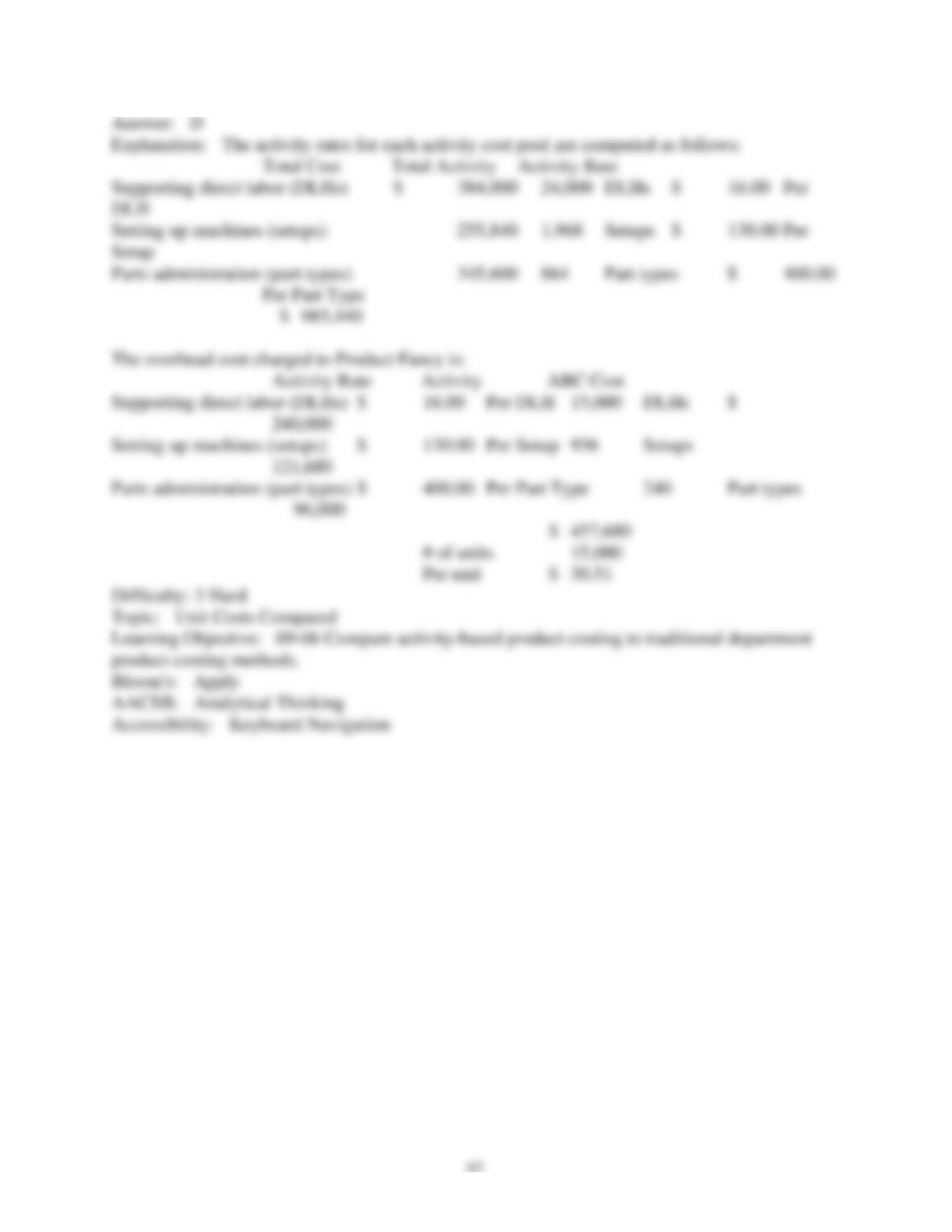
The manufacturing overhead that would be applied to a unit of product Fancy under the activity-
based costing system is closest to:
A) $71.57.
B) $41.06.
C) $8.11.
D) $30.51.
63
98) Russell Manufacturing Corporation has a traditional costing system in which it applies
manufacturing overhead to its products using a predetermined overhead rate based on direct
labor-hours (DLHs). The company has two products, Slow and Fast, about which it has provided
the following data:
Slow Fast
Direct materials per unit $ 14.10 $ 43.40
Direct labor per unit $ 3.20 $ 25.60
Direct labor-hours per unit 0.20 1.60
Annual production 30,000 15,000
The company’s estimated total manufacturing overhead for the year is $1,526,700 and the
company’s estimated total direct labor-hours for the year is 30,000.
The company is considering using a variation of activity-based costing to determine its unit
product costs for external reports. Data for this proposed activity-based costing system appear
below:
Activities and Activity Measures Estimated Overhead Cost
Assembling products (DLHs) $ 720,000
Preparing batches (batches) 362,700
Product support (product variations) 444,000
Total $ 1,526,700
Expected Activity
Slow Fast Total
DLHs 6,000 24,000 30,000
Batches 1,380 1,410 2,790
Product variations 570 540 1,110
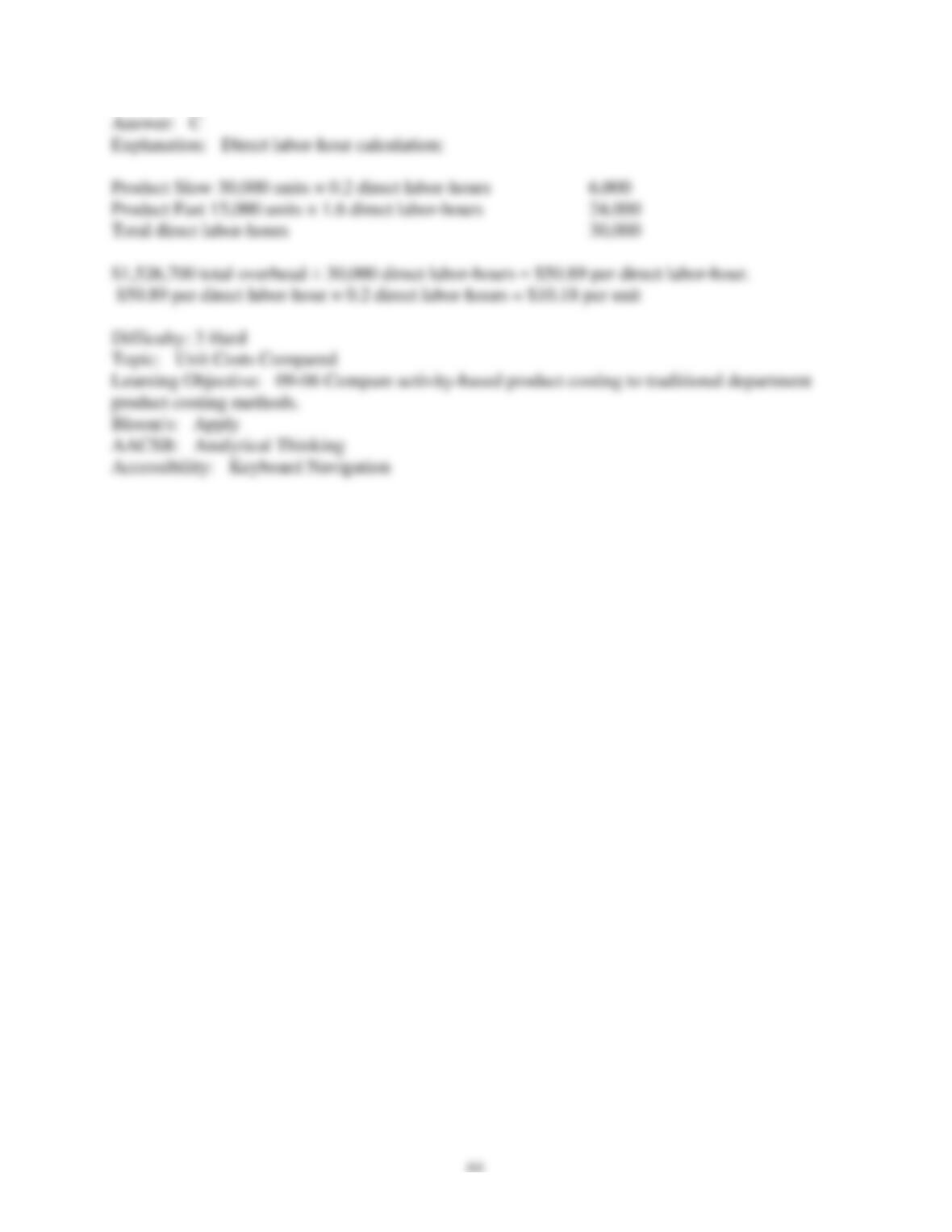
The manufacturing overhead that would be applied to a unit of product Slow under the
company’s traditional costing system is closest to:
A) $18.38.
B) $28.56.
C) $10.18.
D) $4.80.
65
99) Russell Manufacturing Corporation has a traditional costing system in which it applies
manufacturing overhead to its products using a predetermined overhead rate based on direct
labor-hours (DLHs). The company has two products, Slow and Fast, about which it has provided
the following data:
Slow Fast
Direct materials per unit $ 14.10 $ 43.40
Direct labor per unit $ 3.20 $ 25.60
Direct labor-hours per unit 0.20 1.60
Annual production 30,000 15,000
The company’s estimated total manufacturing overhead for the year is $1,526,700 and the
company’s estimated total direct labor-hours for the year is 30,000.
The company is considering using a variation of activity-based costing to determine its unit
product costs for external reports. Data for this proposed activity-based costing system appear
below:
Activities and Activity Measures Estimated Overhead Cost
Assembling products (DLHs) $ 720,000
Preparing batches (batches) 362,700
Product support (product variations) 444,000
Total $ 1,526,700
Expected Activity
Slow Fast Total
DLHs 6,000 24,000 30,000
Batches 1,380 1,410 2,790
Product variations 570 540 1,110
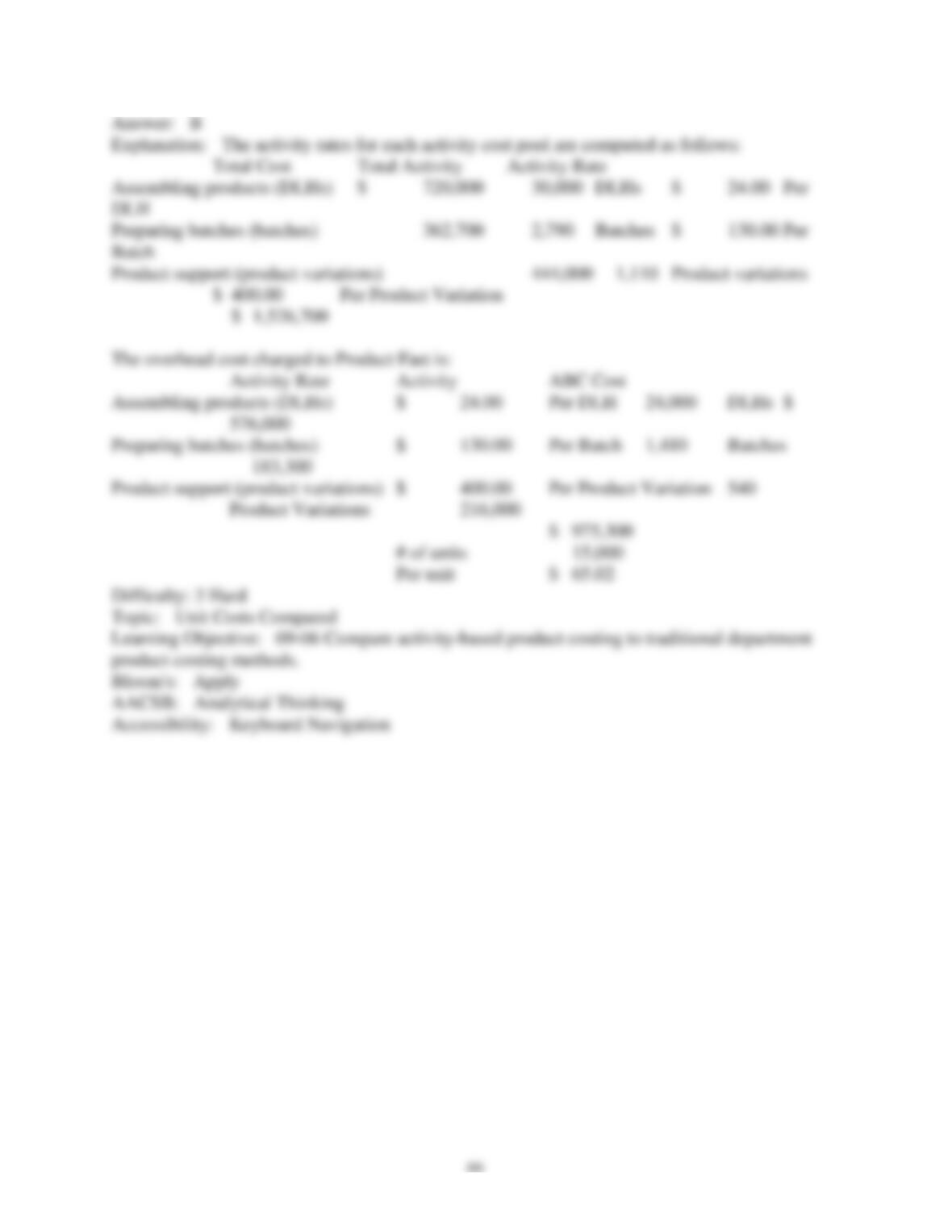
The manufacturing overhead that would be applied to a unit of product Fast under the activity-
based costing system is closest to:
A) $81.42.
B) $65.02.
C) $146.44.
D) $12.22.
67
100) Upton Manufacturing Corporation has a traditional costing system in which it applies
manufacturing overhead to its products using a predetermined overhead rate based on direct
labor-hours (DLHs). The company has two products, Long and Short, about which it has
provided the following data:
Long Short
Direct materials per unit $ 14.20 $ 48.30
Direct labor per unit $ 16.80 $ 50.40
Direct labor-hours per unit 0.80 2.40
Annual production 45,000 10,000
The company’s estimated total manufacturing overhead for the year is $3,170,400 and the
company’s estimated total direct labor-hours for the year is 60,000.
The company is considering using a variation of activity-based costing to determine its unit
product costs for external reports. Data for this proposed activity-based costing system appear
below:
Activities and Activity Measures Estimated Overhead Cost
Direct labor support (DLHs) $ 1,740,000
Setting up machines (setups) 422,400
Part administration (part types) 1,008,000
Total $ 3,170,400
Expected Activity
Long Short Total
DLHs 36,000 24,000 60,000
Setups 1,140 1,500 2,640
Part types 900 2,460 3,360
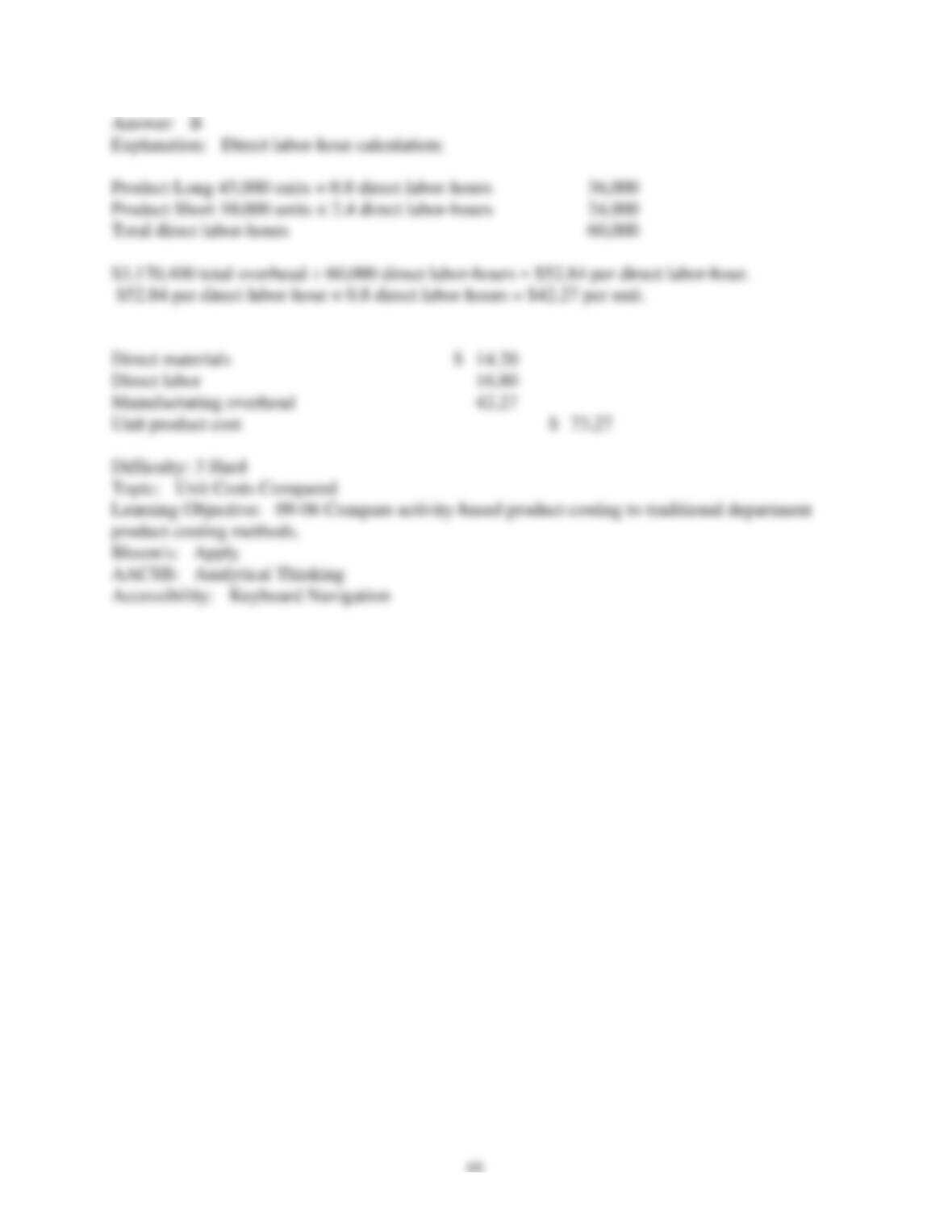
The unit product cost of Product Long under the company’s traditional costing system is closest
to:
A) $54.20.
B) $73.27.
C) $64.25.
D) $31.00.
69
101) Upton Manufacturing Corporation has a traditional costing system in which it applies
manufacturing overhead to its products using a predetermined overhead rate based on direct
labor-hours (DLHs). The company has two products, Long and Short, about which it has
provided the following data:
Long Short
Direct materials per unit $ 14.20 $ 48.30
Direct labor per unit $ 16.80 $ 50.40
Direct labor-hours per unit 0.80 2.40
Annual production 45,000 10,000
The company’s estimated total manufacturing overhead for the year is $3,170,400 and the
company’s estimated total direct labor-hours for the year is 60,000.
The company is considering using a variation of activity-based costing to determine its unit
product costs for external reports. Data for this proposed activity-based costing system appear
below:
Activities and Activity Measures Estimated Overhead Cost
Direct labor support (DLHs) $ 1,740,000
Setting up machines (setups) 422,400
Part administration (part types) 1,008,000
Total $ 3,170,400
Expected Activity
Long Short Total
DLHs 36,000 24,000 60,000
Setups 1,140 1,500 2,640
Part types 900 2,460 3,360
Unit overhead cost of Product Short under the activity-based costing system is closest to:
A) $266.10.
B) $98.70.
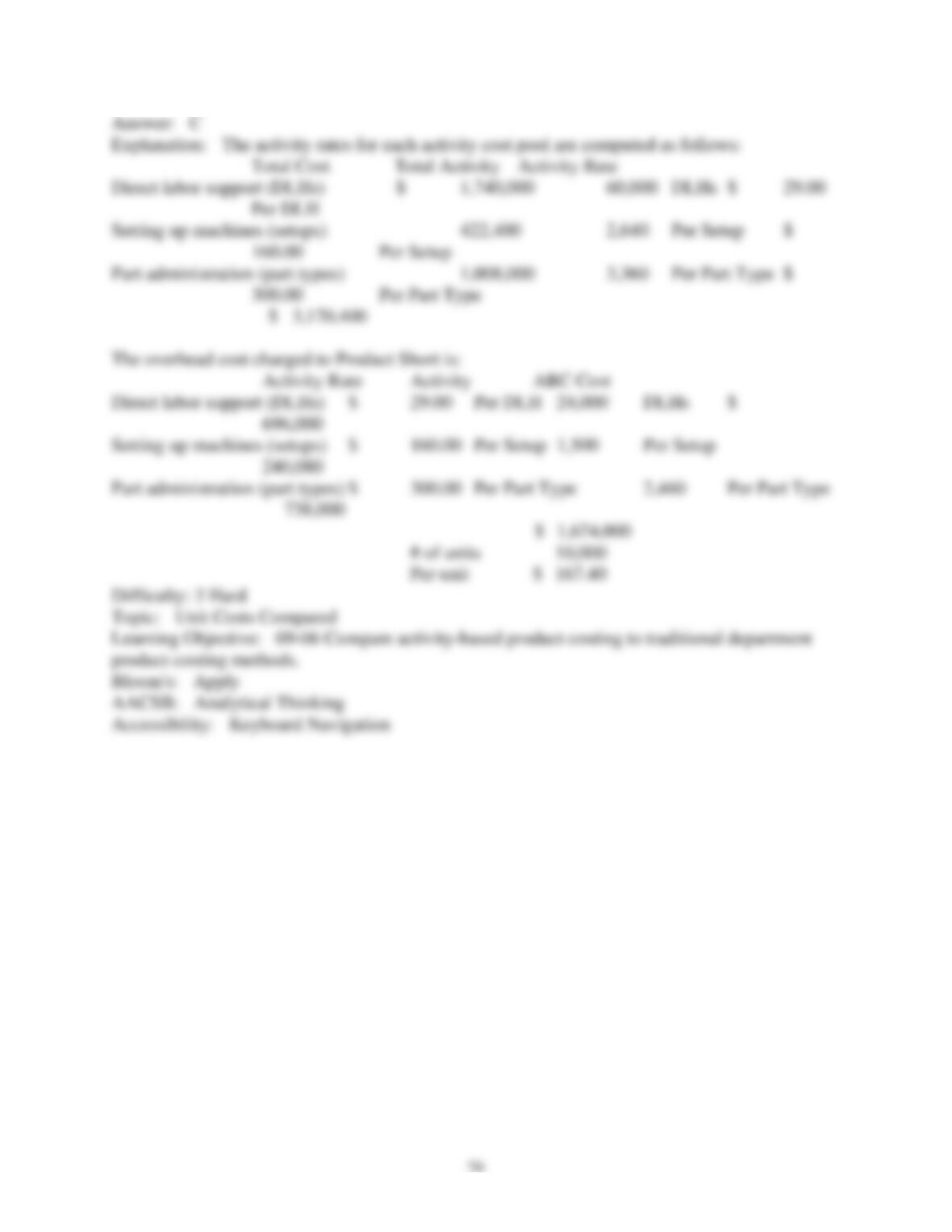
C) $167.40.
D) $225.52.
71
102) Cassidy Manufacturing Corporation has a traditional costing system in which it applies
manufacturing overhead to its products using a predetermined overhead rate based on direct
labor-hours (DLHs). The company has two products, VIP and Kommander, about which it has
provided the following data:
VIP Kommander
Direct materials per unit $ 27.50 $ 62.10
Direct labor per unit $ 15.60 $ 52.00
Direct labor-hours per unit 0.60 2.00
Annual production 40,000 15,000
The company’s estimated total manufacturing overhead for the year is $2,449,440 and the
company’s estimated total direct labor-hours for the year is 54,000.
The company is considering using a variation of activity-based costing to determine its unit
product costs for external reports. Data for this proposed activity-based costing system appear
below:
Activities and Activity Measures Estimated Overhead Cost
Assembling products (DLHs) $ 918,000
Preparing batches (batches) 397,440
Product support (product variations) 1,134,000
Total $ 2,449,440
Expected Activity
VIP Kommander Total
DLHs 24,000 30,000 54,000
Batches 1,458 1,026 2,484
Product variations 2,592 1,188 3,780
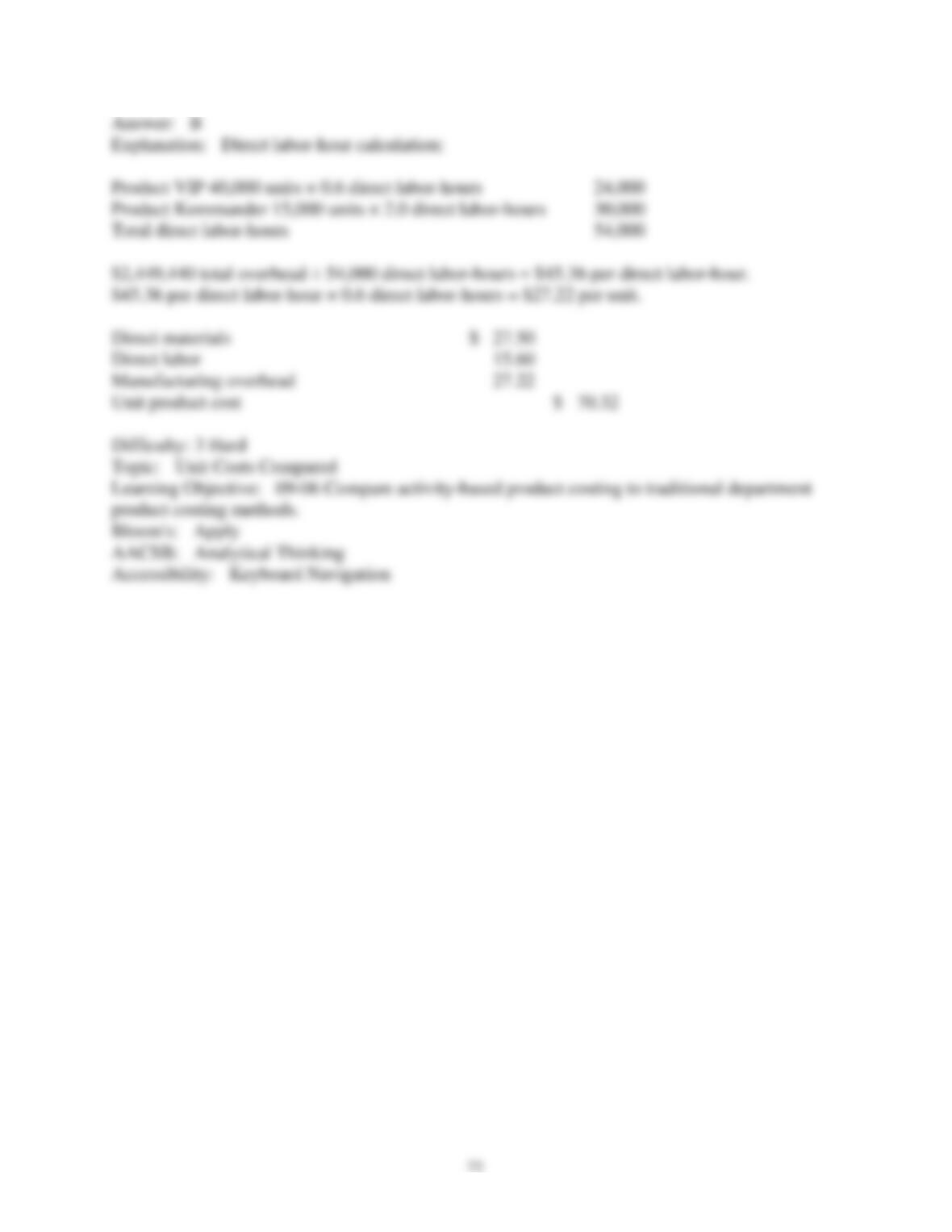
The unit product cost of Product VIP under the company’s traditional costing system is closest
to:
A) $53.30.
B) $70.32.
C) $43.10.
D) $78.57.
73
103) Cassidy Manufacturing Corporation has a traditional costing system in which it applies
manufacturing overhead to its products using a predetermined overhead rate based on direct
labor-hours (DLHs). The company has two products, VIP and Kommander, about which it has
provided the following data:
VIP Kommander
Direct materials per unit $ 27.50 $ 62.10
Direct labor per unit $ 15.60 $ 52.00
Direct labor-hours per unit 0.60 2.00
Annual production 40,000 15,000
The company’s estimated total manufacturing overhead for the year is $2,449,440 and the
company’s estimated total direct labor-hours for the year is 54,000.
The company is considering using a variation of activity-based costing to determine its unit
product costs for external reports. Data for this proposed activity-based costing system appear
below:
Activities and Activity Measures Estimated Overhead Cost
Assembling products (DLHs) $ 918,000
Preparing batches (batches) 397,440
Product support (product variations) 1,134,000
Total $ 2,449,440
Expected Activity
VIP Kommander Total
DLHs 24,000 30,000 54,000
Batches 1,458 1,026 2,484
Product variations 2,592 1,188 3,780
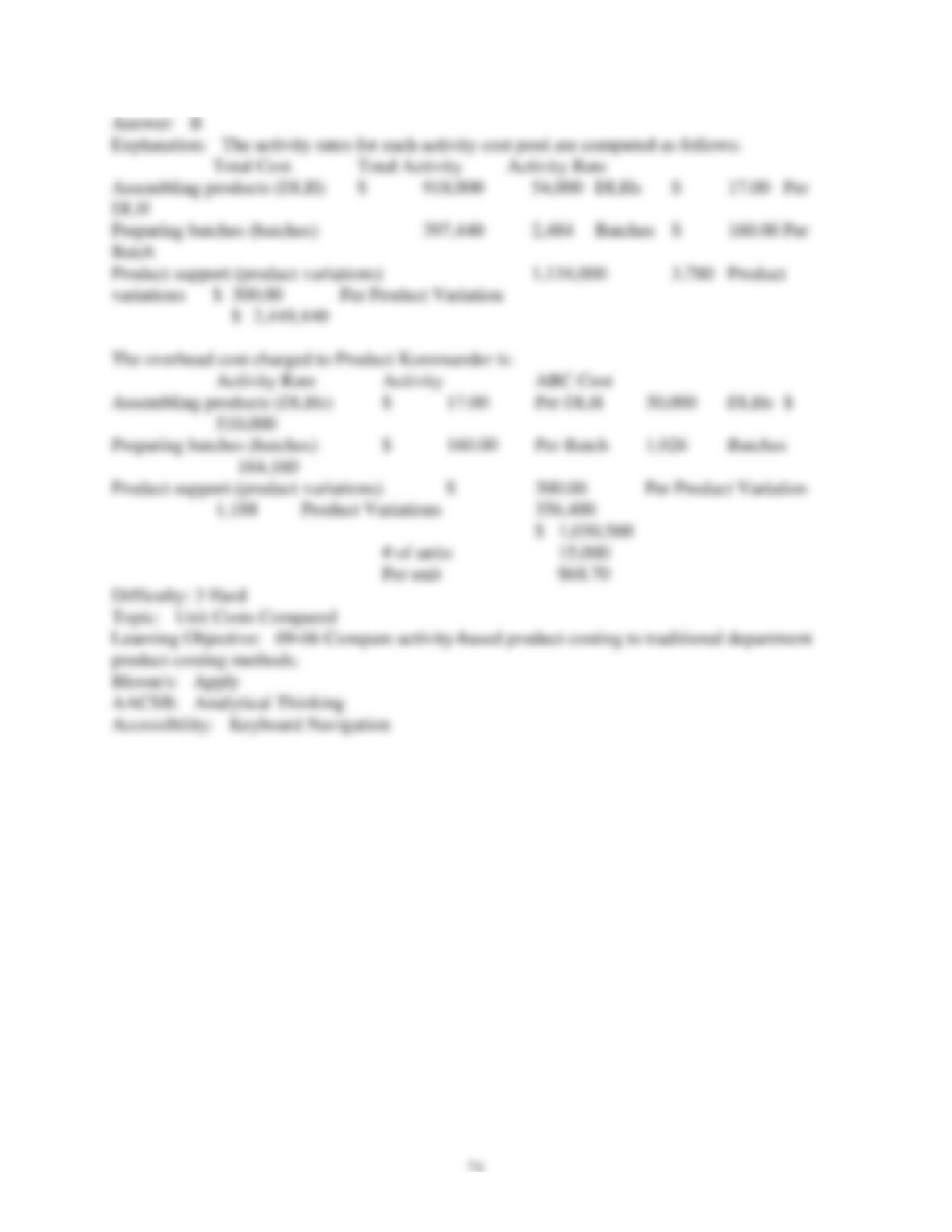
Unit overhead cost of Product Kommander under the activity-based costing system is closest to:
A) $204.82.
B) $68.70.
C) $182.80.
D) $114.10.
104) Miracle Consulting Corporation has its headquarters in Chicago and operates from three
branch offices in Portland, Dallas, and Miami. Two of the company’s activity cost pools are
General Service and Research Service. These costs are allocated to the three branch offices using
an activity-based costing system. Information for next year follows:
Activity Cost Pool Activity Measure Estimated Cost
General service % of time devoted to branch $ 700,000
Research service Computer time $ 140,000
Estimated branch data for next year is as follows:
% of time Computer time
Portland 30 % 200,000 minutes
Dallas 60 % 150,000 minutes
Miami 10 % 50,000 minutes
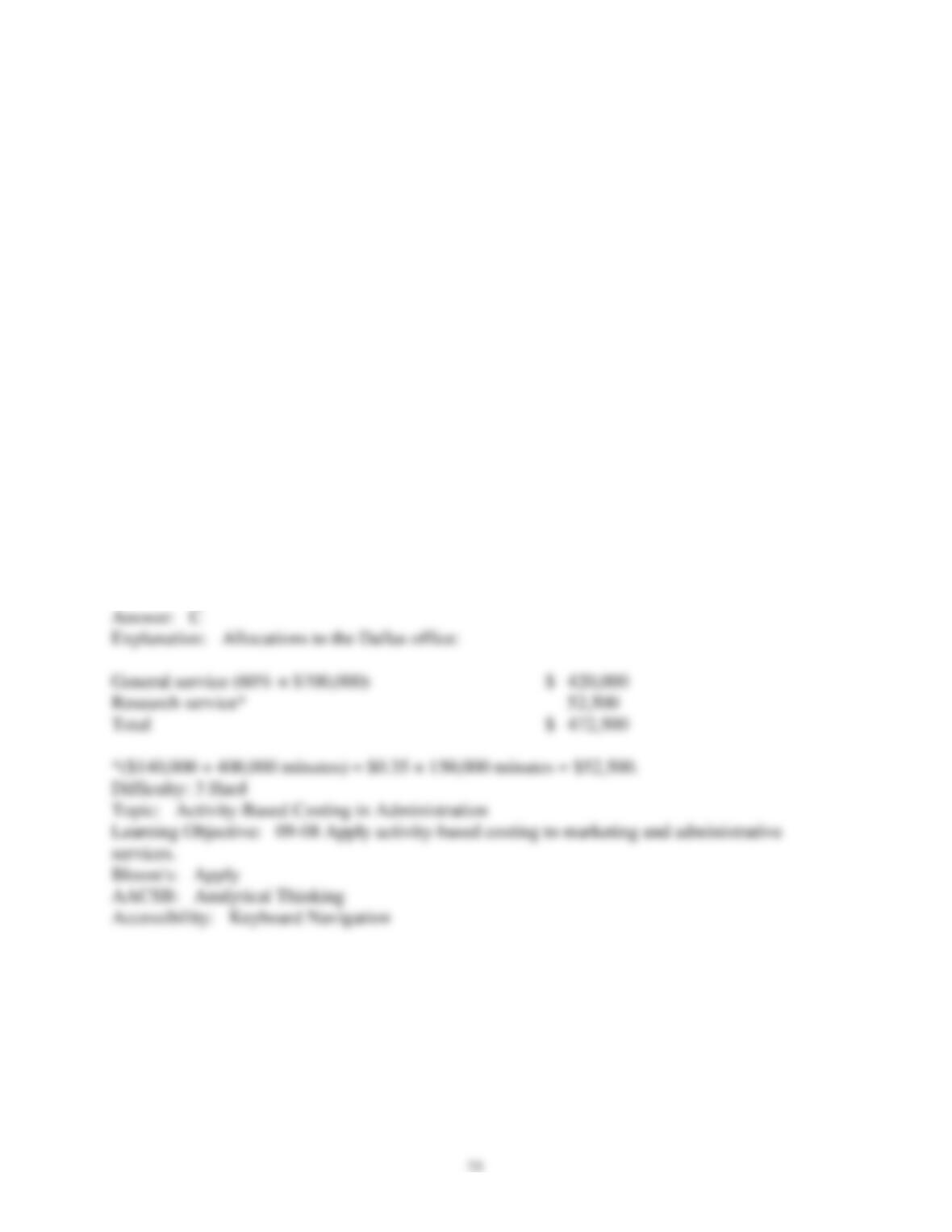
How much of the headquarters cost allocation should the Dallas office expect to receive next
year?
A) $280,000.
B) $409,500.
C) $472,500.
D) $504,000.
105) A basic assumption of activity-based costing (ABC) is that:
A) All manufacturing costs vary directly with units of production.
B) Products or services require the performance of activities and activities consume resources.
C) Only costs that respond to unit-level drivers are product costs.
D) Only variable costs are included in the activity cost pools.
106) In an activity-based costing (ABC) system, what should be used to assign departmental
manufacturing overhead costs to products produced in varying lot sizes?
A) A product’s ability to bear cost allocations.
B) A single cause-and-effect relationship.
C) Multiple cause-and-effect relationships.
D) Relative net sales values of the products.
107) Mission Company is preparing its annual profit plan. As part of its analysis of the
profitability of individual products, the controller estimates the amount of overhead that should
be allocated to the individual product lines from the information provided below. (CMA based)
Wall Mirrors Specialty Windows
Units Produced 40 20
Material moves per product line 5 15
Direct labor hours per product line 200 300
Budgeted material handling costs: $50,000
Under a traditional costing system that allocates overhead on the basis of direct labor hours, the
materials handling costs allocated to one unit of Wall Mirrors would be:
A) $1,000.
B) $500.
C) $2,000.
D) $5,000.
108) Mission Company is preparing its annual profit plan. As part of its analysis of the
profitability of individual products, the controller estimates the amount of overhead that should
be allocated to the individual product lines from the information provided below. (CMA based)
Wall Mirrors Specialty Windows
Units Produced 40 20
Material moves per product line 5 15
Direct labor hours per product line 200 300
Budgeted material handling costs: $50,000
Under a traditional costing system that allocates overhead on the basis of direct labor hours, the
materials handling costs allocated to one unit of Specialty Windows would be:
A) $1,500.
B) $500.
C) $2,000.
D) $5,000.
109) Mission Company is preparing its annual profit plan. As part of its analysis of the
profitability of individual products, the controller estimates the amount of overhead that should
be allocated to the individual product lines from the information provided below. (CMA based)
Wall Mirrors Specialty Windows
Units Produced 40 20
Material moves per product line 5 15
Direct labor hours per product line 200 300
Budgeted material handling costs: $50,000
Under an activity-based costing (ABC) system, the materials handling costs allocated to one unit
of Wall Mirrors would be:
A) $625.00.
B) $312.50.
C) $833.33.
D) $1,000.00.
110) Mission Company is preparing its annual profit plan. As part of its analysis of the
profitability of individual products, the controller estimates the amount of overhead that should
be allocated to the individual product lines from the information provided below. (CMA based)
Wall Mirrors Specialty Windows
Units Produced 40 20
Material moves per product line 5 15
Direct labor hours per product line 200 300
Budgeted material handling costs: $50,000
Under an activity-based costing (ABC) system, the materials handling costs allocated to one unit
of Specialty Windows would be:
A) $1,875.00.
B) $937.50.
C) $312.50.
D) $1,500.00.