Chapter 09 – Reporting and Interpreting Liabilities
104. Wolf Company borrowed $5,000 on an 8% note payable on March 1, 2010. The maturity
date of the note (and payment of all interest) is September 1, 2011. The accounting period
ends December 31. Assuming no adjusting entries are made during the year, prepare the
journal entry for each of the following dates:
A. March 1, 2010.
B. December 31, 2010.
C. September 1, 2011.
Chapter 09 – Reporting and Interpreting Liabilities
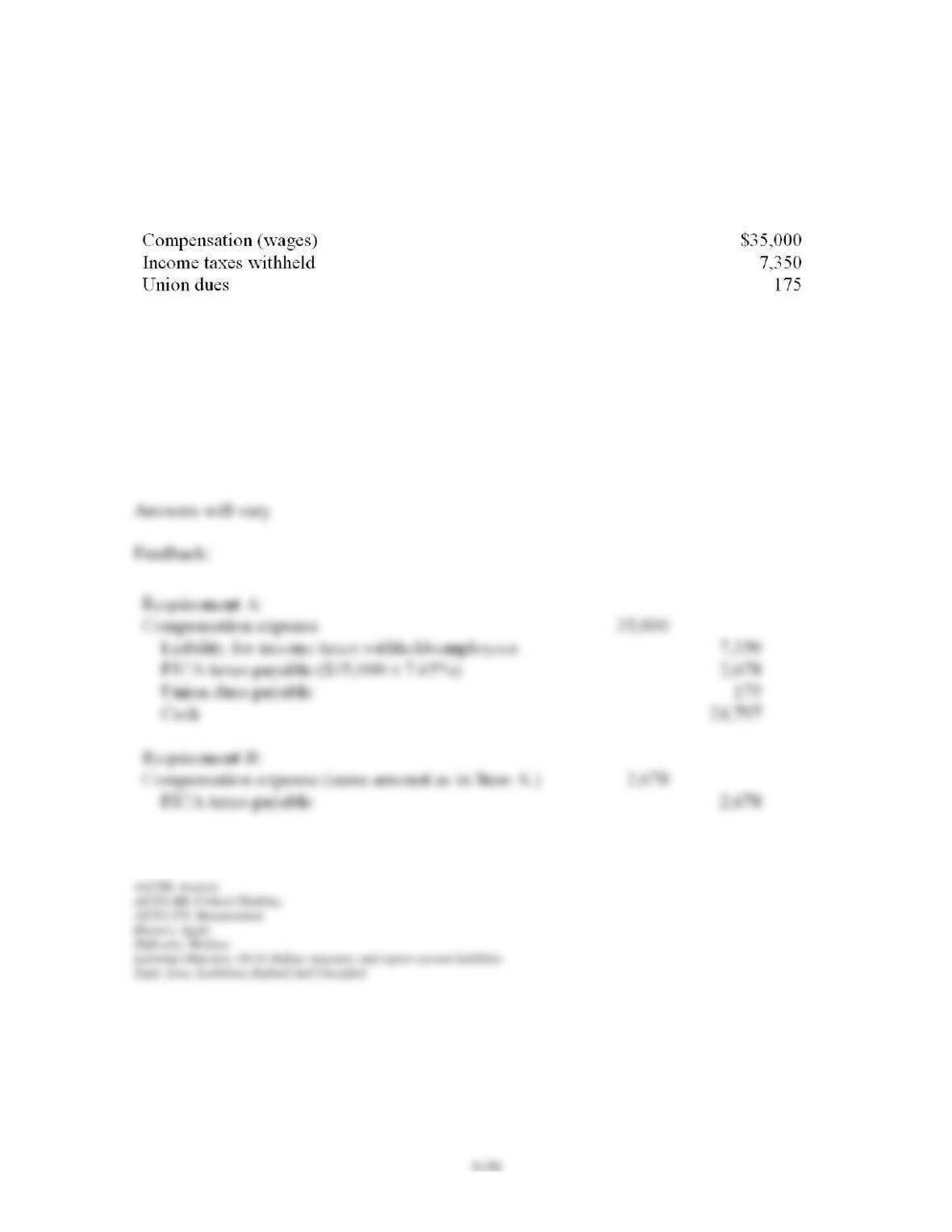
105. The following data were provided by the detailed payroll records of Mountain
Corporation for the month of March 2011:
FICA taxes at a 7.65% rate (no employee had reached the maximum).
Requirements:
A. Prepare the March 31, 2011 journal entry to record the payroll and the related employee
deductions.
B. Give the March 31, 2011 journal entry to record the employer’s FICA payroll tax expense.
Chapter 09 – Reporting and Interpreting Liabilities
9-60
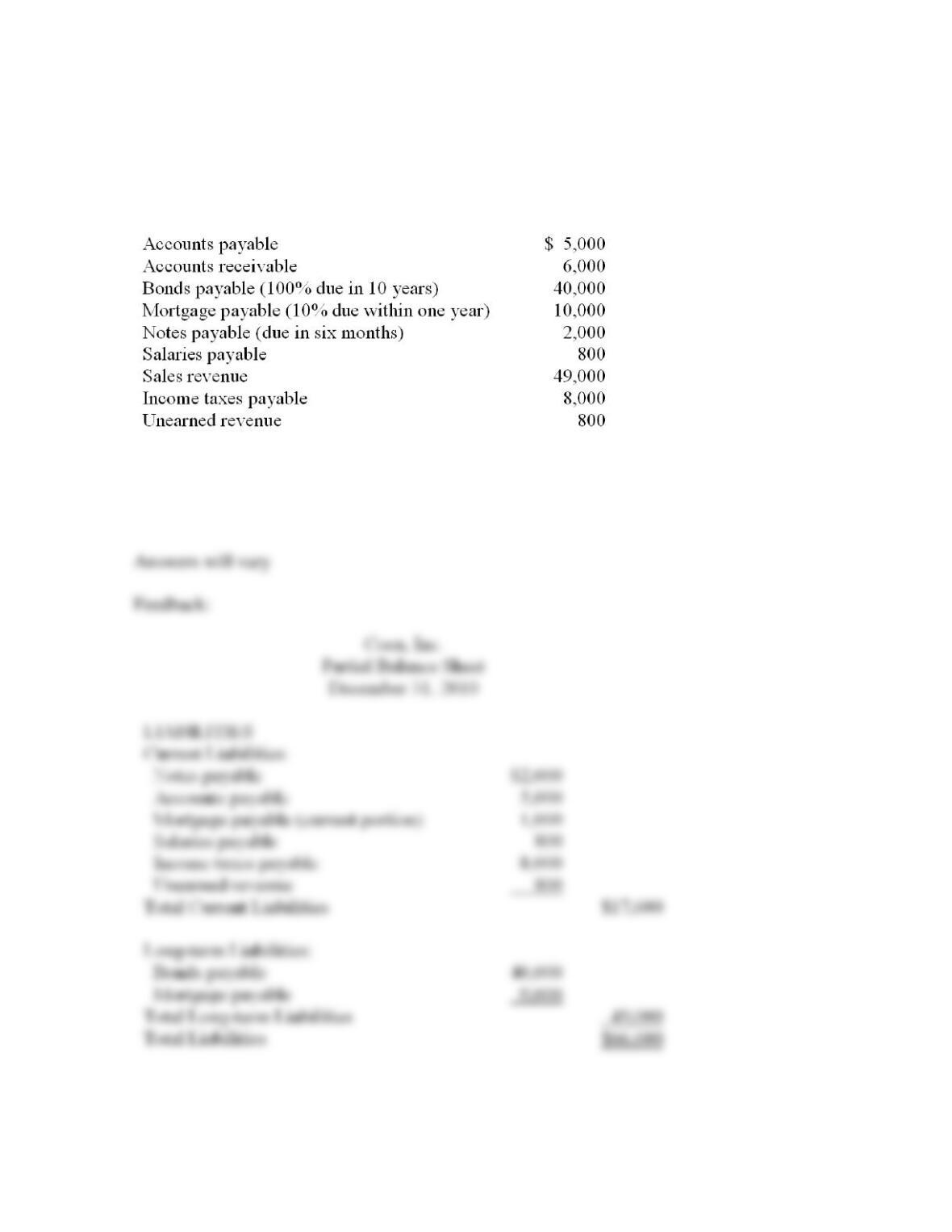
106. The following is a partial list of account balances for Coen, Inc. as of December 31,
2010:
Required:
Prepare the liability section of Coen Inc.’s classified balance sheet for December 31, 2010.
Chapter 09 – Reporting and Interpreting Liabilities
9-61
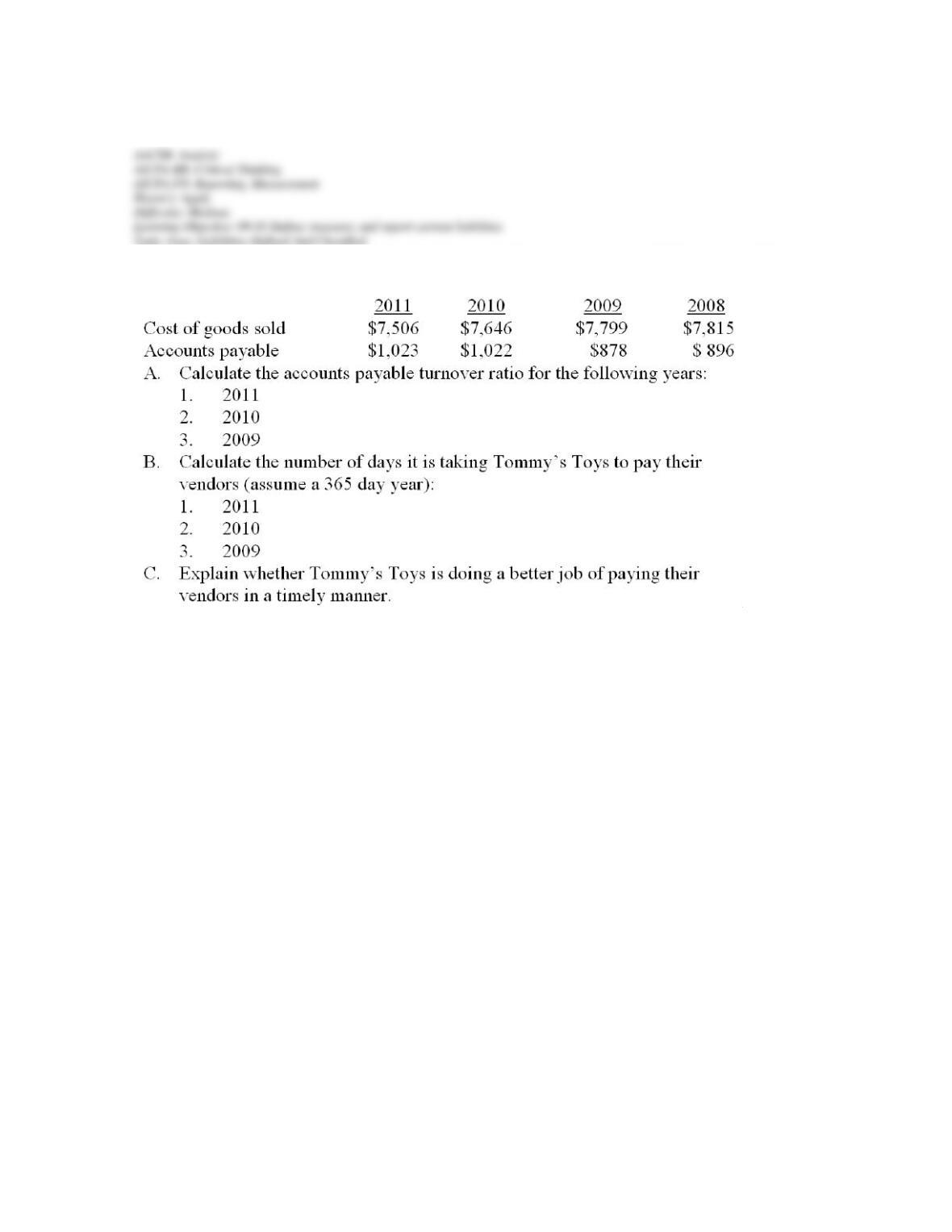
107. The following data is available for Tommy’s Toys for the years 2008 through 2011:
Chapter 09 – Reporting and Interpreting Liabilities
Chapter 09 – Reporting and Interpreting Liabilities
108. Answer the following four questions.
A. What is a contingent liability?
B. When must a contingent liability be recorded through a journal entry?
C. When should a contingent liability be disclosed in the footnotes to the financial statements?
D. When is disclosure of a contingent liability not required?
Chapter 09 – Reporting and Interpreting Liabilities
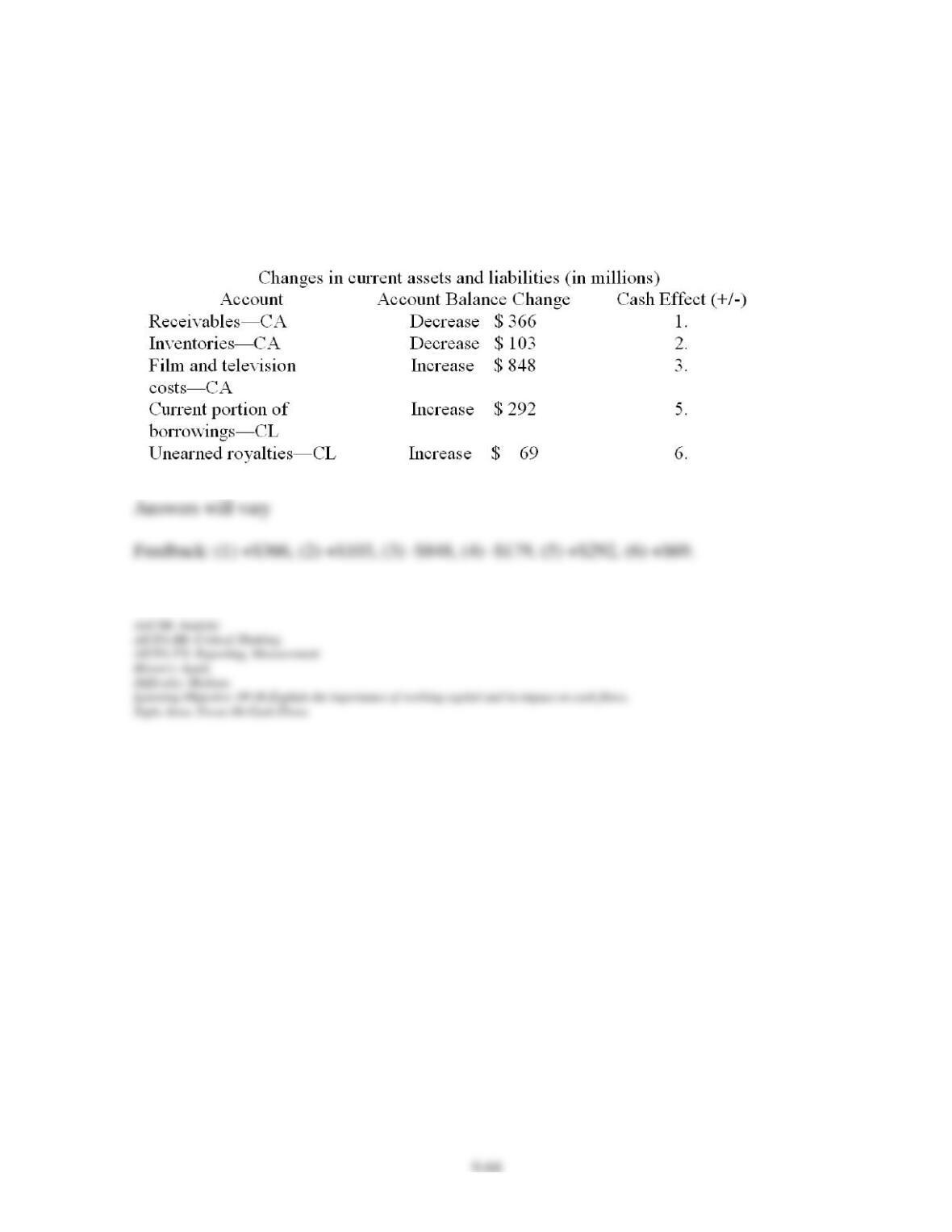
109. In a recent year, The Walt Disney Company reported the following increases or
decreases in current assets and current liabilities. Identify whether each of these increases or
decreases caused cash to increase or decrease. Show increases with a (+) in front of the
amount and decreases with a (-) in front of the amount in the column labeled cash effect.
Chapter 09 – Reporting and Interpreting Liabilities
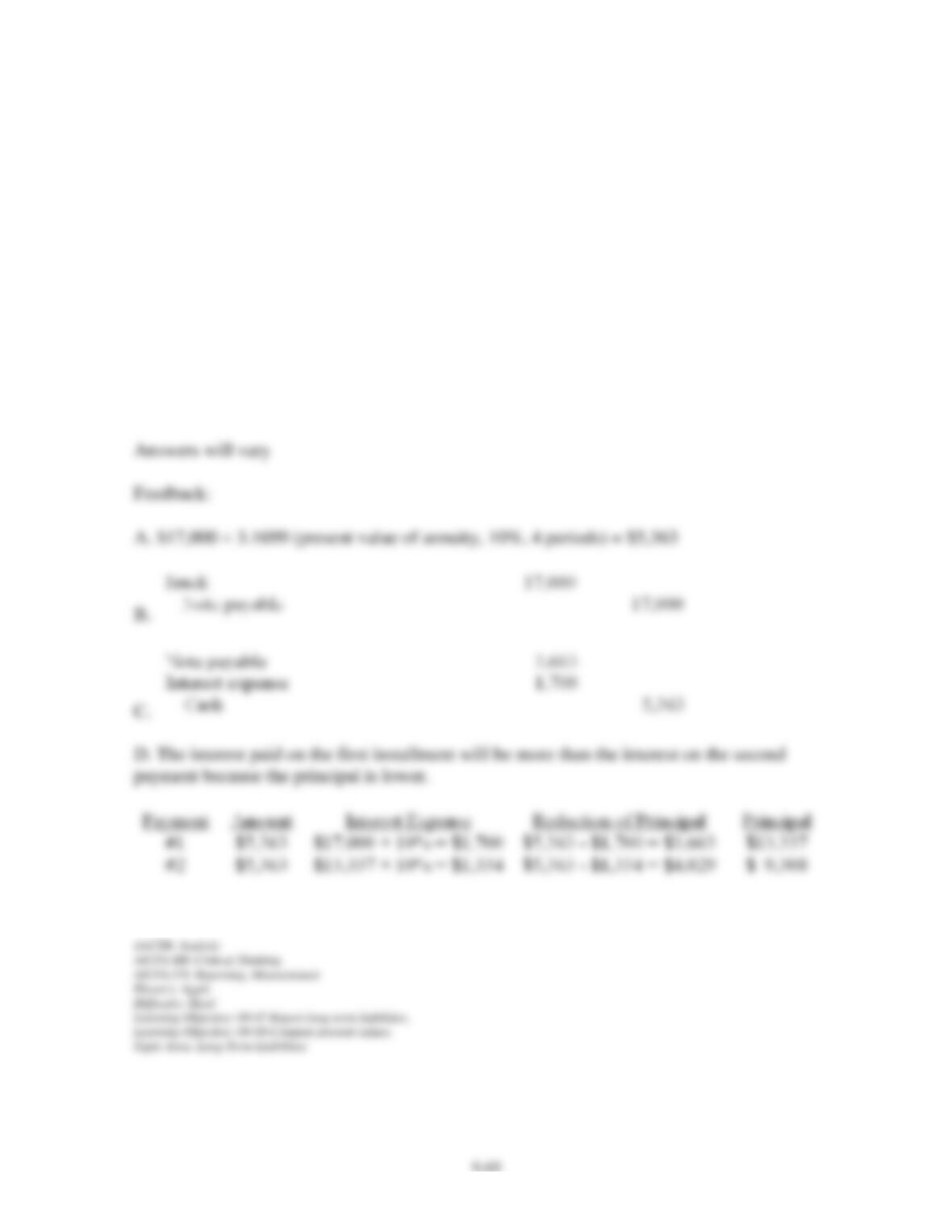
110. Border Company purchased a truck that cost $17,000. The company signed a $17,000
note payable that specified four equal annual payments (at each year-end), each of which
includes a payment on the principal and interest on the unpaid balance at 10% per annum.
Requirements:
A. Calculate the amount of each equal payment (round to the nearest dollar).
B. Prepare the journal entry to record the purchase of the truck.
C. Prepare the journal entry to record the first annual payment on the note (assume no interest
has been accrued during the year).
D. Will the interest paid with the first annual payment be more or less than the interest paid
with the second annual payment? Explain your answer.
Chapter 09 – Reporting and Interpreting Liabilities
111. Fold and Hold Corporation purchased a machine which had a current cash equivalent
cost of $38,971 on January 1, 2010. Fold and Hold paid cash of $10,000 and signed an
interest-bearing note for the balance, payable in six equal annual installments on each
December 31 beginning with December 31, 2010. The note specified a 10% interest rate on
the unpaid balance.
Requirements:
A. Prepare the journal entry to record the purchase on January 1, 2010 (round to the nearest
dollar).
B. Prepare the entry to record the first installment payment on December 31, 2010 (round to
the nearest dollar). Assume that no adjusting entries have been made during the year.
Chapter 09 – Reporting and Interpreting Liabilities
9-67
112. Information Company purchased an asset that cost $70,000 on January 1, 2010.
Arrangements were made with the supplier to pay $10,000 cash on January 1, 2010, and the
balance was to be paid over a three-year period, with equal annual payments of $24,553 to be
made at the end of 2010, 2011, and 2012. Each payment will include principal plus interest on
the unpaid balance at 11% per year.
Requirements:
A. Complete the following table:
*Round to reduce principal to zero.
B. Prepare the journal entry for the payment on December 31, 2011.
C. Explain the change, over time, on the amount of interest and the balance of the debt
principal.

Chapter 09 – Reporting and Interpreting Liabilities
Chapter 09 – Reporting and Interpreting Liabilities
9-69
113. On January 1, 2010, Mission Company agreed to buy some equipment from Anna
Company. Mission Company signed a note, agreeing to pay Anna Company $500,000 for the
equipment on December 31, 2012. The market rate of interest for this note was 10%.
Requirements:
A. Prepare the journal entry Mission Company would record on January 1, 2010 related to
this purchase.
B. Prepare the December 31, 2010, adjusting entry to record interest expense related to the
note for the first year. Assume that no adjusting entries have been made during the year.
C. Prepare the December 31, 2011, adjusting entry to record interest expense related to the
note for the second year. Assume that no adjusting entries have been made during the year.
D. Prepare the entry Mission Company would record on December 31, 2012, the due date of
the note to record interest expense for the third year and payment of the note. Assume that no
adjusting entries have been made during the year.
Chapter 09 – Reporting and Interpreting Liabilities
9-70
Chapter 09 – Reporting and Interpreting Liabilities
114. Why are present value concepts and applications so important when companies purchase
equipment financed by the seller?
Chapter 09 – Reporting and Interpreting Liabilities
9-72
115. Answer each of the independent problems (show computations):
A. Company A deposited $20,000 in a savings account on January 1, 2009, that will
accumulate 6% interest each December 31.
1. What will be the fund balance as of December 31, 2013?
2. How much interest will be earned as of December 31, 2013?
B. Company B needs to accumulate a $50,000 fund by making five equal annual deposits.
Assuming a 7% interest accumulation, how much must be deposited at the end of each year?
C. Company C has a new machine that has an estimated life of five years and a $5,000
residual value. Assuming an 8% interest rate, what is the present value of the estimated
residual value?
D. Company D owes a $50,000 debt that is now due (January 1, 2011). Arrangements have
been made to pay it off in five equal annual installments starting December 31, 2011 (an
ordinary annuity situation).
1. Assuming 8% interest, how much will be the annual payment?
2. Give the entry for Company D above for the first payment on December 31, 2009 on the
note payable. Assume that no adjusting entries have been made during the year.
Chapter 09 – Reporting and Interpreting Liabilities
116. A company’s income statement reported net income of $80,000 during 2010. The income
tax return excluded a revenue item of $10,000 (reported on the income statement) because
under the tax laws the $10,000 would not be reported for tax purposes until 2011.
Prepare the journal entry to record the 2010 income tax expense assuming a 40% tax rate.
117. A company’s income statement reported income tax expense of $200,000 during 2010.
The deferred tax liability on the balance sheet increased $20,000 during 2010. How much was
the company’s tax liability during 2010?