82) Banc Corp. Trust is considering either a bankwide overhead rate or department overhead
rates to allocate $396,000 of indirect costs. The bankwide rate could be based on either direct
labor hours (DLH) or the number of loans processed. The departmental rates would be based on
direct labor hours for Consumer Loans and a dual rate based on direct labor hours and the
number of loans processed for Commercial Loans. The following information was gathered for
the upcoming period:
Department DLH Loans Processed Direct Costs
Consumer 14,000 700 $ 280,000
Commercial 8,000 300 $ 180,000
Banc Corp. Trust estimates that it costs $400 to analyze and close a commercial loan. What is the
overhead rate if Banc Corp. Trust allocates the remaining indirect costs using direct labor hours?
A) $12.55 per hour.
B) $18.00 per hour.
C) $1,000 per loan.
D) $800 per loan.
42
83) Vanguard Corporation has provided the following data from its activity-based costing
system:
Activity Cost Pool Total Cost Total Activity
Assembly $ 942,480 66,000 machine-hours
Processing orders $ 85,050 1,800 orders
Inspection $ 126,854 1,820 inspection-hours
The company makes 430 units of product O37W a year, requiring a total of 690 machine-hours,
40 orders, and 10 inspection-hours per year. The product’s direct materials cost is $35.72 per unit
and its direct labor cost is $29.46 per unit.
According to the activity-based costing system, the average cost of product O37W is closest to:
A) $94.11 per unit.
B) $89.72 per unit.
C) $65.18 per unit.
D) $92.49 per unit.
44
84) Pinnocle Corporation has provided the following data from its activity-based costing system:
Activity Cost Pool Total Cost Total Activity
Assembly $ 1,114,920 57,000 machine-hours
Processing orders $ 47,016 1,800 orders
Inspection $ 107,328 1,560 inspection-hours
The company makes 430 units of product S78N a year, requiring a total of 1,120 machine-hours,
40 orders, and 30 inspection-hours per year. The product’s direct materials cost is $49.81 per unit
and its direct labor cost is $12.34 per unit. The product sells for $129.90 per unit.
According to the activity-based costing system, the product margin for product S78N is:
A) $4,116.50.
B) $29,132.50.
C) $6,180.50.
D) $5,161.30.
46
85) Donnati Corporation has provided the following data from its activity-based costing system:
Activity Cost Pool Total Cost Total Activity
Assembly $ 383,180 23,000 machine-hours
Processing orders $ 50,798 1,100 orders
Inspection $ 106,110 1,620 inspection-hours
Data concerning one of the company’s products, Product A43V, appear below:
Selling price per unit $ 124.60
Direct materials cost per unit $ 22.08
Direct labor cost per unit $ 45.77
Annual unit production and sales 210
Annual machine-hours 320
Annual orders 80
Annual inspection-hours 10
According to the activity-based costing system, the product margin for Product A43V is:
A) $2,891.90.
B) $5,931.30.
C) $11,917.50.
D) $2,236.90.
86) Allure Company manufactures and distributes two products, M and XY. Overhead costs are
currently allocated using the number of units produced as the allocation base. The controller has
recommended changing to an activity-based costing (ABC) system. She has collected the
following information:
Activity Cost Driver Amount M XY
Production setups Number of setups $ 82,000 8 12
Material handling Number of parts 48,000 56 24
Packaging costs Number of units 130,000 80,000 50,000
$ 260,000
What is the total overhead allocated to Product M using the current system?
A) $113,600.
B) $130,000.
C) $146,400.
D) $160,000.
87) Allure Company manufactures and distributes two products, M and XY. Overhead costs are
currently allocated using the number of units produced as the allocation base. The controller has
recommended changing to an activity-based costing (ABC) system. She has collected the
following information:
Activity Cost Driver Amount M XY
Production setups Number of setups $ 82,000 8 12
Material handling Number of parts 48,000 56 24
Packaging costs Number of units 130,000 80,000 50,000
$ 260,000
What is the total overhead per unit allocated to Product M using activity-based costing (ABC)?
A) $2.60.
B) $2.27.
C) $2.00.
D) $1.83.
88) Allure Company manufactures and distributes two products, M and XY. Overhead costs are
currently allocated using the number of units produced as the allocation base. The controller has
recommended changing to an activity-based costing (ABC) system. She has collected the
following information:
Activity Cost Driver Amount M XY
Production setups Number of setups $ 82,000 8 12
Material handling Number of parts 48,000 56 24
Packaging costs Number of units 130,000 80,000 50,000
$ 260,000
What is the total overhead allocated to Product XY using the current system?
A) $113,600.
B) $100,000.
C) $146,400.
D) $160,000.
89) Allure Company manufactures and distributes two products, M and XY. Overhead costs are
currently allocated using the number of units produced as the allocation base. The controller has
recommended changing to an activity-based costing (ABC) system. She has collected the
following information:
Activity Cost Driver Amount M XY
Production setups Number of setups $ 82,000 8 12
Material handling Number of parts 48,000 56 24
Packaging costs Number of units 130,000 80,000 50,000
$ 260,000
What is the total overhead per unit allocated to Product XY using activity-based costing (ABC)?
A) $2.60.
B) $2.27.
C) $2.00.
D) $1.83.
90) The Mega Construction Company recently switched to activity-based costing (ABC) from
the department allocation method. The department method allocated overhead costs at a rate of
$60 per machine hour. The cost accountant for the Finishing Department has gathered the
following data:
Activity Cost Drivers Rate
Material handling Tons of material handled $ 80
Machine setups Number of production runs 3,750
Utilities Machine hours 25
Quality control Number of inspections $ 500
During April, Mega purchased and used $100,000 of direct materials at $20 per ton. There were
8 production runs using a total of 12,000 machine hours in April. The manager of the Finishing
Department needed 12 inspections. Actual overhead costs totaled $820,000 for the month.
How much overhead costs were applied to the Work-in-Process Inventory during April using
activity-based costing?
A) $536,000.
B) $720,000.
C) $736,000.
D) $820,000.
91) The Mega Construction Company recently switched to activity-based costing (ABC) from
the department allocation method. The department method allocated overhead costs at a rate of
$60 per machine hour. The cost accountant for the Finishing Department has gathered the
following data:
Activity Cost Drivers Rate
Material handling Tons of material handled $ 80
Machine setups Number of production runs 3,750
Utilities Machine hours 25
Quality control Number of inspections $ 500
During April, Mega purchased and used $100,000 of direct materials at $20 per ton. There were
8 production runs using a total of 12,000 machine hours in April. The manager of the Finishing
Department needed 12 inspections. Actual overhead costs totaled $820,000 for the month.
How much overhead costs were applied to the Work-in-Process Inventory during April using
traditional costing?
A) $536,000.
B) $720,000.
C) $736,000.
D) $820,000.
92) Markham Company makes two products: Basic Product and Deluxe Product. Annual
production and sales are 1,700 units of Basic Product and 1,100 units of Deluxe Product. The
company has traditionally used direct labor-hours as the basis for applying all manufacturing
overhead to products. Basic Product requires 0.3 direct labor hours per unit and Deluxe Product
requires 0.6 direct labor hours per unit. The total estimated overhead for next period is $98,785.
The company is considering switching to an activity-based costing system for the purpose of
computing unit product costs for external reports. The new activity-based costing system would
have three overhead activity cost pools—Activity 1, Activity 2, and General Factory—with
estimated overhead costs and expected activity as follows:
Estimated Expected Activity
Activity Cost Pool Overhead Costs Basic Product Deluxe Product
Total
Activity 1 $ 30,528 1,000 600 1,600
Activity 2 17,385 1,700 200 1,900
General Factory 50,872 510 660 1,170
Total $ 98,785
(Note: The General Factory costs are allocated on the basis of direct labor hours.)
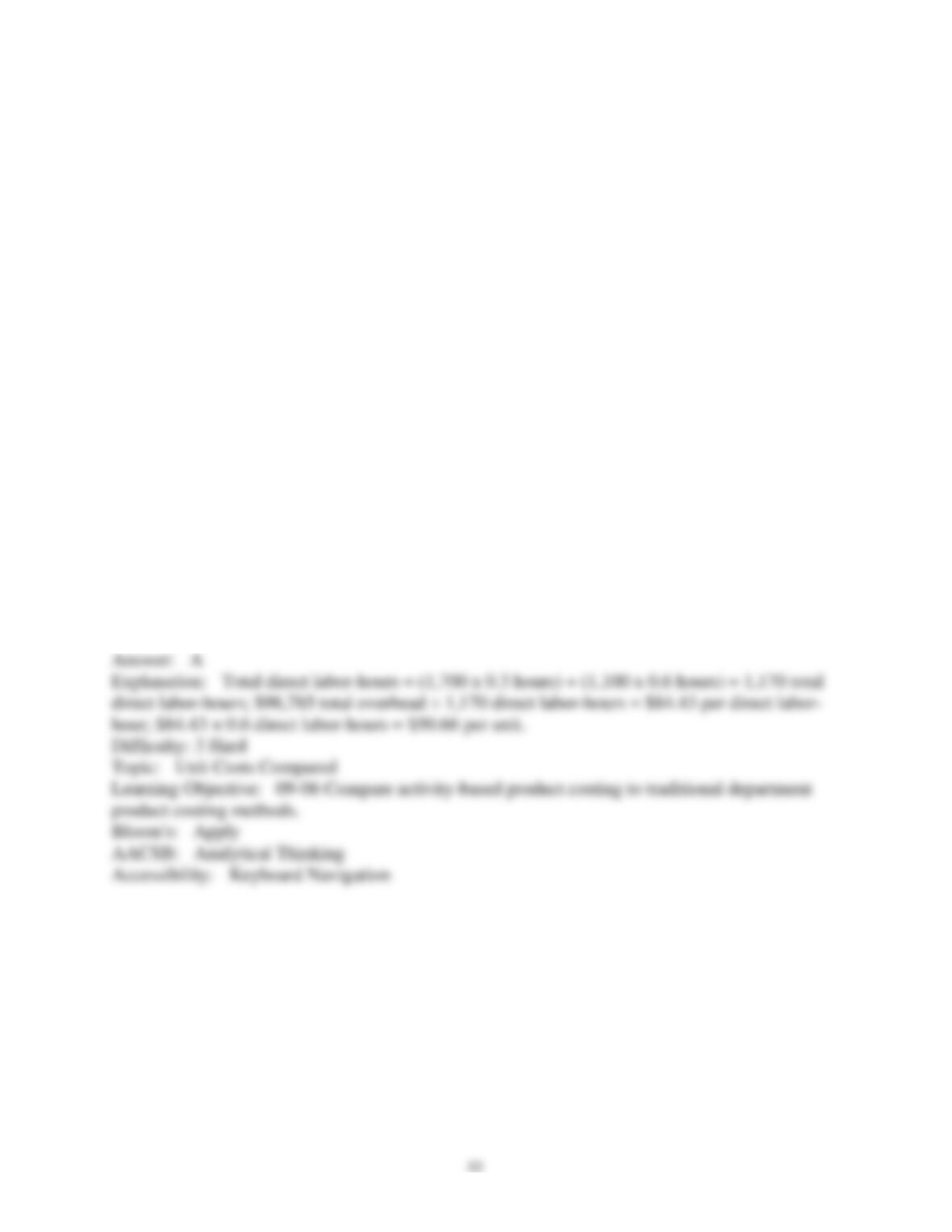
The predetermined overhead rate under the traditional costing system is closest to:
A) $9.15.
B) $43.48.
C) $84.43.
D) $19.08.
93) Markham Company makes two products: Basic Product and Deluxe Product. Annual
production and sales are 1,700 units of Basic Product and 1,100 units of Deluxe Product. The
company has traditionally used direct labor-hours as the basis for applying all manufacturing
overhead to products. Basic Product requires 0.3 direct labor hours per unit and Deluxe Product
requires 0.6 direct labor hours per unit. The total estimated overhead for next period is $98,785.
The company is considering switching to an activity-based costing system for the purpose of
computing unit product costs for external reports. The new activity-based costing system would
have three overhead activity cost pools—Activity 1, Activity 2, and General Factory—with
estimated overhead costs and expected activity as follows:
Estimated Expected Activity
Activity Cost Pool Overhead Costs Basic Product Deluxe Product
Total
Activity 1 $ 30,528 1,000 600 1,600
Activity 2 17,385 1,700 200 1,900
General Factory 50,872 510 660 1,170
Total $ 98,785
The overhead cost per unit of Deluxe Product under the traditional costing system is closest to:
A) $50.66.
B) $5.49.
C) $26.09.
D) $11.45.
94) Markham Company makes two products: Basic Product and Deluxe Product. Annual
production and sales are 1,700 units of Basic Product and 1,100 units of Deluxe Product. The
company has traditionally used direct labor-hours as the basis for applying all manufacturing
overhead to products. Basic Product requires 0.3 direct labor hours per unit and Deluxe Product
requires 0.6 direct labor hours per unit. The total estimated overhead for next period is $98,785.
The company is considering switching to an activity-based costing system for the purpose of
computing unit product costs for external reports. The new activity-based costing system would
have three overhead activity cost pools—Activity 1, Activity 2, and General Factory—with
estimated overhead costs and expected activity as follows:
Estimated Expected Activity
Activity Cost Pool Overhead Costs Basic Product Deluxe Product
Total
Activity 1 $ 30,528 1,000 600 1,600
Activity 2 17,385 1,700 200 1,900
General Factory 50,872 510 660 1,170
Total $ 98,785
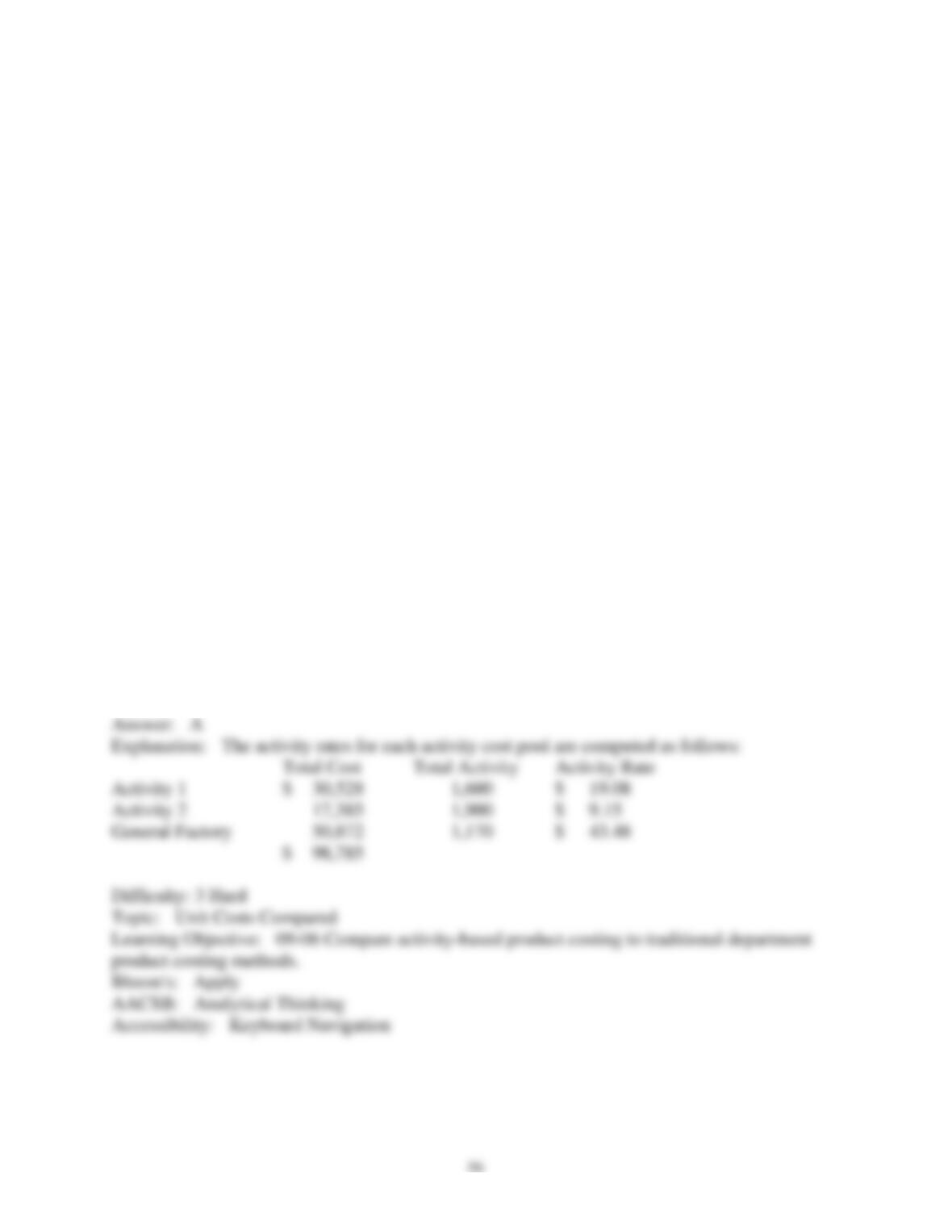
(Note: The General Factory costs are allocated on the basis of direct labor hours.)
The predetermined overhead rate (i.e., activity rate) for Activity 2 under the activity-based
costing system is closest to:
A) $9.15.
B) $51.99.
C) $86.93.
D) $10.23.
57
95) Markham Company makes two products: Basic Product and Deluxe Product. Annual
production and sales are 1,700 units of Basic Product and 1,100 units of Deluxe Product. The
company has traditionally used direct labor-hours as the basis for applying all manufacturing
overhead to products. Basic Product requires 0.3 direct labor hours per unit and Deluxe Product
requires 0.6 direct labor hours per unit. The total estimated overhead for next period is $98,785.
The company is considering switching to an activity-based costing system for the purpose of
computing unit product costs for external reports. The new activity-based costing system would
have three overhead activity cost pools—Activity 1, Activity 2, and General Factory—with
estimated overhead costs and expected activity as follows:
Estimated Expected Activity
Activity Cost Pool Overhead Costs Basic Product Deluxe Product
Total
Activity 1 $ 30,528 1,000 600 1,600
Activity 2 17,385 1,700 200 1,900
General Factory 50,872 510 660 1,170
Total $ 98,785
(Note: The General Factory costs are allocated on the basis of direct labor hours.)
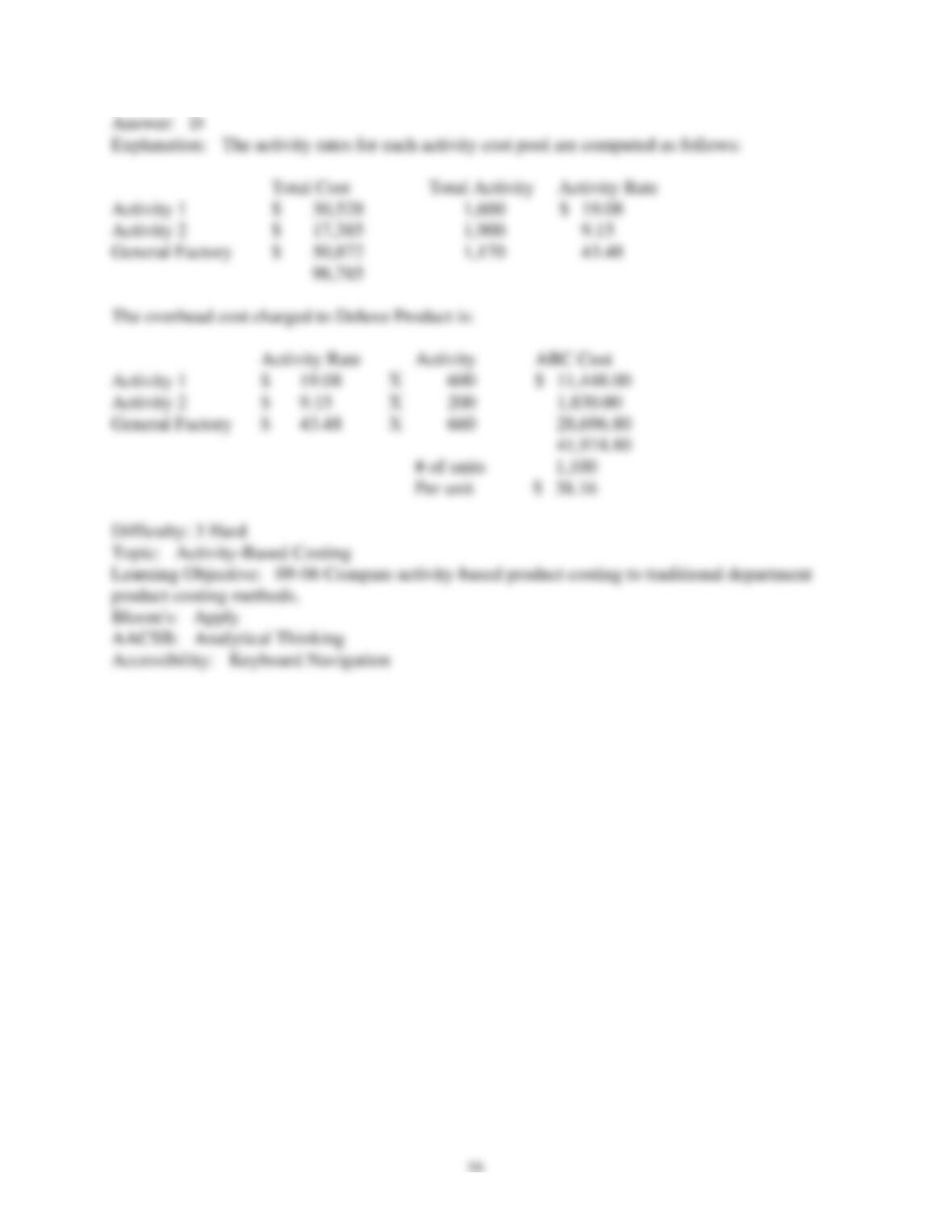
The overhead cost per unit of Deluxe Product under the activity-based costing system is closest
to:
A) $50.66.
B) $26.09.
C) $35.28.
D) $38.16.
59
96) Chang Manufacturing Corporation has a traditional costing system in which it applies
manufacturing overhead to its products using a predetermined overhead rate based on direct
labor-hours (DLHs). The company has two products, Plain and Fancy, about which it has
provided the following data:
Plain Fancy
Direct materials per unit $ 24.50 $ 59.30
Direct labor per unit $ 5.00 $ 25.00
Direct labor-hours per unit 0.20 1.00
Annual production 45,000 15,000
The company’s estimated total manufacturing overhead for the year is $985,440 and the
company’s estimated total direct labor-hours for the year is 24,000.
The company is considering using a variation of activity-based costing to determine its unit
product costs for external reports. Data for this proposed activity-based costing system appear
below:
Activities and Activity Measures Estimated Overhead Cost
Supporting direct labor (DLHs) $ 384,000
Setting up machines (setups) 255,840
Parts administration (part types) 345,600
Total $ 985,440
Expected Activity
Plain Fancy Total
DLHs 9,000 15,000 24,000
Setups 1,032 936 1,968
Part types 624 240 864
The manufacturing overhead that would be applied to a unit of Plain under the company’s
traditional costing system is closest to:
A) $8.21.
B) $3.20.
C) $11.73.
D) $19.94.