108. When bonds are issued at a discount (below face amount), the carrying value and the
corresponding interest expense increase over time.
109. When bonds are issued at a premium (above face amount), the carrying value and the
corresponding interest expense increase over time.
110. Interest expense is calculated as the carrying value times the market rate.
111. The cash payment each period is calculated as the carrying value times the market rate.
112. An amortization schedule provides a summary of the cash interest payments, interest
expense, and changes in carrying value for each period.
113. For bonds issued at a premium, the difference between interest expense and the cash paid
increases the carrying value of the bonds.
114. The market value of bonds moves in the opposite direction of interest rates.
115. At the maturity date, the carrying value will equal the face amount of the bond.
116. When an issuer retires debt of any type before its scheduled maturity date, the transaction
is an early extinguishment of debt.
117. Losses/gains on the early extinguishment of debt are reported as part of operating income
in the income statement.
118. Losses have the effect of reducing net income, while gains increase net income.
119. A gain or loss is recorded on bonds retired at maturity.
120. Monthly installment payments on a note payable include both an amount that represents
interest and an amount that represents a reduction of the outstanding loan balance.
121. A lease is a contractual arrangement by which the lessor provides the lessee the right to
use an asset for a specified period of time.
122. Operating leases are contractual agreements where the lessor owns the asset and the
lessee simply uses the asset temporarily.
123. Operating leases occur when the lessee essentially buys an asset and borrows the money
through a lease to pay for the asset.
124. The debt to equity ratio measures a company’s risk and is calculated as total liabilities
divided by stockholders’ equity.
125. Leverage enables a company to earn a higher return using debt than without debt.
126. Return on assets is calculated as net income divided by the ending balance for total
assets.
127. Return on equity is calculated as net income divided by average stockholders’ equity.
128. The times interest earned ratio compares interest expense with income available to pay
interest charges.
129. Listed below are four bond terms followed by a list of definitions. Match (by number)
the bond terms with their definitions. Each letter is used only once.
1. Matures in installments.
2. Secured only by the “full faith and credit” of the issuing
corporation.
3. Matures on a single date.
4. Supported by specific assets pledged as collateral by the
issuer
(A) Serial bond.
(B) Term bond.
(C) Secured
bond.
(D) Unsecured
bond.
130. Listed below are four bond terms followed by a list of definitions. Match (by number)
the bond terms with their definitions. Each letter is used only once.
1. Includes underwriting, legal, accounting, registration,
and printing fees
2. Allows the investor to transfer each bond into shares of
common stock
3. A contract between the issuer and the investor
4. Allows the issuer to pay off the bonds early at a fixed
price
(A) Callable bond.
(B) Convertible
bond.
(C) Bond issue
costs.
(D) Bond indenture.
131. Listed below are eight bond terms followed by a list of definitions. Match (by number)
the bond terms with their definitions. Each letter is used only once.
1. Matures in installments
2. Allows the investor to transfer each bond into shares of
common stock
3. Secured only by the “full faith and credit” of the issuing
corporation
4. Includes underwriting, legal, accounting, registration,
and printing fees
5. Supported by specific assets pledged as collateral by the
issuer
6. Matures on a single date
7. Allows the issuer to pay off the bonds early at a fixed
price
8. A contract between the issuer and the investor
(A) Serial bond.
(B) Callable
bond.
(C) Convertible
bond.
(D) Bond issue
costs.
(E) Bond
indenture.
(F) Secured
bond.
(G) Unsecured
bond.
(H) Term bond.

132. Listed below are ten terms followed by a list of phrases that describe or characterize the
terms. Match each phrase with the best term placing the number designating
1. Discount
2. Market interest
rate
3. Amortization
schedule
4. Stated interest rate
5. Debt to equity
ratio
6. Sinking fund
7. Premium
8. Capital lease
9. Operating lease
10. Times interest
earned ratio
(A) The rate quoted in the bond contract used to
calculate the cash payments for interest.
(B) The lessor owns the asset and the lessee simply
uses the asset temporarily.
(C) Total liabilities divided by total stockholders’
equity; measure a company’s risk.
(D) The true interest rate used by investors to value a
bond.
(E) The issue price is below its face amount.
(F) Provides a summary of the cash interest
payments, interest expense, and changes in carrying
value for debt instruments.
(G) The lessee essentially buys an asset and borrows
the money through a lease to pay for the asset.
(H)The issue price is above its face amount.
(I) Ratio that compares interest expense with income
available to pay those charges.
(J) An investment fund used to set aside money to be
used to pay debts as they come due.

133. Listed below are five terms followed by a list of phrases that describe or characterize the
terms. Match each phrase with the best term placing the number designating
1. Stated interest rate
2. Bonds issued at a
discount
3. Market interest
rate
4. Bonds issued at
face value
5. Bonds issued at a
premium
(A) The true interest rate used by investors to value a
bond.
(B) The stated interest rate is more than the market
interest rate.
(C) The stated interest rate equals the market interest
rate.
(D) The stated interest rate is less than the market
interest rate.
(E) The rate quoted in the bond contract used to
calculate the cash payments for interest.
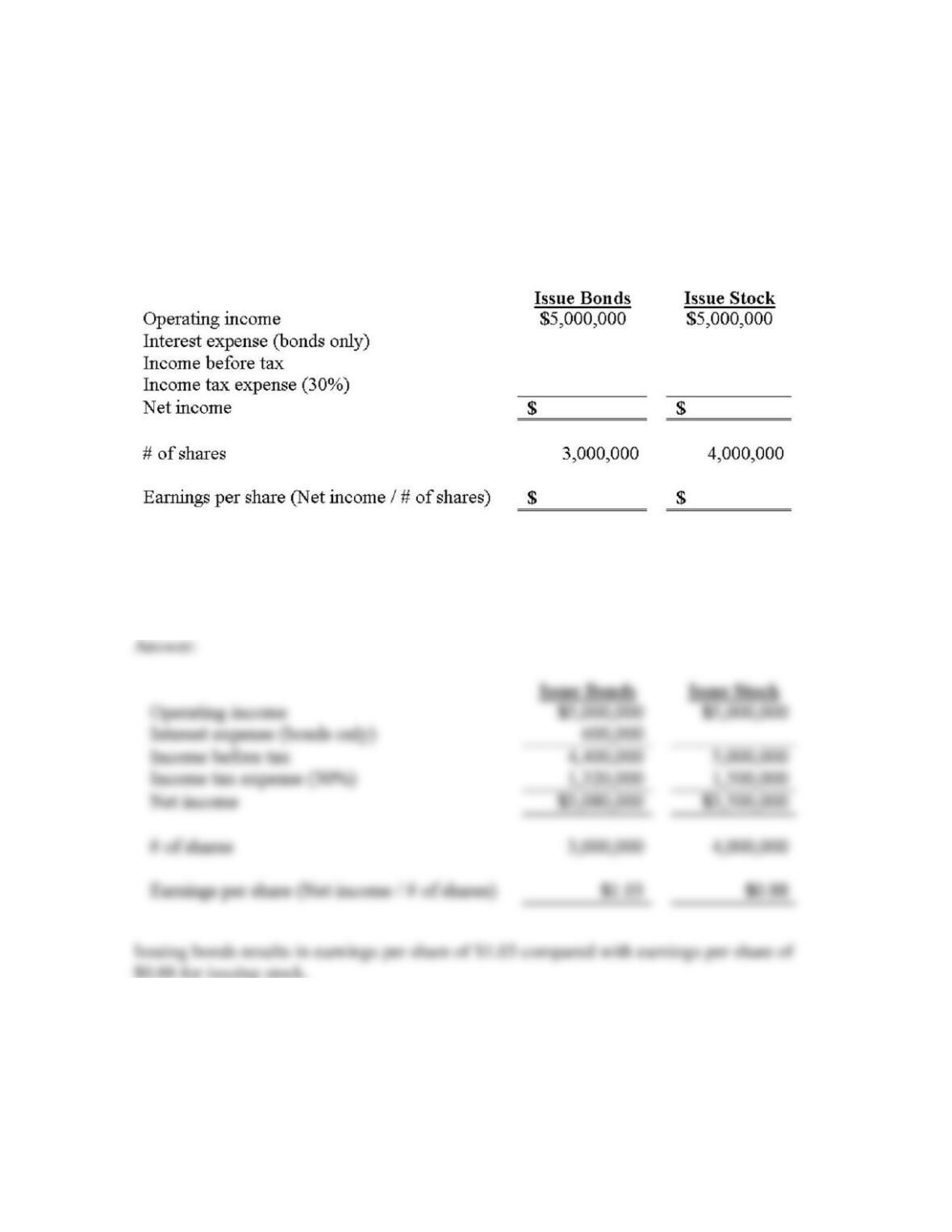
134. Frontier City is trying to decide between the following two alternatives to finance its new
$10 million roller coaster:
a. Issue $10 million of 6% bonds at face amount.
b. Issue one million shares of common stock for $10 per share.
Assuming bonds or shares of stock are issued at the beginning of the year, complete the
income statement listed above for each alternative. Which alternative results in the highest
earnings per share?

135. What is capital structure? Why would a company choose to borrow money rather than
issue additional stock?
136. Why do some companies issue bonds rather than borrow money directly from a bank?
137. Valentino’s Pizza issues $40 million of 3% convertible bonds that mature in ten years.
Each $1,000 bond is convertible into twenty-five shares of common stock. The current market
price of Valentino’s stock is $35 per share.
1. Explain why Valentino’s might choose to issue convertible bonds.
2. Explain why investors might choose Valentino’s convertible bonds.
Answer:
138. Contrast the following types of bonds:
(a) Secured and unsecured.
(b) Term and serial.
(c) Callable and convertible.
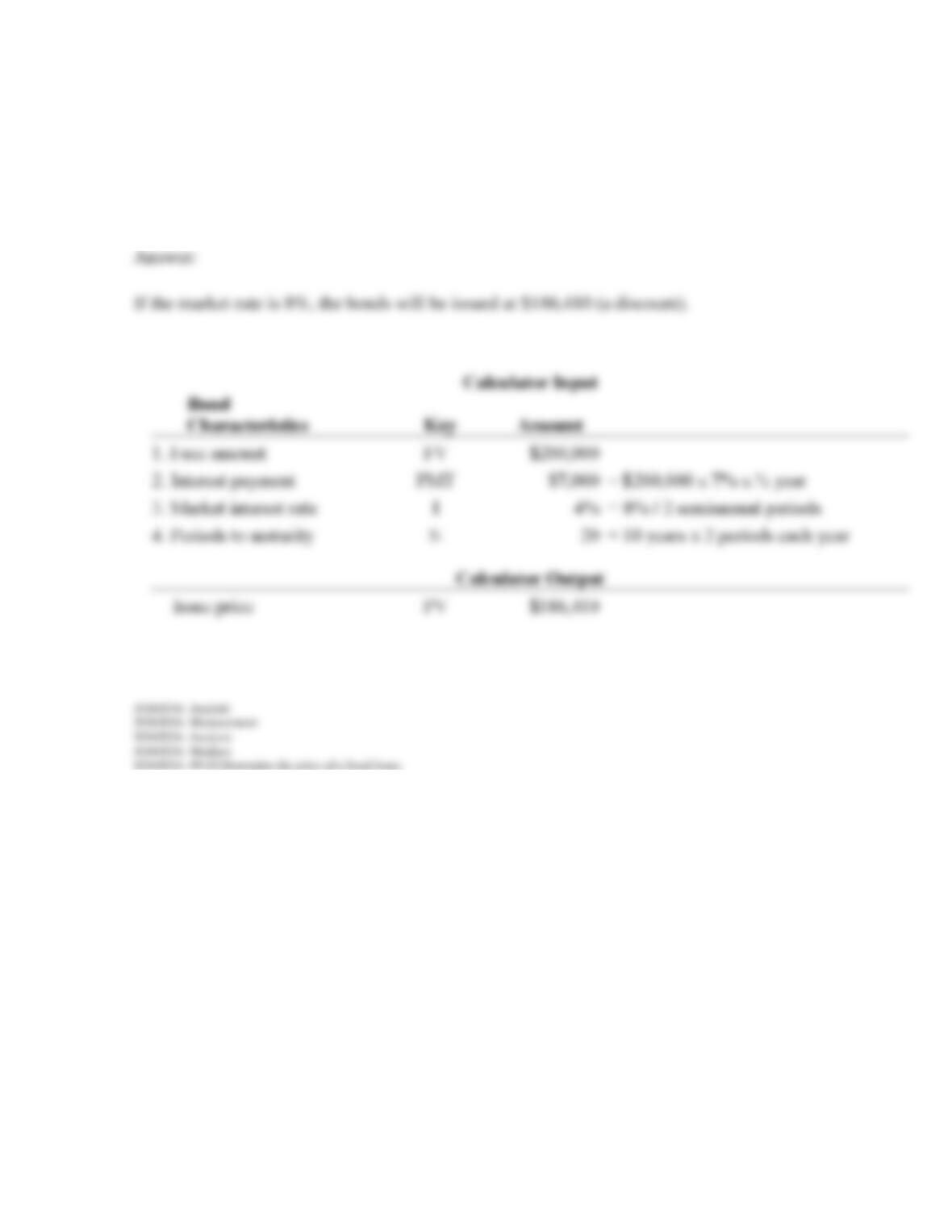
139. Stealth Fitness Center issues 7%, 10-year bonds with a face amount of $200,000. The
market interest rate for bonds of similar risk and maturity is 8%. Interest is paid semiannually.
At what price will the bonds be issued?
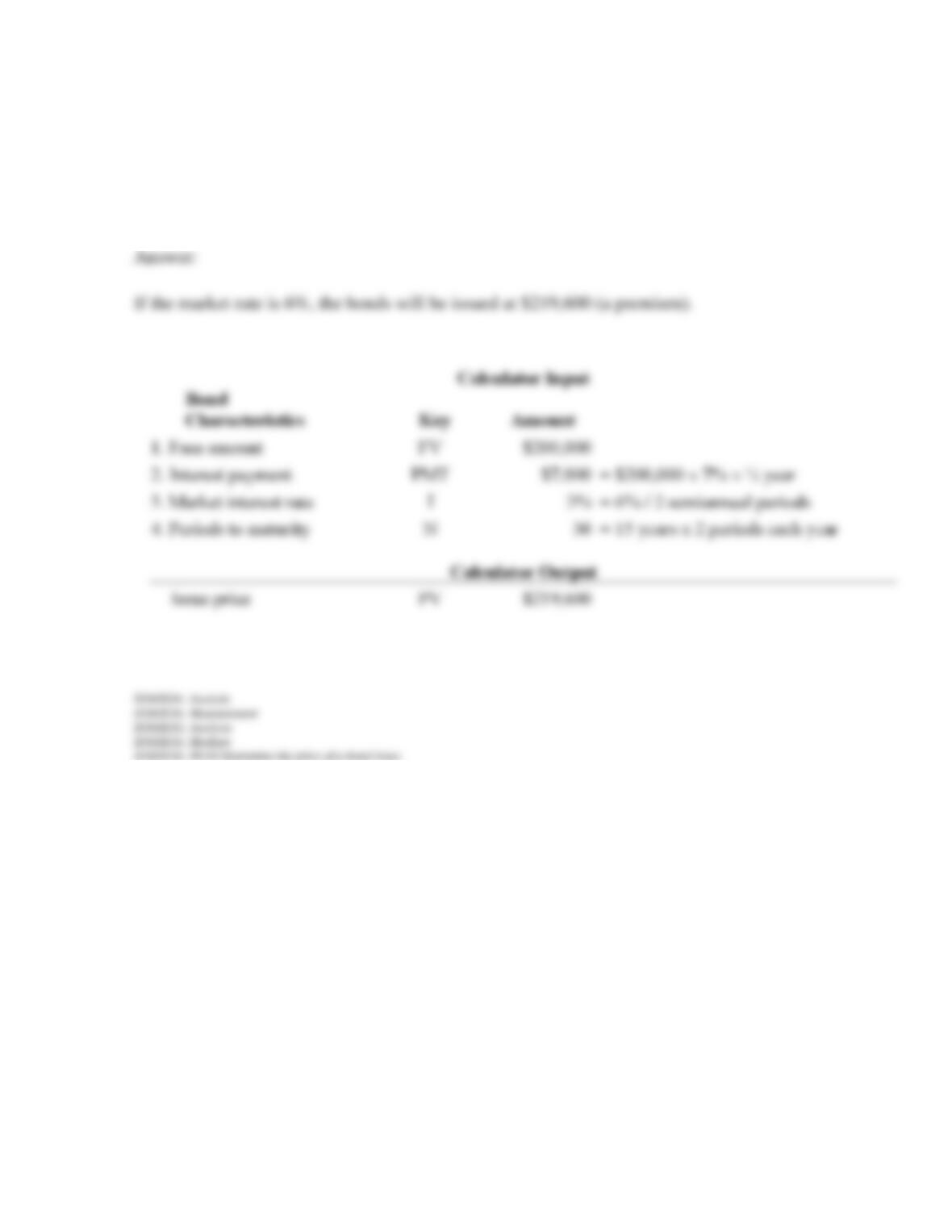
140. Stealth Fitness Center issues 7%, 15-year bonds with a face amount of $200,000. The
market interest rate for bonds of similar risk and maturity is 6%. Interest is paid semiannually.
At what price will the bonds be issued?
141. On January 1, 2012, Water Wonderland issues $20 million of 8% bonds, due in ten
years, with interest payable semiannually on June 30 and December 31 each year.
1. If the market rate is 7%, will the bonds issue at face amount, a discount, or a premium?
Calculate the issue price.
2. If the market rate is 8%, will the bonds issue at face amount, a discount, or a premium?
Calculate the issue price.
3. If the market rate is 9%, will the bonds issue at face amount, a discount, or a premium?
Calculate the issue price.