c. IFRS permits inventory reductions due to lower of cost or market writedowns to be reversed if
the market recovers.
d. Since the use of LIFO is not allowed under IFRS, inventory holding gains are included in
income.
Essay and Computational Questions
[QUESTION]
95. For the year 2018, the gross profit of Alpha Company was $80,000; the cost of goods
manufactured was $400,000; the beginning inventories of goods in process and finished goods
were $28,000 and $50,000, respectively; and the ending inventories of goods in process and
finished goods were $38,000 and $75,000, respectively.
Required:
What is the dollar amount of Alpha’s sales for 2018?
96. Information from Hope Company’s records for the year ended December 31, 2018 is
available as follows:
Net sales
$2,800,000
Cost of goods manufactured:
Variable
$1,260,000
Fixed
$630,000
Operating expenses:
Variable
$196,000
Fixed
$240,000
Units manufactured
70,000
Units sold
60,000
Finished goods inventory, 1/1/2018
$0
Hope had no work-in-process inventories at either the beginning or end of 2018.
Required:
a. What would be Hope’s finished goods inventory cost under the variable (direct) costing
method at December 31, 2018?
b. What would Hope’s operating income be under the absorption costing method?
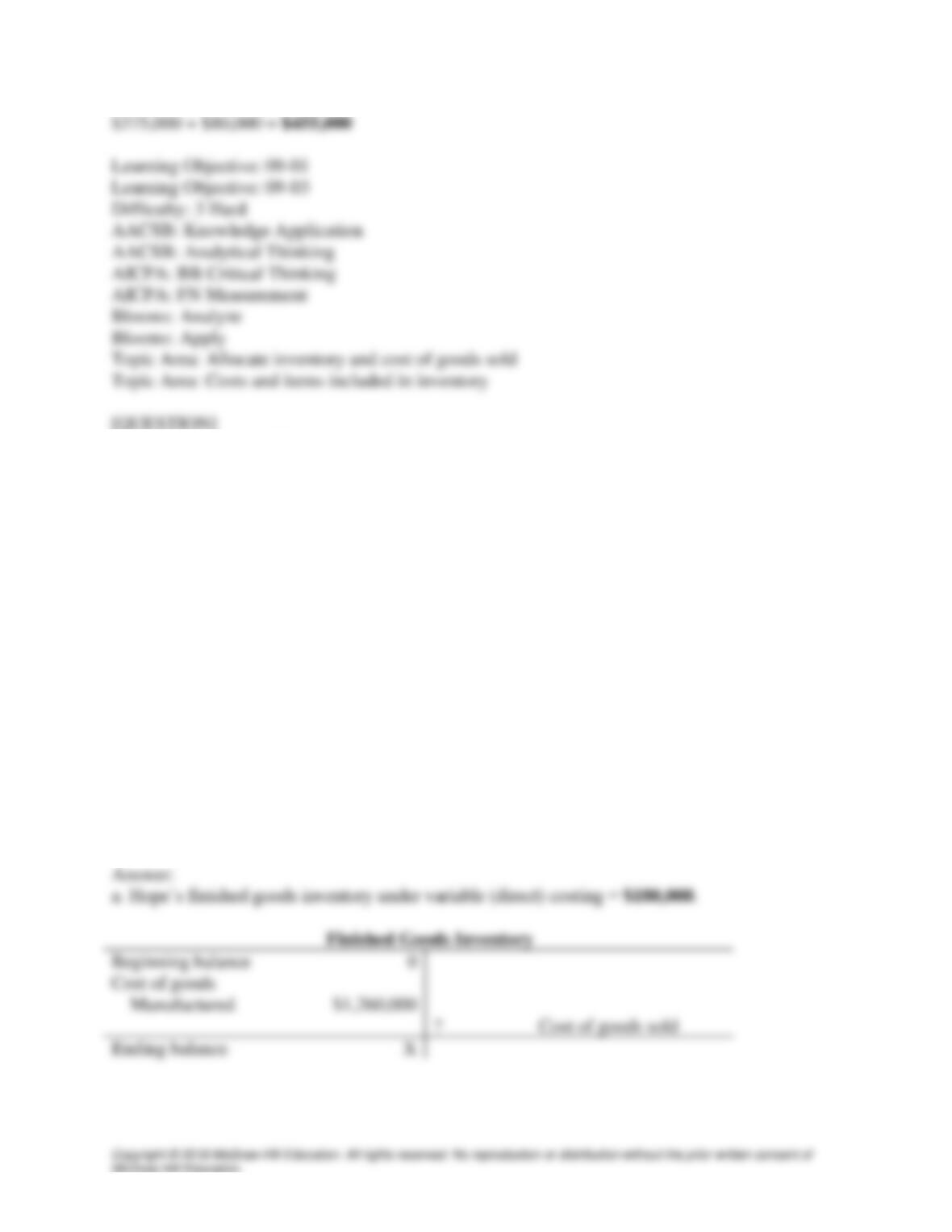
Beginning balance
Manufactured
?
Cost of goods sold
Ending balance
97. Tool City, Inc. had 300 cordless screwdrivers on hand at January 1, 2018 costing $45 each.
Purchases and sales of cordless screwdrivers during the month of January were as follows:
Date
Purchases
Sales
January 9
200 @ $75
January 14
100 @ $47
January 23
75 @ $76
January 25
100 @ $48
January 30
75 @ $77
Tool City does not maintain perpetual inventory records. Based on a physical count, 150
cordless screwdrivers were on hand at January 31, 2018.
Required:
a. What is the cost of the inventory at January 31, 2018 under the FIFO method?
b. What is the cost of the inventory at January 31, 2018 under the LIFO method?
c. What is the cost of the inventory at January 31, 2018 under the FIFO method if only 145
cordless screwdrivers were on hand at the time of the physical count? Based on the data given,
what is the most likely explanation for the fact that only 145 cordless screwdrivers were actually
counted?
a. FIFO
b. LIFO
c. FIFO

98. Yarnco, Inc. is a diversified North American producer and processor of multi-filament
polyester and nylon yarns, including specialty yarns with enhanced performance characteristics.
The Company manufactures partially oriented, textured, dyed, twisted and beamed polyester
yarns as well as textured nylon and nylon covered spandex products. Refer to the excerpts of the
2018 Yarnco, Inc. Annual Report. All questions relate to 2018 unless stated otherwise. Assume a
35% corporate tax rate where necessary.
Yarnco, Inc.
Consolidated Income Statement
Fiscal Years Ended
($ in thousands)
June 24,
2018
June 25,
2017
Net sales
$690,308
$738,665
Cost of sales
652,743
696,055
Selling, general, and administrative expenses
44,886
41,534
Provision for bad debts
7,174
1,256
Interest expense
25,518
19,266
Interest income
(3,187)
(6,320)
Other (income) expense, net
(2,576)
(1,466)
Equity in (earnings) losses of unconsolidated affiliates
4,292
(825)
Restructuring reversal of prior accrual
(157)
(254)
Writedown of long-lived assets
16,731
2,366
Writedown of investment in equity affiliate
84,742
Loss from early extinguishment of debt
—
2,949
Loss from continuing operations before income taxes and
discontinued operations
(139,858)
(15,896)
Income tax expense (benefit)
(22,088)
(1,170)
Loss before discontinued operations
(117,770)
(14,726)
Income (loss) from discontinued operations, net of tax
1,465
360
Net Loss
$(116,305)
$(14,366)
Inventories. The Company utilizes the last-in, first-out (“LIFO”) method for valuing certain
inventories representing 38.6% and 38.2% of all inventories at June 24, 2018, and June 25, 2017,
respectively, and the first-in, first-out (“FIFO”) method for all other inventories. Inventories are
valued at lower of cost or market for LIFO inventories and at lower of cost or net realizable
value for FIFO inventories, including a provision for slow moving and obsolete items. Market is
considered net realizable value. Inventories valued at current or replacement cost would have
been approximately $8.2 million and $7.3 million in excess of the LIFO valuation at June 24,
2018, and June 25, 2017, respectively. The Company did not have LIFO liquidations during
fiscal year 2018 and fiscal year 2017. The Company maintains reserves for inventories valued
utilizing the FIFO method and may provide for additional reserves over and above the LIFO
reserve for inventories valued at LIFO. Such reserves for both FIFO and LIFO valued
inventories can be specific to certain inventory or general based on judgments about the overall
condition of the inventory. General reserves are established based on percentage markdowns
applied to inventories aged for certain time periods. Specific reserves are established based on a
determination of the obsolescence of the inventory and whether the inventory value exceeds
amounts to be recovered through expected sales prices, less selling costs; and, for inventory
subject to LIFO, the amount of existing LIFO reserves. The total inventory reserves on the
Company’s books, including LIFO reserves, at June 24, 2018 and June 25, 2017 were
$15.7 million and $10.7 million, respectively. The following table reflects the composition of the
Company’s inventory at June 24, 2018 and June 25, 2017:
($ in thousands)
June 24, 2018
June 25, 2017
Raw materials and supplies
$47,201
$48,594
Work in process
7,573
10,144
Finished goods
69,353
57,280
$124,127
$116,018
Required:
a. What is the value of inventory reported on the balance sheet at June 24, 2018?
b. Compute Yarnco’s cost of goods sold for the year ending June 24, 2018, using FIFO instead of
LIFO.
c. Compute the amount of the cumulative tax deferral resulting from LIFO existing at the end of
2018.
d. Compute how the use of LIFO affects Yarnco’s book value (common stockholders’ equity) at
the end of 2018.
e. Compute the inventory turnover ratio to approximate physical unit flow for 2018. Show your
work.
Answer:

99. Salvadore Land & Pineapple Company, Inc. is a corporation that consists of a landholding
and operating parent company and its principal subsidiaries, including Salvadore Pineapple
Company, Ltd. and Kapawau Land Company, Ltd. Refer to the excerpts that follow from the
December 31, 2018 annual report. All questions relate to the year ended December 31, 2018
unless stated otherwise. Assume a 35% corporate tax rate where necessary.
SALVADORE LAND & PINEAPPLE COMPANY, INC. & SUBSIDIARIES
CONSOLIDATED STATEMENTS OF OPERATIONS
Years Ended December 31,
2018
2017
2016
(in thousands)
OPERATING REVENUES
Net Sales
$
137,741
$
149,204
$
115,715
Operating Income
39,413
33,679
35,182
Other Income
1,743
3,797
2,352
Total Operating Revenues
178,897
186,680
153,249
OPERATING COSTS AND EXPENSES
Cost of sales
65,488
73,537
71,226
Operating expenses
39,253
36,418
36,177
Shipping and marketing
16,528
14,446
15,621
General and administrative
41,939
38,425
29,347
Total Operating Costs and Expenses
163,208
162,826
152,371
Operating Income
15,689
23,854
878
Equity in losses of affiliates
(5,340
)
(484
)
(727
)
Interest expense
(775
)
(521
)
(1,159
)
Interest income
1,367
443
23
Income (Loss) From Continuing Operations
Before Income Taxes
10,941
23,292
(985
)
Income Tax Expense (Benefit)
3,716
8,723
(528
)
Income (Loss) From Continuing Operations
7,225
14,569
(457
)
Income From Discontinued Operations (net of
income tax expense of $46)
—
—
74
NET INCOME (LOSS)
$
7,225
$
14,569
$
(383
)
INVENTORIES:

Inventories of tinplate, cans, ends and processed pineapple products are stated at cost, not in
excess of market value, using the dollar value last-in, first-out (“LIFO”) method.
Agriculture product inventories were comprised of the following components at December 31,
2018 and 2017:
2018
2017
(in thousands)
Finished Goods
$
1,416
$
2,425
Work In Progress
299
367
Raw Materials
492
861
Total
$
2,207
$
3,653
The replacement cost of agriculture product inventories at year-end approximated $8 million in
2018 and $10 million in 2017. In 2018 and 2017, there were partial liquidations of LIFO
inventories; thus, cost of sales included prior years’ inventory costs, which were lower than
current costs. Had current costs been charged to cost of sales, income from continuing operations
before income taxes for 2018 and 2017 would have decreased by $2.3 million and $2.9 million,
respectively.
Required:
a. What amount of agricultural products inventory is on the balance sheet at December 31, 2018?
b. Assume that ending inventory was overstated at December 31, 2018. Explain how net income
would be affected by the error.
c. The inventory note states that inventory amounts are “stated at cost, not in excess of market
value, using the dollar value last-in, first-out (“LIFO”) method.” Which accounting principle or
concept justifies writing down assets when market prices are lower than cost, but leaving them at
cost when market prices are higher than cost?
d. How much has Salvadore Land & Pineapple Company deferred in income taxes since being
on LIFO?
e. What impact did LIFO liquidations have on net income for the year ended December 31,
2018? Explain why investors would want to know about this impact.
f. Compute the inventory turnover ratio to approximate physical unit flow for the year ended
December 31, 2018.
[QUESTION]
100. Jones Bros. Tools, Inc. had the following layers in its LIFO table saw inventory at January
1, 2018. The company sets its selling price at 200% of replacement cost at the time of sale.
Replacement cost as of January 1, 2018 was $835 per unit and remained unchanged throughout
2018. During 2018, the company purchased 650 units and sold 1,125 units.
Year LIFO Layer Added
Units
Unit Cost
2015
200
$740
2016
180
780
2017
175
820
Required:
Calculate the difference between Jones Bros. Tools, Inc.’s current cost operating margin (on a
replacement cost basis) and the LIFO margin as reported by the company in 2018. What does the
difference represent?
[QUESTION]
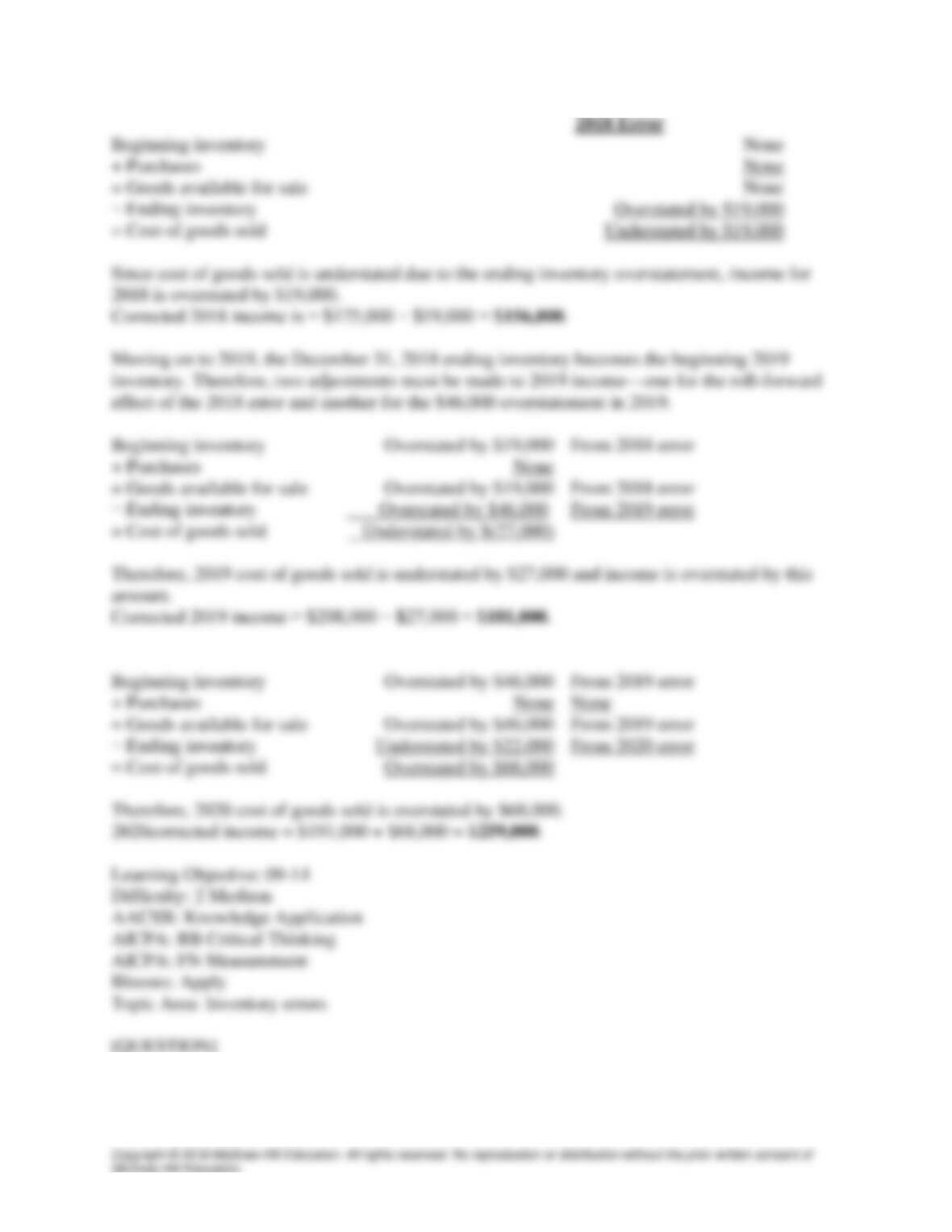
101. The following inventory valuation errors have been discovered for Jellison Corporation:
• The 2018 year-end inventory was overstated by $19,000.
• The 2019 year-end inventory was overstated by $46,000.
• The 2020 year-end inventory was understated by $22,000.
Jellison’s reported income before income taxes in these years was as follows:
Year
Income Before Taxes
2018
$175,000
2019
208,000
2020
191,000
Determine what income before taxes for 2018, 2019, 2020 should have been after correcting for
the errors.
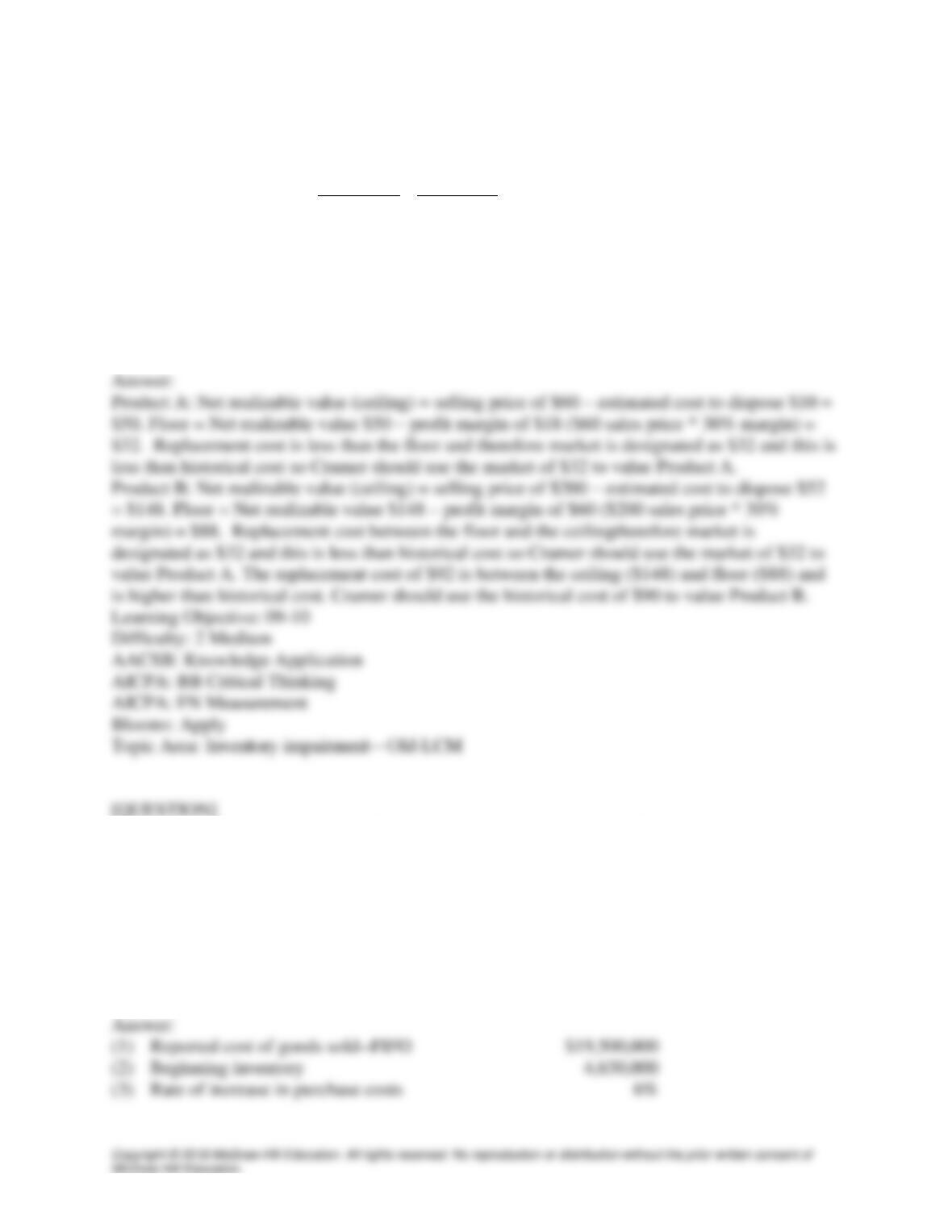
102. Cramer Corporation has two products in its LIFO ending inventory and uses lower of cost
or market to account for each. Cramer normally prices its products to maintain a 30% gross
profit margin. Specific data for each product follows:
Product A
Product B
Historical cost
$34
$90
Replacement cost
30
92
Estimated cost to dispose
10
52
Estimated selling price
60
200
Required:
Using the lower of cost or market rule (Old-LCM), what unit values should Cramer use to value
Products A and B in its ending inventory?
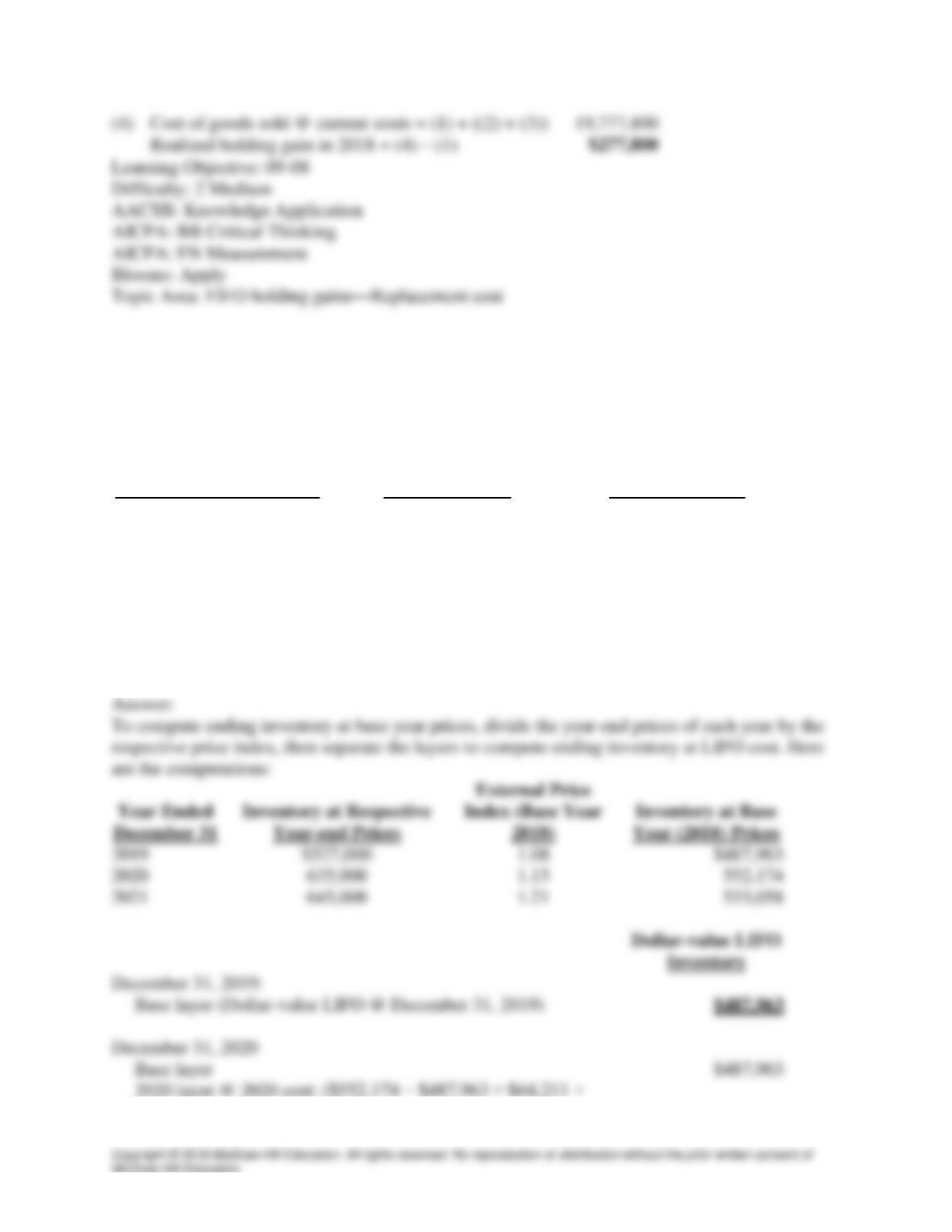
103. Jenkins RV Sales has been selling large recreational vehicles for 20 years. On January 1,
2018, the company had $4,630,000 in inventory (based on a FIFO valuation). While the number
of recreational vehicles in Jenkins’ inventory remained fairly constant throughout 2018, by
December 31, 2018 RV prices were 6% higher than at the beginning of the year. The company
reported cost of goods sold for 2018 of $19,500,000.
Required:
Calculate the amount of realized holding gains in 2018 income for Jenkins RV Sales.
(1)
Reported cost of goods sold—FIFO
$19,500,000
[QUESTION]
104. The Bravo Company manufactures a single product. On December 31, 2018 Bravo adopted
the dollar-value LIFO inventory method. The inventory on that date using the dollar-value LIFO
inventory method was determined to be $500,000. Inventory data for succeeding years are as
follows:
Year Ended December 31
Inventory at Respective
Year-end Prices
Relevant Price Index
(Base Year 2018)
2018
$500,000
1.00
2019
527,000
1.08
2020
635,000
1.15
2021
645,000
1.21
Required:
Compute the inventory amount at December 31, 2019, 2020, and 2021 using the dollar-value
LIFO inventory method for each year. (Round all amounts to the nearest dollar.)
Year (2018) Prices
Inventory