Chapter 9 – Financial Planning and Analysis: The Master Budget
75. Parvis makes all sales on account, subject to the following collection pattern: 20% are
collected in the month of sale; 70% are collected in the first month after sale; and 10% are
collected in the second month after sale. If sales for October, November, and December were
$70,000, $60,000, and $50,000, respectively, what was the budgeted receivables balance on
December 31?
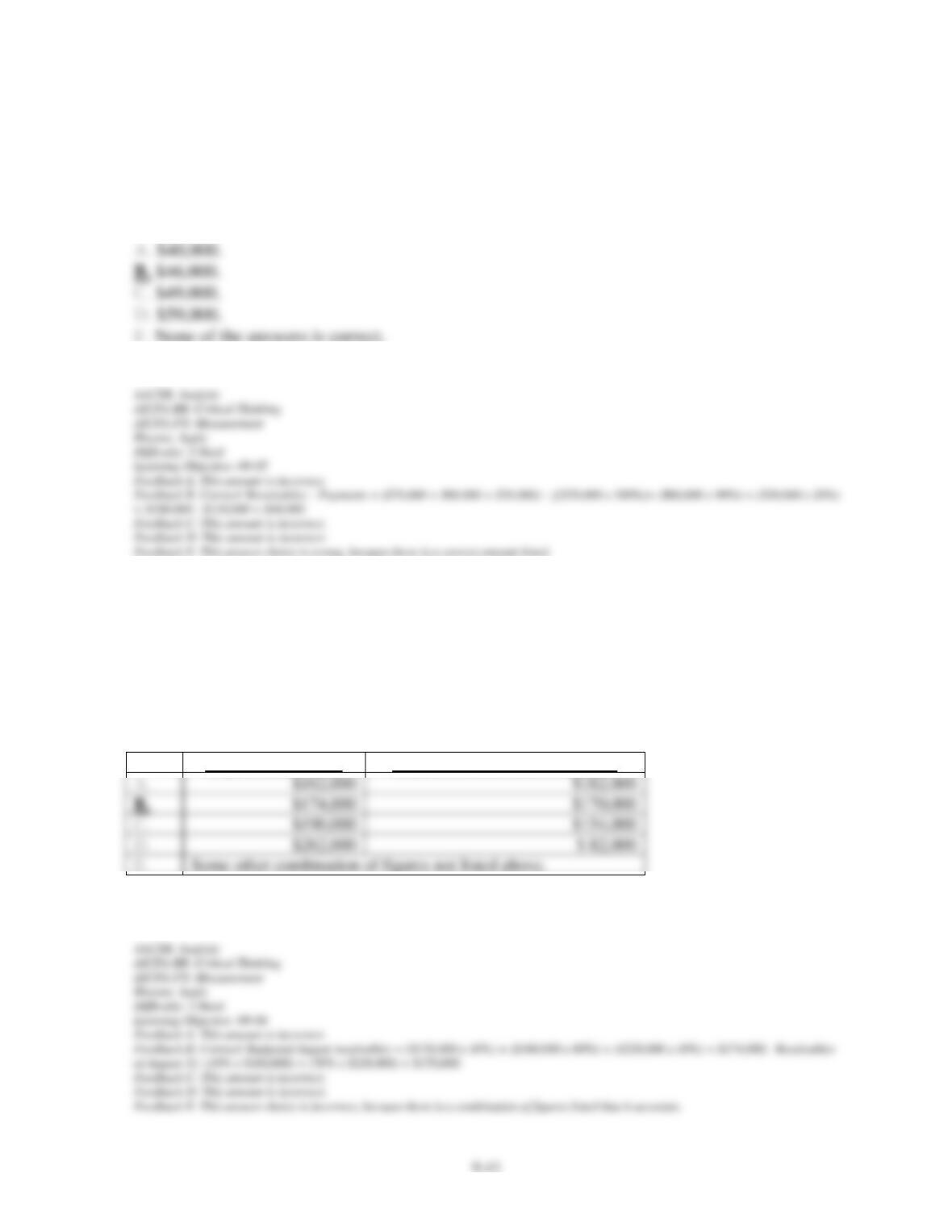
76. Harrington makes all sales on account, subject to the following collection pattern: 30% are
collected in the month of sale; 60% are collected in the first month after sale; and 10% are
collected in the second month after sale. If sales for June, July, and August were $120,000,
$160,000, and $220,000, respectively, what were the firm’s budgeted collections for August
and the company’s budgeted receivables balance on August 31?
August Collections
August 31 Receivables Balance
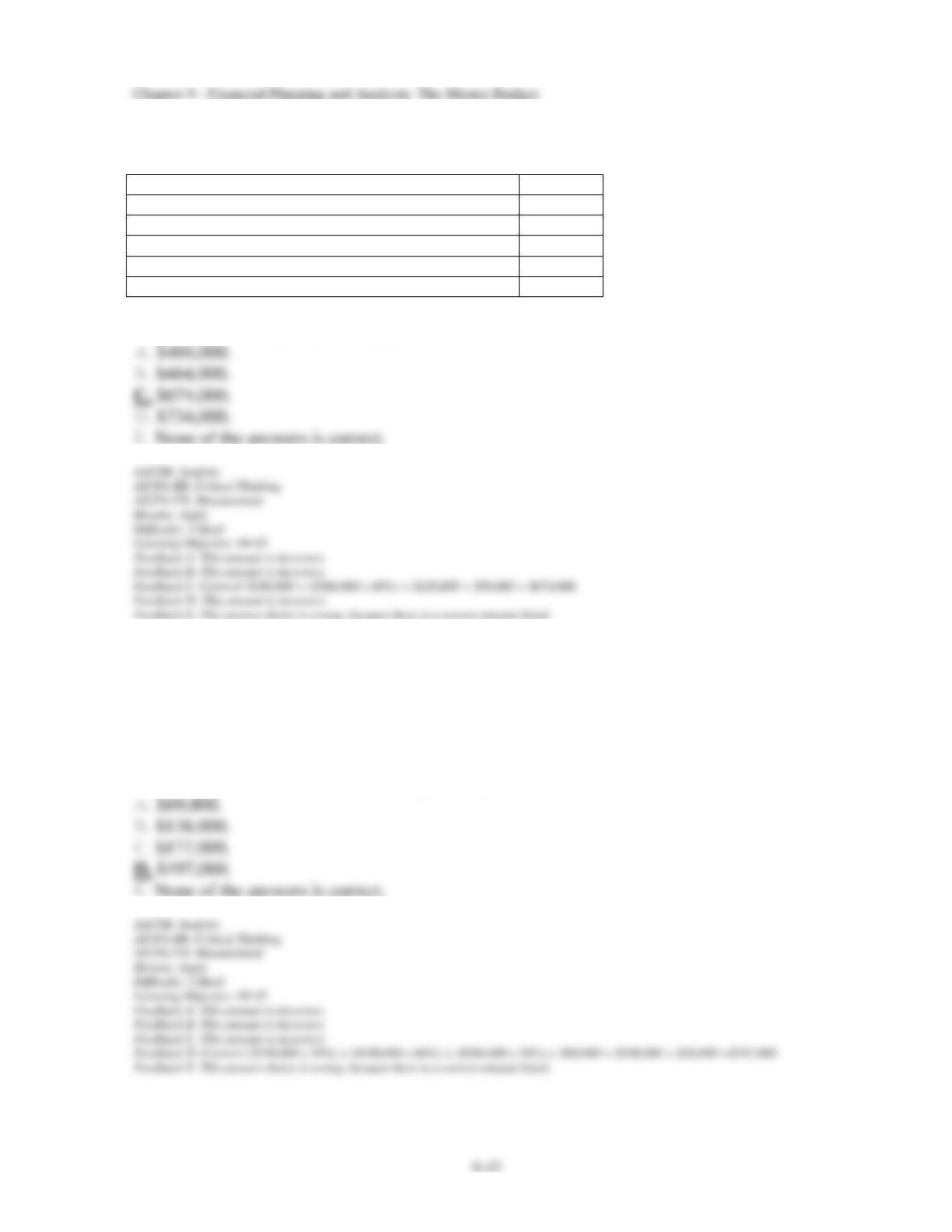
77. The following selected data pertain to Flagship Corporation:
Cash operating expenses July 1-31
$180,000
Depreciation
60,000
Merchandise purchases in July
560,000
Estimated payments in July for June purchases
220,000
Estimated payments in July for purchases prior to June
50,000
Estimated payments in July for purchases in July
40%
July’s cash disbursements are expected to be:
78. Dalton Industries makes all purchases on account, subject to the following payment
pattern:
Paid in the month of purchase: 30%
Paid in the first month following purchase: 60%
Paid in the second month following purchase: 10%
If purchases for January, February, and March were $200,000, $180,000, and $230,000,
respectively, what were the firm’s budgeted payments in March?
79. Virginia Enterprises makes all purchases on account, subject to the following payment
pattern:
Paid in the month of purchase: 30%
Paid in the first month following purchase: 65%
Paid in the second month following purchase: 5%
If purchases for April, May, and June were $200,000, $160,000, and $250,000, respectively,
what was the firm’s budgeted payables balance on June 30?
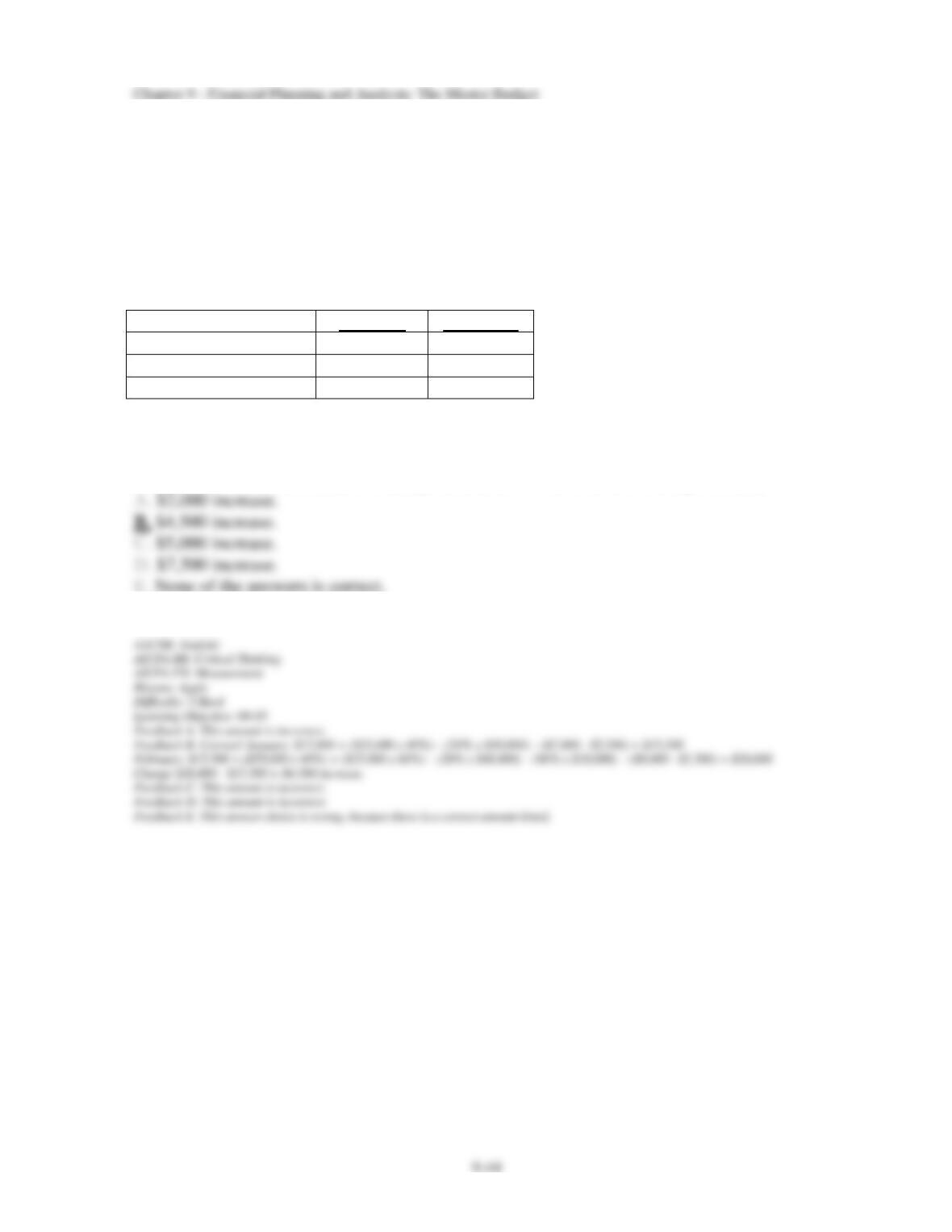
80. Rainbow, Inc. began operations on January 1 of the current year with a $12,000 cash
balance. Forty percent of sales are collected in the month of sale; 60% are collected in the
month following sale. Similarly, 20% of purchases are paid in the month of purchase, and
80% are paid in the month following purchase. The following data apply to January and
February:
January
February
Sales
$35,000
$55,000
Purchases
30,000
40,000
Operating expenses
7,000
9,000
If operating expenses are paid in the month incurred and include monthly depreciation
charges of $2,500, determine the change in Rainbow’s cash balance during February.
Chapter 9 – Financial Planning and Analysis: The Master Budget
Use the following information to answer Questions 81-84.
Morgan Company’s budgeted income statement reflects the following amounts:
Sales
Purchases
Expenses
January
$120,000
$78,000
$24,000
February
110,000
66,000
24,200
March
125,000
81,250
27,000
April
130,000
84,500
28,600
Sales are collected 50% in the month of sale, 30% in the month following sale, and 19% in
the second month following sale. One percent of sales is uncollectible and expensed at the end
of the year.
Morgan pays for all purchases in the month following purchase and takes advantage of a 3%
discount. The following balances are as of January 1:
Cash
$88,000
Accounts receivable*
58,000
Accounts payable
72,000
*Of this balance, $35,000 will be collected in January and the remaining amount will be
collected in February.
The monthly expense figures include $5,000 of depreciation. The expenses are paid in the
month incurred.
81. Morgan’s expected cash balance at the end of January is:
82. Morgan’s budgeted cash receipts in February are:
83. Morgan’s budgeted cash payments in February are:
84. Morgan’s expected cash balance at the end of February is:
85. End-of-period figures for accounts receivable and payables to suppliers would be found
on the:
86. Which of the following statements is false regarding the budgeted schedule of cost of
goods manufactured and sold?
87. The direct-material budget shows the number of units and the cost of material to be
purchased and used during a budget period. Which of the following formulas is this schedule
based on?
88. Marvel Woodcraft makes furniture. Marvel’s expected sales are 20,000 bookcases for the
quarter. The company begins the quarter with inventory of 3,000 bookcases and wants to have
enough finished bookcases on hand at the end of the quarter to provide for 15% of the next
quarter’s expected sales of 24,000 bookcases. Based on this information, how many
bookcases need to be produced during the quarter?
89. Marvel Woodcraft makes furniture. Marvel’s expected sales are 20,000 bookcases for the
quarter. The company begins the quarter with inventory of 3,000 bookcases and wants to have
enough finished bookcases on hand at the end of the quarter to provide for 15% of the next
quarter’s expected sales of 24,000 bookcases. Ignoring any beginning inventory, if 50 board
feet are required for each bookcase and the wood costs $2 per board foot, how much will
Marvel pay for the bookcases it needs produce during the quarter?
90. Assume that Toy Craft makes ragdolls. Each ragdoll requires 12 square feet of fabric. If
the number of dolls to be produced during the quarter is 19,000, the desired ending inventory
of fabric is 11,400 square feet, the beginning inventory of fabric is 22,800 square feet, and the
cost of the fabric is $9 per square foot, what is the total cost of fabric purchases?
9-51
91. Which of the following statements about financial planning models (FPMs) is (are) false?
A. FPMs express a company’s financial and operating relationships in mathematical terms.
92. Consider the following statements about budget administration:
I. The budgeting process is a very formal process in all organizations regardless of an
organization’s size.
93. Which of the following statements concerning the budget director is false?
A. The budget director is often an organization’s controller.
94. Consider the following statements about companies that are involved with international
operations:
I. Budgeting for these firms is often very involved because of fluctuating values in foreign
currencies.
II. Multinational firms may encounter hyperinflationary economies.
III. Such organizations often face changing laws and political climates that affect business
activity.
Which of the above statements is (are) true?
95. The difference between the revenue or cost projection that a person provides, and a
realistic estimate of the revenue or cost, is called:
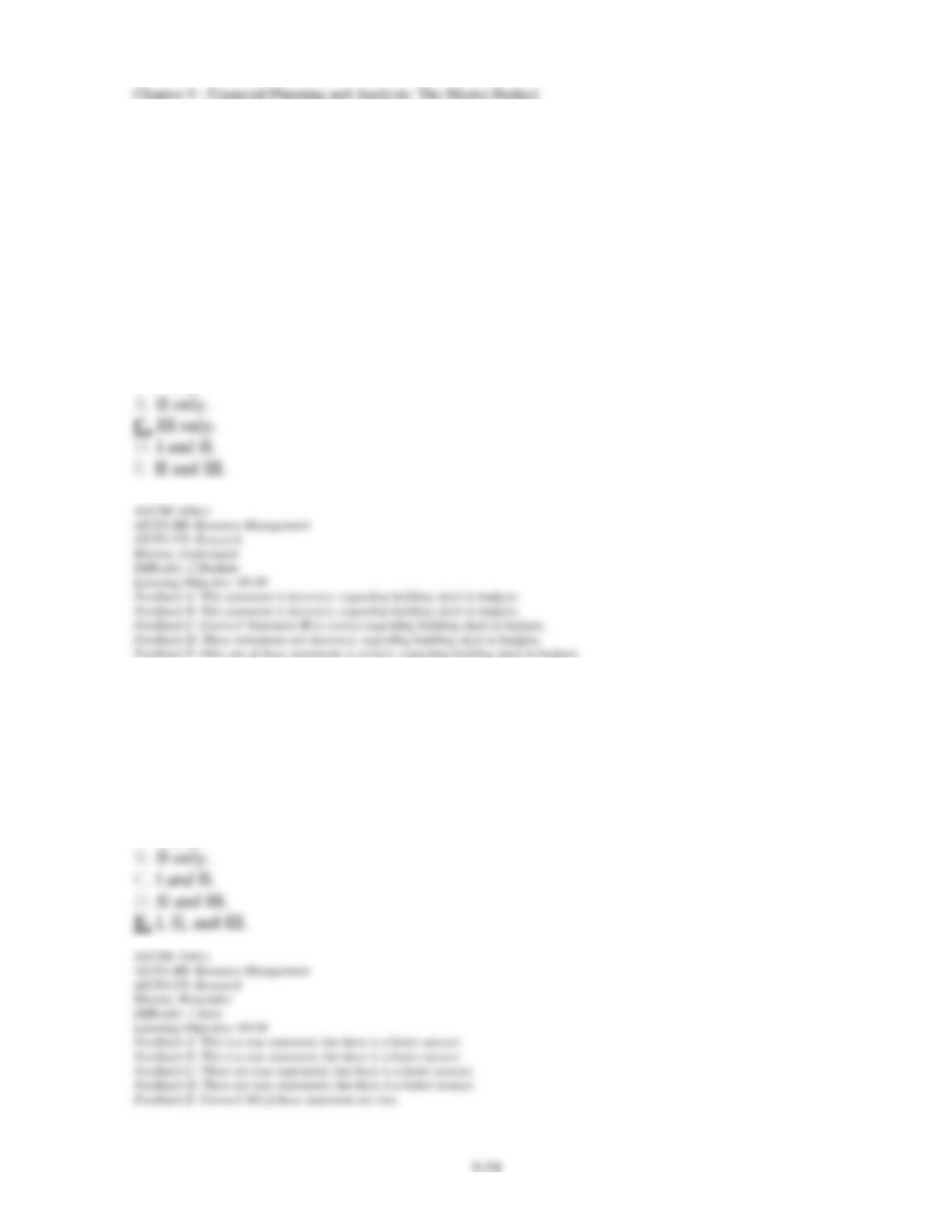
96. If a manager builds slack into a budget, how would that manager handle estimates of
revenues and expenses?
Revenues
Expenses
97. The following events took place when Managers A, B, and C were preparing budgets for
the upcoming period:
I. Manager A increased property tax expenditures by 2% when she was informed of a recent
rate hike by local authorities.
II. Manager B reduced sales revenues by 4% when informed of recent aggressive actions by a
new competitor.
III. Manager C, who supervises employees with widely varying skill levels, used the highest
wage rate in the department when preparing the labor budget.
Assuming that the percentage amounts given are reasonable, which of the preceding cases is
(are) an example of building slack in budgets?
A. I only.
98. Consider the following statements about budgetary slack:
I. Managers build slack into a budget so that they stand a greater chance of receiving
favorable performance evaluations.
II. Budgetary slack is used by managers to guard against uncertainty and unforeseen events.
III. Budgetary slack is used by managers to guard against dollar cuts by top management in
the resource allocation process.
Which of the above statements is (are) true?
A. I only.
99. When an organization involves its many employees in the budgeting process in a
meaningful way, the organization is said to be using an approach most commonly known as:
A. budgetary slack.
100. Which of the following outcomes is (are) sometimes associated with participative
budgeting?
101. Company A uses a heavily participative budgeting approach whereas at Company B, top
management develops all budgets and imposes them on lower-level personnel. Which of the
following statements is false?
A. A’s employees will likely be more motivated to achieve budgetary goals than the
employees of Company B.
Chapter 9 – Financial Planning and Analysis: The Master Budget
9-57
Essay Questions
102. Paradise, Inc., a distributor of suntan lotion, has the following historical collection
pattern for its credit sales.
70 percent collected in the month of sale.
15 percent collected in the first month after sale.
10 percent collected in the second month after sale.
4 percent collected in the third month after sale.
1 percent uncollectible.
The sales on account have been budgeted for the last seven months as follows:
April
$ 49,000
May
60,000
June
70,000
July
80,000
August
90,000
September
100,000
October
85,000
Required:
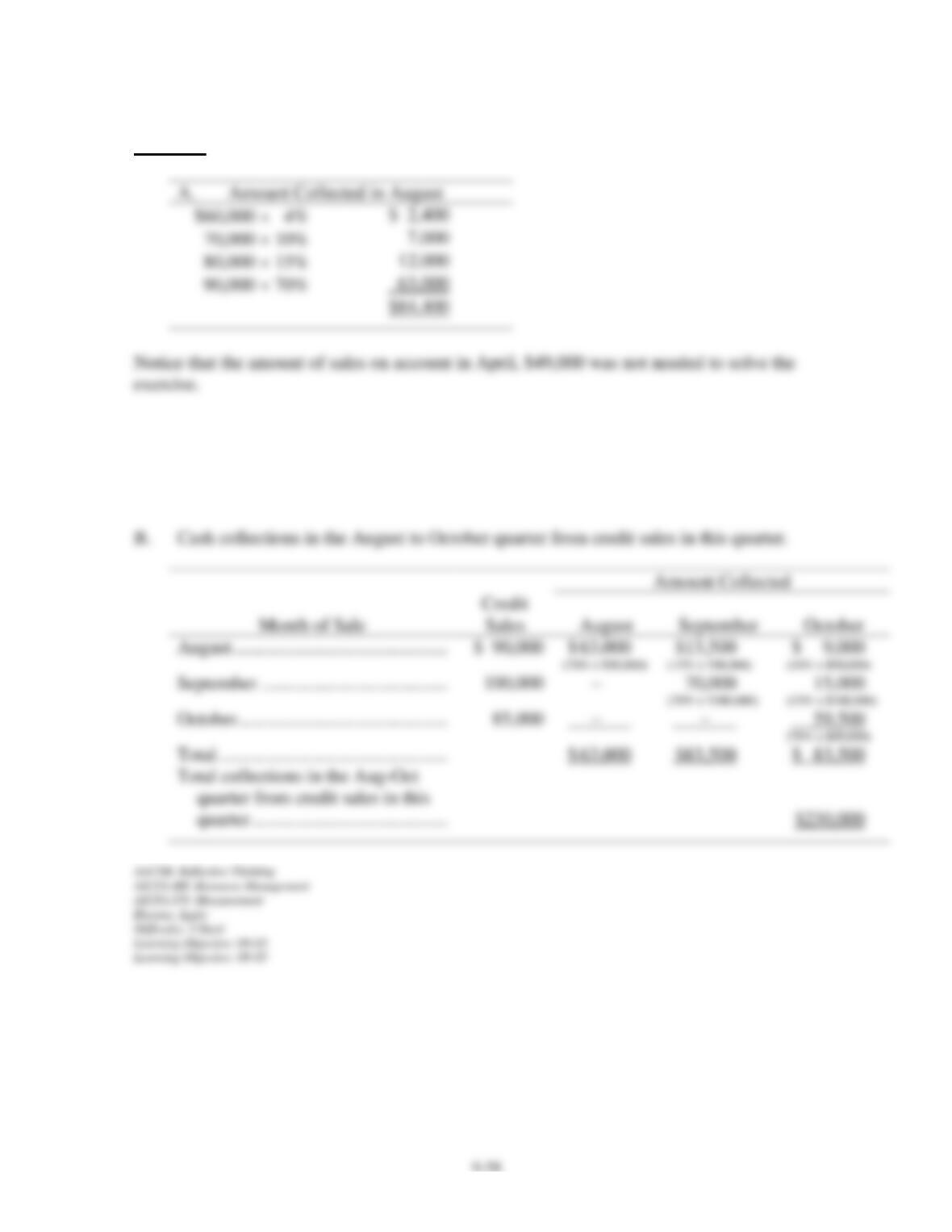
A. Compute the estimated total cash collections during August from credit sales.
B. Compute the estimated total cash collections during the August – October quarter from
sales made on account during this quarter.
Chapter 9 – Financial Planning and Analysis: The Master Budget
Solution:
103. Tsao Company budgets on an annual basis. The following beginning and ending
inventory levels (in units) are planned for the year 20×1. Three units of raw material are
required to produce each unit of finished product.
Required:
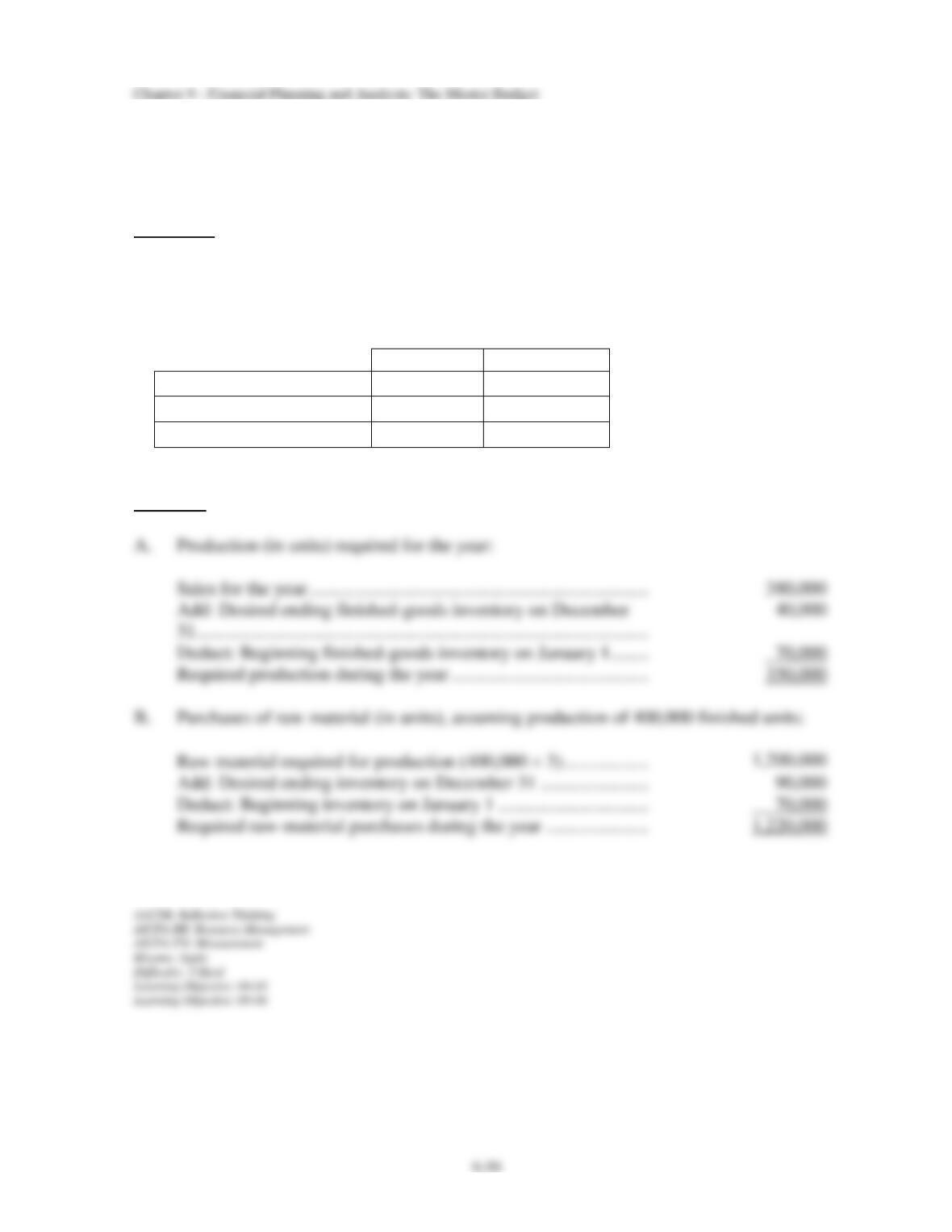
A. If Tsao Company plans to sell 380,000 units during the year, compute the number of
units the firm would have to manufacture during the year.
B. If 400,000 finished units were to be manufactured by Tsao Company during the year,
determine the amount of raw material to be purchased.
January 1
December 31
Raw material
70,000
90,000
Work in process
12,000
12,000
Finished goods
70,000
40,000
Solution:

9-60
104. Weed Master Company plans to sell 200,000 units of finished product in July and
anticipates a growth rate in sales of 5 percent per month. The desired monthly ending
inventory in units of finished product is 80 percent of the next month’s estimated sales. There
are 160,000 finished units in inventory on May 31. Each unit of finished product requires four
pounds of raw material at a cost of $1.15 per pound. There are 700,000 pounds of raw
material in inventory on May 31.
Required:
A. Compute the company’s total required production in units of finished product for the entire
three-month period ending August 31.
B. Independent of your answer to requirement (A), assume the company plans to produce
600,000 units of finished product in the three-month period ending August 31, and to have
raw-material inventory on hand at the end of the three-month period equal to 25 percent of
the use in that period. Compute the total estimated cost of raw-material purchases for the
entire three-month period ending August 31.