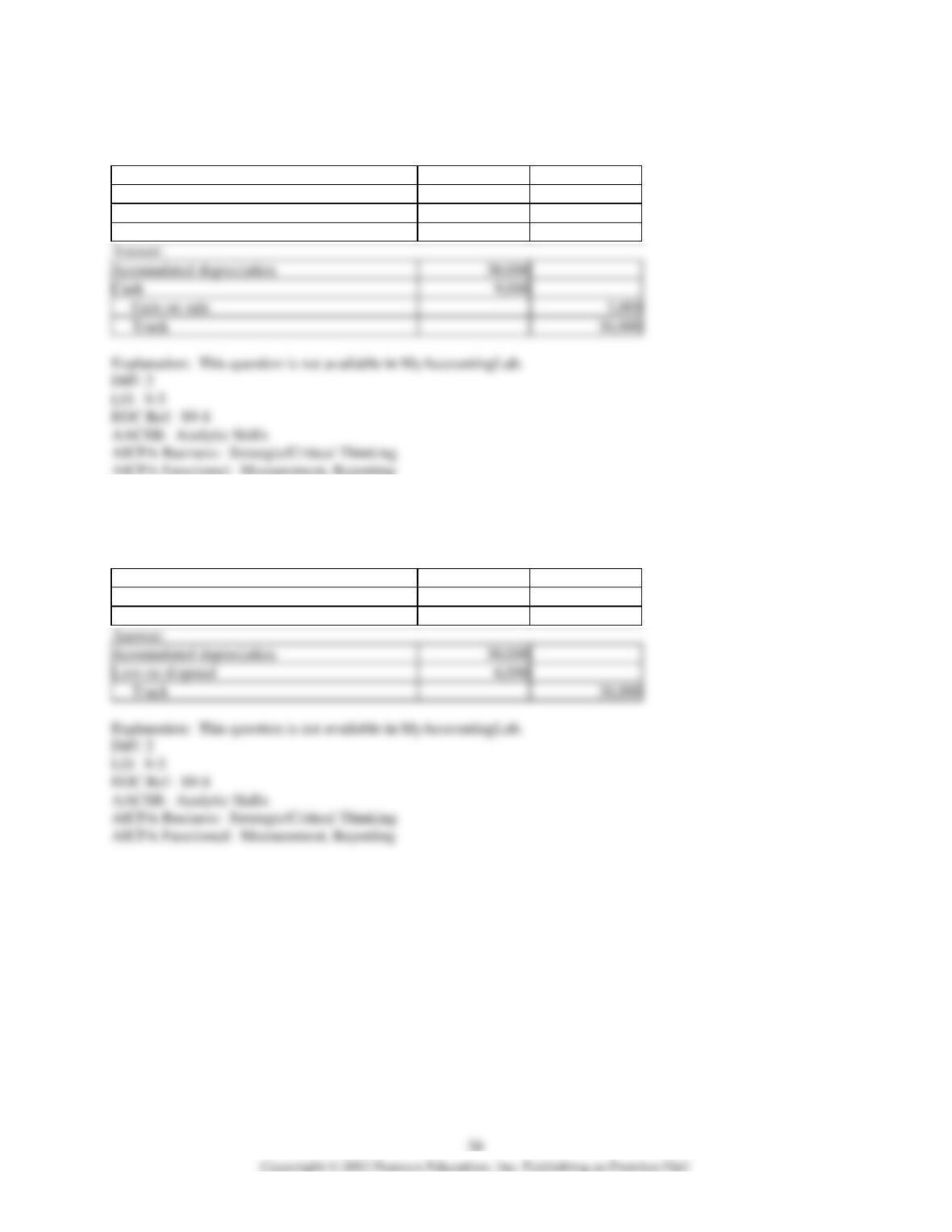
37) Job Sales sold a truck for $9,000 cash. It was originally purchased for $36,000, and had accumulated
depreciation of $30,000 at the time of sale. Please provide the journal entry for the sale of the truck.
Accumulated depreciation
Cash
38) Job Sales had to scrap a truck that could no longer be used. It was originally purchased for $36,000, and had
accumulated depreciation of $30,000 at the time it was scrapped. Please provide the journal entry for the scrapping
of the truck.
Accumulated depreciation
Loss on disposal
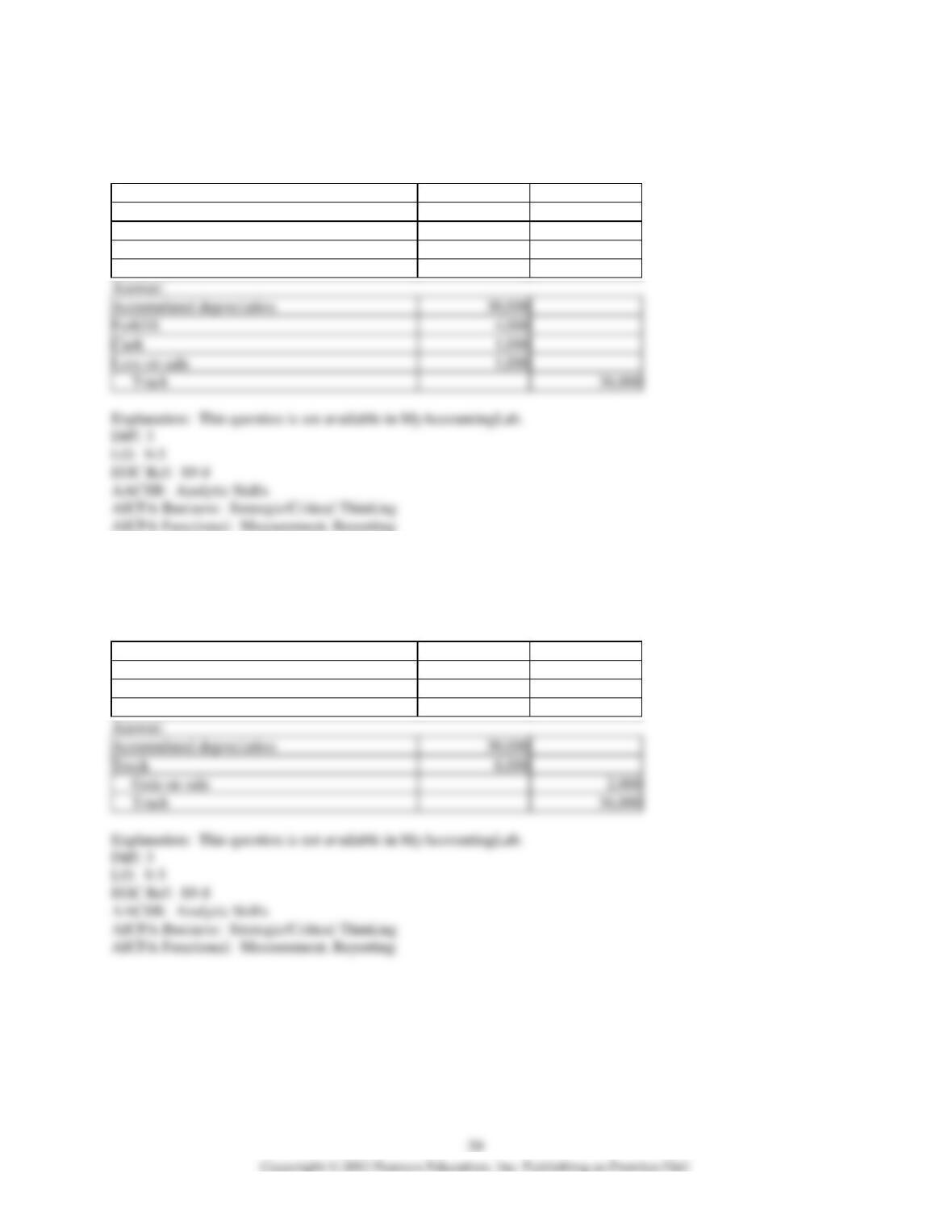
39) Job Sales sold a truck in exchange for $1,000 cash plus a forklift. The truck was originally purchased for
$36,000, and had accumulated depreciation of $30,000 at the time it was sold. The forklift was valued at $4,000.
Please provide the journal entry for this transaction.
Accumulated depreciation
Forklift
Cash
Loss on sale
40) Job Sales traded a truck they had owned for some time, in an even like–kind exchange for another truck. The
original truck had been purchased by Job for $36,000, and had accumulated depreciation of $30,000 at the time it
was exchanged. The truck Job received in exchange was valued at $8,000. Please provide the journal entry for this
transaction.
Accumulated depreciation
Truck
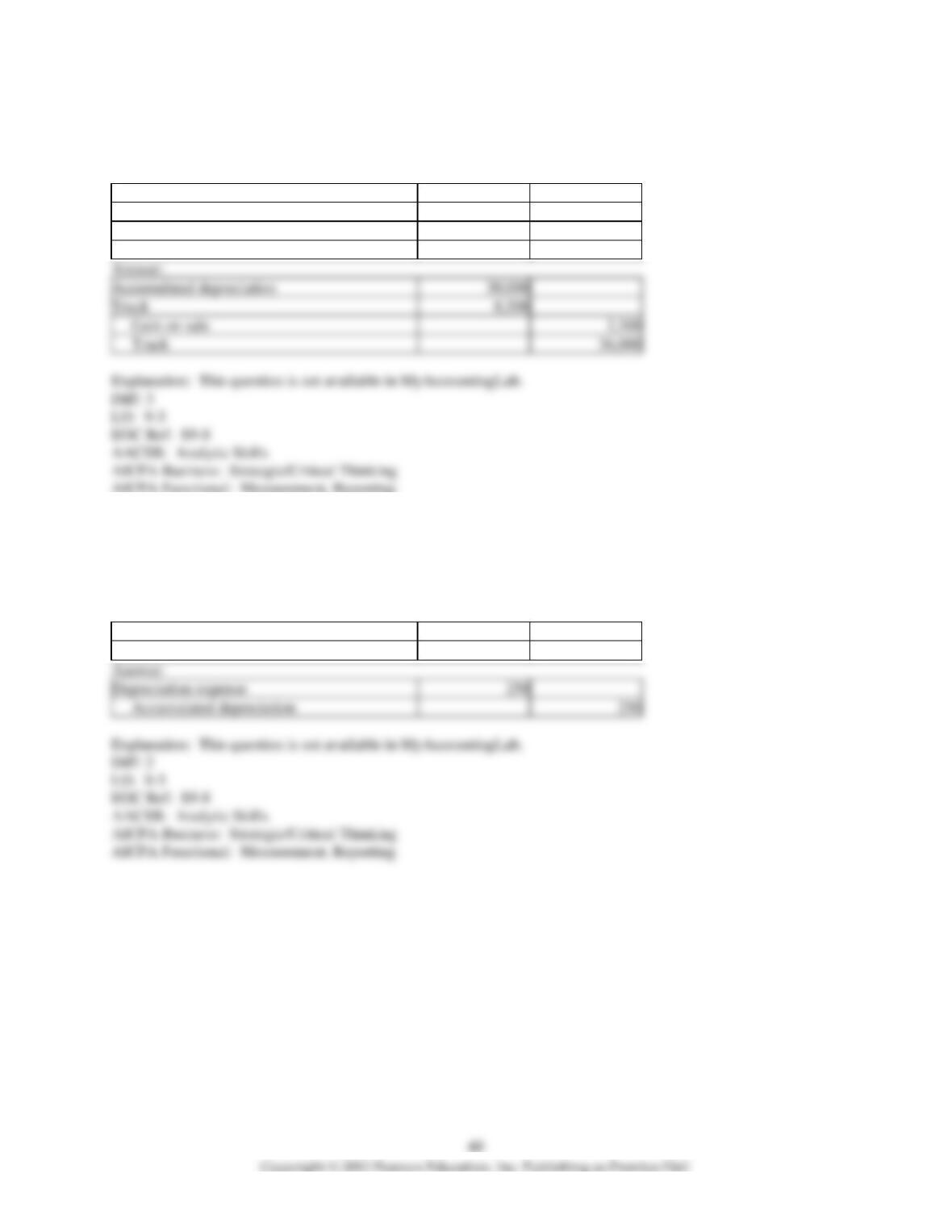
41) Job Sales traded a truck they had owned for some time plus $2,500 cash in exchange for another truck of similar
type. The original truck had been purchased by Job for $36,000, and had accumulated depreciation of $30,000 at the
time it was exchanged. Please provide the journal entry for this transaction.
Accumulated depreciation
Truck
42) Barnhart’s sold a piece of restaurant equipment to another restaurant on July 1, 2013 for $1,100 cash. The
equipment originally cost $12,000, had an estimated life of 20 years, and an estimated salvage value
of $2,000. Barnhart’s had recorded total depreciation of $9,000 through the end of 2012, using the straight-line
method. Barnhart’s had to update the depreciation of the asset before recording the sale. Please provide the entry to
record that additional depreciation.
Depreciation expense
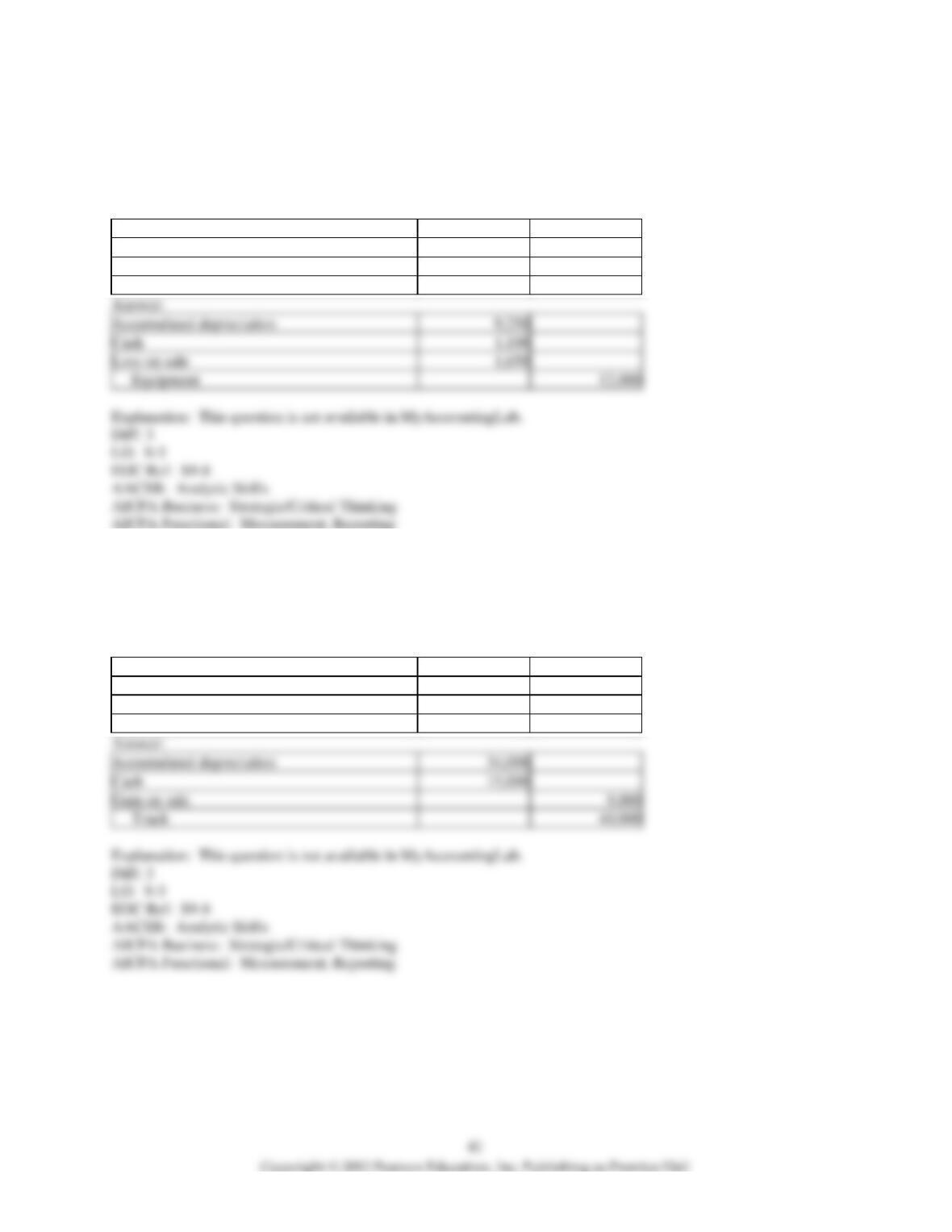
43) Barnhart’s sold a piece of restaurant equipment to another restaurant on July 1, 2013 for $1,100 cash. The
equipment originally cost $12,000, had an estimated life of 20 years, and an estimated salvage value of $2,000.
Barnhart’s had recorded total depreciation of $9,000 through the end of 2012, using the straight-line method.
Barnhart’s had to update the depreciation of the asset before recording the sale. After the depreciation was updated,
Barnhart’s then recorded the sale transaction. Please provide the entry for the sale transaction.
Accumulated depreciation
Cash
Loss on sale
44) On September 1, 2013, Algernon Company sold a truck for $15,000 cash. The truck was originally purchased
for $40,000, had an estimated salvage value of $4,000 and an estimated life of 6 years. Algernon had recorded
depreciation of $30,000 through the end of 2012 using the straight-line method.
First, Algernon had to update the depreciation prior to sale. Then Algernon recorded the sale transaction. Please
provide the journal entry to record the sale.
Accumulated depreciation
Cash
Gain on sale
Learning Objective 9-4
1) Depletion expense is the portion of a natural resource’s cost used up in a particular period.
2) Accumulated depletion is a contra asset account.
3) Depletion is the word we use instead of depreciation to attach to recovering the cost of natural resources.
4) Which of the following items should be depleted?
A) Intangible property
B) Land
C) Natural resources
D) Tangible property, plant, and equipment, other than land
5) Which of the following is the expense resulting from a decline in the utility of a natural resource?
A) Depletion
B) Amortization
C) Depreciation
D) Obsolescence
6) Which of the following accounting methods is the method used to compute depletion?
A) Straight-line
B) Declining-balance
C) Units-of-production
D) First-In, First-Out
7) Navajo Mining Company purchased a mine in 2013 for $3,400,000. It was estimated that the mine contained
200,000 tons of ore and that the mine would be worthless after all of the ore was extracted. The company extracted
25,000 tons of ore in 2013 and 30,000 tons of ore in 2014.
What is depletion expense for 2013?
A) $340,000
B) $680,000
C) $510,000
D) $425,000
8) Navajo Mining Company purchased a mine in 2013 for $3,400,000. It was estimated that the mine contained
200,000 tons of ore and that the mine would be worthless after all of the ore was extracted. The company extracted
25,000 tons of ore in 2013 and 30,000 tons of ore in 2014.
What is depletion expense for 2014?
A) $425,000
B) $680,000
C) $340,000
D) $510,000
9) Navajo Mining Company purchased a mine in 2013 for $3,400,000. It was estimated that the mine contained
200,000 tons of ore and that the mine would be worthless after all of the ore was extracted. The company extracted
25,000 tons of ore in 2013 and 30,000 tons of ore in 2014.
What is the book value of the mine at the end of 2014?
A) $2,975,000
B) $2,720,000
C) $3,060,000
D) $2,465,000
10) Which would NOT be accounted for by the depletion method?
A) Oil reserves
B) Timber reserves
C) Land
D) Coal reserves
11) A mine is purchased for $4,000,000. There will be a salvage value of $300,000 when the land is restored after
mining is completed. The mine has an estimated 250,000 tons of coal. What is the depletable cost per ton of coal?
A) $13.33
B) $16.00
C) $14.80
D) Cannot be determined from given information
12) A mine is purchased for $4,000,000. There will be a salvage value of $300,000 when the land is restored after
mining is completed. The mine has an estimated 250,000 tons of coal. During 2012, there were 35,000 tons of coal
removed. What is the depletion expense for 2012?
A) $518,000
B) $466,550
C) $560,000
D) $300,000
13) Depletion would be used for all of the following EXCEPT:
A) timber.
B) oil and gas.
C) merchandise inventory.
D) minerals.
Learning Objective 9-5
1) Tangible assets are assets with no physical form that have value because of the special rights they carry.
2) Goodwill is NOT amortized—but evaluated—each year for a decline in value.
3) A patent is an exclusive right to reproduce and sell a book, musical composition, film, other work of art, or
computer program.
4) Goodwill is amortized each year, similar to other intangible assets.
5) If goodwill decreases, the company records a loss and writes down the value of the goodwill.
6) If goodwill increases, the company records a gain.
7) A trademark should be amortized over its estimated life.
8) On January 1, 2012, Portwell Company purchased a patent for $200,000. They estimate a useful life of 4 years.
At the end of 2012, the Patent account will have a debit balance of $200,000, and there will be a credit balance in
the Accumulated amortization account of $50,000.
9) Research and development costs are treated the same under GAAP and IFRS.
10) Which of the following is NOT considered a plant asset?
11) Which of the following is the amount capitalized as goodwill?
A) The excess of the cost of an acquired company over the sum of the market value of its net assets
B) The excess of the cost of an acquired company over the sum of the book value of its assets
C) The excess of the cost of an acquired company over the sum of the book value of its net assets
D) The excess of the cost of an acquired company over the sum of the market value of its assets
12) Which of the following items should be amortized?
A) Natural resources
B) Land
C) Some intangible items
D) Tangible property, plant, and equipment, other than land
13) Which of the following types of expenses result from a decline in the utility of an intangible asset?
A) Depreciation
B) Depletion
C) Obsolescence
D) Amortization
14) Which of the following accounting methods is usually used to compute amortization expense?
A) Declining-balance
B) Units-of-production
C) Straight-line
D) First-In, First-Out
15) Azimuth Company purchases a small business for $500,000. The market value of the business’s assets are
$850,000, and the market value of the liabilities are $400,000. How much goodwill should Azimuth record?
A) None
B) $500,000
C) $450,000
D) $50,000
16) Azimuth Company purchases a small business for $450,000. The market value of the business’s assets are
$850,000, and the market value of the liabilities are $400,000. How much goodwill should Azimuth record?
A) None
B) $500,000
C) $450,000
D) $50,000
17) In 2012, Azimuth Company purchased a small business for $500,000. The market value of the business’s assets
were $850,000, and the market value of the liabilities were $400,000. Azimuth recorded goodwill of $50,000 at time
of acquisition. At the end of 2013, they measured the goodwill and found it had a remaining value of only $20,000.
What will Azimuth have to do at year-end 2013?
A) Record a loss on sale of assets.
B) Record a loss on goodwill.
C) Record accumulated depletion.
D) Record a gain in goodwill.
18) Which of the following is the proper accounting treatment for research and development costs?
A) Research and development costs must be capitalized and amortized over 70 years or less.
B) Research and development costs must be capitalized and amortized over 20 years or less.
C) Research and development costs must be capitalized and expensed each year to the extent that their value has
declined.
D) Research and development costs must be expensed.
19) Which of the following is the proper accounting treatment for purchased goodwill?
A) Goodwill must be capitalized when acquired, and amortized over 70 years or less.
B) Goodwill must be capitalized when acquired, and amortized over 20 years or less.
C) Goodwill must be expensed when acquired.
D) Goodwill must be capitalized when acquired, and expensed each year to the extent that the value has declined.
20) Which of the following is the proper accounting treatment for a purchased patent?
A) A purchased patent must be expensed.
B) A purchased patent must be capitalized and expensed each year to the extent that the value has declined.
C) A purchased patent must be capitalized and amortized over 20 years or less.
D) A purchased patent must be capitalized and amortized over 70 years or less.
21) The decline in value of a copyright is accounted for by:
A) depreciation.
B) amortization.
C) depletion.
D) deterioration.
22) Which of the following assets is NOT an intangible asset?
A) Patent
B) Goodwill
C) Building
D) Trademark
23) The type of intangible asset related to the rights of original music and media is:
A) goodwill.
B) a trademark.
C) a copyright.
D) a patent.
24) Which of the following intangible assets bars other manufacturers from using the same name for a product?
A) Trademark
B) Patent
C) Copyright
D) Franchise
25) On January 1, 2014, Portwell Company purchased a patent for $200,000. They estimate a useful life of 4 years.
What entry is needed at the end of the first year?
A)
Amortization expense—patents
50,000
Patents
50,000
B)
Amortization expense—patents
50,000
Accumulated amortization
50,000
C)
Patents
50,000
Amortization expense—patents
50,000
D)
Loss on patents
50,000
Patents
50,000
26) On January 1, 2014, Portwell Company purchased a patent for $200,000. They estimate a useful life of 4 years.
At the end of 2014, the balance in the Patent account will be:
A) $200,000.
B) $210,000.
C) $250,000.
D) $150,000.
27) Azimuth Company purchases a small business for $500,000. The market value of the business’s assets are
$850,000, and the market value of the liabilities are $400,000. Please provide the journal entry to record the
acquisition of the business along with goodwill, if any.
Assets
Goodwill
50,000
Liabilities
Cash
28) In 2013, Azimuth Company purchased a small business for $500,000. The market value of the business’s assets
were $850,000, and the market value of the liabilities were $400,000. Azimuth recorded goodwill of $50,000 at time
of acquisition. At the end of 2014, they measured the goodwill and found it had a remaining value of only $20,000.
Please provide the entry needed at year–end 2014.
Loss on goodwill
30,000
Goodwill
30,000
Loss on goodwill
30,000
Goodwill
30,000
Learning Objective 9-6
1) The major ethical issues surrounding the recording of assets have to do with how assets are defined.
2) One of the key concepts surrounding the definition of an asset is that it must provide future benefit.
3) If a company incurs an expense, but treats it as an asset, net income would be understated.
4) Many companies have gotten into trouble by recording costs as expenses, rather than capitalizing them.