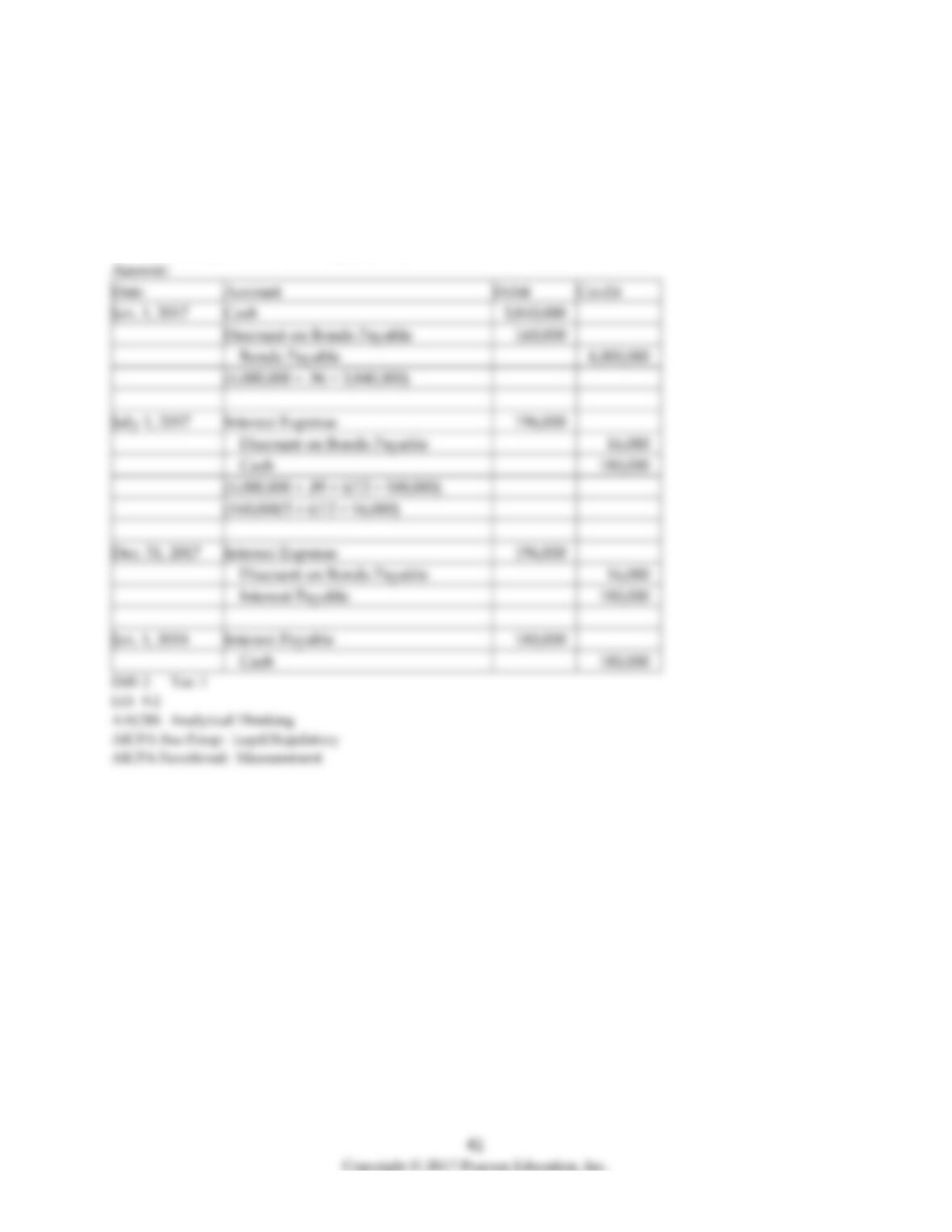
58) On January 1, 2017, Tarantino Corporation issued $4,000,000, 9%, 5-year bonds at 96. The bonds pay
semiannual interest on January 1 and July 1. Tarantino uses the straight-line method of amortization
and has a calendar year end.
Required:
Prepare all the journal entries that Tarantino Corporation would make related to this bond issue
through January 1, 2018. Omit explanations.
3 Learning Objective 9-3
1) The effective-interest method of amortizing a bond discount or premium results in different amounts
of interest expense for every interest payment over the bond’s life.
2) When a corporation converts bonds payable into common stock, its equity increases.
3) Callable bonds allow the issuer to pay off the bonds whenever the issuer chooses.
4) If a bond is retired before maturity, the journal entry to record the retirement will include a credit to
Cash.
5) Solderman Company issued $460,000, 8%, 10-year bonds for $442,800 with a market rate of 10%. The
effective-interest method of amortization is to be used and interest is paid annually. The journal entry
on the first interest payment date would include a:
A) credit to Interest Expense of $36,800.
B) credit to Cash of $44,280.
C) credit to Discount on Bonds Payable of $7480.
D) credit to Interest Expense of $7480.
6) Under the effective-interest method, the amount of bond discount amortized each interest period is
equal to the:
A) amount of interest expense less the cash paid for interest.
B) amount of interest expense plus the cash paid for interest.
C) face value of the bond times the stated interest rate.
D) face value of the bond times the market interest rate at the date of issue.
7) NBC Corporation issued $620,000, 10%, 5-year bonds on January 1, 2017 for $670,288 when the
market interest rate was 8%. Interest is paid semiannually on January 1 and July 1. The corporation uses
the effective-interest method to amortize bond premium. The total amount of bond interest expense
recognized on July 1, 2017 is:
A) $24,800.
B) $26,812.
C) $33,514.
D) $31,000.
8) Under the effective-interest method of amortization, the bond cash payment on each interest date is
calculated by multiplying the:
A) face value of the bonds times the effective–interest rate for the appropriate time period.
B) face value of the bonds times the stated interest rate for the appropriate time period.
C) carrying value of the bonds times the stated interest rate for the appropriate time period.
D) carrying value of the bonds times the effective-interest rate for the appropriate time period.
9) On January 1, 2017, Chin Corporation issued $2,600,000, 16%, 5-year bonds. The bond interest is
payable on January 1 and July 1. The bonds sold for $2,819,600. The market rate of interest for these
bonds was 14%. Under the effective-interest method, what is the interest expense for the six months
ending July 1, 2017?
A) $182,000
B) $225,568
C) $197,372
D) $208,000
10) Under the effective-interest method, if bonds are issued at a discount, the amount of interest
expense:
A) increases each period as the bonds move towards maturity.
B) decreases each period as the bonds move towards maturity.
C) remains the same over the term of the bonds.
D) is less than the cash interest payment.
11) Which is the most theoretically correct method to use when amortizing a bond discount or
premium?
A) market-interest rate method of amortization
B) straight-line method of amortization
C) effective-interest method of amortization
D) Both straight-line and market-interest rate methods of amortization are equally preferred.
12) Under the effective-interest method of amortization, interest expense for each interest period can be
calculated by multiplying the:
A) face value of the bonds times the effective-interest rate for the appropriate time period.
B) carrying value of the bonds times the effective-interest rate for the appropriate time period.
C) face value of the bonds times the stated interest rate for the appropriate time period.
D) carrying value of the bonds times the stated interest rate for the appropriate time period.
13) On January 1, 2017, Naperville Corporation issued $1,600,000, 15%, 5-year bonds with interest
payable on January 1 and July 1. The bonds sold for $1,746,400. The market rate of interest was 13%.
Using the effective-interest method, the debit entry to interest expense on July 1, 2017 is (round to the
nearest dollar):
A) $104,000.
B) $130,980.
C) $113,516.
D) $120,000.
14) Lisle Corporation issued $200,000 of 10% bonds on January 1, 2017. The bonds pay interest
semiannually on January 1 and July 1. The company has a fiscal year end of May 31. On May 31, 2017,
the Lisle Corporation will:
A) make a journal entry to accrue interest expense from July 1 through December 31.
B) make a journal entry to accrue interest expense from January 1 through July 1
C) make a journal entry to accrue interest expense from January 1 through May 31.
D) make a journal entry to record cash interest paid on May 31.
15) When a company retires bonds early, the gain or loss on the retirement is the difference between the
cash paid and the:
A) face value of the bonds.
B) original selling price of the bonds.
C) maturity value of the bonds.
D) carrying value of the bonds.
16) Godwin Corporation retires its bonds at 108 on January 1, after the payment of interest. The face
value of the bonds is $640,000. The carrying value of the bonds at retirement is $662,500. The entry to
record the retirement will include a:
A) debit of $51,200 to Premium on Bonds Payable.
B) debit of $22,500 to Premium on Bonds Payable.
C) credit of $28,700 to Gain on Retirement of Bonds.
D) credit of $28,700 to Loss on Retirement of Bonds.
17) Bonds that the issuer may pay off at a prearranged price whenever the issuer chooses before the
maturity date are:
A) serial bonds.
B) callable bonds.
C) convertible bonds.
D) debenture bonds.
18) Miller Corporation has $1,900,000 of bonds outstanding. The unamortized premium is $61,000. If the
company retired the bonds at 102, what would be the gain or loss on the retirement? Ignore any interest
due.
A) $38,000 gain
B) $38,000 loss
C) $23,000 gain
D) $61,000 gain
19) The journal entry to record the conversion of bonds payable into common stock will include a:
A) debit to Bonds Payable and a credit to Common Stock.
B) debit to Bonds Payable and a credit to Cash.
C) debit to Cash and a credit to Common Stock.
D) debit to Cash and a credit to Paid-in Capital in Excess of Par.
20) If bonds with a face value of $170,000 are converted into common stock when the carrying value of
the bonds is $135,000, the entry to record the conversion would include a debit to:
A) Bonds Payable for $135,000.
B) Bonds Payable for $170,000.
C) Discount on Bonds Payable for $35,000.
D) Cash for $35,000.
21) Immediately after the last interest payment, Henry Company converted $2,700,000 of its bonds into
270,000 shares of $10 par value common stock. The unamortized premium on the bonds at the date of
the conversion was $900,000. As a result of this conversion:
A) liabilities decreased by $3,600,000 and stockholders’ equity decreased by $3,600,000.
B) liabilities decreased by $2,700,000 and stockholders’ equity increased by $2,700,000.
C) liabilities decreased by $3,600,000 and stockholders’ equity increased by $3,600,000.
D) liabilities decreased by $900,000 and stockholders’ equity increased by $900,000.
22) Marshall Corporation has $37,000 of bonds outstanding with a carrying value of $45,400. The bonds
are converted into 18,500 shares of $1 par value common stock immediately after the last interest
payment. The common stock had a market value of $5 per share on the date of conversion. The entry to
record the conversion would include a credit to:
A) Common Stock for $18,500 and credit to Paid-in Capital in Excess of Par for $8400.
B) Bonds Payable for $37,000 and credit to Premium on Bonds Payable for $8400.
C) Cash for $45,400.
D) Common Stock for $18,500 and credit to Paid-in Capital in Excess of Par for $26,900.

23) Lloyd Corporation has $2,100,000 of bonds outstanding with an unamortized premium of $105,000
immediately following the last interest payment. At that time, the bonds were converted into 270,000
shares of $8 par value common stock. As a result of this conversion:
A) liabilities decreased by $1,995,000 and stockholders’ equity increased by $1,995,000.
B) liabilities decreased by $2,100,000 and stockholders’ equity increased by $2,100,000.
C) liabilities decreased by $2,205,000 and stockholders’ equity increased by $2,205,000.
D) liabilities increased by $1,995,000 and stockholders’ equity increased by $1,995,000.
24) If bonds have been issued at a discount and the effective–interest method is used, ________ over the
life of the bonds.
A) carrying value of the bonds will decrease
B) interest payment will increase
C) interest expense will decrease
D) interest expense will increase
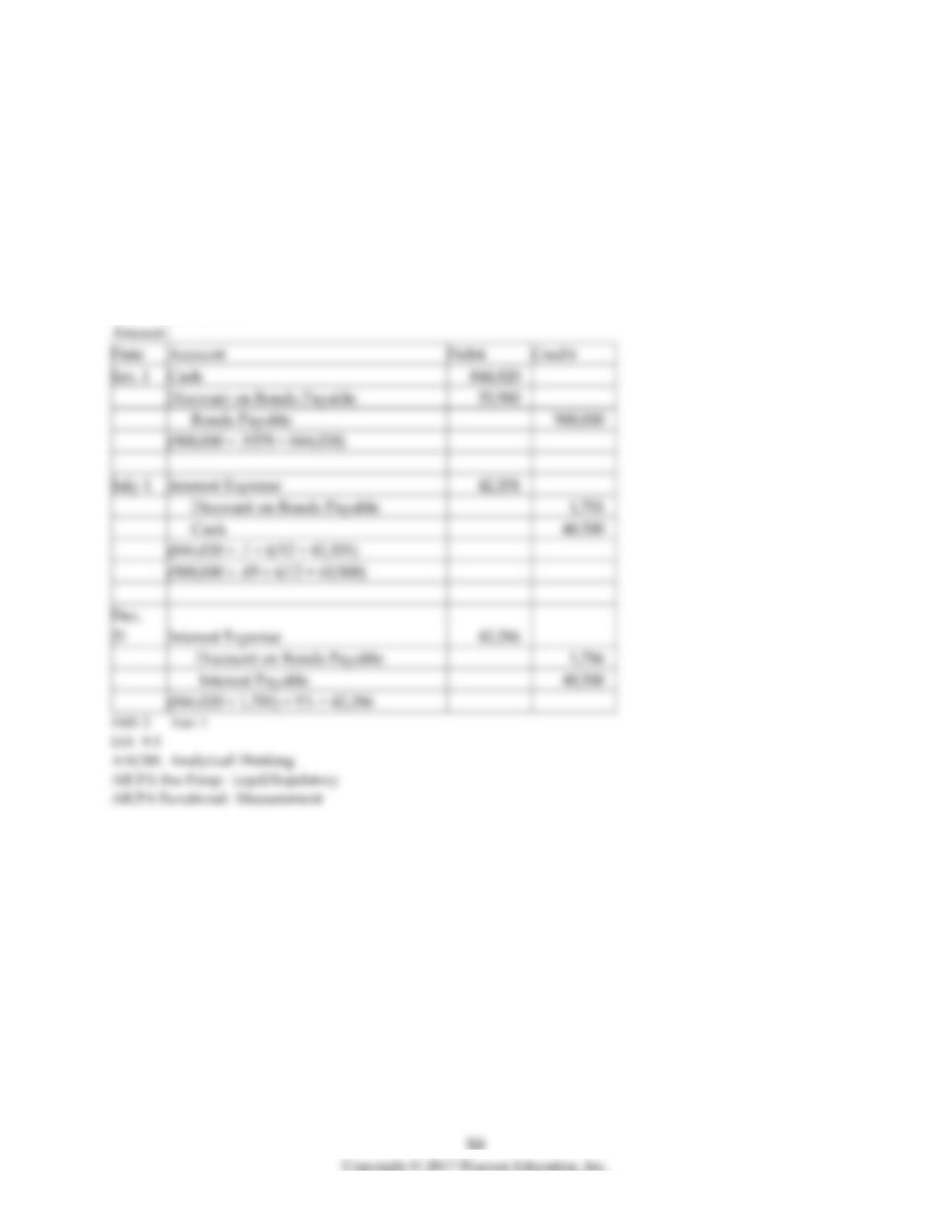
25) On January 1, 2017, Fleming Corporation issued 9%, 10-year bonds with a face value of $900,000 at
93.78. Interest is payable semiannually on January 1 and July 1. The effective-interest rate when the
bonds were issued was 10%. Any discount or premium is amortized using the effective-interest method.
Required:
Prepare journal entries on:
1. January 1, 2017
2. July 1, 2017
3. December 31, 2017, the fiscal year end
Omit explanations.
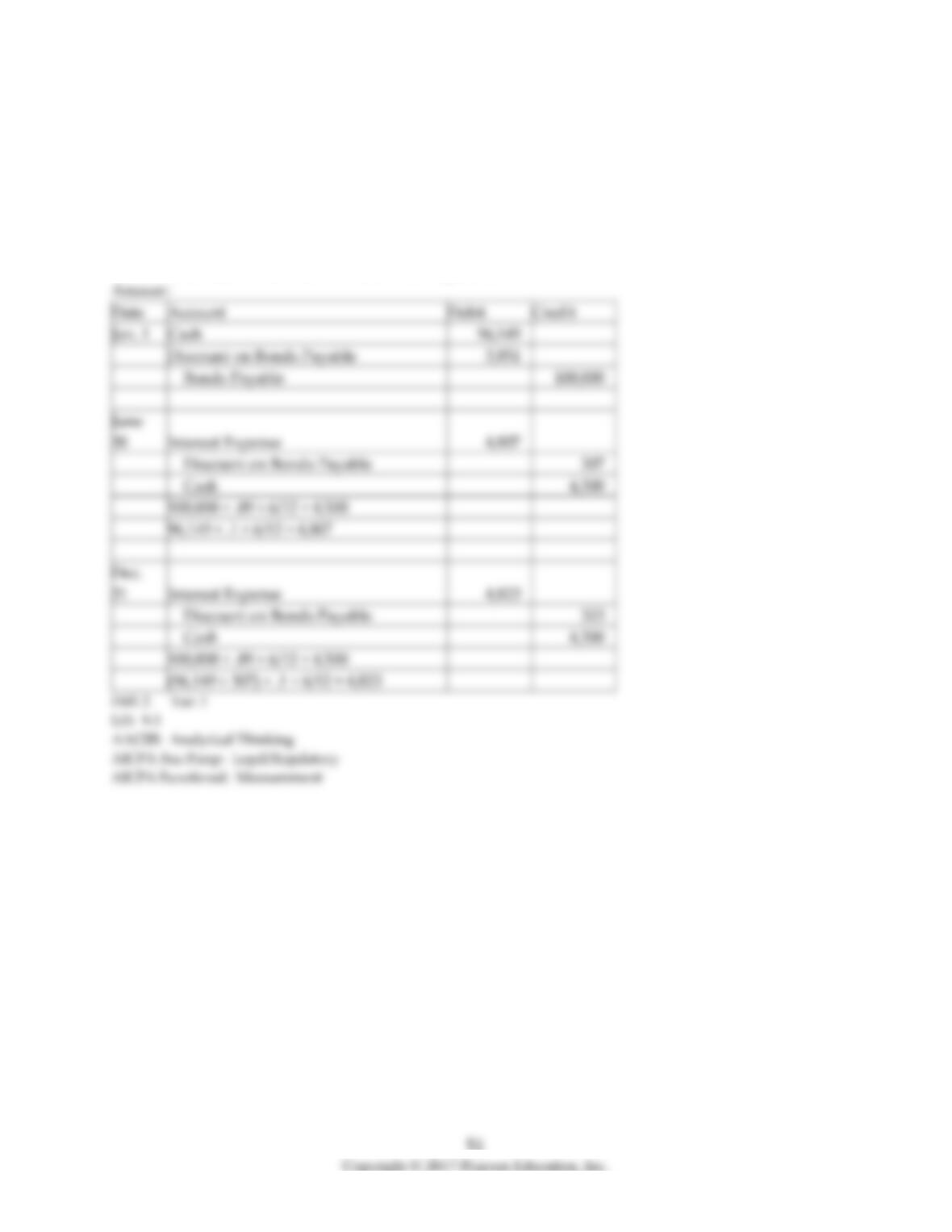
26) On January 1, 2017, Patterson Corporation issued $100,000, 9%, 5-year bonds with semiannual
interest payments on June 30 and December 31. The bonds were issued at $96,149 yielding an effective–
interest rate of 10%. Patterson uses the effective-interest method of amortization. The company’s fiscal
year ends on December 31.
Required:
Prepare the journal entries that Patterson would make on January 1, June 30 and December 31, 2017.
Round all amounts to the nearest dollar. Omit explanations.
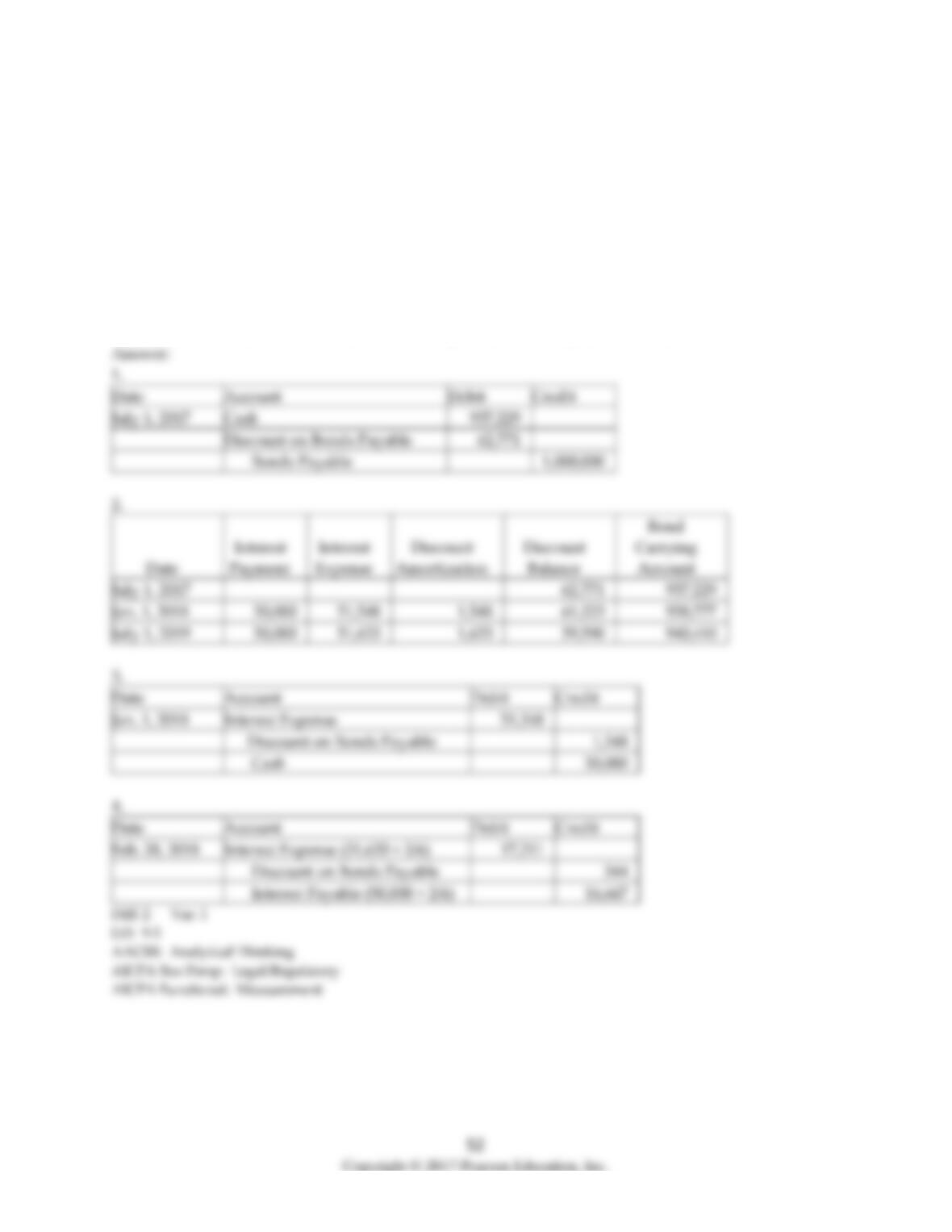
27) On July 1, 2017, Bobby’s Building Corp. issued $1,000,000 of 10% bonds dated July 1, 2017 for
$937,229. The bonds were sold to yield 11% and pay interest semiannually on July 1 and January 1.
Bobby’s Building Corp. uses the effective interest method of amortization. The company’s fiscal year
ends on February 28.
Required :
1. Prepare the journal entry on July 1, 2017.
2. Prepare the amortization table for the first two interest periods.
3. Prepare the journal entry on January 1, 2018.
4. Prepare the adjusting entry needed on February 28, 2018.
Round all amounts to the nearest dollar. Omit explanations for all journal entries.
4 Learning Objective 9-4
1) Earnings per share is the amount of a company’s net income divided by the par value of its stock.
2) Earnings per share is a standard measure of operating performance that applies to companies of
different sizes and from different industries.
3) The times-interest-earned ratio is calculated by dividing operating income by operating expenses.
4) The times-interest-earned ratio indicates the company’s ability to pay interest expense.
5) A leverage ratio of exactly 1.0 would mean that assets exactly equal total liabilities.
6) If net income is positive, the return on assets is negative.
7) A disadvantage of using bonds instead of stock as a method of long-term financing is that with
bonds:
A) interest must be paid regardless of the level of earnings.
B) interest expense is tax deductible.
C) bonds do not dilute stockholders’ proportionate ownership.
D) issuing bonds results in higher earnings per share than issuing common stock.
8) A disadvantage of issuing stock instead of debt is that stock:
A) creates no interest expense which must be paid.
B) is less risky to the issuing corporation.
C) creates no liabilities for the corporation.
D) generally results in lower earnings per share.
9) The financing option that has the lowest risk to a company is financing by:
A) retained earnings.
B) issuing stock.
C) issuing bonds payable.
D) issuing notes payable.
10) Which of the following is NOT a primary strategy for financing operations?
A) retained earnings
B) selling corporate assets
C) issuing stock
D) issuing bonds or notes payable