19) What is the difference between bolt-on tagging and integrated tagging?
1) A taxonomy is a dictionary that defines the XBRL tags used for specific data items.
2) Tags are used to label or identify data and metadata.
3) In XBRL, the opening and closing tags are identical.
4) An instance document contains specific amounts for a taxonomy at one instance.
5) XBRL software tools using a specified taxonomy transforms data into XBRL instance
documents.
6) A definition link base defines the relationship between elements and the external regulations
or standards.
7) A ________ is a dictionary that defines the XBRL tags used for specific data items.
8) ________ elements are numeric or nonnumeric facts.
9) The ________ contains specific amounts for a taxonomy at one instance.
10) ________ elements explain the circumstance in which the data appears.
11) The ________ element defines the time frame.
12) The ________ element defines the company.
13) The XBRL linkbase ________ link defines different kinds of relationships between
elements. For example, ZIP code is the postal code used in the United States.

Match the following elements to the appropriate definitions.
A) Unit of measure
B) Numeric and nonnumeric facts
C) Time period
D) Defines the company or entity
E) Unique ID for the element
F) Explains the environment in which the data appears
14) Data element
Diff: 2
Objective: Q9.6 How does XBRL work?
15) Unit elements
Diff: 1
Objective: Q9.6 How does XBRL work?
16) Entity elements
Diff: 1
Objective: Q9.6 How does XBRL work?
17) Identifier elements
Diff: 1
Objective: Q9.6 How does XBRL work?
18) Context element
Diff: 1
Objective: Q9.6 How does XBRL work?

Match the linkbase to the appropriate definition.
A) Defines the basic validation rules
B) Defines the labels used in the document
C) Defines how the elements are presented
D) Defines different kinds of relationships between elements
E) Defines the relationships between the elements and the external regulations or standards
19) Reference link
Diff: 1
Objective: Q9.6 How does XBRL work?
20) Calculation link
Diff: 1
Objective: Q9.6 How does XBRL work?
21) Presentation link
Diff: 1
Objective: Q9.6 How does XBRL work?
22) Definition link
Diff: 1
Objective: Q9.6 How does XBRL work?
23) Label link
Diff: 1
Objective: Q9.6 How does XBRL work?
Match the XBRL essential to the appropriate definition.
A) Defines which elements are related to a particular taxonomy
B) Relates to data and metadata
C) Defines relationships between data
D) A dictionary that defines the XBRL tags used for specific data items
E) Identifies the specific amounts for a taxonomy at one instance
24) Taxonomy
Diff: 1
Objective: Q9.6 How does XBRL work?
25) Instance document
Diff: 1
Objective: Q9.6 How does XBRL work?
26) Elements
Diff: 2
Objective: Q9.6 How does XBRL work?
27) Schema
Diff: 1
Objective: Q9.6 How does XBRL work?
28) Linkbase
Diff: 1
Objective: Q9.6 How does XBRL work?
29) Which of the following is NOT a XBRL essential?
A) Instant document
B) Schema
C) Taxonomy
D) Data integrity
30) XBRL tags appear between
A) { }
B) < >
C) | |
D) [ ]
31) The closing XBRL tag includes which character?
A) /
B) \
C) +
D) –
32) XBRL uses the same syntax as
A) Shadow data
B) HTML
C) RDBMS
D) SDLC
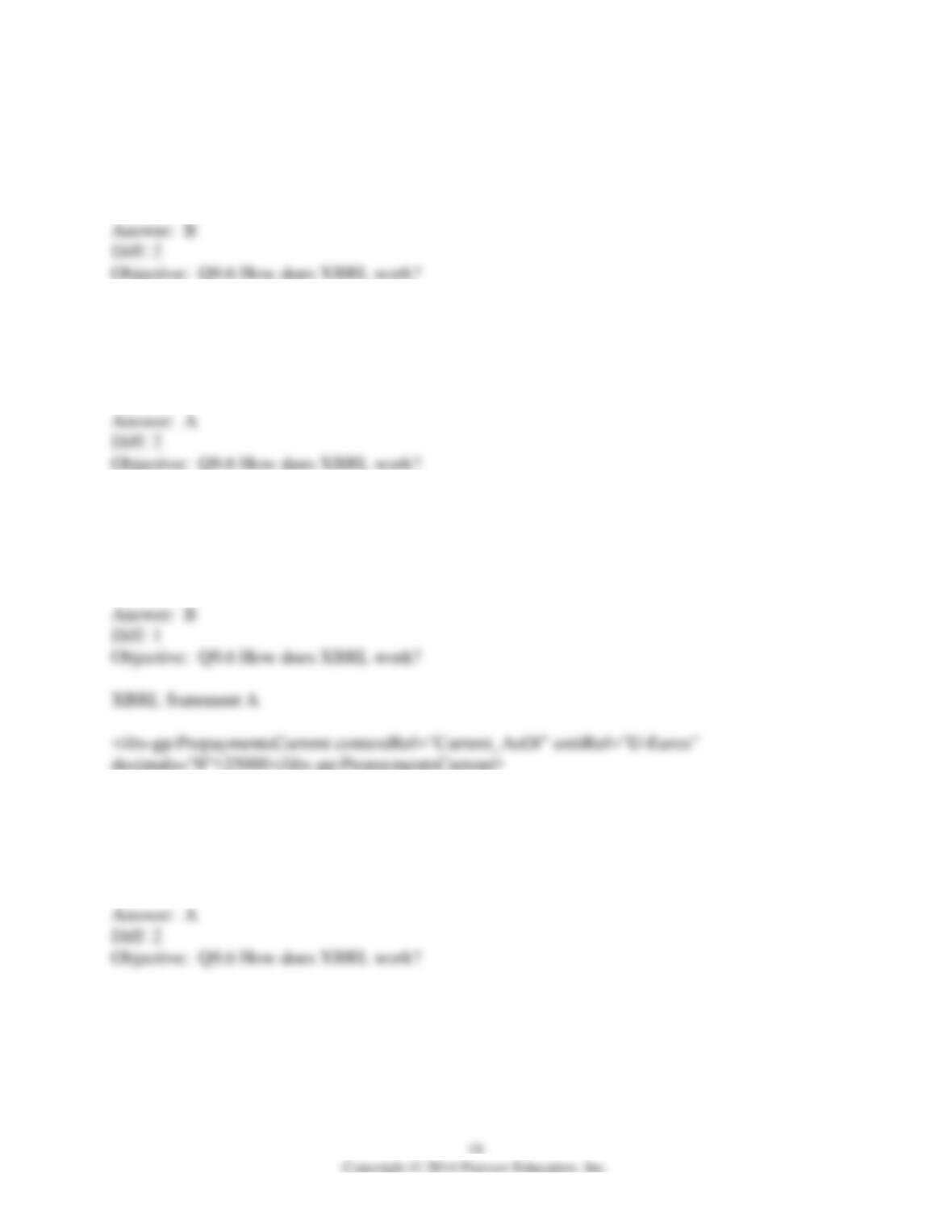
33) In the XBRL Statement A, which taxonomy is used?
A) IFRS
B) Global Ledger
C) Prepayments Current
D) GAAP
34) In the XBRL Statement A, how many decimal places are in the amount?
A) 2
B) 4
C) 3
D) 0
35) In the XBRL Statement A, what is the correct amount?
A) 250.00
B) 2.5000
C) 25000
D) 2500.0
36) In the XBRL Statement B, which taxonomy is used?
A) IFRS
B) Global Ledger
C) Long Term Investments
D) GAAP
37) In the XBRL Statement B, how many decimal places are in the amount?
A) 4
B) 2
C) 5
D) 0
38) What is the purpose of a schema?
A) Define which elements are related to a particular taxonomy
B) Define the relationship between data
C) Explain the context in which data appears
D) Define the relationships between elements
39) Which linkbase defines the different kinds of relationships between elements?
A) Presentation link
B) Definition link
C) Reference link
D) Label link
40) Which linkbase defines the relationships between the elements and the external regulations
or standards?
A) Label link
B) Calculation link
C) Definition link
D) Reference link
41) Which of the following is NOT an XBRL linkbase?
A) Location link
B) Calculation link
C) Presentation link
D) Label link
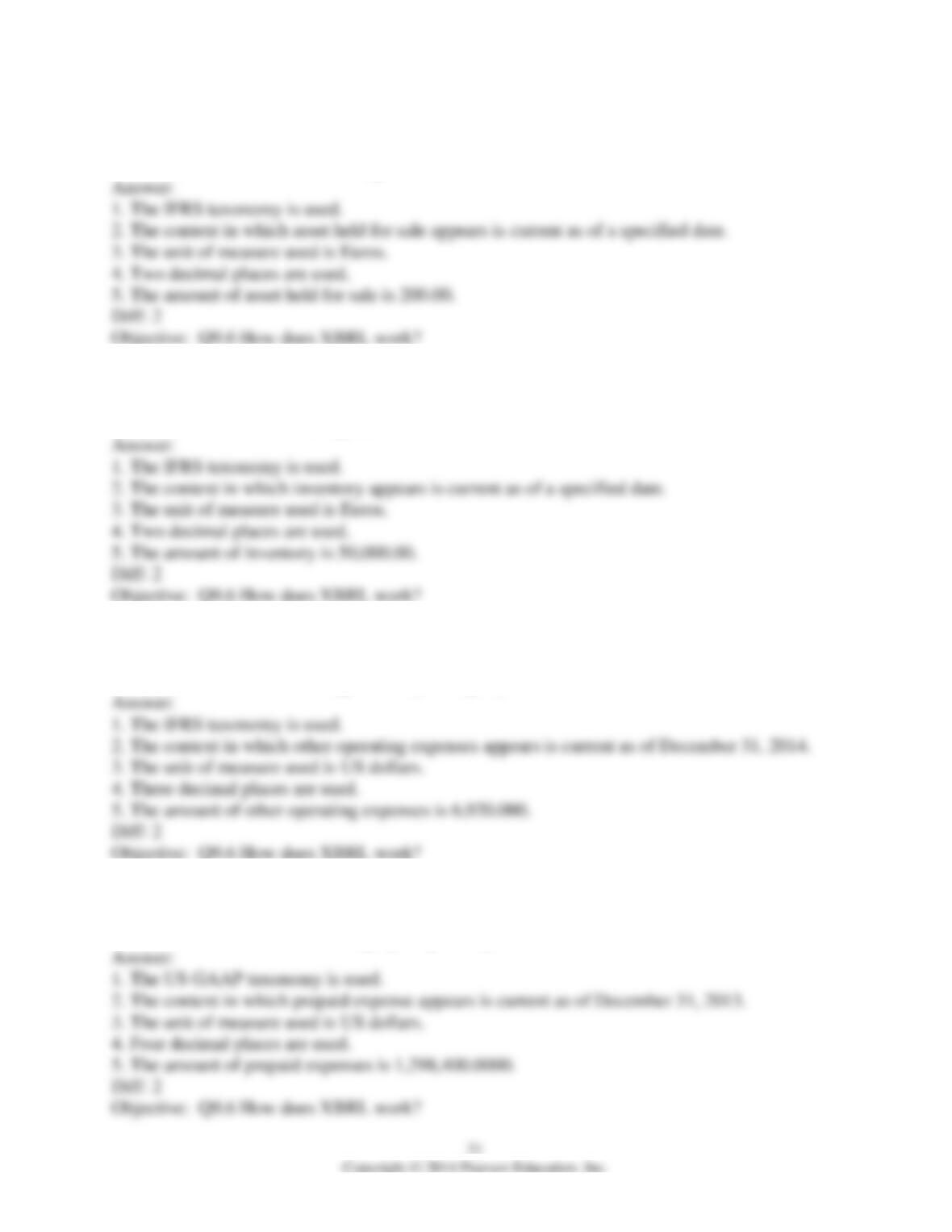
42) What information does the following XBRL tag provide?
<ifrs-gp:AssetsHeldSale contextRef=”Current_AsOf” unitRef=”U-
Euros”decimals=”2″>20000</ifrs-gp:AssetsHeldSale>
43) What information does the following XBRL tag provide?
<ifrs-gp:Inventories contextRef=”Current_AsOf” unitRef=”U-Euros”
decimals=”2″>5000000</ifrs-gp:Inventories>
44) What information does the following XBRL tag provide?
<ifrs-gp:OtherOperatingExpenses contextRef=”Dec312014″ unitRef=”USD”
decimals=”3″>6920000</ifrs-gp:OtherOperatingExpenses>
45) What information does the following XBRL tag provide?
<us-gaap:PrepaidExpenseCurrent contextRef=”Dec312013″ unitRef=”USD”
decimals=”4″>12984000000</us-gaap:PrepaidExpenseCurrent>
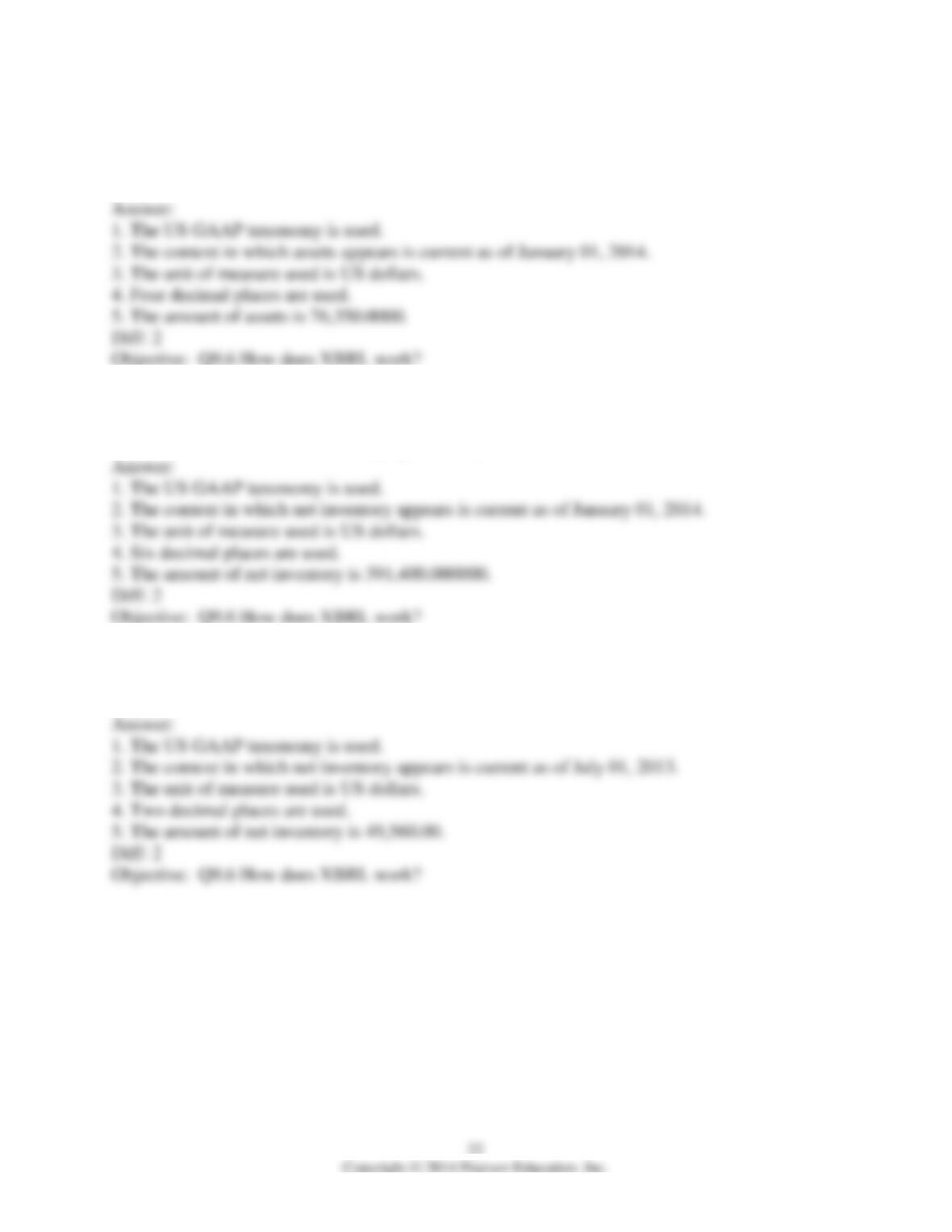
46) What information does the following XBRL tag provide?
<us-gaap:Assets contextRef=”Jan012014″ unitRef=”USD” decimals=”4″>763500000</us-
gaap:Assets>
47) What information does the following XBRL tag provide?
<us-gaap:InventoryNet contextRef=”Jan012014″ unitRef=”USD”
decimals=”6″>391400000000</us-gaap:InventoryNet>
48) What information does the following XBRL tag provide?
<us-gaap:GoodWill contextRef=”Jul012013″ unitRef=”USD” decimals=”2″>4956000</us–
gaap:GoodWill>
49) List and define the XBRL essentials.
50) What types of linkbases are used in XBRL to define relationships?