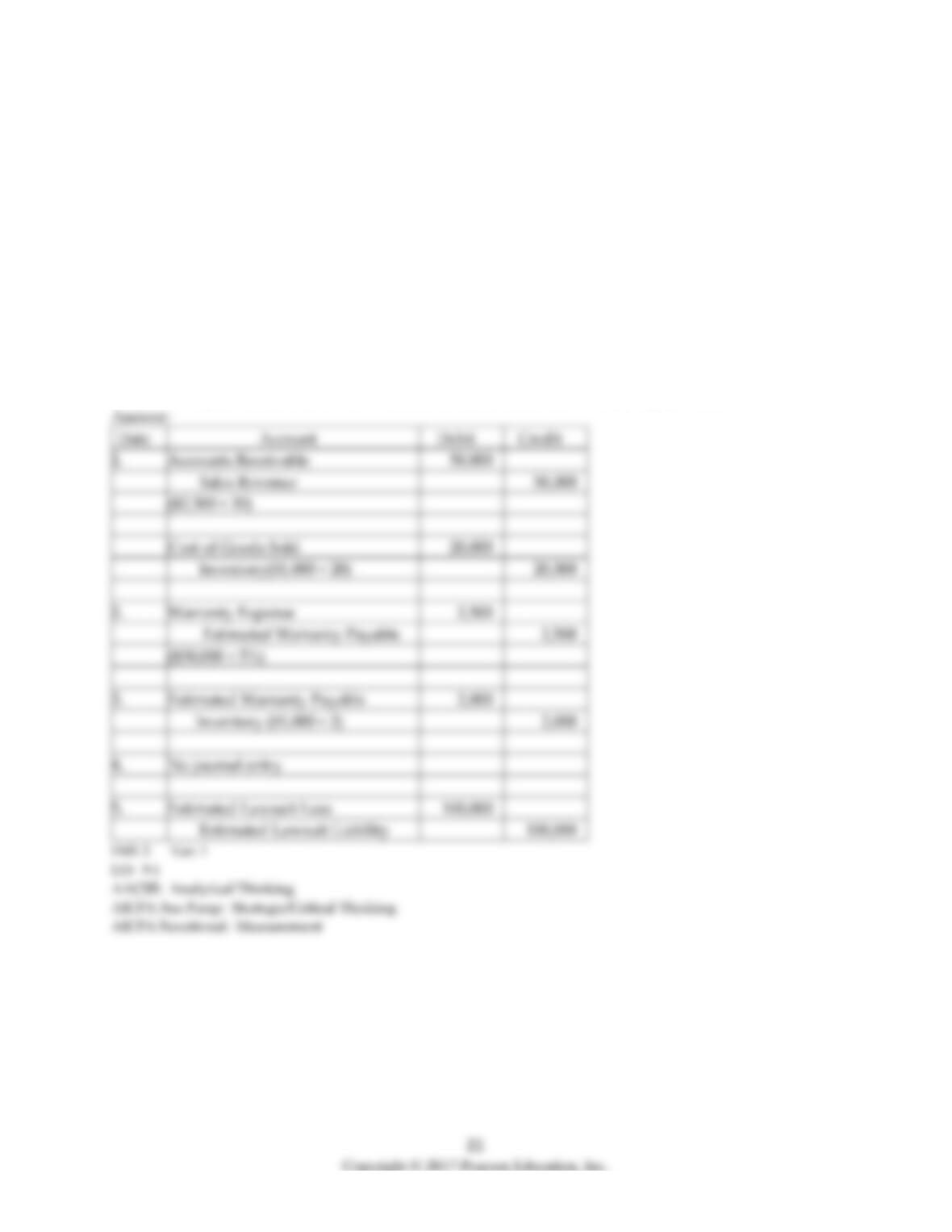
60) The following information is available for a retail store for the month of February:
1. Wahlberg Computers sells computers for $2,500 each on account. On February 1, Wahlberg sold 20
computers. The cost of each computer sold was $1,000. The store uses the perpetual inventory system.
2. It is estimated that the warranty expense is 5% of gross sales. A journal entry is prepared February 1.
3. During February, Wahlberg replaced two computers due to product warranty complaints for
products purchased in a prior month.
4. A customer fell in the store and is seeking $100,000 in damages. Wahlberg’s attorney believes the case
is frivolous because the customer has similar lawsuits pending against other retail stores.
5. A customer is suing Wahlberg Computers for $100,000 because the customer‘s computer purchased
from Wahlberg Computers started a fire and destroyed the customer’s residence. Wahlberg’s attorney
believes the customer will probably win the case and receive $100,000.
Required: Prepare the journal entries to record the transactions above. Omit explanations.
2 Learning Objective 9-2
1) Corporations borrow large amounts of money by issuing (selling) bonds to the public.
2) If bonds are issued at a premium, the carrying value of the bonds will be greater than the face value
of the bonds for all interest periods prior to the bond’s maturity date.
3) If bonds are issued at a discount, the issuing corporation will pay an amount greater than the face
amount of the bonds on the maturity date.
4) The account Premium on Bonds Payable increases the issuer’s liabilities.
5) If the market interest rate is greater than the stated interest rate, the bonds will sell at a discount.
6) If $500,000, 6% bonds are issued on January 1 and pay interest semiannually, the amount of the
interest payment on July 1 will be $15,000.
7) If $120,000 face value bonds are issued at 104, the proceeds received will be $104,000.
8) The carrying amount of bonds is calculated by adding the balance of the Discount on Bonds Payable
account to the balance in the Bonds Payable account.
9) At maturity, the carrying amount of bonds should equal the face value of the bonds.
10) If the stated interest rate on a bond is 8% and the market interest rate is 7%, the bond will be issued
at a price above the par value of the bond.
11) The straight-line amortization method keeps interest expense at the same dollar amount for each
interest payment over the bond’s life.
12) The stated interest rate is always equal to the market interest rate on the date the bonds are issued.
13) The carrying value of bonds decreases over the term of the bonds if the bonds were issued at a
discount.
14) Premium on bonds payable is a contra account to bonds payable.
15) At maturity, the premium on bonds payable will have been amortized to zero, and the bonds’
carrying value will be the face value of the bond.
16) Bonds that are secured by real estate are called:
A) term bonds.
B) secured bonds.
C) mortgage bonds.
D) B and C.
17) Bonds in a particular issue which mature in installments over a period of time are called:
A) serial bonds.
B) term bonds.
C) callable bonds.
D) convertible bonds.
18) Bonds which are backed only by the good faith of the borrower are referred to as:
A) junk bonds.
B) uncertified bonds.
C) debenture bonds.
D) callable bonds.
19) If the market interest rate is greater than the stated interest rate on bonds, bonds will sell:
A) at face value.
B) at a discount.
C) at a premium.
D) at the stated interest rate.
20) If bonds are issued at a discount, it means that the:
A) market interest rate is higher than the stated interest rate.
B) market interest rate is lower than the stated interest rate.
C) financial strength of the issuer is weak.
D) bond is convertible.
21) The market interest rate is also referred to as the:
A) contractual rate.
B) coupon rate.
C) effective rate.
D) stated rate.
22) The carrying amount of bonds issued at a discount is calculated by:
A) subtracting Discount on Bonds Payable from Bonds Payable.
B) subtracting the sum of Discount on Bonds Payable and Interest Payable from Bonds Payable.
C) subtracting Interest Payable from Bonds Payable.
D) subtracting Interest Expense from Bonds Payable.
23) The interest rate that investors demand for loaning their money is referred to as:
A) the coupon rate of interest.
B) the market rate of interest.
C) the stated rate of interest.
D) the debenture rate of interest.
24) Bonds with a 7% stated interest rate were issued when the market rate of interest was 6%. This bond
was issued at:
A) par value.
B) a premium.
C) a discount.
D) face value.
25) If the market interest rate is 6%, a $10,000, 7%, 5-year bond, that pays interest semiannually would
sell at an amount:
A) less than face value.
B) equal to face value.
C) greater than face value.
D) less than the maturity value.
26) A bond will sell at a premium when:
A) the coupon rate is equal to the effective rate.
B) the coupon rate is greater than the effective rate.
C) the coupon rate is less than the effective rate.
D) the stated rate is less than the market rate of interest.
27) Bonds with a 6% interest rate were issued when the market rate of interest was 7%. The quoted bond
price will be:
A) greater than 100.
B) less than 100.
C) 100.
D) greater than 1000.
28) A bond with a face value of $90,000 and a quoted price of 106 has a selling price of: (Round your
final answer to the nearest dollar.)
A) $84,906.
B) $90,000.
C) $95,400.
D) $99,000.
29) A $4000, 9% bond is sold at 95. When the bond is issued, the Cash account will be increased by:
A) $3800.
B) $4000.
C) $4160.
D) $4200.
30) On January 1, Hanley Corporation issued $1,700,000, 10-year, 7% bonds at 101. The journal entry to
record this transaction would include a:
A) credit to Bonds Payable $1,717,000.
B) debit to Discount on Bonds Payable $17,000.
C) debit to Cash $1,700,000.
D) credit to Premium on Bonds Payable $17,000.
31) In the balance sheet, the account, Premium on Bonds Payable, is:
A) added to bonds payable.
B) deducted from bonds payable.
C) classified as a liability account.
D) A and C
32) Maybelline Corporation issues $3,200,000, 10–year, 7% bonds dated January 1 at 103. The journal
entry to record the issuance will include a:
A) credit to Cash for $3,296,000.
B) debit to Cash for $3,200,000.
C) credit to Premium on Bonds Payable for $96,000.
D) credit to Bonds Payable for $3,296,000.
33) Bonds with a face value of $200,000 were sold at an effective interest rate of 8% to yield cash
proceeds in excess of $200,000. It is apparent that the bonds had a:
A) stated interest rate less than NaN%.
B) stated interest rate greater than NaN%.
C) effective interest rate less than NaN%.
D) effective interest rate greater than NaN%.
34) Smith Corporation issues $2,100,000, 10-year, 8% bonds payable at a price of 97. The journal entry to
record the issuance will include a:
A) debit to Cash of $2,100,000.
B) credit to Discount on Bonds Payable for $63,000.
C) credit to Bonds Payable for $2,037,000.
D) debit to Cash for $2,037,000.
35) The carrying value of a bond immediately after the bond was issued was $205,000. The bond price
was 99. The face value of the bond was: (Round your final answer to the nearest dollar.)
A) $202,950.
B) $205,000.
C) $207,050.
D) $207,071.
36) Premium on Bonds Payable:
A) has a debit balance.
B) is a contra account to bonds payable.
C) has a credit balance.
D) is deducted from bonds payable on the balance sheet.
37) If bonds have been issued at a premium, over the life of the bonds, the:
A) carrying value of the bonds will decrease.
B) carrying value of the bonds will increase.
C) interest expense will increase.
D) interest payment will increase.
38) The journal entry to record a semiannual interest payment on a bond payable issued at par:
A) debits Interest Expense and credits Bonds Payable.
B) debits Interest Expense and credits Cash.
C) debits Cash and credits Interest Payable.
D) debits Cash and credits Interest Expense.
39) Basil Company issued $640,000, 6%, 5-year bonds for 104, with interest paid annually. Assuming
straight-line amortization, what is the carrying value of the bonds after one year?
A) $665,600
B) $640,000
C) $660,480
D) $678,400
40) A bond was issued at a discount. The journal entry to record payment of this bond payable at
maturity will include a:
A) debit to Bonds Payable, credit to Discount on Bonds Payable and a credit to Cash.
B) debit to Cash and a credit to Bonds Payable.
C) debit to Bonds Payable and a credit to Cash.
D) debit to Bonds Payable, debit to Discount on Bonds Payable and a credit to Cash.
41) Over the term of the bonds, the balance in the Premium on Bonds Payable account will:
A) increase or decrease if the market is unstable.
B) increase.
C) decrease.
D) not change until the bonds mature.
42) Over the term of a bond, the amortization of the premium on bonds payable:
A) increases the amount of cash paid to bondholders annually.
B) decreases the amount of cash paid to bondholders annually.
C) increases interest expense.
D) decreases interest expense.
43) Fenway Corporation issued a $16,000, 10-year, 8% bond dated January 1, at 103. The journal entry to
record the issuance of the bond will include a:
A) debit to Cash for $16,000.
B) debit to Cash for $16,480.
C) credit to Bonds Payable for $16,480.
D) debit to Discount on Bonds Payable for $480.
44) On January 1, 2015, Brewers Corporation issued $1,000,000 of 6%, 5-year bonds at 99, with interest
paid annually. Using the straight-line amortization method, what is the carrying value of the bonds on
January 1, 2015? (Round your final answer to the nearest dollar.)
A) $990,000
B) $1,010,101
C) $992,000
D) $1,060,000
45) On January 1, 2017, Anthony Corporation issued $800,000 of 7%, 5-year bonds at 97, with interest
paid annually. Using the straight-line amortization method, what is the carrying value of the bonds one
year later on January 1, 2018? (Round any intermediary calculations to two decimal places and your
final answer to the nearest dollar.)
A) $776,000
B) $787,200
C) $780,800
D) $819,942
46) On January 1, 2016, a bond was issued at a discount. The journal entry to record the semiannual
interest payment on July 1, 2016 would include a:
A) debit to Interest Expense, a credit to Discount on Bonds Payable and a credit to Cash.
B) debit to Interest Expense, a debit to Discount on Bonds Payable and a credit to Cash.
C) debit to Interest Expense, a debit to Cash and a credit to Discount on Bonds Payable.
D) debit to Discount on Bonds Payable and a credit to Cash.
47) Cubs Corporation issues $480,000, 10%, 5-year bonds on January 1, 2014 for $469,000. Interest is paid
annually on January 1. If Cubs Corporation uses the straight-line method of amortization of bond
discount, the amount of interest expense recorded at December 31, 2014 would be:
A) $11,000.
B) $45,800.
C) $48,000.
D) $50,200.
48) Schmid Corporation issues $540,000, 8%, 5-year bonds on January 1, 2017 for $489,000. Interest is
paid semiannually on January 1 and July 1. If Schmid uses the straight-line method of amortization of
bond discount, the amount of bond interest expense on July 1, 2017 is:
A) $16,500.
B) $21,600.
C) $26,700.
D) $48,300.
49) On July 1, 2017, Brownlee Corporation issues $1,400,000 of 10-year, 6% bonds dated July 1, 2017 at
91. Brownlee uses the straight-line method of amortization. Interest is paid each July 1 and January 1.
Brownlee Corporation‘s fiscal year end is June 30. The interest expense recognized for the first
semiannual interest payment on January 1, 2018 is:
A) 35,700.
B) $42,000.
C) $48,300.
D) $84,000.
50) On January 1, 2017, Always Corporation issues $2,600,000, 5-year, 11% bonds for $2,540,000. Interest
is paid semiannually on January 1 and July 1. Always Corporation uses the straight-line method of
amortization. The company’s fiscal year ends on December 31. The amount of discount amortized on
July 1, 2017 is:
A) $3000.
B) $6000.
C) $12,000.
D) $60,000.
51) Secured bonds are:
A) also called mortgage bonds.
B) also called serial bonds.
C) bonds that give the bondholder the right to take specified assets of the issuer in the event the issuer
fails to pay interest or principal.
D) A and C.
52) Bonds that mature on a single date are called ________. Bonds that mature on multiple dates are
called ________.
A) mortgage bonds; serial bonds
B) serial bonds; mortgage bonds
C) debentures; special bonds
D) term bonds; serial bonds
53) Unsecured bonds are called ________. Secured bonds are called ________.
A) convertible bonds; callable bonds
B) term bonds; serial bonds
C) debentures; mortgage bonds
D) regular bonds; special bonds
37
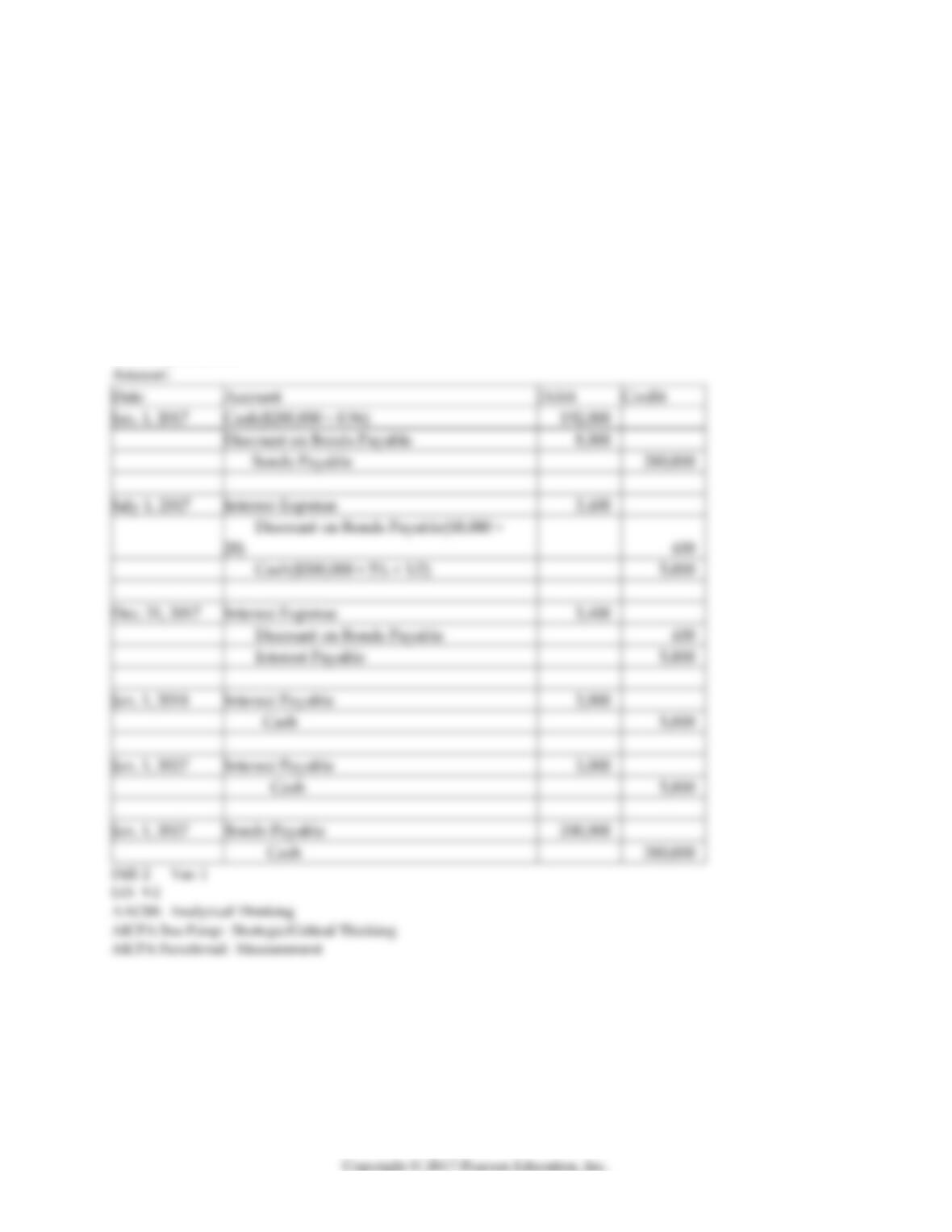
54) Darla’s Cookie Emporium borrowed money by issuing $200,000 of bonds at 96 on January 1, 2017.
The bonds pay interest on January 1 and July 1. The stated rate of interest is 5% and the bonds mature in
10 years. Any discount or premium is amortized using the straight-line method.
Required:
Prepare journal entries on the following dates:
1. January 1, 2017
2. July 1, 2017
3. December 31, 2017, the fiscal year end
4. January 1, 2018
5. January 1, 2027
Omit explanations.
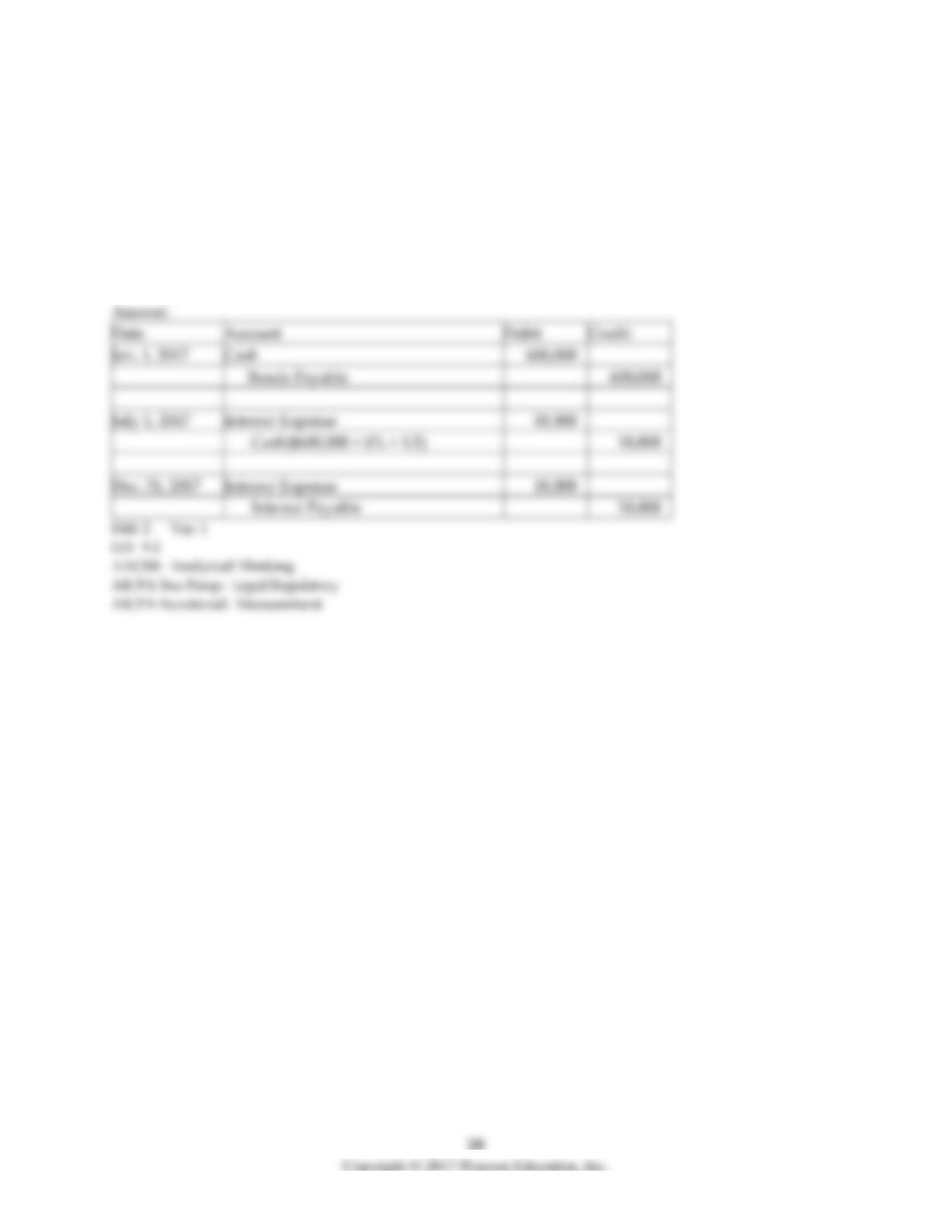
55) On January 1, 2017, Paulsen Company issued $600,000, 6%, 5-year bonds at face value. Interest is
payable semiannually on July 1 and January 1.
Required:
Prepare journal entries on:
1. January 1, 2017
2. July 1, 2017
3. December 31, 2017, the fiscal year end
Omit explanations.
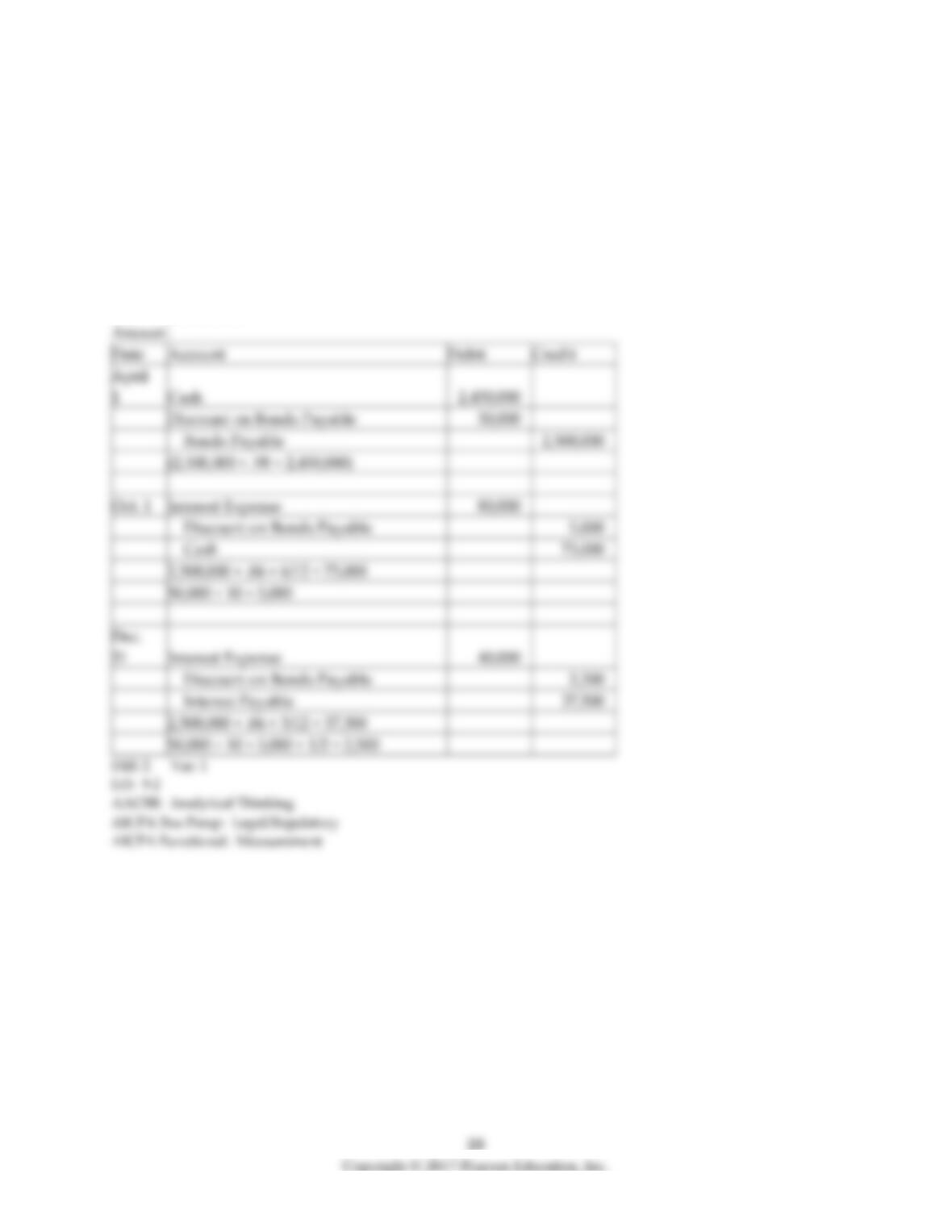
56) On April 1, 2018, Eiche Company issues $2,500,000 of 6%, 5-year bonds, with interest payments
made each October 1 and April 1. The bonds are issued at 98. Eiche Company amortizes any premium
or discount using the straight-line method.
Required:
Prepare journal entries on the following dates:
1. April 1, 2018.
2. October 1, 2018.
3. December 31, 2018, the fiscal year end.
Omit explanations.
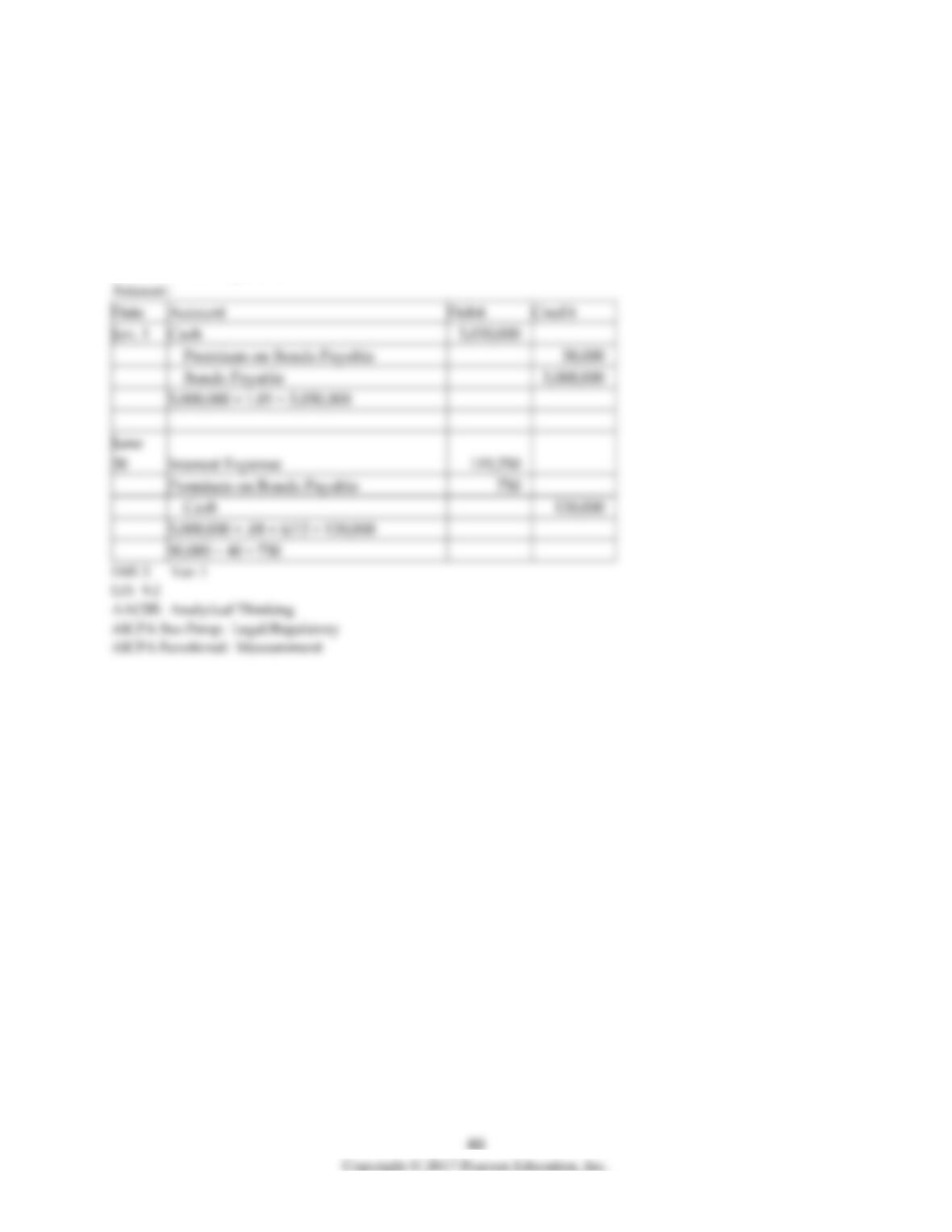
57) On January 1, 2017, Las Vegas Company issued 8%, 20-year bonds with a face amount of $3,000,000
at 101. Interest is payable semiannually on June 30 and December 31. Las Vegas Company uses the
straight-line method to amortize bond premium or discount. The company’s fiscal year ends December
31.
Required:
Prepare the journal entries to record the issuance of the bonds and the first semiannual interest
payment. Omit explanations.