54) Which of the following measures is used by traditional costing systems as an allocation base
for allocating overhead costs to the units produced?
A) Volume-related activities.
B) Batch-related activities.
C) Product-related activities.
D) Facility-related activities.
55) Which of the following measures is not used by activity-based costing (ABC) systems as an
allocation base for allocating overhead costs to the units produced?
A) Volume-related activities.
B) Batch-related activities.
C) Product-related activities.
D) Need-related activities.
56) What is the typical effect on the numbers of cost pools and cost assignment bases when an
activity-based costing (ABC) system replaces a traditional costing system? (CPA adapted)
Cost Pools Cost Assignment Bases
A. No effect No effect
B. Increase No effect
C. No effect Increase
D. Increase Increase
A) Option A
B) Option B
C) Option C
D) Option D
57) Plant administration is an example of a:
A) Volume-related activity.
B) Batch-related activity.
C) Product-related activity.
D) Facility-related activity.
58) Which of the following activities would be classified as a batch-level activity?
A) Setting up equipment.
B) Designing a new product.
C) Training employees.
D) Milling a part required for the final product.
59) Would the following activities at a manufacturer of canned soup be best classified as
volume-related, batch-related, or product-related activities?
Researching new recipes Shipping orders to grocery stores
A. Volume Volume
B. Batch Batch
C. Product Volume
D. Product Batch
A) Option A
B) Option B
C) Option C
D) Option D
60) Plant property taxes are an example of a cost that would be considered to be:
A) Volume-related.
B) Batch-related.
C) Product-related.
D) Facility-related.
61) Product costs are computed by:
A) Dividing the cost driver rate by the number of units of the cost driver in each product.
B) Multiplying the cost driver rate by the number of units of the cost driver in each product.
C) Adding the cost driver rates of all products.
D) Averaging the plantwide cost driver rate with the cost driver for each product.
62) Which of the following is not a step involved in activity-based costing?
A) Identify the activities that consume resources and assign costs to those activities.
B) Determine how to reduce the costs of making products by cutting activities.
C) Assign costs to products by multiplying the cost driver rate by the volume of cost driver units
consumed by the product.
D) Compute a cost rate per cost driver unit or transaction.
63) Which of the following statements is true?
A) Activity-based costs per unit are always greater than volume-based costs per unit.
B) Volume-based costing has typically resulted in lower gross margins for high-volume products
and higher gross margins for low-volume products.
C) Different cost allocation methods are constructed so that they typically result in the same or
similar estimates of how much it costs to make a product.
D) Activity-based costing typically provides less information about product costs while requiring
more recordkeeping.
27
64) Volume-based costing allocates indirect product costs based on the volume of output, using
such allocation bases as direct labor hours, machine hours, or the amount of direct material used
in the production process. Activity-based costing (ABC) has consistently shown that volume-
based costing ________ the cost of high-volume products and ________ the cost of low-volume
products.
High-Volume Products Low-Volume Products
A. Overstates Overstates
B. Overstates Understates
C. Understates Overstates
D. Understates Understates
A) Option A
B) Option B
C) Option C
D) Option D
65) Companies using activity-based costing (ABC) have learned that costs are a function of:
A) Volume and activities.
B) Time and complexity.
C) Volume and time.
D) Resources and time.
66) Activity-based costing provides:
A) More detailed measures of costs than do plantwide or department allocation methods.
B) Less detailed measures of costs than do plantwide or department allocation methods.
C) More detailed measures of costs than do plantwide allocations but less than department
allocation methods.
D) Less detailed measures of costs than do plantwide allocations but more than department
allocation methods.
67) Which one of the following accounts is not used in an activity-based costing (ABC) system?
A) Materials Inventory.
B) Work-in-Process Inventory.
C) Finished Goods Inventory.
D) Allocations Incurred.
68) Which of the following would be a reasonable basis for assigning the materials handling
costs to the units produced in an activity-based costing (ABC) system?
A) Number of production runs per year.
B) Number of components per completed unit.
C) Amount of time required to produce one unit.
D) Amount of overhead applied to each completed unit.
69) Which of the following statements is true regarding activity-based costing in administration?
A) The principles of ABC are different when applied to administrative services.
B) ABC in administration involves five steps.
C) All cost drivers in an administrative system will be time-related.
D) Activity-based costing for administrative services follows the same four-step procedure
described for manufacturing.
70) Which of the following would be the most appropriate activity and cost drivers pairing for a
Purchasing Department?
A) Activity: Placing orders – Possible Cost Driver: Number of orders.
B) Activity: Placing orders – Possible Cost Driver: Number of new hires.
C) Activity: Placing orders – Possible Cost Driver: Frequency of audits.
D) Activity: Placing orders – Possible Cost Driver: Employee turnover rate.
71) Which of the following statements is true regarding time-driven activity-based costs?
A) A manager needs to determine the cost of resources for each individual item produced.
B) This approach requires interviews and surveys from multiple managers and employees.
C) It is more costly than the unmodified ABC system.
D) It uses the cost of the resources supplied to a department and the time it takes to complete the
various activities of the department.
72) Which of the following statements is true regarding time equations used in time-driven
activity-based costing?
A) Time equations cannot adjust extra time for new vendors.
B) Time equations allow managers to adjust the times for orders with different characteristics.
C) Time equations cannot be used where there is a maximum size of an order that can be
inspected or transported to the warehouse.
D) Time equations are only used as part of unmodified ABC systems.
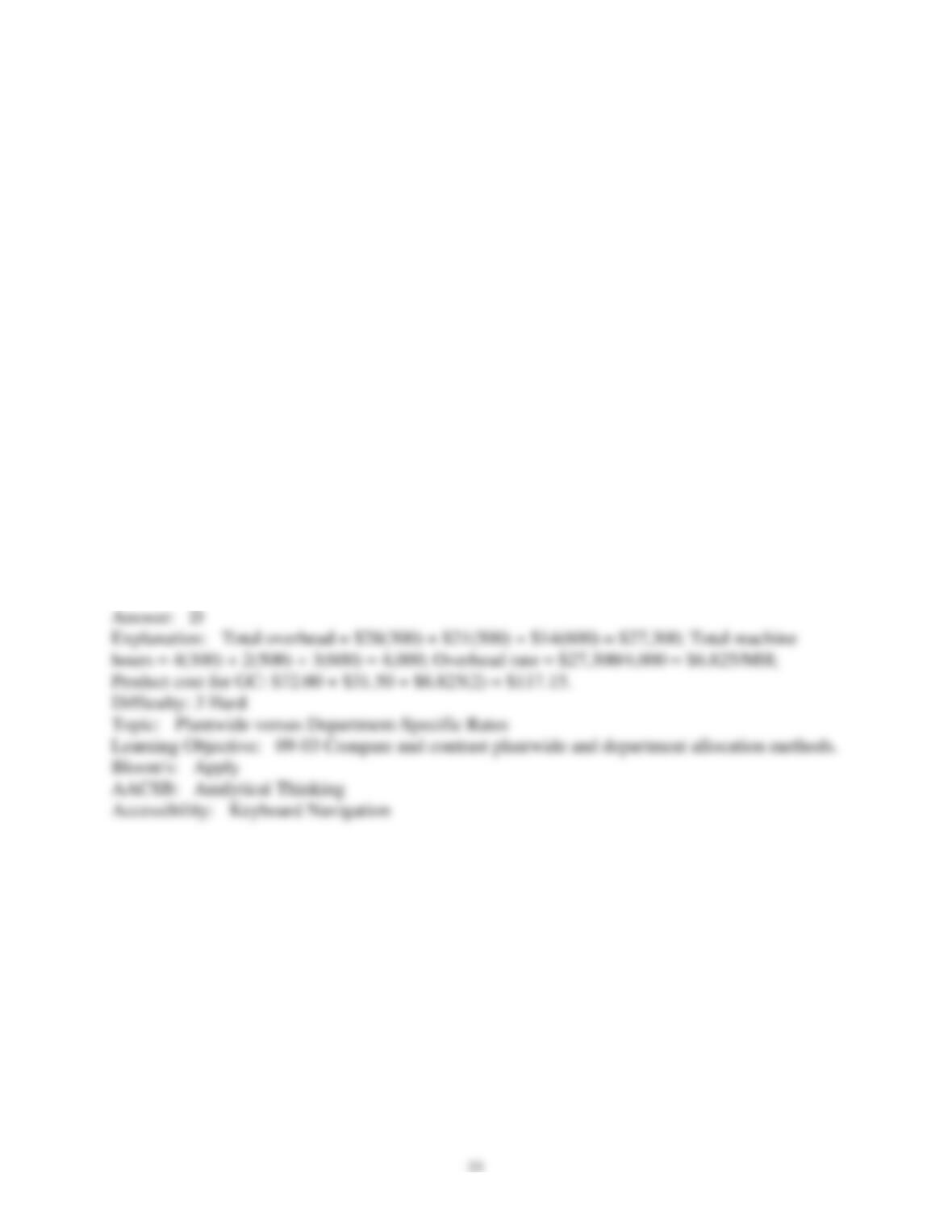
73) Flawless Cosmetic Company manufactures and distributes several different products. The
company currently uses a plantwide allocation method for allocating overhead at a rate of $7 per
direct labor hour. Loren is the department manager of the Makeup Department that produces
Products – Concealer (C) and Glow Cream (GC). Jennifer is the department manager of the Hair
Care Department that manufactures Product – Shampoo (S). The product costs (per case of 24
bottles) and other information are as follows:
Products
C GC S
Direct materials $ 100.00 $ 72.00 $ 48.00
Direct labor 42.00 31.50 12.00
Overhead 28.00 21.00 14.00
$ 170.00 $ 124.50 $ 74.00
Machine hours 4 2 3
Number of cases (per year) 300 500 600
Based on this information, if Flawless changes its allocation basis to machine hours, what is the
overhead rate per machine hour?
A) $3.00
B) $2.00
C) $21.00
D) $6.825
74) Flawless Cosmetic Company manufactures and distributes several different products. The
company currently uses a plantwide allocation method for allocating overhead at a rate of $7 per
direct labor hour. Loren is the department manager of the Makeup Department that produces
Products – Concealer (C) and Glow Cream (GC). Jennifer is the department manager of the Hair
Care Department that manufactures Product – Shampoo (S). The product costs (per case of 24
bottles) and other information are as follows:
Products
C GC S
Direct materials $ 100.00 $ 72.00 $ 48.00
Direct labor 42.00 31.50 12.00
Overhead 28.00 21.00 14.00
$ 170.00 $ 124.50 $ 74.00
Machine hours 4 2 3
Number of cases (per year) 300 500 600
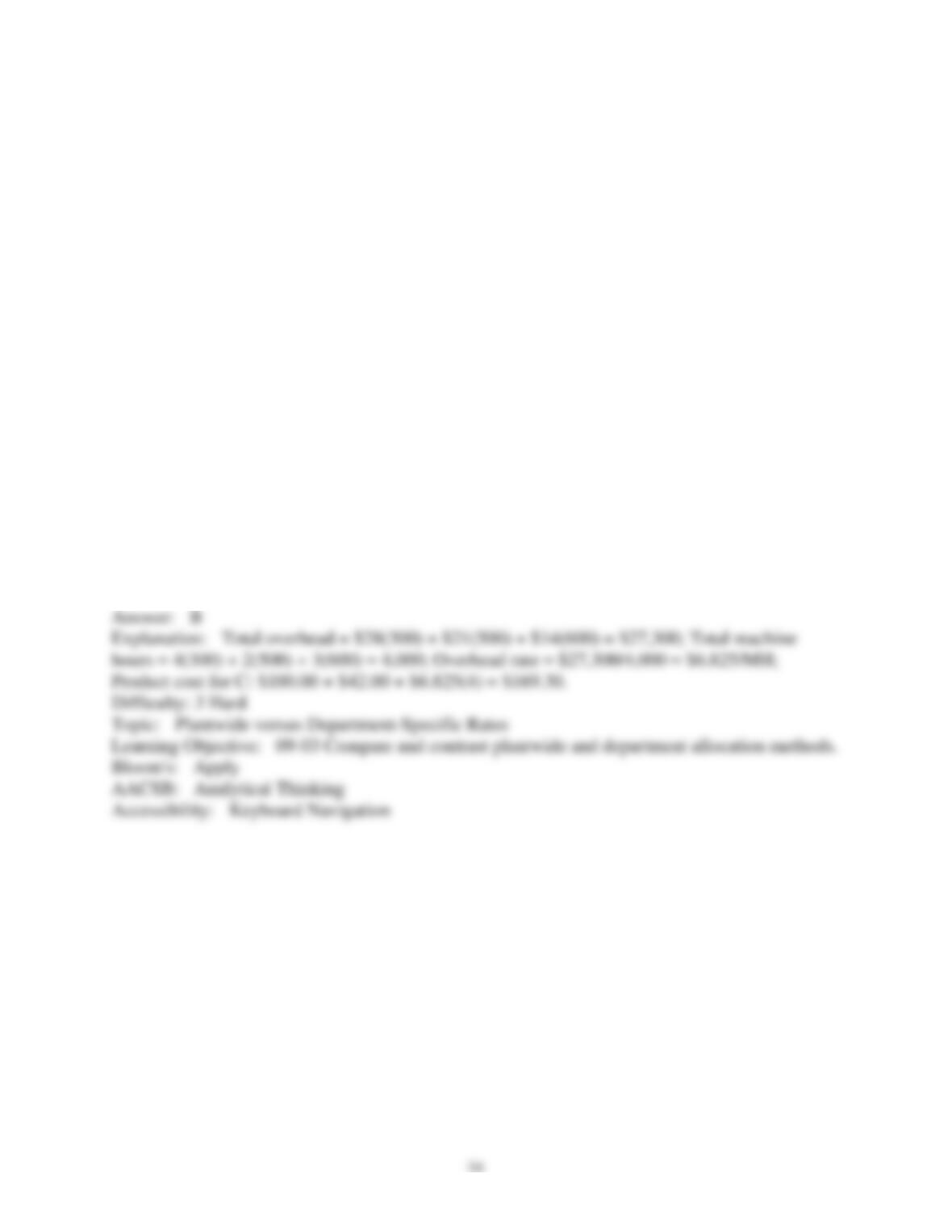
If Flawless changes its allocation basis to machine hours, what is the total product cost per case
for Product GC?
A) $163.50
B) $144.00
C) $138.15
D) $117.15
75) Flawless Cosmetic Company manufactures and distributes several different products. The
company currently uses a plantwide allocation method for allocating overhead at a rate of $7 per
direct labor hour. Loren is the department manager of the Makeup Department that produces
Products – Concealer (C) and Glow Cream (GC). Jennifer is the department manager of the Hair
Care Department that manufactures Product – Shampoo (S). The product costs (per case of 24
bottles) and other information are as follows:
Products
C GC S
Direct materials $ 100.00 $ 72.00 $ 48.00
Direct labor 42.00 31.50 12.00
Overhead 28.00 21.00 14.00
$ 170.00 $ 124.50 $ 74.00
Machine hours 4 2 3
Number of cases (per year) 300 500 600
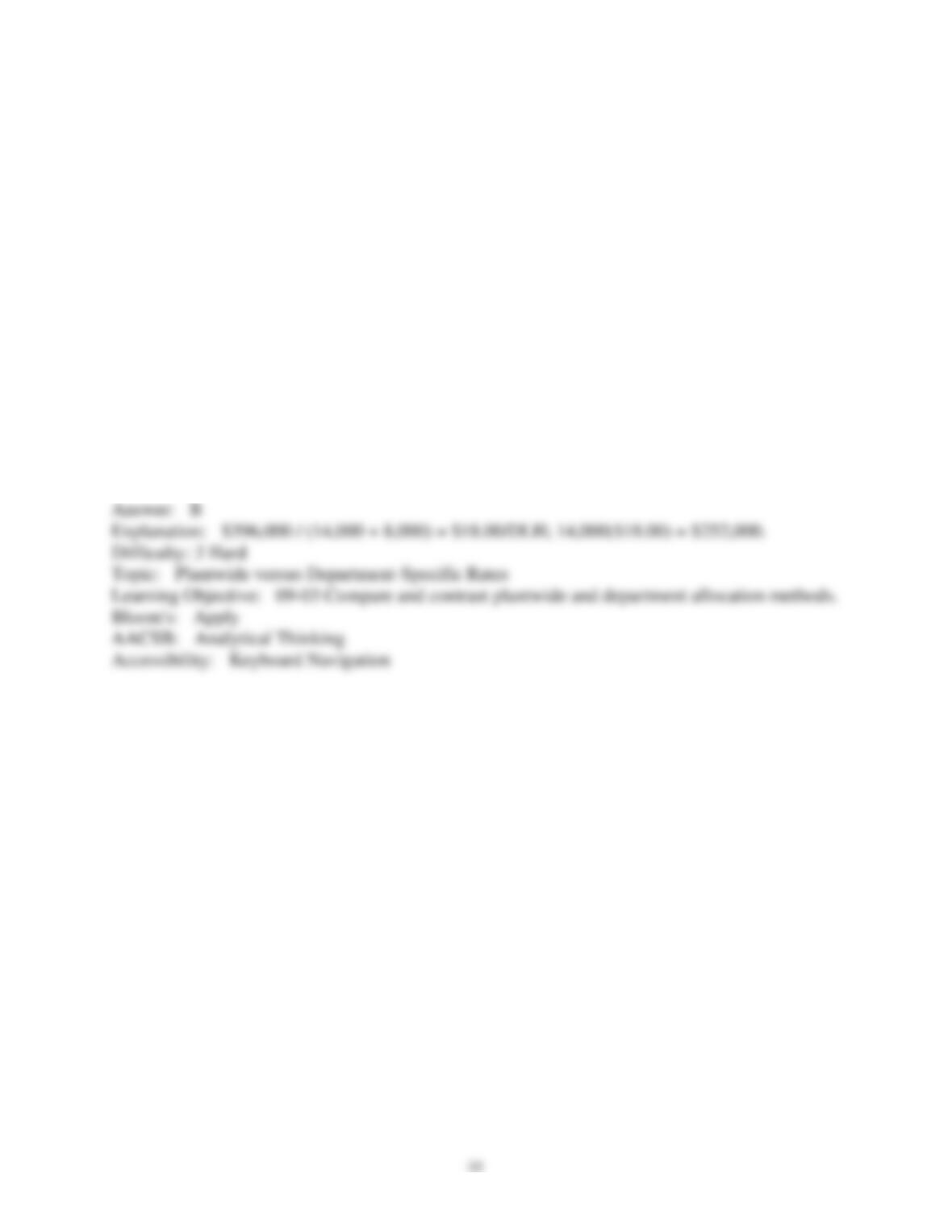
If Flawless changes its allocation basis to machine hours, what is the total product cost per case
for Product C?
A) $161.50.
B) $169.30.
C) $182.44.
D) $183.36.
76) Banc Corp. Trust is considering either a bankwide overhead rate or department overhead
rates to allocate $396,000 of indirect costs. The bankwide rate could be based on either direct
labor hours (DLH) or the number of loans processed. The departmental rates would be based on
direct labor hours for Consumer Loans and a dual rate based on direct labor hours and the
number of loans processed for Commercial Loans. The following information was gathered for
the upcoming period:
Department DLH Loans Processed Direct Costs
Consumer 14,000 700 $ 280,000
Commercial 8,000 300 $ 180,000
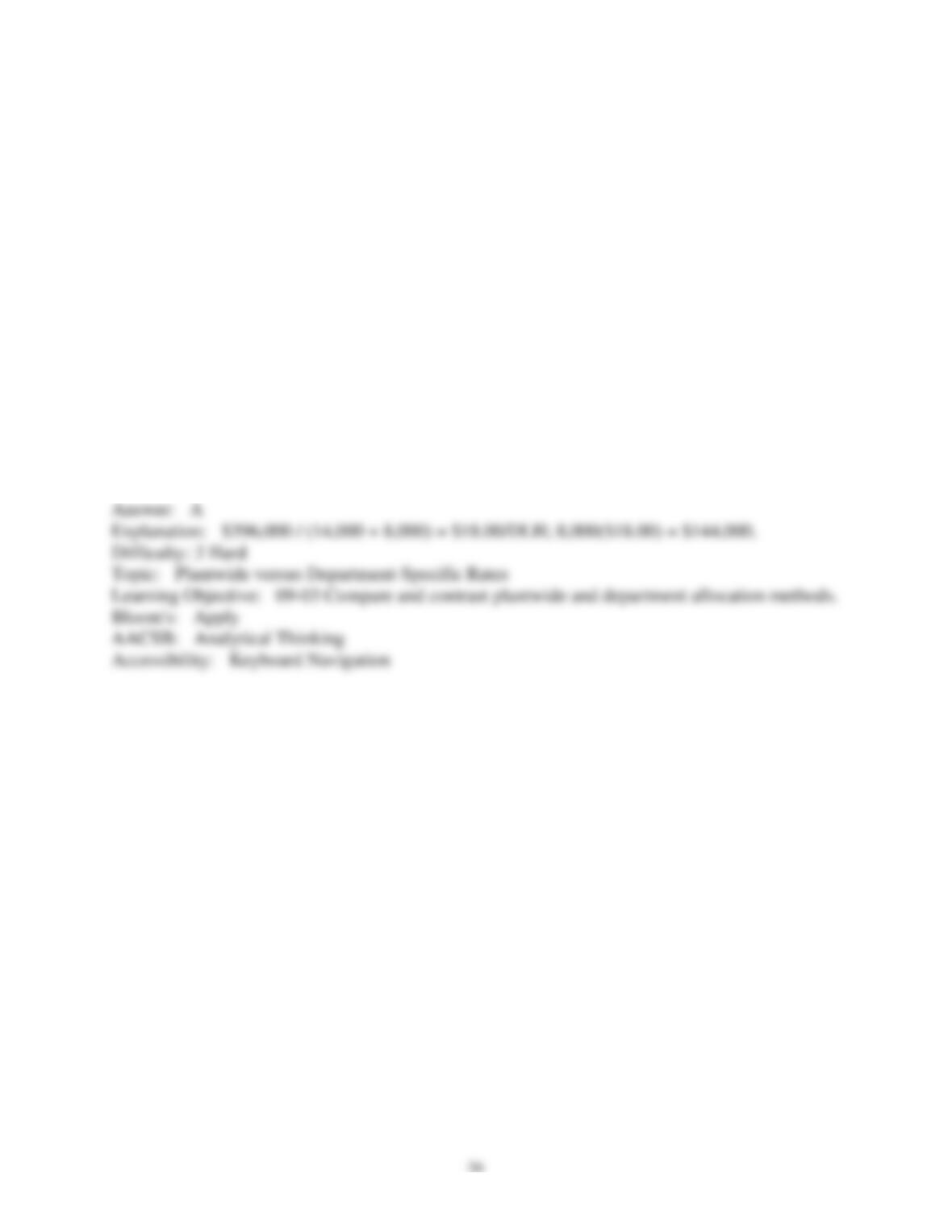
If Banc Corp. Trust uses a bankwide rate based on direct labor hours, what would be the indirect
costs allocated to the Consumer Department?
A) $49,000.
B) $252,000.
C) $198,000.
D) $396,000.
77) Banc Corp. Trust is considering either a bankwide overhead rate or department overhead
rates to allocate $396,000 of indirect costs. The bankwide rate could be based on either direct
labor hours (DLH) or the number of loans processed. The departmental rates would be based on
direct labor hours for Consumer Loans and a dual rate based on direct labor hours and the
number of loans processed for Commercial Loans. The following information was gathered for
the upcoming period:
Department DLH Loans Processed Direct Costs
Consumer 14,000 700 $ 280,000
Commercial 8,000 300 $ 180,000
If Banc Corp. Trust uses a bankwide rate based on direct labor hours, what would be the indirect
costs allocated to the Commercial Department?
A) $144,000.
B) $138,000.
C) $180,000.
D) $148,500.
78) Banc Corp. Trust is considering either a bankwide overhead rate or department overhead
rates to allocate $396,000 of indirect costs. The bankwide rate could be based on either direct
labor hours (DLH) or the number of loans processed. The departmental rates would be based on
direct labor hours for Consumer Loans and a dual rate based on direct labor hours and the
number of loans processed for Commercial Loans. The following information was gathered for
the upcoming period:
Department DLH Loans Processed Direct Costs
Consumer 14,000 700 $ 280,000
Commercial 8,000 300 $ 180,000
If Banc Corp. Trust uses a bankwide rate based on the number of loans processed, what would be
the total costs for the Commercial Department?
A) $118,800.
B) $180,000.
C) $298,800.
D) $318,000.
79) Banc Corp. Trust is considering either a bankwide overhead rate or department overhead
rates to allocate $396,000 of indirect costs. The bankwide rate could be based on either direct
labor hours (DLH) or the number of loans processed. The departmental rates would be based on
direct labor hours for Consumer Loans and a dual rate based on direct labor hours and the
number of loans processed for Commercial Loans. The following information was gathered for
the upcoming period:
Department DLH Loans Processed Direct Costs
Consumer 14,000 700 $ 280,000
Commercial 8,000 300 $ 180,000
If Banc Corp. Trust uses a bankwide rate based on the number of loans processed, what would be
the total costs for the Consumer Department?
A) $280,000.
B) $256,800.
C) $576,000.
D) $557,200.
80) Banc Corp. Trust is considering either a bankwide overhead rate or department overhead
rates to allocate $396,000 of indirect costs. The bankwide rate could be based on either direct
labor hours (DLH) or the number of loans processed. The departmental rates would be based on
direct labor hours for Consumer Loans and a dual rate based on direct labor hours and the
number of loans processed for Commercial Loans. The following information was gathered for
the upcoming period:
Department DLH Loans Processed Direct Costs
Consumer 14,000 700 $ 280,000
Commercial 8,000 300 $ 180,000
Banc Corp. Trust estimates that it costs $500 to analyze and close a commercial loan. This
amount has been included in the $396,000 of indirect costs. How much of the $396,000 indirect
costs should be allocated to the Commercial Department, if Banc Corp. Trust uses a bankwide
rate based on the number of loans processed?
A) $396,000.
B) $246,000.
C) $223,800.
D) $216,000.
81) Banc Corp. Trust is considering either a bankwide overhead rate or department overhead
rates to allocate $396,000 of indirect costs. The bankwide rate could be based on either direct
labor hours (DLH) or the number of loans processed. The departmental rates would be based on
direct labor hours for Consumer Loans and a dual rate based on direct labor hours and the
number of loans processed for Commercial Loans. The following information was gathered for
the upcoming period:
Department DLH Loans Processed Direct Costs
Consumer 14,000 700 $ 280,000
Commercial 8,000 300 $ 180,000
Banc Corp. Trust estimates that it costs $500 to analyze and close a commercial loan. This
amount has been included in the $396,000 of indirect costs. How much of the $396,000 indirect
costs should be allocated to the Commercial Department, if Banc Corp. Trust uses a bankwide
rate based on the number of loans processed?
A) $246,000.
B) $280,000.
C) $172,200.
D) $116,000.