
Chapter 9 – Financial Planning and Analysis: The Master Budget
9-1
Chapter 9
Financial Planning and Analysis: The Master Budget
Answer Key
True / False Questions
1. A complete financial planning and analysis (FP&A) system includes subsystems for
(1) planning, (2) measuring and recording results, and (3) evaluating performance.
2. The planning component of the FP&A system is called the sales budget.
3. The budgeting technique that helps managers assess the company’s future and know if they
are reaching their performance goals is called life-cycle budgeting.

Chapter 9 – Financial Planning and Analysis: The Master Budget
9-2
4. The comprehensive set of budgets that serves as a company’s overall financial plan is
commonly known as the financial budget.
5. A company’s sales forecast would likely not consider general economic and industry
trends.
6. Companies develop a set of operating budgets to project cash flow and likely cash
shortfalls and/or surpluses.

Chapter 9 – Financial Planning and Analysis: The Master Budget
9-3
7. A budgeted income statement, a budgeted balance sheet, and a budgeted statement of cash
flows are the end result of the master budgeting process.
8. A three-stage allocation process is used in activity-based costing systems.
9. Activity-based budgeting (ABB) takes the Activity-based costing model (ABC) and
reverses the flow of the analysis.

Chapter 9 – Financial Planning and Analysis: The Master Budget
9-4
10. Sainte Claire Corporation has a highly automated production facility. Production volume
and management judgment are the two factors that would likely have the most direct
influence on the company’s manufacturing overhead budget.
11. The first step in developing a master budget is always the creation of a cash budget.
12. All conversion costs are included in the direct-labor budget.

Chapter 9 – Financial Planning and Analysis: The Master Budget
9-5
13. A difference in timing between units sold and units produced can result from logistical
lags.
14. Managers typically avoid making assumptions that will be part of the year’s financial
plan.
15. The risk of being wrong about predictions can sometimes be mitigated by managers’
actions.

Chapter 9 – Financial Planning and Analysis: The Master Budget
9-6
16. A disadvantage of a provider hosted approach through the cloud is that the company’s
proprietary financial data resides outside of the company’s walls.
17. Translation of foreign currencies is a challenge faced by the budgeting process in firms
with international operations.
18. Budgetary slack often is used to cope with uncertainty.

Chapter 9 – Financial Planning and Analysis: The Master Budget
9-7
19. That employees make little effort to achieve budgetary goals is an outcome sometimes
associated with participative budgeting.
20. Implementation of participative budgeting prevents budget padding.
Chapter 9 – Financial Planning and Analysis: The Master Budget
9-8
Multiple Choice Questions
21. Generally speaking, budgets are not used to:
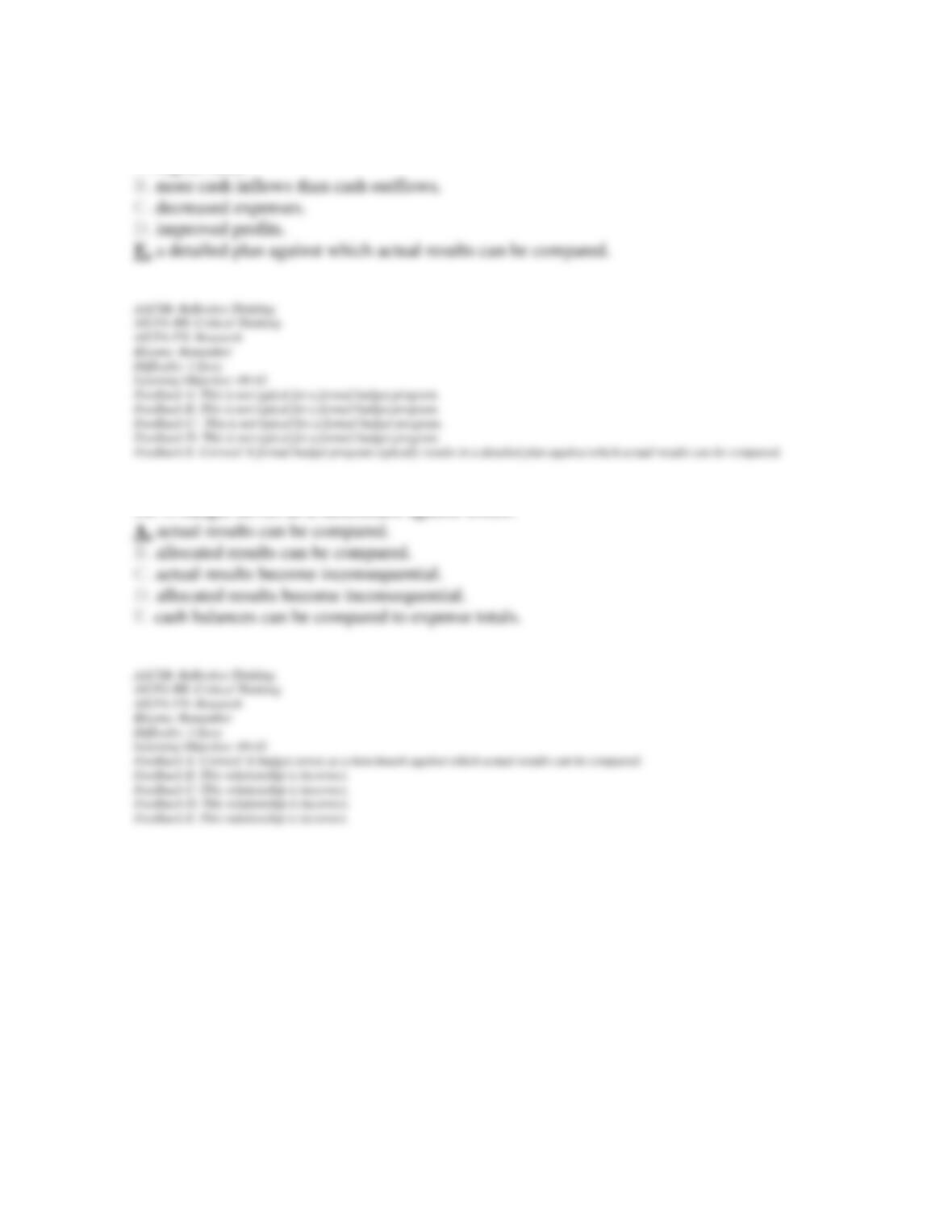
22. Which of the following choices correctly denotes managerial functions that are commonly
associated with budgeting?
Chapter 9 – Financial Planning and Analysis: The Master Budget
9-9
23. A formal budget program will almost always result in:
A. higher sales.
24. A budget serves as a benchmark against which:

Chapter 9 – Financial Planning and Analysis: The Master Budget
9-10
25. The comprehensive set of budgets that serves as a company’s overall financial plan is
commonly known as:
26. A company’s plan for the acquisition of long-lived assets, such as buildings and
equipment, is commonly called a:
A. pro-forma budget.

Chapter 9 – Financial Planning and Analysis: The Master Budget
9-11
27. A company’s plan for the issuance of stock or incurrence of debt is commonly called a:
28. A company’s expected receipts from sales and planned disbursements to pay bills is
commonly called a:
A. pro-forma budget.

Chapter 9 – Financial Planning and Analysis: The Master Budget
9-12
29. Salizar Corporation is budgeting its equipment needs on an on-going basis, with a new
quarter being added to the budget as the current quarter is completed. This type of budget is
most commonly known as a:
A. capital budget.
30. An organization’s budgets will often be prepared to cover:
A. one month.

Chapter 9 – Financial Planning and Analysis: The Master Budget
9-13
31. A manufacturing firm would begin preparation of its master budget by constructing a:
32. Which of the following budgets is based on many other master-budget components?
Chapter 9 – Financial Planning and Analysis: The Master Budget
9-14
33. The budgeted income statement, budgeted balance sheet, and budgeted statement of cash
flows comprise:
34. Which of the following budgets is prepared at the end of the budget-construction cycle?

Chapter 9 – Financial Planning and Analysis: The Master Budget
9-15
35. Which of the following would depict the logical order for preparing (1) a production
budget, (2) a cash budget, (3) a sales budget, and (4) a direct-labor budget?
Chapter 9 – Financial Planning and Analysis: The Master Budget
9-16
36. The master budget contains the following components, among others: (1) direct-material
budget, (2) budgeted balance sheet, (3) production budget, and (4) cash budget. Which of
these components would be prepared first and which would be prepared last?
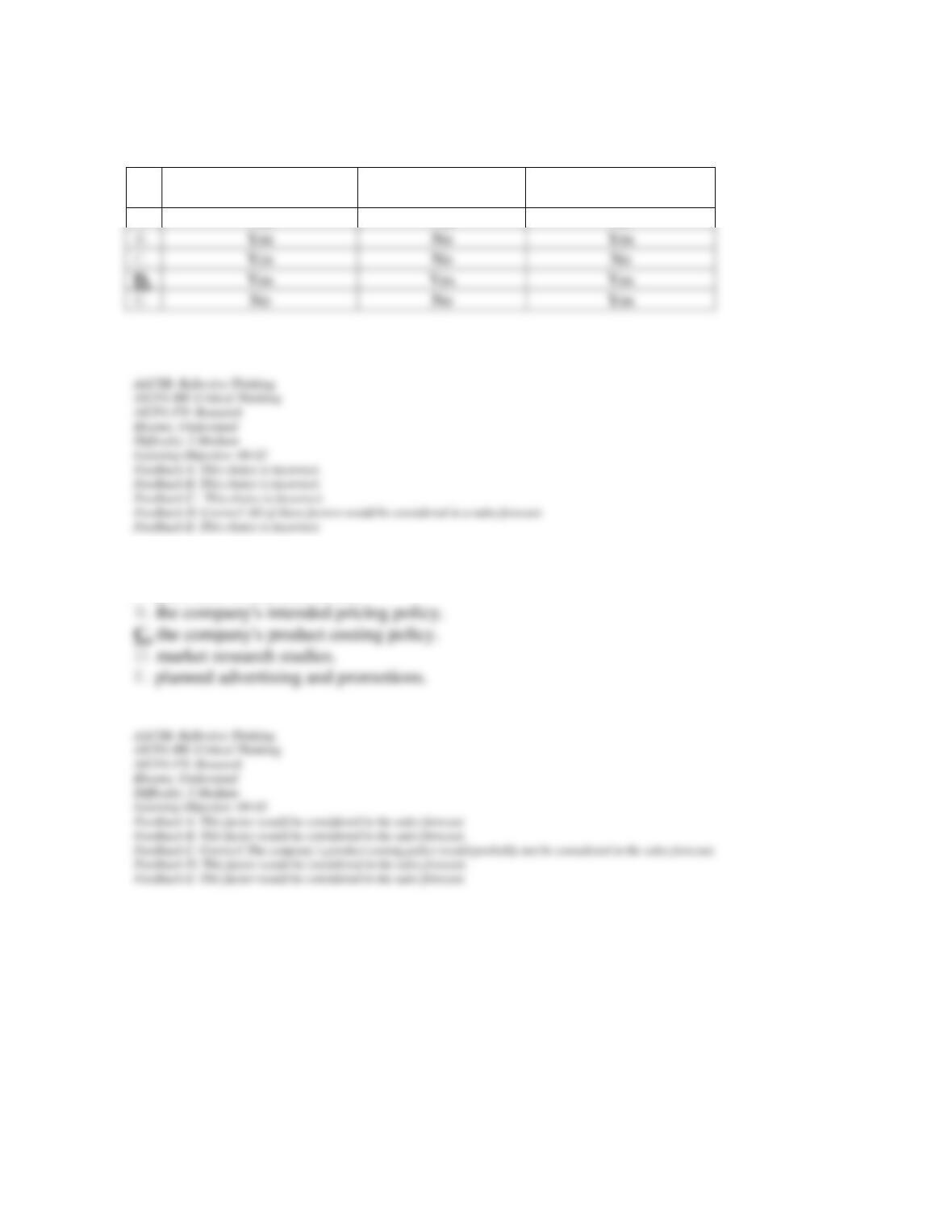
37. A company’s sales forecast would likely consider all of the following factors except:
A. political and legal events.
Chapter 9 – Financial Planning and Analysis: The Master Budget
9-17
38. Which of the following would be considered when preparing a company’s sales forecast?
Anticipated Advertising
Campaigns
General Economic
Trends
Expected Competitive
Actions
A.
Yes
Yes
No
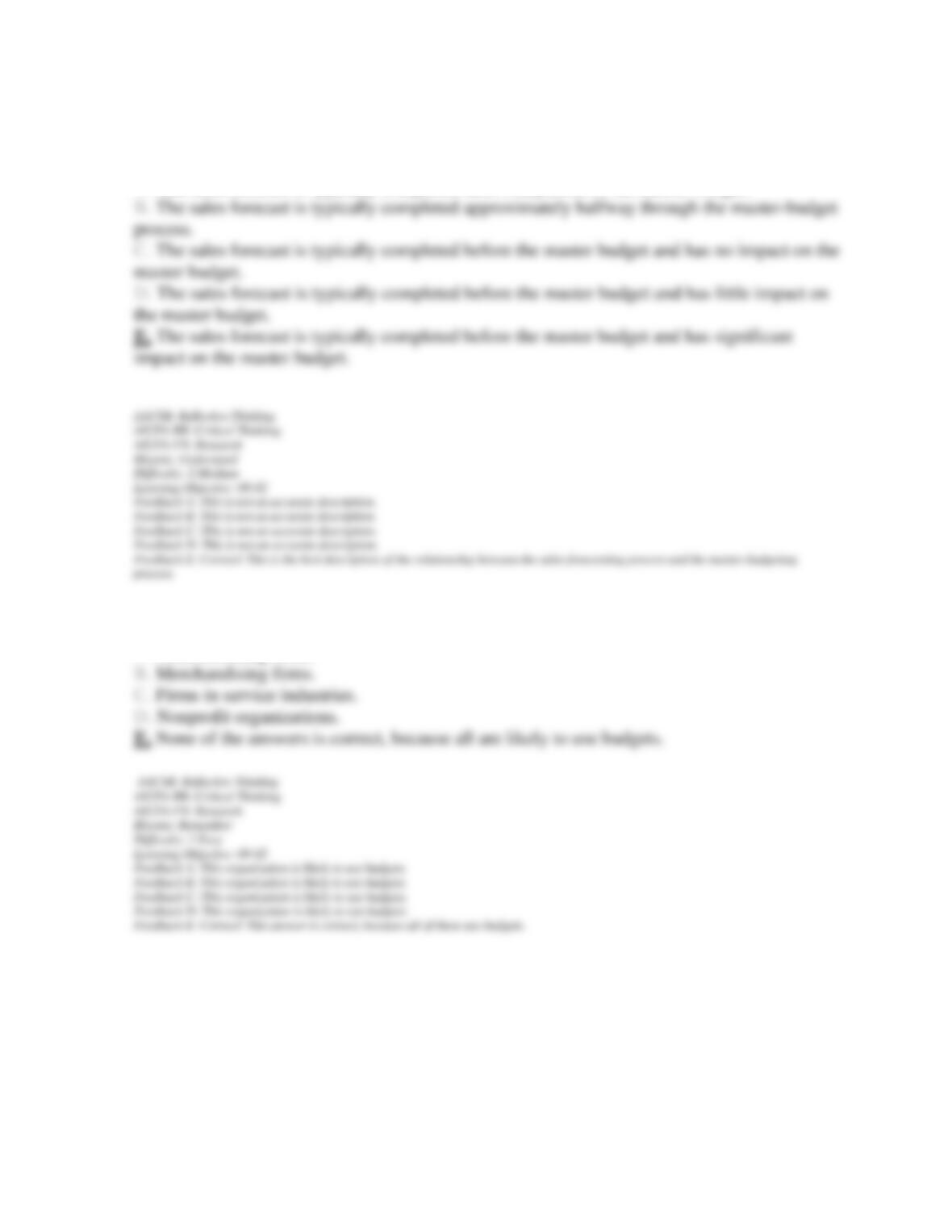
39. A company’s sales forecast would likely consider all of the following factors except:
A. past sales levels and trends.
Yes
No
Chapter 9 – Financial Planning and Analysis: The Master Budget
9-18
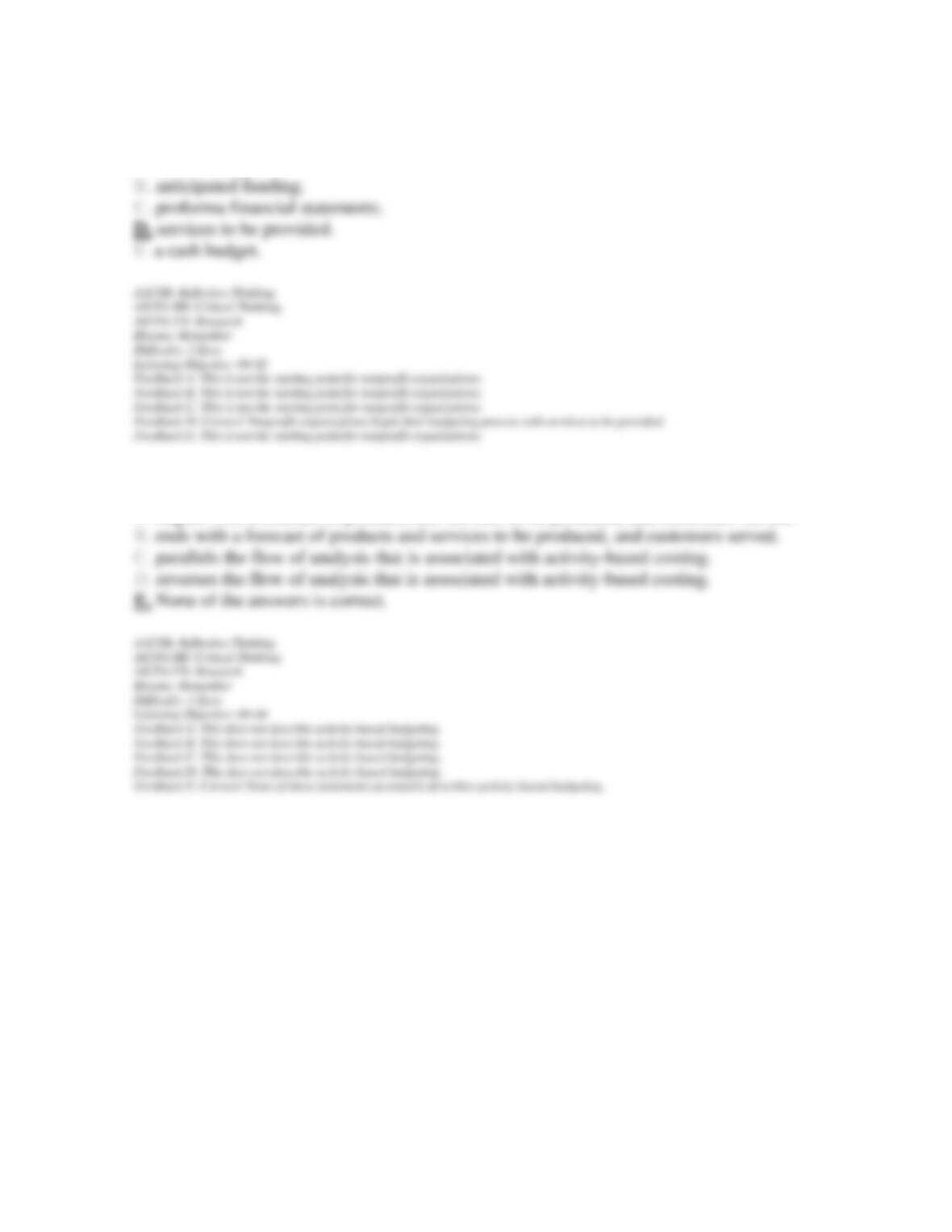
40. Which of the following statements best describes the relationship between the sales–
forecasting process and the master-budgeting process?
A. The sales forecast is typically completed after completion of the master budget.
41. Which of the following organizations is not likely to use budgets?
A. Manufacturing firms.
Chapter 9 – Financial Planning and Analysis: The Master Budget
9-19
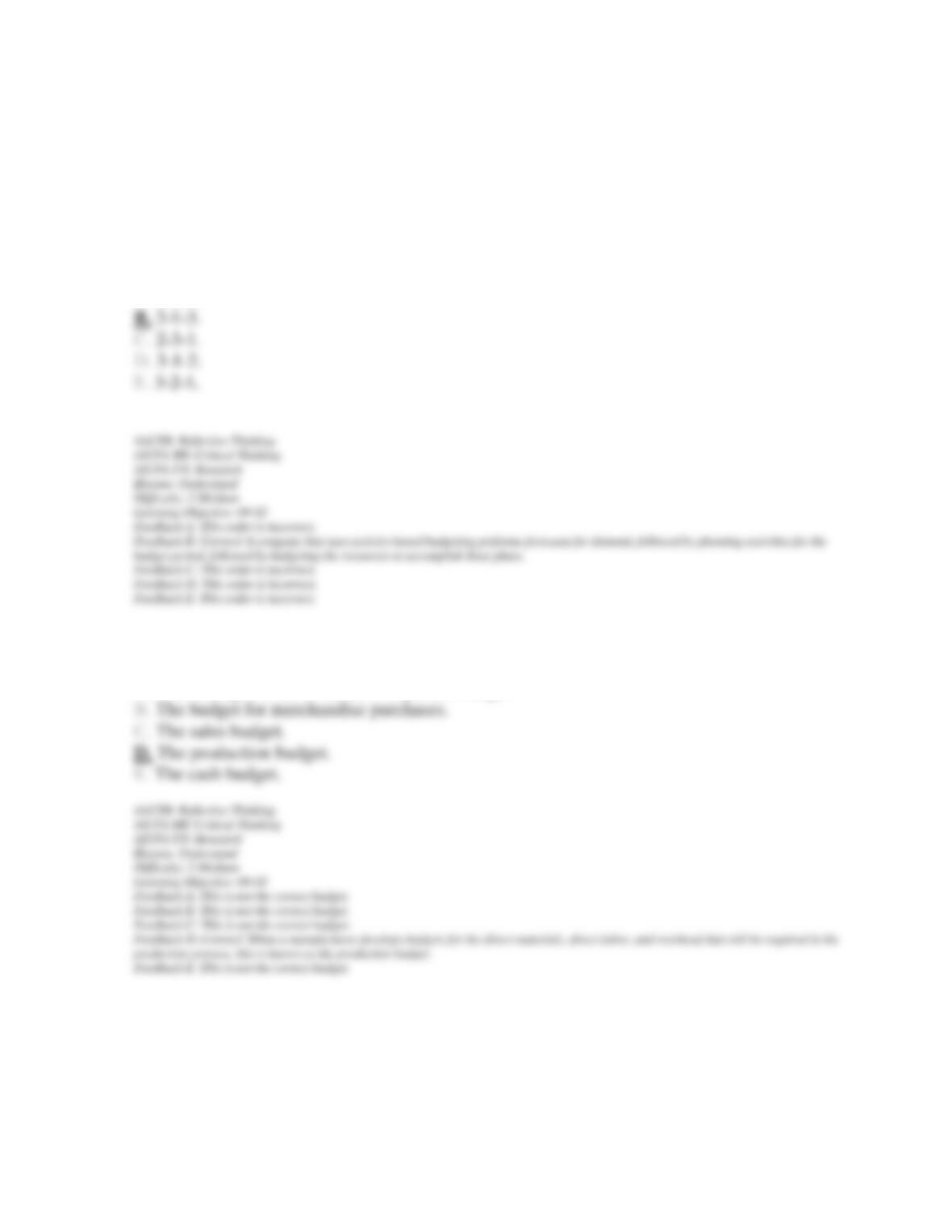
42. Nonprofit organizations begin their budgeting process with:
A. a sales budget.
43. Activity-based budgeting:
A. begins with a forecast of products and services to be produced, and customers served.
Chapter 9 – Financial Planning and Analysis: The Master Budget
9-20
44. A company that uses activity-based budgeting performs the following:
1—Plans activities for the budget period.
2—Forecasts the demand for products and services as well as the customers to be served.
3—Budgets the resources necessary to carry out activities.
Which of the following denotes the proper order of the preceding activities?
A. 1-2-3.
45. A manufacturer develops budgets for the direct materials, direct labor, and overhead that
will be required in the production process from which of the following?
A. The selling and administrative expenses budget.