1. Which of the following is not a primary source of corporate debt financing?
2. The mixture of liabilities and stockholders’ equity a business uses is called its:
3. Which of the following is not a true statement?
4. Samson Enterprises issued a ten-year, $20 million bond with a 10% interest rate for
$19,500,000. The entry to record the bond issuance would have what effect on the financial
statements?
5. Megginson, Inc. issued a five-year corporate bond of $300,000 with a 5% interest rate for
$330,000. What effect would the bond issuance have on Megginson, Inc.’s accounting
equation?
6. The advantages of obtaining long-term funds by issuing bonds, rather than issuing
additional common stock, include which of the following?
7. The advantages of obtaining long-term funds by issuing bonds, rather than issuing
additional common stock, include which of the following?
8. Which of the following definitions describes a term bond?
9. Which of the following definitions describes a serial bond?
10. Which of the following definitions describes a secured bond?
11. Term bonds are:
12. Serial bonds are:
13. Bonds can be secured or unsecured. Likewise, bonds can be term or serial bonds. Which is
more common?
14. A home loan with fixed monthly payments and the house as collateral most closely
represents which of the following bond characteristics?
15. Which of the following is not true regarding callable bonds?
16. Convertible bonds:
17. The price of a bond is equal to:
18. A bond issue with a face amount of $500,000 bears interest at the rate of 10%. The current
market rate of interest is also 10%. These bonds will sell at a price that is:
19. A bond issue with a face amount of $500,000 bears interest at the rate of 7%. The current
market rate of interest is 8%. These bonds will sell at a price that is:
20. A bond issue with a face amount of $500,000 bears interest at the rate of 7%. The current
market rate of interest is 6%. These bonds will sell at a price that is:
21. Ordinarily, the proceeds from the sale of a bond issue will be equal to:
22. Bonds usually sell at their:
23. A $500,000 bond issue sold for $510,000. Therefore, the bonds:
24. A $500,000 bond issue sold for $490,000. Therefore, the bonds:
25. For a bond issue that sells for more than the bond face amount, the stated interest rate is:
26. For a bond issue that sells for less than the bond face amount, the stated interest rate is:
27. Bond X and Bond Y are both issued by the same company. Each of the bonds has a face
value of $100,000 and each matures in 10 years. Bond X pays 8% interest while Bond Y pays
7% interest. The current market rate of interest is 7%. Which of the following is correct?
28. Bond X and Bond Y are both issued by the same company. Each of the bonds has a face
value of $100,000 and each matures in 10 years. Bond X pays 8% interest while Bond Y pays
9% interest. The current market rate of interest is 8%. Which of the following is correct?
29. Raiders Company issues a bond with a stated interest rate of 10%, face value of $50,000,
and due in 5 years. Interest payments are made semi-annually. The market rate for this type of
bond is 12%. What is the issue price of the bond?
30. Raiders Company issues a bond with a stated interest rate of 10%, face value of $50,000,
and due in 5 years. Interest payments are made semi-annually. The market rate for this type of
bond is 8%. What is the issue price of the bond?
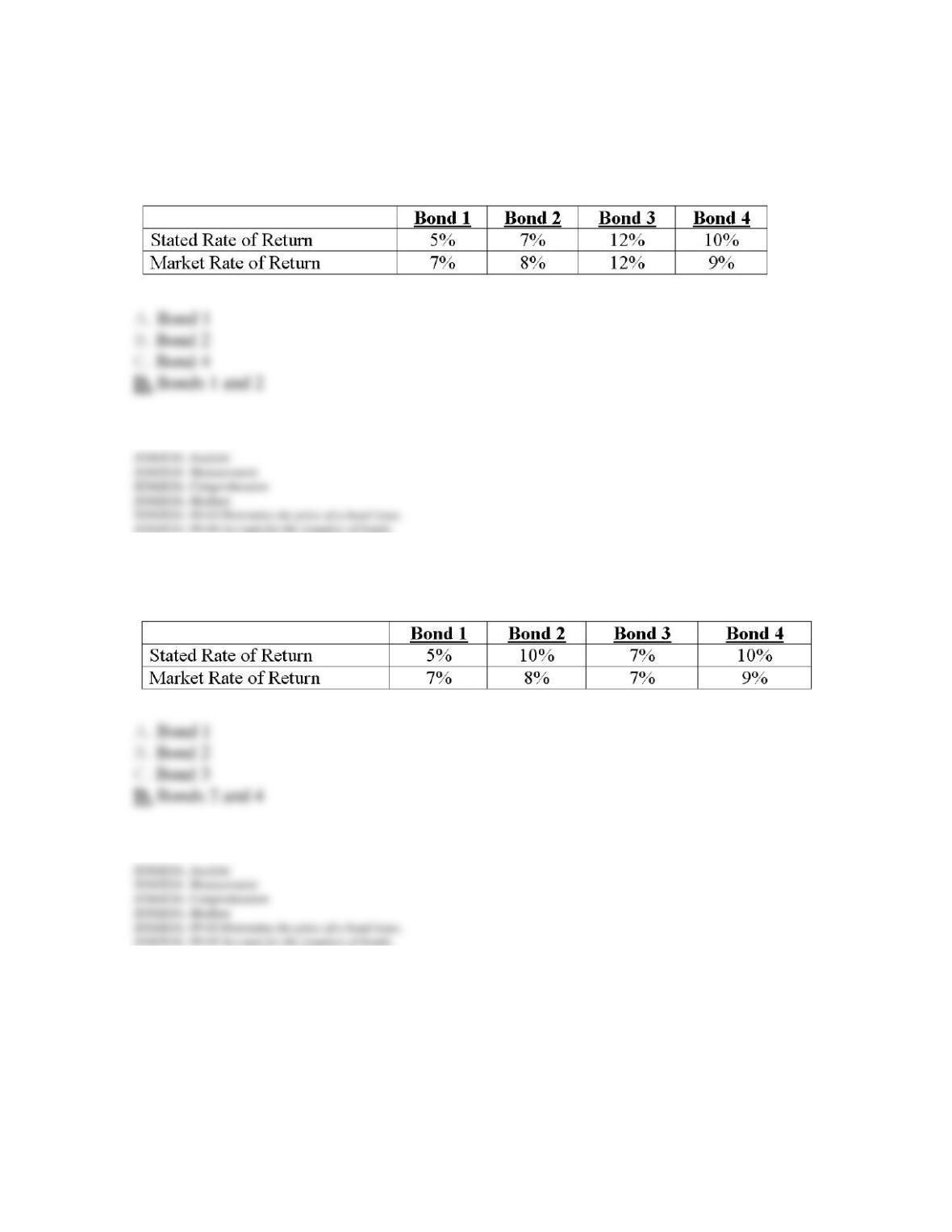
31. Given the information below, which bond(s) will be issued at a discount?
32. Given the information below, which bond(s) will be issued at a premium?
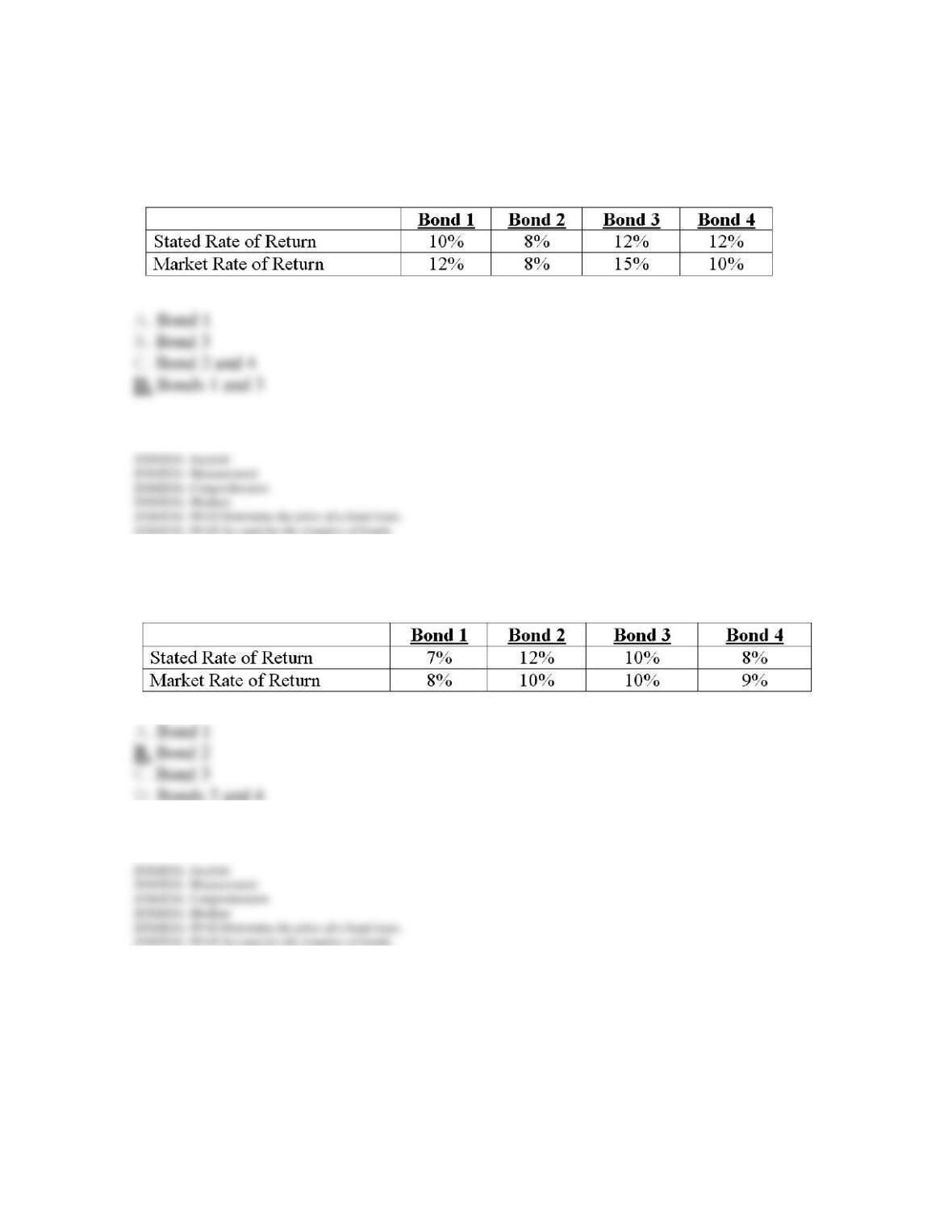
33. Given the information below, which bond(s) will be issued at a discount?
34. Given the information below, which bond(s) will be issued at a premium?
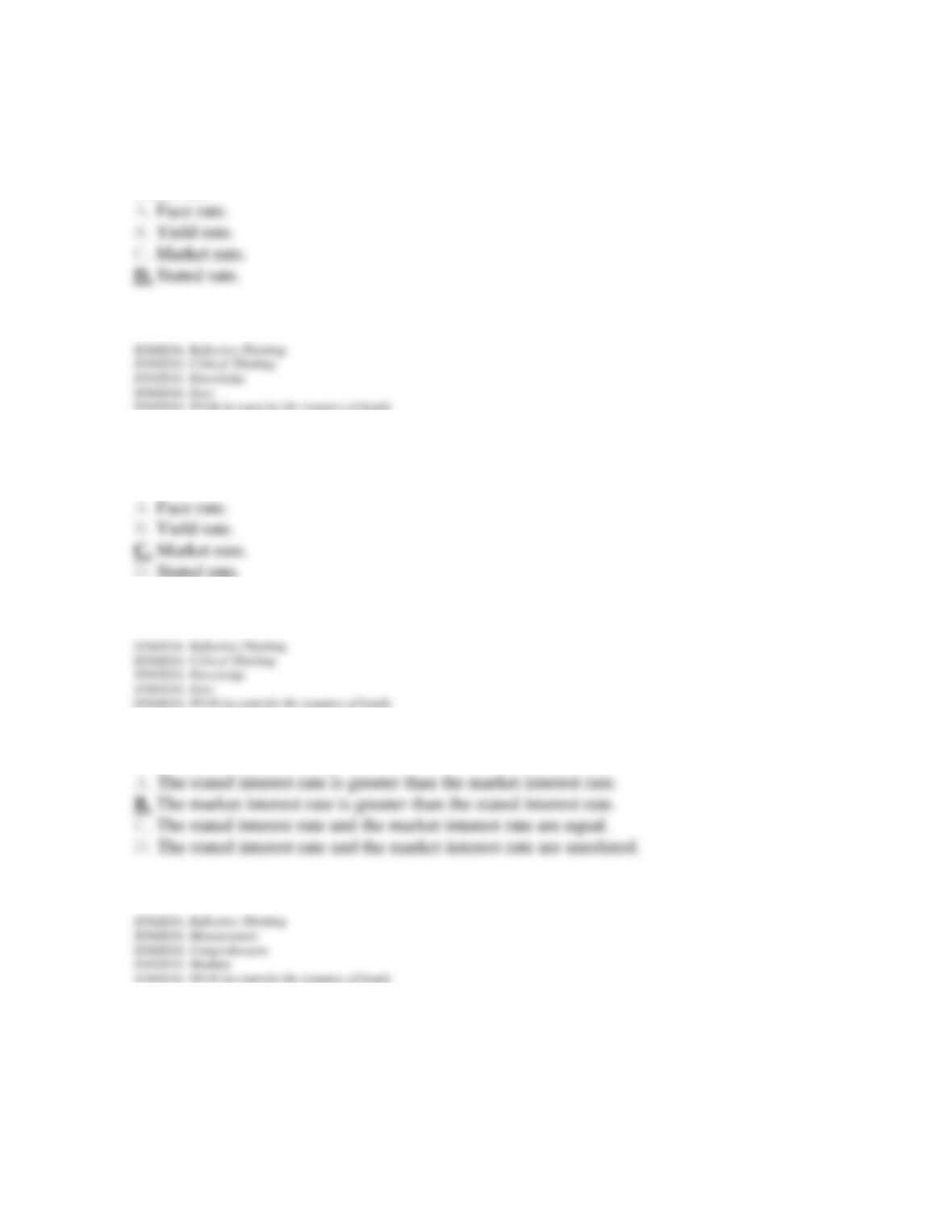
35. The rate quoted in the bond contract used to calculate the cash payments for interest is
called the:
36. The rate of interest expense incurred on a bond payable for bonds of similar risk is called
the:
37. Which of the following is true for bonds issued at a discount?
39. The cash interest payment each period is calculated as the:
40. Interest expense on bonds payable is calculated as the:
41. When bonds are issued at a discount, what happens to the carrying value and interest
expense over the life of the bonds?
42. When bonds are issued at a premium, what happens to the carrying value and interest
expense over the life of the bonds?
43. Bonds payable should be reported as a long-term liability in the balance sheet at:
44. A bond issued at a discount indicates that at the date of issue:
45. A bond issued at a premium indicates that at the date of issue:
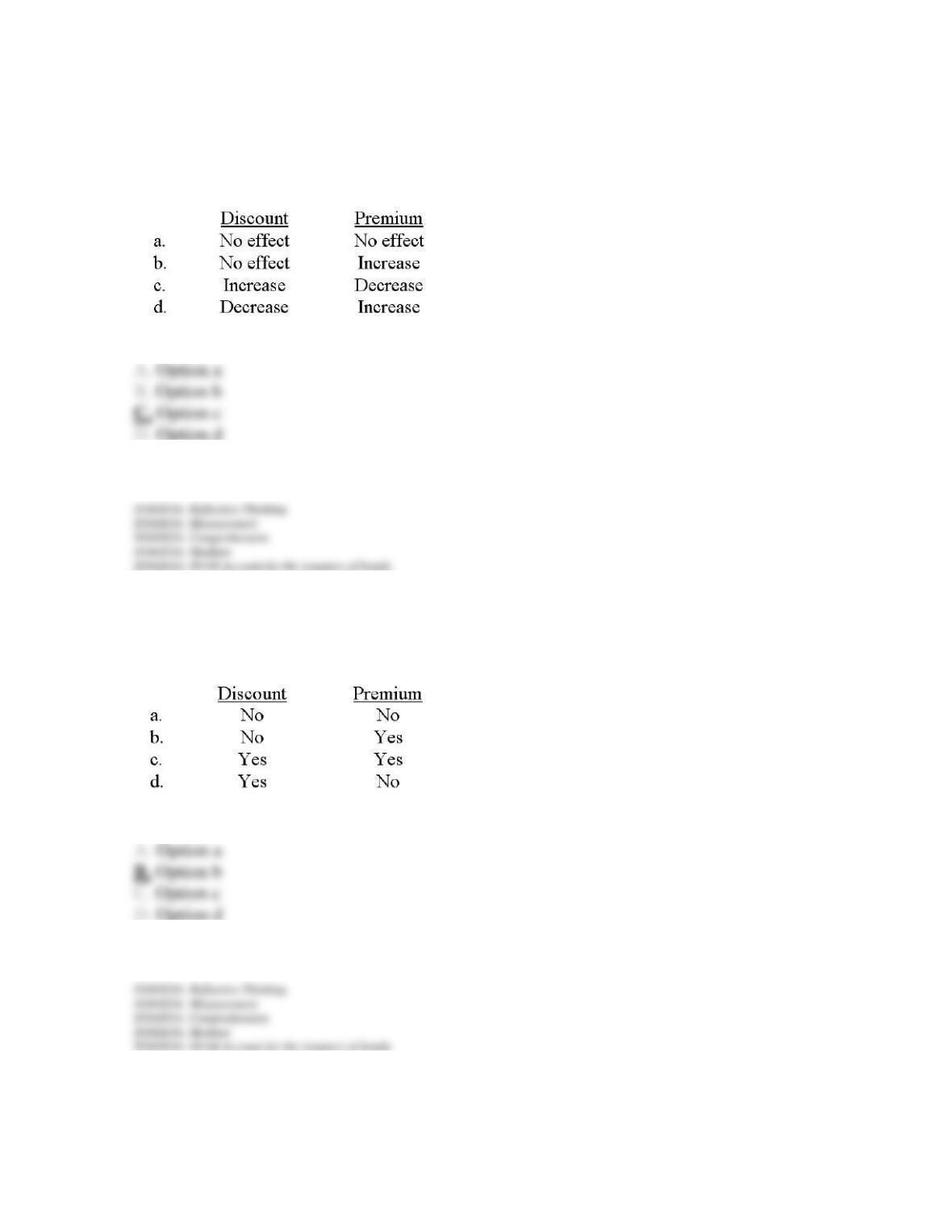
46. How would the carrying value of bonds payable change over time for bonds issued at a
47. For the issuer of 20-year bonds, the carrying value using the effective interest method
would decrease each year if the bonds were sold at a:
48. When bonds are issued at a discount and the effective interest method is used for
amortization, at each subsequent interest payment date, the cash paid is:
49. When bonds are issued at a premium and the effective interest method is used for
amortization, at each subsequent interest payment date, the cash paid is:
50. When bonds are issued at a discount and the effective interest method is used for
amortization, at each interest payment date, the interest expense:
51. When bonds are issued at a premium and the effective interest method is used for
amortization, at each interest payment date, the interest expense:
52. An amortization schedule for a bond issued at a discount:
53. An amortization schedule for a bond issued at a premium: