Financial Accounting, 11e (Harrison/Horngren/Thomas)
Chapter 9 Liabilities
1 Learning Objective 9-1
1) Current liabilities are expected to be paid within one year or the operating cycle, whichever is shorter.
2) Purchasing inventory on account results in an accounts receivable.
3) A note payable may require the borrower to accrue interest expense and interest payable at the end of
the accounting period.
4) Unearned revenues should be classified as Other revenues on the income statement.
5) When accruing interest expense on a short-term note payable, the Interest Payable account will
decrease.
6) Interest expense on a note payable is only recorded at maturity.
7) Accounts payable turnover is an important measure of liquidity for a retail business.
8) Employee compensation is the major expense for most service companies.
9) The balance of the Unearned Revenue account becomes zero when a company has earned all of the
revenue it had collected in advance.
10) The current portion of a long-term note payable refers to the amount of interest on a note payable
that must be paid in the current year.
11) A potential obligation that depends on the future outcome of past events is a contingent liability.
12) A contingent liability should be disclosed in the notes to the financial statements if there is a
reasonable possibility that a loss (or expense) will occur.
13) All contingent liabilities should be reported as liabilities on the financial statements, even those that
are unlikely to occur.
14) At the end of each year, a company must reclassify from long-term debt to a current liability the
amount of its long-term debt that is due next year.
15) Vacation pay and income taxes are examples of expenses that must be estimated.
16) At the end of the year, a company makes a journal entry to accrue the interest expense on a short–
term note payable. As a result of this transaction:
A) current liabilities increase and current assets increase.
B) current liabilities increase and stockholders’ equity increases.
C) current liabilities decrease and stockholders’ equity decreases.
D) current liabilities increase and stockholders’ equity decreases.
17) On November 1, 2017, a company signed a promissory note. The interest and principal are due on
July 1, 2018. What accounts relating to the note payable will be reported on the financial statements for
the fiscal year ending December 31, 2017?
A) Short-term notes payable will be reported on the balance sheet and interest payable will be reported
on the income statement.
B) Interest receivable will be reported on the balance sheet.
C) Short-term notes payable and interest payable will be reported on the balance sheet.
D) Short-term notes payable, interest payable and interest expense will be reported on the balance sheet.
18) The journal entry to record salaries earned by employees will debit:
A) Salary Expense and credit Salary Payable for net pay.
B) Salary Expense and credit Salary Payable for gross pay.
C) Salary Expense for gross pay, credit FICA Tax Payable, credit Employee Income Tax Payable and
credit Salary Payable for net pay.
D) Salary Expense for net pay, debit FICA Tax Payable, debit Employee Income Tax Payable, and credit
Salary Payable for gross pay.
19) When a business receives cash from customers before earning the revenue, the ________ account is
credited.
A) Accounts Receivable
B) Sales Tax Payable
C) Accounts Payable
D) Unearned Revenue
20) All of the following are reported as current liabilities EXCEPT:
A) unearned revenues for services to be provided in 16 months.
B) sales tax payable.
C) accounts payable.
D) bonds payable due in 6 months.
21) Failure to record an accrued liability for wages earned by employees causes a company to:
A) understate net income.
B) overstate assets.
C) overstate liabilities.
D) overstate stockholders‘ equity.
22) Which of the following liability accounts is usually NOT an accrued liability:
A) Interest Payable.
B) Wages Payable.
C) Taxes Payable.
D) Notes Payable.
23) On December 31, 2017, Estimated Warranty Payable is reported on the balance sheet for White and
Decker Company. The liability pertains to products sold, in 2017, with five year warranties. The
Estimated Warranty Payable should be reported on the balance sheet at December 31, 2017 as a:
A) part of stockholders’ equity.
B) long-term liability only.
C) current liability only.
D) current liability and a long-term liability.
24) The accounting principle that requires a company to record warranty expense in the same period
that it records sales revenue is the:
A) going concern principle.
B) expense recognition principle.
C) conservatism principle.
D) consistency principle.
25) Madison Bank lends Neenah Paper Company $110,000 on January 1, 2017. Neenah signs a $110,000,
10%, 6-month note. The journal entry made by Neenah on January 1, 2017 will debit:
A) Cash for $99,000 and credit Note Payable for $99,000.
B) Interest Expense for $11,000 and credit Cash for $11,000.
C) Cash for $110,000 and credit Notes Payable for $110,000.
D) Interest Expense for $11,000 and credit Interest Payable for $11,000.
26) Monthly sales are $530,000. Warranty costs are estimated at 6% of monthly sales. Warranties are
honored with replacement products. No defective products are returned during the month. At the end
of the month, the company should record a journal entry with a credit to:
A) Estimated Warranty Payable for $31,800.
B) Warranty Expense for $31,800.
C) Sales for $31,800.
D) Inventory for $31,800.
27) Aisha Company paid $1,500 cash to replace a wheel on equipment sold under a two-year warranty
in the prior year. The entry to record the payment will debit:
A) Warranty Expense and credit Cash.
B) Repair Expense and credit Cash.
C) Estimated Warranty Payable and credit Cash.
D) Operating Expense and credit Cash.
28) Mariano Corporation sells 12,000 units of inventory during the first year of operations for $700 each.
Mariano provides a one-year warranty on parts. It is estimated that 4% of the units will be defective and
that repair costs are estimated to be $70 per unit. In the year of sale, warranty contracts are honored on
70 units for a total cost of $4900. What amount will be reported as Estimated Warranty Liability at the
end of the year?
A) $4900
B) $13,720
C) $28,700
D) $33,600
29) Wisconsin Bank lends Local Furniture Company $140,000 on November 1. Local Furniture
Company signs a $140,000, 3%, 4–month note. The fiscal year end of Local Furniture Company is
December 31. The journal entry made by Local Furniture Company on December 31 is:
A) debit Interest Expense and credit Interest Payable for $700
B) debit Interest Payable and credit Interest Expense for $700
C) debit Interest Expense and credit Cash for $700
D) debit Interest Payable and credit Cash for $700
30) Michigan Bank lends Detroit Furniture Company $80,000 on December 1. Detroit Furniture
Company signs a $80,000, 6%, 4-month note. The total cash paid for interest (only) at maturity of the
note is: (Round your final answer to the nearest dollar.)
A) $800
B) $1600
C) $3200
D) $4800
31) Illinois Bank lends Lisle Furniture Company $70,000 on December 1. Lisle Furniture Company signs
a $70,000, 6%, 4-month note. The total cash paid at maturity of the note is: (Round your final answer to
the nearest dollar.)
A) $70,000.
B) $71,400.
C) $72,100.
D) $74,200.
32) The journal entry to record accrued interest on a short-term note payable includes a debit to:
A) Interest Payable and a credit to Cash.
B) Interest Expense and a credit to Cash.
C) Interest Expense and a credit to Interest Payable.
D) Interest Payable and a credit to Notes Payable.
33) Kathy’s Corner Store has total cash sales for the month of $38,000 excluding sales taxes. If the sales
tax rate is 8%, which journal entry is needed? (Ignore Cost of Goods Sold.)
A) debit Cash $41,040, credit Sales Revenue $41,040
B) debit Cash $38,000 and credit Sales Revenue $38,000
C) debit Cash $34,960, debit Sales Tax Receivable for $3040 and credit Sales Revenue for $38,000
D) debit Cash $41,040, credit Sales Revenue $38,000 and credit Sales Tax Payable $3040
34) Notes payable due in six months are reported as:
A) a reduction to notes receivable on the balance sheet.
B) current assets on the balance sheet.
C) current liabilities on the balance sheet.
D) long-term liabilities on the balance sheet.
35) Sales taxes collected from customers are sent to the state at the end of each month. What journal
entry is prepared?
A) debit Accounts Receivable and credit Sales
B) debit Sales Tax Payable and credit Sales
C) debit Accounts Payable and credit Cash
D) debit Sales Taxes Payable and credit Cash
36) Montana Company sold merchandise with a retail price of $34,000 for cash. Montana Company is
required to collect 6% state sales tax. The total cash received from customers was:
A) $2040.
B) $31,960.
C) $34,000.
D) $36,040.
37) Mike’s Pharmacy sold inventory with a selling price of $2800 to customers for cash. They also
collected sales taxes of $500. The journal entry to record this information includes a:
A) debit to Cash of $3300.
B) debit to Sales Tax Expense $500.
C) credit to Sales $3300.
D) debit to Sales Tax Payable $500.
38) Total wages employees earned for the payroll period are called ________. The amount of wages the
employees take home is the ________.
A) gross pay; withholding amount
B) gross pay; net pay
C) net pay; gross pay
D) net pay; taxes withheld amount
39) Unearned Service Revenue relating to services, to be provided in one month, is reported on the
balance sheet as:
A) a revenue account.
B) a current liability.
C) a component of stockholders’ equity.
D) a long-term liability.
40) Nationwide Magazine sells 63,000 subscriptions on account in March. The subscription price is $14
each. The subscriptions start in April. The journal entry in March would include a:
A) debit to Unearned Subscription Revenue for $882,000.
B) debit to prepaid subscriptions for $882,000.
C) credit to Cash for $882,000.
D) credit to Unearned Subscription Revenue for $882,000.
41) Hoover Company signs a four month promissory note for $270,000 on January 31, 2016. The
company is required to pay $67,500 on the note each month. The first payment is on February 1, 2016,
and the final payment is on May 1, 2016. How will this note be reported on the balance sheet at January
31, 2016?
A) long-term liability, $270,000
B) long-term liability, $202,500
C) current liability, $67,500; long-term liability, $202,500
D) current liability, $270,000
42) Potential liabilities that depend on future events arising out of past events are called:
A) long-term liabilities.
B) estimated liabilities.
C) contingent liabilities.
D) current liabilities.
43) A company has a lawsuit pending with regard to patent infringement. The amount of the loss can be
estimated and has a probable chance of occurrence. What journal entry is required?
A) debit Lawsuit Loss and credit Cash
B) debit Estimated Lawsuit Loss and credit Cash
C) debit Cash and credit Estimated Lawsuit Liability
D) debit Estimated Lawsuit Loss and credit Estimated Lawsuit Liability
44) A company has a pending lawsuit that has a remote possibility of being settled in favor of the
plaintiff who is a former employee. What should the company do?
A) Nothing.
B) Make a disclosure in a financial statement footnote.
C) Prepare a journal entry.
D) Make a note to the financial statements and prepare a journal entry.
45) On December 31, 2016, a note payable of $180,000 has installments of $45,000 due yearly, beginning
on December 31, 2017. On December 31, 2016, how will the note payable be reported on the balance
sheet?
A) $135,000 current liability and $45,000 long-term liability
B) $180,000 long-term liability
C) $180,000 current liability
D) $45,000 current liability and $135,000 long-term liability
46) What is the accounts payable turnover?
A) a measure of liquidity
B) a measure of the number of times a year a company is able to pay its accounts payable
C) purchases on account from suppliers divided by average accounts payable
D) all of the above
47) A company reports Cost of Goods Sold of $390,000, Ending Inventory of $49,000, Beginning
Inventory of $47,000, Ending Accounts Payable of $48,000 and Beginning Accounts Payable of $27,000.
What is the accounts payable turnover? (Round your final answer to two decimal places.)
A) 8.17
B) 8.13
C) 10.40
D) 10.45
48) A company reports Cost of Goods Sold of $420,000, Ending Inventory of $52,000, Beginning
Inventory of $50,000, Ending Accounts Payable of $51,000 and Beginning Accounts Payable of $35,000.
What is the days’ payable outstanding? (Round any intermediary calculations to two decimal places and
your final answer to the nearest day.)
A) 37 days
B) 40 days
C) 44 days
D) 45 days
49) Company A has an accounts payable turnover of 9.5. Company B has an accounts payable turnover
of 7.3. Which company is more liquid?
A) Company A is more liquid.
B) Company B is more liquid.
C) Both are equally liquid.
D) None of the above are correct.
50) A company reports Cost of Goods Sold of $325,000, Ending Inventory of $125,000, Beginning
Inventory of $40,000, Ending Accounts Payable of $95,000 and Beginning Accounts Payable of $55,000.
What is the accounts payable turnover? (Round your final answer to two decimal places.)
A) 4.32
B) 4.33
C) 3.42
D) 5.47
51) A company reports Cost of Goods Sold of $275,000, Ending Inventory of $120,000, Beginning
Inventory of $15,000, Ending Accounts Payable of $110,000 and Beginning Accounts Payable of $80,000.
What is the days’ payable outstanding? (Round any intermediary calculations to two decimal places and
your final answer to the nearest day.)
A) 91 days
B) 106 days
C) 84 days
D) 146 days
52) A company has days’ payable outstanding of 70 days. If credit terms of purchases are 2/10, net 30, is
the company paying accounts payable on a timely basis?
A) Yes, days’ payable outstanding exceeds the net period of 30 days.
B) Yes, days’ payable outstanding exceeds the discount period of 10 days and the net period of 30 days.
C) No, days’ payable outstanding exceeds the discount period of 10 days and the net period of 30 days.
D) There is not enough information to make an assessment.
53) At January 1, 2017, the Estimated Warranty Payable is $1100. During 2017, the company recorded
Warranty Expense of $19,500. During 2017, the company replaced defective products in accordance
with product warranties at a cost of $12,000. What is the Estimated Warranty Payable at December 31,
2017?
A) $7500
B) $8600
C) $20,600
D) $19,500
54) Which of the following statements regarding contractual commitments is INCORRECT?
A) Even though contractual commitments are slightly different, the disclosures fall into the same
category as contingencies.
B) Commitments represent contractual promises a company has made to enter into transactions in the
future and thus obligate the company to commit resources toward a certain purpose.
C) It would not be proper to accrue commitments because the transactions have not yet occurred as of
the balance-sheet date.
D) All contractual commitments must be disclosed, regardless of whether there will be a substantial
impact on the company’s financial statements in future years.
55) The international accounting standard for loss contingencies:
A) contains the same language and requirements as the U.S. standard.
B) defines the term contingency as a probable obligation that arises from a past event.
C) states that contingencies can, by definition, only be disclosed in the financial statement footnotes.
D) never allows a provision to be recorded.
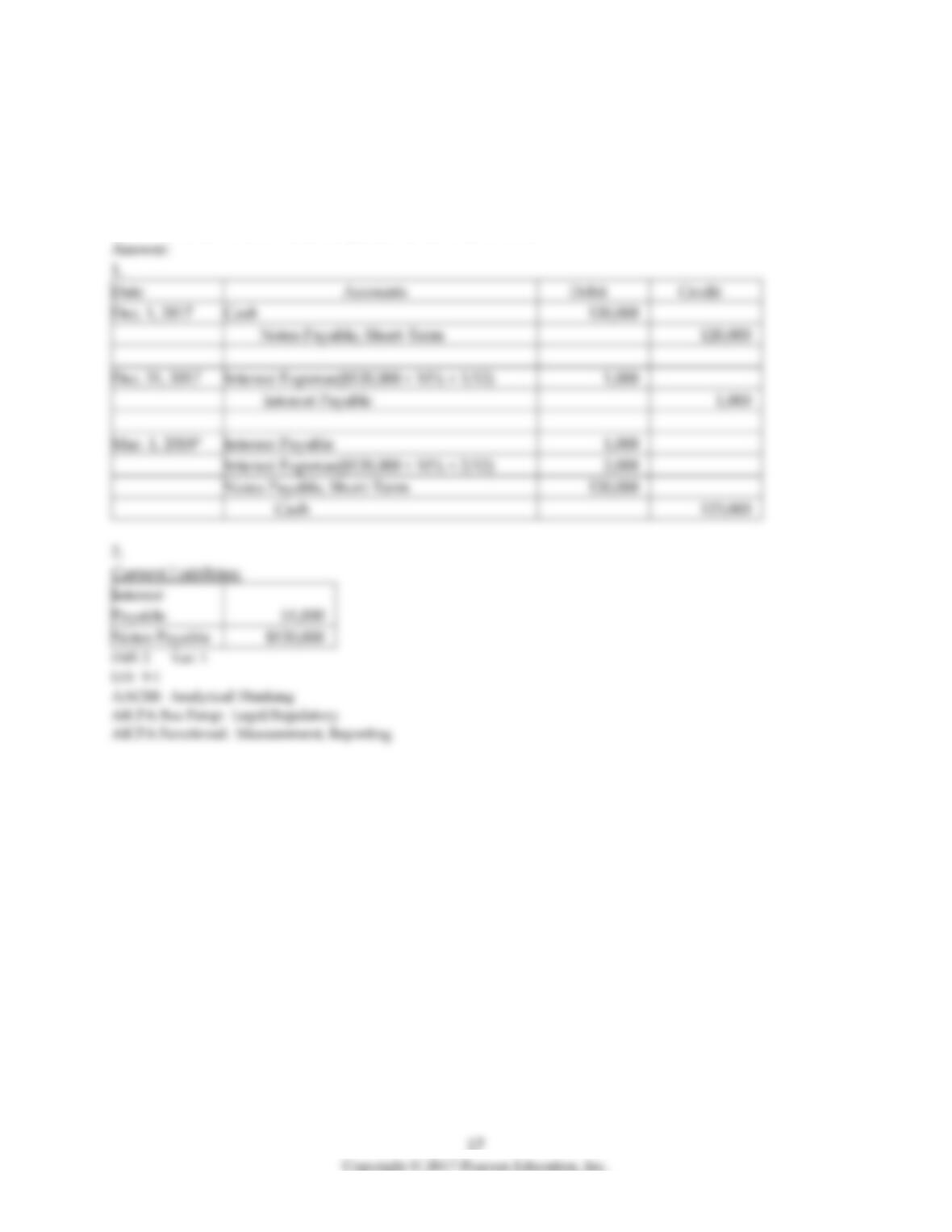
56) On December 1, 2017, Goliath Corporation borrowed $120,000 on a three month, 10% note. Goliath
Corporation’s year end is December 31.
Required:
1. Prepare the journal entries in 2017 and 2018 for Goliath Corporation. Omit explanations.
2. At December 31, 2017, what is reported on the balance sheet?
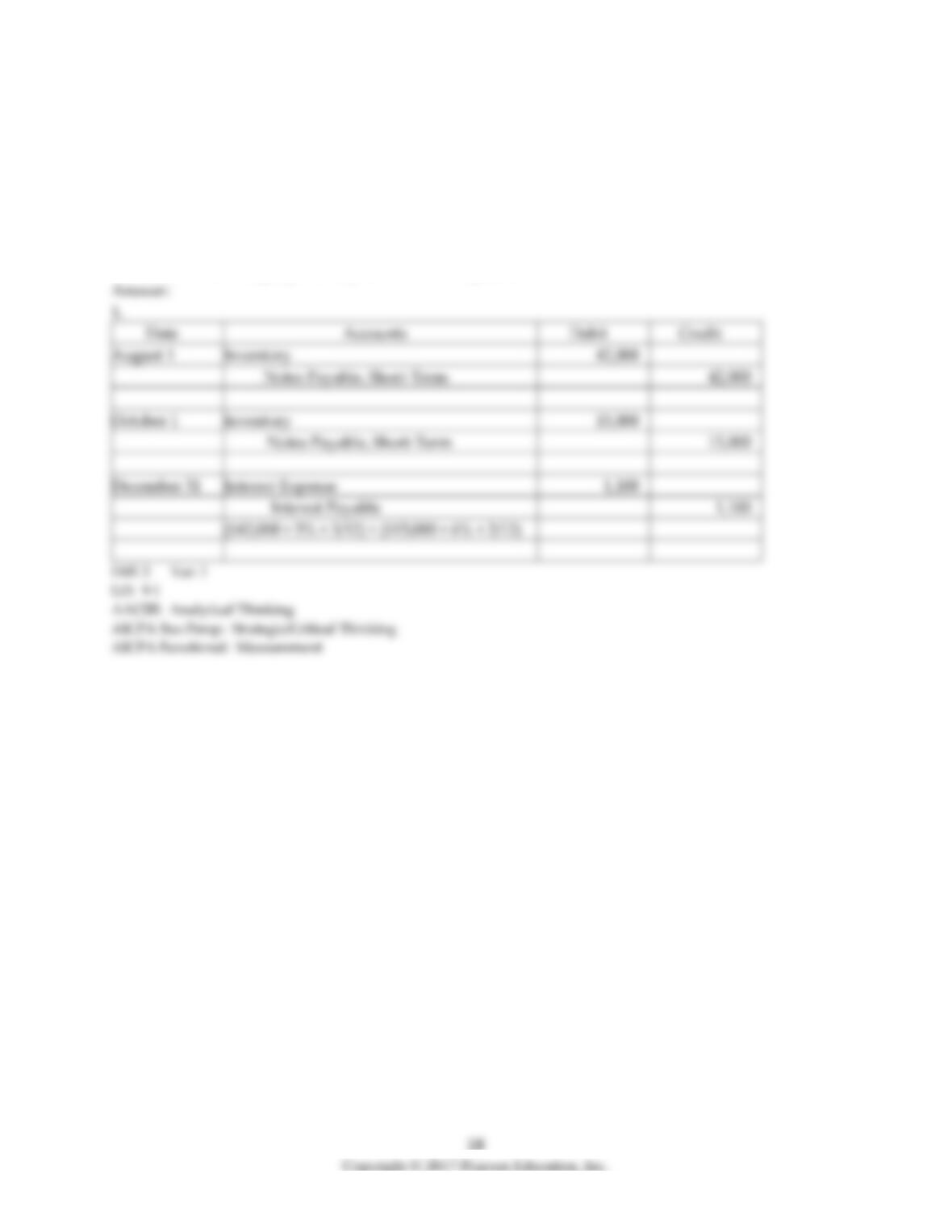
57) Davies Accessories Company entered into the following transactions relating to notes payable:
August 1 Purchased inventory costing $42,000 by signing an 8-month, 5% note payable.
October 1 Purchased inventory costing $15,000 by signing a 1-year, 6% note payable.
Required:
Prepare journal entries to record the above transactions. Also, prepare journal entries needed on
December 31, the company’s fiscal year end. Omit explanations.
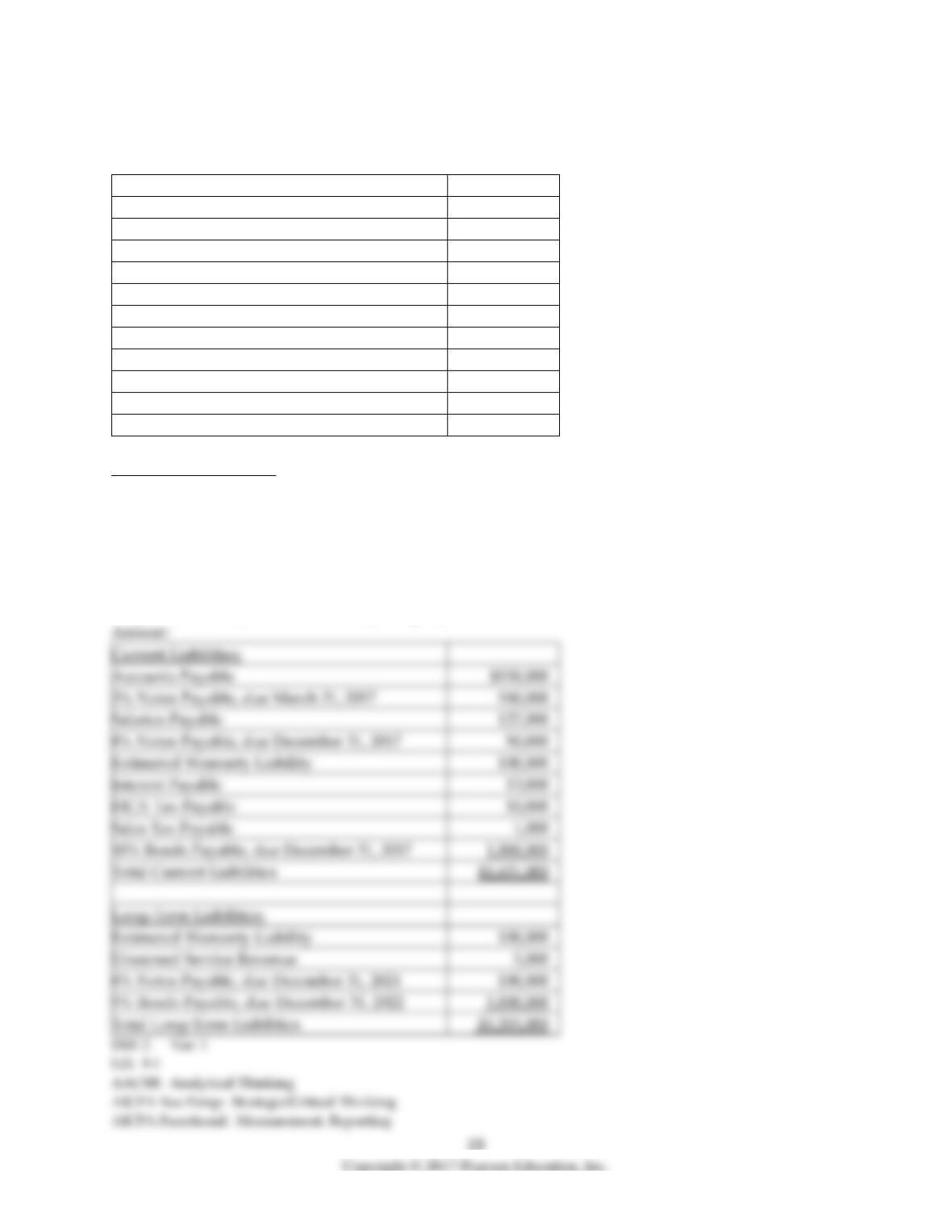
58) At December 31, 2016, Lansing Company’s general ledger shows the following balances after
posting adjusting entries:
Accounts Payable
$150,000
3% Notes Payable, due March 31, 2017
180,000
Salaries Payable
127,000
Accumulated Depreciation
114,000
8% Notes Payable, due December 31, 2021
150,000
Estimated Warranty Liability
200,000
Interest Payable
13,000
FICA Tax Payable
10,000
10% Bonds Payable, due December 31, 2017
1,000,000
5% Bonds Payable, due December 31, 2022
1,000,000
Sales Tax Payable
1,000
Unearned Service Revenue
5,000
Additional information:
1. $50,000 of the 8% note due December 31, 2021 is due on December 31, 2017.
2. The Estimated Warranty Liability relates to a multiple year product warranty. One-half of the liability
will be honored in 2017, and one-half in 2018.
3. The Unearned Service Revenue pertains to a service contract to be performed in 2018.
Required:
Prepare the liability section of Lansing Company’s balance sheet at December 31, 2016.
Current Liabilities:
Accounts Payable
$150,000
3% Notes Payable, due March 31, 2017
180,000
Salaries Payable
127,000
8% Notes Payable, due December 31, 2017
50,000
Estimated Warranty Liability
100,000
Interest Payable
FICA Tax Payable
10,000
Sales Tax Payable
1,000
10% Bonds Payable, due December 31, 2017
Total Current Liabilities
Long-Term Liabilities:
Estimated Warranty Liability
100,000
Unearned Service Revenue
5,000
8% Notes Payable, due December 31, 2021
100,000
5% Bonds Payable, due December 31, 2022
Total Long-Term Liabilities
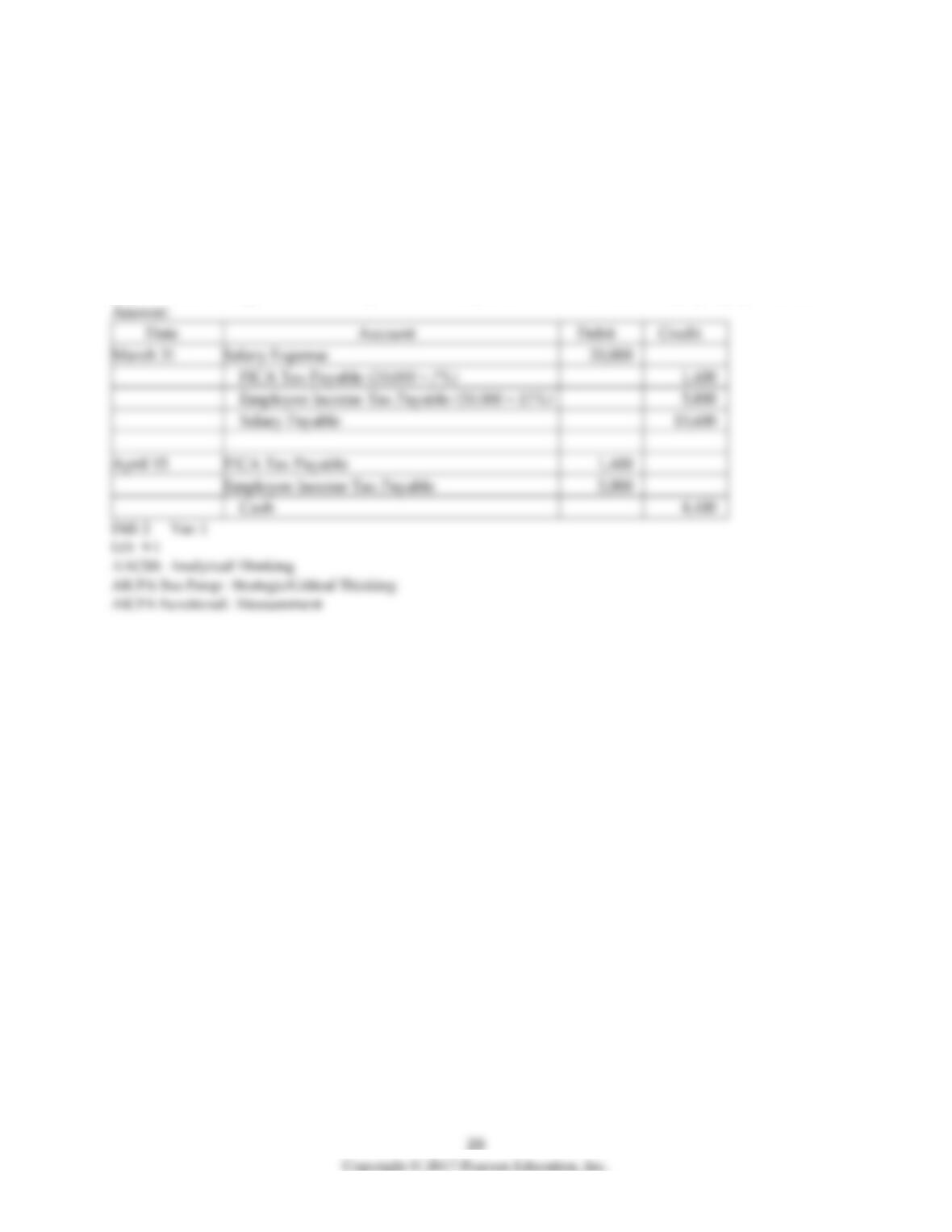
59) Devin’s Animal Shop has the following information for the pay period of March 15 to March 31:
Gross payroll $20,000
FICA tax rate 7%
Federal income tax withheld 15%
Required:
Prepare the journal entry to record the accrued payroll on March 31 and the journal entry to remit the
payroll taxes to the government on April 15. Omit explanations. Do not record employer payroll taxes.