
1. Traditional product costing systems (e.g., job and process costing) are designed primarily
to accumulate cost information for financial reporting.
2. The death spiral concept refers to the process of continually decreasing selling prices to
meet foreign competition.

3. The basic difference between a first-stage cost allocation and a second–stage cost
allocation is that cost pools are not used in first-stage cost allocations.
4. Predetermined overhead rates are used in first-stage cost allocations but not in second–
stage cost allocations.

5. In general, variable costs are allocated using a first–stage cost allocation system and fixed
costs are allocated using a second-stage cost allocation system.
6. The single-stage cost allocation system uses a plantwide rate because the cost pool is the
entire plant.
7. The department cost allocation method provides more accurate product cost information
for managerial decision-making than the plantwide cost allocation method.
8. The plantwide cost allocation method should be used by companies that manufacture
products that are similar and use the same resources.

9. Activity-based costing (ABC) is a two-stage cost allocation system that (1) allocates costs
to activities and (2) then to products based on their use of the activities.
10. The basic difference between the department cost allocation method and activity-based
costing (ABC) is the number of stages involved in allocating costs to products.

11. Direct labor cost (DLC) and direct labor hours (DLH) are examples of volume-related cost
drivers in the cost hierarchy.
12. The number of products produced is an example of a facility-related cost driver in the cost
hierarchy.
13. Activity-based costing (ABC) provides more detailed measures of costs than do plantwide
or department allocation methods.
14. Before using activity-based costing (ABC), managers must apply the cost-benefit principle
to the additional recordkeeping costs associated with ABC.
15. In general, traditional product costing methods allocate less cost to low-volume products
and more costs to high-volume products than activity-based costing (ABC).
16. Using direct labor costs to allocate overhead costs in an activity-based costing (ABC)
system will encourage management to reduce labor costs.
17. In general, low-volume products (and services) have a lower degree of complexity
associated with them.
18. When overhead is applied based on the volume of output, high-volume products tend to
“subsidize” low-volume products.
19. Activity-based costing (ABC) can be applied to administrative activities (e.g., purchasing)
but not to marketing activities.
20. It is possible to apply activity-based costing (ABC) to segments of an organization without
applying it to the entire organization.

21. Which of the following statements is (are) true regarding the potential effects of using
reported product costs for decision making?
(A) Traditional product costing systems (e.g., job and process costing) are designed primarily to
accumulate cost information for financial reporting.
(B) If a single cost driver is used as the allocation base, applied manufacturing overhead for
product costing purposes may lead to inappropriate managerial decisions.

22. Which of the following statements is (are) false regarding first-stage and second-stage
cost allocation methods?
(A) The basic difference between a first-stage cost allocation and a second-stage cost allocation
is that cost pools are not used in first-stage cost allocations.
(B) Predetermined overhead rates are used in first-stage cost allocations but not in second–stage
cost allocations.
23. Activity-based costing (ABC) is a costing technique that uses a two stage allocation
process. Which of the following statements best describes these two stages?
24. Which of the following statements is true?
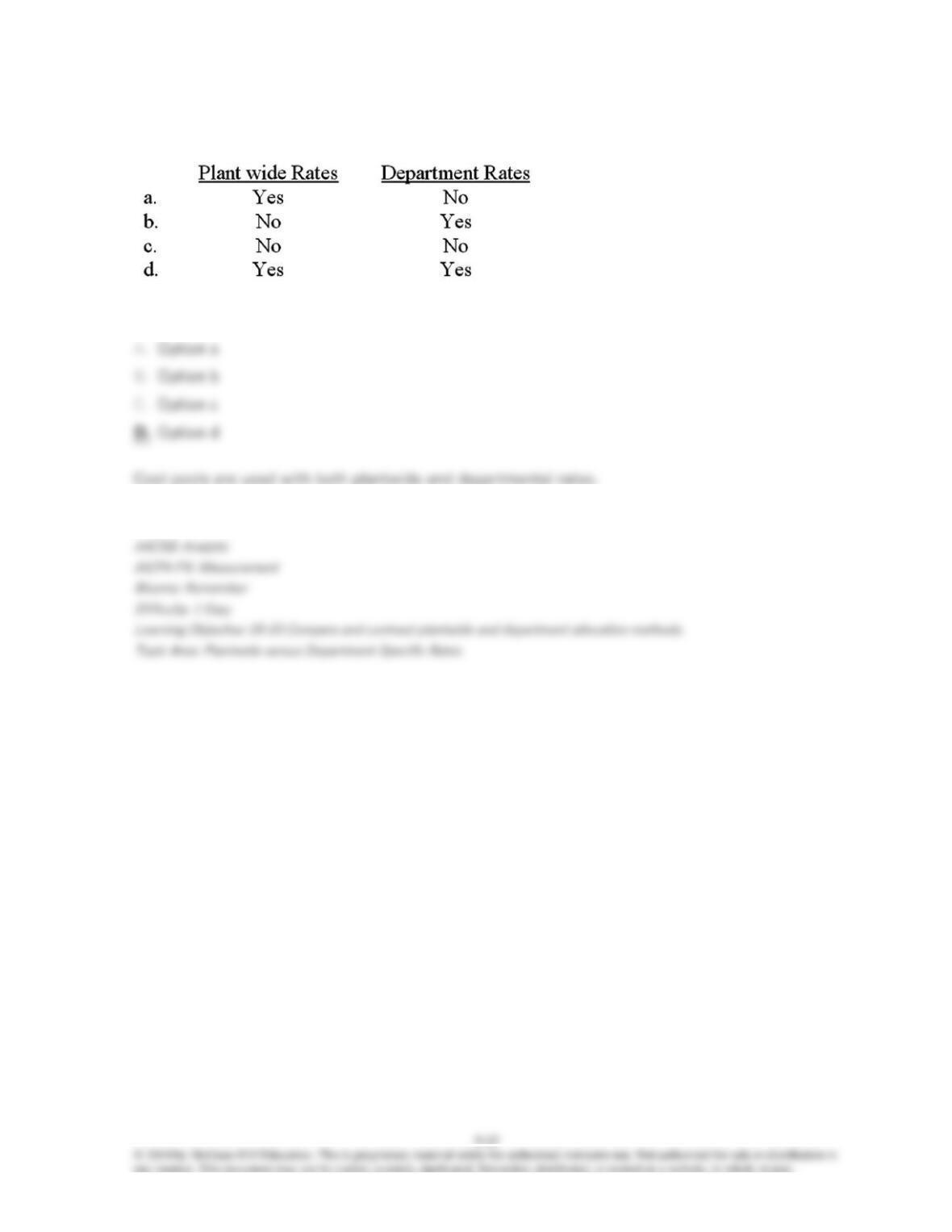
25. Cost pools are used with:
26. Which of the following should not be used as the allocation base in a company that
appropriately uses a single plantwide rate?
27. The electricity used for production machinery would be classified as a:
28. The number of services provided by an accounting firm would be classified as a(n):
29. Which of the following costs is not related to a batch-related activity?
30. Which of the following would NOT be a batch–related activity?
31. Which of the following measures is used by traditional costing systems as an allocation
base for allocating overhead costs to the units produced?
32. Which of the following measures is used by activity-based costing (ABC) systems as an
allocation base for allocating overhead costs to the units produced?
33. Which of the following statements is (are) true?
(1) Activity-based costs per unit are always greater than volume-based costs per unit.
(2) Volume-based costing has typically resulted in lower gross margins for high volume products
and higher gross margins for low volume products.

34. Volume-based costing allocates indirect product costs based on the volume of output,
using such allocation bases as direct labor hours, machine hours, or the amount of direct material
used in the production process. Activity-based costing (ABC) has consistently shown that
Volume-based costing ___________ the cost of high volume products and ______________ the cost
of low volume products.