Chapter 09 – Reporting and Interpreting Liabilities
1. When a liability is initially recorded, it is recorded at the future amount of all payments.
2. A current liability is always a short-term obligation expected to be paid within one year of
the balance sheet date.
3. A quick ratio that is high according to an industry average might mean the company may
have excessive inventory levels or slow moving inventory items.
Chapter 09 – Reporting and Interpreting Liabilities
4. The quick ratio can be manipulated by management through paying off current liabilities
before the end of the accounting period.
5. Many strong companies intentionally create low quick ratios.
6. Quick assets include cash, accounts receivable, and inventory.
Chapter 09 – Reporting and Interpreting Liabilities
7. Selling inventory on account increases the quick ratio.
8. Purchasing inventory on account decreases the quick ratio.
9. A current liability is created when a customer pays cash for services to be provided in the
future.
Chapter 09 – Reporting and Interpreting Liabilities
10. Purchasing inventory on account increases the accounts payable turnover ratio.
11. The choice of inventory method has an impact on the accounts payable turnover ratio.
12. The accounts payable turnover ratio is calculated by dividing accounts payable by cash
payments to suppliers.
Chapter 09 – Reporting and Interpreting Liabilities
13. Income taxes payable is an example of an accrued liability.
14. The accounts payable turnover ratio is difficult to manipulate.
15. The accrual of interest on a short-term note payable decreases both the quick ratio and
current assets.
Chapter 09 – Reporting and Interpreting Liabilities
16. The FICA (social security) tax is a matching tax with a portion paid by both the employer
and the employee.
17. A company borrowed $100,000 at 6% interest on September 1, 2009. Assuming no
adjusting entries have been made during the year, the entry to record interest accrued on
December 31, 2009 would include a debit to interest expense and a credit to interest payable
for $2,000.
18. An estimated liability can’t be reported on the balance sheet.
Chapter 09 – Reporting and Interpreting Liabilities
19. A contingent liability is reported on the balance sheet if it is probable and can be
estimated.
20. A contingent liability is disclosed in a note to the financial statements when the liability is
reasonably possible and can be estimated.
21. The journal entry to record a contingent liability creates an accrued liability on the balance
sheet and a loss on the income statement.
Chapter 09 – Reporting and Interpreting Liabilities
22. A contingent liability can’t be disclosed in a note to the financial statements unless it can
be estimated.
23. Working capital is a measure of short-run liquidity and is measured by dividing current
assets by current liabilities.
24. Working capital decreases when accrued wages expense is recorded at year-end.
Chapter 09 – Reporting and Interpreting Liabilities
25. Working capital decreases when a company pays taxes payable.
26. Working capital increases when a company accrues revenues at year-end.
27. Long-term liabilities are reported on the balance sheet at an amount equal to the future
cash flows.
Chapter 09 – Reporting and Interpreting Liabilities
28. Operating leases are reported on the balance sheet at an amount equal to the present value
of the future cash flows.
29. For the present value of a single amount, the compounding period may only be once a
year.
30. An annuity is a series of consecutive payments, each one increasing by a fixed dollar
amount over the payment amount of the prior year.
Chapter 09 – Reporting and Interpreting Liabilities
31. Which of the following statements is correct?
32. Which of the following is not a current liability?
Chapter 09 – Reporting and Interpreting Liabilities
33. Which of the following is incorrect?
34. How is the quick ratio calculated?
Chapter 09 – Reporting and Interpreting Liabilities
35. Which of the following accounts would not be considered when calculating the quick
ratio?
36. Which of the following accounts would not be considered when calculating the quick
ratio?
Chapter 09 – Reporting and Interpreting Liabilities
37. A company has a quick ratio of 1.9 before paying off a large current liability with cash. As
a result, what happens to the quick ratio?
38. A company has a quick ratio of 0.9 before paying off a large current liability with cash. As
a result, what happens to the quick ratio?
Chapter 09 – Reporting and Interpreting Liabilities
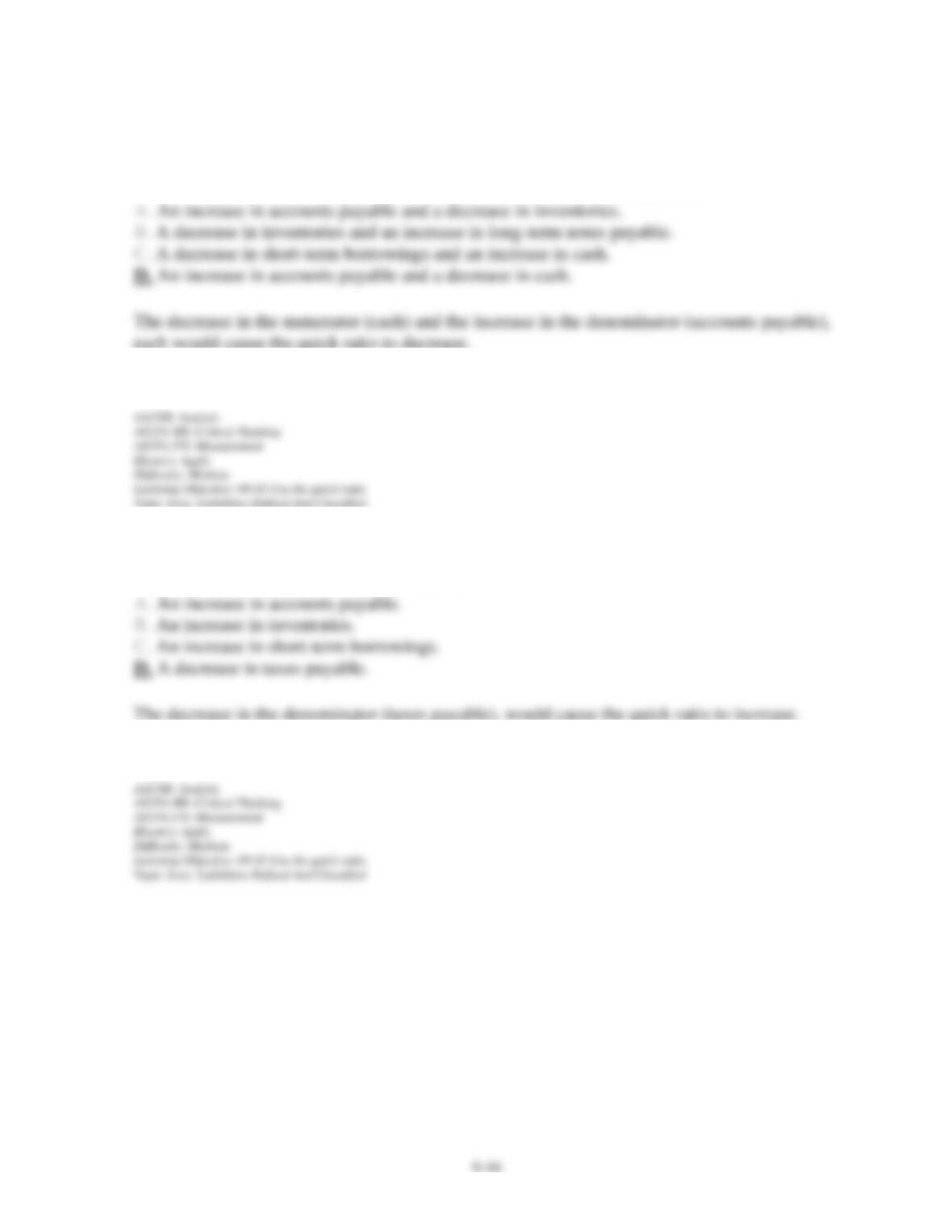
39. The following is a partial list of account balances from the books of Probst Enterprise at
the end of 2010:
Based solely upon these balances, what is the quick ratio?
Chapter 09 – Reporting and Interpreting Liabilities
40. At year-end 2010, General Tech reported a quick ratio of 2.75 and at year-end 2009 it was
3.10. Which of the following is a potential cause of the decrease in this ratio?
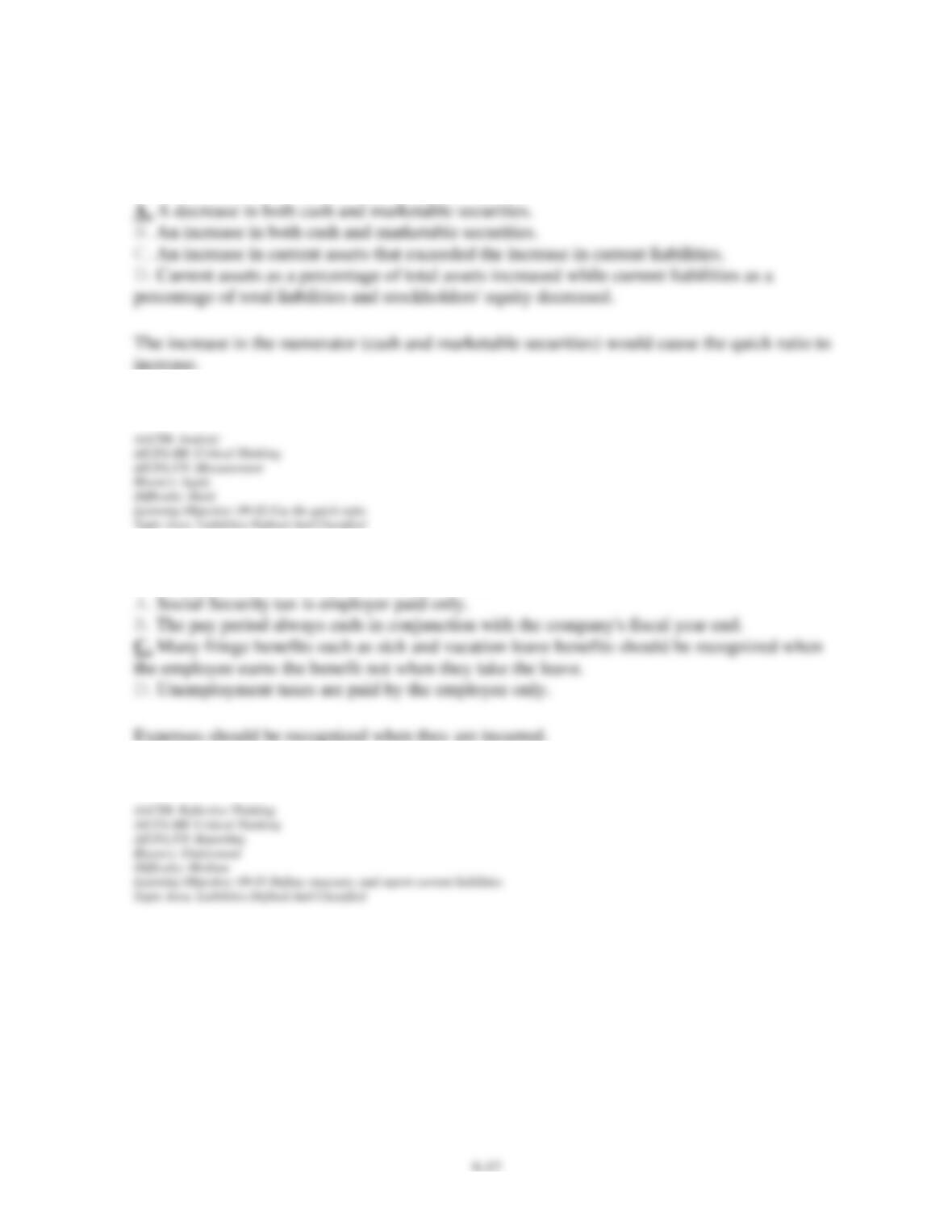
41. If the quick ratio has been increasing over the past several years, which of the following
would cause the ratio to continue to increase?
Chapter 09 – Reporting and Interpreting Liabilities
42. Chavez Chocolates had a quick ratio of 1.74 at year-end 2009. Which of the following
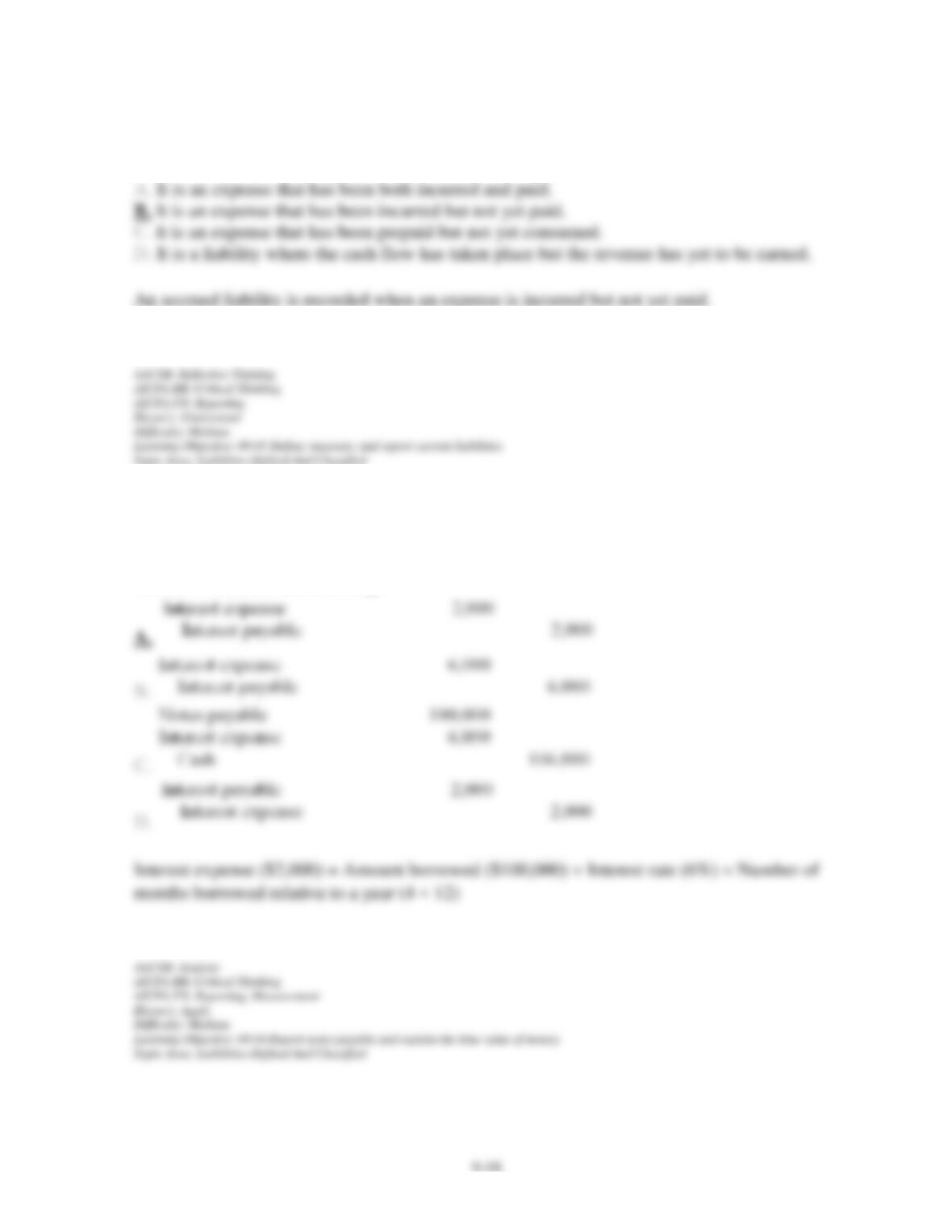
would cause the ratio to decrease during 2010?
43. Which of the following statements is correct?
Chapter 09 – Reporting and Interpreting Liabilities
44. Which of the following describes an accrued liability?
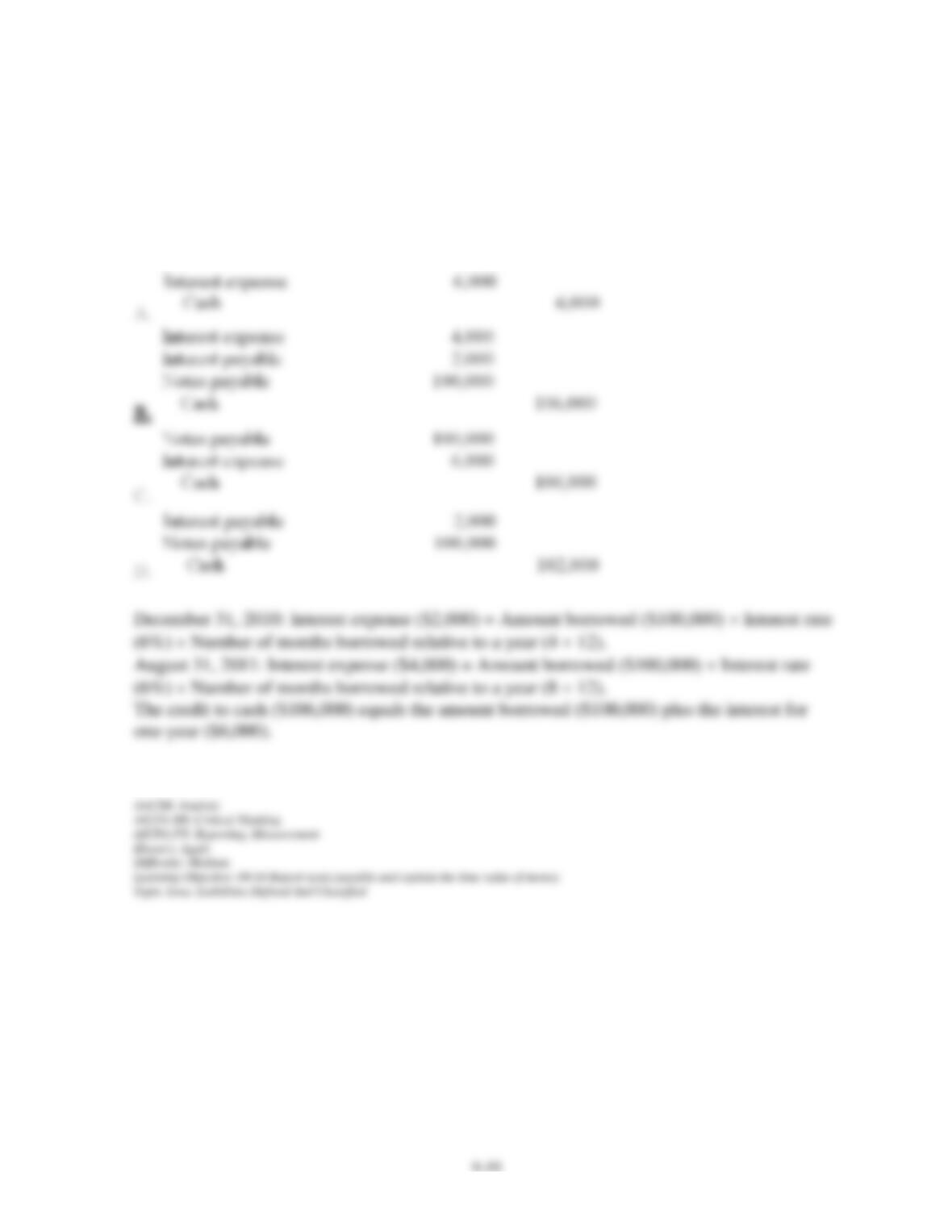
45. Miranda Company borrowed $100,000 cash on September 1, 2010, and signed a one-year
6%, interest-bearing note payable. Assuming no adjusting entries have been made during the
year, the required adjusting entry at the end of the accounting period, December 31, 2010,
would be which of the following?
Chapter 09 – Reporting and Interpreting Liabilities
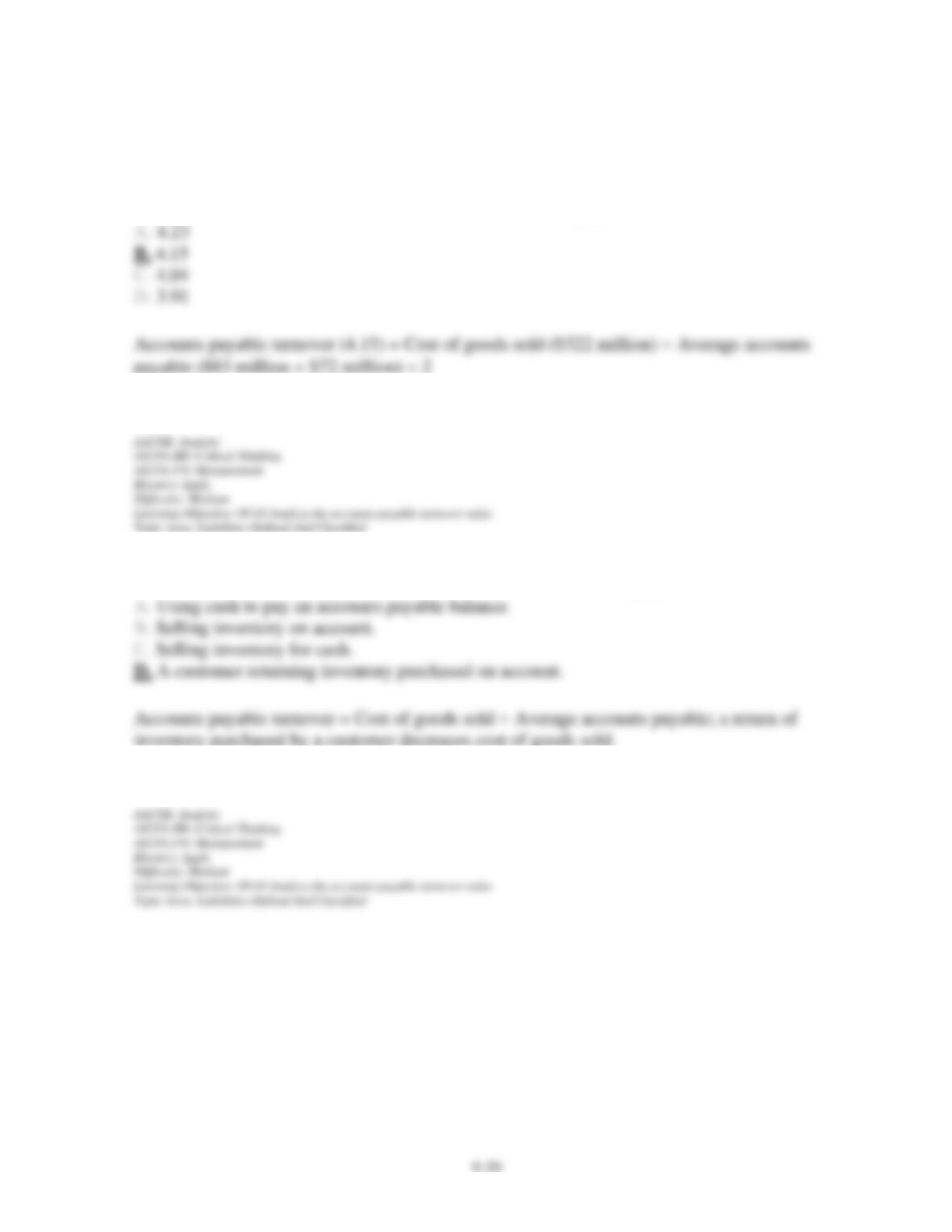
46. Miranda Company borrowed $100,000 cash on September 1, 2010, and signed a one-year
6%, interest-bearing note payable. The interest and principal are both due on August 31, 2011.
Assume that the appropriate adjusting entry was made on December 31, 2010 and that no
adjusting entries have been made during 2011. The required journal entry to pay the note on
August 31, 2011 would be which of the following?
Chapter 09 – Reporting and Interpreting Liabilities
47. Landseeker’s Restaurants reported cost of goods sold of $322 million and accounts
payable of $83 million for 2011. In 2010, cost of goods sold was $258 million and accounts
payable was $72 million. What was Landseeker’s accounts payable turnover ratio in 2011?
48. Which of the following transactions will decrease the accounts payable turnover ratio?