177) Match each of the following terms with the appropriate definitions.
a. Depletion
b. Betterment
c. Ordinary repairs
d. Units-of production method
e. Intangible assets
f. Accelerated depreciation
g. Amortization
h. Goodwill
i. Total asset turnover
j. Revenue expenditure
____ 1.
The amount by which the company’s value exceeds the value of its individual
assets and liabilities.
____ 2.
A cost reported as an expense on the current income statement because it does
not provide a material benefit in future periods.
____ 3.
An expenditure that makes a plant asset more efficient or productive.
____ 4.
A method of depreciation that yields larger expense during the early years of
an asset’s life and smaller expense in the later years.
____ 5.
Expenditures to keep a plant asset in good operating condition.
____ 6.
The process of allocating the cost of a natural resource to the period when it is
consumed.
____ 7.
A measure of a company’s effectiveness in using its assets to generate sales.
____ 8.
The process of systematically allocating the cost of an intangible asset to
expense over its estimated useful life.
____ 9.
A depreciation method that charges a varying amount to expense for each
period of an asset’s useful life depending on its usage.
____10.
Nonphysical assets used in operations that give long-term rights or
competitive advantages to their owners.
178) Match each of the following terms with the appropriate definitions.
a. Extraordinary repairs
b. Obsolescence
c. Leasehold improvements
d. Depletion
e. Salvage value
f. Book value
g. Land improvements
h. Copyright
i. Inadequacy
j. Patent
____ 1.
An estimate of an asset’s value at the end its benefit period.
____ 2.
Major repairs that extend the useful life of a plant asset beyond its original
estimate.
____ 3.
Improvements to leased property made by the lessee.
____ 4.
A right granted that gives its owner the exclusive privilege to publish and sell
musical, literary, or artistic work during the life of the creator plus 70 years.
____ 5.
A process of becoming outdated and no longer used.
____ 6.
The total cost of a plant asset less its accumulated depreciation.
____ 7.
The process of allocating the cost of natural resources to the periods when
they are consumed.
____ 8.
An exclusive right granted to its owner to manufacture and sell an item, or to
use a process, for 20 years.
____ 9.
The insufficient capacity of plant assets to meet the company’s productive
demands.
____ 10.
Assets that increase the benefits of land, have a limited useful life, and are
subject to depreciation.
179) Define plant assets and identify the four primary issues in accounting for them.
180) What is depreciation of plant assets? What are the factors necessary in computing
depreciation?
181) What are some of the variables that make a plant asset’s useful life difficult to predict?
182) Explain the purpose of and method of depreciation for partial years.
183) Explain the impact, if any, on depreciation when estimates that determine depreciation
change.
184) Compare the different depreciation methods (straight-line, units-of-production, and double-
declining-balance) with respect to the amounts of depreciation expense per period and the total
depreciation over the life of the asset.
185) Explain how to calculate total asset turnover. Describe what it reveals about a company’s
financial condition, whether a higher or lower ratio is desirable, and how it is best applied for
comparative purposes.
186) How is the cost computed for individual assets purchased as a lump-sum?
187) Explain in detail how to compute each of the following depreciation methods: straight-line,
units-of-production, and double-declining-balance.
188) Explain the difference between revenue expenditures and capital expenditures and how they
are recorded in the accounting system.
189) What are the general accounting procedures for recording asset disposals?
190) Describe the accounting for natural resources, including their acquisition, cost allocation,
and account titles.
191) Describe the accounting for intangible assets, including their acquisition, cost allocation,
and accounts involved.
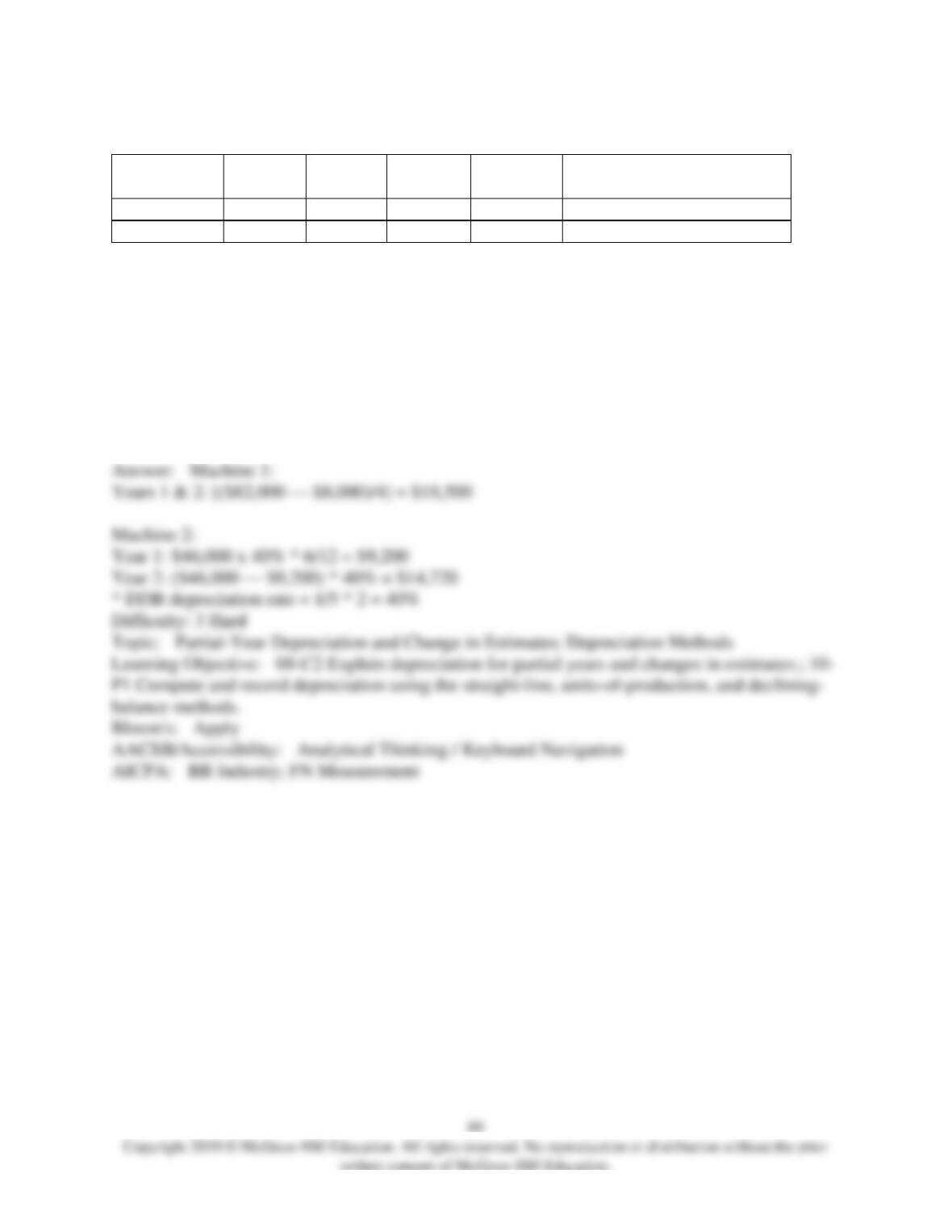
192) A company’s property records revealed the following information about its plant assets:
Machine No.
Cost
Salvage
Value
Purchase
Date
Estimated
Life
Depreciation Method
1
$42,000
$3,000
10/1
3 years
Straight-line
2
86,000
8,600
7/01
5 years
Double-declining balance
Calculate the depreciation expense for each machine in Year 1 and Year 2 for the year ended
December 31.
Machine 1:
Year 1________ Year 2 ________
Machine 2:
Year 1 ________ Year 2 ________
193) A company’s property records revealed the following information about its plant assets:
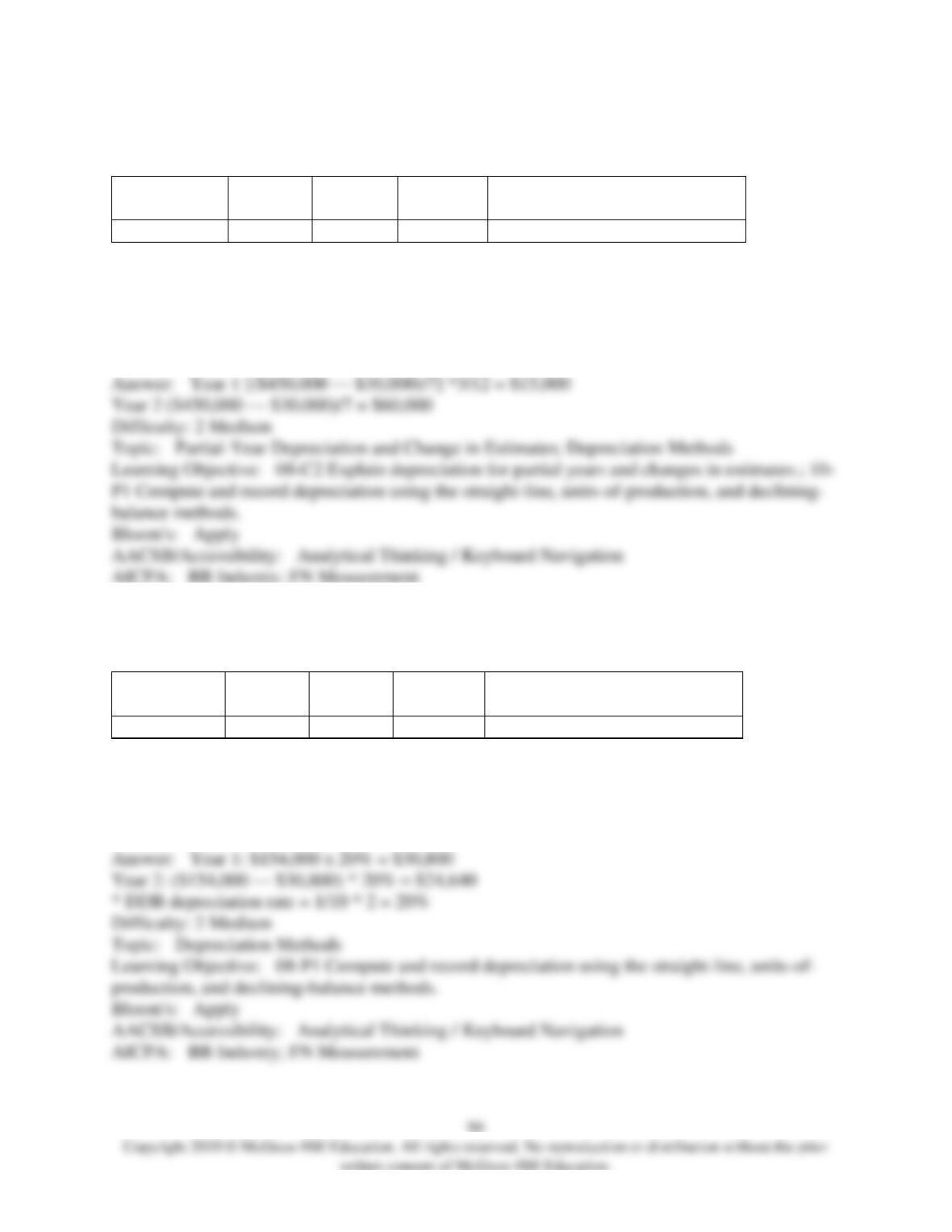
Machine No.
Cost
Salvage
Value
Purchase
Date
Estimated
Life
Depreciation Method
1
$82,000
$8,000
1/01
4 years
Straight-line
2
46,000
3,600
7/01
5 years
Double-declining balance
Calculate the depreciation expense for each machine in Year 1 and Year 2 for the year ended
December 31.
Machine 1:
Year 1________ Year 2 ________
Machine 2:
Year 1 ________ Year 2 ________
194) A company’s property records revealed the following information about one of its plant
assets:
Cost
Salvage
Value
Purchase
Date
Estimated
Life
Depreciation Method
$450,000
$30,000
10/01
7 years
Straight-line
Calculate the depreciation expense for the asset in Year 1 and Year 2 for the year ended
December 31.
Year 1________ Year 2 ________
195) A company’s property records revealed the following information about one of its plant
assets:
Cost
Salvage
Value
Purchase
Date
Estimated
Life
Depreciation Method
154,000
15,000
01/01
10 years
Double-declining balance
Calculate the depreciation expense in Year 1 and Year 2 for the year ended December 31.
Year 1 ________ Year 2 ________
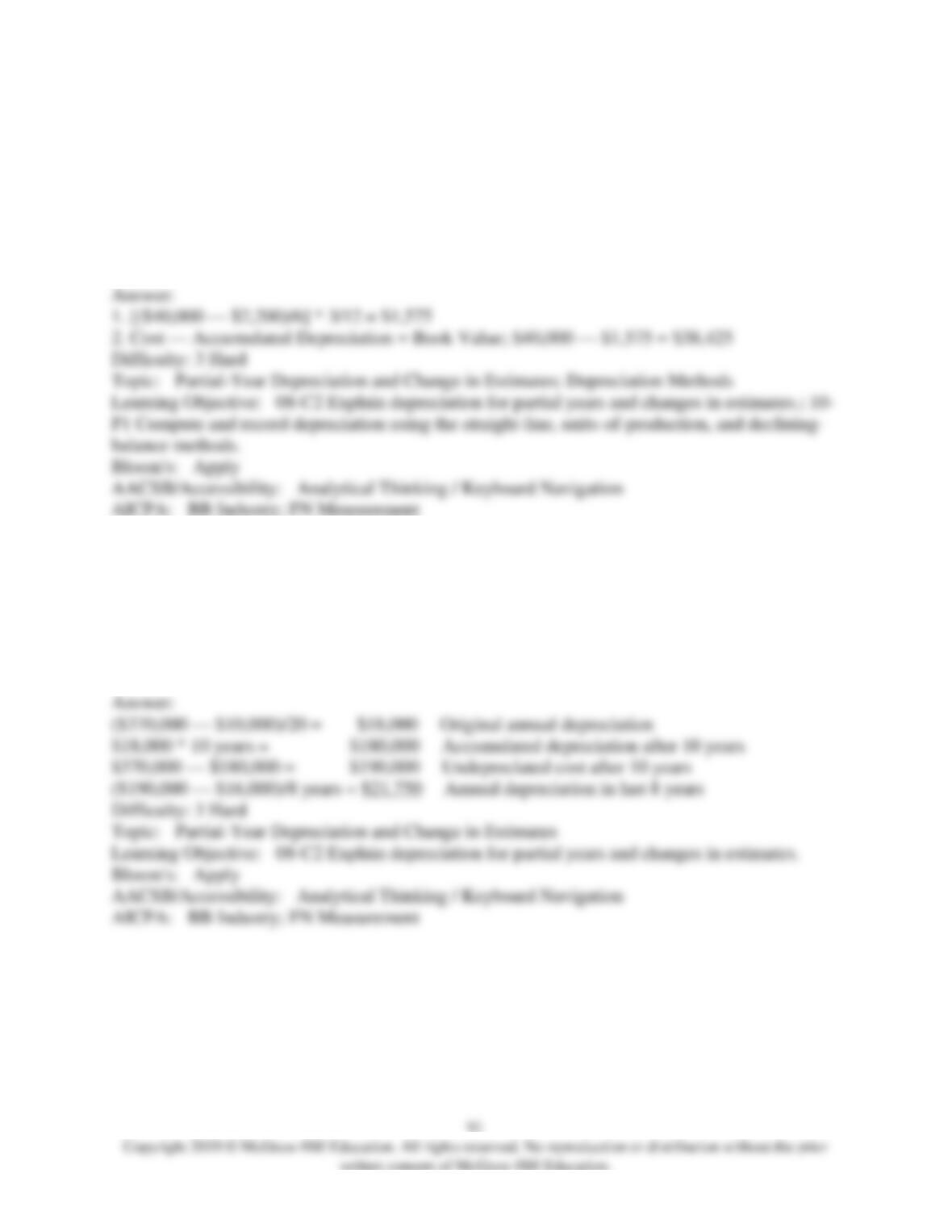
196) A company purchased a delivery van on October 1 of the current year at a cost of $40,000.
The van is expected to last six years and has a salvage value of $2,200. The company’s annual
accounting period ends on December 31.
1. What is the depreciation expense for the current year, assuming the straight-line method is
used?
2. What is the book value of the van at the end of the first year?
197) A building was purchased for $370,000 and depreciated for ten years on a straight-line basis
under the assumption it would have a twenty-year life and a $10,000 salvage value. At the
beginning of the building’s eleventh year it was recognized the building had eight years of
remaining life instead of ten and that at the end of the remaining eight years its salvage value
would be $16,000. What amount of depreciation should be recorded in each of the building’s
remaining eight years?
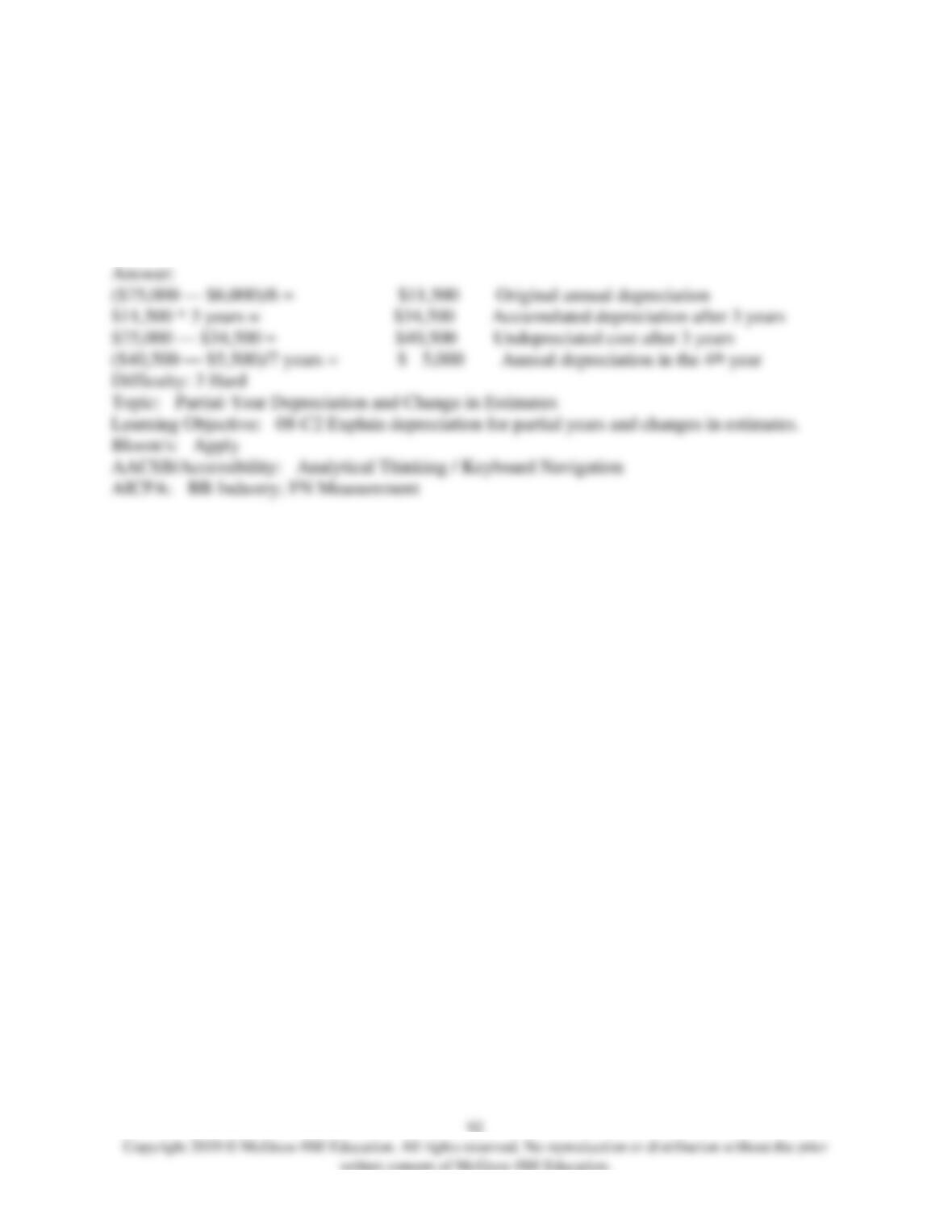
198) Greene Company purchased a machine for $75,000 that was expected to last 6 years and to
have a salvage value of $6,000. At the beginning of the machine’s fourth year the company
decided that the estimated useful life should be revised to a total of 10 years instead of 6 years
and the salvage value revised to be $5,500. Straight-line depreciation was used throughout the
machine’s life. Calculate the depreciation expense for the fourth year of the machine’s useful
life.
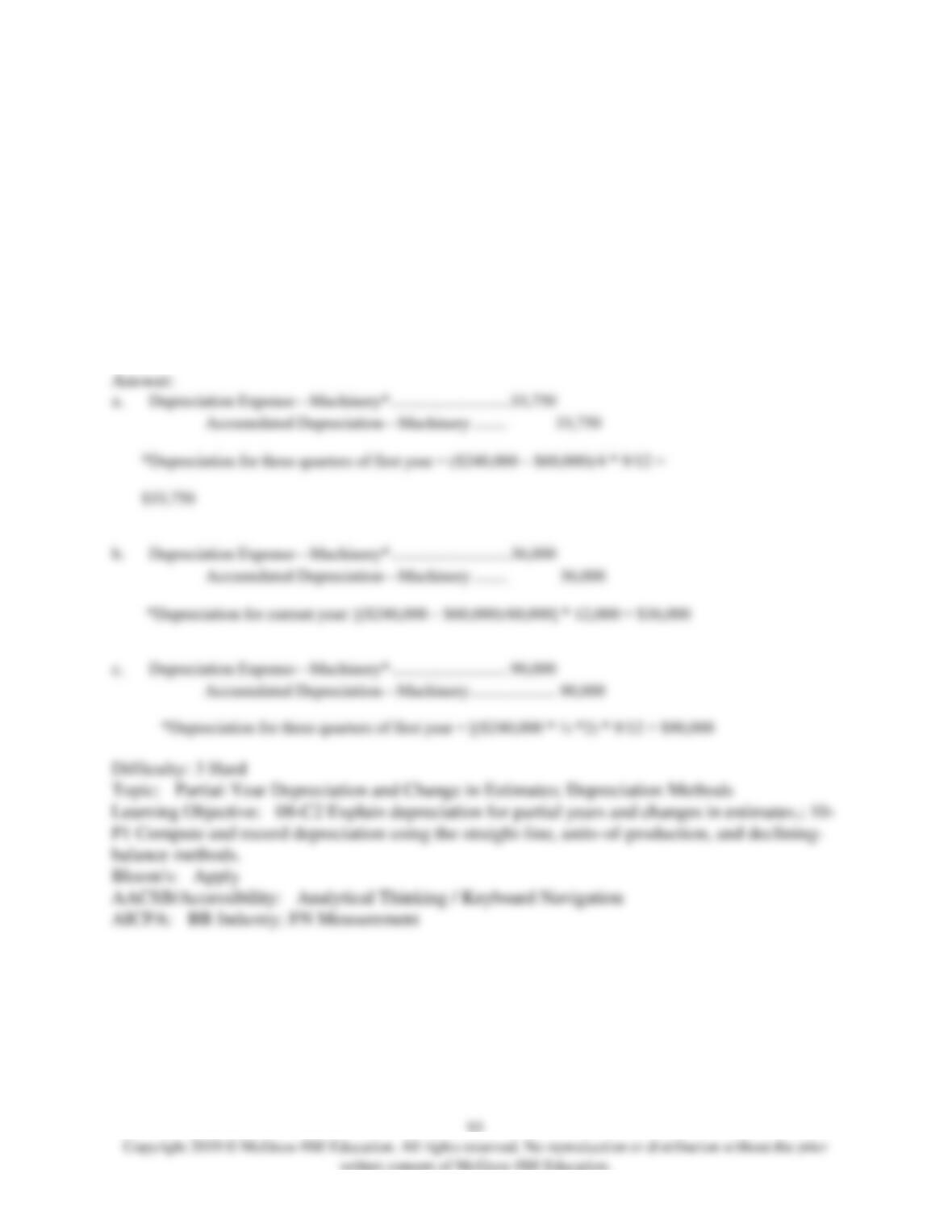
199) On April 1 of the current year, a company purchased and placed in service a machine with a
cost of $240,000. The company estimated the machine’s useful life to be four years or 60,000
units of output with an estimated salvage value of $60,000. During the current year, 12,000
units were produced.
Prepare the necessary December 31 adjusting journal entry to record depreciation for the current
year assuming the company uses:
a. The straight-line method of depreciation
b. The units-of-production method of depreciation
c. The double-declining balance method of depreciation
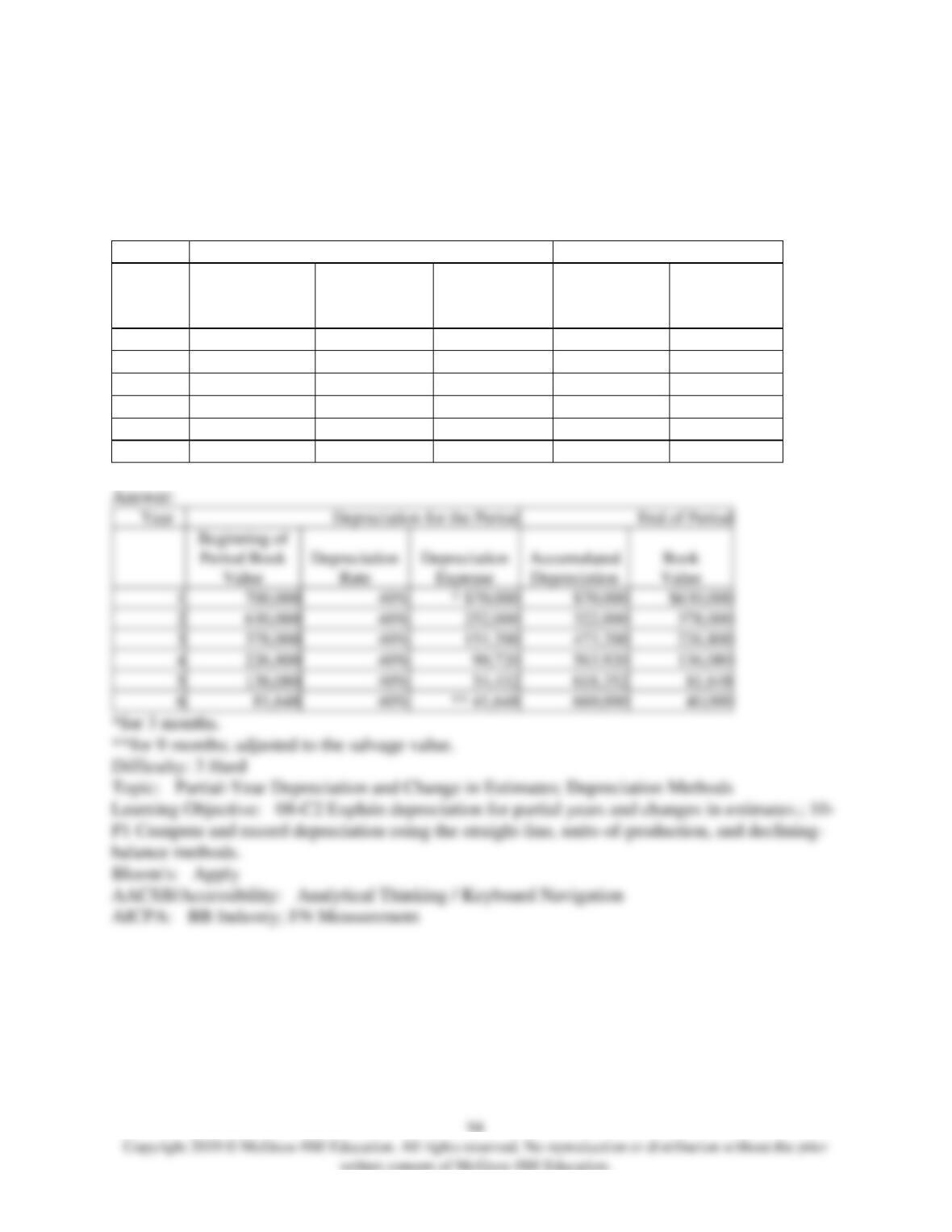
200) On September 30 of the current year, a company acquired and placed in service a machine
at a cost of $700,000. It has been estimated that the machine has a service life of five years and a
salvage value of $40,000. Using the double-declining-balance method of depreciation, complete
the schedule below showing depreciation amounts for all six years (round answers to the nearest
dollar). The company closes its books on December 31 of each year.
Year
Depreciation for the Period
End of Period
Beginning of
Period Book
Value
Depreciation
Rate
Depreciation
Expense
Accumulated
Depreciation
Book
Value
1
2
3
4
5
6
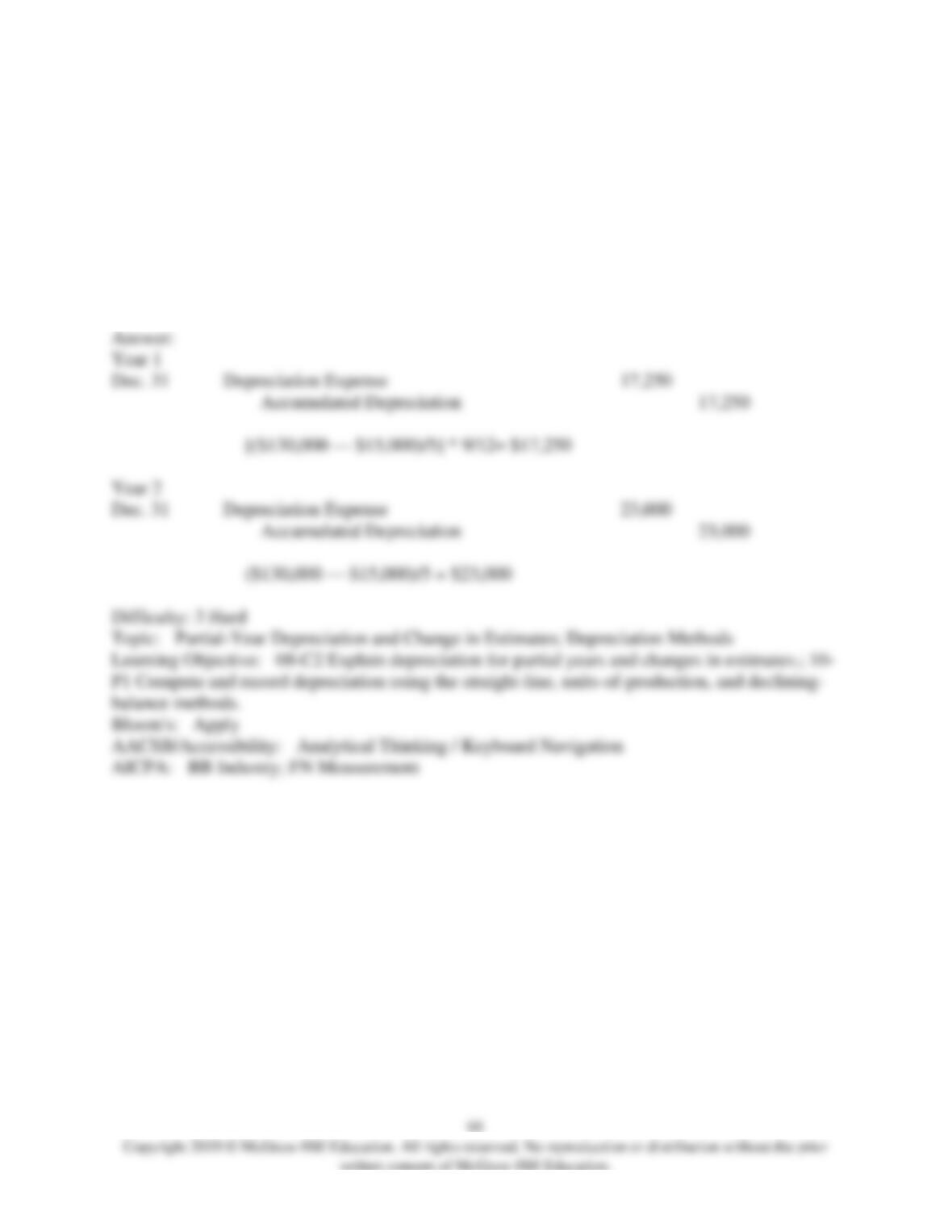
201) On April 1, Year 1, Astor Corp. purchased and placed a plant asset in service. The
following information is available regarding the plant asset:
Acquisition cost
$130,000
Estimated salvage value
$15,000
Estimated useful life
5 years
Make the necessary adjusting journal entries at December 31, Year 1, and December 31, Year 2
to record depreciation for each year under the straight-line depreciation method.
Year 1
Dec. 31
Depreciation Expense
Year 2
Dec. 31
Depreciation Expense
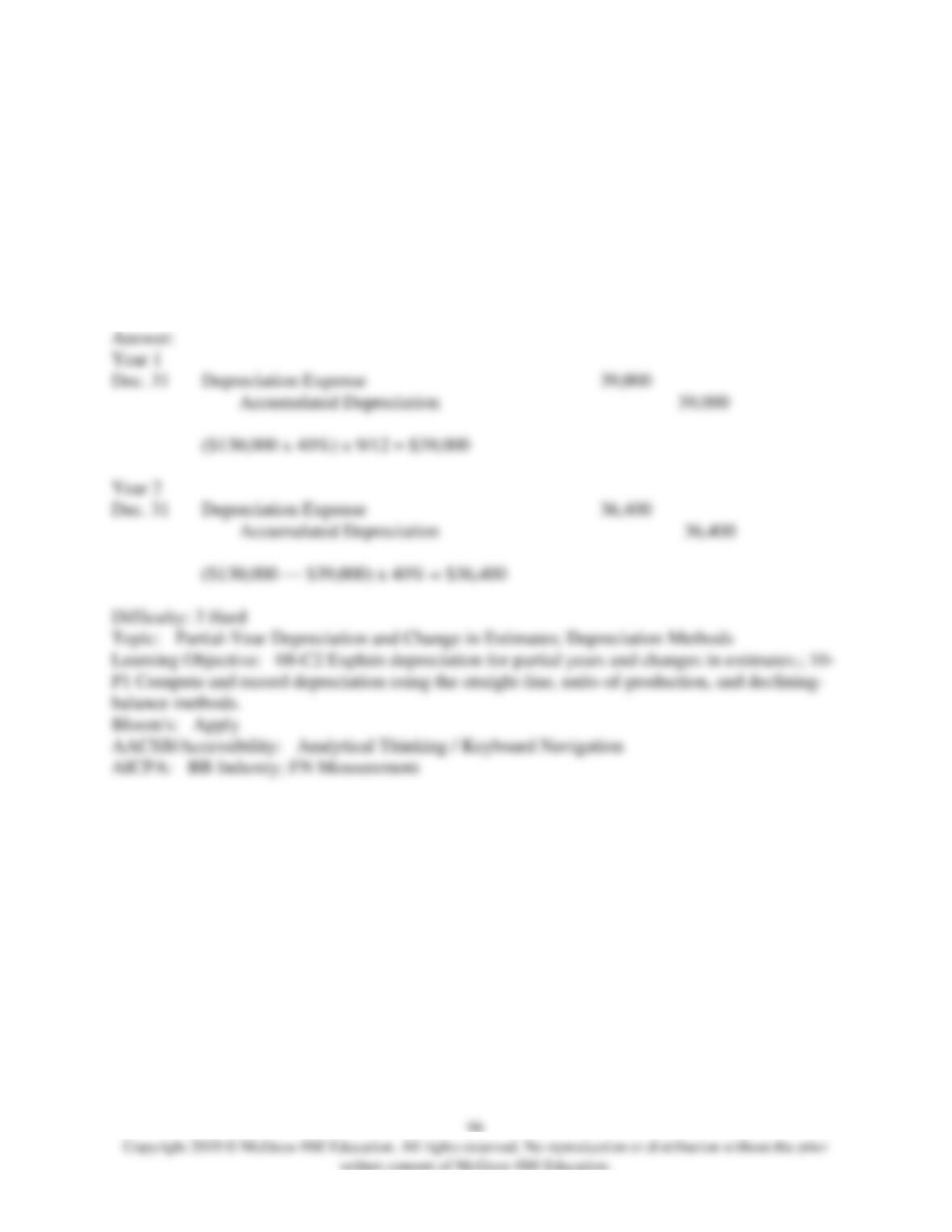
202) On April 1, Year 1, Raines Co. purchased and placed a plant asset in service. The following
information is available regarding the plant asset:
Acquisition cost
$130,000
Estimated salvage value
$15,000
Estimated useful life
5 years
Make the necessary adjusting journal entries at December 31, Year 1, and December 31, Year 2
to record depreciation for each year under the double-declining balance depreciation method:
Year 1
Dec. 31
Depreciation Expense
($130,000 x 40%) x 9/12 = $39,000
Year 2
Dec. 31
Depreciation Expense
($130,000 — $39,000) x 40% = $36,400
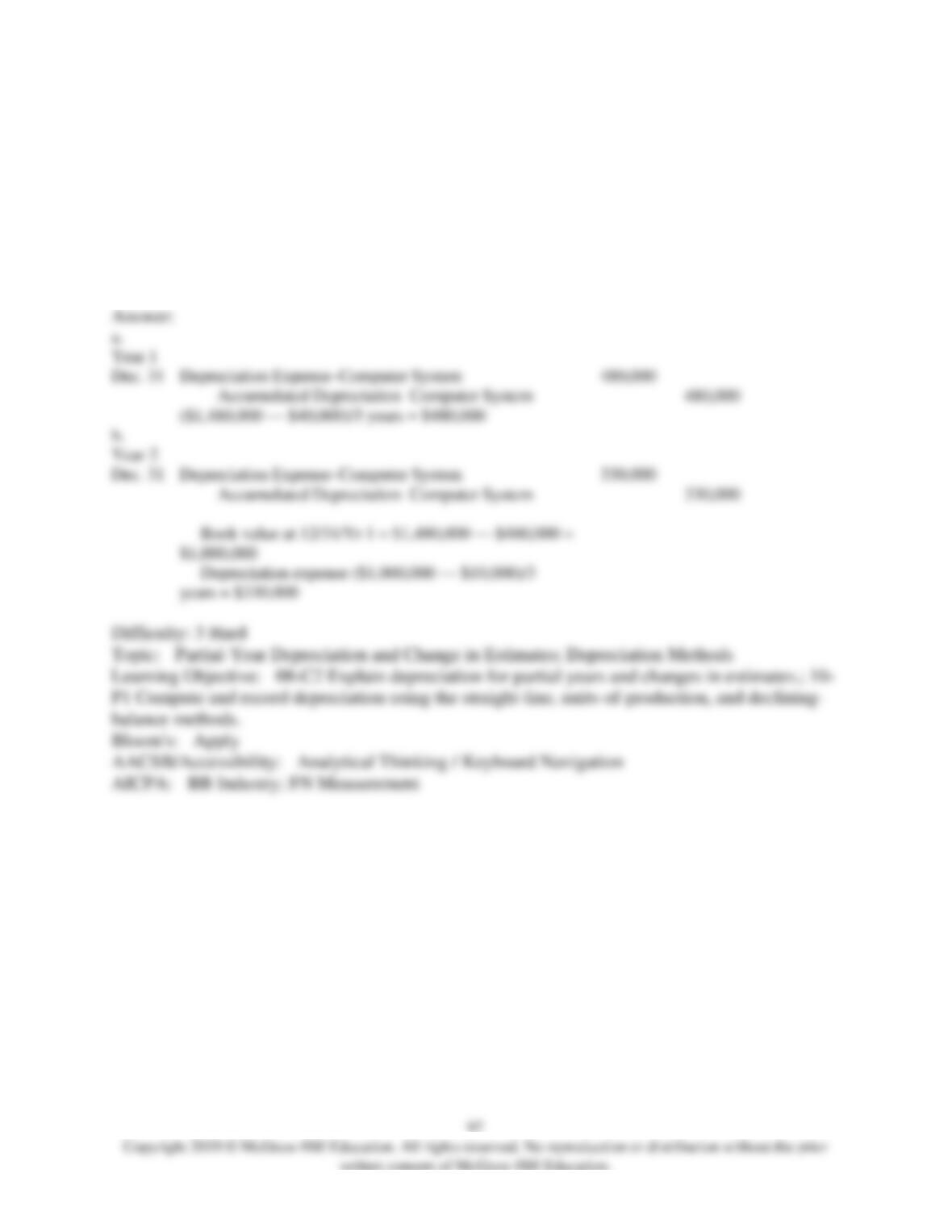
203) On January 1, Year 1, Naples purchased a computer system that cost $1,480,000. The
estimated useful life of the computer is 3 years and salvage value is $40,000. Straight-line
depreciation is to be used. On January 1, Year 2, Naples determined that the estimated useful
life of the computer would be 4 years instead of 3 years. The estimated salvage value will only
be $10,000.
Prepare the journal entry to record depreciation expense for Year 1.
Prepare the journal entry to record depreciation expense for Year 2.
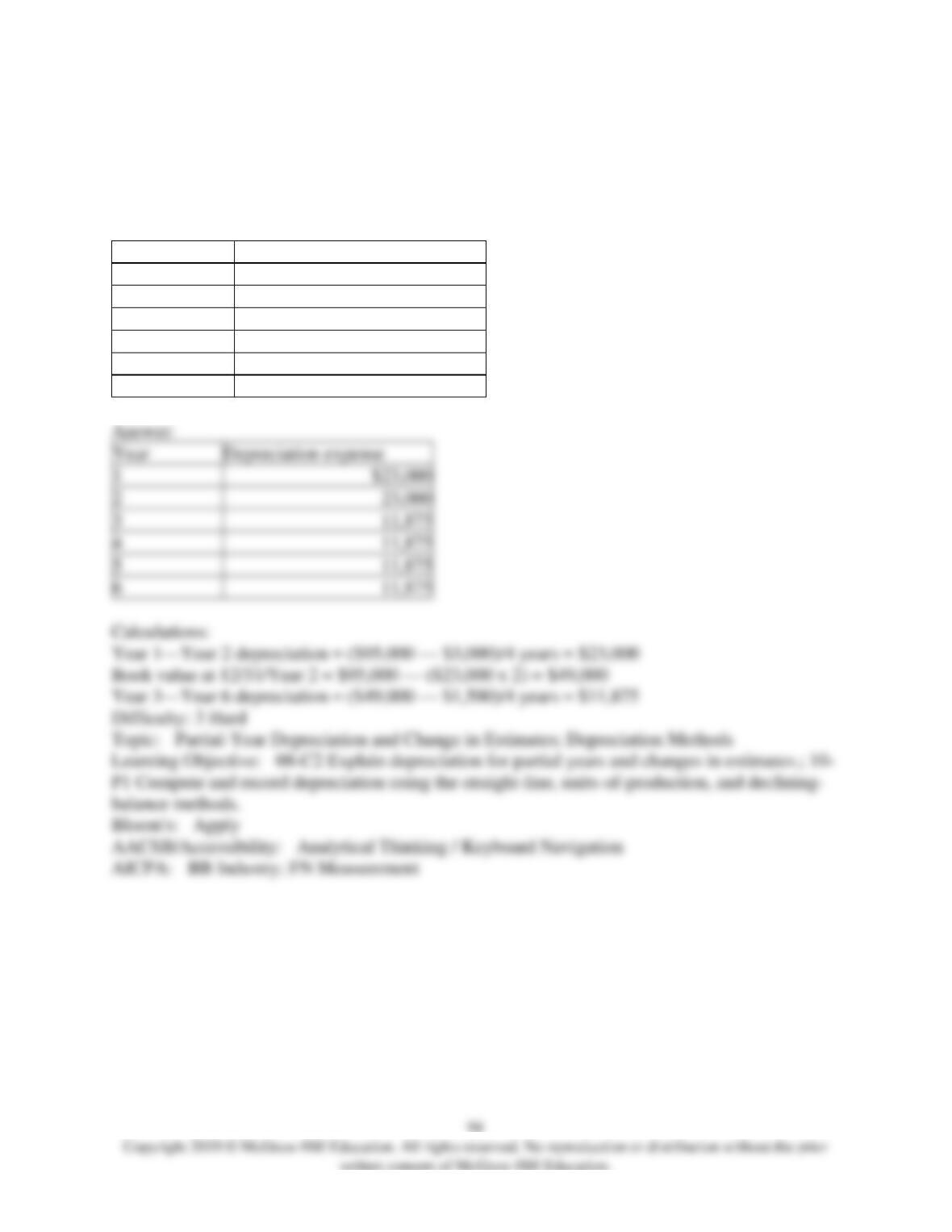
204) The Oberon Company purchased a delivery truck for $95,000 on January 2. The truck was
estimated to have a $3,000 salvage value and a 4 year life. The truck was depreciated using the
straight-line method. At the beginning of the third year, it was determined the truck’s total
useful life would be 6 years rather than 4, and the salvage at the end of the 6th year would be
$1,500. Determine the depreciation expense for the truck for the 6 years of its life.
Year
Depreciation expense
1
2
3
4
5
6
Year
Depreciation expense
1
2
3
4
5
6
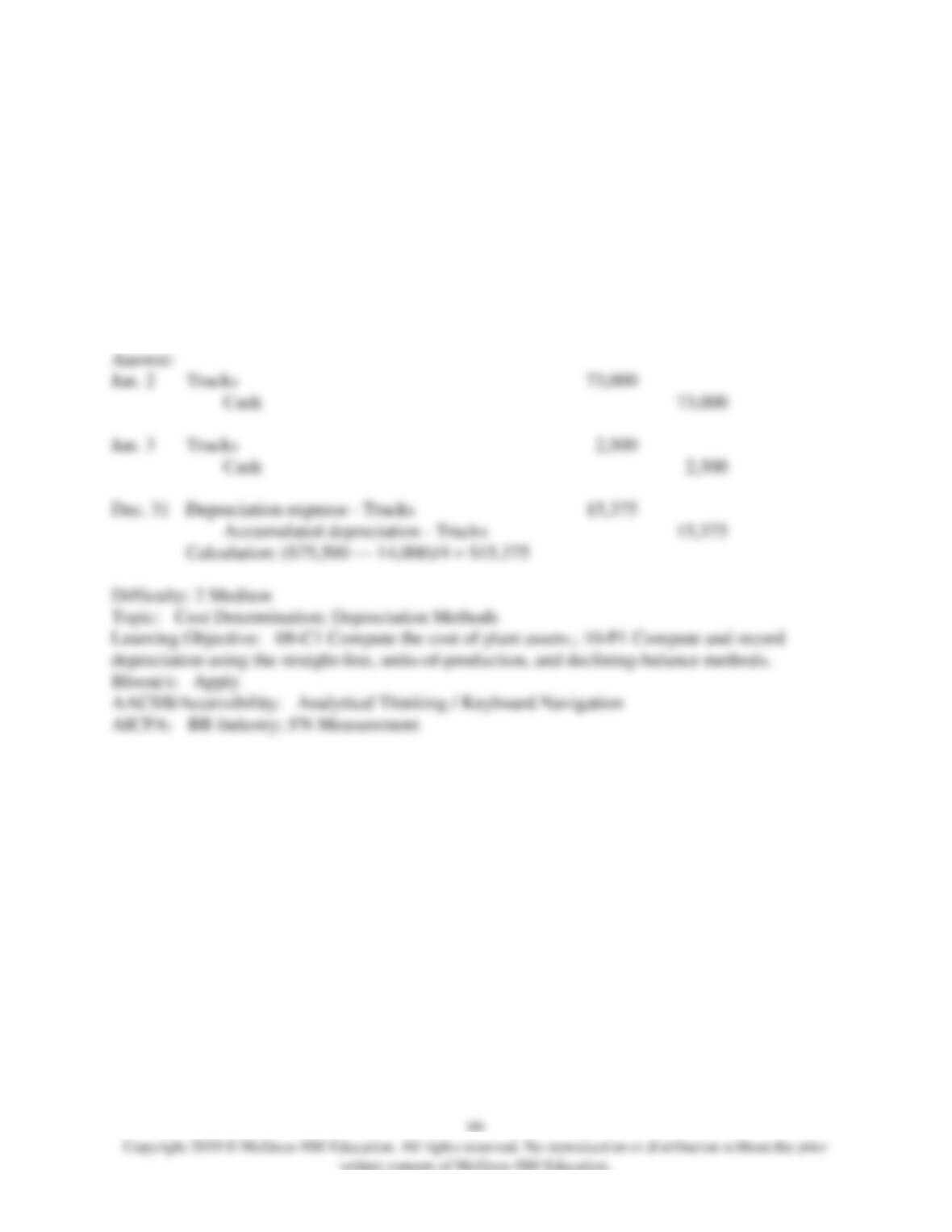
205) McClintock Co. had the following transactions involving plant assets during Year 1. Unless
otherwise indicated, all transactions were for cash.
Jan. 2
Purchased a truck for $70,000 plus sales taxes of $3,000. The truck is
expected to have a $14,000 salvage value and a 4 year life.
Jan. 3
Paid $2,500 to have the company’s logo painted on the truck. This did not
change the truck’s salvage value.
Dec. 31
Recorded straight-line depreciation on the truck.
Prepare the general journal entries to record these transactions.
Jan. 2
Trucks
Jan. 3
Trucks
Dec. 31
Depreciation expense – Trucks
Calculation: ($75,500 — 14,000)/4 = $15,375
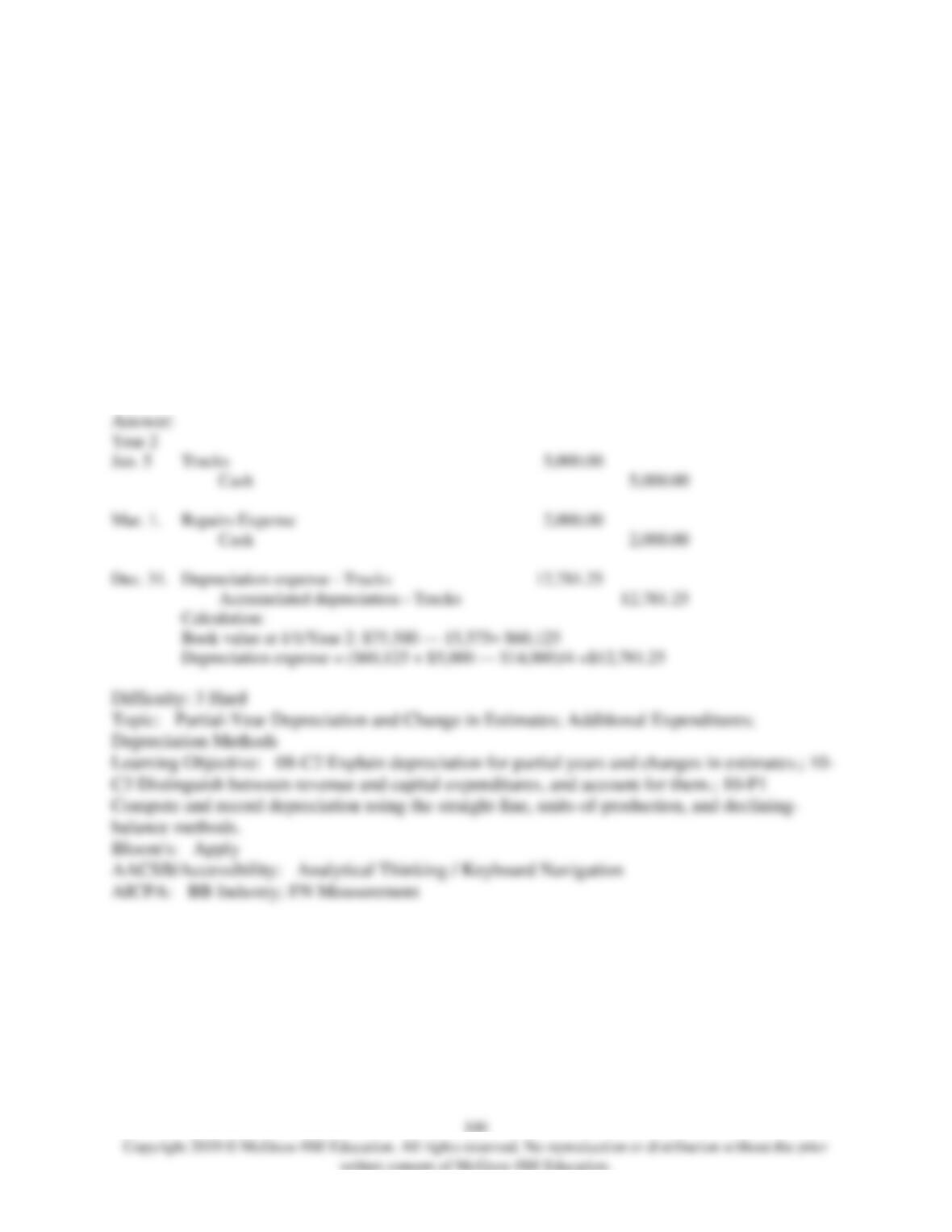
206) In year one, McClintock Co. acquired a truck that cost $75,500 with an estimated $14,000
salvage value and 4 year estimated useful life. Depreciation in the first year was $15,375.
McClintock had the following transactions involving plant assets during Year 2. Unless
otherwise indicated, all transactions were for cash.
Jan. 5
Paid $5,000 to put a new engine in the truck that is expected to make the truck
run more efficiently and increase the truck’s useful life by one year. The
salvage value did not change.
Mar. 1
Paid $2,000 to replace a broken tailgate that was damaged when a heavy
carton was inadvertently dropped on it.
Dec. 31
Recorded straight-line depreciation on the truck.
Prepare the general journal entries to record these transactions.