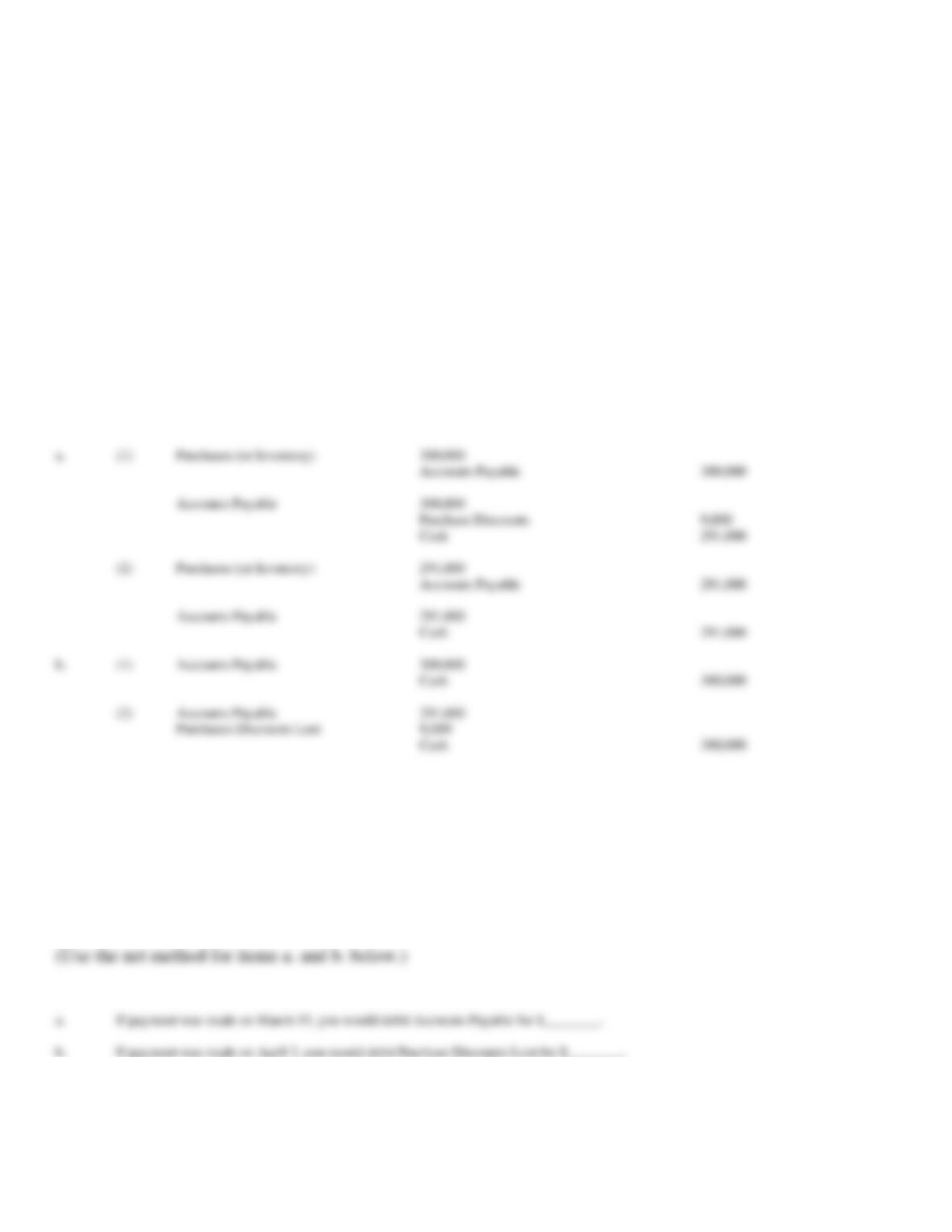
69. On January 15, Watson, Inc. purchased merchandise inventory at an invoice price of $300,000, with terms
of 3/15, n/30.
Required:
a.
Assuming that the full, appropriate payment was made on January
28, prepare journal entries to record the purchase and payment,
using:
(1)
the gross price method
(2)
the net price method
b.
Assuming that the full, appropriate payment was made on February
15, prepare journal entries to record the payment, using:
(1)
the gross price method
(2)
the net price method
70. On March 1, Sabine Electric bought $4,400 of goods with terms of 3/15, n/45.
Required:
Fill in the blanks below with dollar amounts, if any are appropriate.
If payment was made on April 3, you would debit Purchase Discounts Lost for $________.
(1)
Purchases (or Inventory)
300,000
Accounts Payable
300,000
Accounts Payable
300,000
Purchase Discounts
9,000
Cash
291,000
(2)
Purchases (or Inventory)
291,000
Accounts Payable
291,000
Cash
291,000
(1)
Accounts Payable
300,000
Cash
300,000
(2)
Accounts Payable
291,000
Purchases Discounts Lost
9,000
Cash
300,000

(Use the gross method for c. and d. below.)
c.
If payment is made on March 15, you would credit Cash for $________.
d.
Assuming no payment had yet been made, you would debit Purchase Discounts Lost for $________ in the adjusting entry at April 30
(fiscal year-end).
71. Revolution Hardware reported $300,000 of inventory on December 31, 2010, based on a physical count.
Additional information is as follows:
·
Included in the 2010 physical count were machines billed to a customer FOB shipping point on December 31. These machines had a
cost of $12,000 and had been billed at $30,000. The shipment was on Revolution’s loading dock waiting to be picked up by the carrier.
·
Goods were in transit from a vendor to Revolution. The invoice cost was $35,000 and the goods were shipped FOB shipping point on
December 29, 2010.
·
Work-in-process inventory (not included in the physical count) costing $5,000 was sent to an outside processor for finishing on
December 30, 2010.
·
Goods out on consignment amounted to $19,550 (sales price) with shipping costs of $490 (not included in sales price). Markup is 15%
on cost.
Required:
Compute the correct amount of December 31, 2010, ending inventory for Revolution Hardware.
72. At December 31, 2010, Johnson, Inc. had inventory on hand amounting to $270,000. The following items
were not included in this inventory:
·
Goods sold and still in transit, shipped Dec. 29 FOB destination, sales price $12,000, freight costs $500.
·
Goods held by Johnson on consignment from Miller Company, sales price $12,500, shipping costs $300.
·
Goods returned by customers and held pending inspection, cost $1,100.
·
On Jan. 1, 2011, a monthly freight bill for $1,600 was received. The bill specifically related to merchandise purchased in December
2010, 40 percent of which was sold in December. No related adjustment had yet been made.
a.
$4,268
$ 132
c.
$4,268
$ 0

Johnson sells at a gross profit of 25% on cost.
Required:
Compute the cost of ending inventory to be reported on the December 31, 2010, balance sheet.
73. Langston Company has provided the following information:
(1)
Included in the physical count were inventory items billed to a customer FOB shipping point on December 31, 2010. The goods had a
cost of $280 and had been billed at $400. The shipment was on Langston’s loading dock waiting to be picked up by the trucking
company.
(2)
Goods returned by customers and held pending inspection in the returned goods area on December 31, 2010, were not included in the
physical count. On January 5, 2011, the goods costing $260 were inspected and returned to inventory. Credit memos totaling $380 were
issued to the customers on the same date.
(3)
On January 3, 2011, a monthly freight bill in the amount of $170 was received. The bill specifically related to merchandise purchased in
December 2010, 30% of which was still in inventory at December 31, 2010. The freight charges had not been recorded at December 31,
2010.
(4)
Goods were shipped out on consignment on December 15, 2010, and were recorded as a sale at the sales price of $550. The consignee
has not yet sold these items. Goods are sold at a markup of 10% on cost. The goods were not included in inventory.
Required:
Langston’s unadjusted balances on December 31, 2010, for Inventory, Accounts Payable, and Sales are provided in the three columns of the schedule
below.
a.
Complete the schedule to provide the correct
adjusted balances at December 31, 2010.
Inventory
Accounts Payable
Sales
Unadjusted balances
$18,100
$9,000
$90,000
(1)
________
________
________
(2)
________
________
________
(3)
________
________
________
(4)
________
________
________
Adjusted balances
________
________
________
b.
Prepare the December 31, 2010, adjusting journal
entry that Langston would prepare to record the
freight charges described in item “c.” above.
*
$12,000 / 1.25
$1,600 – (0.4 ´ $1,600)
74. Listed below are several terms connected with inventory valuation. Following the list is a series of
descriptive statements.
a.
consignee
f.
gross price method
b.
consignor
g.
merchandise inventory
c.
finished goods inventory
h.
net price method
d.
FOB destination
i.
periodic inventory system
e.
FOB shipping point
j.
perpetual inventory system
____
1.
Goods acquired for resale.
____
2.
Goods manufactured for resale.
____
3.
Maintains an up-to-date cost of goods sold account balance.
____
4.
Establishes ending inventory by performing a physical count.
____
5.
Legal title to the inventory transfers to the buyer when the goods leave the seller’s place of business.
____
6.
Legal title to the inventory passes to the buyer when the goods reach the buyer’s place of business.
____
7.
The company that relinquishes possession to the goods so that they may be sold, while retaining ownership of the goods
until they are sold.
____
8.
The company that takes possession of the goods, but not legal title, in order to sell them.
____
9.
Records the discount only if it is taken.
____
10.
Records the discount only if it is not taken.
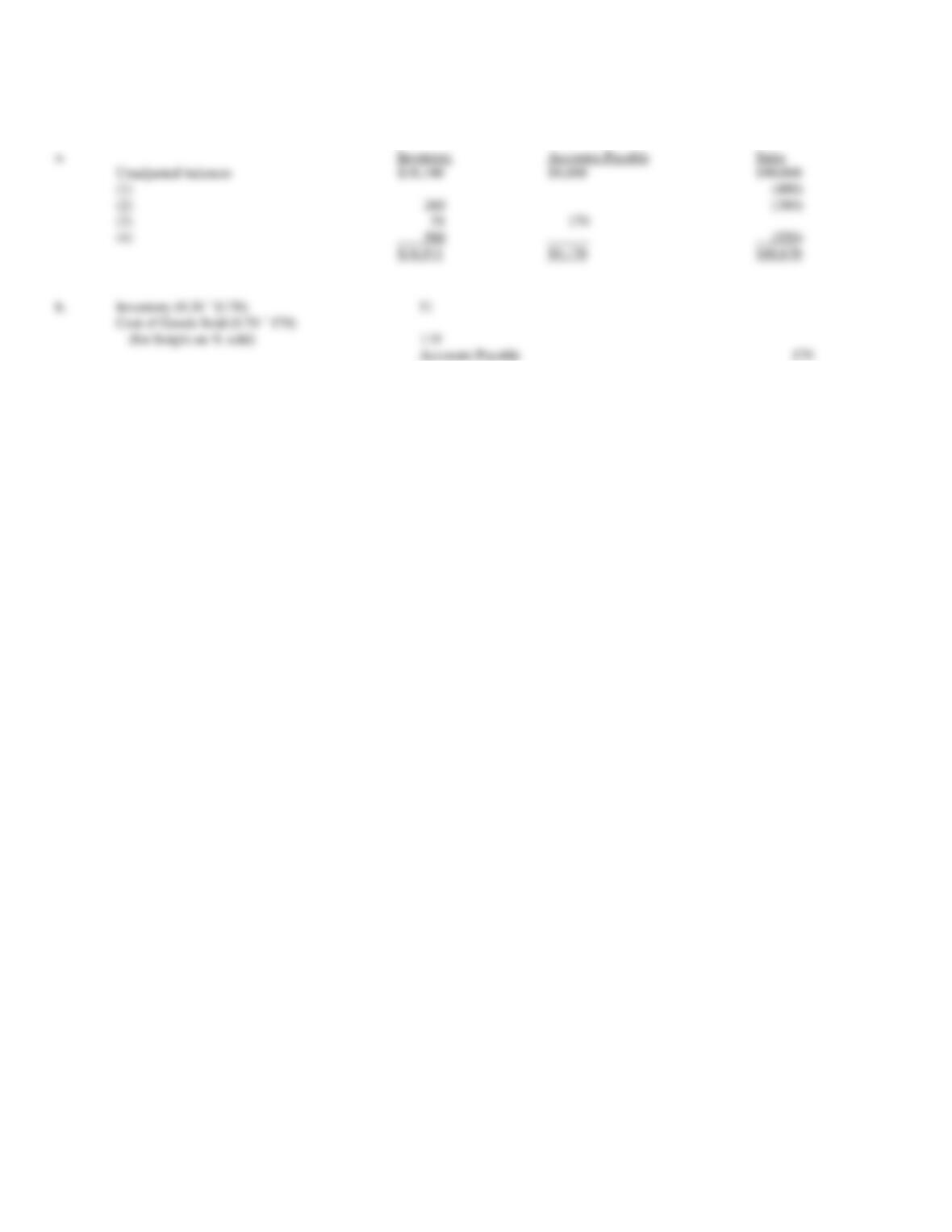
a.
Inventory
Accounts Payable
Sales
Unadjusted balances
$18,100
$9,000
$90,000
(1)
(400)
(2)
260
(380)
(3)
170
(4)
500
(550)
$18,911
$9,170
$88,670
b.
Inventory (0.30 ´ $170)
51
Cost of Goods Sold (0.70 ´ 170)
(for freight on % sold)
119
Accounts Payable
170
Required:
Match the terms to their respective descriptive statements by placing the appropriate letter in the space provided
75. On October 17, Sedona Salon Supplies bought $42,000 of goods with terms of 1/10, n/30. One-third of the
bill was paid on October 24, and the rest of the bill was paid on October 31.
Required:
Journalize for October 24 as follows:
a.
gross method of accounting for purchase discounts
b.
net method of accounting for purchase discounts
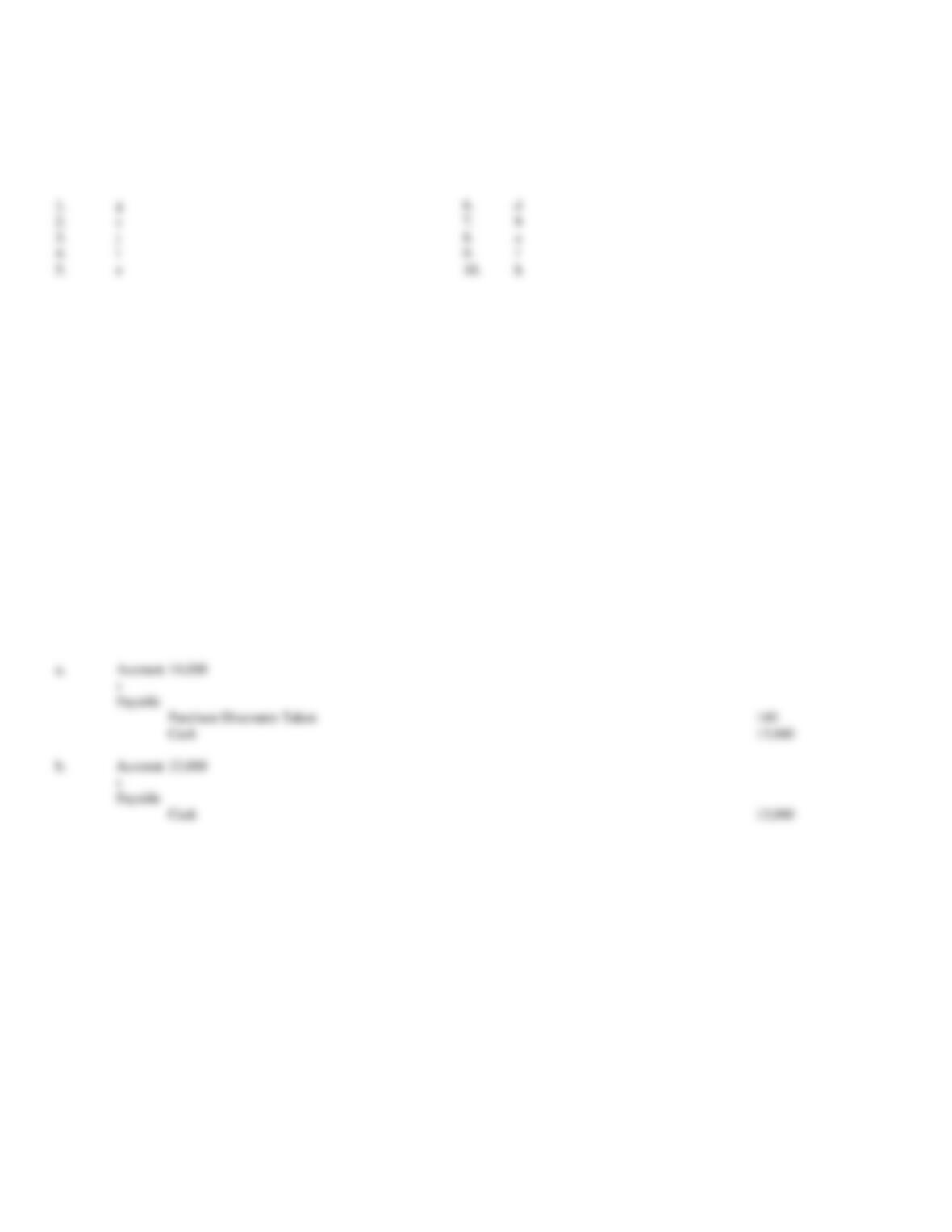
Purchase Discounts Taken
140
Cash
13,860
Cash
13,860
76. Matrix Company has provided the following inventory data for 2010:
Transaction
Units
Cost per Unit
1/1
Balance
50
$ 7
2/14
Sale
25
5/23
Purchase
100
9
8/21
Sale
50
11/5
Purchase
25
13
11/18
Sale
95
1.
g
6.
d
2.
c
7.
b
3.
j
8.
a
i
f
5.
e
10.
h
Required:
Compute the cost of goods sold and the ending inventory using the periodic inventory system for each of the following cost flow assumptions:
a.
FIFO
b.
LIFO
c.
weighted average
77. On July 1, the Lavaca Company began business with the purchase of 250 units of inventory for $21,625.
During the month, Lavaca had the following inventory transactions:
Date
July 6
Purchased 100 units @ $75 per unit.
11
Sold 200 units.
17
Sold 85 units.
24
Purchased 100 units @ $125 per unit.
28
Purchased 50 units @ $110 per unit.
30
Sold 100 units.
Required:
Compute the cost of the inventory at the end of July under the following alternatives:
a.
FIFO periodic
b.
FIFO perpetual
c.
LIFO periodic
d.
LIFO perpetual
e.
Weighted average (round unit costs to 2 decimal places)
f.
Moving average (round unit costs to 2 decimal places)
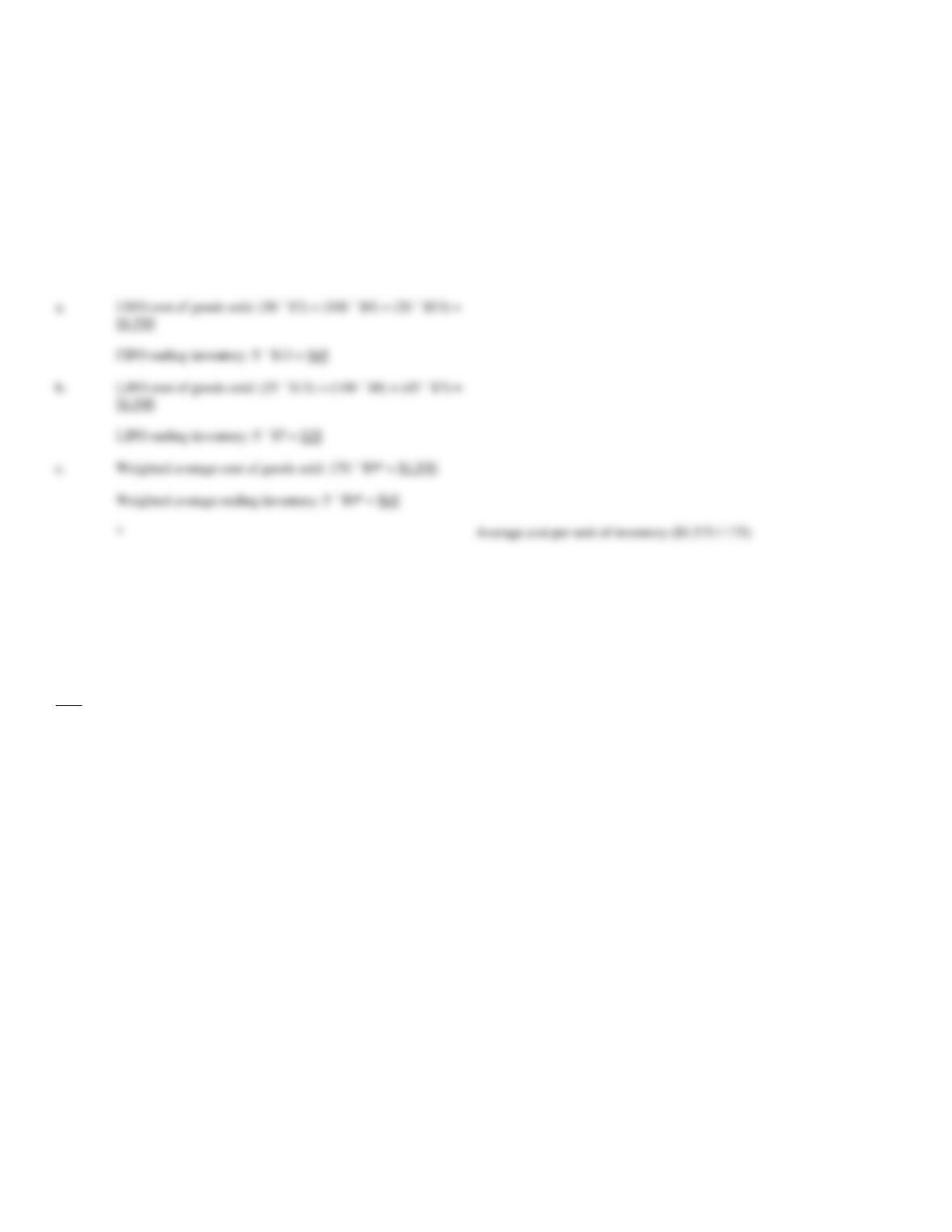
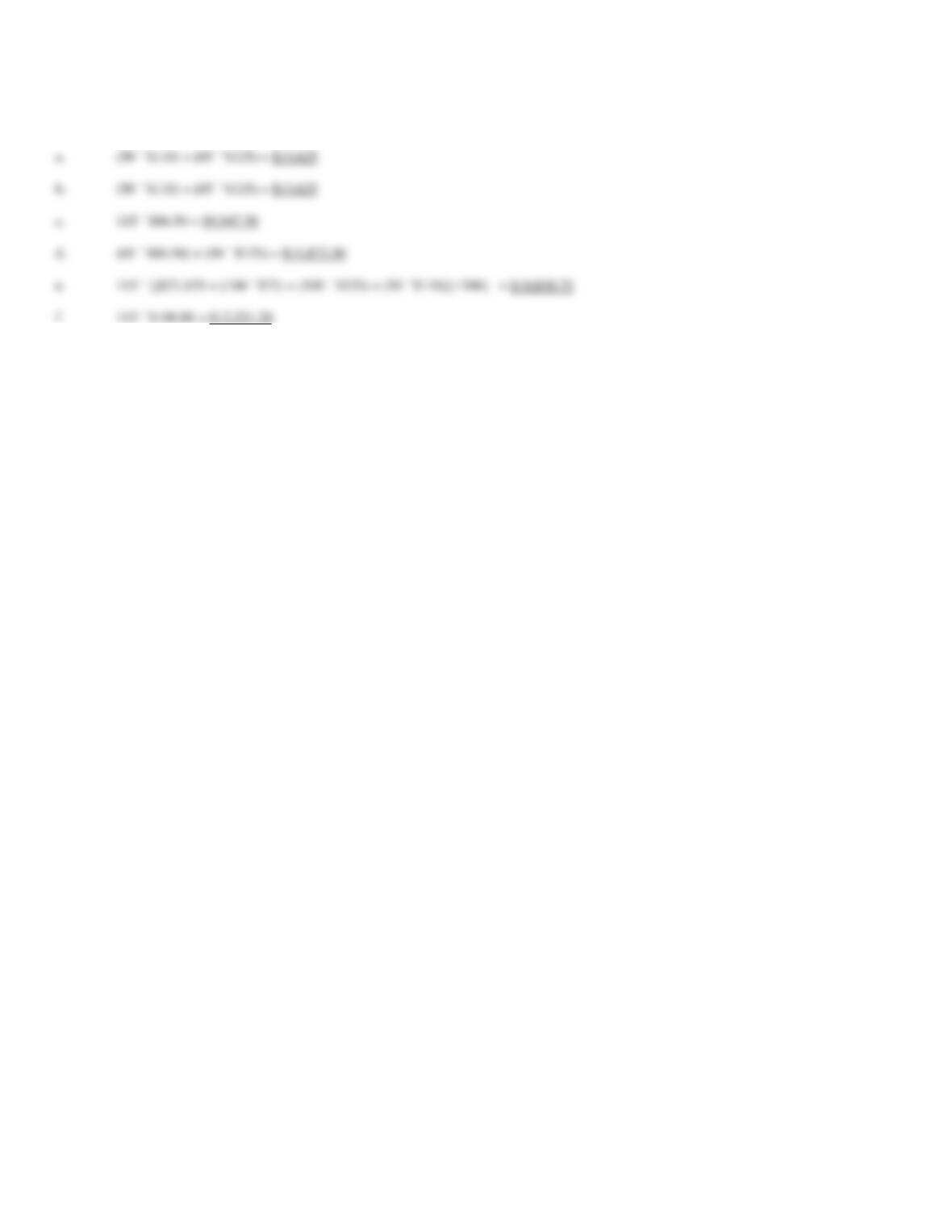
FIFO ending inventory: 5 ´ $13 = $65
LIFO ending inventory: 5 ´ $7 = $35
c.
Weighted average cost of goods sold: 170 ´ $9* = $1,530
Weighted average ending inventory: 5 ´ $9* = $45
*
78. The following information is available for Crystal Company:
Jan. 1
Beginning inventory
15 units @ $12.00 each
Jan. 9
Purchase
10 units @ $16.00 each
Jan. 14
Sale
6 units
Jan. 20
Purchase
6 units@ $18.00 each
Jan. 26
Sale
9 units
Required:
Answer the following questions for Crystal Company:
a.
If FIFO is in use, what is the ending inventory in dollars?
b.
If periodic LIFO is in use, what is the cost of goods sold?
c.
If moving average is in use, what is the ending inventory in dollars (round calculations to nearest cent)?
d.
If weighted average is in use, what is the ending inventory in dollars (round unit cost to the nearest cent)?
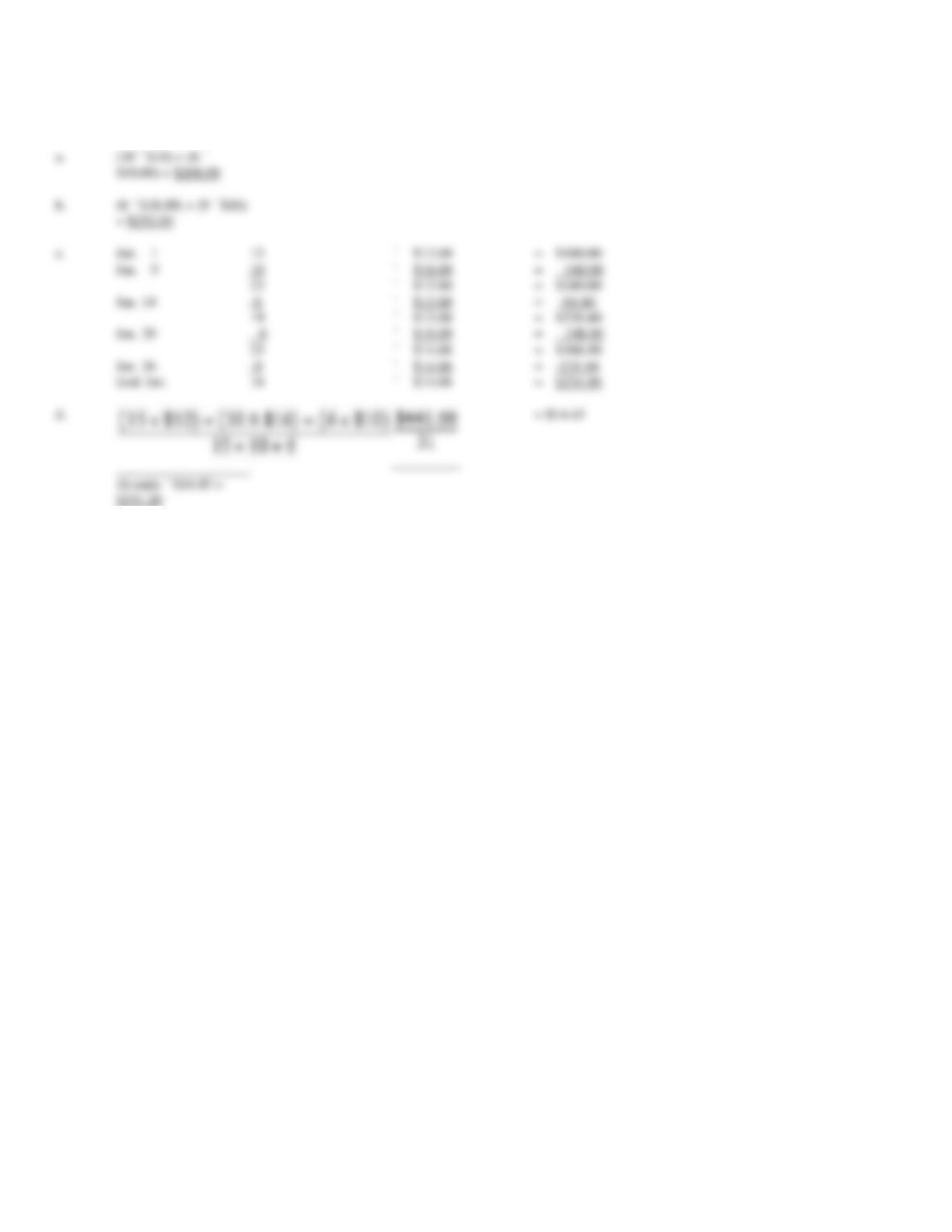
a.
(50 ´ $110) + (65 ´ $125) = $13,625
(50 ´ $110) + (65 ´ $125) = $13,625
c.
115 ´ $86.50 = $9,947.50
(65 ´ $86.50) + (50 ´ $125) = $11,872.50
e.
115 ´ {[$21,625 + (100 ´ $75) + (100 ´ $125) + (50 ´ $110)] / 500} = $10,838.75
115 ´ $108.88 = $12,521.20
79. Given the following information for Glade Company:
Jan. 1
Beginning inventory
18 units @ $4 each
Jan. 7
Purchase
12 units @ $5 each
Jan. 10
Sale
14 units
Jan. 17
Purchase
10 units @ $6 each
Jan. 19
Sale
4 units
Required:
Answer the following questions for Glade Company:
a.
If FIFO is in use, what is total ending inventory in dollars?
b.
If perpetual LIFO is in use, what is cost of goods sold for the month?
c.
If weighted average is in use, what is ending inventory?
d.
If moving average is in use, what is the cost per unit sold for the January 10 sale?
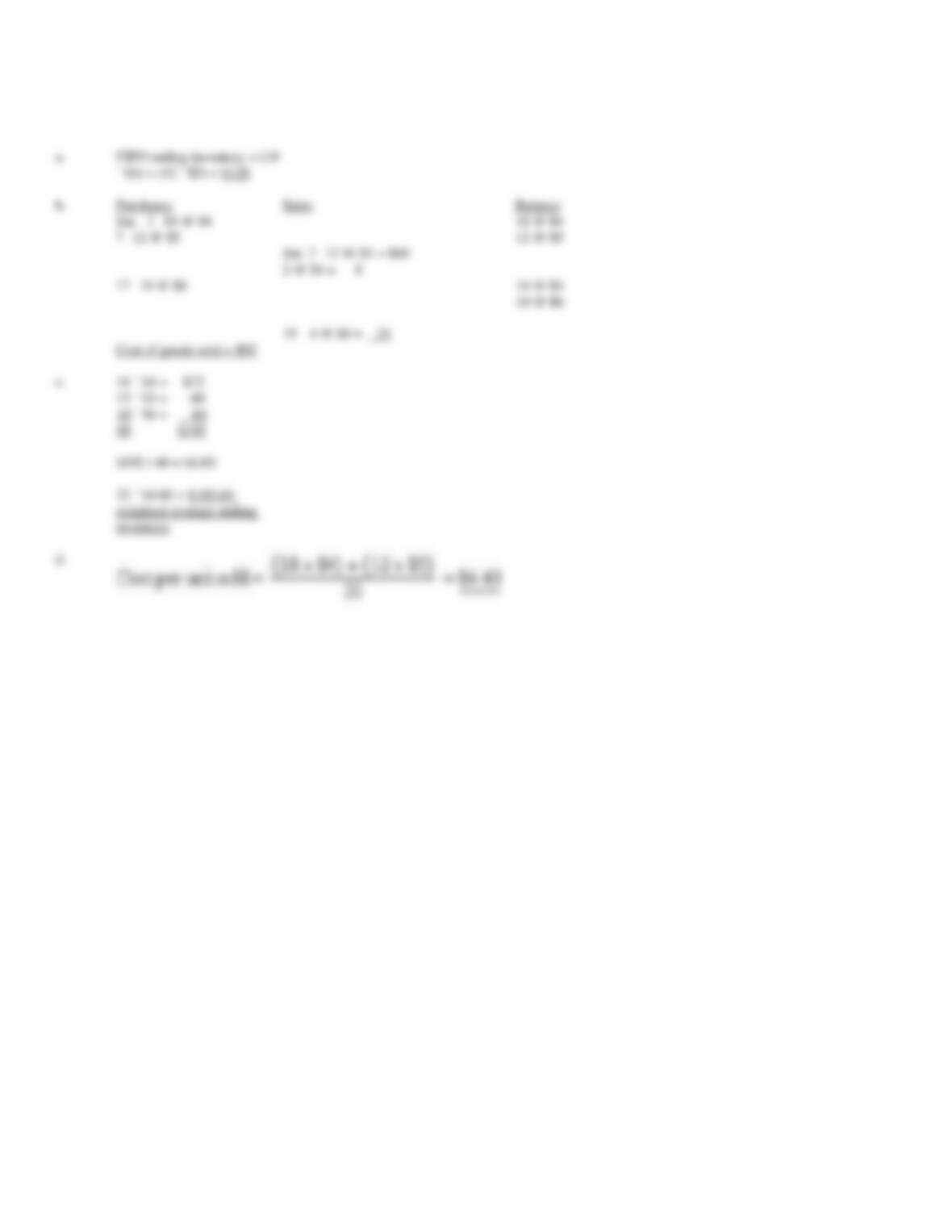
Jan. 1
15
´ $12.00
= $180.00
Jan. 9
10
´ $16.00
= 160.00
25
´ $13.60
= $340.00
Jan. 14
-6
´ $13.60
= -81.60
19
´ $13.60
= $258.40
Jan. 20
6
´ $18.00
= 108.00
25
´ $14.66
= $366.40
Jan. 26
-9
´ $14.66
= -131.94
End. Inv.
16
´ $14.66
= $234.46
80. Quicksilver adopted LIFO in January 1, 2010, when the inventory had a FIFO cost of $180,000 ($10 per
unit). At the end of 2010, inventory consisted of 18,750 units at $12 per unit, and the ending inventory for 2011
consisted of 20,000 units at $15 per unit.
Required:
a.
Calculate the cost index to be used for 2010 and 2011 using the link-chain method.
b.
Compute the ending inventory for 2010 and 2011 using dollar-value LIFO.
Purchases
Sales
Balance
Jan. 1 18 @ $4
18 @ $4
7 12 @ $5
12 @ $5
Jan. 7 12 @ $5 = $60
2 @ $4 = 8
16 @ $4
10 @ $6
19 4 @ $6 = 24
Cost of goods sold = $92
c.
18 ´ $4 = $72
12 ´ $5 = 60
$192 / 40 = $4.80
inventory
81. On December 31, 2009, the current cost of the Greene Company’s ending inventory was $10,000 when the
cost index was 100. On January 1, 2010, Greene adopted the dollar value LIFO method of inventory costing.
Information from the company’s ending inventory records is as follows:.
Ending Inventory
Cost
Reported at
Year
Index
Dollar-Value LIFO
2010
110
$10,000
2011
125
15,500
2012
140
16,340
Required:
Determine the current cost of Greene’s ending inventory for the years 2010, 2011, and 2012.
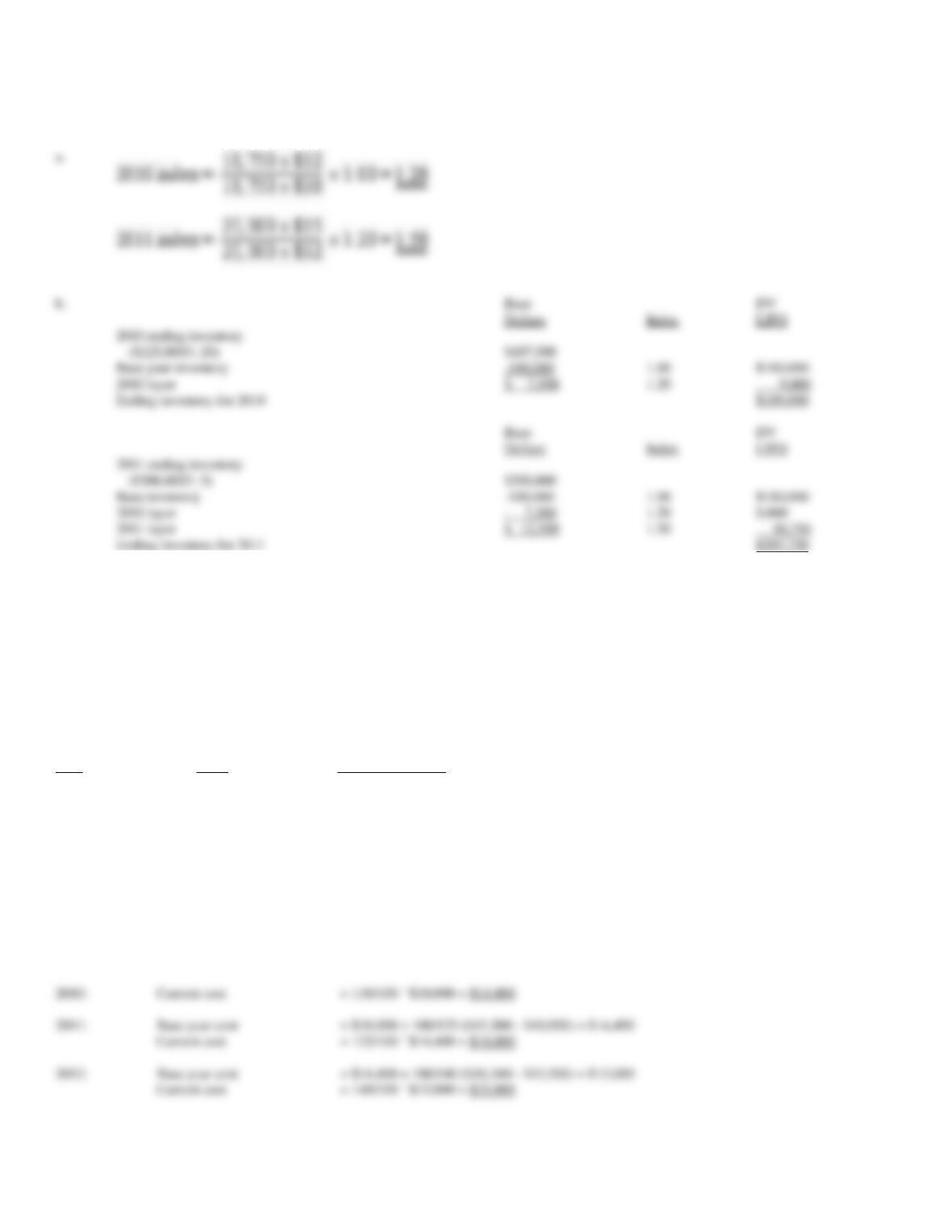
2010:
Current cost
= 110/100 ´ $10,000 = $11,000
2011:
Base year cost
= $10,000 + 100/125 ($15,500 – $10,000) = $14,400
Current cost
= 125/100 ´ $14,400 = $18,000
2012:
Base year cost
= $14,400 + 100/140 ($16,340 – $15,500) = $15,000
b.
Base
Dollars
Index
LIFO
2010 ending inventory
($225,000/1.20)
$187,500
Base year inventory
-180,000
1.00
$180,000
Ending inventory for 2010
$189,000
Base
Dollars
Index
LIFO
2011 ending inventory
($300,000/1.5)
$200,000
Base inventory
-180,000
1.00
$180,000
2010 layer
– 7,500
1.20
9,000
2011 layer
$ 12,500
1.50
18,750
Ending inventory for 2011
$207,750
82. The information below is provided for Sedona Company:
Ending Inventory
Price-Level
Year
End-of-Year Prices
Index
2009
$ 90,000
100
2010
97,650
105
2011
103,550
109
2012
109,760
112
Required:
a.
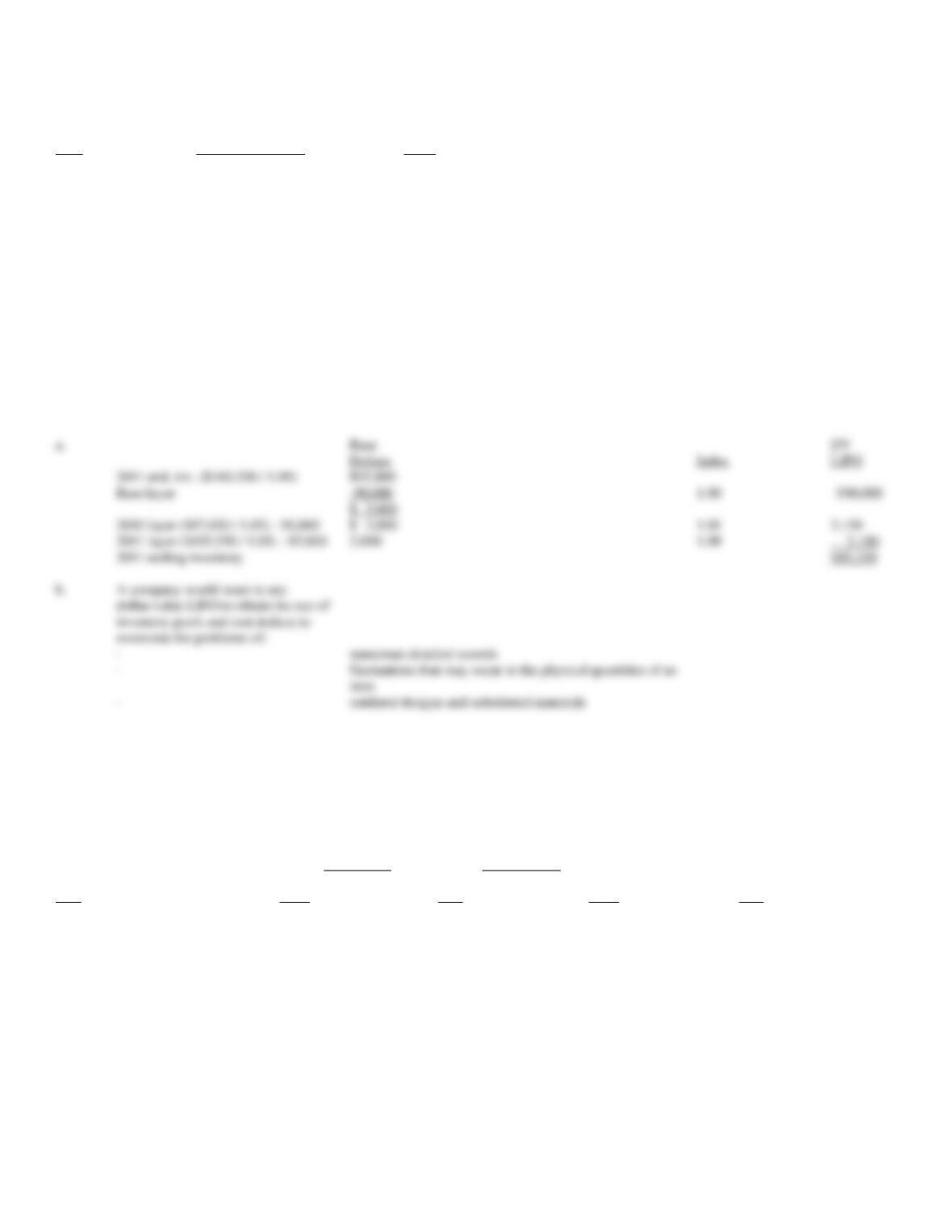
Compute the ending inventory for Sedona Company using dollar-value LIFO for 2011.
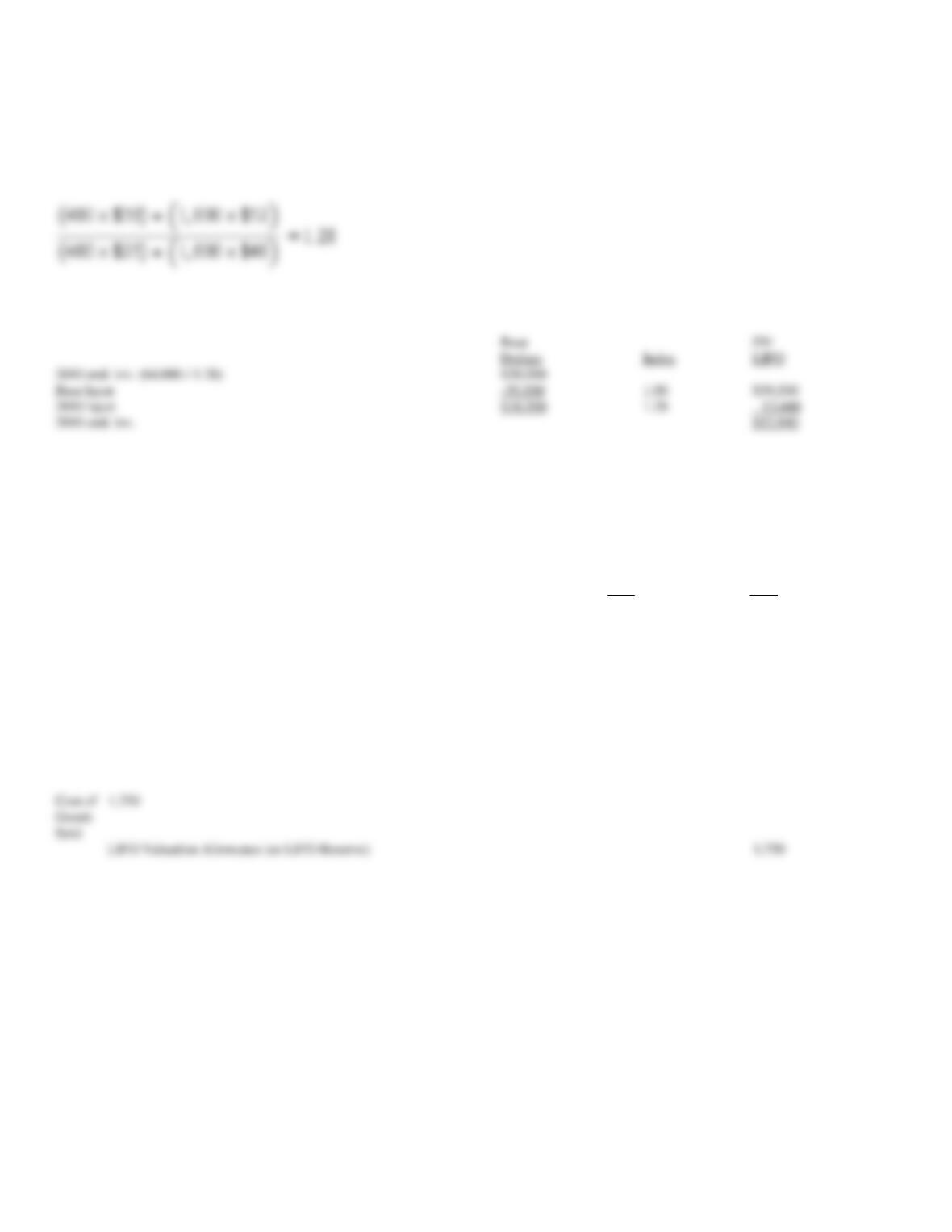
b.
Explain why a company would want to use dollar-value LIFO.
83. The information below is provided for two inventory items held by Haskell, Inc.:
Base
Jan. 1, 2010
Dec. 31, 2010
No. of
Cost per
No. of
Cost per
Item
Units
Unit
Units
Unit
Tapes
300
$25.00
400
$30.00
Extenders
800
40.00
1,000
52.00
Base
Dollars
Index
LIFO
2011 end. inv. ($103,550 / 1.09)
$95,000
Base layer
-90,000
1.00
$90,000
$ 5,000
2010 layer ($97,650 / 1.05) – 90,000
$ 3,000
1.05
3,150
2011 layer ($103,550 / 1.09) – 93,000
2,000
1.09
2,180
2011 ending inventory
$95,330
·
numerous detailed records
·
outdated designs and substituted materials
The company uses double-extension dollar-value LIFO with only one pool.
Required:
Calculate the December 31, 2010 ending inventory for Haskell using dollar-value LIFO. Round to the nearest dollar or to the nearest hundredth for
decimals.
84. Cabinets-R-Us uses FIFO for internal reporting purposes and LIFO for financial and income tax purposes.
At the end of 2010, the following information was obtained from the inventory records:
2009
2010
Ending inventory, FIFO
$56,000
$66,250
Ending inventory, LIFO
46,500
55,000
Required:
Prepare the necessary entry to convert to LIFO at the end of 2010.
Sold
LIFO Valuation Allowance (or LIFO Reserve)
1,750
85. Martinez Video began the current quarter with the following inventory: 900 units @ $10 per unit and 250
units @ $12 per unit. During the quarter, Martinez purchased 400 units @ $13 per unit and sold 680 units.
Martinez prepares interim financial statements each quarter.
Required:
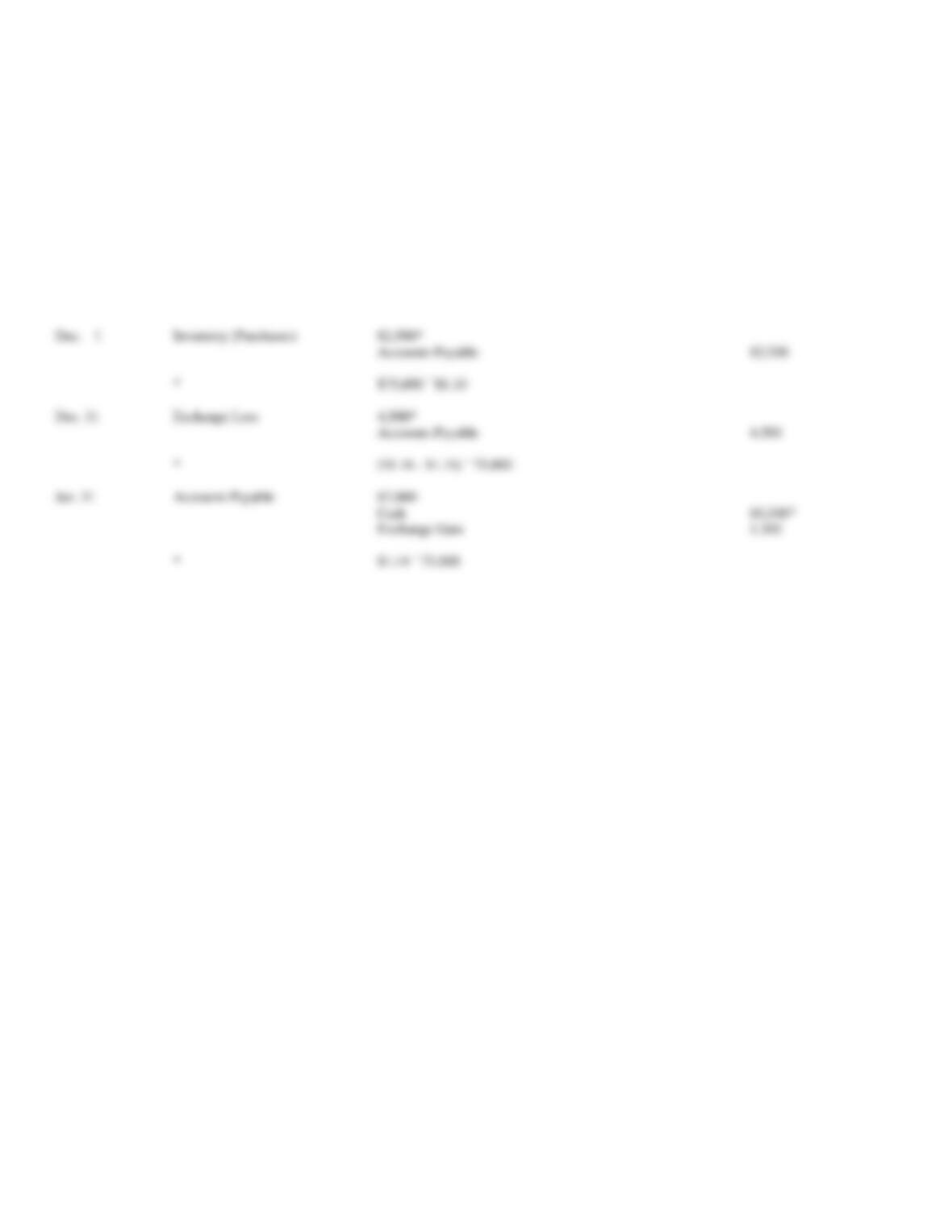
a.
Determine the amount of LIFO liquidation profit for the quarter.
b.
Assume the liquidation is not to be reflected in the current quarter’s financial statements. Prepare the necessary adjusting entry.
c.
Explain the circumstances when an inventory liquidation is not reported on interim financial statements.
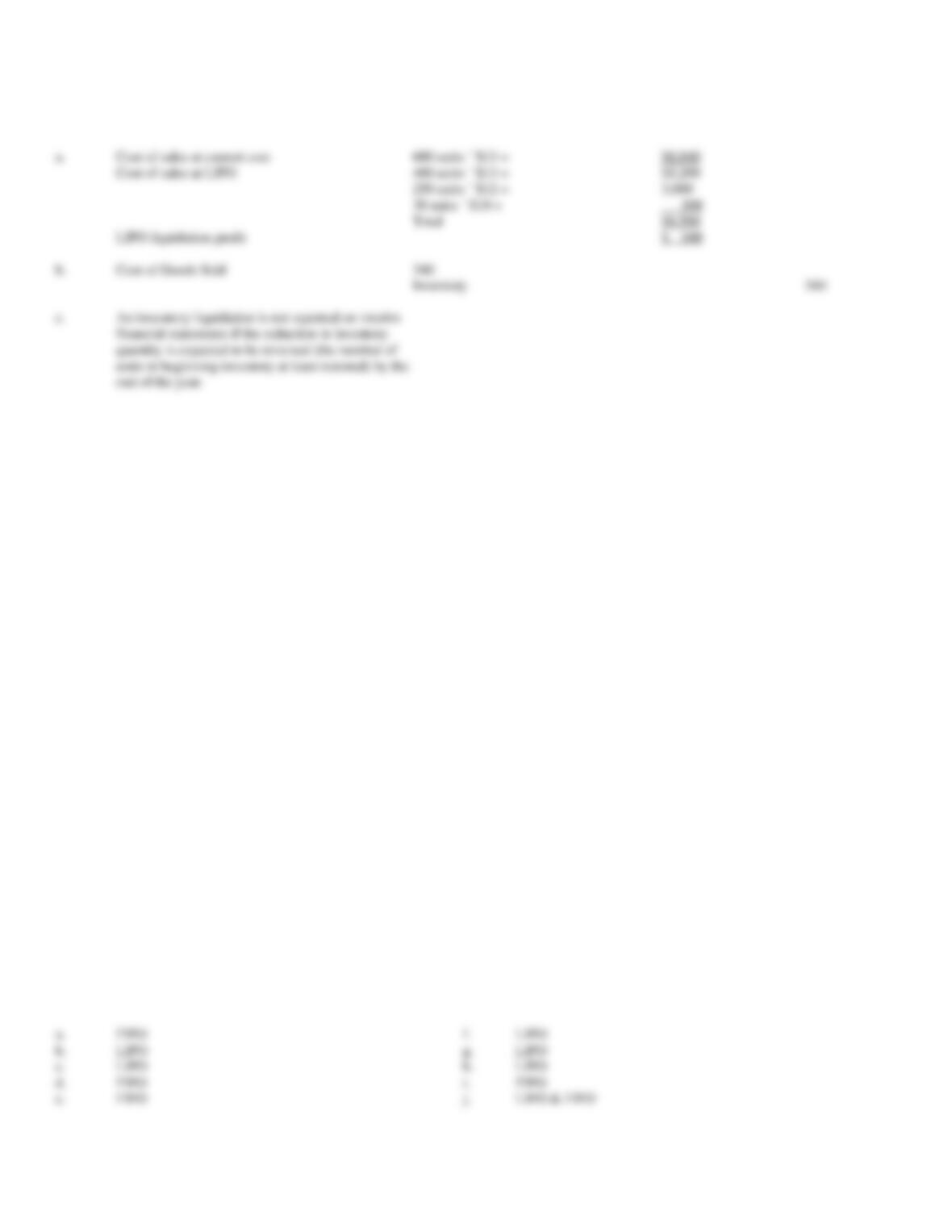
Dollars
Index
LIFO
2010 end. inv. (64,000 / 1.28)
$50,000
Base layer
-39,500
1.00
$39,500
2010 layer
$10,500
1.28
13,440
86. There are many differences between inventory cost flow assumptions. Listed below is a series of descriptive
statements.
LIFO
FIFO
_____
_____
a.
Requires increased cash outflows during periods of rising prices.
_____
_____
b.
Places the most recent costs in cost of goods sold.
_____
_____
c.
Is susceptible to possible income manipulation.
_____
_____
d.
Includes all of the holding gains in income.
_____
_____
e.
Usually approximates the physical flow of goods.
_____
_____
f.
Is required for financial reporting when used for income taxes.
_____
_____
g.
Results in liquidation profits when unit sales exceed purchases.
_____
_____
h.
Impairs comparability between companies.
_____
_____
i.
Emphasizes the balance sheet valuation of inventory.
_____
_____
j.
Can be used with either periodic or perpetual inventory systems.
Required:
For each statement, indicate if it applies to LIFO or FIFO or both by placing an “X” in the appropriate column(s).
a.
FIFO
f.
LIFO
b.
LIFO
g.
LIFO
LIFO
LIFO
a.
Cost of sales at current cost
680 units ´ $13 =
$8,840
Cost of sales at LIFO
400 units ´ $13 =
$5,200
250 units ´ $12 =
3,000
30 units ´ $10 =
300
Total
$8,500
LIFO liquidation profit
$ 340
b.
Cost of Goods Sold
340
Inventory
340
87. Wilson Inc. purchased merchandise on account from a French supplier on December 1, 2010. This
transaction was for 75,000 euros. Wilson’s accounting year ends December 31. Payment was made on January
31, 2011. The exchange rates during this period were as follows:
December 1
$1.10/euro
December 31
1.16/euro
January 31
1.14/euro
Required:
Prepare the necessary journal entries to record this purchase and subsequent payment.
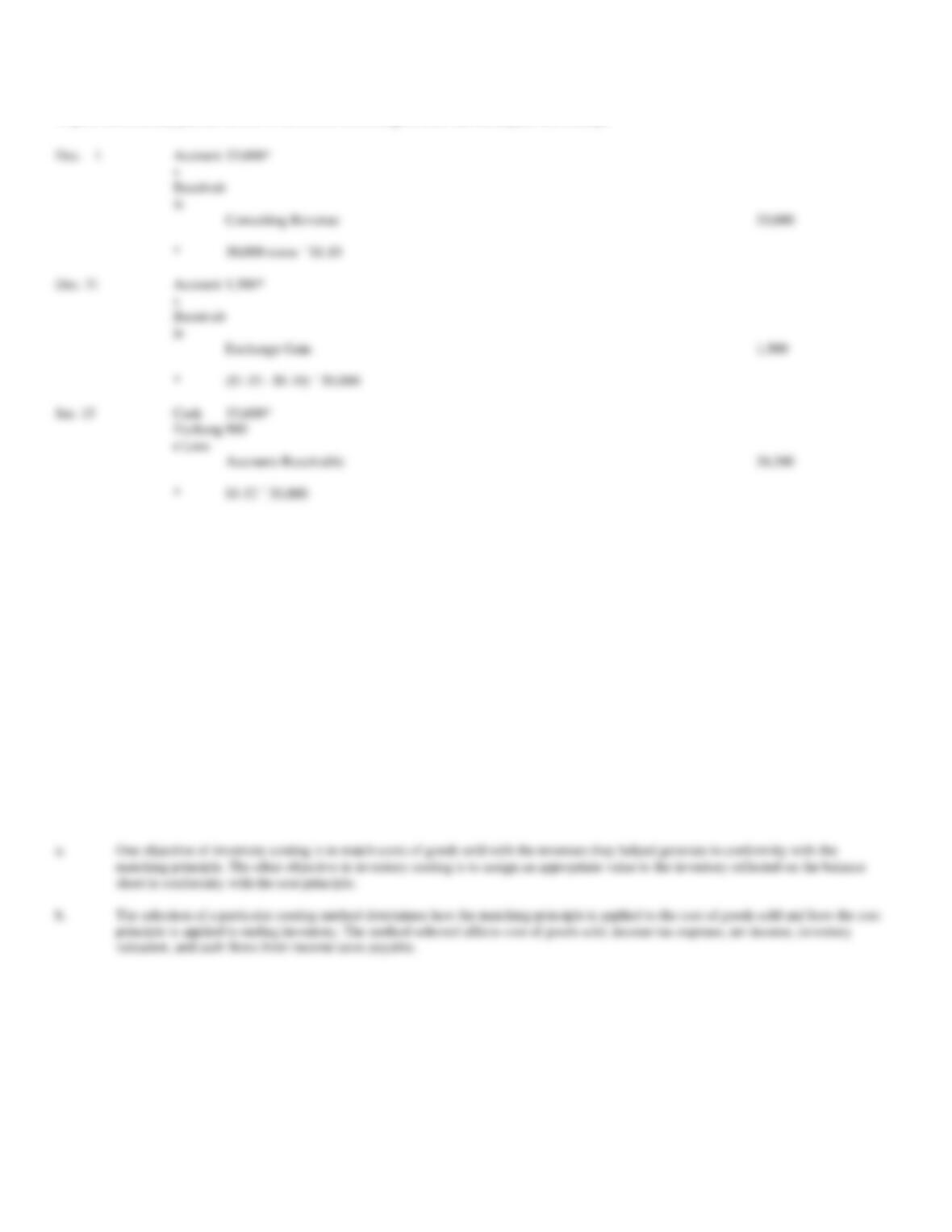
88. Johnson Industries performed consulting services on account for a German customer on December 1, 2010.
This transaction was for 30,000 euros. Johnson’s accounting year ends December 31. The invoice amount was
received by Johnson on January 15, 2011. The exchange rates during this period were as follows:
December 1
$1.10/euro
December 31
1.15/euro
January 15
1.12/euro
Dec. 1
Inventory (Purchases)
82,500*
Accounts Payable
82,500
Dec. 31
Exchange Loss
4,500*
Accounts Payable
4,500
*
($1.16 – $1.10) ´ 75,000
Jan. 31
Accounts Payable
87,000
Cash
85,500*
Exchange Gain
1,500
*
$1.14 ´ 75,000
Required:
Prepare the necessary journal entries to record this consulting revenue and subsequent cash receipt.
89. There are many different methods available for costing inventory. Therefore, the decision on which method
to select should involve some serious thought as to the consequences involved.
Required:
a.
Discuss the objectives of inventory costing in terms of accounting principles.
b.
Explain the consequences of the method selected.
Consulting Revenue
33,000
*
30,000 euros ´ $1.10
Exchange Gain
1,500
*
($1.15 – $1.10) ´ 30,000
Jan. 15
Cash
33,600*
Accounts Receivable
34,500
*
$1.12 ´ 30,000
90. Because the specific identification method is used so often in the retail industry, it may appear to be the
ideal cost flow assumption to be used in any situation.
Required:
Indicate whether a periodic or perpetual inventory system is more appropriate for this cost flow assumption,
indicate when its use is practical, and discuss the practical and theoretical objections to its use.
91. One of the disadvantages of the LIFO cost flow assumption is the impact of the liquidation of LIFO layers.
Required:
a.
Explain what is meant by inventory liquidation under the LIFO cost flow assumption.
b.
Discuss why this may be a serious problem for LIFO but not for FIFO.
92. Even though the LIFO cost flow assumption will reduce taxable income and the related cash outflow for
income taxes, there are certain difficulties encountered with its implementation. Thus, dollar-value LIFO is
often used.
Required:
Discuss three different ways that the dollar-value LIFO method overcomes some of the difficulties in the
application of the LIFO approach.
93. The IFRS disallow the use of LIFO for external financial reporting. Assume a U.S. based company has been
using LIFO for financial and tax reporting but now wants to prepare IFRS conforming financial statements to
enable its stock to be traded on one of the European stock exchanges.
Required:
a.
Describe the adjustments that the U.S.-based company must make to its accounting records to conform with IFRS.
b.
What choices of inventory accounting methods would be available to the U.S. company under IFRS?
retained earnings of each year reported would be restated to FIFO cost.
b.
All methods other than LIFO are acceptable under IFRS. However, IFRS require that the method selected be adopted for all inventories.