115) The financial statements of Franklin Company contained the following errors:
Item
December
31, 2019
December
31, 2020
Depreciation expense
on office equipment
$1,000
understated
$900
overstated
A. Was net income for 2019 understated or overstated? Briefly explain your answer.
B. 1. Considering the effect of the errors of both years at December 31, 2020, is retained
earnings overstated or understated, and by what amount?
2. Briefly explain your answer to part B (1).
116) On January 1, 2018, Boston Company purchased a heavy duty machine having an invoice
price of $13,000. Boston paid transportation and installation costs totaling $3,000. The machine
is estimated to have a 4-year useful life and a $1,400 residual value.
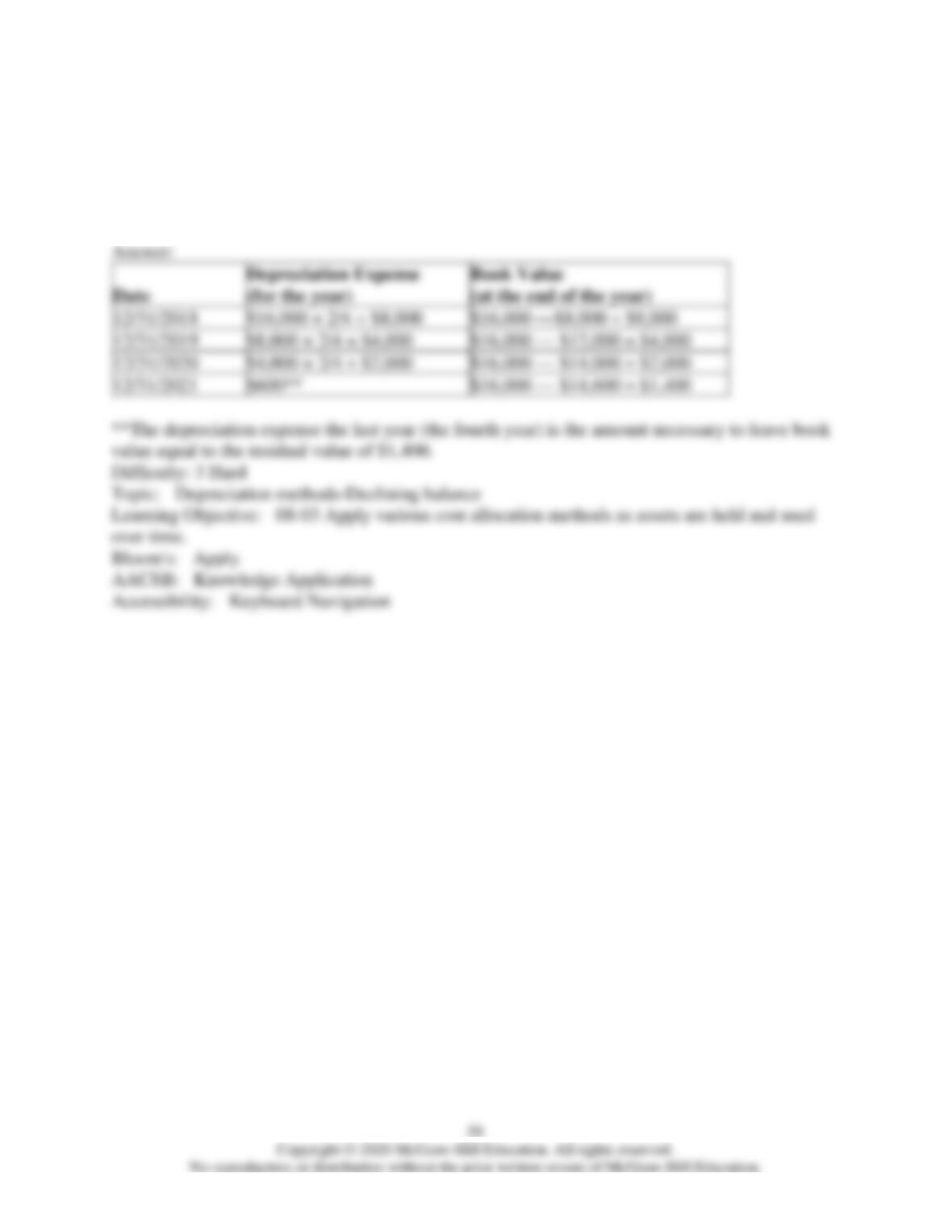
Calculate depreciation expense and book value for 2018-2021, assuming double declining-
balance method of depreciation.
117) Covey Company purchased a machine on January 1, 2019, by paying cash of $250,000. The
machine has an estimated useful life of five years, is expected to produce 500,000 units, and has
an estimated residual value of $25,000.
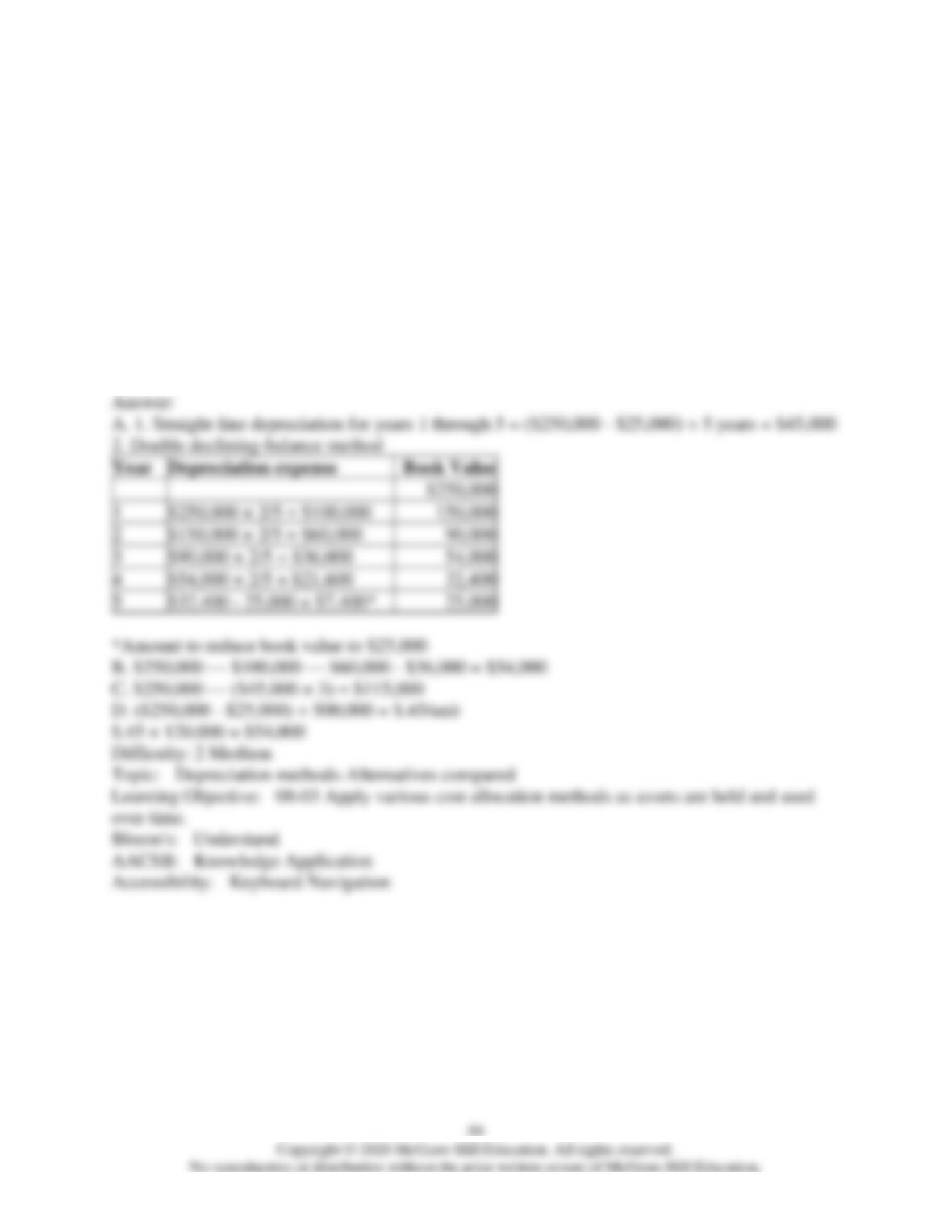
A. Calculate depreciation expense to the nearest whole dollar for each year of the machine’s
useful life under.
1. Straight-line depreciation method.
2. Double declining-balance method.
B. What is the book value of the machine after three years using the double declining-balance
method?
C. What is the book value of the machinery after three years using the straight-line method?
D. If the machine was used to produce and sell 120,000 units in 2019, what would be the
depreciation expense using the units-of-production method?
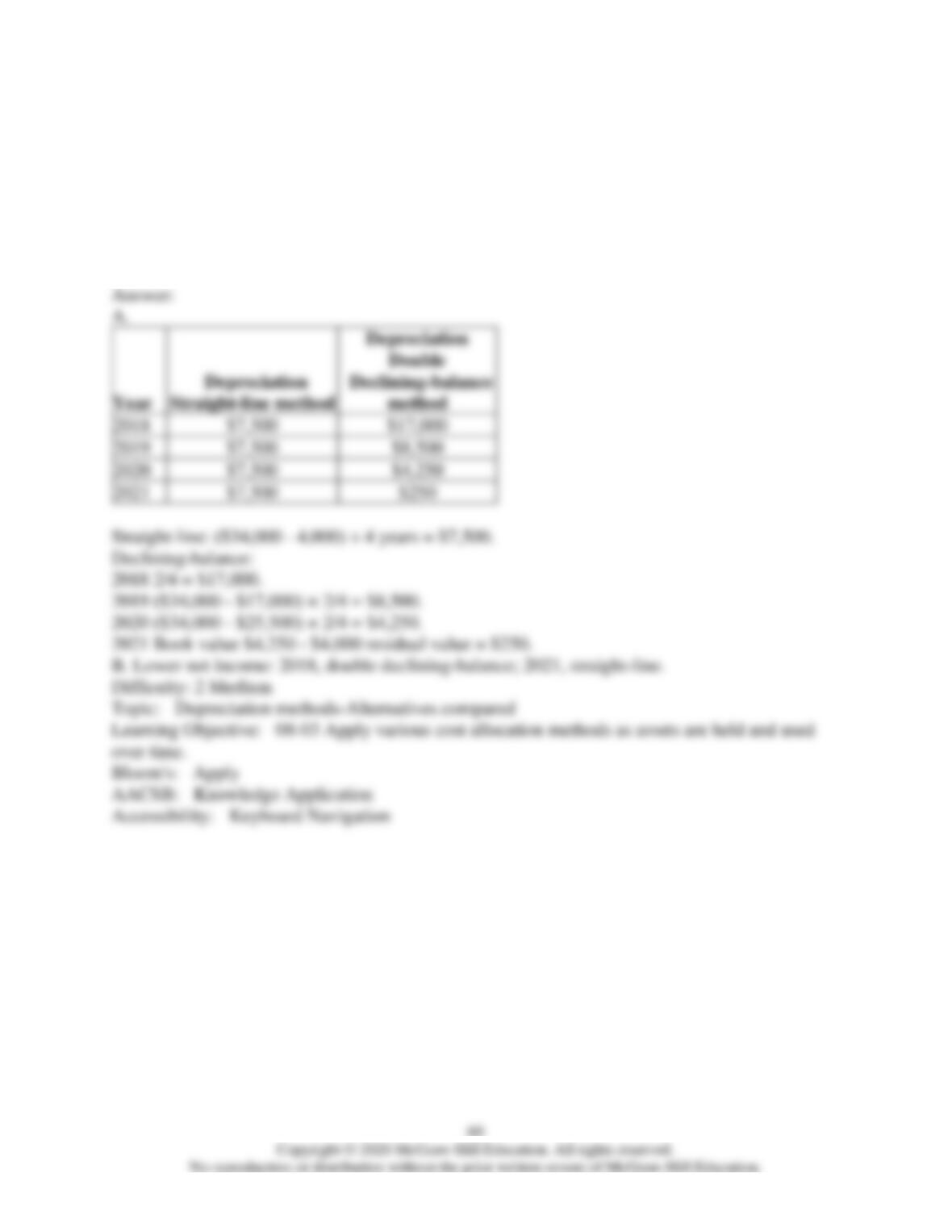
118) Hubbard Company purchased a truck on January 1, 2018, at a cost of $34,000. The
company estimated that the truck would have a useful life of 4 years and a residual value of
$4,000.
A. Calculate depreciation expense under straight line and double declining balance for 2018-
2021.
B. Which of the two methods would result in lower net income in 2018 and 2021?
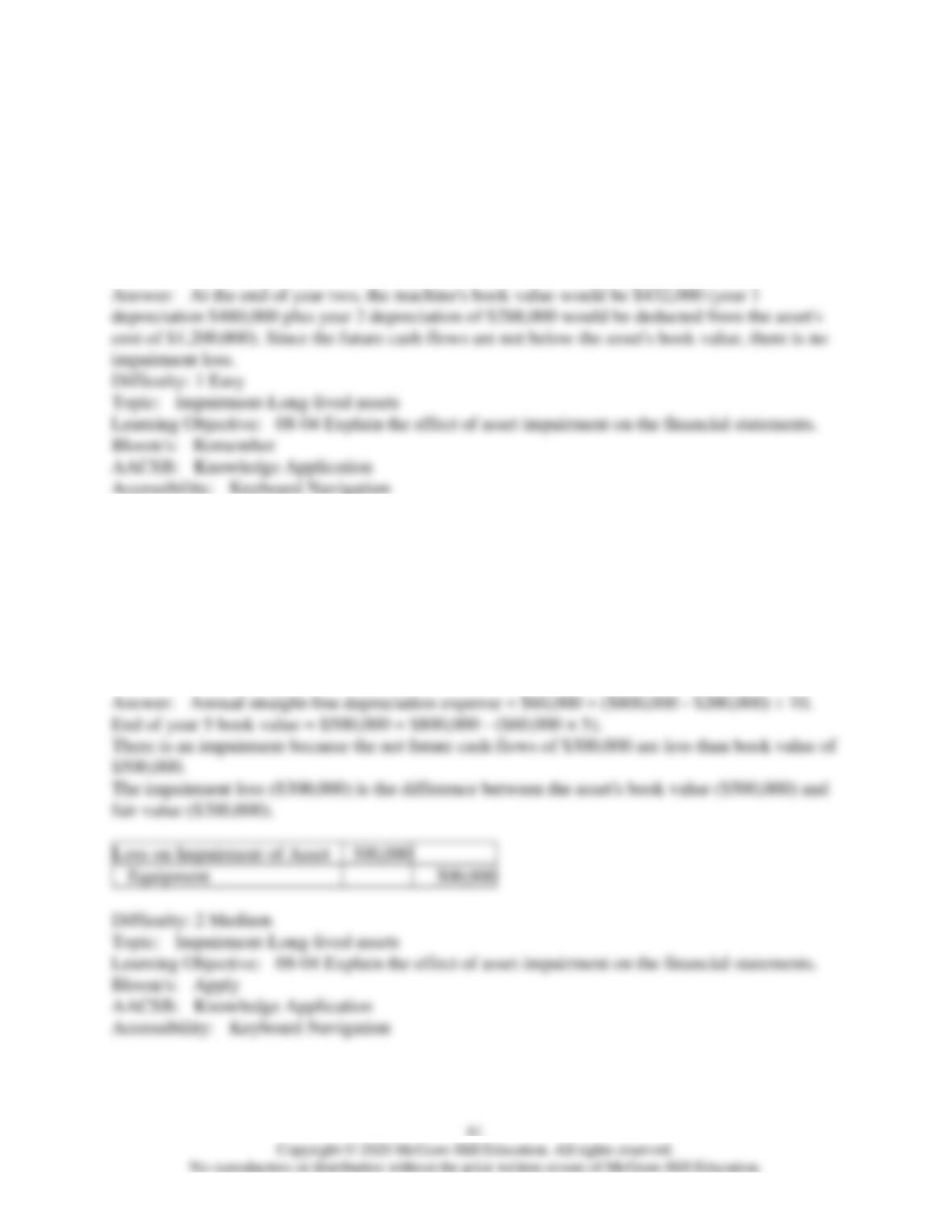
119) Allison Company purchased a machine for $1,200,000 at the beginning of 2018. Allison
was using the double-declining-balance (200%) method to depreciate the asset and its useful life
was estimated to be 5 years with a residual value of $200,000. At the end of 2019, Allison Co.
estimates the future cash flows from the asset to be equal to $500,000 and the fair value to be
$450,000.
What is the amount of the impairment loss?
120) A company purchased equipment for $800,000 and has depreciated it using the straight-line
method for the past 5 years when its original life was estimated to be 10 years with a $200,000
residual value. The equipment’s utility to the company has declined because management expects
the equipment to generate net cash flows over the remaining years of $300,000. The asset’s fair
value at the end of the fifth year is $200,000.
If the asset has been impaired, record the journal entry to record the impairment.
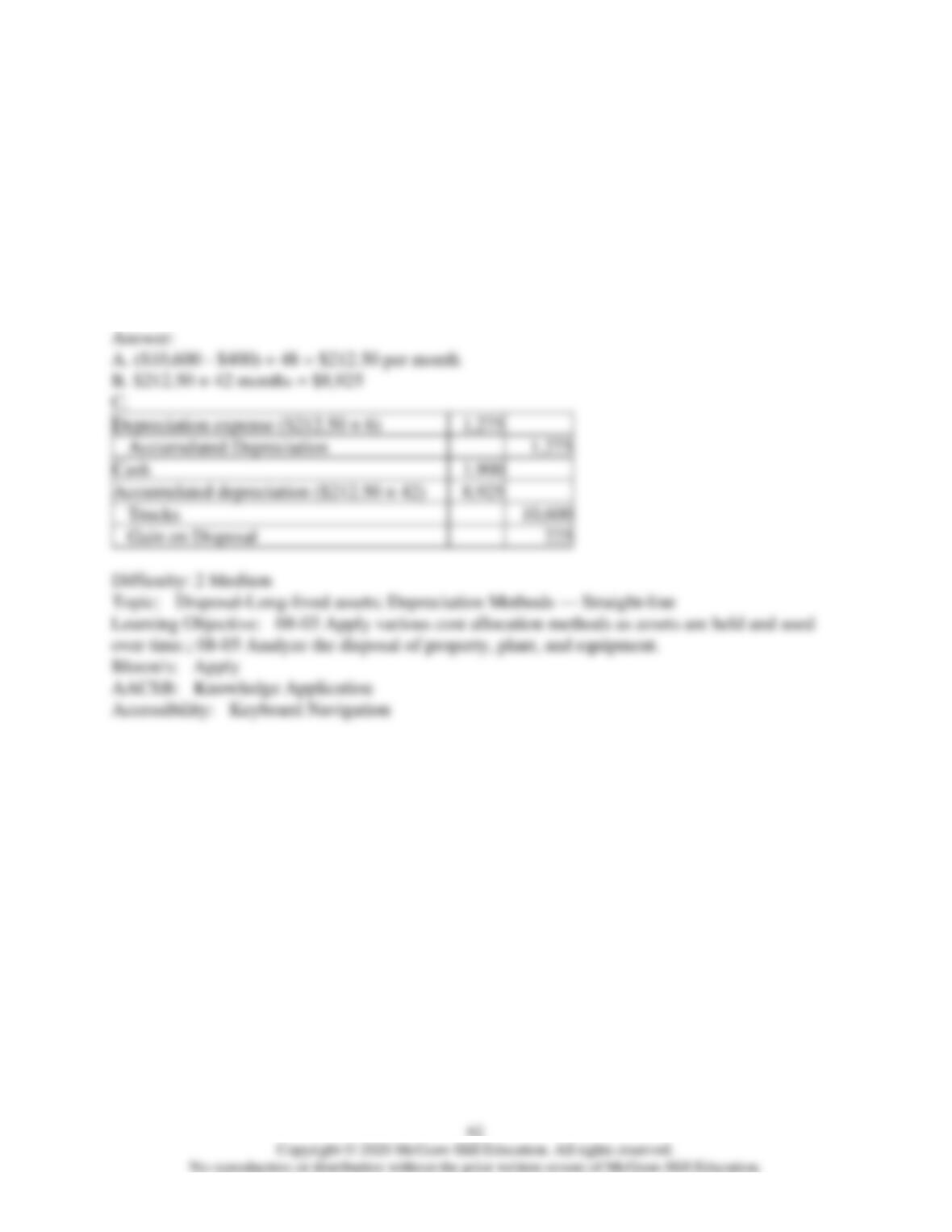
121) Beckworth Company purchased a truck on January 1, 2018, at a cash cost of $10,600. The
estimated residual value was $400 and the estimated useful life 4 years. The company uses
straight-line depreciation computed monthly. On July 1, 2021, the company sold the truck for
$1,900 cash.
A. What was the depreciation expense amount per month?
B. What was the amount of accumulated depreciation at July 1, 2021?
C. Prepare the required journal entries on the date of disposal, July 1, 2021. (Assume no 2021
depreciation had yet been recorded)
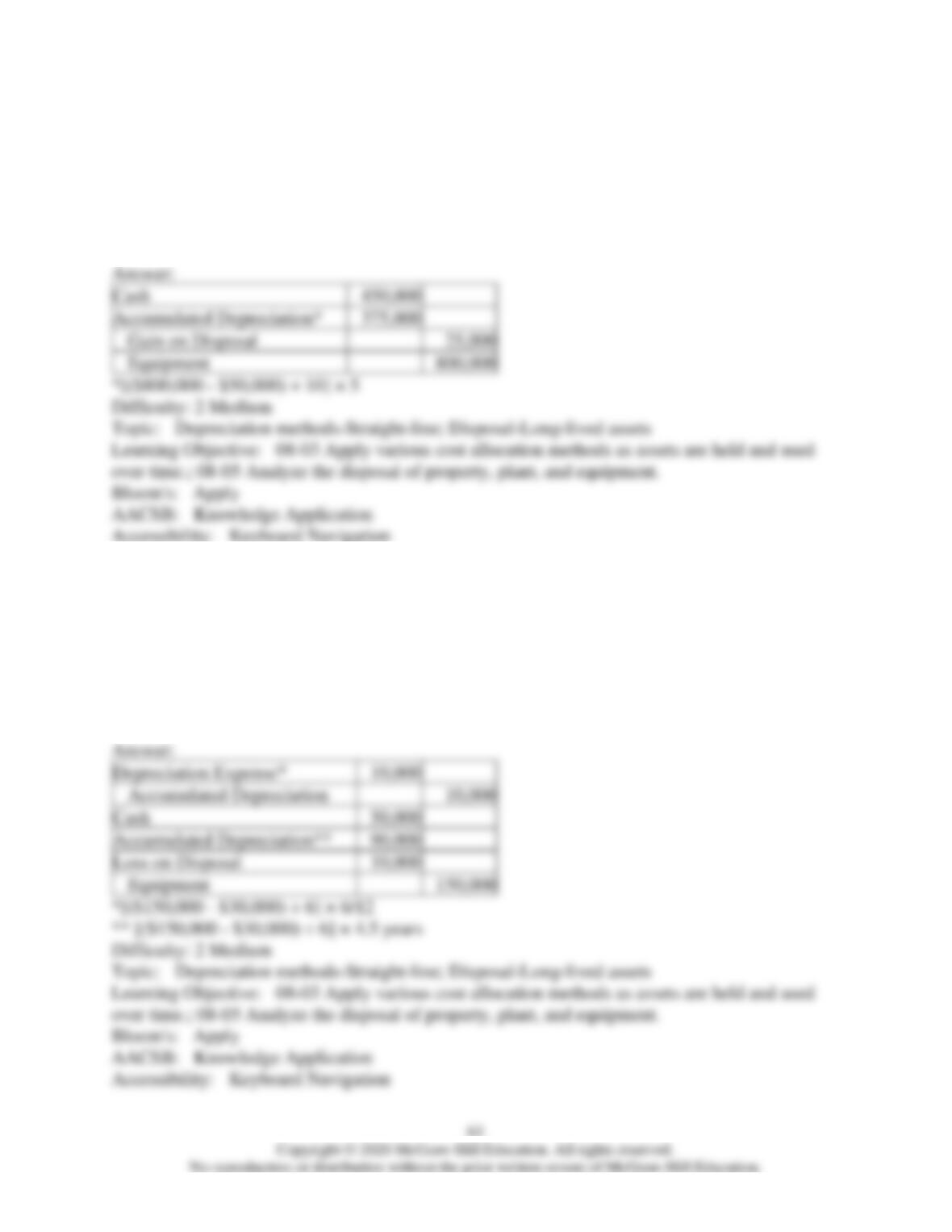
122) Lue Company sold used equipment for $450,000 cash. The equipment was purchased 5
years ago for a cost of $800,000. It has been depreciated using the straight-line method over an
estimated useful life of 10 years with an estimated residual value of $50,000.
Prepare the journal entry at the end of year five for the asset’s disposal assuming the fifth year’s
depreciation had been recorded.
123) Bennett Corporation sold a piece of equipment on June 30, 2019, for $50,000 cash. The
equipment had been purchased on January 1, 2015, for $150,000. The equipment had an
estimated useful life of 6 years and a $30,000 residual value. Bennett Corp. has been using the
straight-line method of depreciation and has a year-end of December 31st.
Prepare any necessary journal entries on June 30, 2019, assuming that 2019 depreciation expense
has not been recorded.
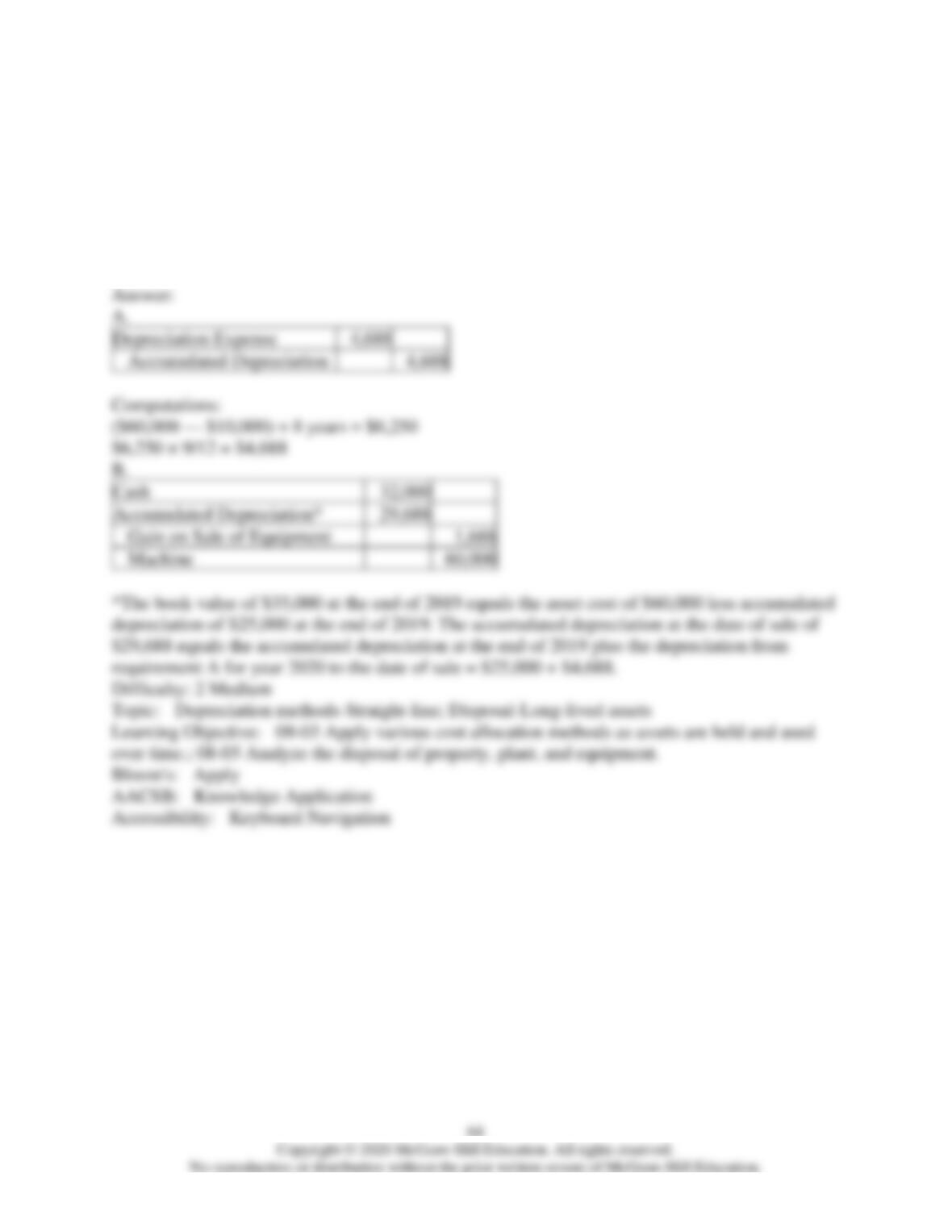
124) Spa Sources Corporation purchased a machine that had an original cost of $60,000 and an
estimated residual value of $10,000. The useful life was expected to be 8 years and straight-line
depreciation is used. At the end of 2019, the book value of the machine was $35,000. Spa
Sources sold the machine for $32,000 cash on October 1, 2020.
A. Prepare the journal entry to record depreciation for 2020 up to the date of sale.
B. Prepare the journal entry to record the sale of the machine.
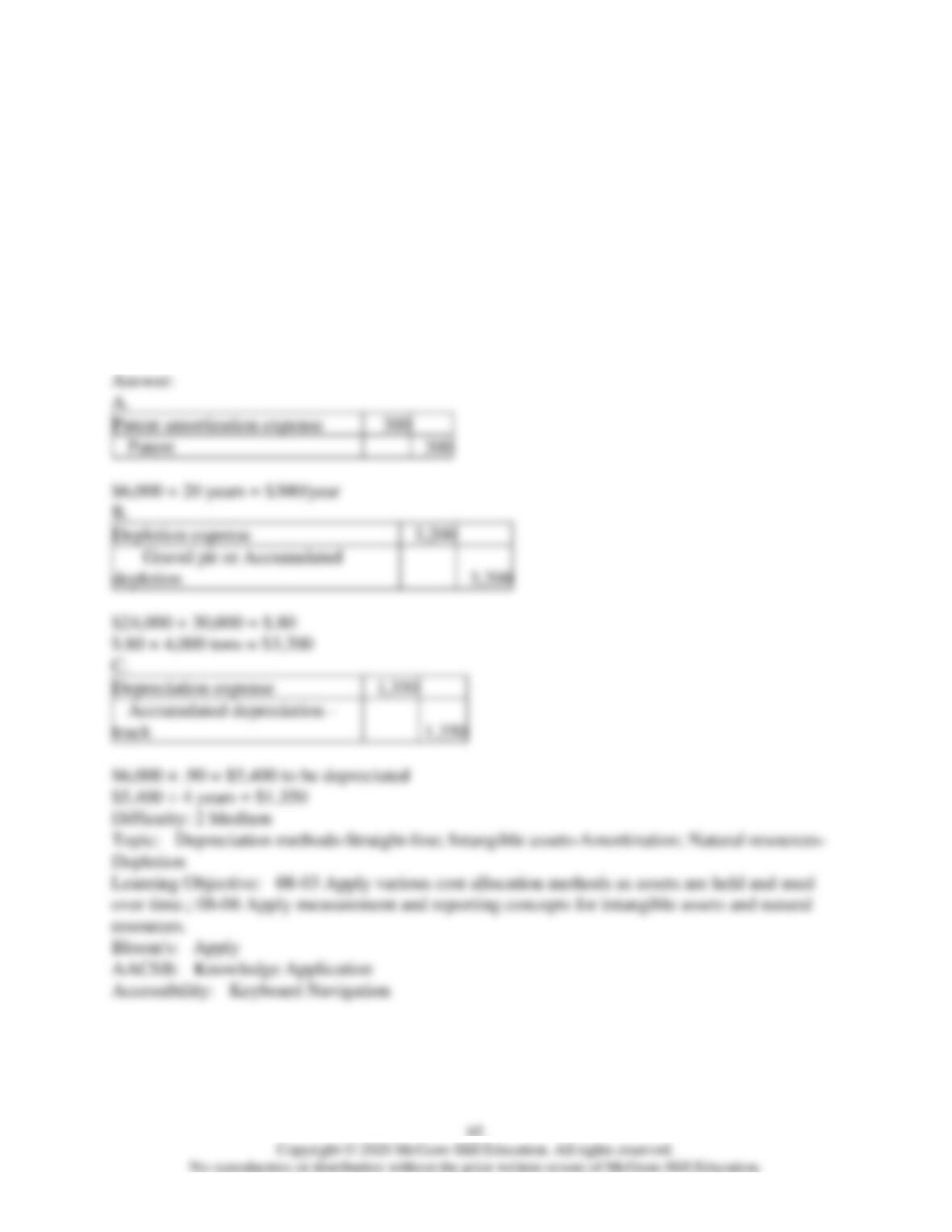
125) Prepare the required adjusting journal entry at December 31, 2019, the end of the annual
accounting period for the three items below. Assume that no adjusting entries have been made
during the year. If no entry is required, explain why.
A. Polk Company acquired a patent that cost $6,000 on January 1, 2019. The patent was
registered on January 1, 2015. The useful life of a patent is 20 years from registration.
B. Polk Company acquired a gravel pit on January 1, 2019, that cost $24,000. The company
estimates that 30,000 tons of gravel can be extracted economically. When all the gravel has been
extracted, no residual value is anticipated. During 2019, 4,000 tons were extracted and sold.
C. On January 1, 2019, Polk Company acquired a used dump truck that cost $6,000 to use
hauling gravel. The company estimated a residual value of 10% of cost and a useful life 4 years.
The company uses straight-line depreciation.
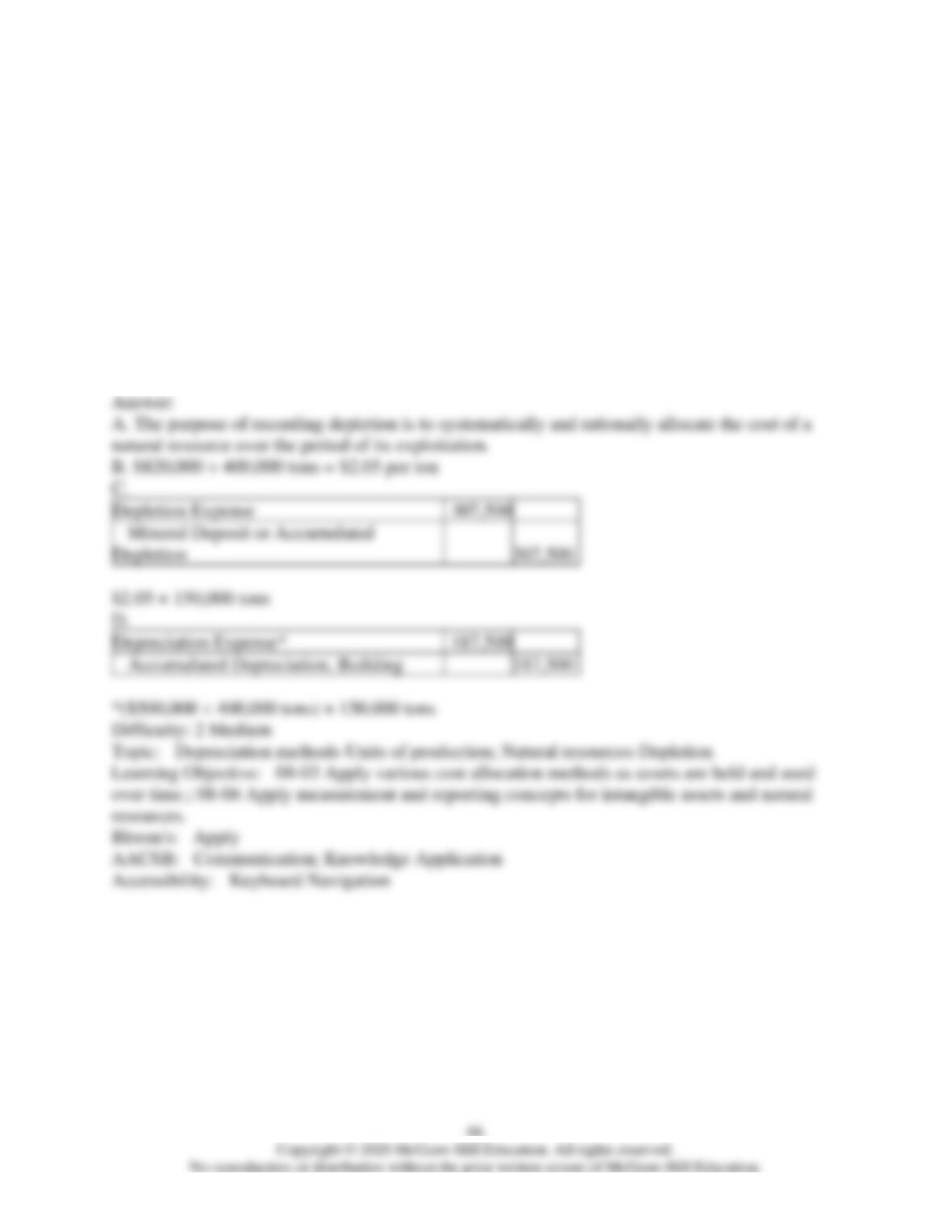
126) Benson Mining Company purchased a site containing a mineral deposit during 2019. The
purchase price was $820,000, and the site is estimated to contain 400,000 tons of extractable ore.
Benson constructed a building at the site, at a cost of $500,000, to be used while the ore is being
extracted. When the ore reserves are gone, the building will have no further value.
A. Explain the objective of recording depletion of natural resources.
B. Determine Benson’s depletion rate per ton of ore.
C. Prepare the journal entry to record depletion for the year 2019, when Benson mined and sold
150,000 tons of ore.
D. Prepare the journal entry to record depreciation on the building for 2019. Benson calculates
depreciation on the building using the units-of-production method based on the amount of ore
extracted (150,000 tons in 2019).
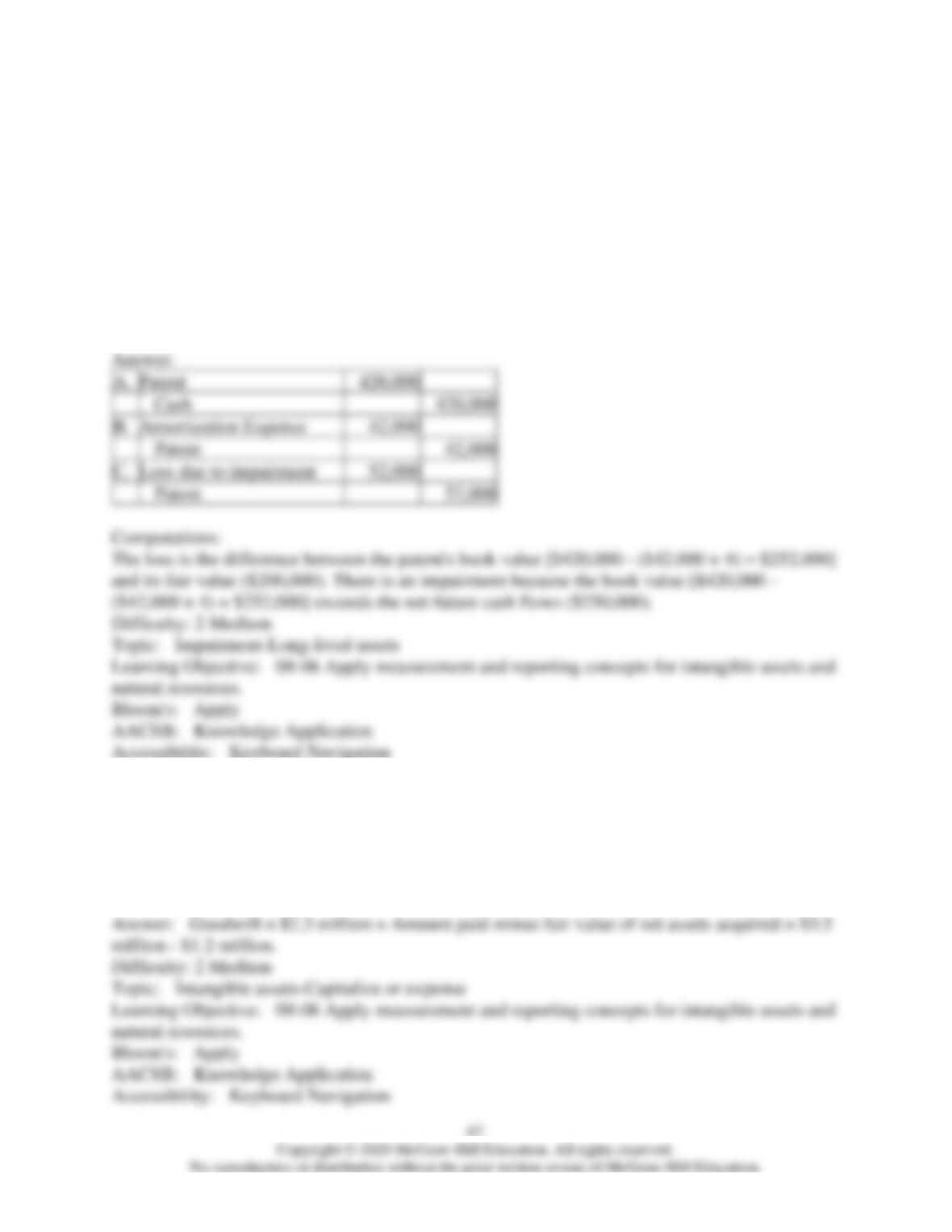
127) On January 1, 2017, Gordon Company purchased a patent for $420,000 from an inventor
who had developed a new manufacturing process. At the time of the purchase, the patent had a
remaining useful life of 10 years.
A. Prepare the journal entry to record Gordon’s purchase of the patent.
B. Prepare the journal entry to record amortization of the patent on December 31, 2017.
C. At the end of 2020, after amortization had been recorded through December 31, 2020, Gordon
concluded that the estimated future cash flows from the patent to be $250,000. The patent’s
estimated fair value on December 31, 2020 was $200,000. Prepare the journal entry to record the
patent impairment, if necessary.
128) Pier 5 has been in business 8 years with 4 stores in the San Francisco bay area. Its local
reputation for making savory pies such as curried potatoes is well recognized. A national food
distributor has offered to purchase the company. Pier 5 has $0.9 million of net assets at book
value, but those net assets have a fair value of $1.2 million. If the distributor offers to buy Pier 5
for $3.5 million, how much will be recorded as goodwill based on the offered acquisition price?
129) Landmark Restaurants reported net income of $45.9 million during Year 6. Landmark
reported depreciation and amortization of plant and equipment of $48.8 million and cash paid for
additions to property, plant, and equipment of $162.9 million during Year 6.
Explain where each of these items would be reported and their impact on cash flows on the
statement of cash flows (the indirect method is used to prepare the statement of cash flows).
130) Frankel Feed purchased a new machine on January 1, Year 1. Relevant information is as
follows:
Cost when acquired
$26,000
Estimated residual value
2,000
Estimated useful life
10 years
Accumulated depreciation at the end of year 5
(assume straight-line depreciation)
12,000
It is now the beginning of year 6 and the management reevaluated the estimates related to the
machine.
Compute the depreciation expense for year 6 under each of the following independent cases:
Case
Event
A
The estimated total useful life is changed to 15 years; residual
value is unchanged.
B
The residual value is changed to $1,000; useful life is unchanged.
C
The estimated total useful life is changed to 7 years and the
residual value is changed to $3,000.
131) Sadler Corporation purchased equipment to be used in manufacturing. The purchase was
made at the beginning of 2018 by paying cash of $150,000. The equipment has an estimated
residual value of $10,000 and an expected useful life of 10 years. At the beginning of 2020,
Sadler concluded that the total useful life of the equipment will be 8 years rather than 10, and
that the residual value will be zero. Sadler uses the straight-line method for depreciation.
A. Prepare the journal entry to record depreciation on the equipment for 2019.
B. Prepare the journal entry to record depreciation on the equipment for 2020, including the
effect of the changes in estimates.
C. Describe how and when a business should account for a change in the estimated useful life
and/or residual value of a depreciable asset.

71
132) Determine the effect of the following transactions on the financial statement components
identified. Code each item listed under the transaction with the letter A, B, or C, as follows.
A. If the transaction results in an increase in the financial statement component.
B. If the transaction results in a decrease in the financial statement component.
C. If the transaction does not affect the financial statement component.
Transaction 1: The adjusting journal entry to record depreciation expense was properly prepared
and recorded.
Net income _____
Total assets _____
Stockholders’ equity _____
Transaction 2: The adjusting journal entry to record patent amortization expense was properly
prepared and recorded.
Net income _____
Total assets _____
Stockholders’ equity _____
Transaction 3: A depreciable asset was sold for a gain and properly recorded.
Net income _____
Total assets _____
Stockholders’ equity _____
Transaction 4: The adjusting journal entry to record an impairment loss was properly prepared
and recorded.
Net income _____
Total assets _____
Stockholders’ equity _____