
Chapter 8: The Governmental Fund Accounting Cycle—Fiduciary Funds
Multiple Choice
1. Which of the following characteristics is true of fiduciary funds?
a. they report assigned fund balances
b. their net assets are unavailable to finance government programs
c. they prepare statements of cash flows for external reporting
d. their net assets cannot have debit balances under any circumstances
2. If a government participates in a defined contribution pension plan, which of the
following always will be true?
a. the government will report expenditures/expenses for pension contributions
b. the government will maintain one or more pension trust funds
c. the government will record its pension transactions based on actuarial values
d. the government will have no liability for other postemployment benefits
3. Which of the following types of pension plans results in a government bearing the
risk that investments do not yield an expected return?
Defined Defined
Benefit Contribution
a. no no
b. yes yes
c. no yes
d. yes no
4. Which of the following is not a fiduciary fund?
a. pension trust fund
b. permanent fund
c. private-purpose trust fund
d. agency fund
5. Which of the following is not a characteristic of a defined benefit pension plan?

a. Benefits are based on actual contributions plus amounts earned on the contributions
b. Benefits are linked to the number of years worked by the employee
c. Benefits are based on a formula that considers salaries earned by the employee
d. Benefits, rather than contributions, are guaranteed by the employer
6. On what basis are investments valued in the financial statements of a Pension Trust
Fund?
a. at cost
b. at the lower of cost or market value of each individual security
c. at fair value
d. at actuarial value
7. Which of the following type of pension plans results in all the employers
participating in the plan being liable for the accumulated liabilities of the plan?
a. sole-employer plan
b. multiple-employer plan
c. defined contribution plan
d. cost-sharing plan
8. Which of the following statements is true regarding an agent multi-employer
pension plan?
a. the annual required pension contributions are unique to each participating employer
b. the annual required pension contributions are uniform for each participating employer
c. a participating government legally must make the required annual contribution in full
each year
d. a participating government must account for its pension contributions using a pension
trust fund
9. Under which of the following circumstances will a government maintain a Pension
Trust Fund?
a. the government contributes to a defined benefit pension plan
b. the government sponsors a defined benefit pension plan
c. the government contributes to a defined contribution pension plan
d. the government has an unfunded actuarial pension liability
10. What are the two components of an actuary’s calculation of the required annual

contribution to a Pension Trust Fund?
a. the net pension obligation and the actuarial accrued liability
b. the regular cost and the normal cost
c. the amortization of the actuarial value of assets and the actuarial accrued liability
d. the normal cost and the amortization of the unfunded actuarial accrued liability
11. A Pension Trust Fund prepares two financial statements and two supplementary
schedules. Where does the obligation (calculated by the actuary) for the total
benefits earned by employees and retirees, as of a specific point in time, appear?
a. in the Statement of Fiduciary Fund Net Position
b. in the Schedule of Funding Progress
c. in both the Statement of Fiduciary Fund Net Position and the Schedule of Funding
Progress
d. in the Statement of Changes in Fiduciary Fund Net Position
12. What can you learn from the “funded ratio” in the financial report of a Pension
Trust Fund?
a. the relationship between the amounts paid into the Pension Trust Fund by employers
and the amounts that should have been paid into the Fund
b. the relationship between the amounts paid into the Pension Trust Fund by employers
and the amounts paid into the Fund by the employees
c. the relationship between the actuarial value of assets in the Pension Trust Fund and the
actuarial accrued liabilities of benefits earned by the employees
d. the relationship between the actuarial value of assets in the Pension Trust Fund and the
total annual payroll of the employees covered by the pension plan
13. Two sets of ratios are shown in the schedule of funding progress prepared for
Pension Trust Funds: (A) the funded ratio; and (B) the unfunded actuarial accrued
liability as a percentage of covered payroll. The financial status of the pension fund
is said to be improving when:
a. both A and B increase over time
b. both A and B decrease over time
c. A increases and B decreases over time
d. A decreases and B increases over time
14. Based on the GASB’s proposed new pension accounting standard, the net pension
liability is:
a. the unfunded annual required contribution

b. the pension benefit that is due to retirees during the next fiscal year
c. the present value of projected benefit payments that is attributable to employees’ past
periods of service, less the related pension plan’s net position
d. the actuarial value of a pension plan’s assets minus the actuarial present value of
projected retiree pension benefits
15. A recent proposed changed in pension reporting is that:
a. a net pension liability is reported in an employer’s government-wide financial
statements
b. the actuarial accrued liability is reported in an employer’s government-wide statement
of net position
c. governments no longer have the option of reporting or not reporting the net pension
liability in an employer’s government-wide statement of net position
d. changes in the net pension liability are reported as an expense in an employer’s
government-wide statement of activities
16. When a donor makes a gift that is accounted for in a Private Purpose Trust Fund,
which account should be credited?
a. Additions – donations
b. Deferred revenues
c. Net appreciation in fair value of investments
d. Transfers in to Private Purpose Trust Fund
17. The City of Altoona Pension Trust Fund has assets with an actuarial value of
$4,000,000, an actuarial accrued liability of $5,000,000, and an annual covered
payroll of $800,000.What is the Pension Trust Fund’s funded ratio?
a. 20 percent
b. 80 percent
c. 125 percent
d. 500 percent
18. During its fiscal year, a Pension Trust Fund buys 1,000 shares of stock, for which it
pays $33,000. At year end, the stock has a fair value of $28,000. How should this
fact be reported in the Trust Fund’s financial statements?
a. The investment should be reported at a value of $33,000

b. The investment should be reported at a value of $33,000, and the loss in market value
should be reported in a footnote
c. The investment should be reported at a value of $30,500
d. The investment should be reported at a value of $28,000
19. Wadsworth County maintains an investment pool in which it invests funds both for
Wadsworth County and for all legally separate school districts in the county. When
it reports assets in the Investment Trust Fund’s statement of fiduciary net position,
whose assets should be reported?
a. only the assets of the legally separate school districts
b. only the assets belonging to Wadsworth County
c. both the assets of the separate school districts and the assets belonging to Wadsworth
County
d. only the assets of the major school districts and the assets belonging to Wadsworth
County
20. The City of Albertville invests the assets of several neighboring cities through its
Investment Trust Fund. What account should Albertville credit when it receives
money from the neighboring cities for investment purposes?
a. Revenues
b. Additions – contributions from city
c. Additions – revenues
d. Additions – net increase in fair value of investments
21. Liberty County maintains an investment pool on behalf of certain cities within the
county. When it prepares its statement of fiduciary net position at year-end, how
should Liberty value the corporate securities that it holds on behalf of the cities?
a. at the amount of cash originally sent by the cities for investment
b. at the amount paid by the county to acquire the securities
c. at the fair value (at year-end) of the securities held on behalf of the cities
d. at the average value of the securities held during the year on behalf of the cities
22. In the statement of fiduciary net position prepared for an Investment Trust Fund,
how should the equity of the participants in the investment pool be characterized?
a. as fund balance
b. as retained earnings
c. as the excess of additions over deductions

d. as net position held in trust
23. Securities held by an Investment Trust Fund and carried on the books at $100,000
are sold for $110,000. On receiving the cash from the sale, how should the
Investment Trust Fund account for the $10,000 gain?
a. as a direct credit to net position of the Fund participants
b. as a liability – due to Fund participants
c. as an addition – net increase in fair value of investments
d. as a gain – equity in investment pool
24. What is the distinction between Private Purpose Trust Funds and Permanent Funds?
a. Private Purpose Trust Funds account on the modified accrual basis; Permanent Funds
account on the full accrual basis
b. The beneficiaries of Private Purpose Trust Funds are “outside” the government; the
beneficiaries of Permanent Funds are the reporting government or its citizenry
c. Private Purpose Trust Funds are governmental fund types; Permanent Funds are
fiduciary fund types
d. Investments of Private Purpose Trust Funds are valued at cost; investments of
Permanent Funds are valued at fair value
25. Which of the following resources should be accounted for in a Private Purpose
Trust Fund?
a. a gift received from a donor who stipulates in a formal trust agreement that the
principal must be kept intact and the income must be used to beautify the state’s parks
b. admissions fees that are legally required, based on state laws, to pay the debt service on
the state’s new museum and cultural center
c. dormant bank accounts that escheat to the state, with state laws requiring that the
resources be held in perpetuity for the rightful owners
d. fees received by a state from insurance companies, representing charges for overseeing
insurance companies located within the state
26. Assume a pension plan’s actuarially-computed liabilities are greater than the
actuarial value of the assets. How does this difference between assets and liabilities
affect the actuarially determined contribution to the pension plan required for the
following year?
a. It does not enter into the actuary’s calculation if the actuarial value of plan assets
exceeds their aggregate cost

b. It is not considered in establishing the required contribution, but it is disclosed in the
schedule of funding progress
c. The entire amount of the unfunded actuarially accrued liability is included in the next
year’s required contribution to show “good faith” to retirees
d. A portion of the unfunded actuarial accrued liability is included in the next year’s
contribution by means of an amortization process
27. Which of the following resources should be accounted for in a Private Purpose
Trust Fund?
a. sales taxes received by a state and held pending distribution to the local governments
on whose behalf they were collected
b. a gift received from a donor who stipulates in a trust agreement that the principal must
be kept intact and the income used for benefits to spouses of deceased uniformed
officers
c. a grant received from a higher level government that stipulates that the grant can be
used for no purpose other than to construct highways
d. employee contributions to a health care plan that will be used, together with
government contributions, to pay employee health care benefits
28. Which of the following activities of a state should be accounted for in an Agency
Fund?
a. a lottery, wherein half the revenues is used for prizes and the other half is used for
lottery operating expenses and to enhance revenues available for education purposes
b. sales taxes collected on behalf of counties that elect to “piggy-back” their own sales tax
onto the state sales tax, with the county portion to be remitted later to the counties
c. contributions from the state and from local governments that will be invested and paid
out to state and local government employees in the form of pension benefits
d. highway taxes that will be used to finance improvements made to roads within the state
29. Which financial statements are prepared for an Agency Fund?
a. only a statement of fiduciary net position
b. only a statement of changes in fiduciary net position
c. a statement of fiduciary net position and a statement of changes in fiduciary net
position
d. a statement of fiduciary net position, a statement of changes in fiduciary net position,
and a cash flow statement

30. Which of the following best summarizes the accounting equation for Agency
Funds?
a. assets – liabilities = net position
b. assets = liabilities + net position
c. assets = liabilities + opening net position + (revenues – expenditures)
d. assets = liabilities
The following information pertains to questions 31 and 32
Bevo County levies a property tax of $10 million. Of this amount, $6 million pertains to the
activities of Bevo County’s General Fund, while the other $4 million pertains to and will be
remitted to the 10 villages within the County. The County anticipates that it will collect the entire
$10 million that has been levied.
31. How much revenue should Bevo County recognize in its Agency Fund?
a. $0
b. $4 million
c. $6 million
d. $10 million
32. If Bevo County prepares an Agency Fund statement of fiduciary net position before
it collects the property taxes, how much should it report as property taxes
receivable?
a. $0
b. $4 million
c. $6 million
d. $10 million
33. Empire State collects personal income taxes both for its own activities and for cities
in the state that have elected to “piggy-back” their own income taxes on top of the
state taxes. As a fiduciary, the state temporarily invests all tax receipts pending
determination of amounts to remit to the cities. The total investment income
received by the state is $300,000, of which $100,000 will be sent to the cities. How
much of the investment income should be recognized as revenue in the state’s

Agency Fund?
a. $0
b. $100,000
c. $200,000
d. $300,000
Problems
34. (MatchingBfiduciary fund concepts)
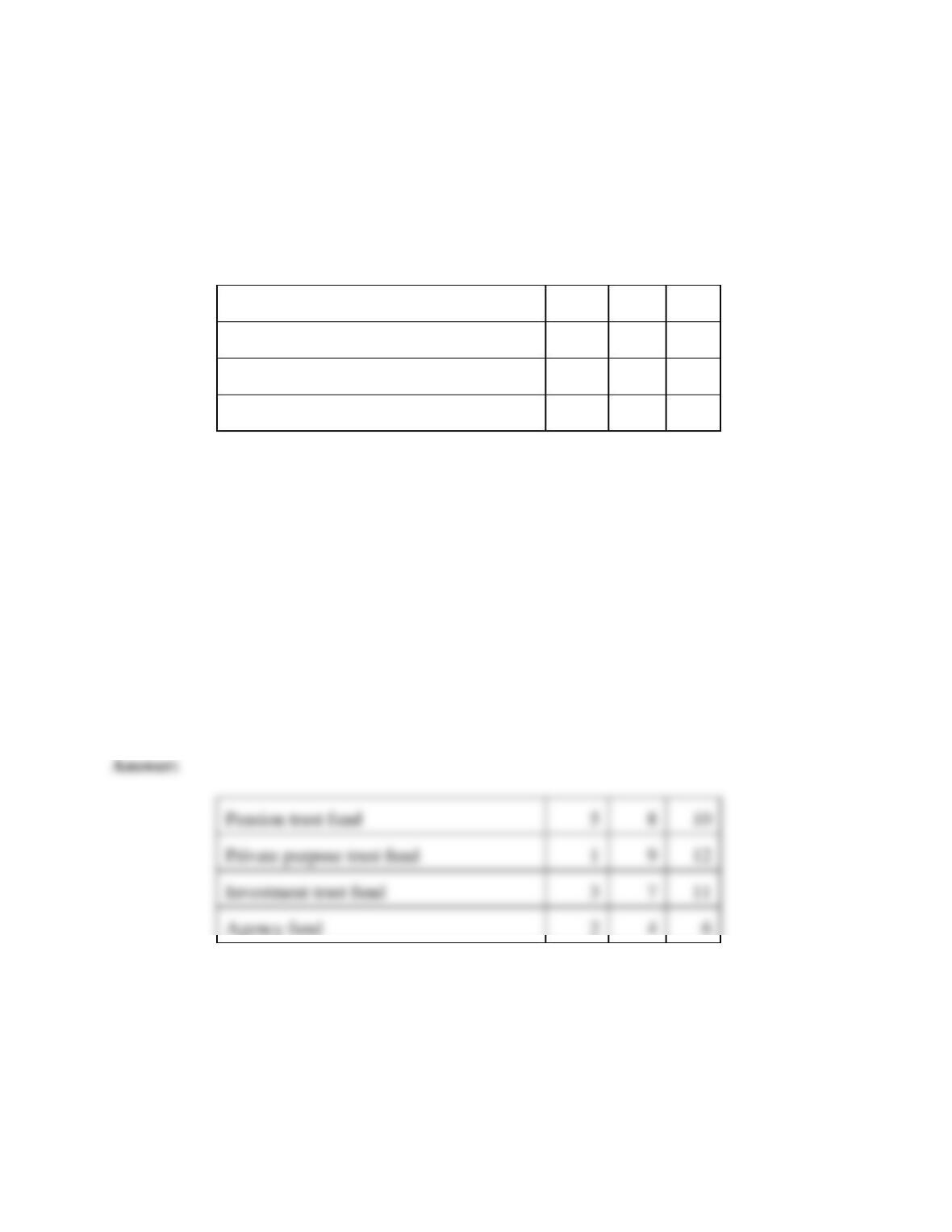
Listed immediately below are the 4 generic fiduciary funds. Following these are 12
statements. Match each fund with the 3 statements that best correspond to each
fund. No statement applies to more than 1 fund
Pension trust fund
Private purpose trust fund
Investment trust fund
Agency fund
1. May be used to account for escheat property
2. Has no operating statement
3. Allows smaller governments to tap special financial expertise of larger governments
4. Has no fund balance
5. Requires that a schedule of funding progress be prepared
6. Often used to account for tax collections
7. Must have one or more outside participants
8. Typically involves the services of an actuary
9. Scope of operations is specified by trust agreement
10. May or may not have other governments as participants
11. Participants record their contributions in a “pool investment” asset account
12. Often associated with a philanthropic purpose
35. (Journal entries for a Pension Trust Fund)
Moody Village maintains a Pension Trust Fund for its employees. At the start of
the year, the Fund holds cash of $150,000 and investments that have a fair value of
$4,000,000. The Fund has the following transactions. Prepare entries to record them
in the Fund’s accounts
Pension trust fund
Investment trust fund
Agency fund
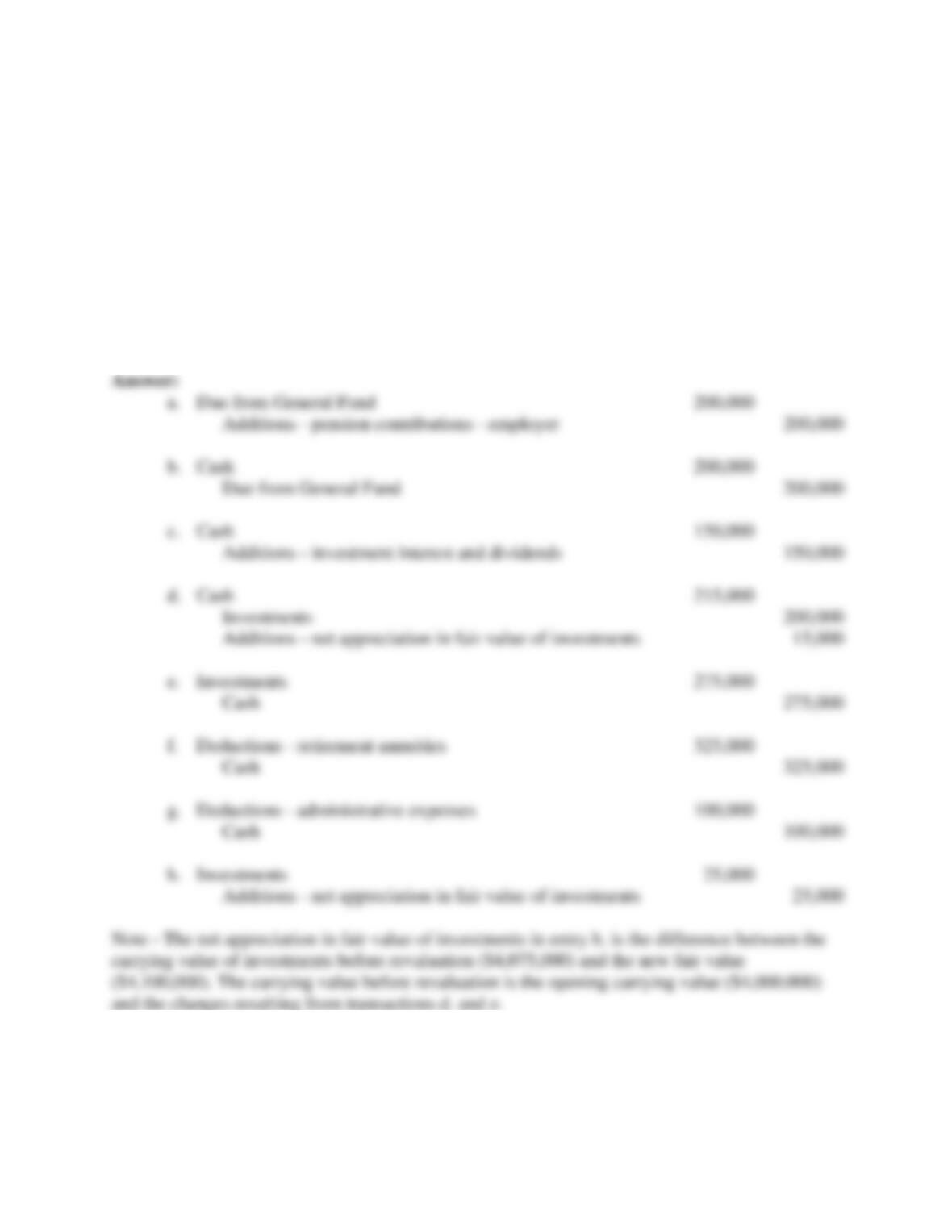
a. Bills the General Fund $200,000 for the required annual contribution. The pension plan
does not require contributions from the employees
b. Receives payment of $200,000 from the General Fund
c. Receives interest and dividend income of $150,000 in cash on its investment portfolio
d. Receives $215,000 from selling investments carried on the books at $200,000
e. Makes new investments totaling $275,000
f. Pays annuity benefits of $325,000 to retirees or their spouses
g. Pays administrative expenses of $100,000 in cash
h. The investments held by the Fund have a fair value of $4,100,000 at year-
end.
36. (Preparation of Pension Trust Fund schedule of funding progress)

Based on the following data elements (not all of which are relevant to this problem)
calculate (a) the funded ratio and (b) the unfunded actuarial accrued liability as a
percentage of covered payroll for Elisa County’s schedule of funding progress at
December 31, 2013.
Total investments, at fair value, January 1, 2013 $11,500,000
Actuarial accrued liability at December 31, 2013 $15,750,000
Pension benefits paid during the year 2013 $3,100,000
Actuarial value of assets at December 31, 2013 $13,800,000
Total payroll for year 2013, including overtime $4,000,000
Covered payroll for year 2013 $3,800,000
37. (Journal Entries for an Investment Trust Fund)
Smith County operates an external investment pool, which invests idle cash on
behalf of school districts within the county. Prepare journal entries to record the
following transactions.
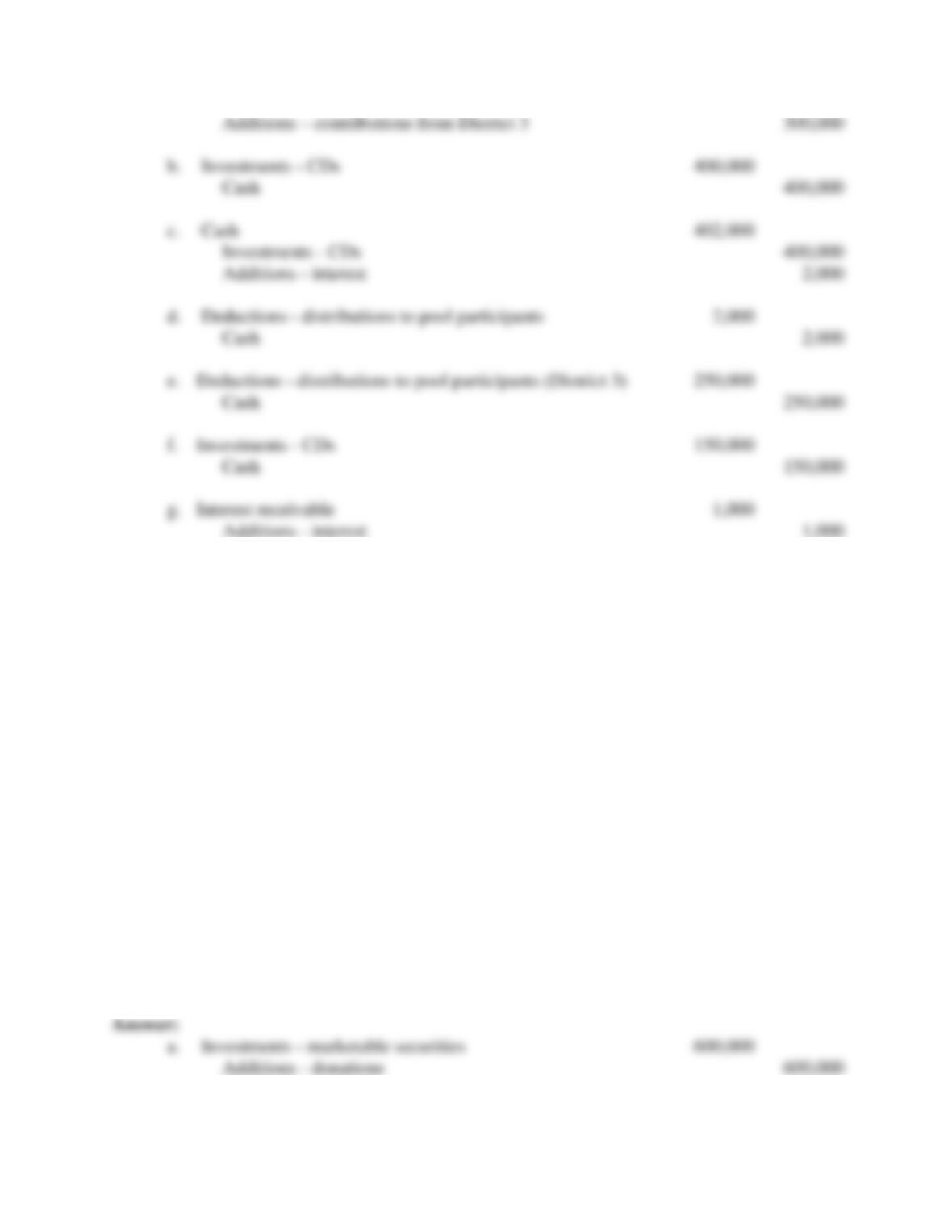
a. The pool receives cash deposits from District 1 ($100,000) and District 3 ($300,000).
b. The pool invests the $400,000 in certificates of deposit (CDs) maturing in three
months.
c. The CDs mature and the pool receives $402,000, which includes $2,000 interest.
d. The pool remits the interest to Districts 1 and 3 in proportion to their investments.
e. District 3 needs some cash. In accordance with District 3’s request, the pool
returns $250,000 cash to the District.
f. The pool invests the remaining $150,000 in another CD.
g. At year-end, interest earned but not received on the $150,000 CD, amounts
to $1,000.
38. (Journal entries for Private Purpose Trust Fund)
Towry School District accepts donations that are used to provide awards to
graduating seniors. Record the following transactions in the Towry Private Purpose
Trust Fund – Awards Fund. Also, prepare a statement of changes in fiduciary net
position for the Fund for the year ended December 31, 2013. This is the first year
of operation for the Towry Private Purpose Trust Fund – Awards Fund.
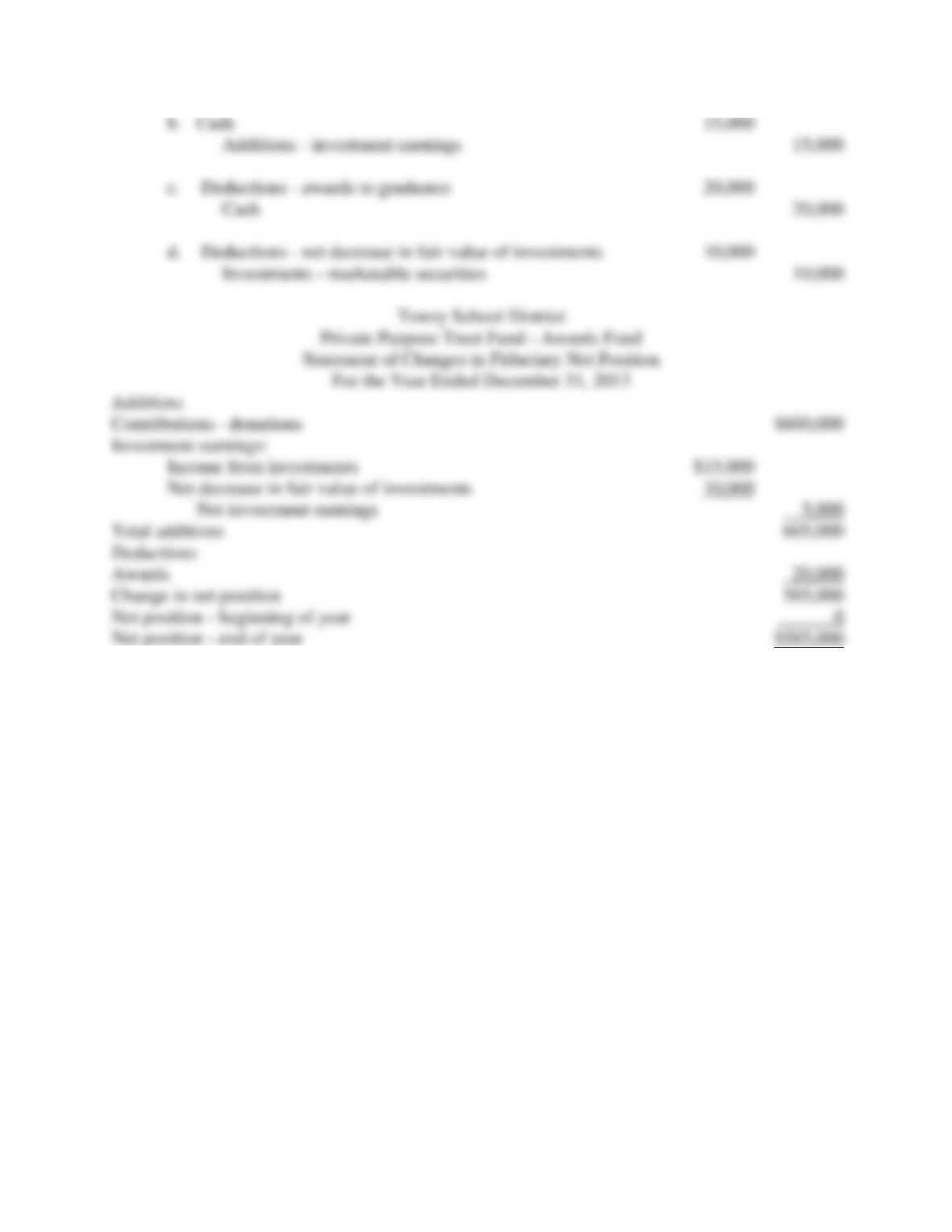
a. Hannah Banana, noted philanthropist, donates marketable securities worth $600,000 to
the District, stipulating that all earnings on the securities be used for awards to
graduates.
b. The District receives dividends on the securities in the amount of $15,000.
c. The District makes various awards to graduating seniors in the amount of $20,000.
d. When the District prepares financial statements at the end of the year, the marketable
securities have a fair value of $590,000.
39. (Journal entries for an Agency Fund)
A state collects sales taxes both for itself and for counties that have elected to
“piggy-back” their taxes on the state tax. The state takes several weeks to process
returns and determine how much each participating government should receive, so
tax collections are temporarily invested. Resulting investment income is distributed
to the state to defray processing costs.
Prepare entries to record these transactions in the Agency Fund.
a. The state collects sales taxes totaling $7,000,000 for itself and participating counties.
b. The entire $7,000,000 is temporarily invested.
c. The state determines that $4,800,000 of the tax collections belong to the state and that
the remaining $2,200,000 should be distributed to the counties.
d. The investments are immediately liquidated and $7,003,500 is received in cash.
e. Tax collections and the investment income are forwarded to the state and
the counties.