Managerial Accounting, 16e (Garrison)
Chapter 8: Master Budgeting
1) The basic idea underlying responsibility accounting is that a manager should be held
responsible for those items—and only those items—that the manager can actually control to a
significant extent.
2) The budgeted income statement is typically prepared before the budgeted balance sheet.
3) Control involves developing goals and preparing various budgets to achieve those goals.
4) A continuous or perpetual budget is a 12-month budget that rolls forward one month (or quarter)
as the current month (or quarter) is completed.
5) The cash budget is the starting point in preparing the master budget.
6) The master budget consists of a number of separate but interdependent budgets.
7) The production budget is typically prepared prior to the sales budget.
8) The production budget is typically prepared before the direct materials budget.
9) The selling and administrative budget is typically prepared before the cash budget.
10) A benefit from budgeting is that it forces managers to think about and plan for the future.
11) One of the weaknesses of budgets is that they are of little value in uncovering potential
bottlenecks.
12) One disadvantage of budgeting is that budgeting makes it more difficult to coordinate the
activities of the entire organization.
13) Cash collections in a schedule of cash collections typically consist of collections on sales made
to customers in prior periods plus collections on sales made in the current budget period.
14) The number of units to be produced in a period can be determined by adding the expected sales
to the desired ending inventory and then deducting the beginning inventory.
15) In a production budget, if the number of units in finished goods inventory at the end of the
period is less than the number of units in finished goods inventory at the beginning of the period,
then the expected number of units sold is less than the number of units to be produced during the
period.
16) In the merchandise purchases budget, the required purchases (in units) for a period can be
determined by subtracting the beginning merchandise inventory (in units) from the budgeted sales
(in units) and desired ending merchandise inventory (in units).
17) When preparing a direct materials budget, beginning inventory for raw materials should be
added to production needs, and desired ending inventory should be subtracted to determine the
amount of raw materials to be purchased.
6
18) The direct labor budget begins with the required production in units from the production
budget.
19) The direct labor budget shows the direct labor-hours required to satisfy the production budget.
20) In the manufacturing overhead budget, the non-cash charges (such as depreciation) are
deducted from the total budgeted manufacturing overhead to determine the expected cash
disbursements for manufacturing overhead.
21) The manufacturing overhead budget lists all costs of production other than direct materials and
direct labor.
22) The selling and administrative expense budget lists all costs of production other than direct
materials and direct labor.
23) The budgeted variable selling and administrative expense is calculated by multiplying the
budgeted unit sales by the variable selling and administrative expense per unit.
24) The disbursements section of a cash budget consists of all cash payments for the period except
cash payments for dividends.
25) The usual starting point for a master budget is:
A) the direct materials purchase budget.
B) the budgeted income statement.
C) the sales forecast or sales budget.
D) the production budget.
26) Which of the following budgets are prepared before the sales budget?
Budgeted Income Statement
Direct Labor Budget
A)
Yes
Yes
B)
Yes
No
C)
No
Yes
D)
No
No
A) Choice A
B) Choice B
C) Choice C
D) Choice D
27) There are various budgets within the master budget. One of these budgets is the production
budget. Which of the following BEST describes the production budget?
A) It details the required direct labor hours.
B) It details the required raw materials purchases.
C) It is calculated based on the sales budget and the desired ending inventory.
D) It summarizes the costs of producing units for the budget period.
28) When preparing a direct materials budget, the required purchases of raw materials in units
equals:
A) raw materials needed to meet the production schedule + desired ending inventory of raw
materials − beginning inventory of raw materials.
B) raw materials needed to meet the production schedule − desired ending inventory of raw
materials − beginning inventory of raw materials.
C) raw materials needed to meet the production schedule − desired ending inventory of raw
materials + beginning inventory of raw materials.
D) raw materials needed to meet the production schedule + desired ending inventory of raw
materials + beginning inventory of raw materials.
29) Which of the following statements is NOT correct concerning the Manufacturing Overhead
Budget?
A) The Manufacturing Overhead Budget provides a schedule of all costs of production other than
direct materials and labor costs.
B) The Manufacturing Overhead Budget shows only the variable portion of manufacturing
overhead.
C) The Manufacturing Overhead Budget shows the expected cash disbursements for
manufacturing overhead.
D) The Manufacturing Overhead Budget is prepared after the Sales Budget.
30) Which of the following statements is NOT correct concerning the Cash Budget?
A) It is not necessary to prepare any other budgets before preparing the Cash Budget.
B) The Cash Budget should be prepared before the Budgeted Income Statement.
C) The Cash Budget should be prepared before the Budgeted Balance Sheet.
D) The Cash Budget builds on earlier budgets and schedules as well as additional data.
31) All of Gaylord Corporation’s sales are on account. Thirty-five percent of the sales on account
are collected in the month of sale, 45% in the month following sale, and the remainder are
collected in the second month following sale. The following are budgeted sales data for the
company:
January
February
March
April
Total sales
$50,000
$60,000
$40,000
$30,000
What is the amount of cash that should be collected in March?
A) $24,000
B) $37,000
C) $41,000
D) $51,000
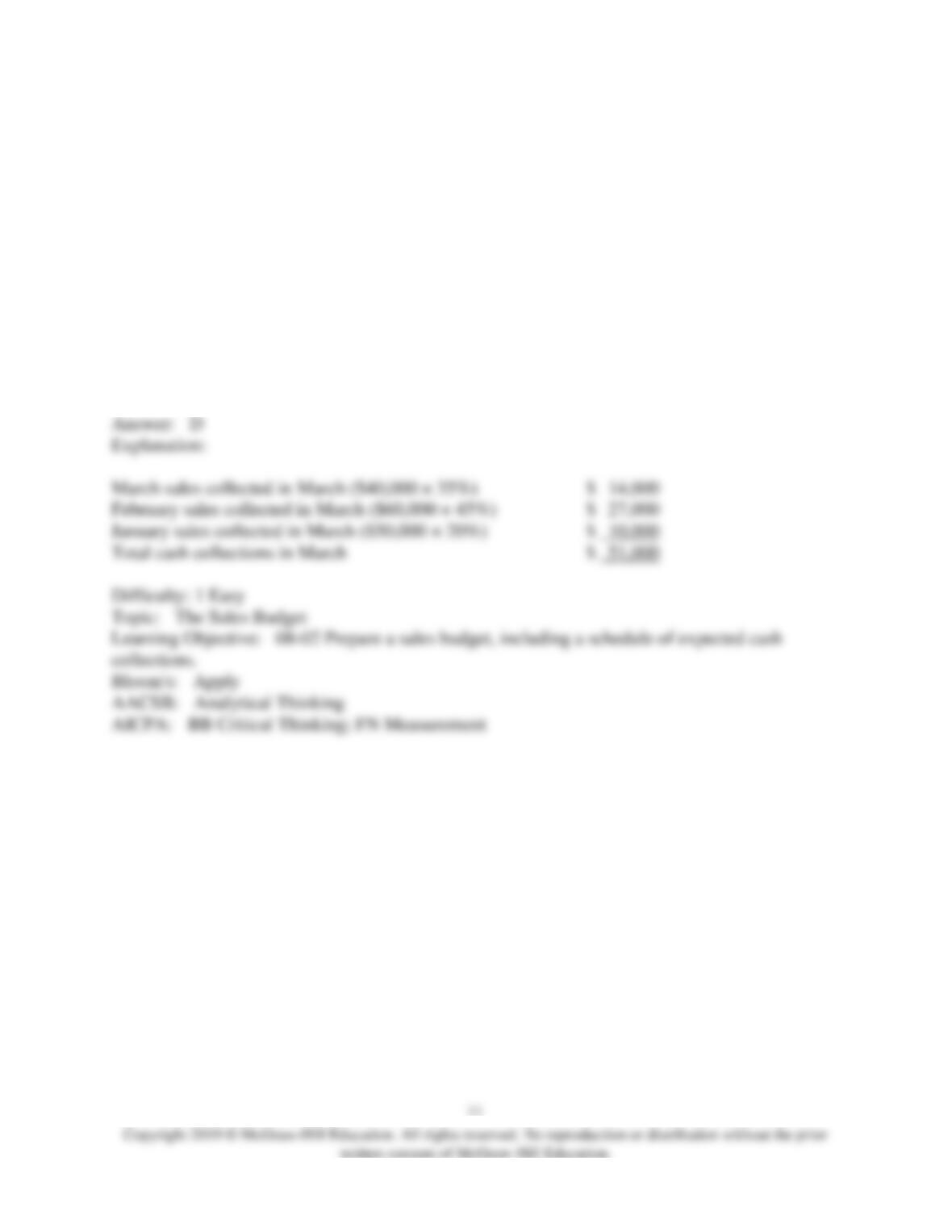
March sales collected in March ($40,000 × 35%)
February sales collected in March ($60,000 × 45%)
January sales collected in March ($50,000 × 20%)
Total cash collections in March
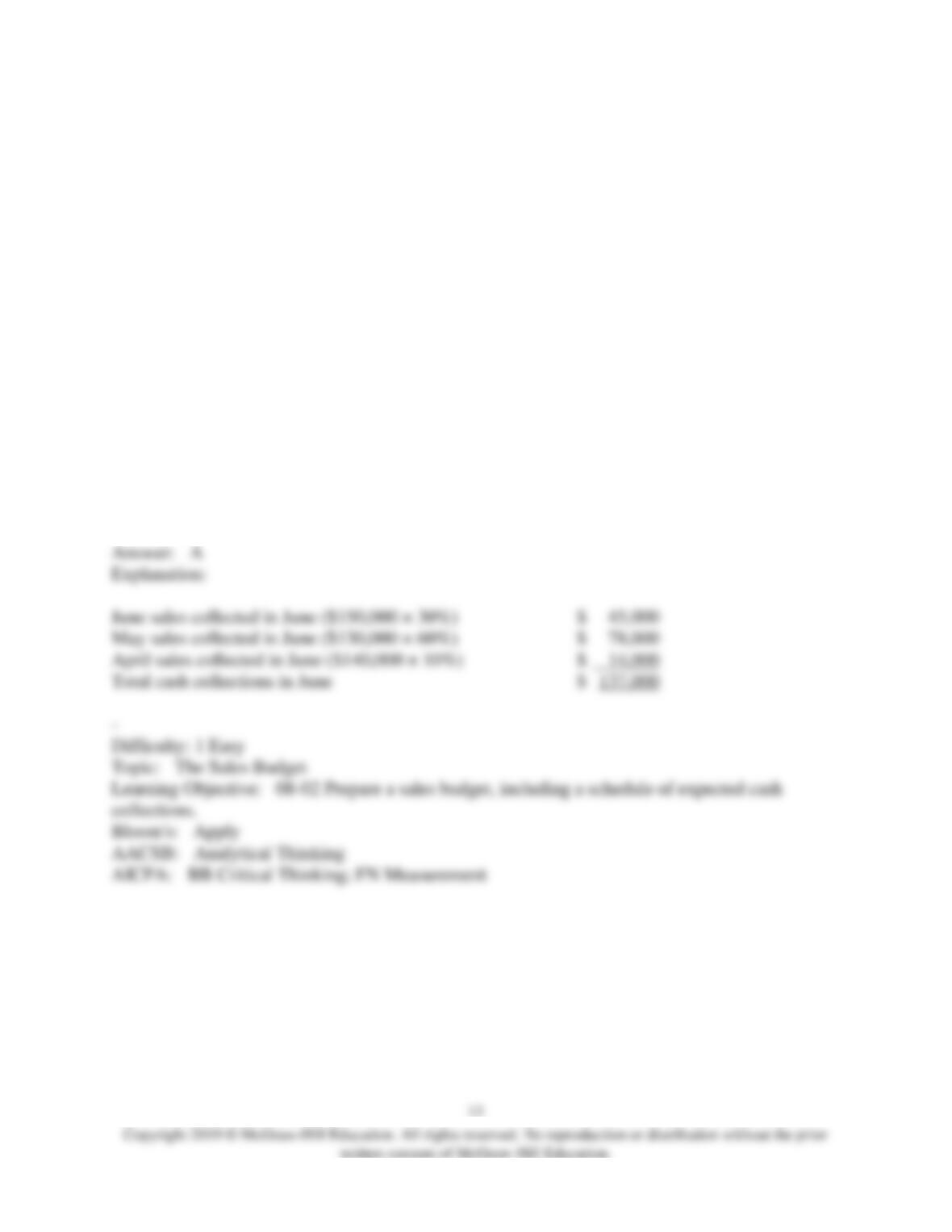
32) Seventy percent of Pitkin Corporation’s sales are collected in the month of sale, 20% in the
month following sale, and 10% in the second month following sale. The following are budgeted
sales data for the company:
January
February
March
April
Budgeted sales
$200,000
$300,000
$350,000
$250,000
Total budgeted cash collections in April would be:
A) $175,000
B) $275,000
C) $70,000
D) $30,000
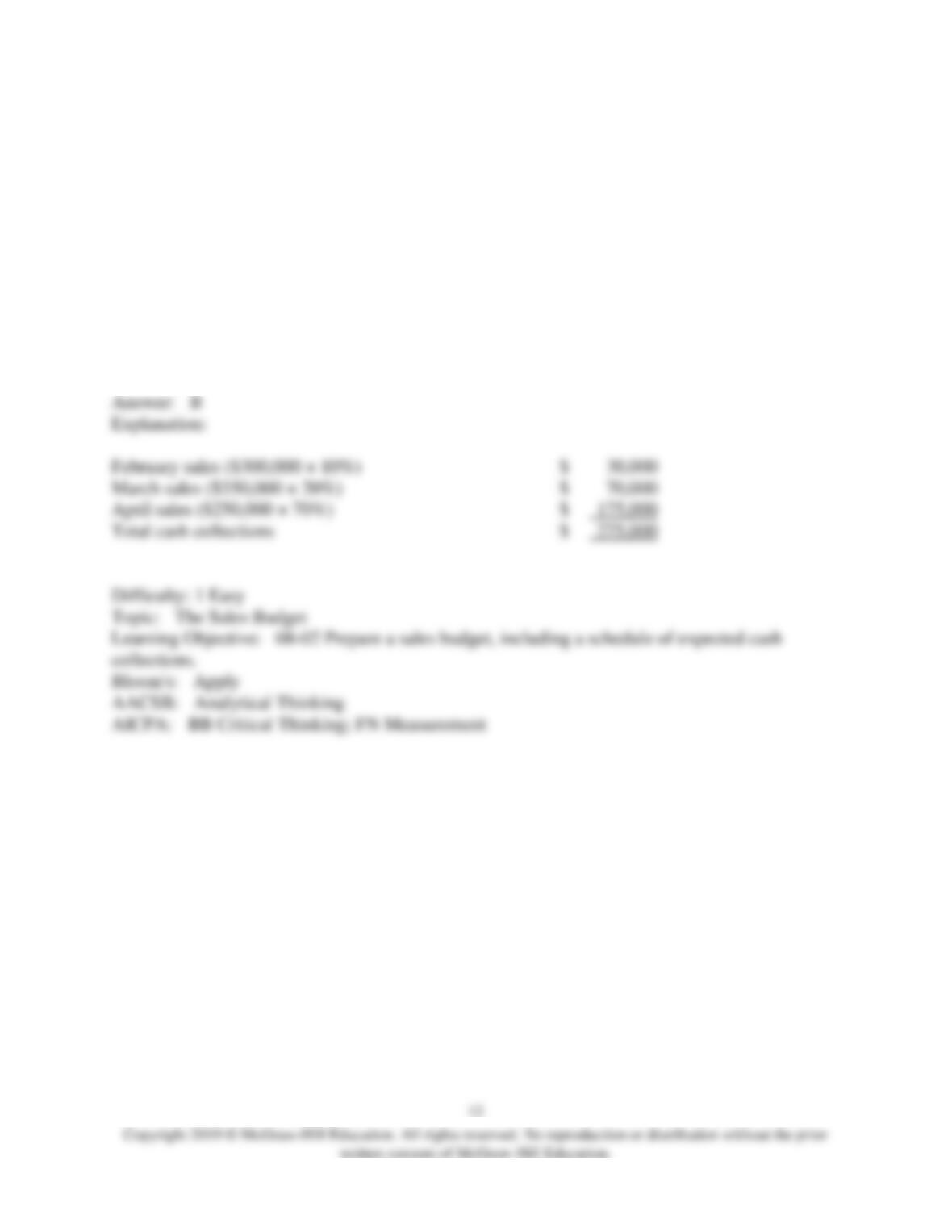
February sales ($300,000 × 10%)
March sales ($350,000 × 20%)
April sales ($250,000 × 70%)
Total cash collections
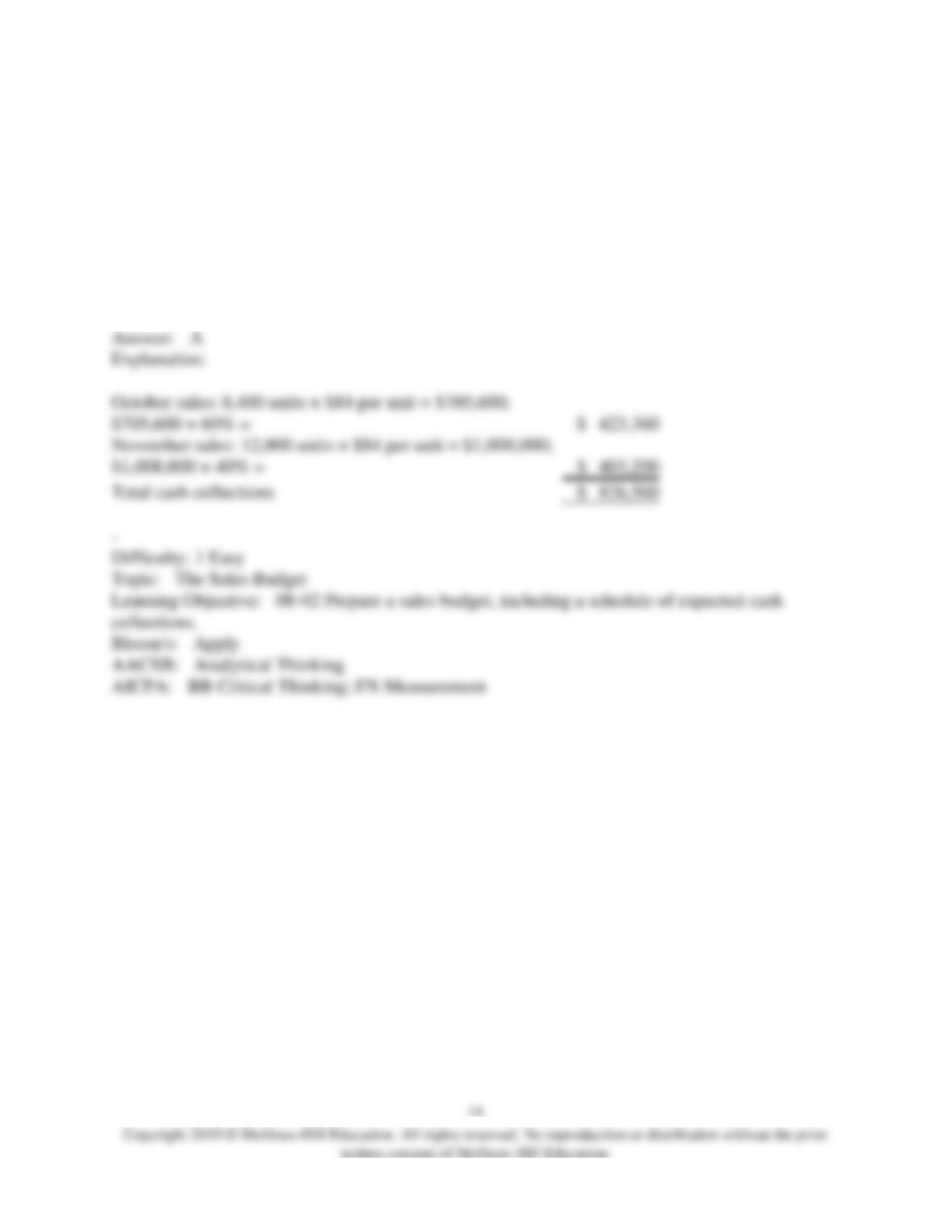
33) The BRS Corporation makes collections on sales according to the following schedule:
30% in month of sale
60% in month following sale
10% in second month following sale
The following sales have been budgeted:
Sales
April
$
140,000
May
$
130,000
June
$
150,000
Budgeted cash collections in June would be:
A) $137,000
B) $85,000
C) $45,000
D) $123,000
June sales collected in June ($150,000 × 30%)
May sales collected in June ($130,000 × 60%)
April sales collected in June ($140,000 × 10%)
Total cash collections in June
–
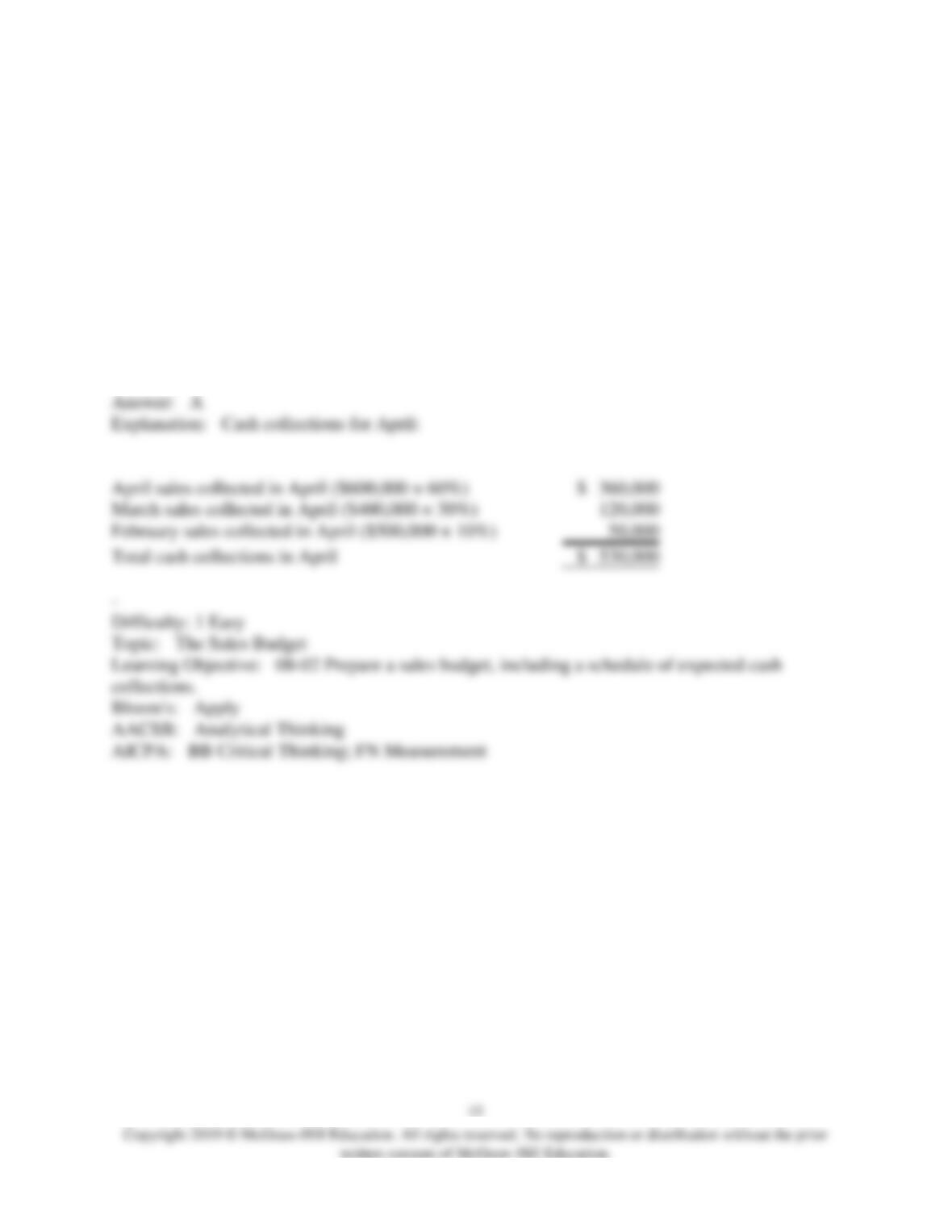
34) Sirignano Corporation produces and sells one product. The budgeted selling price per unit is
$84. Budgeted unit sales for October, November, December, and January are 8,400, 12,000,
13,800, and 14,300 units, respectively. All sales are on credit with 40% collected in the month of
the sale and 60% in the following month. The expected cash collections for November is closest
to:
A) $826,560
B) $705,600
C) $423,360
D) $403,200
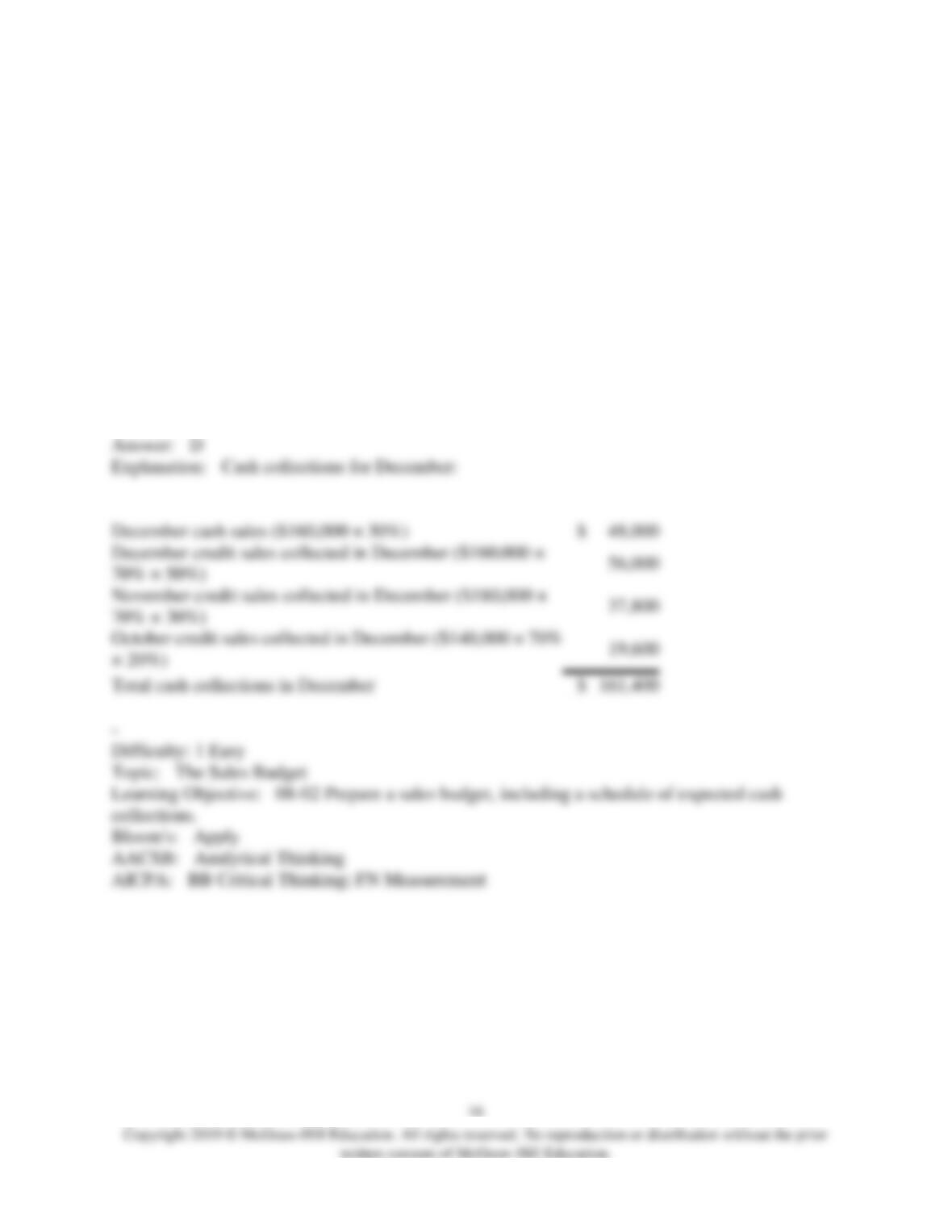
35) All of Pocast Corporation’s sales are on account. Sixty percent of the credit sales are collected
in the month of sale, 30% in the month following sale, and 10% in the second month following
sale. The following are budgeted sales data for the company:
January
February
March
April
Total sales
$
700,000
$
500,000
$
400,000
$
600,000
–
Cash receipts in April are expected to be:
A) $530,000
B) $360,000
C) $460,000
D) $410,000
April sales collected in April ($600,000 × 60%)
$
360,000
March sales collected in April ($400,000 × 30%)
120,000
February sales collected in April ($500,000 × 10%)
Total cash collections in April
$
530,000
–
36) Budgeted sales in Acer Corporation over the next four months are given below:
September
October
November
December
Budgeted sales
$120,000
$140,000
$180,000
$160,000
–
Thirty percent of the company’s sales are for cash and 70% are on account. Collections for sales on
account follow a stable pattern as follows: 50% of a month’s credit sales are collected in the month
of sale, 30% are collected in the month following sale, and 20% are collected in the second month
following sale. Given these data, cash collections for December should be:
A) $141,800
B) $100,500
C) $118,700
D) $161,400
December cash sales ($160,000 × 30%)
70% × 50%)
70% × 30%)
Total cash collections in December
–
37) Corvi Corporation produces and sells one product. The budgeted selling price per unit is $126.
Budgeted unit sales are shown below:
July
August
September
October
Budgeted unit sales
7,300
11,500
14,200
12,100
–
All sales are on credit with 40% collected in the month of the sale and 60% in the following month.
The expected cash collections for August is closest to:
A) $551,880
B) $579,600
C) $919,800
D) $1,131,480
$
551,880
$1,449,000 × 40% =
579,600
Total cash collections
$
38) Sioux Corporation is estimating the following sales for the first four months of next year:
January
$
210,000
February
$
280,000
March
$
340,000
April
$
370,000
–
Sales are normally collected 60% in the month of sale and 40% in the month following the sale.
Based on this information, how much cash should Sioux expect to collect during the month of
April?
A) $370,000
B) $222,000
C) $119,000
D) $358,000
April sales collected in April ($370,000 × 60%)
222,000
March sales collected in April ($340,000 × 40%)
Total cash collections in March
358,000
–
39) Jeanclaude Corporation produces and sells one product. The budgeted selling price per unit is
$105. Budgeted unit sales for July, August, September, and October are 7,400, 7,500, 13,800, and
15,300 units, respectively. All sales are on credit. Regarding credit sales, 40% are collected in the
month of the sale and 60% in the following month.
The budgeted accounts receivable balance at the end of August is closest to:
A) $525,000
B) $315,000
C) $472,500
D) $787,500
40) Crocetti Corporation makes one product and has provided the following information to help
prepare the master budget for the next four months of operations:
Budgeted selling price per unit
$
121
Budgeted unit sales (all on credit):
January
7,000
February
7,500
March
11,900
April
14,900
–
Credit sales are collected:
40% in the month of the sale
60% in the following month
The budgeted accounts receivable balance at the end of February is closest to:
A) $544,500
B) $907,500
C) $605,000
D) $363,000
February sales 7,500 units × $121 per unit (a)
907,500
Percent uncollected (b)
%
Accounts receivable (a) × (b)
544,500
–