108.
Revenue expenditures:
109.
Another name for a capital expenditure is:
110.
Extraordinary repairs:
111.
Which of the following is an example of an extraordinary repair?
112.
Ordinary repairs meet all of the following criteria
except
:
113.
Betterments are:
114.
Which of the following is an example of a betterment?
115.
An asset’s book value is $18,000 on December 31, Year 5. The asset has been depreciated
at an annual rate of $3,000 on the straight-line method. Assuming the asset is sold on
December 31, Year 5 for $15,000, the company should record:
116.
An asset with a cost of $67,000 and accumulated depreciation of $43,000 is sold for
$25,000, the company should record:
117.
Martinez owns an asset that cost $87,000 with accumulated depreciation of $40,000. The
company sells the equipment for cash of $42,000. At the time of sale, the company should
record:
118.
Martinez owns machinery that cost $87,000 with accumulated depreciation of $40,000.
The company sells the machinery for cash of $42,000. The journal entry to record the sale
would include a:
119.
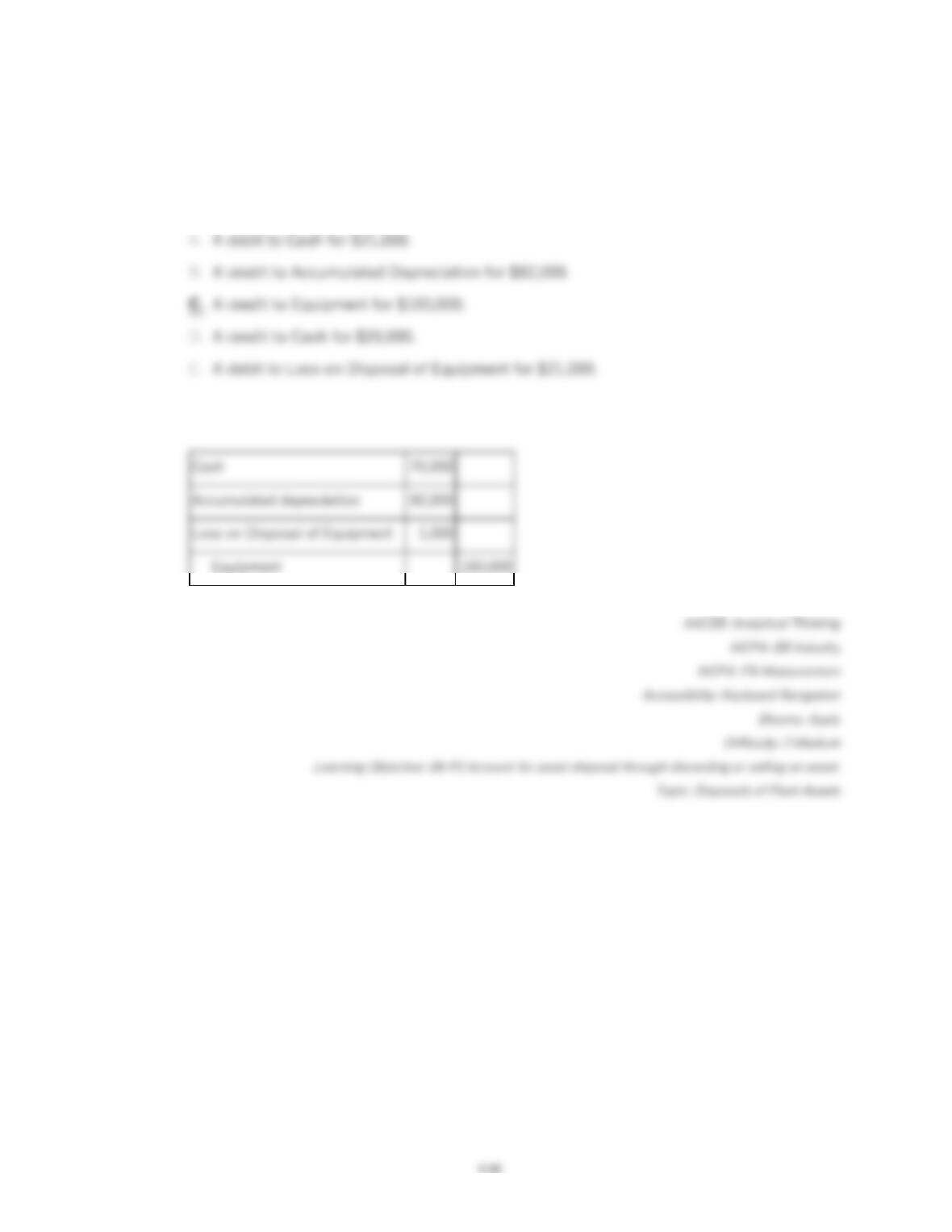
Equipment with a cost of $103,000 and accumulated depreciation of $82,000 was sold for
$20,000. The journal entry to record the sale would include:
120.
An asset’s book value is $36,000 on January 1, Year 6. The asset is being depreciated $500
per month using the straight-line method. Assuming the asset is sold on July 1, Year 7 for
$25,000, the company should record:
121.
An asset that was originally purchased for $46,000 has an estimated salvage value of
$4,000 and a 7 year life. The depreciation on the asset has been properly recorded through
the end of Year 2 using the straight-line method. Assuming the asset is sold on March 31
of Year 3, what is the appropriate amount of depreciation to record before accounting for
the disposal?
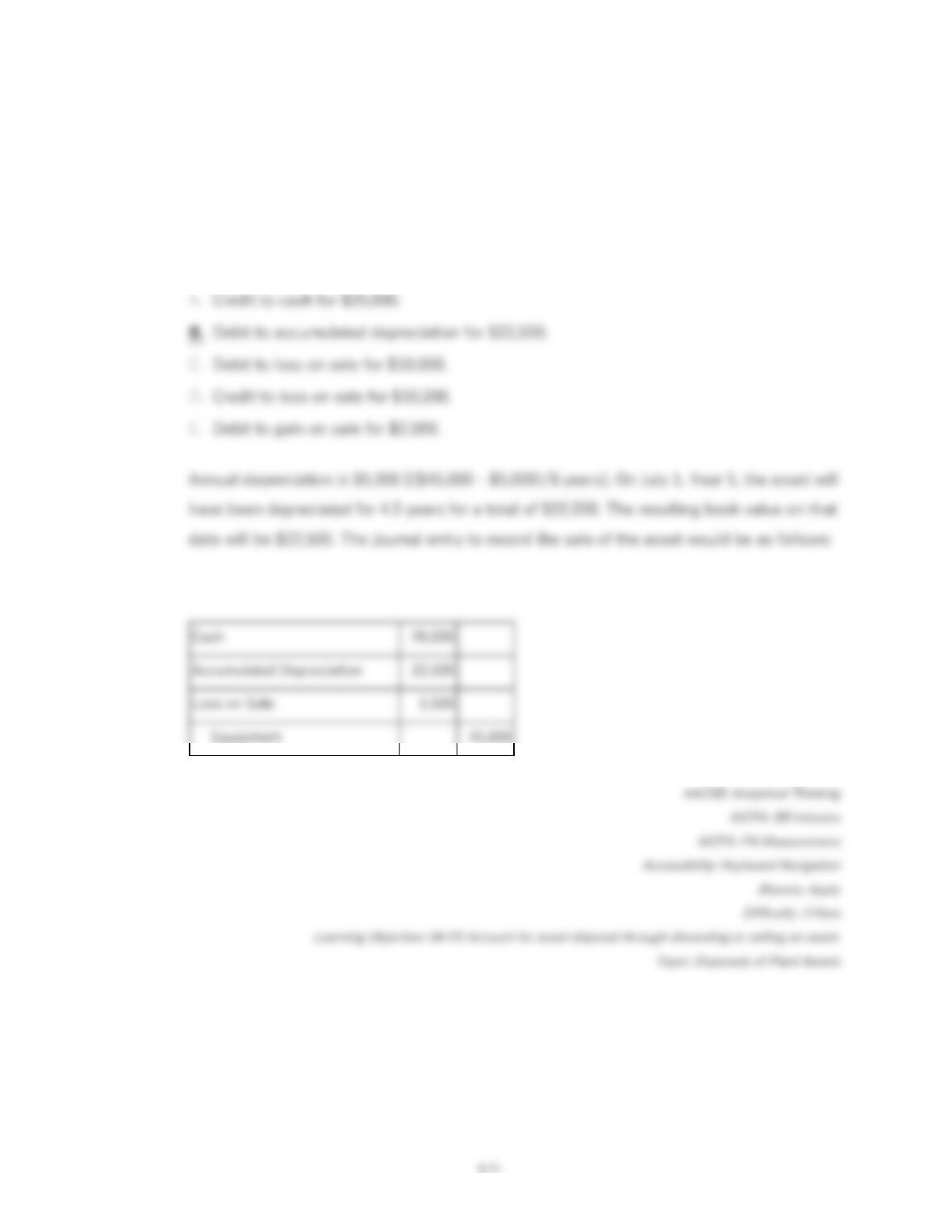
122.
Marks Consulting purchased equipment costing $45,000 on January 1, Year 1. The
equipment is estimated to have a salvage value of $5,000 and an estimated useful life of 8
years. Straight-line depreciation is used. If the equipment is sold on July 1, Year 5 for
$20,000, the journal entry to record the sale will include a:
8-72
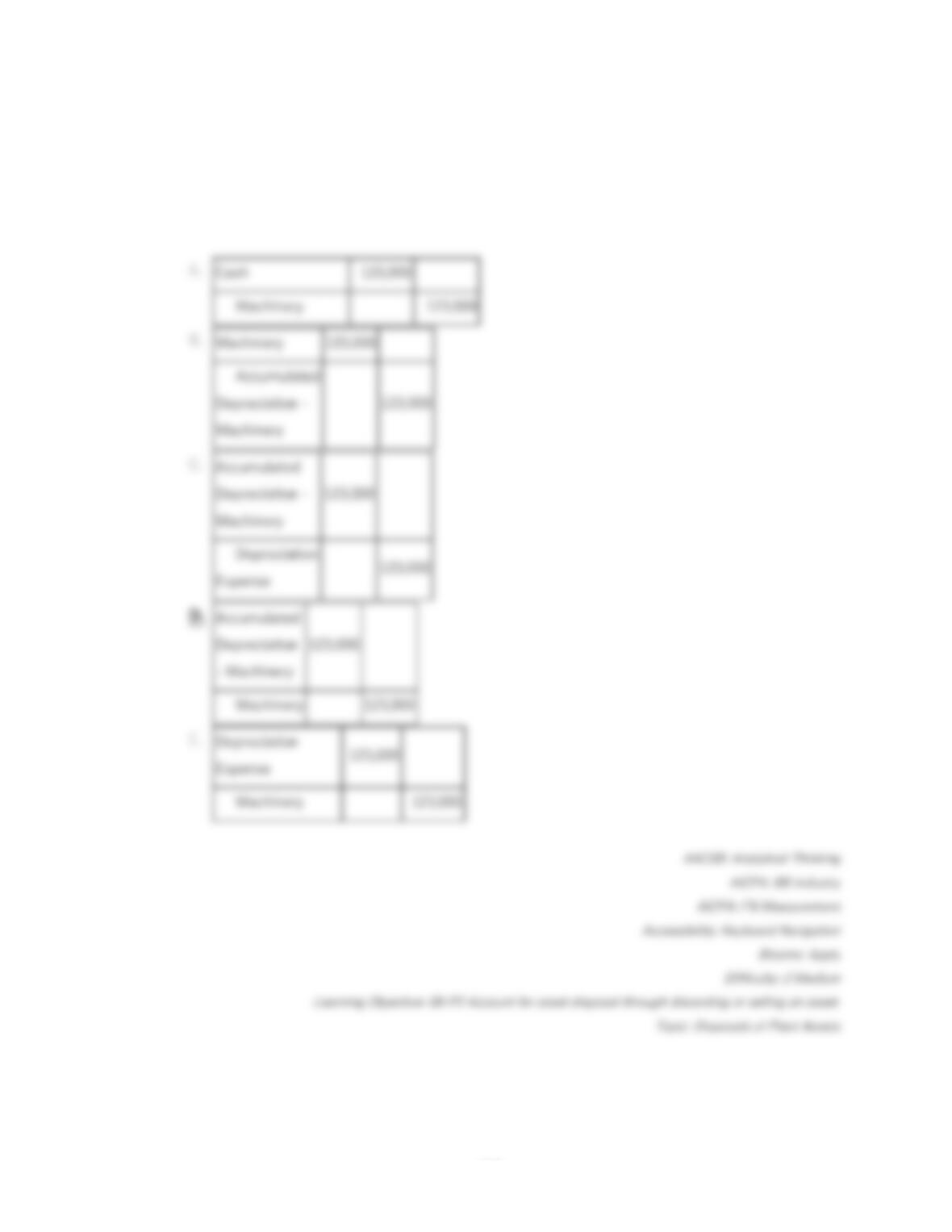
123.
Machinery costing $123,000 with zero salvage value is no longer useful to the company
and has no market value. If the machinery has been fully depreciated at the time of
disposal, the entry to record the disposal would be:
124.
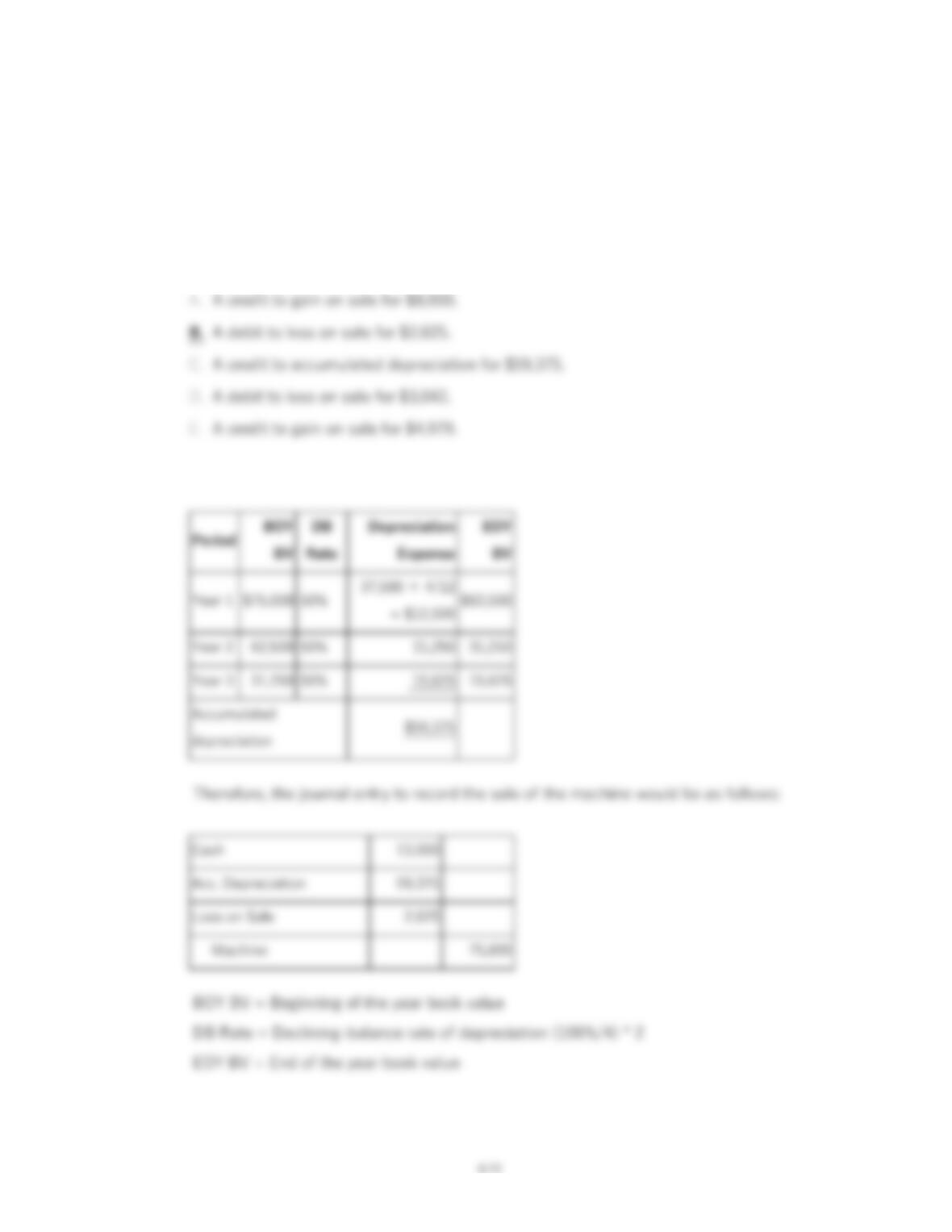
A machine costing $75,000 is purchased on September 1, Year 1. The machine is
estimated to have a salvage value of $10,000 and an estimated useful life of 4 years.
Double-declining-balance depreciation is used. If the machine is sold on December 31,
Year 3 for $13,000, the journal entry to record the sale will include:
125.
An asset can be disposed of by all of the following
except
:
126.
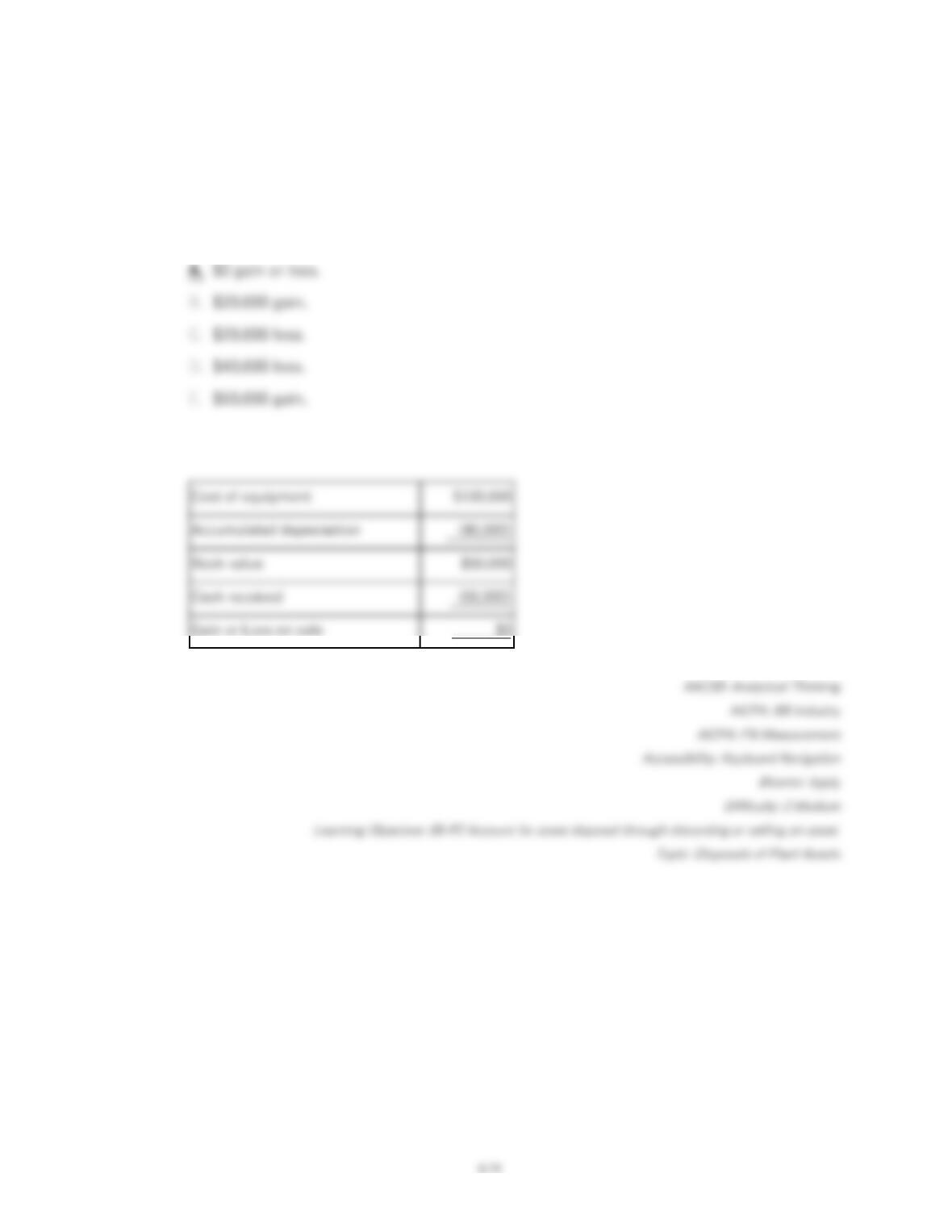
A company sold equipment that originally cost $100,000 for $60,000 cash. The
accumulated depreciation on the equipment was $40,000. The company should recognize
a:
127.
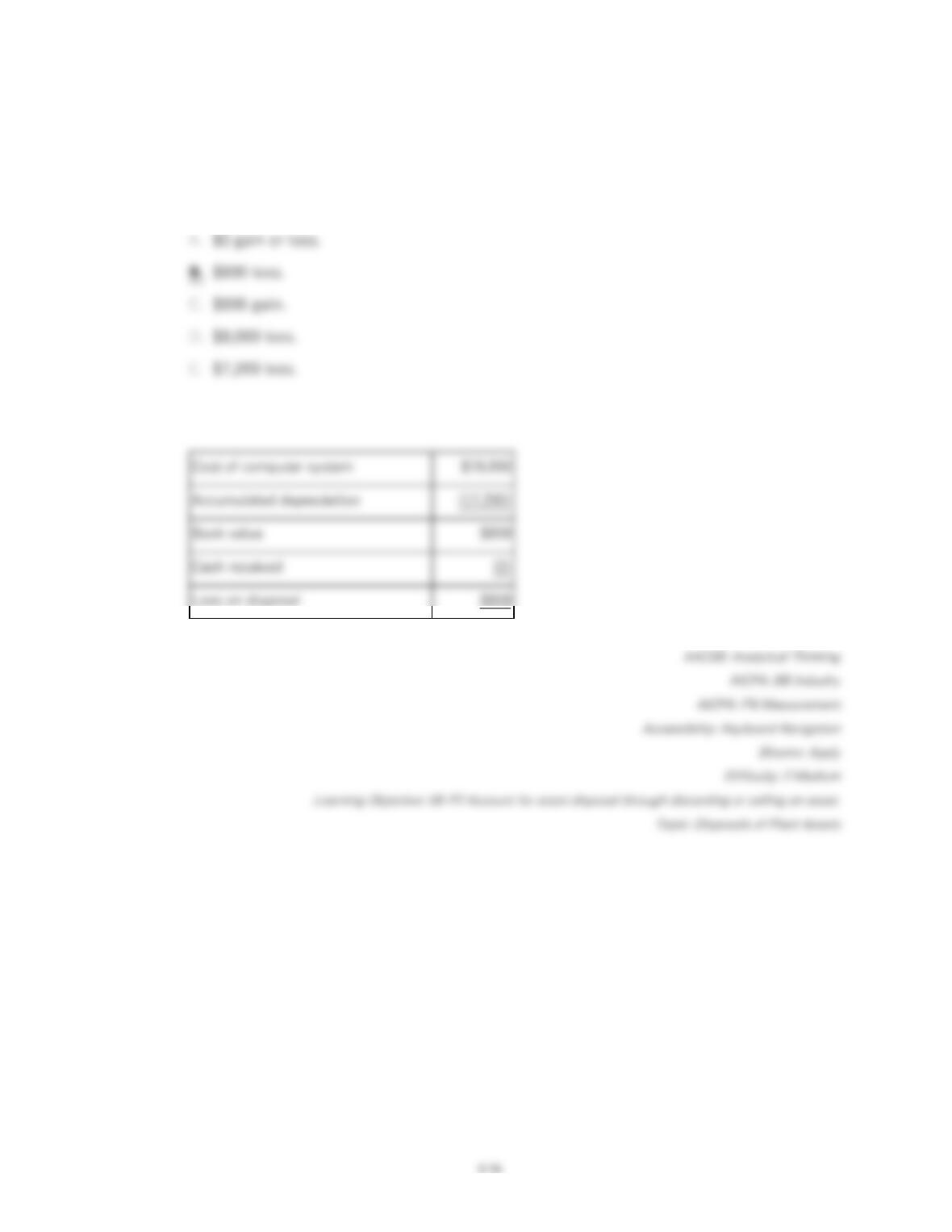
A company discarded a computer system originally purchased for $18,000. The
accumulated depreciation was $17,200. The company should recognize a(an):
128.
A company had a tractor destroyed by fire. The tractor originally cost $85,000 with
accumulated depreciation of $60,000. The proceeds from the insurance company were
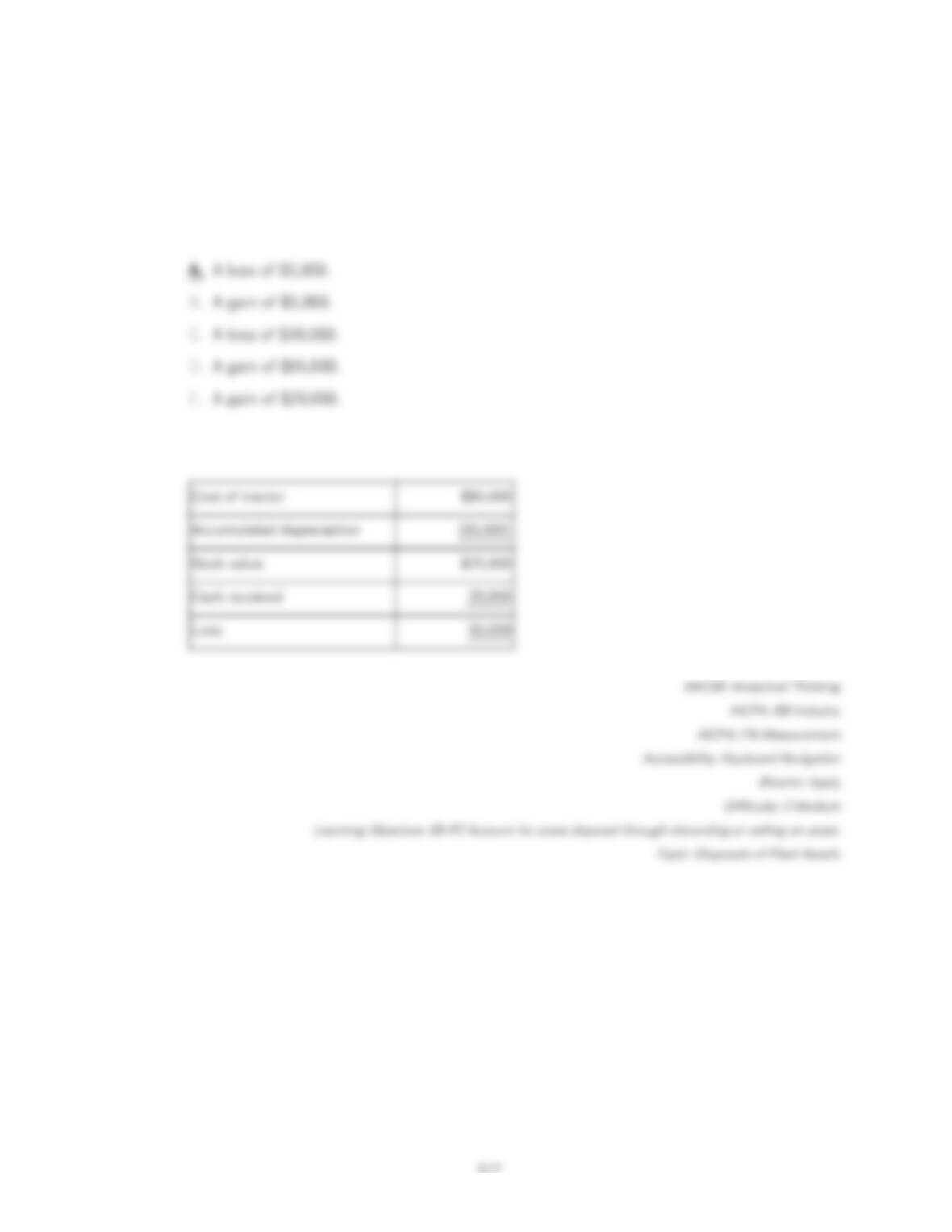
$20,000. The company should recognize:
129.
Natural resources are:
130.
Which of the following would be classified as a natural resource?
131.
Depletion is:
132.
A company purchased a tract of land for its natural resources at a cost of $1,500,000. It
expects to mine 2,000,000 tons of ore from this land. The salvage value of the land is
expected to be $250,000. The depletion expense per ton of ore is:
133.
A company purchased a tract of land for its natural resources at a cost of $1,500,000. It
expects to mine 2,000,000 tons of ore from this land. The salvage value of the land is
expected to be $250,000. If 150,000 tons of ore are mined during the first year, the journal
entry to record the depletion is: