CHAPTER 8
Pricing Decisions, Analyzing Customer Profitability,
and Activity-Based Pricing
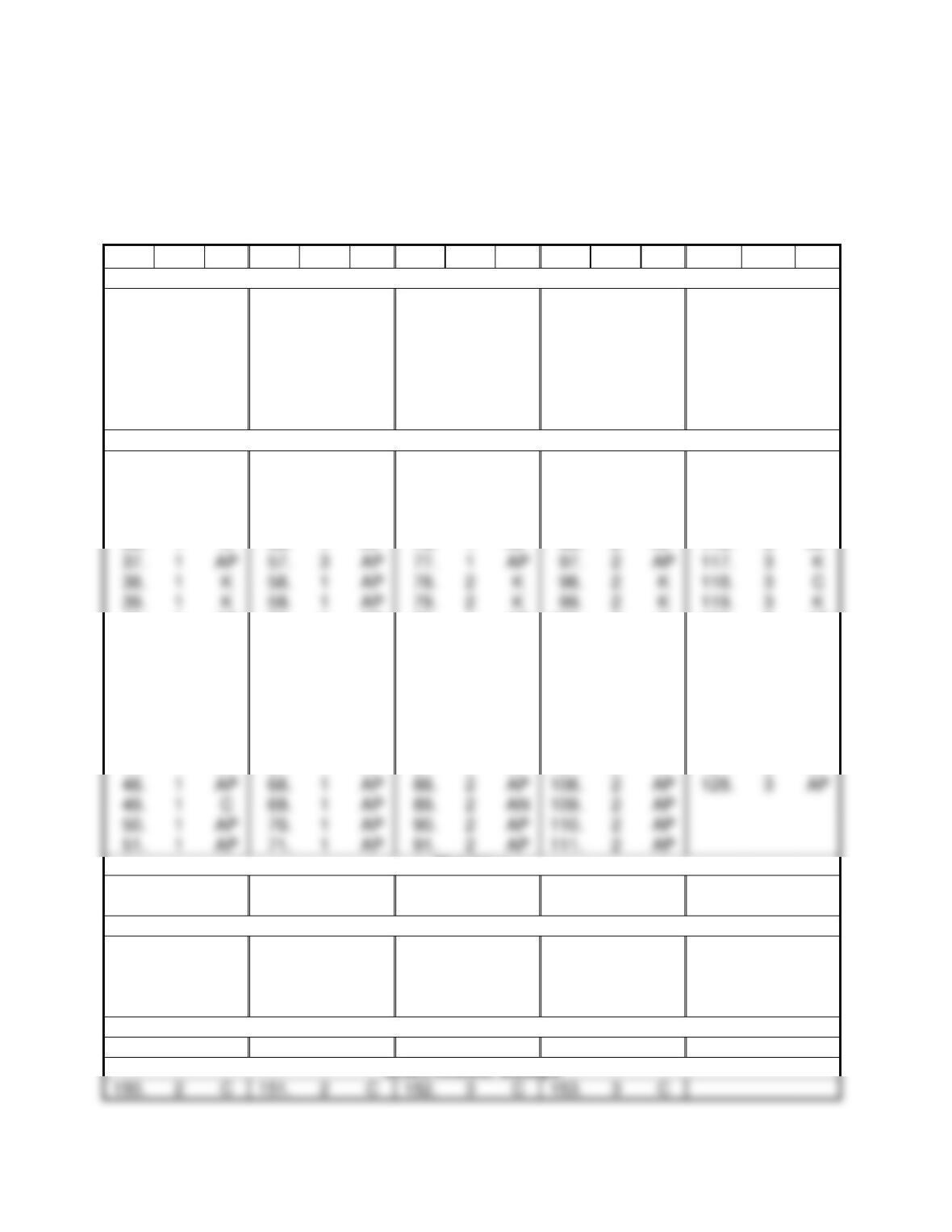
Summary of Questions by Objectives and Bloom’s Taxonomy
Item
LO
BT
Item
LO
BT
Item
LO
BT
Item
LO
BT
Item
LO
BT
True-False Statements
1.
1
K
8.
1
K
15.
2
K
22.
2
K
29.
3
K
2.
1
C
9.
1
K
16.
2
K
23.
2
K
30.
3
K
3.
1
K
10.
1
K
17.
2
K
24.
3
K
31.
3
K
4.
1
K
11.
1
K
18.
2
K
25.
3
K
5.
1
K
12.
1
C
19.
2
K
26.
3
K
6.
1
C
13.
1
C
20.
2
K
27.
3
C
7.
1
K
14.
2
K
21.
2
K
28.
3
K
Multiple Choice Questions
32.
1
K
52.
1
AP
72.
1
AP
92.
2
AP
112.
3
K
33.
2
K
53.
1
AP
73.
1
AP
93.
2
AP
113.
3
K
34.
1
K
54.
1
AP
74.
1
AP
94.
2
AP
114.
3
AP
35.
1
K
55.
1
AP
75.
1
AP
95.
2
AP
115.
3
AP
36.
1
K
56.
1
AP
76.
1
AP
96.
2
AP
116.
3
AP
40.
1
AP
60.
1
AP
80.
1
AP
100.
2
C
120.
3
AP
41.
1
AP
61.
1
C
81.
2
C
101.
2
C
121.
3
AP
42.
1
AP
62.
1
C
82.
2
AP
102.
2
AP
122.
3
AP
43.
1
AP
63.
1
C
83.
2
AP
103.
2
AP
123.
3
AP
44.
1
AP
64.
1
C
84.
2
AP
104.
2
AP
124.
3
AP
45.
1
AP
65.
1
C
85.
2
AP
105.
2
AP
125.
3
AP
46.
1
C
66.
1
C
86.
2
AP
106.
2
AP
126.
3
AP
47.
1
AP
67.
1
AP
87.
2
AP
107.
2
AP
127.
3
AP
48.
1
AP
68.
1
AP
88.
2
AP
108.
2
AP
128.
3
AP
49.
1
C
69.
1
AP
89.
2
AN
109.
2
AP
50.
1
AP
70.
1
AP
90.
2
AP
110.
2
AP
51.
1
AP
71.
1
AP
91.
2
AP
111.
2
AP
Matching
129.
1,
K
2,3
Exercises
130.
1
AP
134.
1
AP
138.
2
AP
142.
3
AP
146.
3
AP
131.
1
AP
135.
1
AP
139.
2
AN
143.
3
AP
132.
1
AP
136.
2
AP
140.
2
AN
144.
3
AP
133.
1
AP
137.
2
AP
141.
2
AP
145.
3
AP
Challenge Exercises
147.
2
AN
148.
3
AN
149.
2
AP
Short-Answer Essays
37.
1
AP
57.
3
AP
77.
1
AP
97.
2
AP
117.
3
K
38.
1
K
58.
1
AP
78.
2
K
98.
2
K
118.
3
C
39.
1
K
59.
1
AP
79.
2
K
99.
2
K
119.
3
K
8-2 Test Bank to accompany Jiambalvo Managerial Accounting, 6th Edition
TRUE-FALSE STATEMENTS
1. The most difficult part of determining the profit-maximizing price is determining the
demand function.
2. Even though the same percentage markup may be applied to all customers, some
customers may be more profitable than others.
3. Generally, the higher the price, the lower the quantity demanded.
4. The selling price that maximizes revenues is the price that will also maximize profit.
5. A demand function is the relation between price and quantity demanded.
6. Charging a higher price per unit causes an increase in profits for the company because
the selling price is larger than the variable cost.
7. A company should never price a product below full cost.
8. Fixed costs will affect a special order decision when the selling company is at capacity.
9. A company cannot increase profits if it accepts a special order at a price below its
incremental variable cost.
10. In order for a special order to be accepted, the full cost of the product must be covered.
11. When evaluating a special order, only costs that are incremental in nature should be a
part of the analysis.
12. A company should accept all orders for which a company has the capacity to produce.
13. As long as fixed costs increase by less than the excess of incremental revenue over
incremental cost, the acceptance of a special order will increase a company’s net
income.
14. The most difficult part of using cost-plus pricing is determining the demand function.
15. Cost-plus pricing is circular for the manufacturing industry in that demand must be
estimated to determine the fixed manufacturing costs per unit before the cost is marked
up to obtain a selling price, which has a major impact on the quantity demanded.
16. A company using cost-plus pricing starts with an estimate of the cost and adds a
markup to arrive at a price that allows for a reasonable level of profit.
17. Cost-plus pricing is the pricing method that begins with a careful analysis of competing
products and customer needs and wants.
18. Product cost can be easily adjusted after the design phase is complete as long as
production has not begun.
19. The target costing process begins with the design of the product.

Chapter 8 Pricing Decisions 8-3
20. The first step in the target costing process is to estimate how much a product will cost
to develop.
21. Prices developed using target costing are based on competing products and customer
needs and wants.
22. Target costing establishes selling prices based on the full cost of the product.
23. Target cost is computed by determining the appropriate selling price and then
subtracting desired profit from it.
24. In effect, a CPM system uses ABC to allocate costs to customers instead of to products
and services.
25. A customer’s profitability is calculated by dividing the sales revenue generated from
each customer by the cost of goods sold for each customer.
26. In a CPM system, costs are allocated to customers, who are the cost objectives.
27. When order processing costs do not vary based on the size of the order, a customer
who makes large, infrequent orders is generally more profitable than a customer who
makes small, more frequent orders, for the same quantity and price.
28. Activity-based pricing is utilized when a customer buying products is charged for the full
cost of a product or service plus a markup added to the cost.
29. In activity-based pricing, customers are offered separate prices for separate items or
services they choose in addition to the price of goods they purchase.
30. Suppliers adopting activity-based pricing may encourage customers to limit the variety
of goods they purchase to mitigate the price to be charged.
31. Activity-based pricing uses ABC concepts to determine one optimum uniform price to
charge all customers.
Answers to True-False

8-4 Test Bank to accompany Jiambalvo Managerial Accounting, 6th Edition
MULTIPLE CHOICE
32. Which one of the following does economic theory suggest?
A. Set a price that allows profit maximization
B. Set a price that allows the minimum number of units to be sold at the highest
unit price
C. Set a price that will maximize revenues
D. Set a price that will maximize market share
33. Which of the following factors is considered in a product pricing decision made using
cost-plus pricing?
A. Price customers are willing to pay
B. Selling and administrative costs
C. Competitors’ actions
D. Fixed cost per unit
34. What occurs to the quantity demanded as the price decreases?
A. It will increase.
B. It will decrease.
C. It will remain constant.
D. It will increase and then decrease.
35. Which of the following stays constant when the price per unit changes?
A. Demand
B. Contribution margin per unit
C. Total fixed costs
D. Profit
36. Which of the following statements about price, demand, and profit is generally true?
A. As price increases, demand decreases.
B. As demand increases, profit decreases.
C. As price increases, demand increases.
D. As price decreases, demand decreases.
37. Rosetone Retail sells one product with a variable cost of $3.50 per unit. The demand at
different prices to be charged is shown below:
Units Demanded Unit Price
10,000 $9
15,000 $8
20,000 $7
25,000 $6
If fixed costs are $42,000, what price should Rosetone charge in order to maximize
profits?
A. $9
B. $8
C. $7
D. $6

Chapter 8 Pricing Decisions 8-5
38. Which of the following statements about prices and profit is true?
A. Higher prices always lead to lower profits because fewer units will be sold.
B. Higher prices always lead to lower demand and higher profits.
C. Higher prices combine with lower demand to change the level of profits.
D. Higher prices will be offset by lower demand so profits will stay constant.
39. What should be maximized when setting the price for a product?
A. Total revenue
B. Contribution margin per unit
C. Net income
D. The number of units of product sold
40. Winslow Carpet produces and sells berber carpet by the yard with a variable cost of
$16 per yard. Total fixed costs are $280,000. The following chart represents the
estimated demand at various price levels.
Yards Demanded Unit Price
57,000 $25
67,500 $24
72,500 $23
86,000 $21
Which price will generate the largest profit for Winslow Carpets?
A. $25
B. $24
C. $23
D. $21
41. Wilkes Manufacturing sells one product with a variable unit cost of $18. The company
knows that the price charged will affect demand. Fixed costs are $275,000. If sales
exceed 50,000 units, the company will need to lease additional manufacturing space
and equipment at an additional cost of $100,000 per year. The following chart
represents the estimated demand at various price levels:
Units Demanded Unit Price
25,000 $30
50,000 $28
75,000 $25
100,000 $23
Based on this information which of the following statements is true?
A. Selling the units at $23 will generate the largest profit.
B. Selling the units at either $23 or $28 will generate a profit of $225,000.
C. Selling the units at either $25 or $28 will generate a profit of $225,000.
D. Selling the units at $28 will generate the largest profit.
8-6 Test Bank to accompany Jiambalvo Managerial Accounting, 6th Edition
42. Testor Paints sells varnish with a variable cost of $6.50 per gallon. The company is
unsure which price to charge in order to maximize profits. The price charged will also
affect the demand.
Gallons Demanded Unit Price Per Gallon
20,000 $11
30,000 $10
40,000 $9
50,000 $8
If fixed costs are $80,000 and the chart above represents the demand at various prices,
what price should be charged in order to maximize profits?
A. $11
B. $10
C. $9
D. $8
43. Dollar Deals sells a single product that has a unit variable cost of $9 per unit. The
company’s total fixed costs are $220,000. The company estimates demand at various
activity levels as follows:
Units Demanded Unit Price
54,000 $15
65,000 $14
72,000 $13
82,000 $12
What price should Dollar Deals charge to maximize profits?
A. $15
B. $14
C. $13
D. $12
44. Calico Joe Fabrics sells a single product. The company estimates total fixed costs at
$360,000 with demand, price, and total variable costs as follows:
Units
Demanded
Unit
Price
Total Variable
Costs
73,000
$31
$1,606,000
83,000
30
1,826,000
93,000
29
2,046,000
103,000
28
2,266,000
113,000
27
2,486,000
What price should Calico Joe Fabrics charge to maximize profits?
A. $31
B. $30
C. $29
D. $28
E. $27
Chapter 8 Pricing Decisions 8-7
45. Calico Joe Fabrics sells a single product. The company estimates total fixed costs at
$360,000 with demand and unit variable costs at various activity levels as follows:
Units
Demanded
Unit
Price
Total Variable
Costs
73,000
$31
$1,606,000
83,000
30
1,826,000
93,000
29
2,046,000
103,000
28
2,266,000
113,000
27
2,486,000
How much profit will Calico Joe Fabrics have if a price of $26 is charged and demand is
120,000?
A. $120,000
B. $3,120,000
C. $480,000
D. $2,760,000
46. Calico Joe Fabrics sells a single product. The company estimates total fixed costs at
$360,000 with demand and unit variable costs at various activity levels as follows:
Units
Demanded
Unit
Price
Total Variable
Costs
73,000
$31
$1,606,000
83,000
30
1,826,000
93,000
29
2,046,000
103,000
28
2,266,000
113,000
27
2,486,000
How would you best describe Calico’s variable cost per unit over the range shown?
A. It is constant.
B. It is increasing as volume increases.
C. It is decreasing as volume increases.
D. There is not enough information provided to determine the answer.
47. Palm Decor sells a single product that has variable costs of $12 per unit. The company
estimates the following demand at various unit prices:
Units
Demanded
Unit Price
31,000
$19
37,000
18
44,000
17
56,000
16
60,000
15
What price should Palm Decor charge to maximize profits?
A. $19
B. $18
C. $17
D. $16

8-8 Test Bank to accompany Jiambalvo Managerial Accounting, 6th Edition
48. Right Air Supply sells a specialized air filter that has a variable cost of $10 each. Fixed
costs are estimated to be $700,000 across all levels of sales shown below:
Units Demanded Unit Price
80,000 $35
90,000 $33
100,000 $31
110,000 $30
120,000 $28
What price should Right Air Supply charge to maximize profits?
A. $35
B. $33
C. $31
D. $30
E. $28
49. Right Air Supply sells a specialized air filter that has a variable cost of $10 each. Fixed
costs are estimated to be $700,000 across all levels of sales shown below:
Units Demanded Unit Price
80,000 $35
90,000 $33
100,000 $31
110,000 $30
120,000 $28
What information given, if any, is not relevant to the price maximization decision?
A. The selling prices
B. The variable costs per unit
C. The quantities demanded
D. The total fixed costs
50. Right Air Supply sells a specialized air filter that has a variable cost of $10 each. Fixed
costs are estimated to be $700,000 across all levels of sales shown below:
Units Demanded Unit Price
80,000 $35
90,000 $33
100,000 $31
110,000 $30
120,000 $28
What price should Right Air Supply charge to maximize revenues?
A. $35
B. $33
C. $31
D. $28

Chapter 8 Pricing Decisions 8-9
51. Maker Sun Chairs is trying to determine the optimal price to charge for its galvanized
deck chairs. The company has total fixed costs of $120,000 and the deck chairs have a
unit variable cost of $27.00 per unit. Maker Sun Chairs has determined that the
following relationships exist between price and demand:
Unit Price Unit Demand
$45 7,200
$44 7,800
$43 8,400
$42 8,800
How much is the contribution margin at a price of $45?
A. $324,000
B. $129,600
C. $12,600
D. $9,600
52. Maker Sun Chairs is trying to determine the optimal price to charge for its galvanized
deck chairs. The company has total fixed costs of $120,000 and the deck chairs have a
unit variable cost of $27.00 per unit. Maker Sun Chairs has determined that the
following relationships exist between price and demand:
Unit Price Unit Demand
$45 7,200
$44 7,800
$43 8,400
$42 8,800
What is the anticipated revenue at a price of $44?
A. $343,200
B. $132,600
C. $12,600
D. $387,200
53. Maker Sun Chairs is trying to determine the optimal price to charge for its galvanized
deck chairs. The company has total fixed costs of $120,000 and the deck chairs have a
unit variable cost of $27.00 per unit. Maker Sun Chairs has determined that the
following relationships exist between price and demand:
Unit Price Unit Demand
$45 7,200
$44 7,800
$43 8,400
$42 8,800
What is the anticipated profit at a price of $43?
A. $134,400
B. $14,400
C. $194,400
D. $361,200

8-10 Test Bank to accompany Jiambalvo Managerial Accounting, 6th Edition
54. Maker Sun Chairs is trying to determine the optimal price to charge for its galvanized
deck chairs. The company has total fixed costs of $120,000 and the deck chairs have a
unit variable cost of $27.00 per unit. Maker Sun Chairs has determined that the
following relationships exist between price and demand:
Unit Price Unit Demand
$45 7,200
$44 7,800
$43 8,400
$42 8,800
What is the anticipated profit at a price of $42?
A. $12,000
B. $132,000
C. $249,600
D. $369,600
55. Maker Sun Chairs is trying to determine the optimal price to charge for its galvanized
deck chairs. The company has total fixed costs of $120,000 and the deck chairs have a
unit variable cost of $27.00 per unit. Maker Sun Chairs has determined that the
following relationships exist between price and demand:
Unit Price Unit Demand
$45 7,200
$44 7,800
$43 8,400
$42 8,800
What price should Maker Sun Chairs charge in order to maximize its profit?
A. $45
B. $44
C. $43
D. $42
56. Tong Chin is the manager of an Asian restaurant. She is considering four price levels
for an all-you-can-eat buffet. Her estimate of price and quantity demanded are:
Buffet Meal Price Meals Demanded
$17.00 3,200
$16.00 3,700
$15.00 4,000
$14.00 4,400
Monthly operating costs include $16,400 of fixed costs and average variable costs of
$9.40 per meal. Which price will yield the largest monthly profit?
A. $17
B. $16
C. $15
D. $14

Chapter 8 Pricing Decisions 8-11
57. Ramsey Foods has analyzed its customer and order handling data for the past year and
has determined the following costs:
Order processing cost per order $5.50
Additional costs if order must be expedited (Per order) $6.00
Customer technical support calls (Per call) $3.50
Relationship management costs (Per customer per year) $1,900
In addition to these costs, product costs amount to 75% of sales. In the prior year,
Ramsey had the following experience with one of its customers, Turnkey Enterprises:
Sales $18,000
Number of orders 28
Percent of orders marked rush 25%
Calls to technical support 14
Calculate the profit earned on the Turnkey Enterprises account.
A. $2,355
B. $4,153
C. $4,482
D. $2,229
58. Allstate HVAC recently developed a low–end electronic thermostat that it plans on
selling via a cable channel marketing program. The cable program’s fee for selling the
item is 20% of revenue. For this fee, the program will advertise the thermostat over six
10–minute segments in September. Allstate’s fixed costs of producing the thermostats
are $110,000 per production run. The company plans to wait for all orders to come in,
and then it will produce exactly the number of units ordered. Variable production costs
are $25 per unit. In addition, it will cost approximately $5 per unit to ship the
thermostats to customers. Production time will be less than three weeks. Henry Kristen,
a product manager at Allstate, is charged with recommending a price for the thermostat.
Based on his experience with similar items, focus group responses, and survey
information, he has estimated the number of units that can be sold at various prices:
Unit Price Quantity
$74.99 15,000
$63.99 20,000
$54.99 25,000
$49.99 35,000
At what price is profit maximized?
A. $74.99
B. $63.99
C. $54.99
D. $49.99

8-12 Test Bank to accompany Jiambalvo Managerial Accounting, 6th Edition
59. Allstate HVAC recently developed a low–end electronic thermostat that it plans on
selling via a cable channel marketing program. The cable program’s fee for selling the
item is 20% of revenue. For this fee, the program will advertise the thermostat over six
10–minute segments in September. Allstate’s fixed costs of producing the thermostats
are $110,000 per production run. The company plans to wait for all orders to come in,
and then it will produce exactly the number of units ordered. Variable production costs
are $25 per unit. In addition, it will cost approximately $5 per unit to ship the
thermostats to customers. Production time will be less than three weeks. Henry Kristen,
a product manager at Allstate, is charged with recommending a price for the thermostat.
Based on his experience with similar items, focus group responses, and survey
information, he has estimated the number of units that can be sold at various prices:
Unit Price Quantity
$90 5,000
$77 8,000
$65 11,000
$62 13,000
At which price should the company sell it products?
A. $90
B. $77
C. $65
D. $62
60. Vanana Tees sells its cool-zone t-shirts for $24 each. Unit product costs are as follows:
Direct materials $4.50
Direct labor 1.80
Manufacturing overhead 3.50
Total $9.80
A special order to purchase 1,200 shirts was recently received. There is enough
capacity to fill the order. Filling this order will not disrupt current operations. Vanana
expects to incur an additional $1.10 per unit for additional labor costs due to a slight
modification the buyer wants made to the shirts. The manufacturing overhead costs
consist of 30% allocated fixed costs. In negotiating a price, how much is Vanana Tees’
minimum acceptable selling price per t-shirt?
A. $6.30
B. $8.75
C. $9.85
D. $7.35
61. Which of the following must be true for a company to accept a special order?
A. Variable costs must be less than the contribution margin.
B. Incremental revenues must be greater than incremental costs.
C. Opportunity costs must be greater than total revenue.
D. Total fixed costs must stay constant.
Chapter 8 Pricing Decisions 8-13
62. When deciding to accept or reject a special order, which of the following costs is most
likely to be irrelevant?
A. The wages of direct labor to make the order
B. Depreciation on the machinery used to make the order
C. The raw material used to make the order
D. The electricity used to run the machine to make the order
63. In accepting a special order, which one of the following is not considered?
A. Whether production capacity exists to complete the order
B. Whether demand for other products will be affected
C. Whether the fixed costs of production will increase
D. Whether the contribution margin per unit is greater for products in the special
order than the contribution margin for the same products sold to regular
customers
64. Which of the following is relevant in deciding whether to accept or reject a special
order?
A. The impact the order will have on existing business
B. The price that will be charged on the special order
C. The impact the order will have on existing business and the price that will be
charged on the special order
D. None of these answer choices are correct.
65. Which of the following statements is true of fixed costs of production in determining
whether to accept or reject a special order?
A. They are increased in proportion to the amount that production increases when
a special order is accepted.
B. They are often considered relevant if the plant is operating at capacity.
C. If the order can be completed without creating additional fixed costs, they are
relevant.
D. They are always relevant in the decision.
66. Wagner Enterprises is contemplating accepting a special order. The company
determined that the order will cause an increase in fixed costs. Should the order be
accepted?
A. No, as any increase in fixed costs will reduce the company’s profit
B. Yes, as long as the total revenue is greater than the associated variable costs
C. Yes, if the increase in fixed costs is less than the incremental revenue
D. Yes, if the incremental revenue is greater than the total incremental costs

8-14 Test Bank to accompany Jiambalvo Managerial Accounting, 6th Edition
67. Cinotti Bread Depot bakes and sells each bagel for $1.25. The cost of producing
600,000 bagels in the prior year was:
Revenues $750,000
Direct materials 330,000
Direct labor 66,000
Manufacturing overhead – fixed 132,000
Manufacturing overhead – variable 84,000
At the start of the current year, Cinotti received a special order for 15,000 bagels to be
sold for $1.10 per bagel. The company estimates it will incur an additional $700 in total
fixed costs in order to lease a special machine needed to bake the bagels in the
customer’s logo shape. Also, this order will not affect any of its other operations. Should
the company accept the special order?
A. No, profit will decrease by $2,950
B. No, profit will decrease by $2,250
C. Yes, profit will increase by $3,800
D. Yes, profit will increase by $500
68. Bell Supply House produces recycled paper that it sells by the case. Budgeted amounts
for the coming year are as follows:
Revenues (20,000 cases at $12 each) $240,000
Direct material $40,000
Direct labor 70,000
Variable manufacturing overhead 50,000
Fixed manufacturing overhead 30,000 190,000
Net income $ 50,000
LTS Enterprises has offered to purchase 2,000 cases of the paper from Bell at a price
of $12.50 per case. This special order will have additional variable costs of $0.35 per
case due to delivery costs. Bell Supply House has the capacity to produce this order
and it will not affect any of its other operations. How much is the incremental revenue
associated with accepting this special order?
A. $8,300
B. $25,000
C. $165,000
D. $9,000
Chapter 8 Pricing Decisions 8-15
69. Bell Supply House produces recycled paper that it sells by the case. Budgeted amounts
for the coming year are as follows:
Revenues (20,000 cases at $12 each) $240,000
Direct material $40,000
Direct labor 70,000
Variable manufacturing overhead 50,000
Fixed manufacturing overhead 30,000 190,000
Net income $ 50,000
LTS Enterprises has offered to purchase 2,000 cases of the paper from Bell at a price
of $12.50 per case. This special order will have additional variable costs of $0.35 per
case due to delivery costs. Bell Supply House has the capacity to produce this order
and it will not affect any of its other operations. How much is the incremental cost of
accepting the special order?
A. $16,000
B. $46,000
C. $16,700
D. $19,000
70. Bell Supply House produces recycled paper that it sells by the case. Budgeted amounts
for the coming year are as follows:
Revenues (20,000 cases at $12 each) $240,000
Direct material $40,000
Direct labor 70,000
Variable manufacturing overhead 50,000
Fixed manufacturing overhead 30,000 190,000
Net income $ 50,000
LTS Enterprises has offered to purchase 2,000 cases of the paper from Bell at a price
of $12.50 per case. This special order will have additional variable costs of $0.35 per
case due to delivery costs. Bell Supply House has the capacity to produce this order
and it will not affect any of its other operations. How much is the incremental profit
(loss) associated with the special order?
A. $8,300
B. $9,000
C. ($21,000)
D. ($11,700)
8-16 Test Bank to accompany Jiambalvo Managerial Accounting, 6th Edition
71. Element Boards makes skateboard wheels. Budget information regarding current period
operations reflecting the sale of 200,000 wheels appears below:
Revenue (200,000 wheels at $3.00 each) $600,000
Direct materials 120,000
Direct labor 220,000
Variable manufacturing overhead 50,000
Fixed manufacturing overhead 70,000
The USA Skate Team has approached Element with a special order for 6,000 wheels at
a price of $2.75 per wheel. Variable costs will be the same as the current production
and accepting the special order will not have any impact on the rest of the company’s
orders. However, Element is operating at capacity and will incur an additional $5,000 in
fixed manufacturing overhead if the order is accepted. What is the incremental revenue
associated with accepting the special order?
A. $616,500
B. $200
C. $16,700
D. $16,500
72. Element Boards makes skateboard wheels. Budget information regarding the current
period is given below:
Revenue (200,000 wheels at $3.00 each) $600,000
Direct materials 120,000
Direct labor 220,000
Variable manufacturing overhead 50,000
Fixed manufacturing overhead 70,000
The USA Skate Team has approached Element with a special order for 6,000 wheels at
a price of $2.75 per wheel. Variable costs will be the same as the current production
and accepting the special order will not have any impact on the rest of the company’s
orders. However, Element is operating at capacity and will incur an additional $5,000 in
fixed manufacturing overhead if the order is accepted. What is the incremental cost
associated with accepting the special order?
A. $16,500
B. $11,700
C. $18,800
D. $16,700
Chapter 8 Pricing Decisions 8-17
73. Element Boards makes skateboard wheels. Budget information regarding the current
period is given below:
Revenue (200,000 wheels at $3.00 each) $600,000
Direct materials 120,000
Direct labor 220,000
Variable manufacturing overhead 50,000
Fixed manufacturing overhead 70,000
The USA Skate Team has approached Element with a special order for 6,000 wheels at
a price of $2.75 per wheel. Variable costs will be the same as the current production
and accepting the special order will not have any impact on the rest of the company’s
orders. However, Element is operating at capacity and will incur an additional $5,000 in
fixed manufacturing overhead if the order is accepted. What is the incremental net
income (loss) associated with accepting the special order?
A. ($2,300)
B. $2,700
C. ($2,700)
D. ($200)
74. P&T Furniture has a capacity to produce 40,000 oak shelves per year and is currently
selling 36,000 shelves for $32 each. Bates Hotel has approached P&T about buying
1,200 shelves for a new hotel it is building and is willing to pay $26 for each shelf. The
shelves can be packaged in bulk, saving P&T $1.50 per shelf compared to the normal
packaging cost. Normally, the shelves have a unit variable cost of $27. The annual fixed
costs of $450,000 will be unaffected by the special order and the order will not affect
any of its other operations. What would be the impact on profit if P&T accepts this
special order?
A. Profit will decrease by $6,000.
B. Profit will increase by $31,200.
C. Profit will increase by $600.
D. Profit will decrease by $1,200.
75. P&T Furniture has a capacity to produce 40,000 oak shelves per year and is currently
selling all 40,000 shelves for $32 each. Bates Hotel has approached P&T about buying
1,200 shelves for a new hotel it is building and is willing to pay $26 each. The shelves
can be packaged in bulk, saving P&T $1.50 per shelf compared to the normal
packaging cost. Normally, the shelves have a unit variable cost of $27. The annual fixed
costs of $450,000 will be unaffected by the special order and it will not affect any of its
other operations. What is the minimum price per shelf that P&T should accept for this
special order?
A. $27.00
B. $25.50
C. $30.50
D. $32.00

8-18 Test Bank to accompany Jiambalvo Managerial Accounting, 6th Edition
76. Accent Furniture has a capacity of 30,000 desk chairs per year and is currently selling
all 20,000 for $240 each. Country Bank has approached Accent with an offer to buy 800
chairs for only $210 each. Accent has a normal variable cost of $165 per chair,
including $50 per unit in direct labor per chair. Accent can produce the special order on
an overtime shift. This would result in direct labor being paid overtime at 150% of the
normal pay rate. The annual fixed costs will be unaffected by the special order and it
will not affect any of its other operations. What will be the impact on profit of accepting
the order?
A. Profit will decrease by $24,000.
B. Profit will increase by $16,000.
C. Profit will increase by $36,000.
D. Profit will decrease by $4,000.
77. Tenna Electronics sells arc monitors for $55 per unit. Unit product costs are as follows:
Direct materials $14
Direct labor 20
Manufacturing overhead 3
Total $37
A special order to purchase 15,000 arc monitors was recently received from a
customer. There is enough capacity to fill the order and filling this order would not
disrupt current operations. Tenna will incur an additional $2 per arc monitor for
additional labor costs due to a slight modification the buyer wants made to the original
product. One-third of the manufacturing overhead costs is fixed and will be incurred no
matter how many units are produced. In negotiating a price, how much is the minimum
selling price that Tenna Electronics should accept for this special order?
A. $34
B. $39
C. $38
D. $36
78. Why is cost-plus pricing criticized?
A. It includes selling and administrative costs in determining the product cost.
B. It does not consider the fixed manufacturing overhead in determining the
product cost.
C. It is inherently circular for manufacturing firms.
D. It requires a high level of technical expertise to price products using this method.
79. To what amount does a company set a price equal if it uses a cost-plus approach to
pricing?
A. Total costs incurred
B. Variable product costs plus a markup for profit
C. Estimated total costs plus a markup for profit
D. Total variable costs plus a share of the fixed costs

Chapter 8 Pricing Decisions 8-19
80. Sky Blue Plans provides financial planning for senior citizens. The costs of preparing
800 financial plans in the prior year were:
Direct labor $400,000
Variable overhead 296,000
Fixed overhead 250,000
Total cost $946,000
At the start of the current year, the company received an offer from MooseHaven, a
retirement home for Moose members. MooseHaven wants Sky Blue Plans to prepare
financial plans for its 150 assisted living citizens. Sky Blue has the capacity to prepare
up to 1,000 plans in a given year, so this special order would not take away revenue
from any of Sky Blue’s current clients. MooseHaven is willing to pay $880 per plan.
What will be the effect on Sky Blue Plan’s profit if it agrees to prepare plans for the 150
citizens of MooseHaven?
A. Profit will increase by $1,500.
B. Profit will decrease by $45,375.
C. Profit will increase by $132,000.
D. Profit will decrease by $1,500.
81. Which of the following is not a valid criticism of cost-plus pricing?
A. It is difficult to determine the appropriate markup.
B. The method depends on technical expertise in determining a cost.
C. The firm’s demand curve is ignored in setting the price and quantity.
D. The method is inherently circular for manufacturing firms.
82. Garden Corporation uses cost-plus pricing with a 30% mark–up. The company is
currently selling 12,000 units at $21.45 per unit. Each unit has a variable cost of $11.50.
In addition, the company incurs $60,000 in fixed costs annually. If demand falls to
10,000 units, how much will the company have to charge per unit in order to earn the
same annual profit?
A. $22.45
B. $21.45
C. $23.44
D. $22.75
83. SawTown Tools uses cost-plus pricing with a 30% mark–up. The company is currently
selling 80,000 units at $65 per unit. Each unit has a variable cost of $47. In addition, the
company incurs $240,000 in fixed costs annually. If demand falls to 40,000 units and
the company wants to continue to charge the same price per unit, what markup
percentage is the company using?
A. 22.6%
B. 26.2%
C. 36.1%
D. 30.1%
8-20 Test Bank to accompany Jiambalvo Managerial Accounting, 6th Edition
84. Clipper Office Furniture uses cost-plus pricing with a 40% mark–up on total cost at
capacity. The company is currently selling 40,000 units at $19.60 per unit. Each unit
has a variable cost of $9. In addition, the company incurs $200,000 in fixed costs
annually. If demand falls to 32,000 units and the company wants to continue to earn a
40% return, what price should the company charge?
A. $15.25
B. $21.35
C. $19.60
D. $6.10
85. Ragtown Grill uses cost-plus pricing with a 40% mark–up. The company is currently
selling 20,000 units annually, but has a capacity of 30,000 units. Each unit has a
variable cost of $15. In addition, the company incurs $60,000 in fixed costs annually.
For how much is the company selling each unit?
A. $25.20
B. $21.00
C. $24.00
D. $23.80
86. Segundo Office Tech uses cost-plus pricing and produces 100,000 calculators at a total
cost of $3.5 million. Total fixed costs are $1.5 million. If the company increases
production by 20% and uses a 30% markup, how much will the price per unit be?
A. $32.50
B. $42.25
C. $45.50
D. $54.40
87. DT Company uses cost-plus pricing and has $30 per unit in variable costs and
$800,000 per year in fixed costs. Demand is estimated to be 200,000 units annually.
What is the price if a markup of 30% on total cost is used to determine the price?
A. $34.00
B. $39.00
C. $44.20
D. $43.00
88. A company uses cost-plus pricing and has a total cost of $40.00 per unit at a volume of
120,000 units. The variable cost per unit is $25.00. What will the price be if the
company expects a volume of 110,000 units and uses a markup of 50%?
A. $41.36
B. $62.05
C. $37.50
D. $60.00
89. A company has $6.50 per unit in variable costs and $2.20 per unit in fixed costs at a
volume of 40,000 units. If the company uses cost-plus pricing, which of the following
should the company use to determine the price?
A. The company should use a unit cost of $8.70 per unit only at a volume of 40,000
units.
B. The company should use a unit cost of $8.70 at any volume level.
C. The company should use a unit cost of $8.70 at any volume within the relevant
range.
D. The company should use a unit cost of $6.50 per unit only at a volume of 40,000
units.