52.
Intangible assets are nonphysical assets used in operations that confer on their owners’
long-term rights, privileges, or competitive advantages.
53.
Since goodwill is an intangible, it is amortized each year using the straight-line method,
the same as other intangibles are amortized.
54.
A patent is an exclusive right granted to its owner to manufacture and sell a patented
device or to use a process for 20 years.
55.
A copyright gives its owner the exclusive right to publish and sell a musical, literary, or
artistic work during the life of the creator plus 17 years.
56.
A trademark is an exclusive right granted to its owner to publish and sell a musical,
literary, or artistic work during the life of the creator plus 70 years.
57.
Morgan Industries purchases land for a building site for $500,000, payed $20,000 to have
an existing structure removed and recovered $4,000 from the sale of salvaged materials.
The cost charge to the land account is $524,000.
58.
If Clark Corp. purchased machinery for $10,000 with no salvage value and a 5 year life on
July 1, the depreciation expense in the first year is $1,000.
59.
Intangible assets, such as goodwill, that are not amortized are tested annually for
impairment.
Multiple Choice Questions
60.
Plant assets are defined as:
61.
One characteristic of plant assets is that they are:
62.
The relevant factors in computing depreciation
do
not
include:
63.
Salvage value is:
64.
Depreciation:
65.
The useful life of a plant asset is:
66.
The term
inadequacy
, as it relates to the useful life of an asset, refers to:
67.
The term,
obsolescence
, as it relates to the useful life of an asset, refers to:
68.
Once the estimated depreciation expense for an asset is calculated:
69.
A machine originally had an estimated useful life of 6 years, but after 4 complete years, it
was decided that the original estimate of useful life should have been 10 years. At that
point the remaining cost to be depreciated should be allocated over the remaining:
70.
A change in an accounting estimate is:
71.
When originally purchased, a vehicle costing $23,000 had an estimated useful life of 8 and
an estimated salvage value of $1,500. After 4 years of straight-line depreciation, the
asset’s total estimated useful life was revised from 8 years to 6 years and there was no
change in the estimated salvage value. The depreciation expense in year 5: equals:
8-32
72.
A company used straight-line depreciation for equipment that cost $12,000, had a salvage
value of $2,000 and a five-year useful life. After depreciating the asset for three complete
years, the salvage value was reduced to $1,200 but its total useful life remained the same.
Determine the amount of depreciation to be charged against the equipment during each of
the remaining years of its useful life:
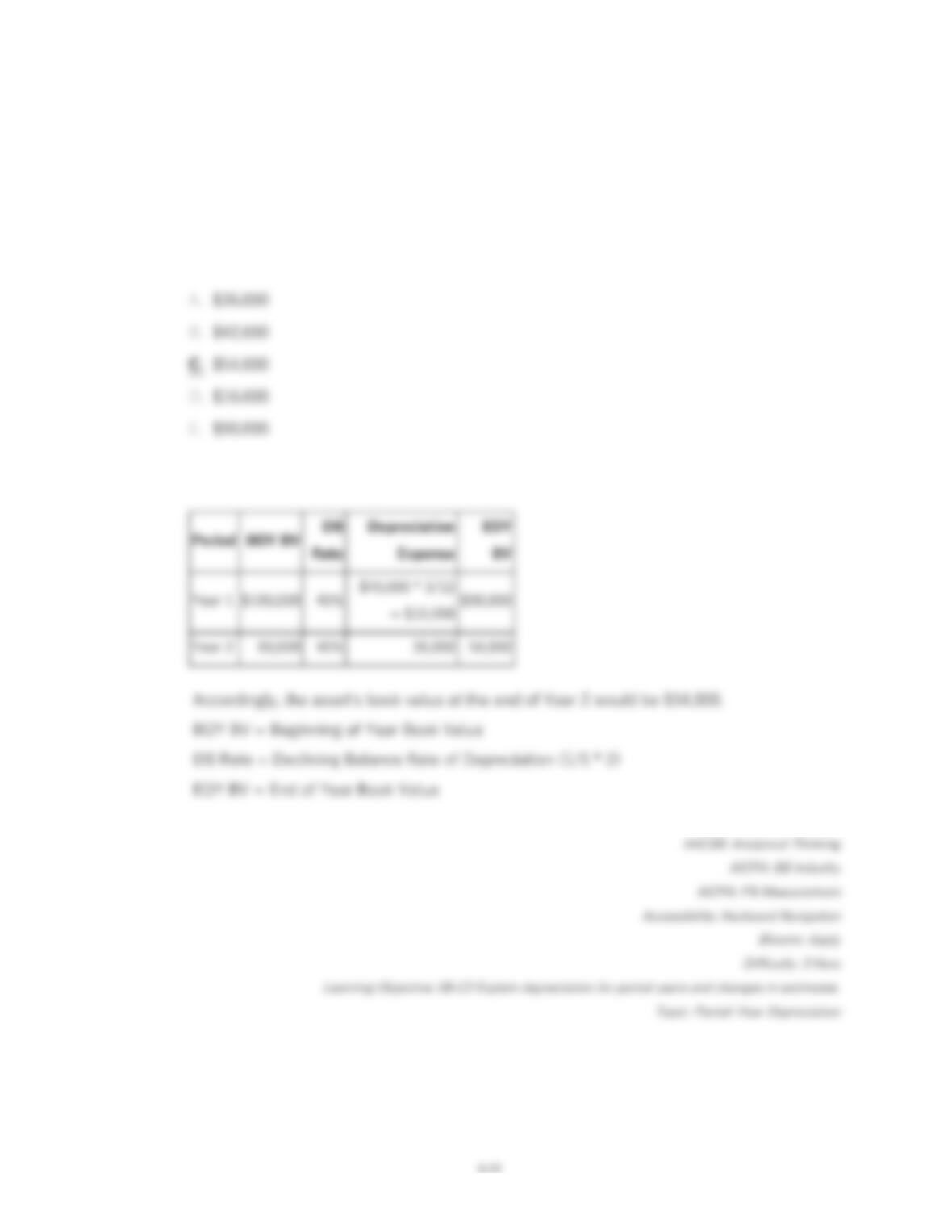
73.
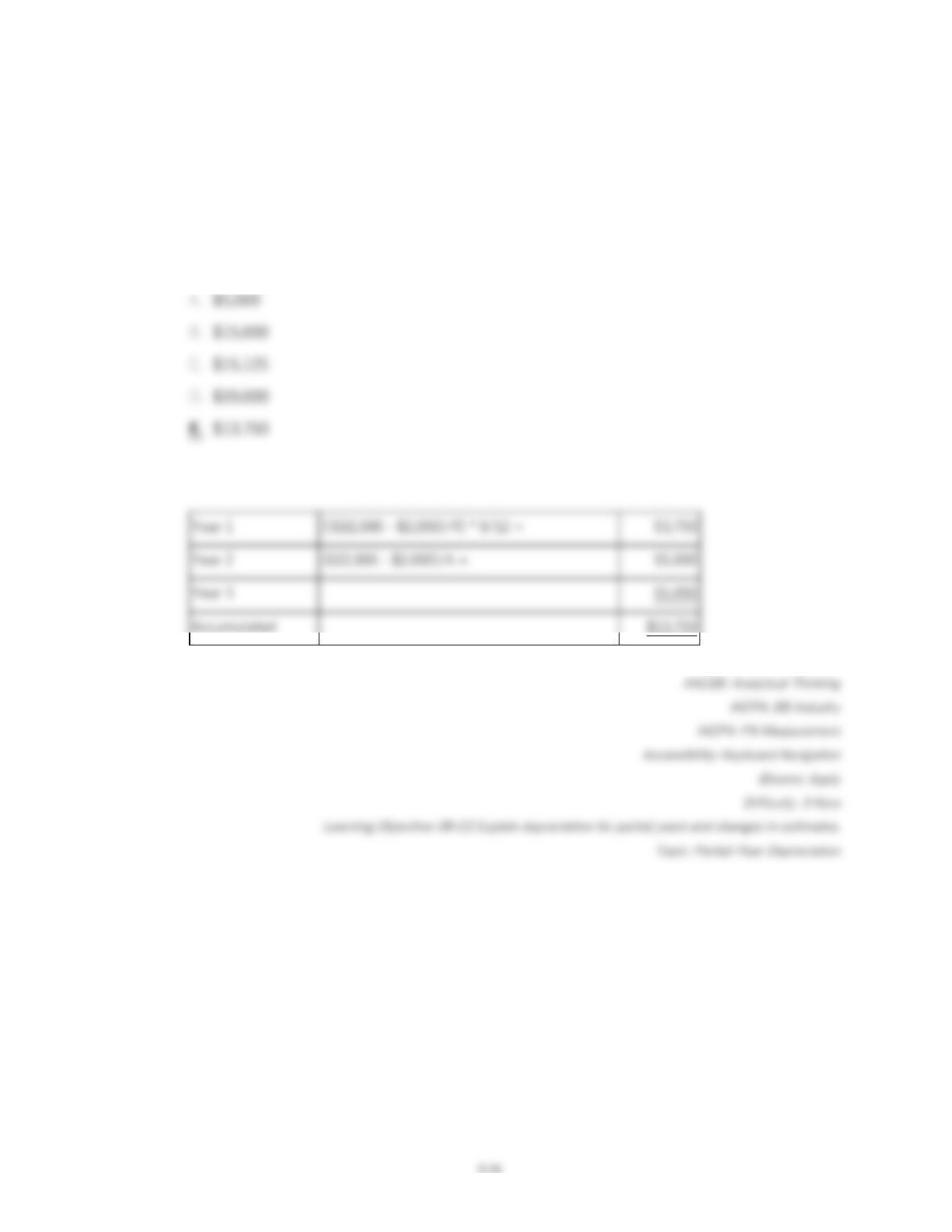
Beckman Enterprises purchased a depreciable asset on October 1, Year 1 at a cost of
$100,000. The asset is expected to have a salvage value of $20,000 at the end of its five–
year useful life. If the asset is depreciated on the double–declining-balance method, the
asset’s
book
value
on December 31, Year 2 will be:
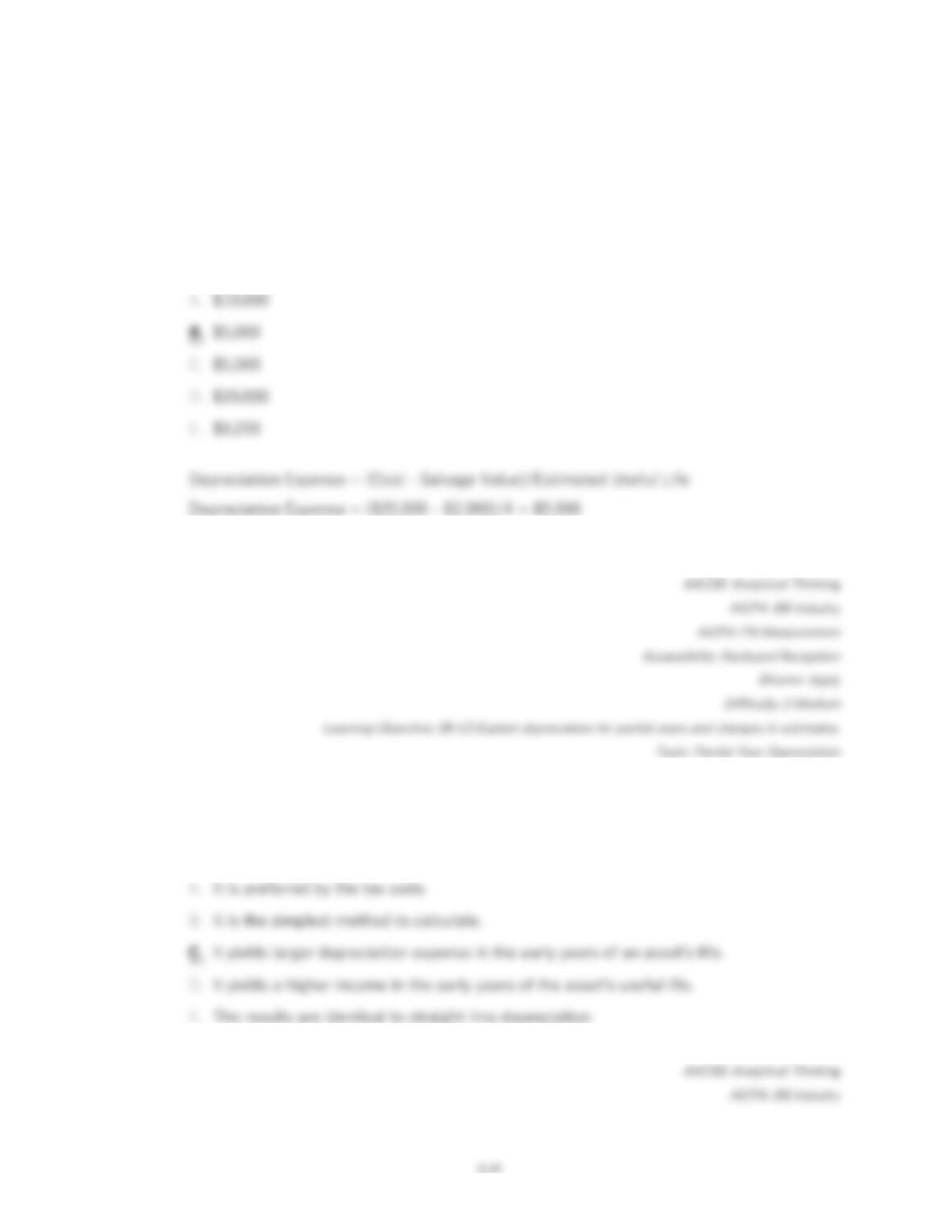
74.
Peavey Enterprises purchased a depreciable asset for $22,000 on April 1, Year 1. The
asset will be depreciated using the straight-line method over its four-year useful life.
Assuming the asset’s salvage value is $2,000, what will be the amount of
accumulated
depreciation
on this asset on December 31, Year 3?
75.
Peavey Enterprises purchased a depreciable asset for $22,000 on April 1, Year 1. The
asset will be depreciated using the straight-line method over its four-year useful life.
Assuming the asset’s salvage value is $2,000, Peavey Enterprises should recognize
depreciation
expense
in Year 2 in the amount of:
76.
A benefit of using an accelerated depreciation method is that:
77.
The following information is available on a depreciable asset owned by Mutual Savings
Bank:
Purchase date
June 1, Year 1
Purchase price
$85,000
Salvage value
$10,000
Useful life
10 years
Depreciation method
Straight-line
The asset’s book value is $70,000 on June 1, Year 3. On that date, management
determines that the asset’s salvage value should be $5,000 rather than the original
estimate of $10,000. Based on this information, the amount of
depreciation
expense
the
company should recognize during the last six months of Year 3 would be:
78.
The modified accelerated cost recovery system (MACRS):
79.
The straight-line depreciation method and the double-declining-balance depreciation
method:
80.
Total asset turnover is used to evaluate:
81.
A total asset turnover ratio of 3.5 indicates that:
82.
The calculation of total asset turnover is:
83.
A company had average total assets of $887,000. Its gross sales were $1,090,000 and its
net sales were $1,000,000. The company’s total asset turnover equals: