Intermediate Accounting, 9e (Spiceland)
Chapter 8 Inventories: Measurement
1) Physical counts of inventory are never made with perpetual inventory systems.
2) The main difference between perpetual and periodic inventory systems is the timing of the
allocation of costs between inventory and cost of goods sold.
3) LIFO periodic and LIFO perpetual always produce the same dollar amounts for ending
inventory.
4) FIFO periodic and FIFO perpetual always produce the same dollar amounts for cost of goods
sold.
5) Cost of goods on consignment is included in the consignee’s inventory until sold.
6) Shipping charges on outgoing goods are included in either cost of goods sold or selling
expenses.
7) Net purchases are reduced for discounts taken whether the net method is used or the gross
method is used.
8) The choice of cost flow assumption (FIFO, LIFO, or average) does not depend on the actual
physical flow of the product.
9) Inventory costing methods are merely means by which costs are allocated between ending
inventory and cost of goods sold.
10) During periods of falling prices, LIFO ending inventory will be less than FIFO ending
inventory.
11) LIFO usually provides a better match of revenue and expense than does FIFO.
12) Unit LIFO is more costly to implement than dollar-value LIFO.
13) LIFO liquidation profits occur when inventory quantity declines and costs are rising.
14) The gross profit ratio is calculated by dividing gross profit by average inventory.
15) Dollar-value LIFO eliminates the risk of LIFO liquidations.
16) A company that prepares its financial statements according to International Financial
Reporting Standards (IFRS) can use all of the same inventory valuation methods as a company
that prepares its statements under U.S. GAAP.
17) In a perpetual inventory system, the cost of purchases is debited to:
A) Purchases.
B) Cost of goods sold.
C) Inventory.
D) Accounts payable.
18) In a periodic inventory system, the cost of purchases is debited to:
A) Purchases.
B) Cost of goods sold.
C) Inventory.
D) Accounts payable.
19) In a perpetual inventory system, the cost of inventory sold is:
A) Debited to accounts receivable.
B) Credited to cost of goods sold.
C) Debited to cost of goods sold.
D) Not recorded at the time goods are sold.
20) In a perpetual inventory system, which of the following is recorded at the time of the sale?
A) Sales revenue only.
B) Both sales revenue and cost of goods sold.
C) Cost of goods sold only.
D) Neither sales revenue or cost of goods sold.
21) In a periodic inventory system, the cost of inventories sold is:
A) Debited to accounts receivable.
B) Credited to cost of goods sold.
C) Debited to cost of goods sold.
D) Not recorded at the time goods are sold.
22) One difference between periodic and perpetual inventory systems is:
A) Cost of goods sold is not recorded under a perpetual system until the end of the period.
B) Cost of goods sold is not recorded under a periodic system until the end of the period.
C) Cost of goods sold is always significantly higher under a perpetual system.
D) Cost of goods sold is always significantly higher under a periodic system.
23) The largest expense on a retailer’s income statement is typically:
A) Salaries and wages.
B) Cost of goods sold.
C) Income tax expense.
D) Depreciation expense.
24) The Mateo Corporation’s inventory at December 31, 2018, was $325,000 based on a physical
count priced at cost, and before any necessary adjustment for the following:
Merchandise costing $30,000, shipped f.o.b. shipping point from a vendor on December 30,
2018, was received on January 5, 2019.
Merchandise costing $22,000, shipped f.o.b. destination from a vendor on December 28, 2018,
was received on January 3, 2019.
Merchandise costing $38,000 was shipped to a customer f.o.b. destination on December 28,
arrived at the customer’s location on January 6, 2019.
Merchandise costing $12,000 was being held on consignment by Traynor Company.
What amount should Mateo Corporation report as inventory in its December 31, 2018, balance
sheet?
A) $367,000.
B) $427,000.
C) $405,000.
D) $325,000.
25) Ending inventory is equal to the cost of items on hand plus:
A) Items in transit sold f.o.b. shipping point.
B) Purchases in transit f.o.b. destination.
C) Items in transit sold f.o.b. destination.
D) None of these answer choices is correct.
26) A company’s estimate of merchandise that will be returned by customers should be:
A) Included in inventory at an amount equal to the selling price of the merchandise.
B) Included in inventory at an amount equal to the cost of the merchandise.
C) Excluded from inventory but deducted from sales revenue and accounts receivable.
D) None of these answer choices are correct.
27) The Constance Corporation’s inventory at December 31, 2018, was $125,000 (at cost) based
on a physical count of inventory on hand, before any necessary adjustment for the following:
Merchandise costing $15,000, shipped f.o.b. shipping point from a vendor on December 27,
2019, was received by Constance on January 5, 2019.
Merchandise costing $45,000 was shipped to a customer f.o.b. shipping point on December 28,
2018, arrived at the customer’s location on January 6, 2019.
Merchandise costing $21,000 was being held on hand for Jess Company on consignment.
Estimated sales returns are 10% of annual sales. Sales revenue was $550,000 with a gross profit
ratio of 25%.
What amount should Constance Corporation report as inventory in its December 31, 2018,
balance sheet?
A) $160,250.
B) $145,250.
C) $187,250.
D) $190,250.
28) Purchases equal the invoice amount:
A) Plus freight-in, plus discounts lost.
B) Less purchase returns, plus purchase allowances.
C) Plus freight-in, less purchase discounts.
D) Plus discounts, less purchase returns.
29) Using the gross method, purchase discounts lost are:
A) Included in purchases.
B) Added to accounts payable.
C) Included in interest expense.
D) Deducted from discount income.
30) Under the net method, purchase discounts lost are:
A) Included in purchases.
B) Added to accounts payable.
C) Included in interest expense.
D) Deducted from discount income.
31) Inventory does not include:
A) Materials used in the production of goods to be sold.
B) Assets intended to be sold in the normal course of business.
C) The cost of office equipment.
D) Assets currently in production for normal sales.
32) Under the gross method, purchase discounts taken are:
A) Deducted from interest expense.
B) Added to net purchases.
C) Added to interest income.
D) Deducted from purchases.
33) Alison’s dress shop buys dresses from McGuire Manufacturing. Alison purchased dresses
from McGuire on July 17 and received an invoice with a list price amount of $6,000 and
payment terms of 2/10, n/30. Alison uses the net method to record purchases. Alison should
record the purchase at:
A) $5,940.
B) $5,880.
C) $6,000.
D) $6,120.
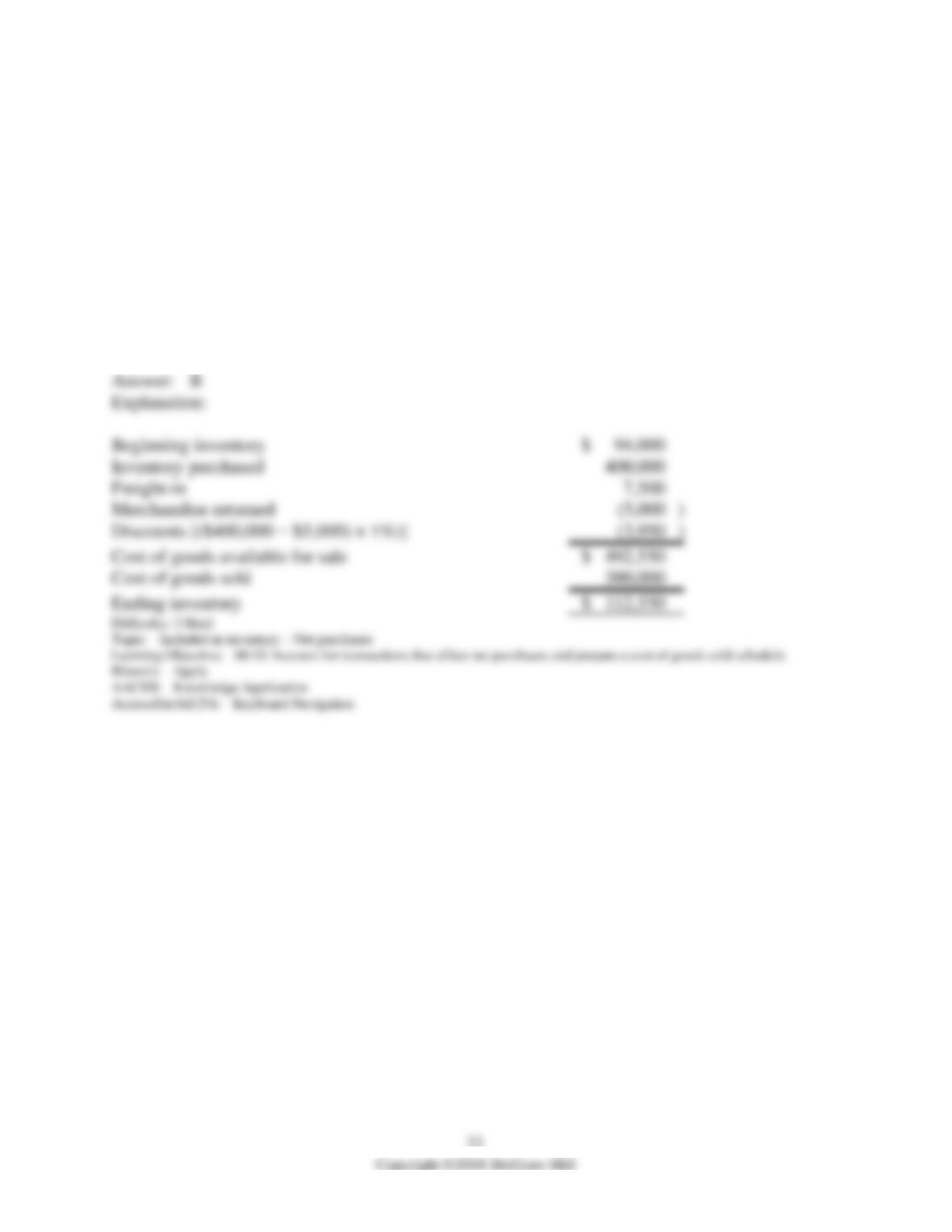
34) Northwest Fur Co. started 2018 with $94,000 of merchandise inventory on hand. During
2018, $400,000 in merchandise was purchased on account with credit terms of 1/15, n/45. All
discounts were taken. Purchases were all made f.o.b. shipping point. Northwest paid freight
charges of $7,500. Merchandise with an invoice amount of $5,000 was returned for credit. Cost
of goods sold for the year was $380,000. Northwest uses a perpetual inventory system.
What is ending inventory assuming Northwest uses the gross method to record purchases?
A) $112,490.
B) $112,550.
C) $116,500.
D) $120,300.
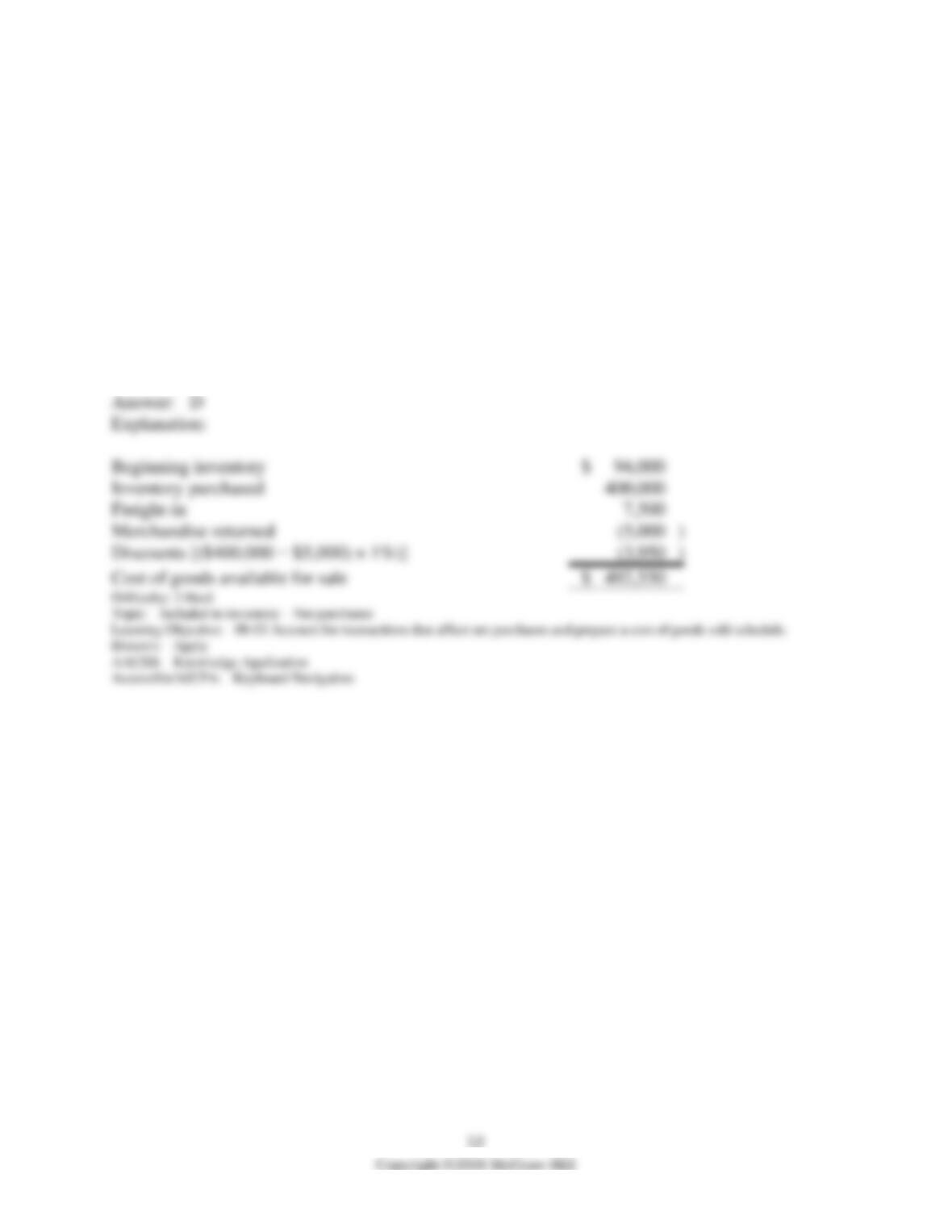
35) Northwest Fur Co. started 2018 with $94,000 of merchandise inventory on hand. During
2018, $400,000 in merchandise was purchased on account with credit terms of 1/15, n/45. All
discounts were taken. Purchases were all made f.o.b. shipping point. Northwest paid freight
charges of $7,500. Merchandise with an invoice amount of $5,000 was returned for credit. Cost
of goods sold for the year was $380,000. Northwest uses a perpetual inventory system.
Assuming Northwest uses the gross method to record purchases, what is the cost of goods
available for sale?
A) $492,500.
B) $496,500.
C) $490,500.
D) $492,550.
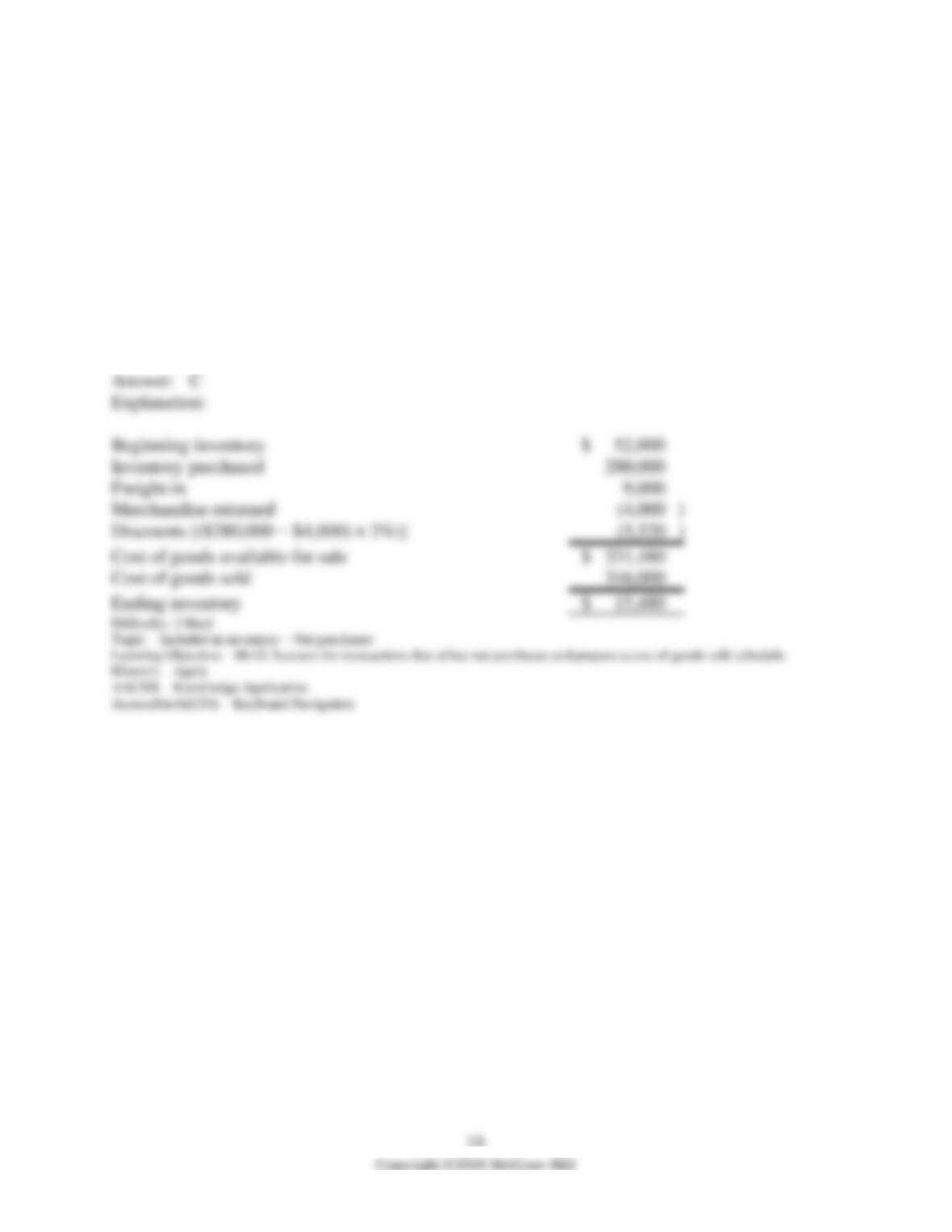
36) Cinnamon Buns Co. (CBC) started 2018 with $52,000 of merchandise on hand. During 2018,
$280,000 in merchandise was purchased on account with credit terms of 2/10, n/30. All
discounts were taken. Purchases were all made f.o.b. shipping point. CBC paid freight charges of
$9,000. Merchandise with an invoice amount of $4,000 was returned for credit. Cost of goods
sold for the year was $316,000. CBC uses a perpetual inventory system.
Assuming CBC uses the gross method to record purchases, ending inventory would be:
A) $6,480.
B) $15,400.
C) $15,480.
D) $21,000.
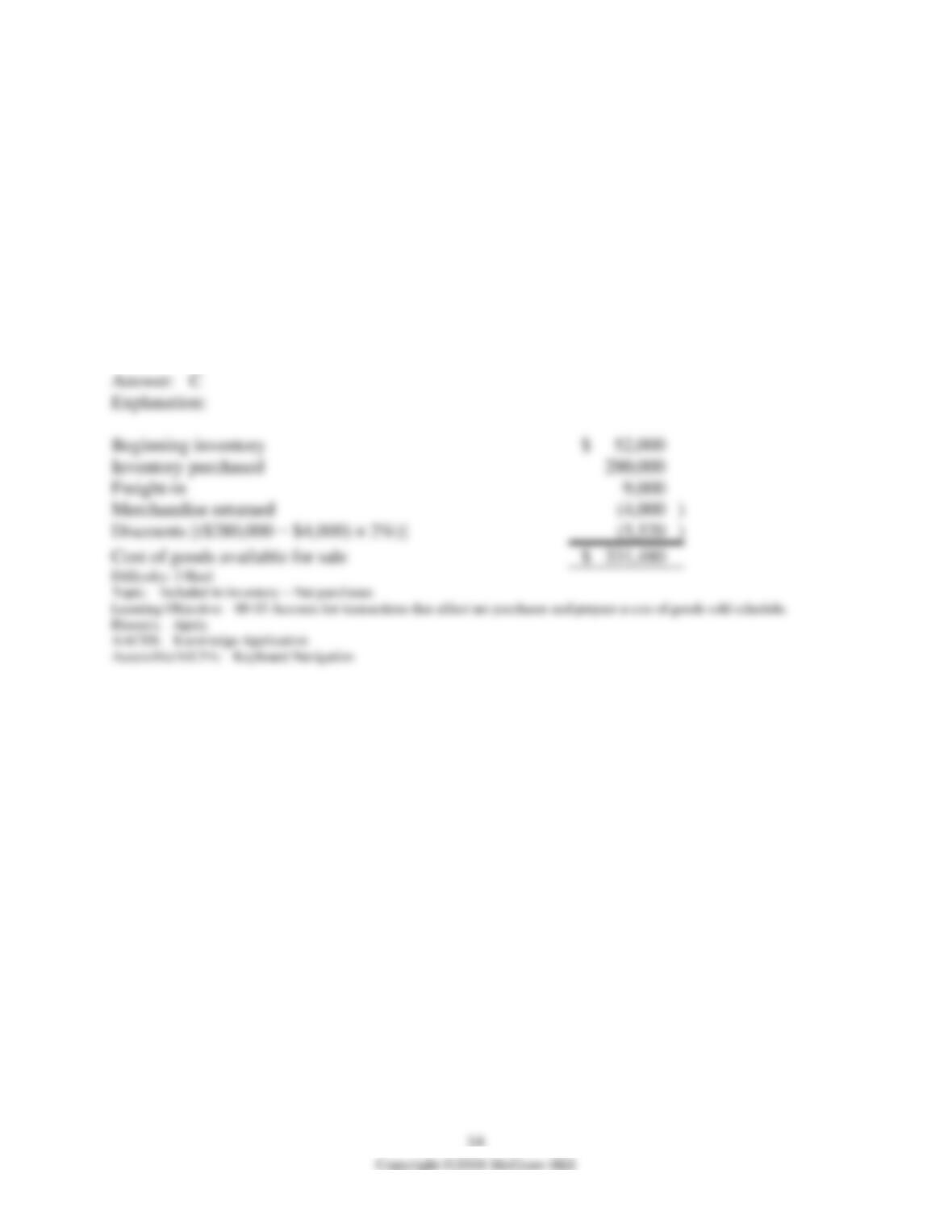
37) Cinnamon Buns Co. (CBC) started 2018 with $52,000 of merchandise on hand. During 2018,
$280,000 in merchandise was purchased on account with credit terms of 2/10, n/30. All
discounts were taken. Purchases were all made f.o.b. shipping point. CBC paid freight charges of
$9,000. Merchandise with an invoice amount of $4,000 was returned for credit. Cost of goods
sold for the year was $316,000. CBC uses a perpetual inventory system.
What is cost of goods available for sale, assuming CBC uses the gross method?
A) $312,480.
B) $326,000.
C) $331,480.
D) $337,000.
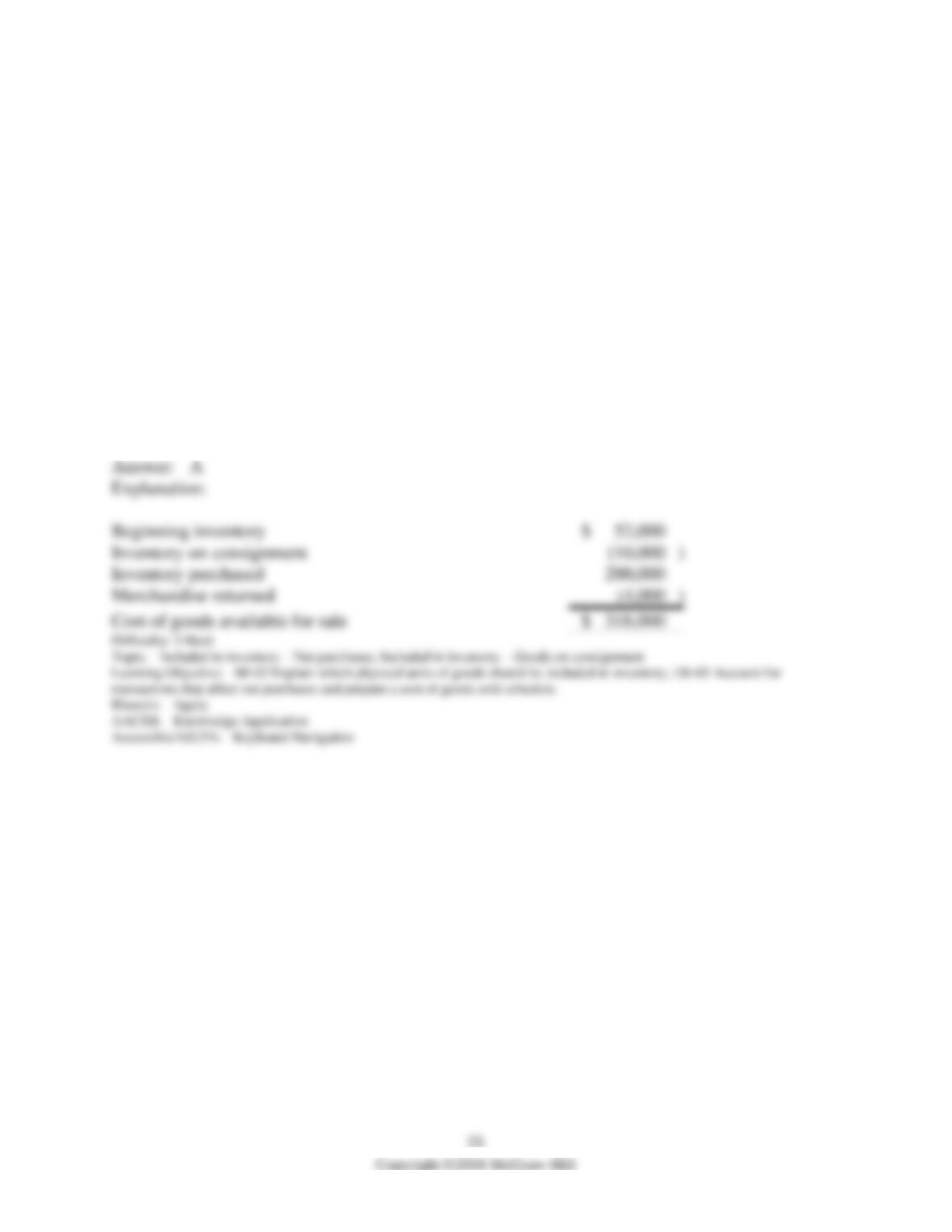
38) Cinnamon Buns Co. (CBC) started 2018 with $52,000 of merchandise on hand. During 2018,
$280,000 in merchandise was purchased on account with credit terms of 2/10, n/30. All
discounts were taken. Purchases were all made f.o.b. shipping point. CBC paid freight charges of
$9,000. Merchandise with an invoice amount of $4,000 was returned for credit. Cost of goods
sold for the year was $316,000. CBC uses a perpetual inventory system.
Assume instead that (a) freight costs were paid by the vendor, (b) no discounts were taken, and
(c) the merchandise on hand at the beginning of 2018 was determined by a physical count that
failed to realize that $10,000 of merchandise was being held on consignment for Frosting R Us
Inc. What is cost of goods available for sale, assuming CBC uses the gross method to record
purchase discounts?
A) $318,000.
B) $327,000.
C) $321,480.
D) $337,000.
39) Cost of goods sold is given by:
A) Beginning inventory − net purchases + ending inventory.
B) Beginning inventory + accounts payable − net purchases.
C) Net purchases + ending inventory − beginning inventory.
D) Net Purchases + beginning inventory − ending inventory.
40) The inventory method that will always produce the same amount for cost of goods sold in a
periodic inventory system as in a perpetual inventory system would be:
A) FIFO.
B) LIFO.
C) Weighted average.
D) None of these answer choices are correct.
41) In a perpetual average cost system:
A) A new weighted-average unit cost is calculated each time additional units are purchased.
B) The cost allocated to ending inventory is generally the same as it would be in a periodic
inventory system.
C) The moving-average unit cost is determined following each sale.
D) The average is determined by dividing the total number of units sold by the cost of units
purchased during the period.
42) In a period when costs are rising and inventory quantities are stable, the inventory method
that would result in the highest ending inventory is:
A) Weighted average.
B) Moving average.
C) FIFO.
D) LIFO.
43) During periods when costs are rising and inventory quantities are stable, cost of goods sold
will be:
A) Higher under FIFO than LIFO.
B) Higher under FIFO than average cost.
C) Lower under average cost than LIFO.
D) Lower under LIFO than FIFO.
44) During periods when costs are rising and inventory quantities are stable, ending inventory
will be:
A) Higher under LIFO than FIFO.
B) Lower under average cost than LIFO.
C) Higher under average cost than FIFO.
D) Higher under FIFO than LIFO.
45) The use of LIFO during a long inflationary period can result in:
A) A net increase in income tax expense.
B) An inflated balance sheet.
C) Significant cash flow advantages over FIFO.
D) A reduction in inventory turnover over FIFO.
46) Which of the following is false regarding the FIFO inventory method?
A) FIFO under a perpetual inventory system results in the same cost of goods sold as FIFO under
a periodic inventory system.
B) A company can choose to account for the flow of inventory using the FIFO method even if
this doesn’t match the actual flow of its inventory.
C) Perishable goods often follow an actual physical flow that is consistent with the FIFO method
assumptions.
D) All of the other answer choices are true.
47) Company A is identical to Company B in every regard except that Company A uses FIFO
and Company B uses LIFO. In an extended period of rising inventory costs, Company A’s gross
profit and inventory turnover ratio, compared to Company B’s, would be:
Gross Profit
Inventory Turnover
a.
lower
lower
b.
higher
higher
c.
higher
lower
d.
lower
higher
A) Option A
B) Option B
C) Option C
D) Option D
48) Company C is identical to Company D in every respect except that Company C uses LIFO
and Company D uses average costs. In an extended period of rising inventory costs, Company
C’s gross profit and inventory turnover ratio, compared to Company D’s, would be:
Gross Profit
Inventory Turnover
a.
higher
higher
b.
higher
lower
c.
lower
lower
d.
lower
higher
A) Option A
B) Option B
C) Option C
D) Option D
49) Fulbright Corp. uses the periodic inventory system. During its first year of operations,
Fulbright made the following purchases (listed in chronological order of acquisition):
40 units at $100
70 units at $80
170 units at $60
Sales for the year totaled 270 units, leaving 10 units on hand at the end of the year.
Ending inventory using the average cost method (rounded) is:
A) $650.
B) $1,000.
C) $707.
D) $600.