Chapter 8
Fuller figures that wood and glass will cost $16 per frame, variable overhead (machining, electricity) is $4 per frame,
direct labor is $12 per frame, and one setup will be required at $1,000 per setup. The set-up charge costs are 100% labor.
Currently, the workers needed to set up for and make the frames are working at Fuller. Their wages will be paid whether
or not the special order is accepted. Fuller’s policy is to avoid layoffs to the extent possible
Which of the following is irrelevant to the special order decision?
a. cost of wood and glass
b. direct labor cost
c. machining and electricity cost
d. $40 price
e. All of these are relevant.
44. Manganese Company makes frames. A customer wants to place a special order for 750 frames in green with the
company logo painted on the frame, to be priced at $60 each. Normally, Manganese would charge $100 per frame for this
type of order. Manganese figures that wood and glass will cost $20 per frame, variable overhead (machining, electricity)
is $5 per frame, direct labor is $10 per frame, and one setup will be required at $1,500 per setup. The set-up charge costs
are 100% labor. Currently, the workers needed to set up for and make the frames are working at Manganese. Their wages
will be paid whether or not the special order is accepted. Manganese’s policy is to avoid layoffs to the extent possible.
If Manganese accepts the special order, by how much will operating income increase or decrease?
a. $16,660 increase
b. $40,000 decrease
c. $26,250 increase
d. $30,000 increase
e. There will be no effect on operating income.
Chapter 8
45. Which of the following costs is not relevant to a decision to sell a product at split-off or process the product further
and then sell the product?
a. joint costs allocated to the product
b. the selling price of the product at split-off
c. the additional processing costs after split-off
d. the selling price of the product after further processing
46. Which of the following decisions involve a choice between internal and external production?
a. Repurchase order
b. Keep-or-drop
c. Sell-or-process-further
d. Special-order
e. Make-or-buy
Chapter 8
47. A decision that focuses on whether a specially priced order should be accepted or rejected is what kind of decision?
a. relevant
b. make-or-buy
c. sell-or-process-further
d. special-order
e. keep-or-drop
48. Which of the following decisions determines whether a product line or segment should be continued or eliminated?
a. Re-engineering
b. Make-or-buy
c. Restructuring
d. Special-order
e. Keep-or-drop
Chapter 8
49. Colortrigon Company makes a variety of paper products. One product is 30 lb copier paper, packaged 3,000 sheets to
a box. One box normally sells for $20. A large bank offered to purchase 6,000 boxes at $15 per box. Costs per box are as
follows:
Direct materials $6
Direct labor 2
Variable overhead 2
Fixed overhead 3
No variable marketing costs would be incurred on the order. The company is operating significantly below the maximum
productive capacity. No fixed costs are avoidable.
Should Colotrigon accept the order?
a. Yes, income will increase by $30,000.
b. Yes, income will increase by $19,000.
c. No, income will decrease by $43,000.
d. No, income will decrease by $86,000.
e. It doesn’t matter; there will be no impact on income.
Chapter 8
50. Merry Toy Company makes toy airplanes. One plane is an excellent replica of a 737; it sells for $8. Joyous Airlines
wants to purchase 15,000 planes at $4 each to give to children flying unaccompanied. Costs per plane are as follows:
Direct materials $1.25
Direct labor 2.05
Variable overhead 0.50
Fixed overhead 0.70
No variable marketing costs would be incurred. The company is operating significantly below the maximum productive
capacity. No fixed costs are avoidable. However, Joyous Airlines wants its own logo and colors on the planes. The cost of
the decals is $0.05 per plane and a special machine costing $2,000 would be required to affix the decals. After the order is
complete, the machine would be scrapped. Should the special order be accepted?
a. Yes, income will increase by $600.
b. No, income will decrease by $200.
c. No, income will decrease by $2,500.
d. Yes, income will increase by $250.
e. It doesn’t matter; there will be no change in income.
51. Foster Industries manufactures 20,000 components per year. The manufacturing cost of the components was
determined as follows:
Direct materials $150,000
Direct labor 240,000
Inspecting products 60,000
Providing power 30,000
Providing supervision 40,000
Chapter 8
Setting up equipment 60,000
Moving materials 20,000
Total $600,000
If the component is not produced by Foster, inspection of products and provision of power costs will only be 10% of the
current production costs; moving materials costs and setting up equipment costs will only be 50% of the production costs;
and supervision costs will amount to only 40% of the production amount. An outside supplier has offered to sell the
component for $25.50.
What is the effect on income if Foster Industries purchases the component from the outside supplier?
a. $25,000 increase
b. $45,000 increase
c. $90,000 decrease
d. $90,000 increase
Chapter 8
52. AlphaBrona Industries manufactures 50,000 components per year. The manufacturing cost of the components was
determined as follows:
Direct materials $ 80,000
Direct labor 100,000
Variable overhead 30,000
Fixed overhead 60,000
Total $270,000
An outside supplier has offered to sell the component for $10. Fixed costs will remain the same if the component is
purchased from an outside supplier.
What is the effect on income if AlphaBrona Industries purchases the component from the outside supplier?
a. $290,000 decrease
b. $290,000 increase
c. $45,000 decrease
d. $45,000 increase
53. Vest Industries manufactures 40,000 components per year. The manufacturing cost of the components was determined
as follows:
Direct materials $ 75,000
Direct labor 120,000
Variable overhead 45,000
Fixed overhead 60,000
Total $300,000
Chapter 8
An outside supplier has offered to sell the component for $12.75. Fixed cost will remain the same if the component is
purchased from an outside supplier.
Vest Industries can rent its unused manufacturing facilities for $45,000 if it purchases the component from the outside
supplier.
What is the effect on income if Vest purchases the component from the outside supplier?
a. $225,000 decrease
b. $195,000 increase
c. $165,000 decrease
d. $135,000 increase
54. Miller Company produces speakers for home stereo units. The speakers are sold to retail stores for $30. Manufacturing
and other costs are as follows:
Variable costs per unit: Fixed costs per month:
Direct materials $ 9.00 Factory overhead $120,000
Direct labor 4.50 Selling and admin. 60,000
Factory overhead 3.00 Total $180,000
Distribution 1.50
Total $18.00
The variable distribution costs are for transportation to the retail stores. The current production and sales volume is 20,000
per year. Capacity is 25,000 units per year.
Chapter 8
A Tennessee manufacturing firm has offered a one-year contract to supply speakers at a cost of $17.00 per unit. If Miller
Company accepts the offer, it will be able to rent unused space to an outside firm for $18,000 per year. All other
information remains the same as the original data. What is the effect on profits if Miller Company buys from the
Tennessee firm?
a. decrease of $8,000
b. increase of $9,000
c. increase of $8,000
d. decrease of $6,000
55. Craydye Corporation manufactures a part for its production cycle. The costs per unit for 8,000 units of this part are as
follows:
Direct materials $ 24
Direct labor 42
Variable overhead 15
Fixed overhead 25
Total $106
Zinkyl Company has offered to sell Craydye Corporation 8,000 units of the part for $120 per unit. If Craydye Corporation
accepts Zinkyl Company’s offer, total fixed overhead will be reduced by $40,000. What alternative is more desirable and
by what amount is it more desirable?
Alternative Amount
a. Make; $220,000
b. Make; $72,000
c. Buy; $188,000
d. Buy; $170,000
Chapter 8
56. The operations of Smits Corporation are divided into the Child Division and the Jackson Division. Projections for the
next year are as follows:
Child Jackson
Division Division Total
Sales revenue $250,000 $180,000 $430,000
Variable expenses 90,000 100,000 190,000
Contribution margin $160,000 $ 80,000 $240,000
Direct fixed expenses 75,000 62,500 137,500
Segment margin $ 85,000 $ 17,500 $102,500
Allocated common costs 35,000 27,500 62,500
Total relevant benefit (loss) $ 50,000 $(10,000) $ 40,000
Operating income for Smits Corporation as a whole if the Jackson Division were dropped would be
a. $22,500.
b. $40,000.
c. $50,000.
d. $60,000.
Chapter 8
57. The operations of Knickers Corporation are divided into the Pacers Division and the Bulls Division. Projections for
the next year are as follows:
Pacers Bulls
Division Division Total
Sales revenue $420,000 $252,000 $672,000
Variable expenses 147,000 115,500 262,500
Contribution margin $273,000 $136,500 $409,500
Direct fixed expenses 126,000 105,000 231,000
Segment margin $147,000 $ 31,500 $178,500
Allocated common costs 63,000 47,250 110,250
Total relevant benefit (loss) $ 84,000 $(15,750) $ 68,250
Pacers Bulls
Division Division Total
Sales revenue $420,000 $252,000 $672,000
Variable expenses 147,000 115,500 262,500
Contribution margin $273,000 $136,500 $409,500
Direct fixed expenses 126,000 105,000 231,000
Segment margin $147,000 $ 31,500 $178,500
Allocated common costs 63,000 47,250 110,250
Total relevant benefit (loss) $ 84,000 $(15,750) $ 68,250
Operating income for Knickers Corporation as a whole if the Bulls Division were dropped would be
a. $99,750.
b. $84,000.
c. $68,250.
d. $36,750.
Chapter 8
58. The following information pertains to Chrysnta Company’s three products:
A B C
Unit sales per year 300 450 300
Selling price per unit $10.00 $15.00 $ 10.00
Variable costs per unit 3.50 10.00 12.00
Unit contribution margin $ 6.50 $ 5.00 $(2.00)
Contribution margin ratio 65% 33.33% (20)%
A B C
Unit sales per year 300 450 300
Selling price per unit $10.00 $15.00 $ 10.00
Variable costs per unit 3.50 10.00 12.00
Unit contribution margin $6.50 $ 5.00 $(2.00)
Contribution margin ratio 65% 33.33% (20)%
Assume that product C is discontinued and an extra space is rented for $800 per month. All other information remains the
same as the original data. Annual profits will:
a. increase by $9,000.
b. decrease by $2,000.
c. increase by $9,600.
d. decrease by $600.
Chapter 8
59. The following information relates to a product produced by Marigold Company:
Direct materials $20
Direct labor 10
Variable overhead 20
Fixed overhead 15
Unit cost $65
Fixed selling costs are $650,000 per year, and variable selling costs are $10 per unit sold. Although production capacity is
400,000 units per year, the company expects to produce only 250,000 units next year. The product normally sells for $100
each. A customer has offered to buy 40,000 units for $80 each.
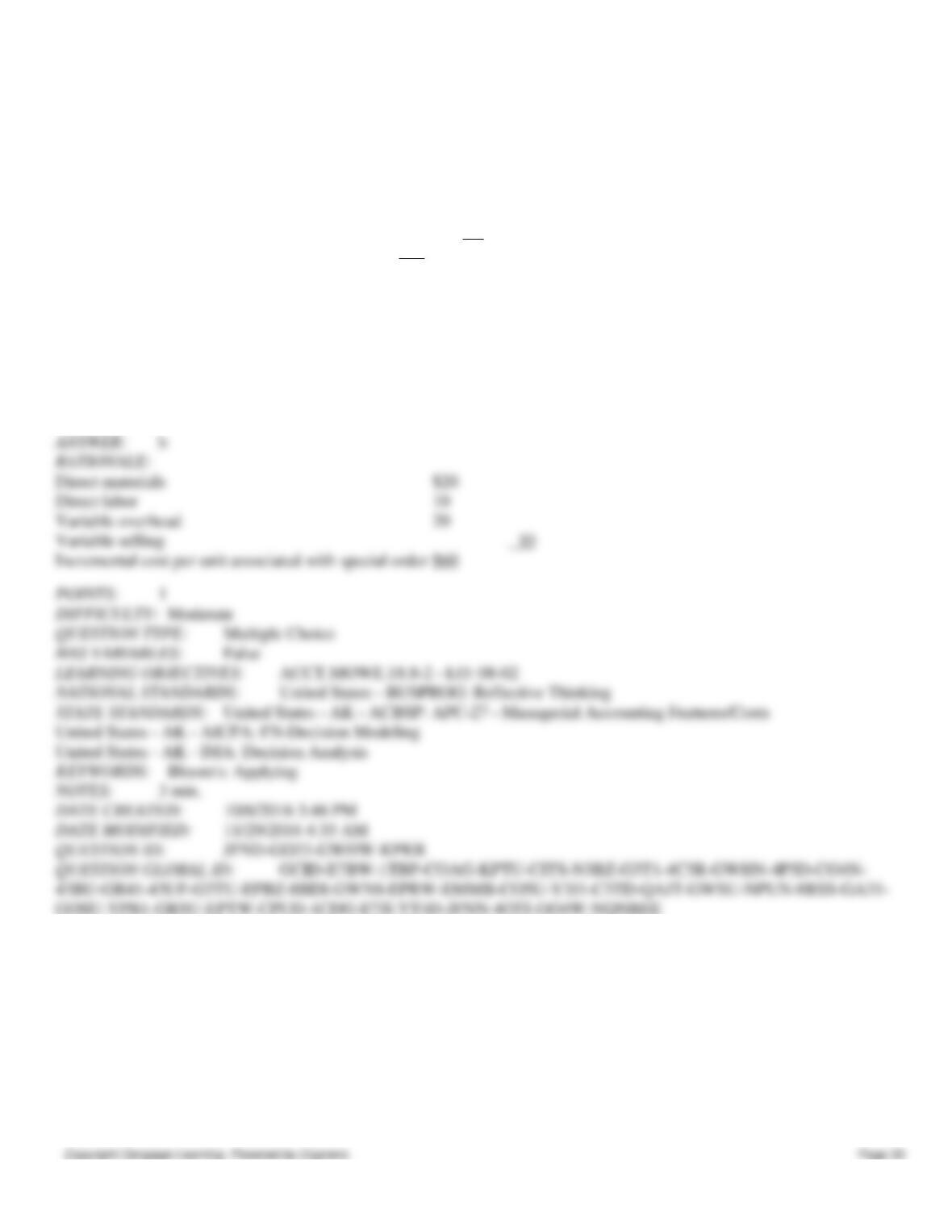
The incremental cost per unit associated with the special order is:
a. $76.
b. $60.
c. $90.
d. $84.
60. Pericloud Company produces a product that has a regular selling price of $500 per unit. At a typical monthly
production volume of 4,000 units, the product’s average unit cost of goods sold amounts to $300. Included in this average
is $150,000 of fixed manufacturing costs. All selling and administrative costs are fixed and amount to $40,000 per month.
Pericloud Company has just received a special order for 2,000 units at $280 per unit. The buyer will pay for
transportation, and the regular selling price will not be affected if Pericloud accepts the order.
Assuming Pericloud Company has excess capacity, the effect on profits of accepting the order would be a:
a. $72,000 increase.
b. $72,000 decrease.
Chapter 8
c. $35,000 increase.
d. $35,000 decrease.
61. The following information relates to a product produced by Creamer Company:
Direct materials $24
Direct labor 15
Variable overhead 30
Fixed overhead 18
Unit cost $87
Fixed selling costs are $500,000 per year, and variable selling costs are $12 per unit sold. Although production capacity is
600,000 units per year, the company expects to produce only 400,000 units next year. The product normally sells for $120
each. A customer has offered to buy 60,000 units for $90 each.
If the firm produces the special order, the effect on income would be a
a. $360,000 increase.
b. $360,000 decrease.
c. $540,000 increase.
d. $540,000 decrease.
Chapter 8
62. Rexeleg Company manufactures a product with the following costs per unit at the expected production of 40,000
units:
Direct materials $ 5
Direct labor 10
Variable overhead 7
Fixed overhead 9
The company has the capacity to produce 50,000 units. The product regularly sells for $50. A wholesaler has offered to
pay $43 per unit for 3,000 units.
If the firm chooses to accept the special order and reject some regular sales, the effect on operating income would be a:
a. $30,000 increase.
b. $21,000 decrease.
c. $64,000 increase.
d. $45,000 decrease.
63. Walton Company manufactures a product with the following costs per unit at the expected production level of 84,000
units:
Direct materials $12
Chapter 8
Direct labor 36
Variable overhead 18
Fixed overhead 24
The company has the capacity to produce 90,000 units. The product regularly sells for $120. A wholesaler has offered to
pay $110 per unit for 7,500 units. If the special order is accepted, the effect on operating income would be a
a. $75,000 decrease.
b. $429,000 increase.
c. $495,000 increase.
d. $249,000 increase.
64. Glascro Manufacturing Company had the following unit costs:
Direct materials $20
Direct labor 10
Variable overhead 15
Fixed overhead (allocated) 20
A one-time customer has offered to buy 3,000 units at a special price of $60 per unit. Assuming that sufficient unused
production capacity exists to produce the order and no regular customers will be affected by the order, how much
additional profit or loss will be generated by accepting the special order?
a. $45,000 profit
b. $22,000 profit
c. $36,000 loss
d. $57,000 loss
Chapter 8
65. Reggie Corporation manufactures a single product with the following unit costs for 1,000 units:
Direct materials $2,400
Direct labor 960
Overhead (30% variable) 1,800
Selling expenses (50% variable) 900
Administrative expenses (10% variable) 840
Total per unit $6,900
Recently, a company approached Reggie Corporation about buying 100 units for $5,100 each. Currently, the models are
sold to dealers for $7,800. Reggie Corporation’s capacity is sufficient to produce the extra 100 units. No additional selling
expenses would be incurred on the special order.
How much will income change if the special order is accepted?
a. increase by $398,400
b. decrease by $180,000
c. increase by $111,600
d. no change
Chapter 8
66. Amaryliz Products had the following unit costs:
Direct materials $20
Direct labor 15
Variable overhead 12
Fixed factory (allocated) 23
A one-time customer has offered to buy 4,000 units at a special price of $60 per unit. Because of capacity constraints,
1,000 units will need to be produced during overtime. Overtime premium is $15 per unit. How much additional profit or
loss will be generated by accepting the special order?
a. $60,000 profit
b. $52,000 loss
c. $27,000 loss
d. $37,000 profit
Chapter 8
67. Stars Manufacturing Company produces Products A1, B2, C3, and D4 through a joint process. The joint costs amount
to $200,000.
If Processed Further
Units Sales Value Additional Sales
Product Produced at Split-Off Costs Value
A1 3,000 $10,000 $2,500 $15,000
B2 5,000 30,000 3,000 35,000
C3 4,000 20,000 4,000 25,000
D4 6,000 40,000 6,000 45,000
If Product B2 is processed further, profits will
a. increase by $30,000.
b. decrease by $3,000.
c. increase by $32,000.
d. increase by $2,000.
68. Manning Company uses a joint process to produce products W, X, Y, and Z. Each product may be sold at its split-off
point or processed further. Additional processing costs of specific products are entirely variable. Joint processing costs for
a single batch of joint products are $120,000. Other relevant data are as follows:
Additional
Product Sales Value
at Split-Off Processing Costs Sales Value of
Final Product
W $ 40,000 $ 60,000 $ 80,000
X 12,000 4,000 20,000
Y 20,000 32,000 120,000
Z 28,000 20,000 32,000
$100,000 $116,000 $252,000
Which products should Manning process further?
a. All.
b. All except Z.
Chapter 8
c. Y and X.
d. None.
69. Information about three joint products follows:
A B C
Anticipated production 5,000 lbs. 1,000 lbs. 2,000 lbs.
Selling price/lb. at split-off $10 $30 $16
Additional processing costs/lb. after split-off
(all variable) $6 $12 $24
Selling price/lb. after further processing $20 $40 $50
The cost of the joint process is $60,000. Which of the joint products should be sold at split-off?
a. A.
b. B.
c. C.
d. Both A and B.