72) The term, obsolescence, as it relates to the useful life of an asset, refers to:
A) The halfway point of an asset’s useful life.
B) A plant asset that is becoming outdated and no longer used.
C) The inability of a company’s plant assets to function as designed.
D) An asset’s salvage value becoming less than its replacement cost.
E) Intangible assets that have been fully amortized.
73) Once the estimated depreciation expense for an asset is calculated:
A) It cannot be changed.
B) It may be revised based on new information.
C) Any changes are accumulated and recognized when the asset is sold.
D) The estimate itself cannot be changed; however, new information should be disclosed in
financial statement footnotes.
E) It can be changed only if U.S. tax law changes.
74) A machine originally had an estimated useful life of 6 years, but after 4 complete years, it
was decided that the original estimate of useful life should have been 10 years. At that point the
remaining cost to be depreciated should be allocated over the remaining:
A) 2 years.
B) 4 years.
C) 6 years.
D) 16 years.
E) 10 years.
75) A change in an accounting estimate is:
A) Reflected in past financial statements.
B) Reflected in future financial statements and also requires modification of past statements.
C) Reflected in current and future years’ financial statements, not in prior statements.
D) Not allowed under current accounting rules.
E) Considered an error in the financial statements.
76) When originally purchased, a vehicle costing $23,000 had an estimated useful life of 8 years
and an estimated salvage value of $3,000. After 4 years of straight-line depreciation, the asset’s
total estimated useful life was revised from 8 years to 6 years and there was no change in the
estimated salvage value. The depreciation expense in year 5 equals:
A) $5,000.
B) $2,875.
C) $5,750.
D) $11,500.
E) $2,500.
77) A company used straight-line depreciation for an item of equipment that cost $12,000, had a
salvage value of $2,000 and a five-year useful life. After depreciating the asset for three
complete years, the salvage value was reduced to $1,200 but its total useful life remained the
same. Determine the amount of depreciation to be charged against the equipment during each of
the remaining years of its useful life:
A) $1,000
B) $1,800
C) $5,400
D) $2,400
E) $2,000
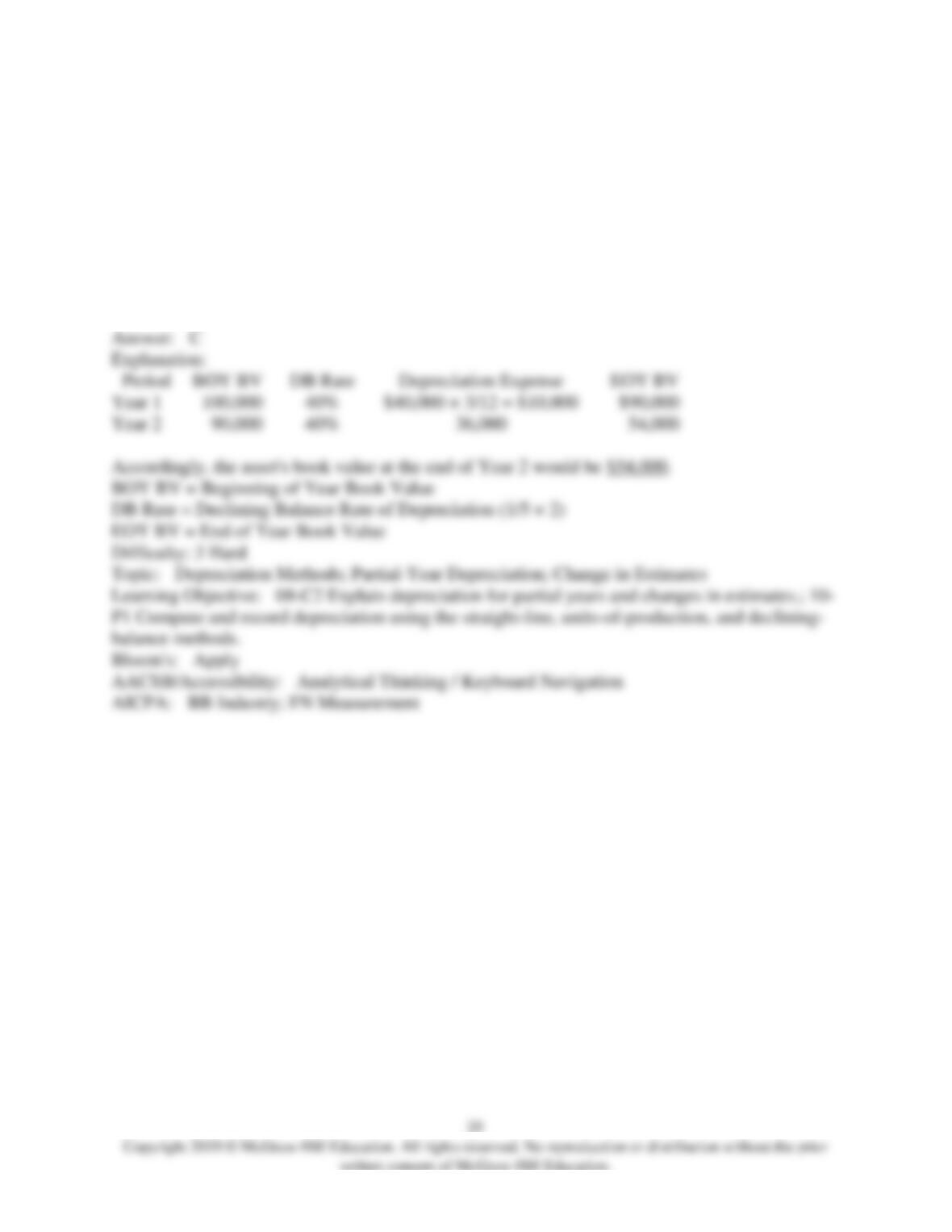
78) Beckman Enterprises purchased a depreciable asset on October 1, Year 1 at a cost of
$100,000. The asset is expected to have a salvage value of $20,000 at the end of its five-year
useful life. If the asset is depreciated on the double-declining-balance method, the asset’s book
value on December 31, Year 2 will be:
A) $36,000
B) $42,000
C) $54,000
D) $16,000
E) $90,000
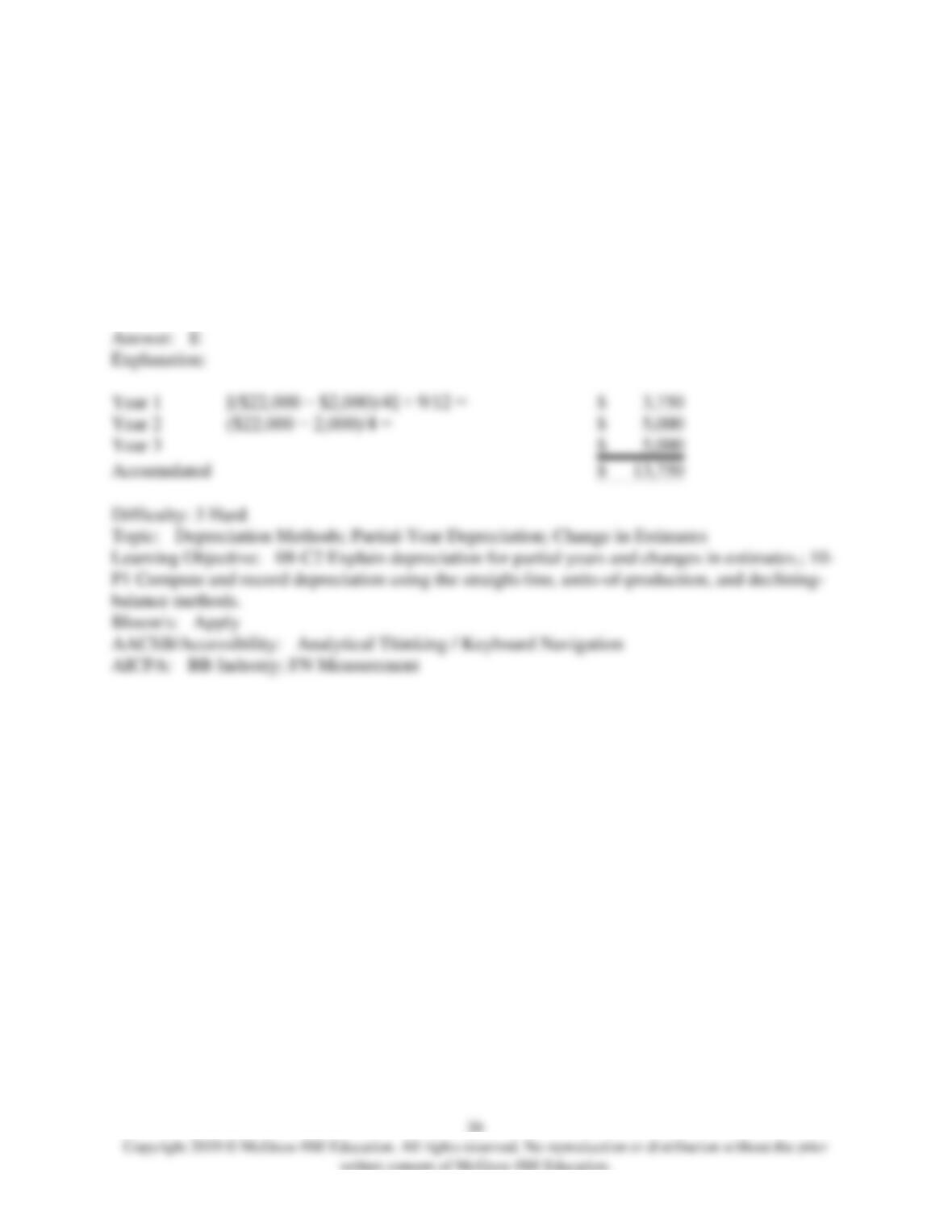
79) Peavey Enterprises purchased a depreciable asset for $22,000 on April 1, Year 1. The asset
will be depreciated using the straight-line method over its four-year useful life. Assuming the
asset’s salvage value is $2,000, what will be the amount of accumulated depreciation on this
asset on December 31, Year 3?
A) $5,000
B) $15,000
C) $15,125
D) $20,000
E) $13,750
80) Peavey Enterprises purchased a depreciable asset for $22,000 on April 1, Year 1. The asset
will be depreciated using the straight-line method over its four-year useful life. Assuming the
asset’s salvage value is $2,000, Peavey Enterprises should recognize depreciation expense in
Year 2 in the amount of:
A) $10,000
B) $5,000
C) $5,500
D) $20,000
E) $9,250
81) The following information is available on a depreciable asset owned by Mutual Savings
Bank:
Purchase date
July 1, Year 1
Purchase price
$85,000
Salvage value
$10,000
Useful life
10 years
Depreciation method
straight-line
The asset’s book value is $70,000 on July 1, Year 3. On that date, management determines that
the asset’s salvage value should be $5,000 rather than the original estimate of $10,000. Based on
this information, the amount of depreciation expense the company should recognize during the
last six months of Year 3 would be:
A) $8,125.00
B) $7,375.00
C) $4,062.50
D) $3,750.00
E) $7,812.50
82) A benefit of using an accelerated depreciation method is that:
A) It is preferred by the tax code.
B) It is the simplest method to calculate.
C) It yields larger depreciation expense in the early years of an asset’s life.
D) It yields a higher income in the early years of the asset’s useful life.
E) The results are identical to straight-line depreciation.
83) The modified accelerated cost recovery system (MACRS):
A) Is included in the U.S. federal income tax rules for depreciating assets.
B) Is an outdated system that is no longer used by companies.
C) Is required for financial reporting.
D) Is identical to units of production depreciation.
E) Does not allow partial year depreciation.
84) The straight-line depreciation method and the double-declining-balance depreciation method:
A) Produce the same total depreciation over an asset’s useful life.
B) Produce the same depreciation expense each year.
C) Produce the same book value each year.
D) Are acceptable for tax purposes only.
E) Are the only acceptable methods of depreciation for financial reporting.
85) Total asset turnover is used to evaluate:
A) The efficient use of assets to generate sales.
B) The necessity for asset replacement.
C) The number of times operating assets were sold during the year.
D) The cash flows used to acquire assets.
E) The relation between asset cost and book value.
86) A total asset turnover ratio of 3.5 indicates that:
A) For every $1 in sales, the firm acquired $3.50 in assets during the period.
B) For every $1 in assets, the firm produced $3.50 in net sales during the period.
C) For every $1 in assets, the firm earned gross profit of $3.50 during the period.
D) For every $1 in assets, the firm earned $3.50 in net income.
E) For every $1 in assets, the firm paid $3.50 in expenses during the period.
87) The calculation of total asset turnover is:
A) Gross profit divided by average total assets.
B) Average total assets divided by gross profit.
C) Net sales divided by average total assets.
D) Average total assets multiplied by net sales.
E) Net assets multiplied by total assets.
88) A company had average total assets of $887,000. Its gross sales were $1,090,000 and its net
sales were $1,000,000. The company’s total asset turnover equals:
A) 0.81.
B) 0.89.
C) 1.09.
D) 1.13.
E) 1.23.
89) Spears Co. had net sales of $35,400 million. Its average total assets for the period were
$14,700 million. Spears’ total asset turnover equals:
A) 0.42.
B) 0.35.
C) 1.48.
D) 2.41.
E) 3.54.
90) Land improvements are:
A) Assets that increase the usefulness of land, and like land, are not depreciated.
B) Assets that increase the usefulness of land, but that have a limited useful life and are subject
to depreciation.
C) Included in the cost of the land account.
D) Expensed in the period incurred.
E) Also called basket purchases.
91) Which of the following is not classified as plant assets?
A) Land.
B) Land improvements.
C) Buildings.
D) Machinery and equipment.
E) Patent.
92) The cost of land would not include:
A) Purchase price.
B) Cost of parking lot lighting.
C) Costs of removing existing structures.
D) Fees for insuring the title.
E) Government assessments.
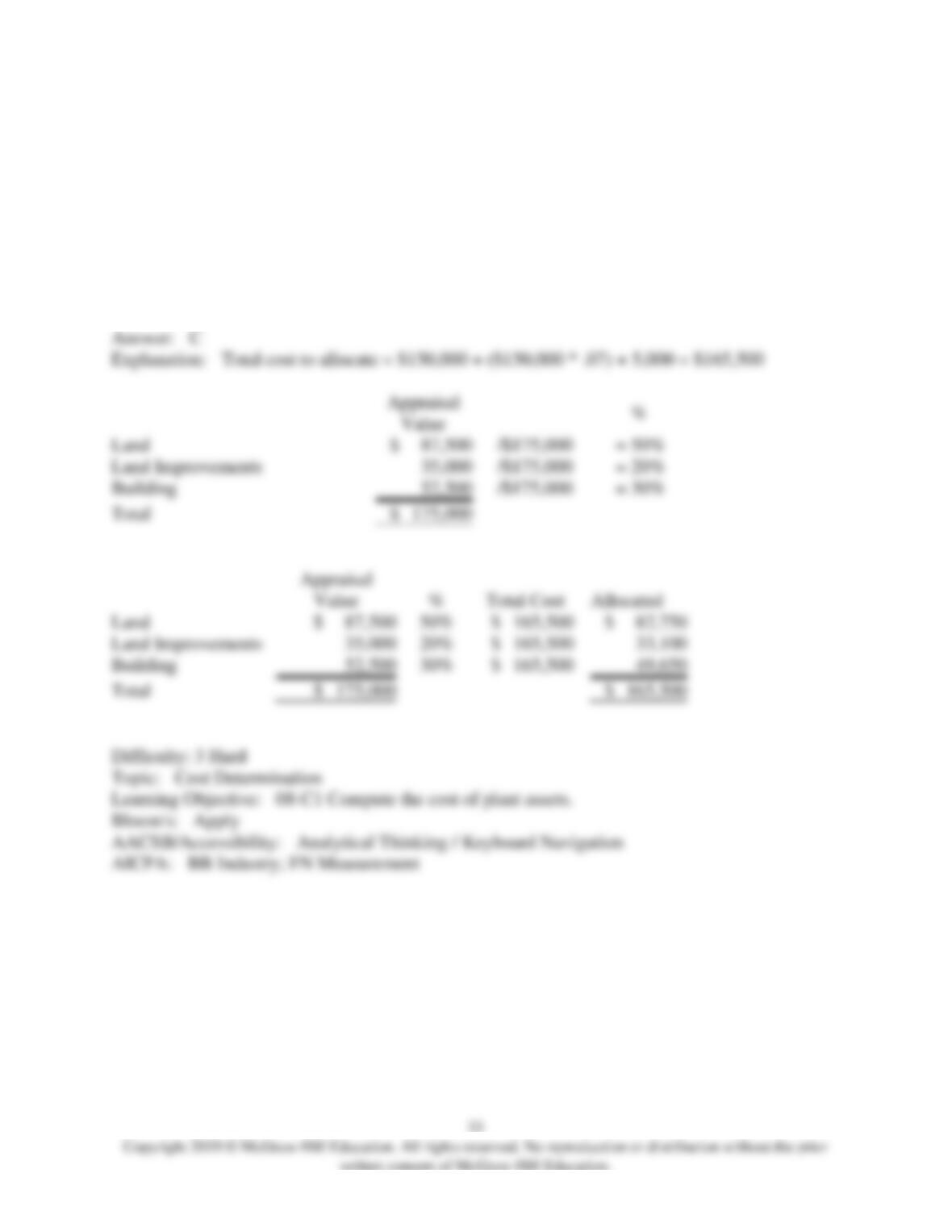
93) A company paid $150,000, plus a 7% commission and $5,000 in closing costs for a property.
The property included land appraised at $87,500, land improvements appraised at $35,000, and a
building appraised at $52,500. What should be the allocation of this property’s costs in the
company’s accounting records?
A) Land $75,000; Land Improvements, $30,000; Building, $45,000.
B) Land $75,000; Land Improvements, $30,800; Building, $46,200.
C) Land $82,750; Land Improvements, $33,100; Building, $49,650.
D) Land $80,250; Land Improvements, $32,100; Building, $48,150.
E) Land $77,500; Land Improvements; $31,000; Building; $46,500.
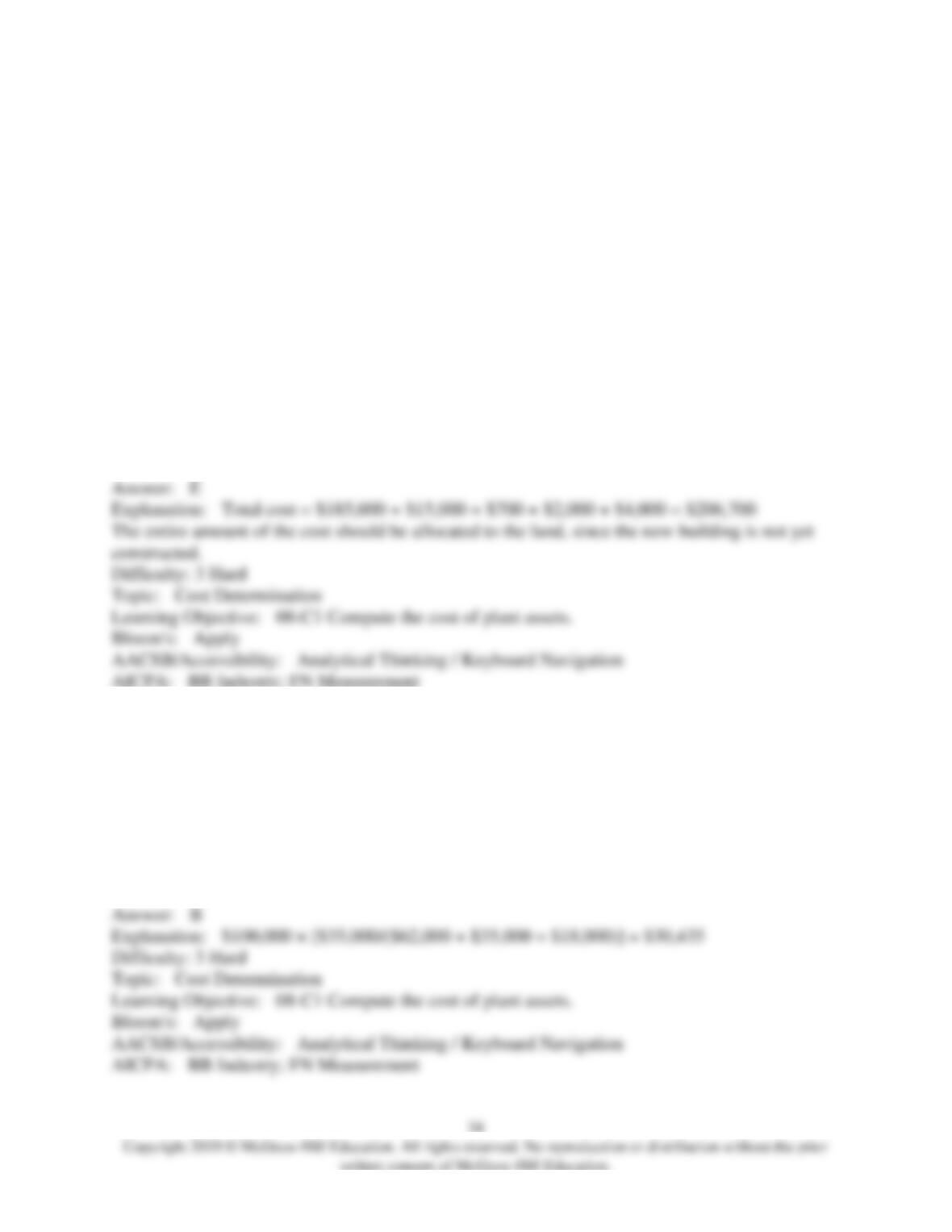
94) Merchant Company purchased property for a building site. The costs associated with the
property were:
Purchase price
$
185,000
Real estate commissions
15,000
Legal fees
700
Expenses of clearing the land
2,000
Expenses to remove old building
4,000
What portion of these costs should be allocated to the cost of the land and what portion should be
allocated to the cost of the new building?
A) $187,700 to Land; $19,000 to Building.
B) $200,700 to Land; $6,000 to Building.
C) $200,000 to Land; $6,700 to Building.
D) $185,000 to Land; $21,700 to Building.
E) $206,700 to Land; $0 to Building.
95) A company purchased property for $100,000. The property included a building, a parking
lot, and land. The building was appraised at $62,000; the land at $35,000, and the parking lot at
$18,000. Land should be recorded in the accounting records with an allocated cost of:
A) $0.
B) $30,435.
C) $35,000.
D) $46,087.
E) $100,000.
96) The formula to compute annual straight-line depreciation is:
A) Depreciable cost divided by useful life in units.
B) (Cost plus salvage value) divided by the useful life in years.
C) (Cost minus salvage value) divided by the useful life in years.
D) Cost multiplied by useful life in years.
E) Cost divided by useful life in units.
97) The total cost of an asset less its accumulated depreciation is called:
A) Historical cost.
B) Book value.
C) Present value.
D) Current (market) value.
E) Replacement cost.
98) The depreciation method that charges the same amount of expense to each period of the
asset’s useful life is called:
A) Accelerated depreciation.
B) Declining-balance depreciation.
C) Straight-line depreciation.
D) Units-of-production depreciation.
E) Modified accelerated cost recovery system (MACRS) depreciation.
99) The depreciation method that allocates an equal portion of the total depreciable cost for a
plant asset to each unit produced is called:
A) Accelerated depreciation.
B) Declining-balance depreciation.
C) Straight-line depreciation.
D) Units-of-production depreciation.
E) Modified accelerated cost recovery system (MACRS) depreciation.
100) The depreciation method in which a plant asset’s depreciation expense for a period is
determined by applying a constant depreciation rate to the asset’s beginning-of-period book value
is called:
A) Book value depreciation.
B) Declining-balance depreciation.
C) Straight-line depreciation.
D) Units-of-production depreciation.
E) Modified accelerated cost recovery system (MACRS) depreciation.
101) The depreciation method that produces larger depreciation expense during the early years of
an asset’s life and smaller expense in the later years is a(an):
A) Accelerated depreciation method.
B) Book value depreciation method.
C) Straight-line depreciation method.
D) Units-of-production depreciation method.
E) Unrealized depreciation method.
102) A company purchased a delivery van for $28,000 with a salvage value of $3,000 on
September 1, Year 1. It has an estimated useful life of 5 years. Using the straight-line method,
how much depreciation expense should the company recognize on December 31, Year 1?
A) $5,000.
B) $1,667.
C) $1,400.
D) $1,250.
E) $2,067.
103) Marlow Company purchased a point of sale system on January 1 for $3,400. This system
has a useful life of 10 years and a salvage value of $400. What would be the depreciation
expense for the second year of its useful life using the double-declining-balance method?
A) $680.
B) $480.
C) $544.
D) $600.
E) $300.
104) Marlow Company purchased a point of sale system on January 1 for $3,400. This system
has a useful life of 10 years and a salvage value of $400. What would be the depreciation
expense for the first year of its useful life using the double-declining-balance method?
A) $680.
B) $2,320.
C) $2,720.
D) $600.
E) $300.
105) Marlow Company purchased a point of sale system on January 1 for $3,400. This system
has a useful life of 10 years and a salvage value of $400. What would be the accumulated
depreciation at the end of the second year of its useful life using the double-declining-balance
method?
A) $2,176.
B) $544.
C) $1,200.
D) $600.
E) $1,224.
106) Marlow Company purchased a point of sale system on January 1 for $3,400. This system
has a useful life of 10 years and a salvage value of $400. What would be the book value of the
asset at the end of the first year of its useful life using the double-declining-balance method?
A) $680.
B) $2,320.
C) $2,720.
D) $600.
E) $300.
107) A company purchased a weaving machine for $190,000. The machine has a useful life of 8
years and a residual value of $10,000. It is estimated that the machine could produce 75,000
bolts of woven fabric over its useful life. In the first year, 15,000 bolts were produced. In the
second year, production increased to 19,000 units. Using the units-of-production method, what is
the amount of depreciation expense that should be recorded for the second year?
A) $48,133.
B) $45,600.
C) $22,500.
D) $23,750.
E) $81,600.