Chapter 8
OR
172. Island Princess Pineapples purchases pineapples from area farmers and processes them into rings, juice, and skins.
The cost of the pineapples is a joint cost, as is the initial processing in which the fruits are skinned, cored, and sliced into
rings. At the split-off point, Island Princess sells the skins (for fertilizer). Juice and rings are processed further (further
processing costs occurs for cooking and canning). Data for the three products follows:
Sales
Rings $2,000
Juice 1,500
Fertilizer 400
Further processing costs:
Rings 500
Juice 300
Joint costs $1,600
A. Prepare a segmented income statement for Island Princess, showing results for rings, juice, fertilizer, and in total.
Do not allocate joint costs individually.
B. Now suppose that Island Princess is considering the option of processing the skins further into pet food which
would sell for $1,000. Additional costs would be $450. Should this be done?
Chapter 8
173. Rippey Corporation manufactures a single product with the following unit costs for 5,000 units:
Direct materials $ 60
Direct labor 30
Factory overhead (40% variable) 90
Selling expenses (60% variable) 30
Administrative expenses (20% variable) 15
Total per unit $225
Recently, a company approached Rippey Corporation about buying 1,000 units for $225. Currently, the models are sold to
dealers for $412.50. Rippey’s capacity is sufficient to produce the extra 1,000 units. No additional selling expenses would
be incurred on the special order.
Required:
A. What is the profit earned by Rippey Corporation on the original 5,000 units?
B. Should Rippey accept the special order if its goal is to maximize short-run profits? How much will income be
affected?
C. Determine the minimum price Rippey would want to receive in order to increase profits by $7,500 on the special
order.
D. When making a special-order decision, what qualitative aspects of the decision should Rippey Corporation
consider?
Chapter 8
174. Salley Company makes pagers. Currently, Salley purchases 10,000 plastic housings per year from an outside
company for $1 each. One of Salley’s engineers suggested that the company make its plastic housings in-house. Estimated
unit costs are as follows:
Direct materials $0.30
Direct labor 0.20
Variable overhead 0.15
Fixed overhead* 0.40
* Fixed overhead is $2,400 per year in equipment costs specifically traceable to the plastic housing line and $1,600 per
year in general overhead costs to be allocated to this line
A. If Salley makes the housing in-house, net income will be $__________________ Higher or Lower?
B. What is the highest price per unit that Salley would pay an outside company for the housings?
Chapter 8
C. Now assume that all of the fixed overhead is allocated fixed overhead and will not be affected by making the
product in-house or purchasing it. If Salley makes the housing in–house, net income will be $__________________
(Higher / Lower).
175. Goutam Company prints a variety of publications and colored inserts for newspapers. Currently, Goutam produces its
own ink, including a special metallic color. India Inks has offered to supply Goutam with the 25,000 ounces of metallic
ink that it needs each year for $1.24 per ounce. Goutam is interested because this is a particularly difficult ink to make.
The purchasing department must make special efforts to locate suppliers, the metallic component requires special
handling, and, since the metallic ink uses machinery that is also used to make other colors of ink, the machinery must be
cleaned very well before every batch of metallic. The accounting department supplied the following unit costs:
Direct materials $0.40
Direct labor 0.15
Variable overhead 0.06
Fixed overhead* 0.50
*Fixed overhead is applied on the basis of a plantwide rate based on direct labor hours.
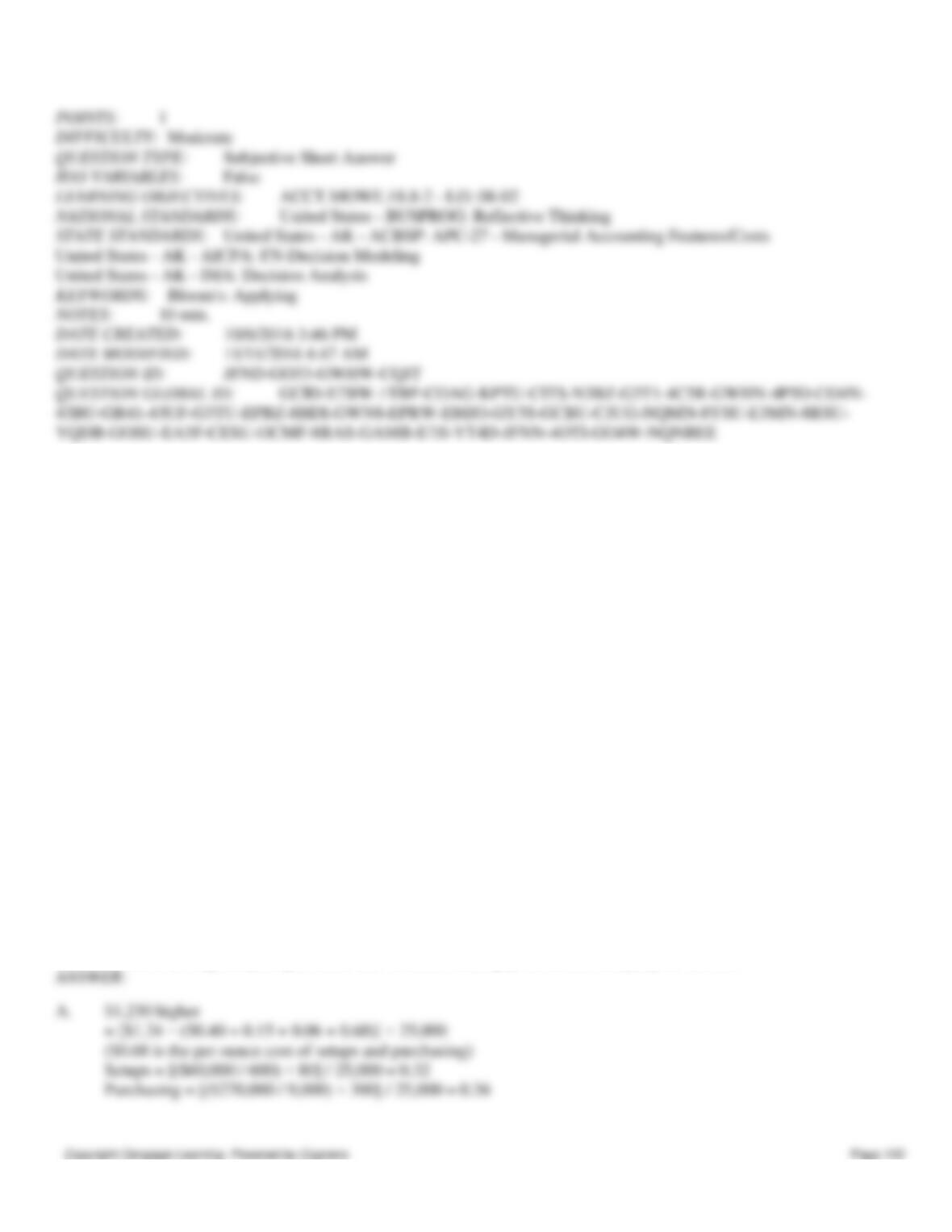
A. Based on the cost figures, if Goutam purchases metallic ink from the outside supplier, operating income will be
$__________________ (Higher / Lower)?
B. What is the highest price per ounce that Goutam would pay an outside supplier for the ink?
Chapter 8
176. Goutam Company prints a variety of publications and colored inserts for newspapers. Currently, Goutam produces its
own ink, including a special metallic color. India Inks has offered to supply Goutam with the 25,000 ounces of metallic
ink that it needs each year for $1.24 per ounce. Goutam is interested because this is a particularly difficult ink to make.
The purchasing department must make special efforts to locate suppliers, the metallic component requires special
handling, and, since the metallic ink uses machinery that is also used to make other colors of ink, the machinery must be
cleaned very well before every batch of metallic. The accounting department supplied the following unit costs:
Direct materials $0.40
Direct labor 0.15
Variable overhead 0.06
Fixed overhead* 0.50
*Fixed overhead is applied on the basis of a plantwide rate based on direct labor hours.
Upon hearing of the analysis of the cost of making the metallic ink in-house versus buying it from an outside supplier, Jim
Webb, the production supervisor said “That’s nuts! This ink is a real pain to make and $1.24 per ounce sounds like a
bargain to me!” Based on Jim’s feelings, Anna Ruiz (a new CMA in the accounting office) did an ABC analysis of ink
production. She came up with the same direct materials, direct labor and variable overhead, as well as the following
information on activities required by metallic ink production.
Setups $ 60,000 600 setups per year
Purchasing $270,000 9,000 purchase orders per year
The metallic ink requires 300 purchase orders per year and 80 setups.
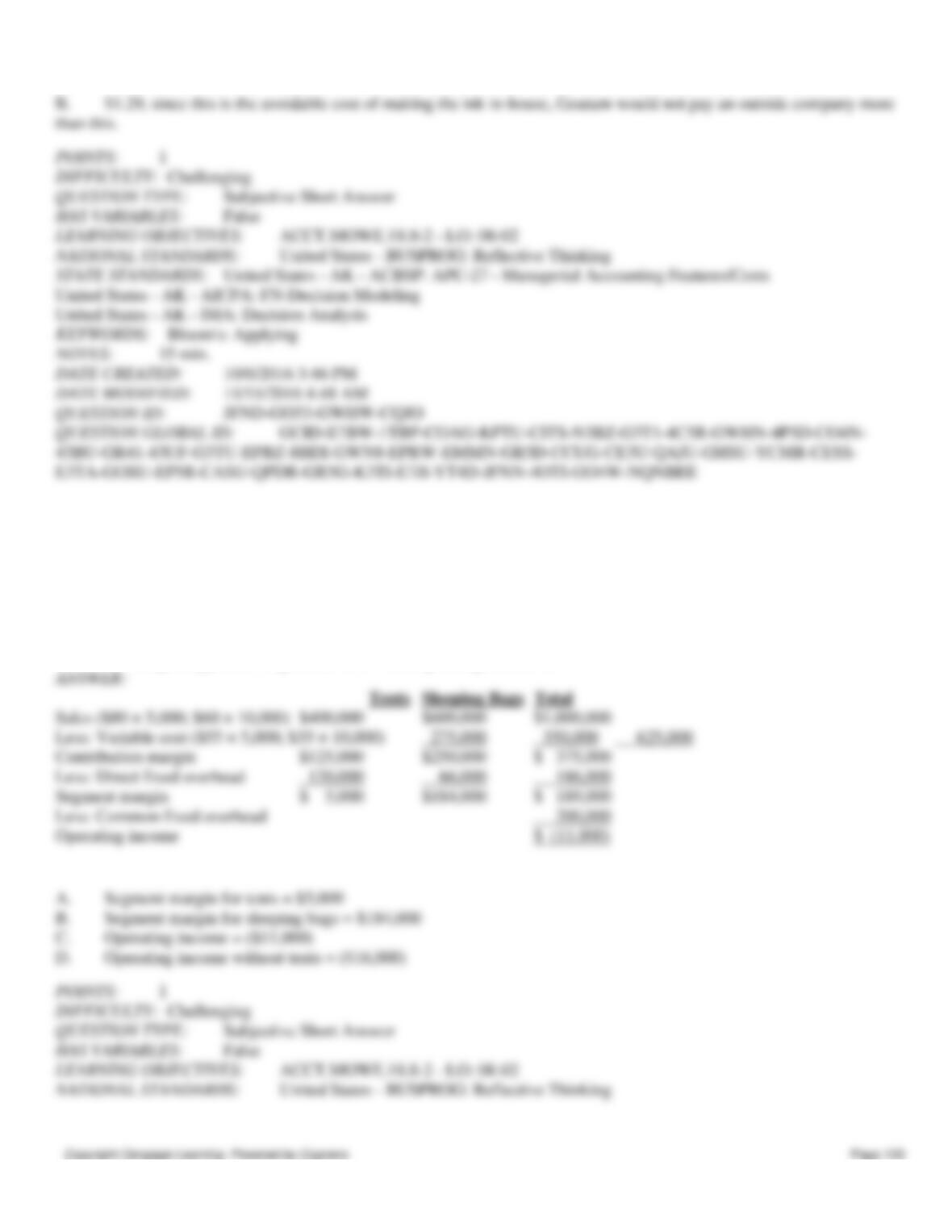
A. If Goutam purchases the ink from the outside supplier, operating income would be $__________________ Higher
Lower (circle one)
B. What is the highest price per ounce that Goutam would pay an outside company for the ink?
Chapter 8
177. Sherpa Company manufactures tents and sleeping bags. Tents are priced at $80, have variable cost of $55, and direct
fixed costs of $120,000. Sleeping bags are priced at $60, have variable cost of $35, and direct fixed costs of $66,000.
Common fixed costs equal $200,000. Last year, the division sold 5,000 tents and 10,000 sleeping bags.
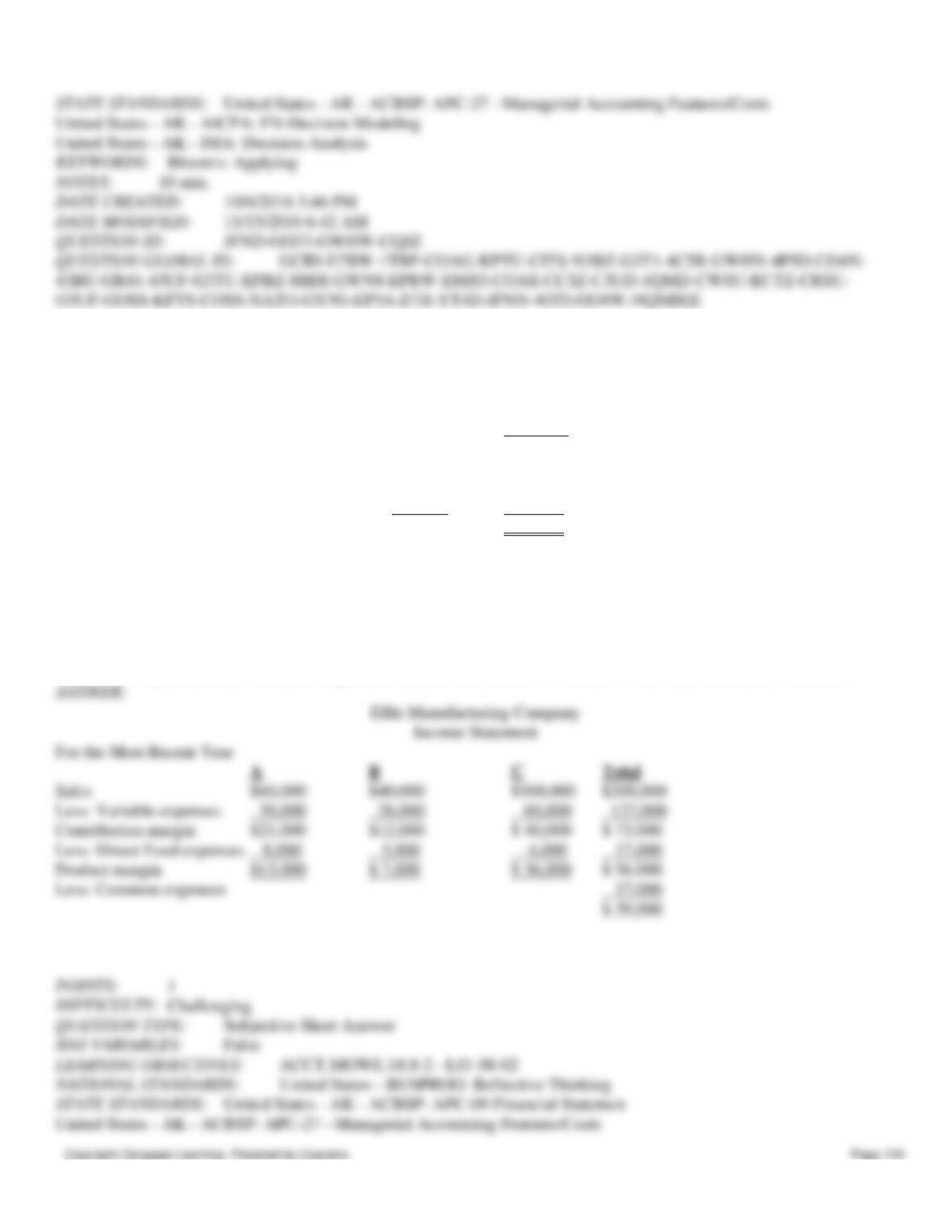
A. What was the segment margin for tents last year?
B. What was the segment margin for sleeping bags last year?
C. What was Sherpa’s operating income last year?
D. If Sherpa stopped making tents, what would operating income be?
Chapter 8
178. Ellie Manufacturing Company produces three products: A, B, and C. The income statement for the most recent year
is as follows:
Sales $200,000
Less: Variable cost 127,000
Contribution margin $ 73,000
Less fixed cost:
Manufacturing $20,000
Selling and administrative 14,000 34,000
Operating income $ 39,000
The sales, contribution margin ratios, and direct fixed expenses for the three types of products are as follows:
A B C
Sales $60,000 $40,000 $100,000
Contribution margin ratio 35% 30% 40%
Direct fixed expenses of products $8,000 $5,000 $4,000
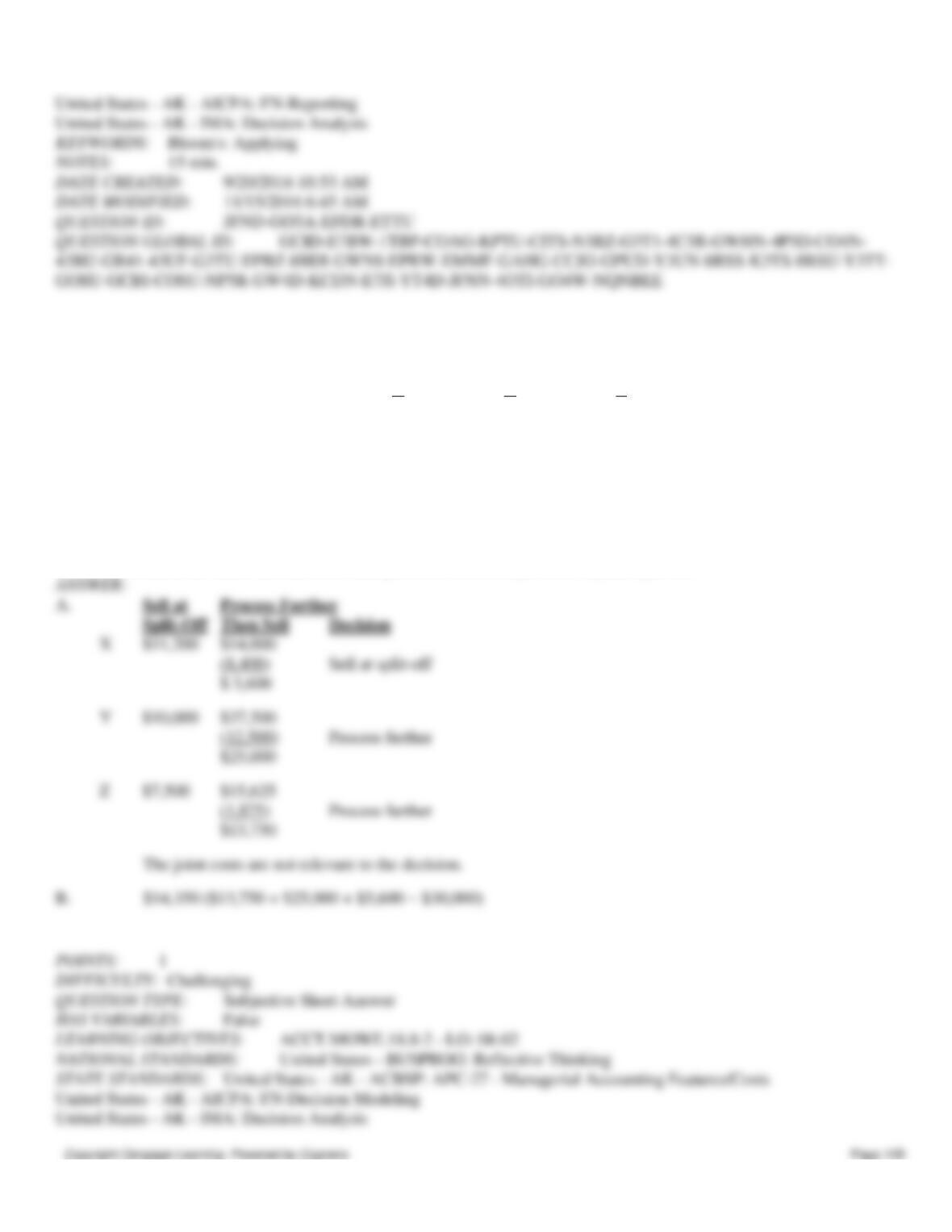
Required: Prepare income statements segmented by products. Include a column for the entire firm in the statement.
Chapter 8
179. Mickey Company manufactures three joint products: X, Y, and Z. The cost of the joint process is $30,000.
Information about the three products follows:
X Y Z
Anticipated production 5,600 lbs. 10,000 lbs. 2,500 lbs.
Selling price/lb. at split-off $2.00 $1.00 $3.00
Additional processing costs/lb. after split-off
(all variable) $1.50 $1.25 $.75
Selling price/lb. after further processing $2.50 $3.75 $6.25
Allocated joint costs $12,000 $10,500 $7,500
Required:
A. Determine whether each product should be sold at split-off or processed further.
B. Determine the firm’s income if the firm processed all three products beyond split-off.
Chapter 8
180. Information pertaining to Mario Co. is as follows:
Leather jackets Suede jackets
Sales $450,000 $542,000
Variable cost of goods sold 134,000 213,000
Direct fixed overhead 29,000 38,000
A sales commission of 2% of sales is paid for each of the two product lines. Direct fixed selling and administrative
expense was estimated to be $32,000 for the leather jackets and $66,000 for the suede jackets. Common fixed overhead
for the factory was estimated to be $83,000 and common selling and administrative expense was estimated to be $14,000.
Required: Prepare a segmented income statement for Mario Co. for the coming year, using variable costing.
Chapter 8
181. Buttons Company produces three products: LMC, DMC, and KPC. For the coming year, they expect to produce
160,000 units. Of these, 65,000 will be LMC; 40,000 will be DMC; and 55,000 will be KPC. The following information
was provided for the coming year:
LMC DMC KPC
Price $ 550 $ 860 $ 625
Unit direct materials 250 405 300
Unit direct labor 180 210 205
Unit variable overhead 60 72 55
Unit variable selling expense 45 60 58
Total direct fixed overhead 240,000 425,000 400,000
Common fixed overhead is $984,000 and fixed selling and administrative expenses for Mario Co. is $881,000 per year.
Required:
A. Calculate the unit variable cost under variable costing.
B. Calculate the unit variable product cost.
C. Prepare a segmented variable-costing income statement for next year.
D. Should Buttons Company keep all product lines?
Chapter 8
182. The operations of Grant Corporation are divided into the Fix Division and the Split Division. Projections for the next
year are as follows:
Fix Split
Division Division Total
Sales revenue $60,000 $ 40,000 $100,000
Variable expenses 20,000 15,000 35,000
Contribution margin $40,000 $ 25,000 $ 65,000
Direct fixed expenses 12,500 30,000 42,500
Segment margin $27,500 $ (5,000) $ 22,500
Allocated common costs 10,000 7,500 17,500
Total relevant benefit (loss) $17,500 $(12,500) $ 5,000
Required:
A. Determine operating income for Grant Corporation as a whole if the Split Division is dropped.
B. Should the Split Division be eliminated?
Chapter 8
183. Classy Carry manufactures two types of handbags, the Clutch and the Tote, with unit contribution margins of $9 and
$15, respectively. Regardless of the type, each handbag must go through a stitching machine. The company owns 4
stitching machines and each provides 3,000 hours of machine time per year. Each Clutch handbag requires 12 minutes of
machine time and each Tote handbag requires 30 minutes of machine time. There are no other constraints.
Required:
A. What is the contribution margin per hour of machine time for each type of handbag?
B. What is the optimal mix of handbags?
C. What is the total contribution margin earned for the optimal mix?
Chapter 8
184. Gordon Company produces two types of gears, Gear Q and Gear S, with unit contribution margins of $2 and $5,
respectively. Each gear must spend time on a special machine. The firm owns ten machines that together provide 25,000
hours of machine time per year. Gear Q requires 0.10 hours of machine time; Gear S requires 0.4 hours of machine time.
A. What is the contribution margin per hour of machine time for Gear Q? Gear S?
B. If Gordon faces only the production constraint (25,000 hours of machine time), how many units of Gear Q should
be produced? Gear S? What is the total contribution margin from this product mix?
C. Now suppose that Gordon cannot sell more than 200,000 units of each type of gear. How many units of Gear Q
should be produced? Gear S? What is the total contribution margin from this product mix?
Chapter 8
185. David Company produces two types of gears, Gear A and Gear B, with unit contribution margins of $6 and $8,
respectively. Each gear must spend time on a special machine. The firm owns five machines that together provide 12,000
hours of machine time per year. Gear A requires 12 minutes of machine time; Gear B requires 24 minutes of machine
time.
A. What is the contribution margin per hour of machine time for Gear A? Gear B?
B. If David faces only the production constraint (12,000 hours of machine time), how many units of Gear A should
be produced? Gear B? What is the total contribution margin from this product mix?
C. Now suppose that David cannot sell more than 45,000 units of each type of gear. How many units of Gear A
should be produced? Gear B? What is the total contribution margin from this product mix?
Chapter 8
186. Auden makes three types of vitamin supplements, all of which require the use of encapsulating machines that have
capacity of 10,000 hours. Information on the three types (per case) follows:
Basic Vita-Stress Antioxidant+
Selling price $100 $125 $160
Variable cost 50 70 90
Machine hours required 0.4 0.50 0.8
A. What is the contribution margin per case for each type?
B. What is the contribution margin per hour of machine time for each type?
C. Based on your analysis in requirement B, if the company can sell all that it can make of all of the products, how
many of each type should be sold to maximize total contribution margin?
187. The Exchange Company is in the process of developing a new product called LS500. The company requires a 35%
profit. The LS500 current design carries with it a total cost of $125.
Chapter 8
Required:
A. What is the sales price of the LS500 using markup costing?
B. Assume that the Exchange Company’s marketing department has determined that consumers are willing to pay $140
for the LS500. What is the target cost for this product?