50) Fulbright Corp. uses the periodic inventory system. During its first year of operations,
Fulbright made the following purchases (listed in chronological order of acquisition):
40 units at $100
70 units at $80
170 units at $60
Sales for the year totaled 270 units, leaving 10 units on hand at the end of the year.
Ending inventory using the FIFO method is:
A) $650.
B) $1,000.
C) $707.
D) $600.
51) Fulbright Corp. uses the periodic inventory system. During its first year of operations,
Fulbright made the following purchases (listed in chronological order of acquisition):
40 units at $100
70 units at $80
170 units at $60
Sales for the year totaled 270 units, leaving 10 units on hand at the end of the year.
Ending inventory using the LIFO method is:
A) $650.
B) $1,000.
C) $707.
D) $600.

52) Fulbright Corp. uses the periodic inventory system. During its first year of operations,
Fulbright made the following purchases (listed in chronological order of acquisition):
40 units at $100
70 units at $80
170 units at $60
Sales for the year totaled 270 units, leaving 10 units on hand at the end of the year.
In comparing the ending inventory balances of FIFO and LIFO, the ending inventory value under
FIFO less the ending inventory balance under LIFO results in a difference of:
A) $400.
B) $(400).
C) $0.
D) $50.
53) Nu Company reported the following pretax data for its first year of operations.
Net sales
2,800
Cost of goods available for sale
2,500
Operating expenses
880
Effective tax rate
40
%
Ending inventories:
If LIFO is elected
820
If FIFO is elected
1,060
What is Nu’s net income if it elects FIFO?
A) $480.
B) $288.
C) $1,360.
D) $144.
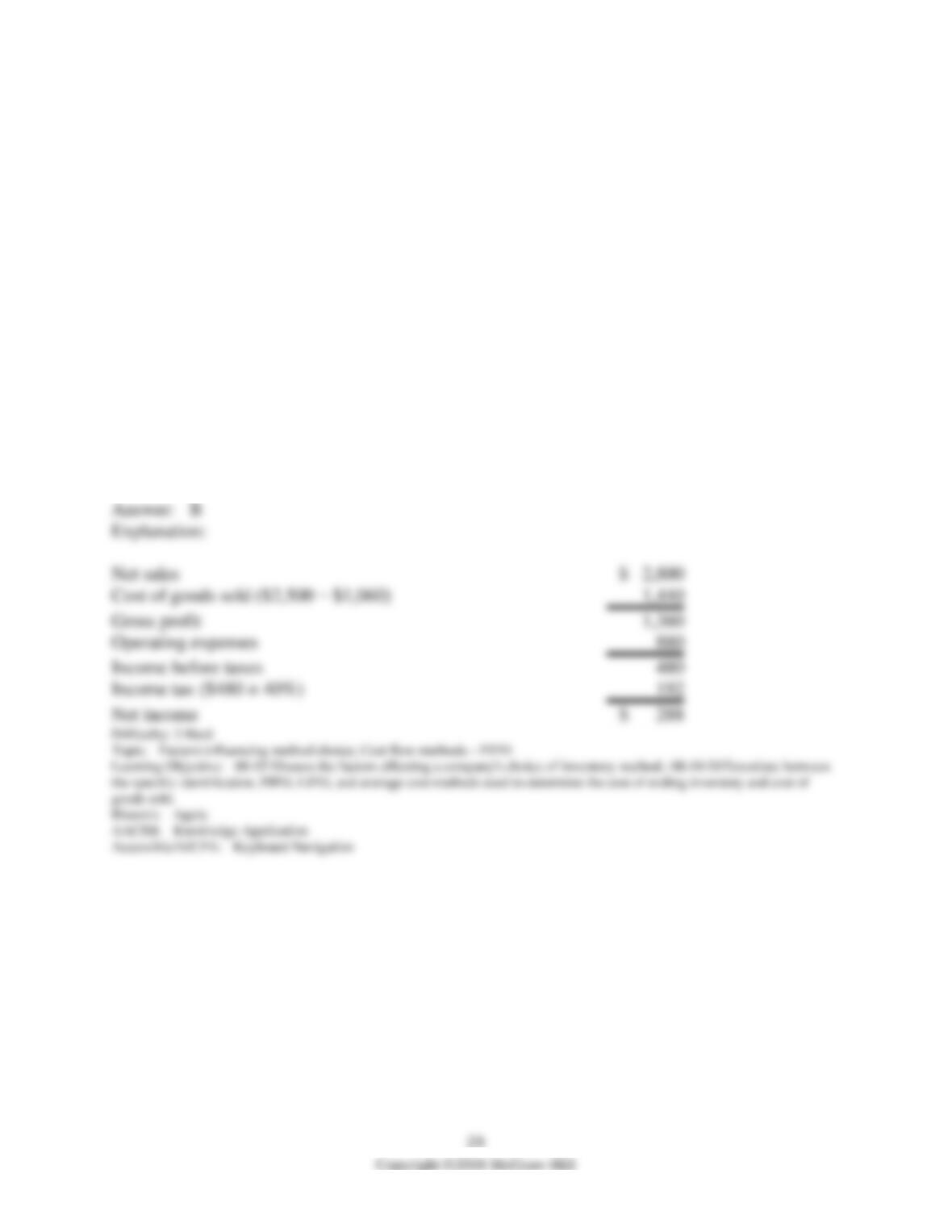
Net sales
$
Cost of goods sold ($2,500 − $1,060)
Gross profit
Income before taxes
480
Income tax ($480 × 40%)
192
Net income
$
288
54) Nu Company reported the following pretax data for its first year of operations.
Net sales
2,800
Cost of goods available for sale
2,500
Operating expenses
880
Effective tax rate
40
%
Ending inventories:
If LIFO is elected
820
If FIFO is elected
1,060
What is Nu’s net income if it elects LIFO?
A) $288.
B) $144.
C) $240.
D) $480.
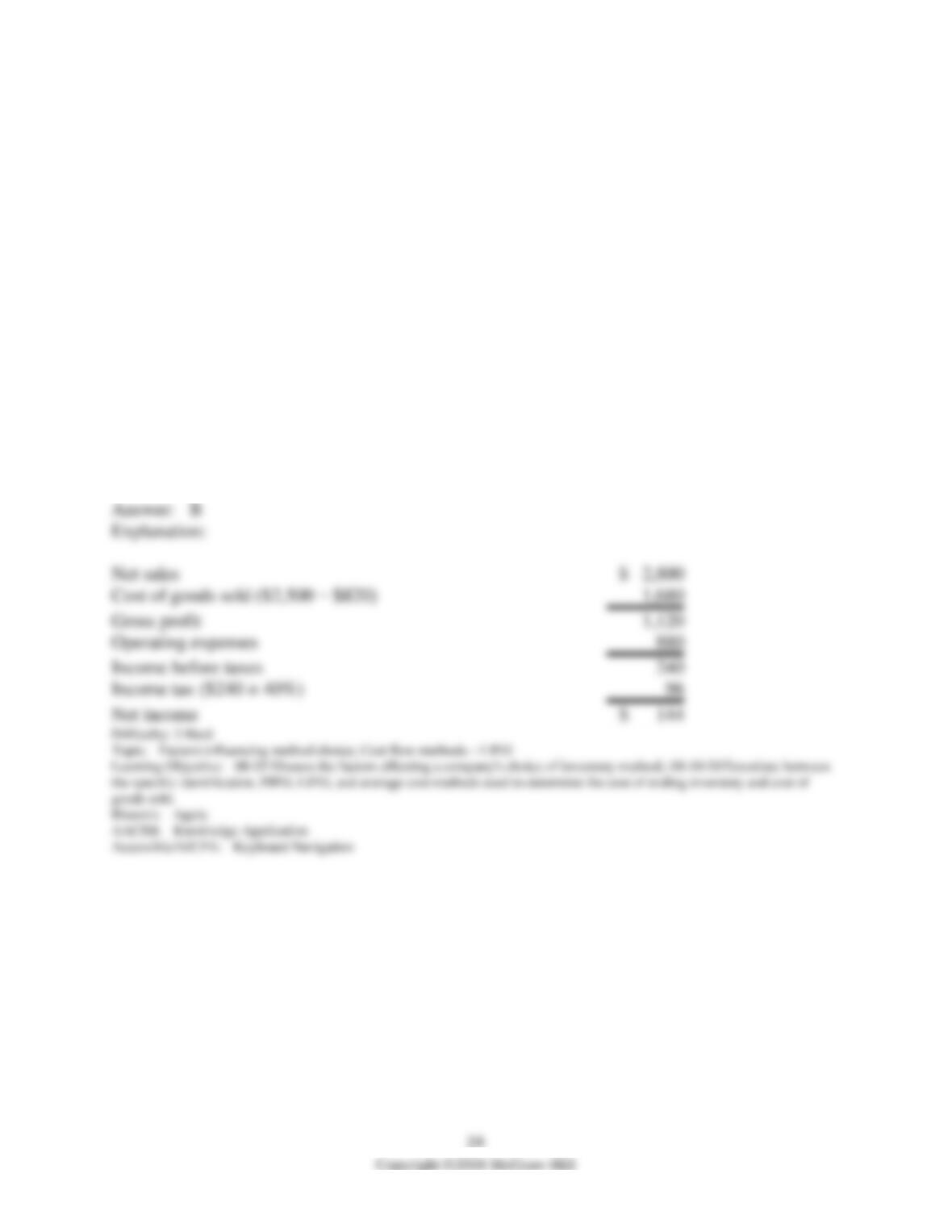
Net sales
$
Cost of goods sold ($2,500 − $820)
Gross profit
Income before taxes
Income tax ($240 × 40%)
96
Net income
$
55) Nu Company reported the following pretax data for its first year of operations.
Net sales
2,800
Cost of goods available for sale
2,500
Operating expenses
880
Effective tax rate
40
%
Ending inventories:
If LIFO is elected
820
If FIFO is elected
1,060
What is Nu’s gross profit ratio if it elects LIFO?
A) 80%.
B) 49%.
C) 40%.
D) 5%.
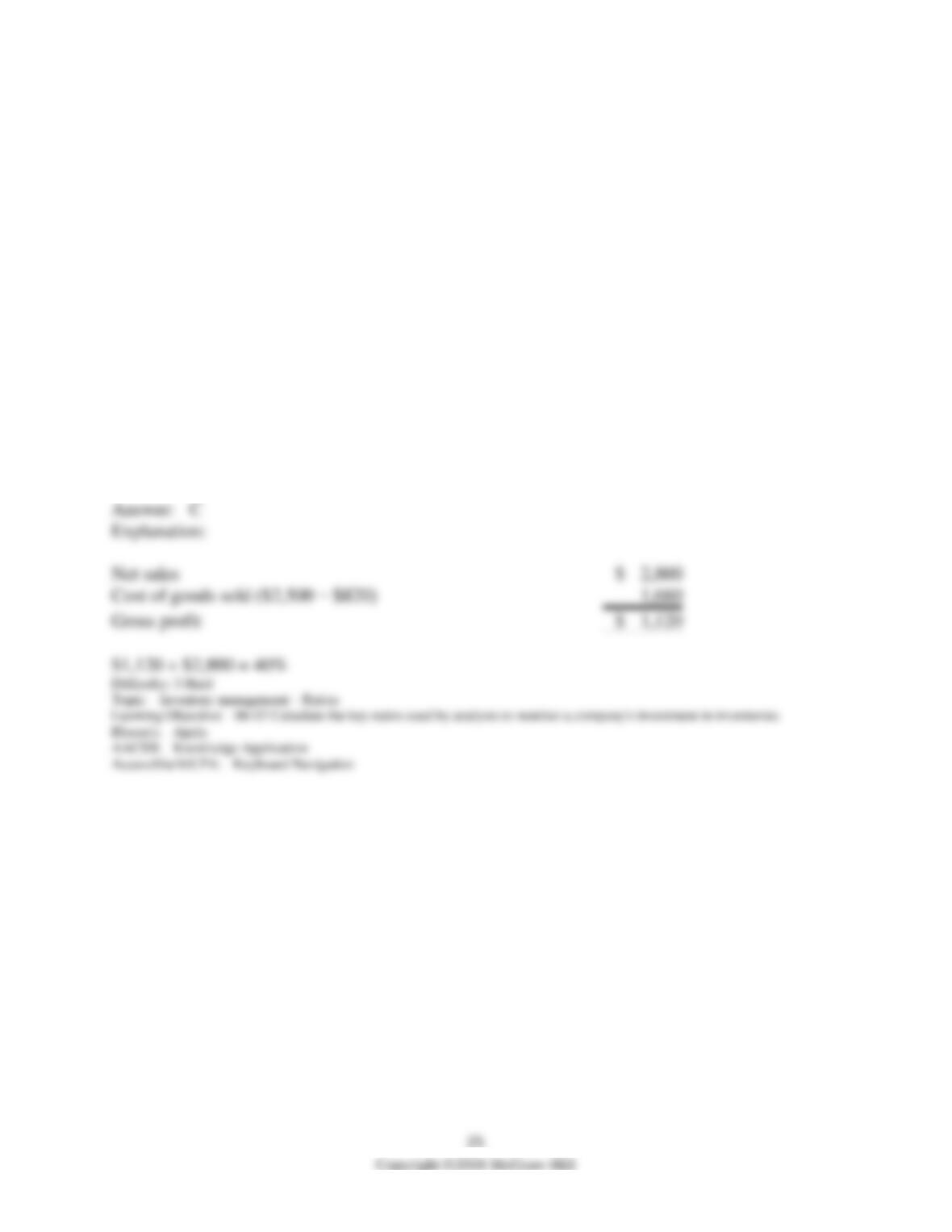
Net sales
$
Cost of goods sold ($2,500 − $820)
Gross profit
$
56) Nueva Company reported the following pretax data for its first year of operations.
Net sales
7,340
Cost of goods available for sale
5,790
Operating expenses
1,728
Effective tax rate
40
%
Ending inventories:
If LIFO is elected
618
If FIFO is elected
798
What is Nueva’s gross profit ratio (rounded) if it elects FIFO?
A) 30%.
B) 32%.
C) 10.7%.
D) 60%.
Net sales
$
Cost of goods sold ($5,790 − $798)
Gross profit
$
57) Nueva Company reported the following pretax data for its first year of operations.
Net sales
7,340
Cost of goods available for sale
5,790
Operating expenses
1,728
Effective tax rate
40
%
Ending inventories:
If LIFO is elected
618
If FIFO is elected
798
What is Nueva’s net income if it elects FIFO?
A) $440.
B) $264.
C) $620.
D) $372.
Net sales
$
7,340
Cost of goods sold ($5,790 − $798)
4,992
Gross profit
2,348
Operating expenses
1,728
Income before taxes
Income tax
Net income
$
58) Nueva Company reported the following pretax data for its first year of operations.
Net sales
7,340
Cost of goods available for sale
5,790
Operating expenses
1,728
Effective tax rate
40
%
Ending inventories:
If LIFO is elected
618
If FIFO is elected
798
What is Nueva’s net income if it elects LIFO?
A) $440.
B) $264.
C) $620.
D) $372.
Net sales
$
7,340
Cost of goods sold ($5,790 − $618)
5,172
Gross profit
2,168
Income before taxes
Income tax
Net income
$
59) Nueva Company reported the following pretax data for its first year of operations.
Net sales
7,340
Cost of goods available for sale
5,790
Operating expenses
1,728
Effective tax rate
40
%
Ending inventories:
If LIFO is elected
618
If FIFO is elected
798
How much more will Nueva report in income tax if it elects FIFO instead of LIFO?
A) $108.
B) $176.
C) $248.
D) $72.
Income tax (under FIFO)
$
248
Income tax (under LIFO)
176
Difference
$
60) Inventory records for Herb’s Chemicals revealed the following:
March 1, 2018, inventory: 1,000 gallons @ $7.20 = $7,200
Purchases:
Sales:
Mar. 10
600
gals
@
$
7.25
Mar. 5
400
gals
Mar. 16
800
gals
@
$
7.30
Mar. 14
700
gals
Mar. 23
600
gals
@
$
7.35
Mar. 20
500
gals
Mar. 26
700
gals
Ending inventory assuming LIFO in a periodic inventory system would be:
A) $5,040.
B) $5,055.
C) $5,075.
D) $5,135.
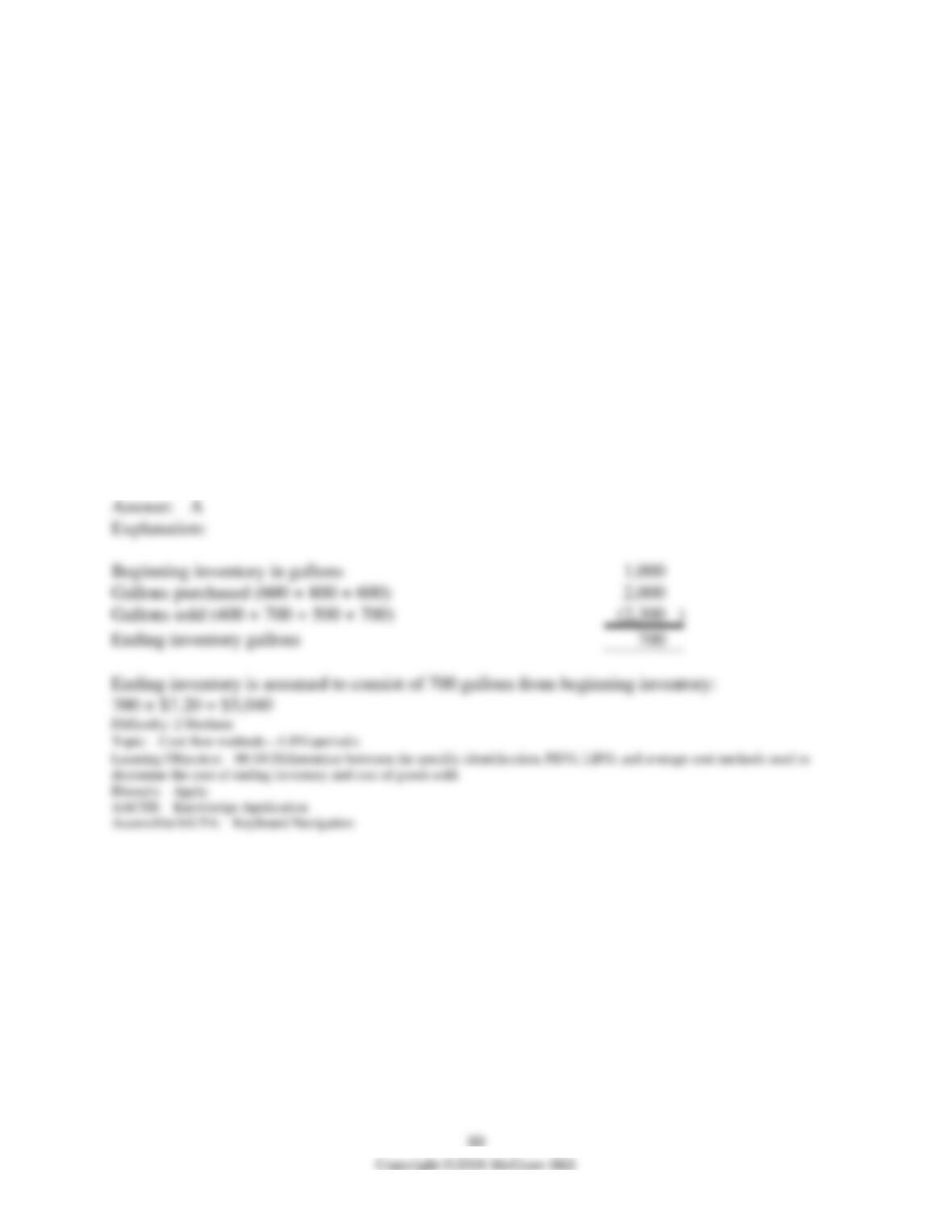
Beginning inventory in gallons
Gallons purchased (600 + 800 + 600)
Gallons sold (400 + 700 + 500 + 700)
(2,300
)
Ending inventory gallons
700
61) Inventory records for Herb’s Chemicals revealed the following:
March 1, 2018, inventory: 1,000 gallons @ $7.20 = $7,200
Purchases:
Sales:
Mar. 10
600
gals
@
$
7.25
Mar. 5
400
gals
Mar. 16
800
gals
@
$
7.30
Mar. 14
700
gals
Mar. 23
600
gals
@
$
7.35
Mar. 20
500
gals
Mar. 26
700
gals
Ending inventory assuming LIFO in a perpetual inventory system would be:
A) $4,960.
B) $5,060.
C) $5,080.
D) $5,140.
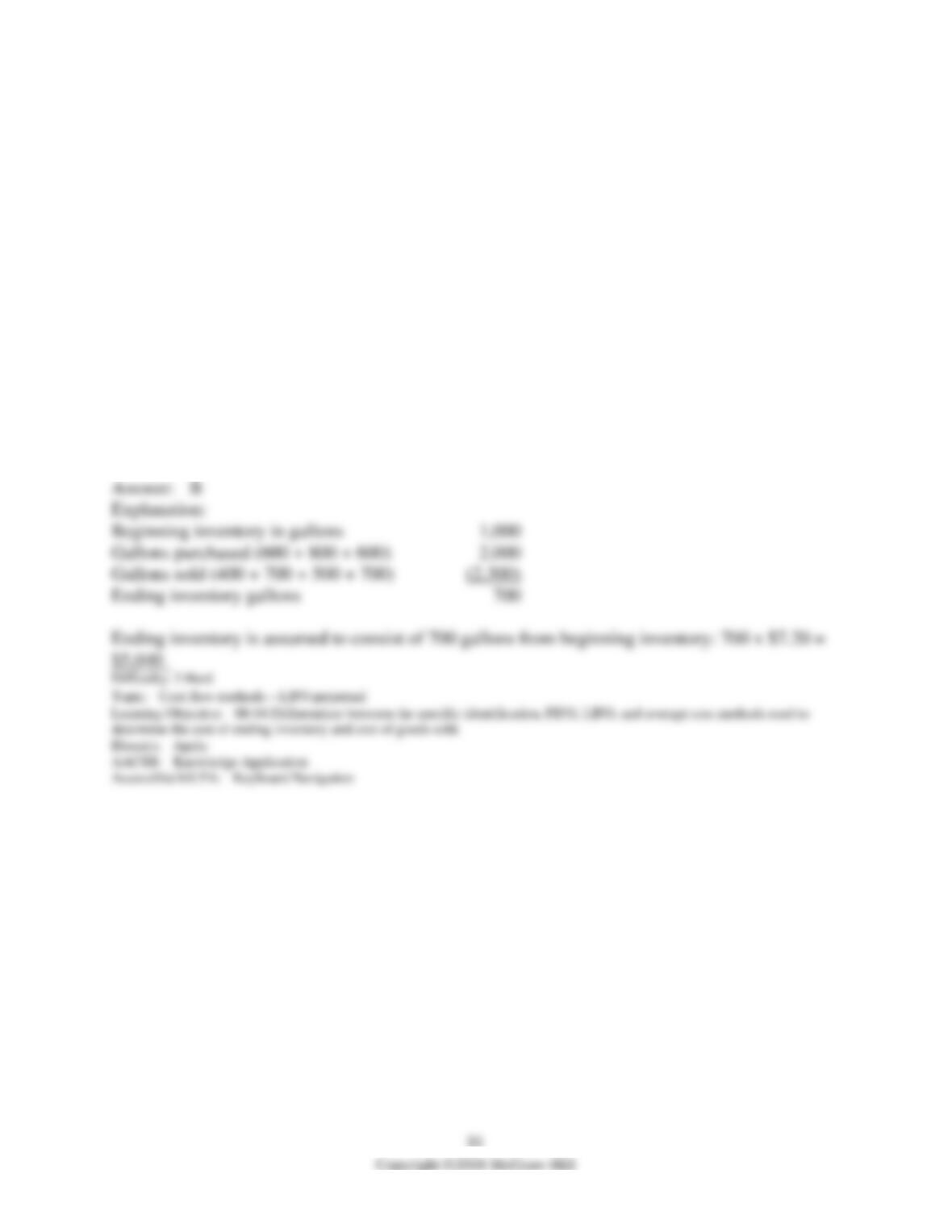
Beginning inventory in gallons
Gallons purchased (600 + 800 + 600)
Gallons sold (400 + 700 + 500 + 700)
Ending inventory gallons
62) Inventory records for Herb’s Chemicals revealed the following:
March 1, 2018, inventory: 1,000 gallons @ $7.20 = $7,200
Purchases:
Sales:
Mar. 10
600
gals
@
$
7.25
Mar. 5
400
gals
Mar. 16
800
gals
@
$
7.30
Mar. 14
700
gals
Mar. 23
600
gals
@
$
7.35
Mar. 20
500
gals
Mar. 26
700
gals
The ending inventory assuming FIFO is:
A) $5,140.
B) $5,080.
C) $5,060.
D) $5,050.
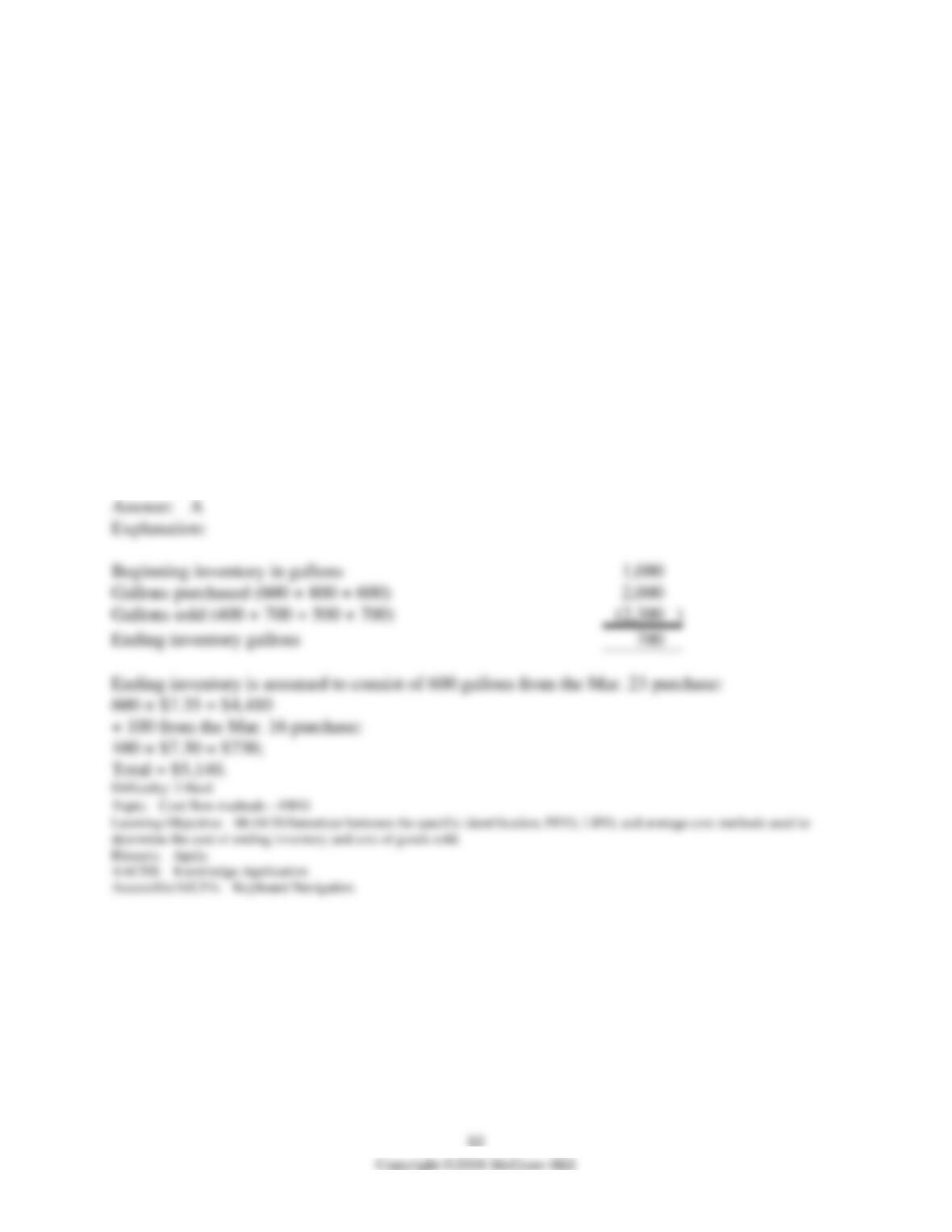
Beginning inventory in gallons
Gallons purchased (600 + 800 + 600)
Gallons sold (400 + 700 + 500 + 700)
(2,300
)
Ending inventory gallons
700
63) Inventory records for Herb’s Chemicals revealed the following:
March 1, 2018, inventory: 1,000 gallons @ $7.20 = $7,200
Purchases:
Sales:
Mar. 10
600
gals
@
$
7.25
Mar. 5
400
gals
Mar. 16
800
gals
@
$
7.30
Mar. 14
700
gals
Mar. 23
600
gals
@
$
7.35
Mar. 20
500
gals
Mar. 26
700
gals
The ending inventory under a periodic inventory system assuming average cost (rounding unit
cost to three decimal places) is:
A) $5,087.
B) $5,107.
C) $5,077.
D) $5,005.
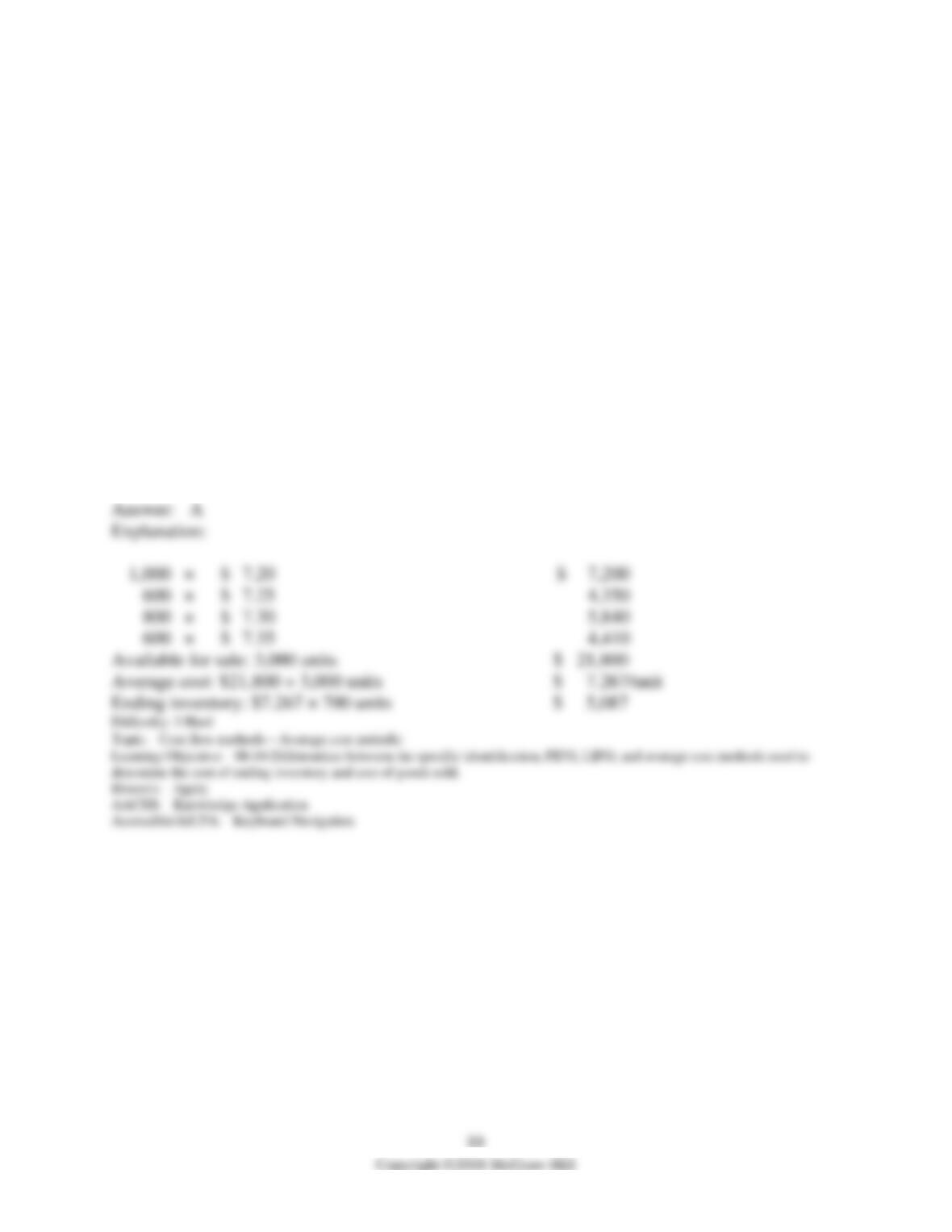
1,000
×
$
7.20
$
×
$
7.25
×
$
7.30
×
$
7.35
Available for sale: 3,000 units
$
21,800
Average cost: $21,800 ÷ 3,000 units
$
/unit
Ending inventory: $7.267 × 700 units
$
64) Texas Petrochemical reported the following April activity for its VC-30 lubricant, which had
a balance of 300 qts. @ $2.40 on April 1.
Purchases:
Sales:
Apr. 10
500
qts
@
$
2.50
Apr. 3
200
qts
Apr. 14
400
qts
@
$
2.60
Apr. 12
500
qts
Apr. 20
400
qts
@
$
2.65
Apr. 26
300
qts
The ending inventory assuming LIFO and a periodic inventory system is:
A) $1,580.
B) $1,510.
C) $1,575.
D) $1,470.
Beginning inventory in qts
Quarts purchased (500 + 400 + 400)
Quarts sold (200 + 500+ 300)
(1,000
)
Ending inventory quarts
Beg. inventory 300 @ $2.40
$
April 10 purchase 300 @2.50
$
65) The LIFO Conformity Rule states that if LIFO is used for:
A) One class of inventory, it must be used for all classes of inventory.
B) Tax purposes, it must be used for financial reporting.
C) One company in an affiliated group, it must be used by all companies in an affiliated group.
D) Domestic companies, it must be used by foreign partners.

66) The use of LIFO in accounting for a firm’s inventory:
A) Usually matches the physical flow of goods through the business.
B) Is usually used for internal management purposes.
C) Usually provides a better match of expenses with revenues.
D) None of these answer choices are correct.
67) In a period when costs are falling and inventory quantities are stable, the lowest taxable
income would be reported by using the inventory method of:
A) Weighted average.
B) LIFO.
C) Moving average.
D) FIFO.
68) The primary reason for the popularity of LIFO is that it:
A) Provides better matching of physical flow and cost flow.
B) Saves income taxes currently.
C) Simplifies recordkeeping.
D) Provides a permanent reduction of income taxes.

69) Which of the following statements is/are true?
A) In a period of rising costs and stable inventory levels, using the LIFO method leads to a lower
taxable income and higher net income compared to the FIFO method.
B) In a period of rising costs and stable inventory levels, using the FIFO method leads to a
higher taxable income and higher net income compared to the LIFO method.
C) In a period of falling costs and stable inventory levels, cost of goods sold is the same under
LIFO and FIFO.
D) All of the other answer choices are true.
70) In periods when costs are rising, LIFO liquidations:
A) Can’t occur.
B) Are used to reduce tax liabilities.
C) Are a source of off-balance-sheet financing.
D) Distort the net income.
71) When reported in financial statements, a LIFO allowance account usually:
A) Is shown in the firm’s income statement.
B) Is added to LIFO cost to indicate what the inventory would cost on a FIFO basis.
C) Indicates the effect on income if LIFO were not used.
D) Shows the current rate of inflation for that asset.
72) CMN Inc. uses LIFO and has experienced increasing costs since its founding. CMN
disclosed that the LIFO reserve (also known as the LIFO allowance) at the end of 2018 was $3
million. The balance sheet showed ending inventory of $17 million at the end of 2018. What
would the ending inventory have been if CMN had always used FIFO?
A) $20 million.
B) $17 million.
C) $14 million.
D) None of these answer choices are correct.
73) TNM Inc. uses LIFO and was founded in on January 1, 2017. At the end of 2017, TNM
disclosed that the LIFO reserve was $1 million, indicating that the ending inventory balance
would have been $1 million higher under FIFO. At the end of 2018, the LIFO reserve decreased
to $0.5 million and inventory balances were relatively stable compared to 2017. Which of the
following is true regarding TNM’s costs?
A) Costs have been increasing since TNM was founded because the LIFO reserve is greater than
zero.
B) Costs have been decreasing since TNM was founded because the LIFO reserve is greater than
zero.
C) Costs were increasing in 2018, but decreasing in 2017.
D) Costs were decreasing in 2018, but increasing in 2017.
74) If a company uses LIFO, a LIFO liquidation causes a company’s income taxes to increase:
A) When inventory purchase costs are rising.
B) When inventory purchase costs are declining.
C) Whether inventory purchase costs are declining or rising.
D) LIFO liquidations have no effect on a company’s income taxes.
75) GG Inc. uses LIFO. GG disclosed that if FIFO had been used, inventory at the end of 2018
would have been $15 million higher than the difference between LIFO and FIFO at the end of
2017. Assuming GG has a 40% income tax rate:
A) Its reported cost of goods sold for 2018 would have been $9 million higher if it had used
FIFO rather than LIFO for its financial statements.
B) Its reported cost of goods sold for 2018 would have been $15 million higher if it had used
FIFO rather than LIFO for its financial statements.
C) Its reported net income for 2018 would have been $9 million higher if it had used FIFO rather
than LIFO for its financial statements.
D) Its reported net income for 2018 would have been $15 million higher if it had used FIFO
rather than LIFO for its financial statements.
76) HH Company uses LIFO. HH disclosed that if FIFO had been used, inventory at the end of
2018 would have been $20 million lower than the difference between LIFO and FIFO at the end
of 2017. Assuming HH has a 30% income tax rate:
A) Its reported cost of goods for 2018 would have been $14 million less if it had used FIFO
rather than LIFO for its financial statements.
B) Its reported cost of goods for 2018 would have been $20 million less if it had used FIFO
rather than LIFO for its financial statements.
C) Its reported cost of goods sold for 2018 would have been $14 million higher if it had used
FIFO rather than LIFO for its financial statements.
D) Its reported cost of goods sold for 2018 would have been $20 million higher if it had used
FIFO rather than LIFO for its financial statements.
77) During 2018, WW Inc. reduced its LIFO eligible inventory quantities due to a problem with
its major supplier. The effect of this liquidation was to increase its cost of goods sold by
approximately $50 million. WW has a 40% income tax rate. If WW had not experienced these
supplier problems and the resulting liquidation:
A) Its 2018 net income would have been $30 million lower because inventory purchase prices
were rising.
B) Its 2018 net income would have been $30 million lower because inventory purchase prices
were declining.
C) Its 2018 net income would have been $30 million higher because inventory purchase prices
were rising.
D) Its 2018 net income would have been $30 million higher because inventory purchase prices
were declining.

78) Thompson TV and Appliance reported the following in its 2018 financial statements:
2018
Sales
$
420,000
Cost of goods sold:
Inventory, January 1
82,000
Net purchases
340,000
Goods available for sale
422,000
Inventory, December 31
86,000
Cost of goods sold
336,000
Gross profit
$
84,000
Thompson’s 2018 gross profit ratio is:
A) 25%.
B) 19%.
C) 20%.
D) None of these answer choices are correct.