Chapter 8 Pricing Decisions 8-21
90. A company has $8.00 per unit in variable costs and $4.00 per unit in fixed costs at a
volume of 50,000 units. If the company marks up total cost by 60%, what price should
be charged if 60,000 units are expected to be sold?
A. $7.20
B. $18.13
C. $19.20
D. $11.33
91. Harp Widgets determined each deluxe widget it produces has a unit variable cost of
$15.00, with total fixed costs of $600,000 for the period. Harp expects to sell 60,000
deluxe widgets and has applied a markup percentage of 35%. What contribution margin
will Harp earn from the sale of each deluxe widget?
A. $33.75
B. $8.75
C. $18.75
D. $25.75
92. Magic Fun has total fixed costs of $4,000,000 and total variable cost of $2,000,000
during a month when it sold 200,000 units. What price will Magic Fun charge if it uses
cost-plus pricing and a markup of 20%?
A. $30.00
B. $24.00
C. $36.00
D. $48.00
93. Cain Manufacturing produces 40,000 clocks at a total cost of $908,000. Total fixed
costs are $408,000. If Cain increases production by 20% and uses a 50% markup, how
much will the selling price per unit be?
A. $49.35
B. $21.00
C. $31.50
D. $34.05
94. A manufacturing company produces and sells 50,000 units of a single product. Total
product costs are $8 per unit. If total sales are $550,000, what markup percentage is
the company using?
A. 37.5%
B. 72.7%
C. 50.0%
D. 137.5%
95. A manufacturing company produces and sells 40,000 buckets. At this level of activity,
variable costs total $80,000 and fixed costs total $120,000. If each bucket is sold for $8,
what markup percentage is the company using?
A. 60%
B. 160%
C. 75%
D. 133%
8-22 Test Bank to accompany Jiambalvo Managerial Accounting, 6th Edition
96. The chief engineer at Wilson Electronics has proposed the production of a digipad to be
sold at a 30 percent markup on full cost. Management estimates that the fixed costs per
year will be $150,000 and the variable cost of the digipad will be $28 per unit. If Wilson
sells 30,000 digipads, what is the full cost of each unit?
A. $42.90
B. $33.00
C. $36.40
D. $9.90
97. The chief engineer at Wilson Electronics has proposed the production of a digipad to be
sold at a 30 percent markup. Management estimates that the fixed costs per year will
be $150,000 and the variable cost of the digipad will be $28 per unit. If Wilson sells
30,000 digipads, how much is the selling price of each digipad?
A. $42.90
B. $33.00
C. $36.40
D. $9.90
98. The target costing process for a new product
A. starts with the features that customers want and the price customers are willing
to pay.
B. is applied after the product has been designed.
C. focuses on creating products that include all possible product features to
broaden the company’s market share.
D. adds a markup percentage for profit once the price of the product has been
determined.
99. Which of the following lists the steps in the target costing process in the proper order?
A. Analyze customer needs and wants, determine the desired profit, find the target
cost, and design the product
B. Design the product, analyze customer needs and wants, determine the desired
profit, and find the target cost
C. Analyze customer needs and wants, find the target cost, design the product, and
determine the desired profit
D. Analyze customer needs and wants, determine the desired profit, design the
product, and find the target cost
100. What is the basic premise of target costing?
A. Products should be designed to meet customer needs at a price customers are
willing to pay that allows the company to make a reasonable profit.
B. Products should be designed at the least cost possible to enable the lowest
price in the market.
C. Products should be designed based on features that competitors’ products
include to enhance the company’s ability to compete more effectively.
D. The price with the highest profit should always be selected.
101. In which stage are most of the manufacturing costs for a product determined?
A. Design stage
B. Preproduction stage
C. During production
D. At the completion of production
Chapter 8 Pricing Decisions 8-23
102. A company believes it can sell 2,000,000 units of its proposed new bottle stopper at a
price of $16.00 each. If the company desires to make a profit of $3,000,000 on the
bottle stopper, what is the target cost for each bottle stopper?
A. $14.50
B. $16.00
C. $17.50
D. $9.67
103. Light Bright believes it can sell 40,000 of its newly developed laser lights at a price of
$24.00 each. There will be $680,000 in fixed costs associated with the laser light. If the
company desires to make a profit of $100,000 on the laser light, what is the target
variable cost for each laser light?
A. $4.50
B. $32.50
C. $28.33
D. $8.50
104. A company believes it can sell 8,000 units of its proposed new garage door opener at a
price of $100 each. If the company desires to make a profit of 30% of selling price on
the garage door opener, what is the target cost per opener?
A. $130
B. $110
C. $70
D. $30
105. Mays Tools believes it can sell 80,000 of its proposed new Dirt Dodgers at a price of
$50 each. If the company desires to make a profit of 60% of selling price, what is the
target variable cost per Dirt Dodger?
A. $25.00
B. $30.00
C. $31.25
D. There is not enough information provided to determine the answer.
106. Clinton Creations believes it can sell 10,000 of its proposed new waterproof camera at
a price of $200 each. There will be annual fixed costs associated with developing,
marketing and manufacturing the camera of $540,000. If the company desires to make
a profit of 40%, how much is the target variable cost per camera?
A. $80
B. $120
C. $66
D. There is not enough information provided to determine the answer.
107. Tire Kingdom requires a 60% profit margin on it dirt bike racing tires. At a price of $78
per tire the company expects to sell 16,000 tires. How much is the company’s target
cost on each tire?
A. $31.20
B. $48.75
C. $130.00
D. $46.80
8-24 Test Bank to accompany Jiambalvo Managerial Accounting, 6th Edition
108. Mason Kitchenware requires a 30% profit margin on the selling price of its jar openers.
At a price of $16 per opener, the company expects to sell 8,000 openers. Total fixed
costs are expected to be $28,000. How much is the target cost per jar opener?
A. $17.30
B. $11.20
C. $7.70
D. $20.80
109. A new product is being designed by an engineering team at Gray Security. Several
managers and employees from the cost accounting department and the marketing
department are also on the team to evaluate the product and determine the cost using a
target costing methodology. An analysis of similar products on the market suggests a
price of $135 per unit. The company requires a profit of 30% of selling price. How much
is the target cost per unit?
A. $175.50
B. $81.00
C. $40.50
D. $94.50
110. Sunshine Travel is designing a travel mug and has determined that a price of $8 will be
attractive in the marketplace. The company seeks to earn a profit of 30% percent of
selling price, and estimates it can sell 21,000 mugs. Total fixed costs are expected to
be $23,100. How much is the target cost per mug?
A. $2.40
B. $5.60
C. $6.70
D. $4.50
111. Sunshine Travel is designing a travel mug and has determined that a price of $8 will be
attractive in the marketplace. The company seeks to earn a profit of 30% percent of
selling price, and estimates it can sell 21,000 mugs. Total fixed costs are expected to
be $23,100. By how much will the target cost change per mug if the profit is raised to
40% instead of 30%?
A. A decrease of $0.80
B. An increase of $0.80
C. An increase of $0.45
D. A decrease of $3.70
112. Which one of the following is not assigned to individual customers when employing a
customer profitability analysis?
A. Sales revenue
B. Cost of goods sold
C. Cost of filling the customer’s orders
D. Cost of designing a new product
113. Which one of the following might result from performing a customer profitability
analysis?
A. Dropping some customers that are unprofitable
B. Increasing prices or offering incentives to profitable customers
C. Eliminating products that cause customers to complain
D. Offering customers that use more services than others a special customer
service unit that provides more one–on-one time
Chapter 8 Pricing Decisions 8-25
114. First Décor has analyzed the indirect costs associated with servicing its various
customers in order to assess customer profitability. Results for the year appear below:
Cost Pool
Cost
Cost Driver
Quantity
Processing electronic orders
$400,000
Number of orders
40,000
Processing non-electronic orders
120,000
Number of orders
8,000
Picking orders
240,000
Number of different products ordered
120,000
Packaging orders
180,000
Number of items ordered
150,000
Returns
15,000
Number of returns
3,000
What is the cost allocation for two Internet orders for 22 items with 7 different products
and one return?
A. $65.40
B. $33.20
C. $60.40
D. $40.40
115. First Décor has analyzed the indirect costs associated with servicing its various
customers in order to assess customer profitability. Results for the year appear below:
Cost Pool
Cost
Cost Driver
Quantity
Processing electronic orders
$400,000
Number of orders
40,000
Processing non-electronic orders
120,000
Number of orders
8,000
Picking orders
240,000
Number of different products ordered
120,000
Packaging orders
180,000
Number of items ordered
150,000
Returns
15,000
Number of returns
3,000
If all costs were assigned to customers based on the number of items ordered, what
would be the cost per item ordered?
A. $6.37
B. $33.20
C. $1.20
D. $0.16
116. First Décor has analyzed the indirect costs associated with servicing its various
customers in order to assess customer profitability. Results for the year appear below:
Cost Pool
Cost
Cost Driver
Quantity
Processing electronic orders
$400,000
Number of orders
40,000
Processing non-electronic orders
120,000
Number of orders
8,000
Picking orders
240,000
Number of different products ordered
120,000
Packaging orders
180,000
Number of items ordered
150,000
Returns
15,000
Number of returns
3,000
One customer of First Décor placed 30 electronic orders with a total selling price of
$25,400. The direct cost of these orders is $17,200. The orders consist of five different
products with a total of 2,200 items, and two returns. Using an activity-based costing
method, how much are the indirect costs associated with serving this customer?
A. $2,960
B. $996
C. $2,660
D. $3,110
8-26 Test Bank to accompany Jiambalvo Managerial Accounting, 6th Edition
117. Activity-based pricing
A. encourages customers to use as many services as possible that are provided by
the seller.
B. charges customers for each service they use.
C. allows all customers to pay lower total prices.
D. reduces the direct costs of offering products for sale.
118. For which of the following items might a customer be charged extra for an order under
activity-based pricing?
A. Placing the order during non-peak times
B. Requesting an order be delivered in three separate shipments
C. Using an automated order system
D. Tracking delivery via an online support utility
119. Which one of the following is a goal of activity-based pricing?
A. To charge customers for the costs that they are creating
B. To increase profits by charging all customers at higher prices
C. To maintain all customers in the customer base
D. To broaden market share
120. A company estimates that ordering costs are $2.00 per order, picking costs are $1.00
for each different item ordered, packing costs are $0.07 per item, and return costs are
$40.00 per return. A customer orders $8,000 worth of goods with direct costs of $6,200.
The customer places 70 orders, orders 24 unique items, 940 total items, and makes 7
returns. What is the customer profit?
A. $509.80
B. $1,290.20
C. $7,490.20
D. $1,800
121. A company estimates that ordering costs are $3.20 per order, picking costs are $2.15
per unique item ordered, packing costs are $0.04 per item, and return costs are $15.00
per return. A customer orders $8,440 worth of goods with direct costs of $5,200. The
customer places 85 orders, orders 72 unique items, 450 total items, and makes 5
returns. What is the customer profit?
A. $519.60
B. $3,240
C. $2,720.20
D. $7,920.20
122. A company estimates that ordering costs are $4.00 per order, picking costs are $3.00
per unique item ordered, packing costs are $0.04 per item, and return costs are $70.00
per return. A customer makes 50 orders, orders 80 unique items, and 900 total items.
The customer makes 11 returns. The pricing structure is to charge customers for the
cost of the services that are provided. Using activity-based pricing for each of the above
items, what will be the total amount of additional cost paid by the customer?
A. $1,246
B. $77.04
C. $1,540
D. $476

Chapter 8 Pricing Decisions 8-27
123. A company using activity-based pricing marks up the direct cost of goods by 30% and
then adds the cost of the services that are provided. Indirect costs are charged as
follows: $8.00 per order placed; $4.00 per separate item ordered; $30.00 per return. A
customer places 10 orders with a total direct cost of $3,000, orders 300 separate items,
and makes 5 returns. What will the customer be charged?
A. $3,000
B. $3,900
C. $5,330
D. $5,759
124. Marquez Enterprises uses activity-based pricing and marks up the direct cost of goods
by 40%. In addition, the customer is charged for indirect costs based on the activities
utilized. Indirect costs are as follows: $7 per order placed and $11 per return. A
customer places 12 orders with a direct cost of $6,100 and makes 2 returns. How much
in indirect costs will the customer be charged?
A. $18
B. $106
C. $6,206
D. $2,440
125. A custom yacht-building company uses activity–based pricing. The company’s annual
activity pools and related information follow:
Cost Pool Estimated Cost Cost Driver Driver Quantity
Design $2,500,000 Number of designs 80 designs
Production 4,000,000 Labor hours 125,000 labor hours
Customer service 80,000 Number of customers 20 customers
The pricing structure is to charge customers for the cost of the services that are
provided. One particular customer requested 2 different designs which led to the
production of one yacht which took 2,400 labor hours to complete. What additional
costs will be charged to this customer?
A. $143,300
B. $112,050
C. $139,300
D. $108,050
126. A law firm uses activity–based pricing. The company’s annual activity pools and related
information are as follows:
Cost Pool Estimated Cost Cost Driver Driver Quantity
Consultation $125,000 Number of consultations 200 consultations
Administrative costs 66,000 Admin labor hours 6,000 labor hours
Client service 34,000 Number of clients 400 clients
The pricing structure is to charge customers for the cost of the services that are
provided. The firm had four consultations with Doris Lansing and required 88
administrative labor hours. What additional costs will be charged to this customer?
A. $636
B. $721
C. $3,468
D. $3,553

8-28 Test Bank to accompany Jiambalvo Managerial Accounting, 6th Edition
127. A law firm uses activity–based pricing. The company’s annual activity pools and related
information are as follows:
Cost Pool Estimated Cost Cost Driver Driver Quantity
Consultation $125,000 Number of consultations 200 consultations
Administrative costs 66,000 Admin labor hours 6,000 labor hours
Client service 34,000 Number of clients 400 clients
The pricing structure is to charge customers for the cost of the services that are
provided. The firm had two consultations with Randall’s Auto Shop and required 64
administrative labor hours. What additional costs will be charged to this customer?
A. $1,954
B. $2,039
C. $721
D. $1,442
128. Veterinarians Johns & Doggins have analyzed their customer data for the past year and
have determined the following costs:
Customer inquiries cost each $ 12
Additional costs if inquiry is after hours 20
Dispensing of prescriptions 18
Relationship management costs (Per customer per year) 800
In addition to these costs, product costs amount to 75% of sales. In the prior year,
Johns & Doggins had the following experience with one of its customers, Millie Woods:
Sales $3,100
Total number of inquiries 50
Percent of after-hours inquiries 80%
Prescriptions dispensed 26
For the coming year, Johns & Doggins have told Woods that she will be switched to an
activity-based pricing system or will be dropped as a customer. In addition to regular
prices, Woods will be required to pay:
Inquiries $18 each
After hours inquiries $21 each
Prescription dispensing $22 each
How much is the additional revenue to be charged to Woods account if activity is the
same as in the prior year?
A. $2,312
B. $2,392
C. $3,112
D. $3,952
Chapter 8 Pricing Decisions 8-29
Answers to Multiple Choice

8-30 Test Bank to accompany Jiambalvo Managerial Accounting, 6th Edition
MATCHING
129. Match each of the following terms with the phrase that most closely describes it.
1. Activity-based pricing
2. Customer profitability analysis
3. Target costing
4. Economic pricing
5. Cost-plus pricing
A. A system that starts with what consumers are willing to pay for a product and
tries to design a product at a cost that allows a reasonable profit
B. A way of using activity-based methods to assess which customers are
covering the costs they are generating
C. A system that charges customers for the services they consume
D. A system that prices based on the laws of supply and demand
E. A system that sets prices based on costs
Answers to Matching
Chapter 8 Pricing Decisions 8-31
EXERCISES
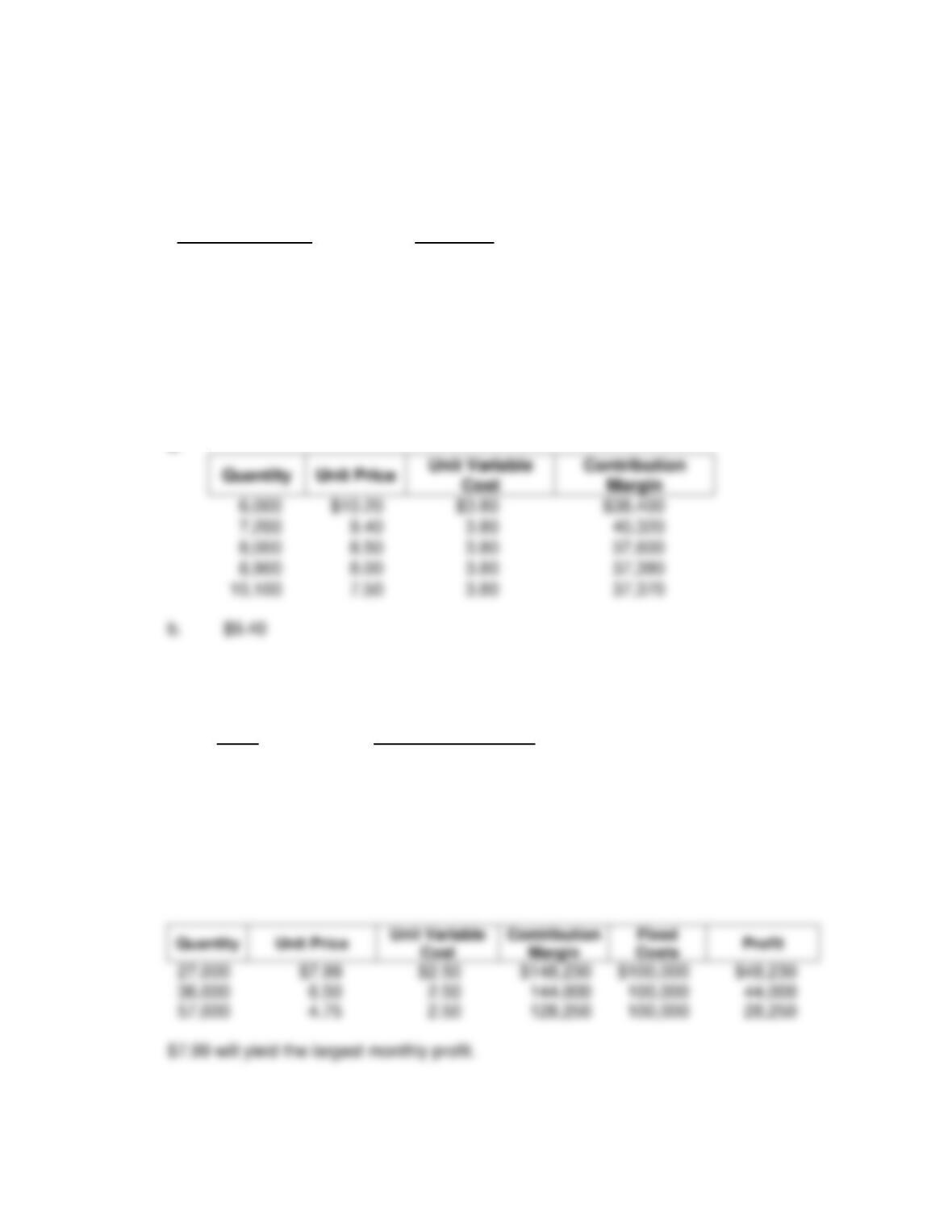
130. Suez Bakery produces and sells chocolate silk pies, each having a variable cost of
$3.80. Total fixed costs are $34,000. Management estimates demand at various
activity levels as follows:
Units Demanded Unit Price
6,000 $10.20
7,200 9.40
8,000 8.50
8,900 8.00
10,100 7.50
a. Calculate the total contribution margin at each price level.
b. Which price maximizes profit?
Answer
a.
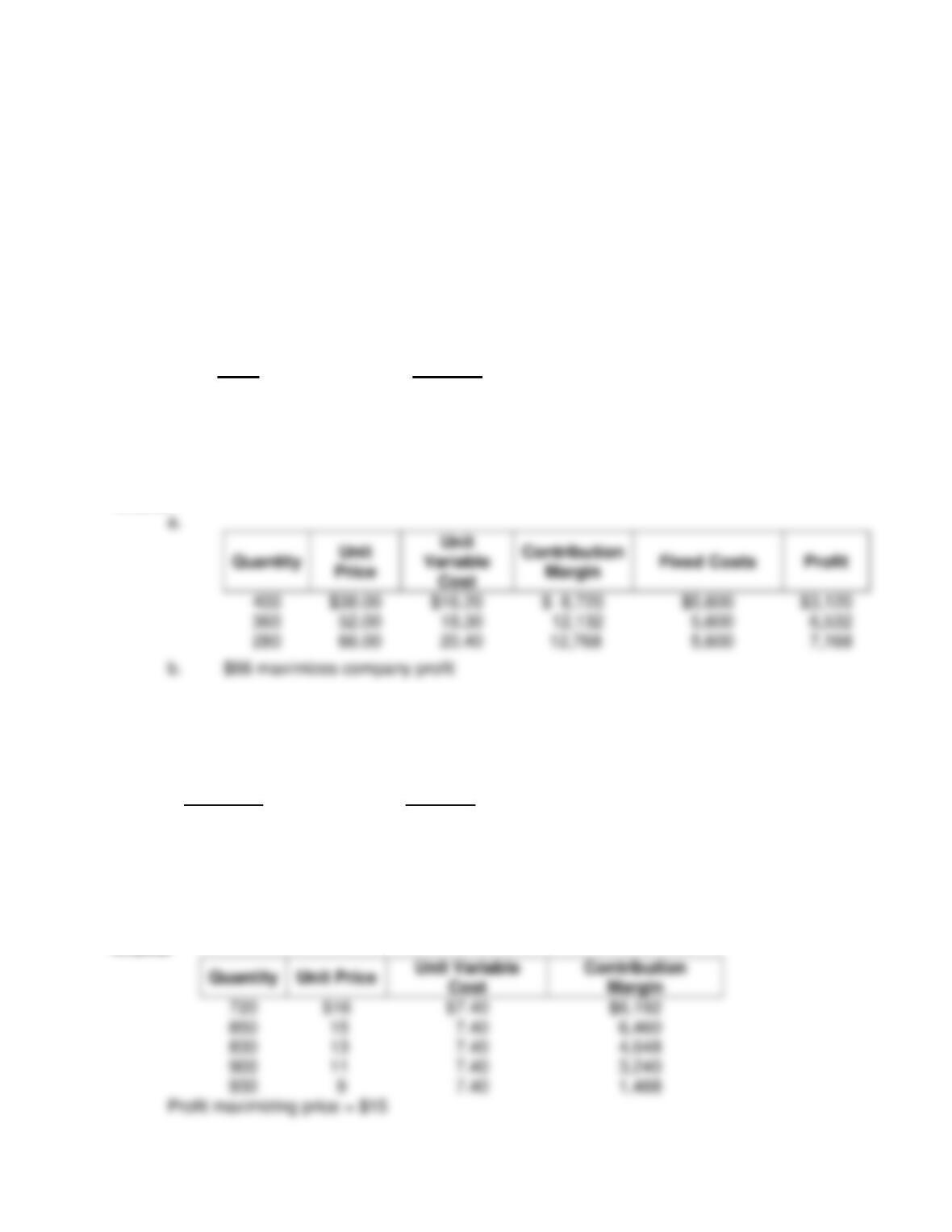
131. The editor of Times Daily is considering three alternative prices for his new monthly
periodical. His estimate of price and quantity demanded are:
Price Quantity Demanded
$7.99 27,000
$6.50 36,000
$4.75 57,000
Monthly costs of producing and delivering the magazines include $100,000 of fixed
costs and variable costs of $2.50 per issue. Which price will yield the largest monthly
profit?
Answer
8-32 Test Bank to accompany Jiambalvo Managerial Accounting, 6th Edition
132. Kitchen Zone has come out with a new line of electric can openers that it plans to
test market through a series of demonstrations at the local mall throughout the month
of August. If the demonstrations result in enough sales, the program will be
expanded to other malls in the region. The cost of the demonstrations is a flat fee of
$2,400 to the mall owner/operator and a commission of 15% of revenue to the
person giving the demonstrations. Kitchen Zone’s fixed costs of producing the can
opener are $3,200 per production run. The company plans to wait for all orders to
come in, and then it will produce exactly the number of units ordered (there will be no
beginning or ending inventory). Variable production costs are $7 per can opener. In
addition, it will cost approximately $3.50 per set to ship each can opener to
customers. Based on experience with similar items, focus group responses, and
survey information, estimates for unit amounts at estimated activity levels follow:
Price Quantity
$38 400
$52 360
$66 280
a. Calculate the expected profit for each price.
b. Which price maximizes company profit?
Answer
133. WDT, Inc. is a large company that publishes ‘how–to’ books for small construction
projects. WDT is considering the purchase of a new binding machine to bind the
books. The variable cost of each book is estimated to be $7.40. Management has
estimated demand at various prices as follows:
Unit Price Quantity
$16 720
15 850
13 830
11 900
9 930
Calculate the profit-maximizing price for the “how–to” books.
Answer