8-142
128.
The Safety Chemical Company produces a special kind of body oil that is widely used by
professional sports trainers. The oil is produced in three processes: Refining, Blending,
and Mixing. Raw oil materials are introduced at the beginning of the refining process. A
“mountain-air scent” material is added in the blending process when processing is 50%
completed.
The following Work–in-Process account for the Blending Department is available for the
month of July. The July 1 Work-in-Process inventory contains $10,370 in conversion costs,
and $1.56/unit in costs transferred in from the Refining Department.
Work-in-Process:
Blending
Beginning balance
(8,000 gal, 30%
complete)
$22,850
Costs transferred in
from Refining (29,000
gal.)
48,200
Materials
20,810
Direct labor
5,748
Overhead
11,600
Ending balance (4,000
gal., 40% complete)
The Safety Chemical Company uses first-in, first-out (FIFO) costing.
Required (use 4 decimal places for computations):
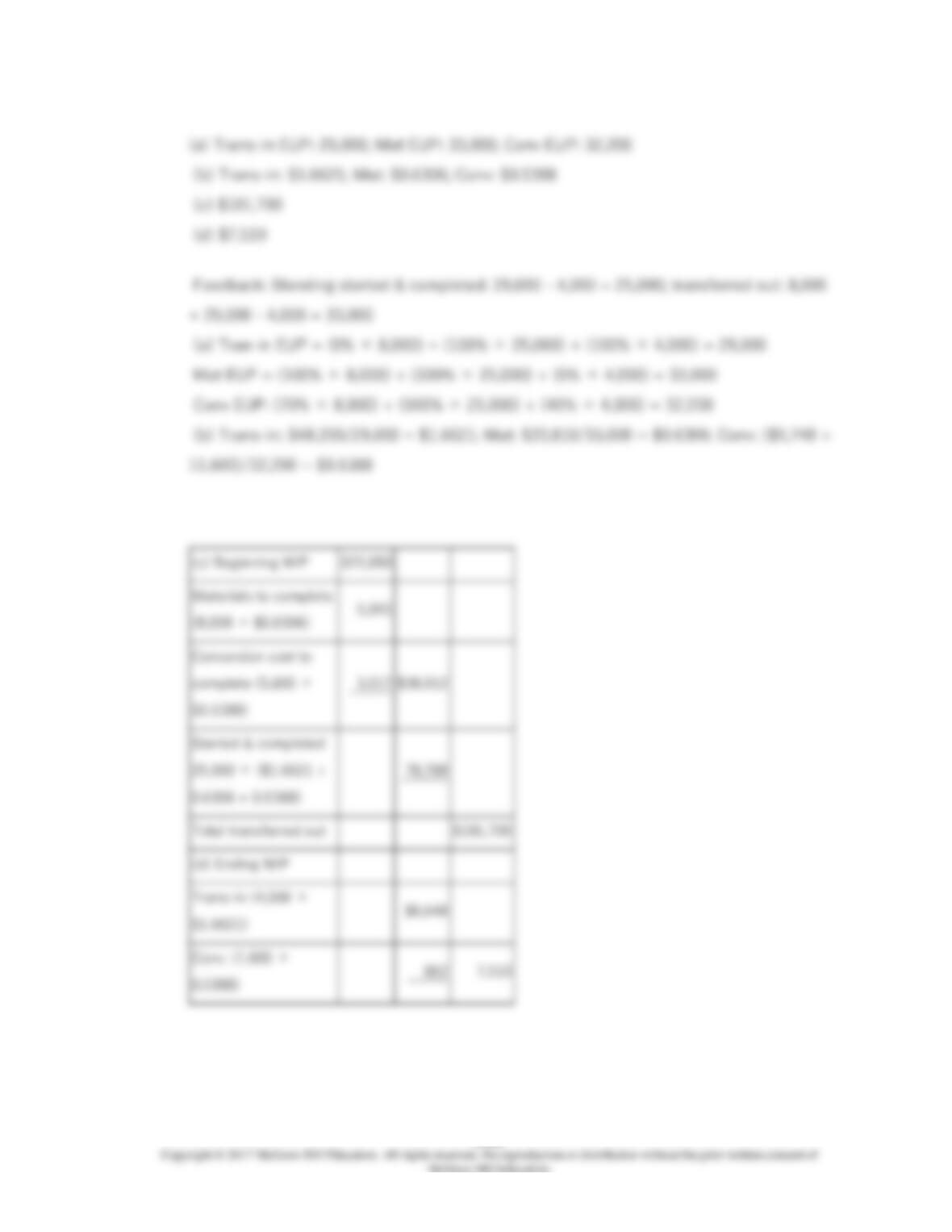
(a) Compute the equivalent units of production for Blending.
(b) Compute the unit costs in the Blending Department for the month of July. (HINT:
There are three.)
(c) Compute the costs transferred out to the Mixing Department for July.
(d) Compute the July 31 Work-in–Process Inventory balance.
8-143
129.
Tracker Sports is a manufacturer of sportswear. Tracker produces its products in two
departments.
8-144
The information for the current month for Department #2 is as follows:
Beginning work-in-process
20,000
units
Units transferred in from Dept #1
40,000
units
Units completed
50,000
units
Ending work-in-process
10,000
units
Beginning WIP transferred in
costs
$50,000
Beginning WIP direct materials
$12,000
Beginning WIP direct labor
$3,200
Beginning WIP overhead
$1,600
Costs transferred in from Dept #1
$100,000
Direct material added during
month
$60,000
Direct manufacturing labor during
month
$20,000
Manufacturing overhead applied
???
Beginning WIP was half complete as to conversion costs. Direct materials for Department
#2 are added when the process is 25% complete. Factory overhead is applied at a rate
equal to 50 percent of direct manufacturing labor. Ending WIP was 60 percent complete.
Tracker Sports uses first-in, first-out (FIFO) costing.
Required:
(
HINT:
use 4 decimal places in your calculations)
a. Compute the equivalent units of production for each input.
b. Compute the cost per unit.
c. Compute the cost transferred out to finished goods.
d. Compute the ending work-in-process inventory balance.
8-145
130.
Malcom Industries manufactures a silicone paste wax that goes through three processing
departments: cracking, blending, and packing. All raw materials are introduced at the start
8-146
of work in the cracking department, with conversion costs being incurred uniformly in each
department. The Work–in-Process T-account for the cracking department for July is:
Work-in-Process Inventory (Cracking
Department)
Balance, July 1 (35,000 lbs, 4/5 done)
$63,700
Direct materials (280,000 lbs)
397,600
Conversion costs
189,700
Balance, July 31 (45,000 lbs, 2/3 done)
??
Costs transferred to Blending Dept
??
8-148
131.
8-150
132.
Toxo Chemicals produces a solvent in its Glendale plant. Three chemicals are combined at
the start of the process and blended under pressure for a period of time. At the 75% point
of completion, an additional chemical is added. The following information has been
gathered:
Chemical
Mix
Additional
Chemical
Conversion
Cost
Gallons
BWIP
$5,000
-0-
$3,000
10,000
Added
65,000
15,000
35,000
100,000
8-152
133.
Racquet Master (RM) Sports manufactures and distributes two types of tennis rackets:
Dominant Drive (DD) and Major Smash (MS). Both types of rackets go through Operations
1 and 3. MS also goes through Operation 2, which adds a layer of graphite for additional
strength. All material is added at the beginning of their respective operations.
The following information relates to a work order from Discount Warehouse, Inc. for
30,000 units of DD (Work order #286) and 8,000 units of MS (Work order #354).
Work order
#286
Work order
#354
Direct
materials:
Operation 1
$120,000
$80,000
Operation 2
—
20,000
Operation 3
45,000
30,000
Conversion
costs:
Operation 1
30,000
15,000
Operation 2
—
25,000
Operation 3
14,793
14,896
8-154
134.
Martin Enterprises uses three operations in sequence to manufacture an assortment of
flower pots. In each operation, the same procedures, time, and costs are used to perform
that operation, regardless of the type of pot being produced. During March, a batch of 500
Clay Pots and a batch of 800 Porcelain Pots were put through the first operation. All
materials for a batch are introduced at the beginning of the operation for that batch. The
costs shown below were incurred in March for the first operation:
Direct Labor
$4,450
Manufacturing Overhead
3,600
Direct Materials:
Clay Pots
$1,200
Porcelain Pots
$2,400
8-155
135.
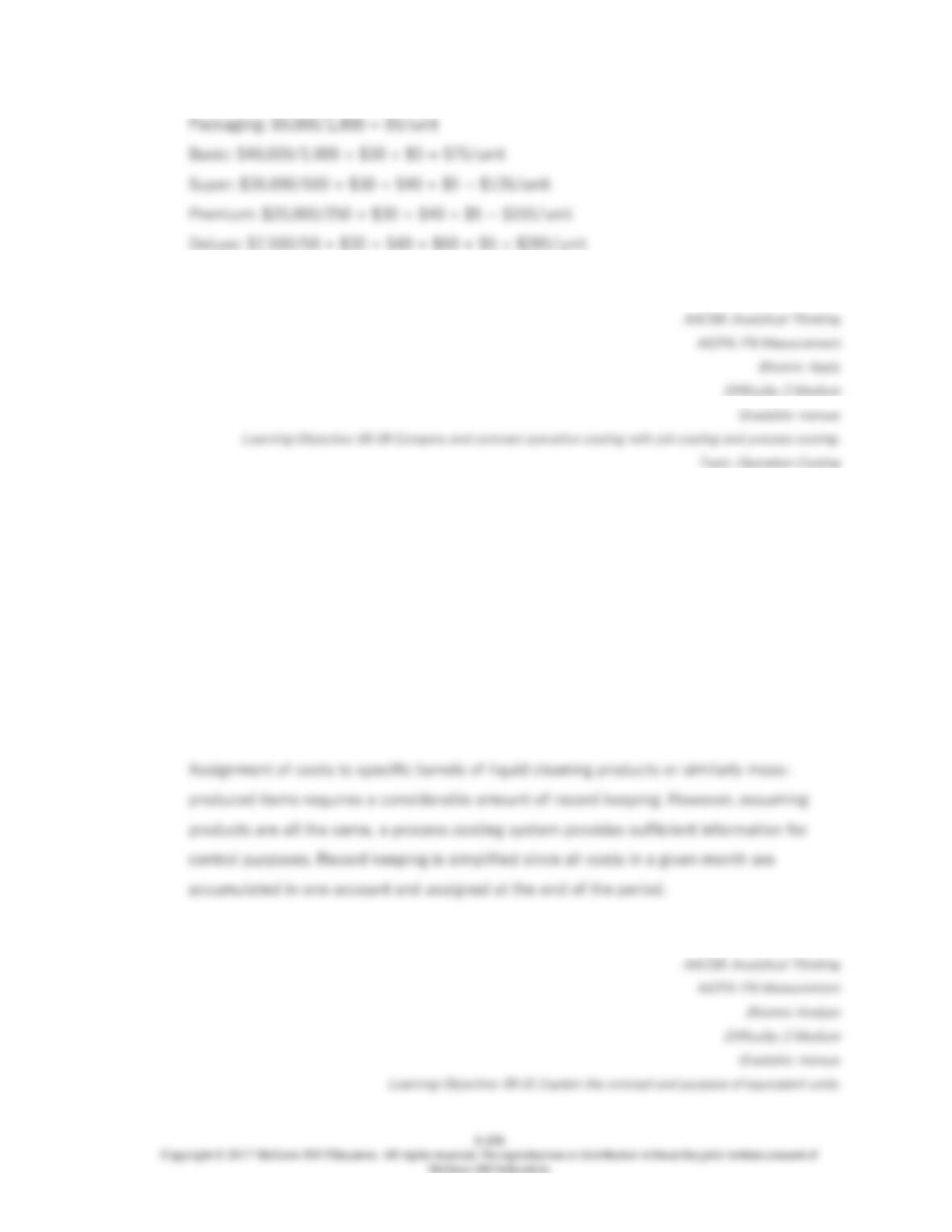
Carmen Products makes four models of guitars. All of the models go through the same
assembly line but they differ as to the materials used and the degree of finishing. The
Basic model has a low gloss finish and goes immediately to Packaging upon completion in
Assembly. The Super model and the Premium model go through a Buffing process upon
completion in Assembly. They then go on to Packaging. The Deluxe model is the top of the
line and goes first to Buffing from the Assembly, then to Special Polishing, then to
Packaging.
Carmen uses operations costing and allocates conversion costs based on the number of
units processed in each department.
Total
Basic
Super
Premium
Deluxe
Units
1,000
500
250
50
Materials
$97,500
$40,000
$30,000
$20,000
$7,500
Conversion
costs:
Assembly
$54,000
Buffing
32,000
Special
Polish
3,000
Packaging
9,000
Total
$98,000
136.
137.
138.
139.
140.
141.
142.
143.