
169) The following information comes from the 2013 Occidental Petroleum Corporation annual
report to shareholders:
NOTE 4 INVENTORIES
Net carrying values of inventories valued under the LIFO method were approximately $205
million and $185 million at December 31, 2013 and 2012, respectively. Inventories consisted of
the following: ($ in millions)
2013
2012
Raw materials
$ 74
$ 70
Materials and supplies
628
612
Finished goods
589
763
1,291
1,445
LIFO reserve
(91)
(101)
Total
$1,200
$1,344
The LIFO reserve indicates that inventories would have been $91 million and 101 million higher
at the end of 2013 and 2012, respectively, if Occidental Petroleum had used FIFO to value its
entire inventory.
Required:
If Occidental Petroleum had used FIFO to value its entire inventory how would its 2013 pre-tax
income be affected?

Use the following to answer the question(s) below:
The inventories disclosure note in the 2014 financial statements for SUPERVALU Inc., one of
the largest grocery chains in the United States, included the following:
“During fiscal 2014, 2013 and 2012, inventory quantities in certain LIFO layers were reduced.
These reductions resulted in a liquidation of LIFO inventory quantities carried at lower costs
prevailing in prior years as compared with the cost of fiscal 2014, 2013 and 2012 purchases. As a
result, Cost of sales decreased by $14, $6 and $9 in fiscal 2014, 2013 and 2012, respectively. All
inventories are stated at the lower of cost or current market values. Cost for inventories at the
majority of our operations is determined on a last-in, first-out (“LIFO”) basis.”
Required:
170) The disclosure note indicates an inventory liquidation during 2014, 2013, and 2012. By
how much did net income in 2014 increase due to the liquidation? Assume an income tax of
40%.
171) What additional income tax payments did the 2014 liquidation cost SUPERVALU?
172) Spando Apparel uses the LIFO inventory method for external reporting and for income tax
purposes but maintains its internal records using FIFO. The following disclosure note was
included in a recent annual report:
Inventories ($ in millions):
2018 2017
Total inventories $625 $604
LIFO reserve (83) (51)
$542 $ 553
The company’s income statement reported cost of goods sold of $3,120 million for the fiscal year
ended December 31, 2018.
Required:
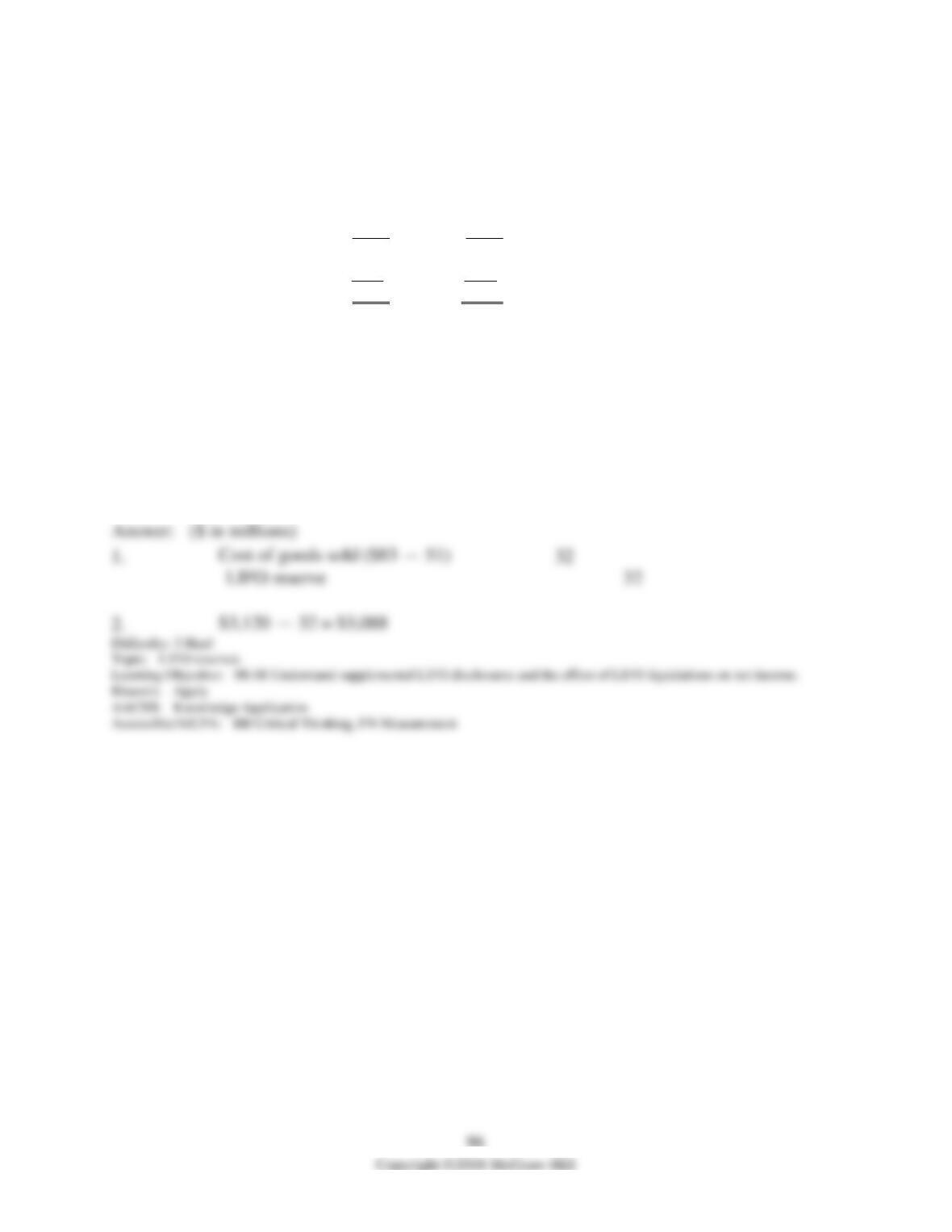
1. Spando adjusts the LIFO reserve at the end of its fiscal year. Prepare the December 31, 2018,
adjusting entry to record the cost of goods sold adjustment.
2. If Spando had used FIFO to value its inventories, what would cost of goods sold have been
for the 2018 fiscal year?
173) The table below contains selected financial information from recent financial statements of
KBI Toys and Little Tikes Adventure Toys, Inc., two toy manufacturing companies ($ in
thousands):
KBI Toys Little Tikes
12/31/2018 12/31/2017 12/31/2018 12/31/2017
Net sales $80,622 $72,120 $63,480 $68,900
Cost of goods sold 58,900 53,800 40,786 46,325
Year-end inventory 7,400 6,900 5,800 6,300
Required:
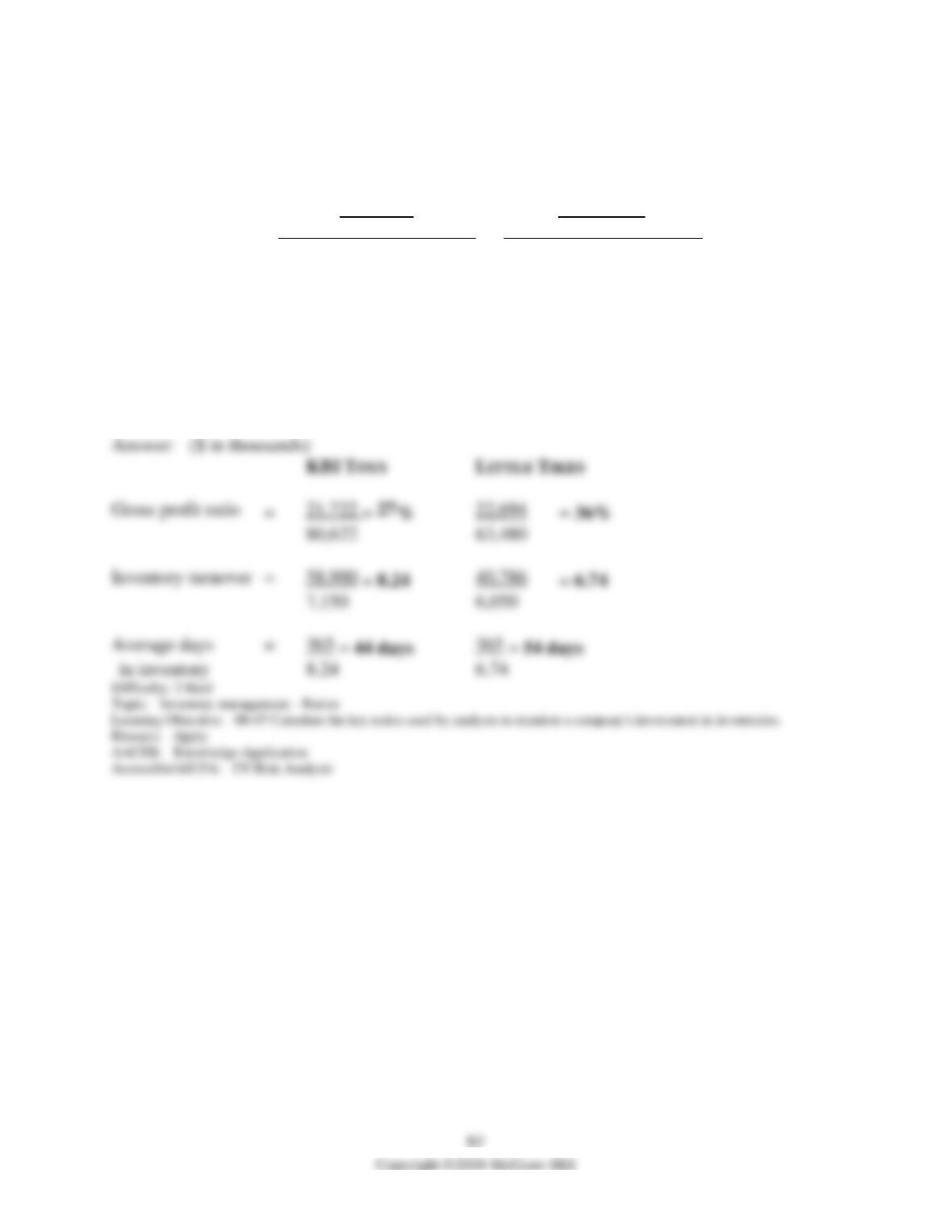
Calculate the 2018 gross profit ratio, inventory turnover ratio, and the average days in inventory
for the two companies (rounded).
174) On January 1, 2018, the National Furniture Company adopted the dollar-value LIFO
method of computing inventory. An internal cost index is used to convert ending inventory to
base year. Inventory on January 1 was $200,000. Year-end inventories at year-end costs and cost
indexes for its one inventory pool were as follows:
Inventory at Cost Index
Year Ended Year-end (Relative to
December 31 Costs Base Year)
2018 $259,200 1.08
2019 296,800 1.12
2020 299,000 1.15
Required:
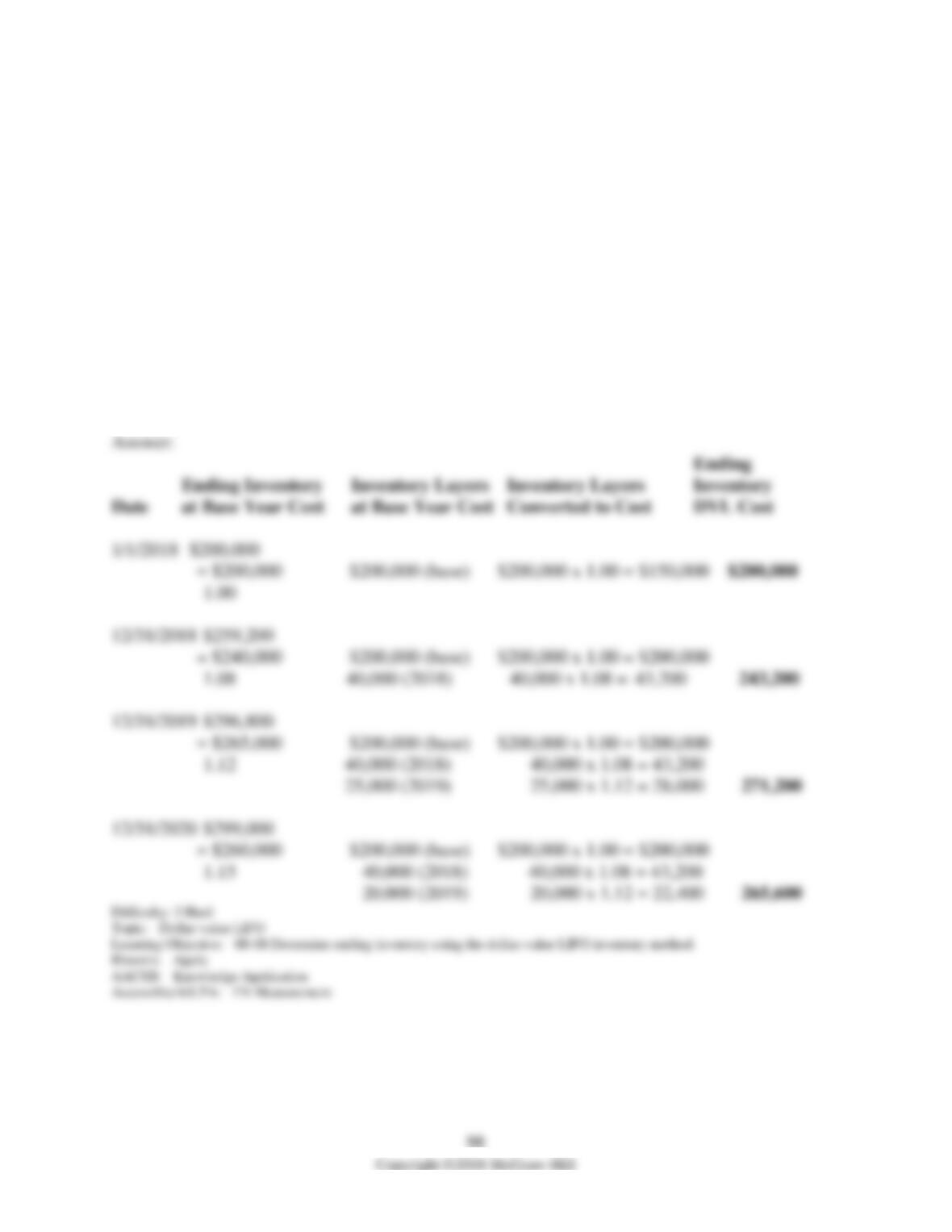
Compute inventory amounts at the end of each year.
175) Appleton Inc. adopted dollar-value LIFO on January 1, 2018, when the inventory value was
$1,200,000. The December 31, 2018, ending inventory at year-end costs was $1,430,000 and the
cost index for the year is 1.1.
Required:
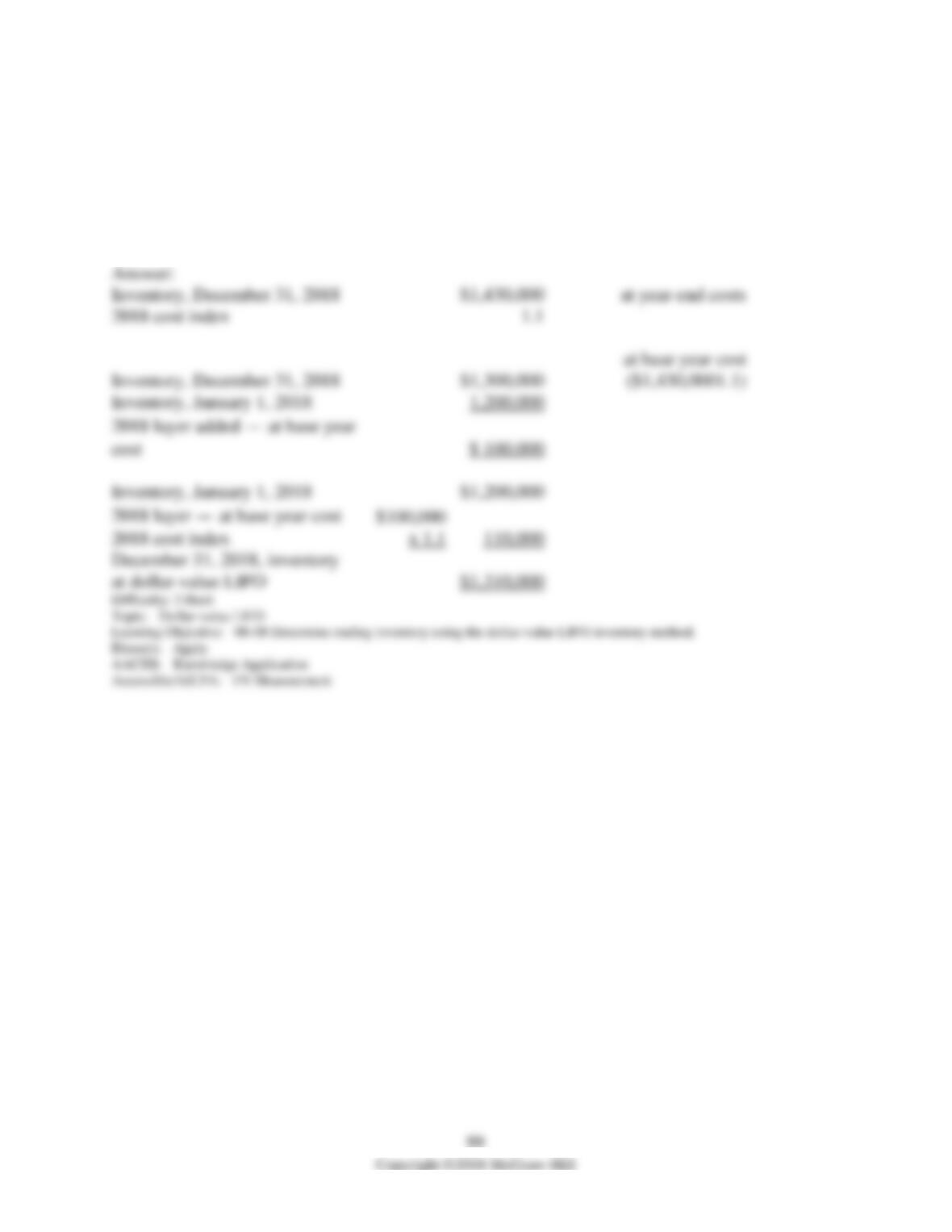
Compute the dollar-value LIFO inventory valuation for the December 31, 2018, inventory.
176) Chavez Inc. adopted dollar-value LIFO on January 1, 2018, when the inventory value was
$850,000. The December 31, 2018, ending inventory at year-end cost was $950,000 and the cost
index for the year is 1.08.
Required:
Compute the dollar-value LIFO inventory valuation (rounded) for the December 31, 2018,
inventory.
177) Liquidated Corporation had a dollar-value LIFO (DVL) inventory of $800,000 at the
beginning of the current year when it adopted DVL. Its year-end inventory at year-end prices
was $850,000. The index for the current year was 1.08.
Required:
Compute the DVL inventory (rounded) to be reported at the end of the year.
178) On January 1, 2017, ECT Co. adopted the dollar-value LIFO method for its one inventory
pool. The pool’s value on this date was $600 million. The 2017 and 2018 ending inventory
valued at year-end costs were $702 million and $840 million, respectively. The appropriate cost
indexes are 1.08 for 2017 and 1.20 for 2018.
Required:
Calculate the inventory balance that ECT Co. would report on its year-end balance sheets for
2017 and 2018, using the dollar-value LIFO method.
179) On January 1, 2017, RAY Co. adopted the dollar-value LIFO method for its one inventory
pool. The pool’s value on this date was $300 million. The 12/31/2017 inventory valued at year-
end costs was $385 million. The 12/31/2017 inventory, using dollar-value LIFO was $355
million.
Required:
Calculate 2017 cost index for RAY’s inventory.
180) The Genworth Company adopted the dollar-value LIFO method on January 1, 2018 when
the inventory value of its one inventory pool was $450,000. The company decided to use an
external index, the Consumer Price Index (CPI), to adjust for changes in the cost level. On
January 1, 2018, the CPI was 280. On December 31, 2018, inventory valued at year-end cost was
$504,000 and the CPI was 294.
Required:
Calculate the inventory value at the end of 2018 using the dollar-value LIFO method.
181) Briefly describe why companies that use perpetual inventory systems must still perform
physical inventories.
182) It is the end of the accounting period, and your boss asks you to help determine the
inventory balance to place in the company’s balance sheet. Explain which physical quantities of
inventory that you will include and which you will exclude.
183) Briefly explain when there would be a tax benefit from electing LIFO rather than FIFO.
184) Briefly explain how companies that use LIFO can both increase and decrease reported
earnings by “managing” ending inventories.
185) Costs and prices regularly fall every year in the microcomputer industry. Briefly indicate
your recommendation and rationale for an inventory method for a firm about to enter this
industry.

186) Carmen Inc., producer of high-tech boating equipment, disclosed the following information
in its 2018 annual report to shareholders:
Inventories are valued at the lower of cost or net realizable value with cost determined by the
last-in, first-out (LIFO) method for inventories.
Inventories at May 31 were as follows:
(Dollars in thousands)
2018
2017
Raw materials and work in process
$ 70,458
$ 66,175
Finished goods
207,231
168,135
Total inventories
$277,689
$234,310
If the inventory had been valued using the first-in, first-out
(FIFO) method, inventories would have been higher by
$22,200 and $24,400 ($ in thousands) at the end of 2018
and 2017, respectively.
How does the supplemental LIFO information indicating what the value of ending inventory
would have been if measured using FIFO improve the quality of financial reporting by Carmen?
187) Briefly explain the advantages of dollar-value LIFO (DVL).