
Chapter 8: Liabilities and Stockholders’ Equity
90. When the contract rate of interest on bonds is higher than the market rate of interest, the bonds
sell at:
a. a premium.
b. their face value.
c. their maturity value.
d. a discount.
91. If the market rate of interest is greater than the contractual rate of interest, bonds will sell:
a. at a premium.
b. at face value.
c. at a discount.
d. only after the stated rate of interest is increased.
92. If the market rate of interest is 10%, a $10,000, 12%, 10-year bond that pays interest
semiannually would sell at an amount:
a. less than face value.
b. equal to the face value.
c. greater than face value.
d. that cannot be determined.
93. When the market rate of interest on bonds is equal to the contract rate, the bonds will sell at:
a. a premium.
b. their face value.
c. a discount.
d. a discount or a premium.
94. The interest rate specified in the bond indenture is called the:
a. discount rate.
b. contract rate.
c. market rate.
d. effective rate.

Chapter 8: Liabilities and Stockholders’ Equity
95. If $500,000 of 8% bonds are issued at 102, the amount of cash received from the sale is:
a. $540,000
b. $510,000
c. $500,000
d. $530,000
96. If $1,000,000 of 10% bonds are issued at 98, the amount of cash received from the sale is:
a. $980,000.
b. $975,000.
c. $987,500.
d. $1,000,000.
97. If $4,000,000 of 12% bonds are issued at 103 1/4, the amount of cash received from the sale
is:
a. $4,040,000.
b. $4,000,000.
c. $4,130,000.
d. $3,520,000.
98. Stockholders’ equity:
a. is usually equal to cash on hand.
b. includes paid-in capital and total liabilities.
c. includes retained earnings and paid-in capital.
d. is shown on the income statement.
99. The charter of a corporation provides for the issuance of 100,000 shares of common stock.
Assume that 60,000 shares were originally issued and 5,000 were subsequently reacquired.
What is the number of shares outstanding?
a. 5,000
b. 100,000
c. 60,000
d. 55,000

Chapter 8: Liabilities and Stockholders’ Equity
100. The charter of a corporation provides for the issuance of 100,000 shares of common stock.
Assume that 75,000 shares were originally issued and 5,000 were subsequently reacquired.
What is the number of shares outstanding?
a. 10,000
b. 70,000
c. 50,000
d. 60,000
101. If a corporation issues only one class of stock, it is called:
a. common stock.
b. treasury stock.
c. no-par stock.
d. preferred stock.
102. The excess of issue price over par of common stock is termed as:
a. discount.
b. income.
c. deficit.
d. premium.
103. A company sold 200 shares of common stock with a par value of $5 at a price of $12 per
share. Which section of the statement of cash flows will contain this transaction?
a. Operating activities
b. Investing activities
c. Financing activities
d. Sale of stock will not appear on the statement of cash flows.
104. A company sold 200 shares of common stock with a par value of $5 at a price of $13 per
share. What is the effect on the accounts of this transaction?
a. Increase cash $2,600; increase retained earnings $2,600
b. Increase cash $1,000; increase common stock $1,000
c. Increase cash $2,600; increase common stock $1,000 and increase paid-in capital $1,600
d. Increase cash $2,600; increase common stock $1,600 and increase paid-in capital $1,000

Chapter 8: Liabilities and Stockholders’ Equity
105. The charter of a corporation provides for the issuance of 100,000 shares of common stock.
Assume that 40,000 shares were originally issued and 5,000 were subsequently reacquired.
What is the number of shares outstanding?
a. 5,000
b. 35,000
c. 45,000
d. 55,000
106. Which of the following is a reason for a corporation to buy back its own stock?
a. To increase liquidity
b. To increase solvency
c. To increase the shares outstanding
d. To reissue as bonuses to employees
107. How is treasury stock shown on the balance sheet?
a. As an addition to assets
b. As a reduction of stockholders’ equity
c. As an addition to stockholders’ equity
d. Treasury stock is not shown on the balance sheet.
108. In which section of the balance sheet would treasury stock be reported?
a. Fixed assets
b. Long-term liabilities
c. Stockholders’ equity
d. Intangible assets
109. A corporation purchases 5,000 shares of its own $20 par common stock for $35 per share,
recording it at cost. What will be the effect on total stockholders’ equity?
a. Increase $175,000
b. Increase $100,000
c. Decrease $175,000
d. Decrease $100,000

Chapter 8: Liabilities and Stockholders’ Equity
110. Which of the following is necessary for a corporation to pay cash dividends?
a. Market value in excess of par value per share
b. Order by the court of law
c. Sufficient retained earnings
d. Prior declaration of stock dividends
111. Three dates included in a dividend announcement are date of declaration, date of record, and .
a. date of acceptance
b. date of payment
c. date of order
d. date of liquidation
112. On which of the following dates, a company incurs liability for a dividend?
a. The date of record
b. The date of payment
c. The date of liquidation
d. The date of declaration
113. What is the effect of a stock dividend on the balance sheet?
a. Decrease total assets and decrease total stockholders’ equity
b. Decrease total assets and increase total stockholders’ equity
c. Increase total liabilities and decrease total stockholders’ equity
d. No effect on total assets, total liabilities, or total stockholders’ equity
114. The reduction of par or stated value of stock by issuance of a proportionate number of
additional shares is termed a:
a. stock dividend.
b. stock split.
c. stock option.
d. preferred dividend.

Chapter 8: Liabilities and Stockholders’ Equity
115. A corporation has 200,000 shares of $100 par value stock outstanding. If the corporation
issues a 2-for-1 stock split, the number of shares outstanding after the split will be:
a. 400,000 shares.
b. 200,000 shares.
c. 600,000 shares.
d. 100,000 shares.
116. A corporation has 50,000 shares of $100 par value stock outstanding that has a current market
value of $180. If the corporation issues a 4-for-1 stock split, the market value of the stock will
fall to approximately:
a. $30.
b. $36.
c. $45.
d. $50.
117. The primary purpose of a stock split is to:
a. increase paid-in capital.
b. reduce the market price of the stock per share.
c. increase the market price of the stock per share.
d. increase retained earnings.
118. Which of the following is a reason to undergo a reverse stock split?
a. To reduce the stock’s market price per share.
b. To increase total stockholders’ equity.
c. To reduce total stockholders’ equity.
d. To increase the market value of the stock per share.
119. The major subdivisions of the Stockholders’ Equity section of the balance sheet are:
a. Paid-in Capital and Retained Earnings.
b. Common Stock and Preferred Stock.
c. Issued Capital, and Authorized Capital.
d. Expenses and incomes.

Chapter 8: Liabilities and Stockholders’ Equity
120. Which of the following accounts is reported in the noncurrent liabilities section of the
corporate balance sheet?
a. Bonds Payable
b. Common Stock
c. Dividends Payable
d. Cash
121. Which of the following is listed under long-term liabilities?
a. Bonds payable due in 18 months
b. Accrued interest payable
c. Accounts payable
d. Notes payable due in 90 days
122. Based on the following information, what is earnings per share?
Common shares outstanding
80,000
Preferred stock dividend declared and paid
$32,000
Net income
$280,000
a. $3.90
b. $3.50
c. $3.00
d. $3.10
123. For the year that just ended, a company reports net income of $1,500,000. There are 500,000
shares authorized, 300,000 shares issued, and 250,000 shares of common stock outstanding.
What is the earnings per share?
a. $5.00
b. $2.50
c. $6.00
d. $3.00
124. Ratio of liabilities to total assets is computed by:
a. dividing total liabilities by total assets.
b. dividing total current liabilities by total current assets.
c. dividing total current liabilities by total quick assets.
d. dividing total liabilities by total quick assets.
Chapter 8: Liabilities and Stockholders’ Equity
125. A company has total assets of $320,000, total liabilities of $180,000, and total stockholders’
equity of $140,000. Calculate the ratio of liabilities to total assets.
a. 43.75%
b. 77.77%
c. 65.25%
d. 56.25%
126. A company has total assets of $320,000, total liabilities of $180,000, and total stockholders’
equity is $140,000. Calculate ratio of liabilities to stockholders’ equity.
a. 2.3
b. 1.7
c. 1.3
d. 3.2
127. Vivi Corporation’s earnings per share of common stock was $1.50 and a market price of
$33.50, calculate the price-earnings ratio.
a. 50.6
b. 22.3
c. 44.0
d. 33.5
128. Illustrate the effects on the accounts and the financial statements of each of the following
transactions:
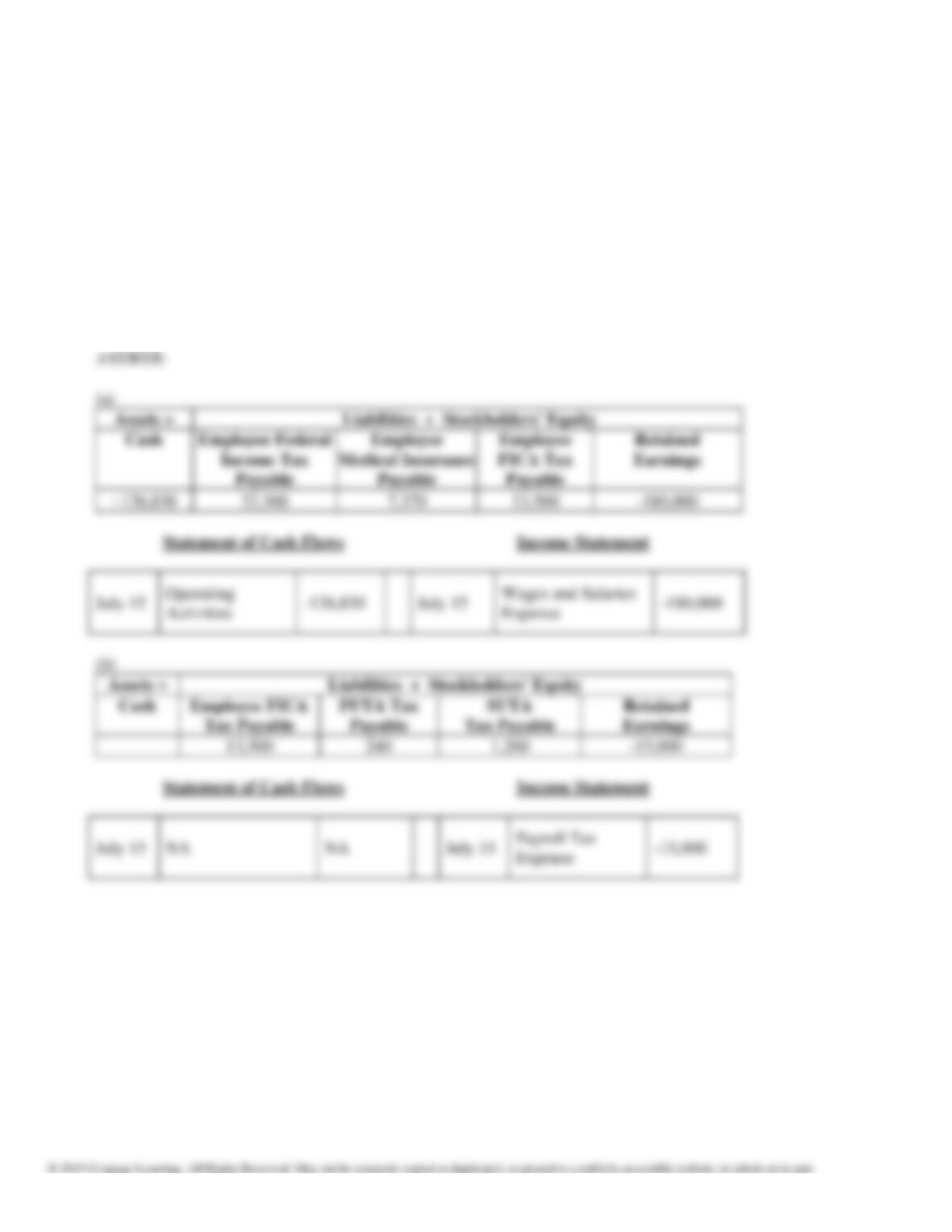
Apr. 30 Issued a $70,000, 60-day, 6% note dated April 30 to Goldman Co. on account.
June 29 Paid Goldman Co. the amount owed on note dated April 30.
Chapter 8: Liabilities and Stockholders’ Equity
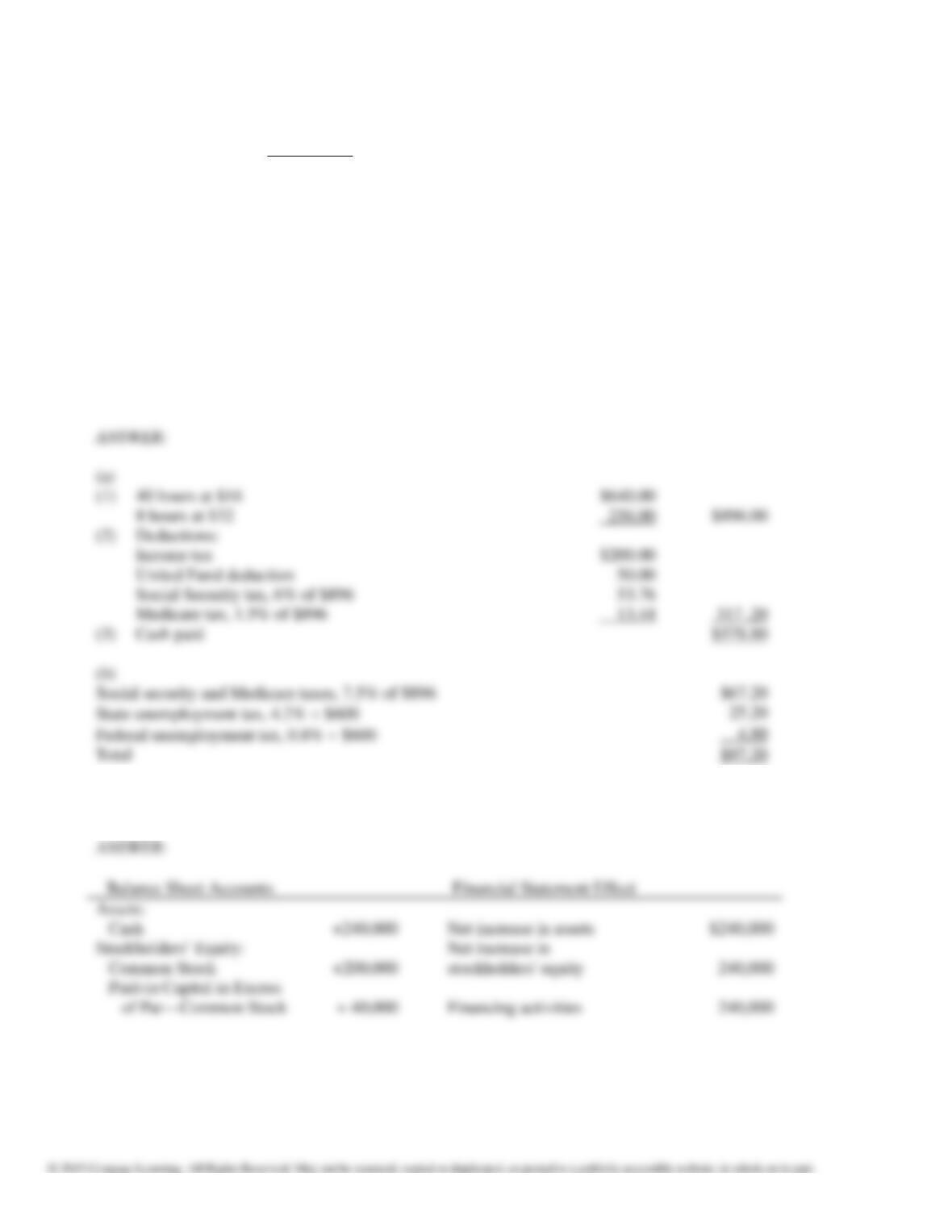
129. The summary of the payroll for the monthly pay period ending July 15 indicated the
following:
Salaries
$180,000
Federal income tax withheld
32,300
Medical insurance withheld
7,370
Social security tax withheld
10,800
Medicare tax withheld
2,700
Illustrate the effects on the accounts and the financial statements of (a) the payroll and (b) the
employer’s payroll tax expense for the month. The state unemployment tax rate is 4.2%, and
the federal unemployment tax rate is 0.8%. Only $30,000 of salaries are subject to
unemployment taxes.
Chapter 8: Liabilities and Stockholders’ Equity
130. The following information is for employee William Heedy for the week ended March 15.
Total hours worked: 48
Rate: $16 per hour, with double time for all hours in excess of 40
Federal income tax withheld: $200
United Fund deduction: $50
Cumulative earnings prior to current week: $6,400
Tax rates:
Social security: 6% on maximum earnings of $106,800
Medicare tax: 1.5% on all earnings; on both employer and employee
State unemployment: 4.2% on maximum earnings of $7,000; on employer
Federal unemployment: 0.8% on maximum earnings of $7,000; on employer
(a) Determine (1) total earnings, (2) total deductions, and (3) cash paid.
(b) Determine each of the employer’s payroll taxes related to the earnings of William Heedy
for the week ended March 15.
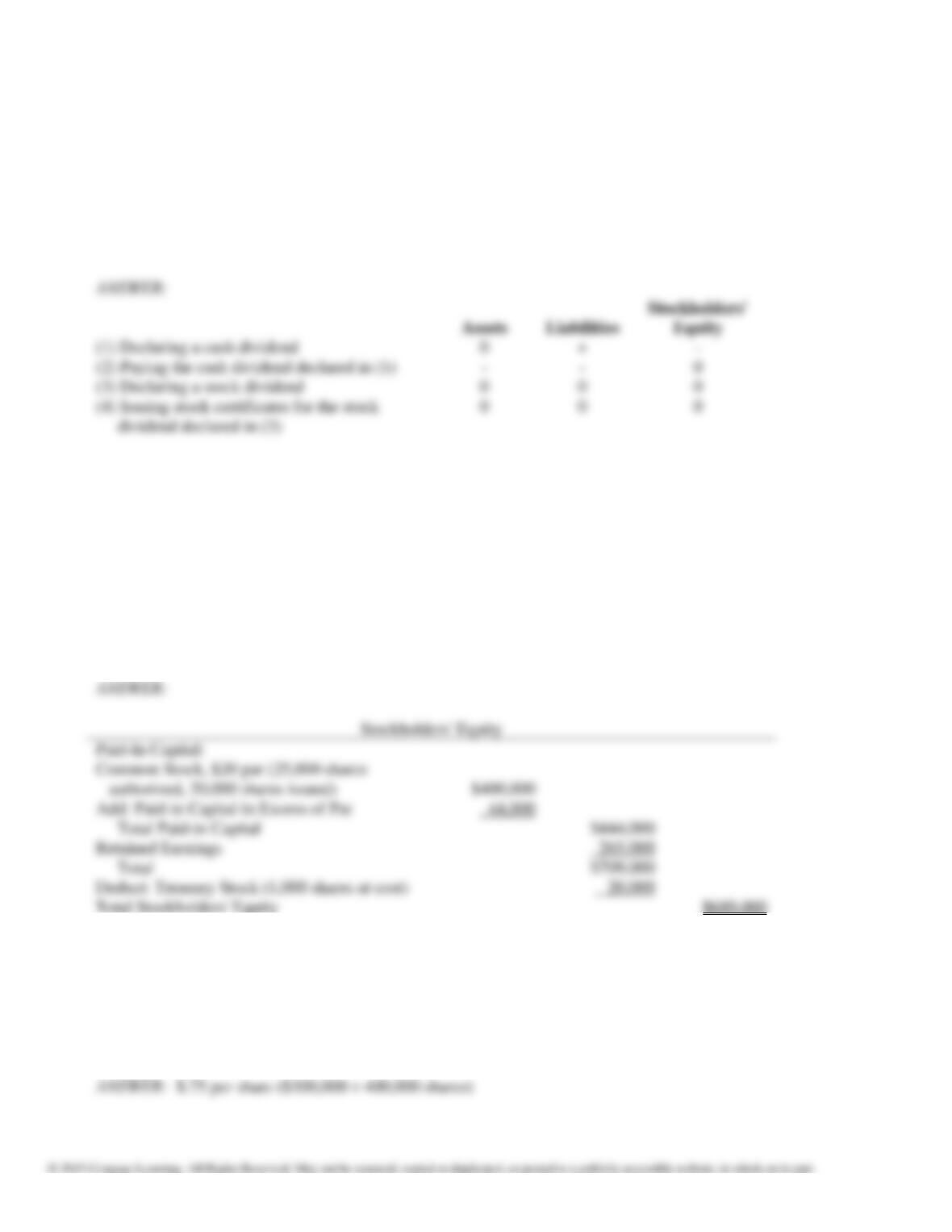
131. On April 1, 10,000 shares of $20 par common stock were issued at $24. Illustrate the effects
on the accounts and the financial statements.
Chapter 8: Liabilities and Stockholders’ Equity
132. Indicate whether the following actions would (+) increase, (-) decrease, or (0) not affect a
company’s total assets, liabilities, and stockholders’ equity.
Assets Liabilities Stockholders’ Equity
(1) Declaring a cash dividend
(2) Paying the cash dividend declared in (1)
(3) Declaring a stock dividend
(4) Issuing stock certificates for the stock
dividend declared in (3)
(1) Declaring a cash dividend
(2) Paying the cash dividend declared in (1)
(3) Declaring a stock dividend
dividend declared in (3)
133. The following accounts and their balances appear in the ledger on December 31 of the current
year:
Common Stock, $20 par
$400,000
Paid-In Capital in Excess of Par
44,000
Retained Earnings
265,000
Treasury Stock
20,000
Prepare the Stockholders’ Equity section of the balance sheet as of December 31. Twenty five
thousand shares of common stock are authorized, and 1,000 shares have been reacquired.
Paid-In Capital:
authorized, 20,000 shares issued)
Add: Paid-in Capital in Excess of Par
Total Paid-in Capital
Retained Earnings
Total
Deduct: Treasury Stock (1,000 shares at cost)
Total Stockholders’ Equity
$689,000
134. A corporation has the following stockholders’ equity accounts at the end of the current fiscal
year, after the closing entries have been posted: Common Stock, $5 par, $2,000,000; Paid-In
Capital in Excess of Par—Common Stock, $375,000; Retained Earnings, $1,285,000. The
earnings for the current year, during which there were no unusual items, were $300,000.
Compute the earnings per share of common stock.
Chapter 8: Liabilities and Stockholders’ Equity
135. A corporation, which had 20,000 shares of common stock outstanding, declared a 3-for-1
stock split.
(a) What will be the number of shares outstanding after the split?
(b) If the common stock had a market price of $240 per share before the stock split, what
would be an approximate market price per share after the split?
136. Smith Co. is considering the following alternative plans for financing the company:
Plan I
Plan II
Issue 10% Bonds (at face)
–
$1,000,000
Issue $10 Common Stock
$3,000,000
$2,000,000
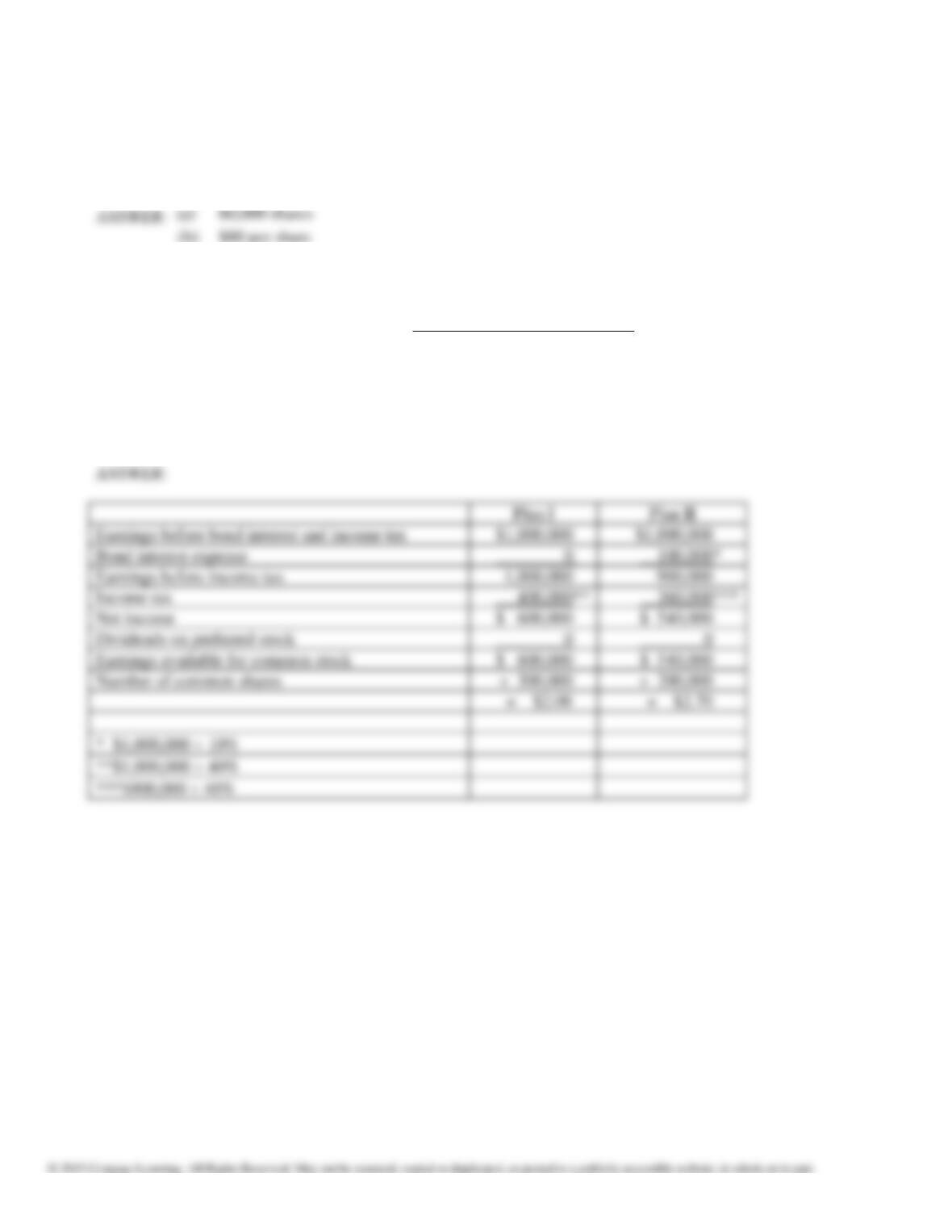
Determine the earnings per share of common stock under the two alternative financing plans,
assuming income before bond interest and income tax is $1,000,000.
Earnings before bond interest and income tax
$1,000,000
Bond interest expense
100,000*
Earnings before income tax
Income tax
Net income
Dividends on preferred stock
Earnings available for common stock
Number of common shares
* $1,000,000 10%
**$1,000,000 40%
***$900,000 40%
Chapter 8: Liabilities and Stockholders’ Equity
137. June Co. is considering the following alternative plans for financing the company:
Plan I
Plan II
Issue 10% Bonds (at face)
–
$3,000,000
Issue $10 Common Stock
$4,000,000
$1,000,000
Income tax is estimated at 40% of income.
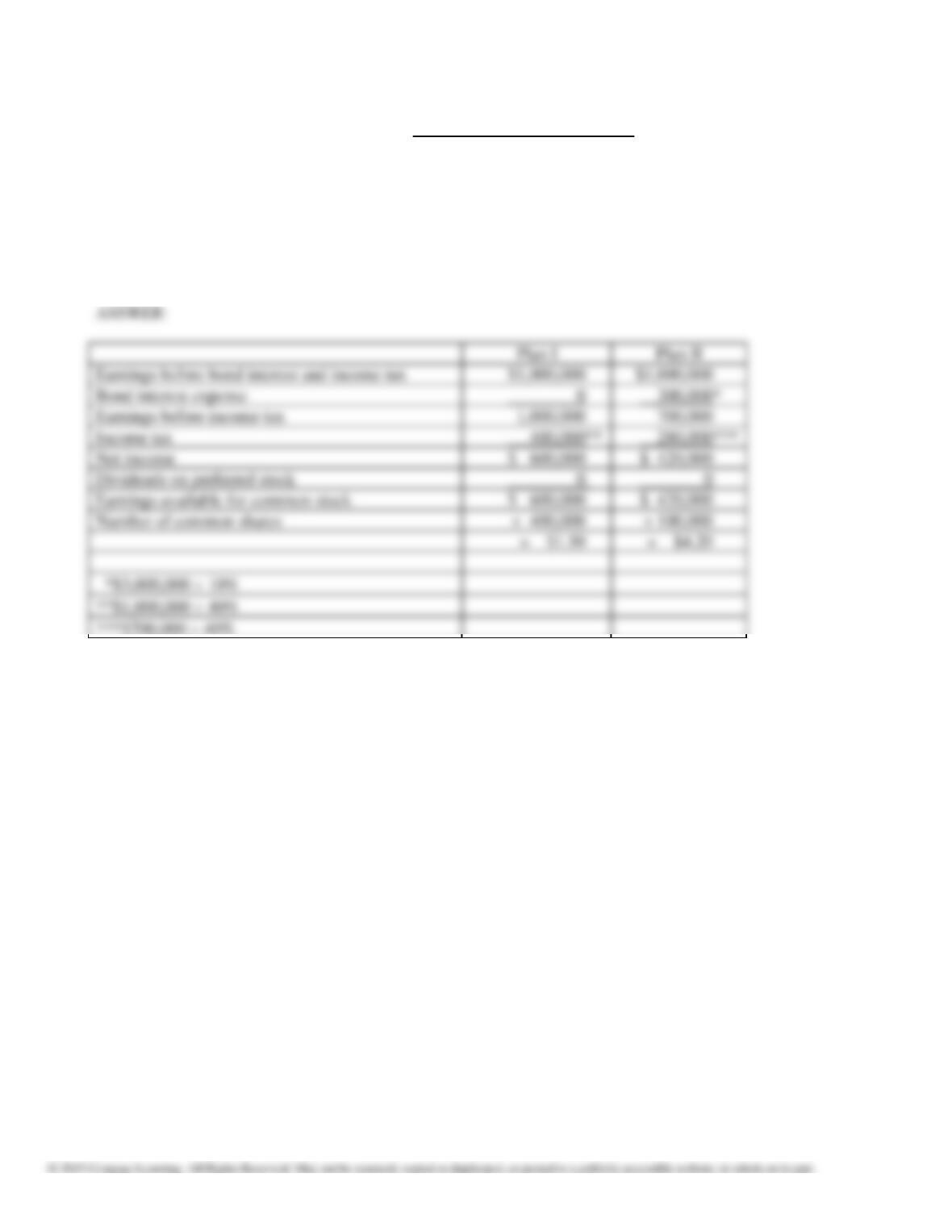
Determine the earnings per share of common stock under the two alternative financing plans,
assuming income before bond interest and income tax is $1,000,000.
Earnings before bond interest and income tax
Bond interest expense
Earnings before income tax
Income tax
Net income
Dividends on preferred stock
Earnings available for common stock
Number of common shares
÷ 100,000
*$3,000,000 10%
**$1,000,000 40%
***$700,000 40%